


Welcome to the evolving world of search!
As search practices and AI technologies continue to integrate, the industry jargon is expanding just as fast. Familiar concepts are taking on broader meanings, while entirely new terms are emerging to describe how systems understand context and how people find information.
Drawn from conversations between Gianluca Fiorelli and his expert guests on The Search Session, this glossary decodes the new language shaping modern discovery - covering both formal technical standards and informal terms that emerged during these discussions.
Whether you need to demystify complex industry jargon or look up specific concepts as you navigate modern SEO, dive in to explore the vocabulary driving the web forward!
What’s inside
Clear, easy-to-digest definitions organized across six core sections:
Search Journeys and Experience: the vocabulary defining how people search, explore, and make decisions across sessions and platforms.
Entities, Semantics, and Knowledge Organization: terms covering how machines interpret meaning, relationships, and context beyond simple word matching.
Search Visibility and Discoverability: the language explaining where and how brands and content appear across discovery surfaces and AI models.
Agentic Search and Readiness: concepts defining automated search processes and technical infrastructure for AI agents.
Content Strategy, Quality, and Topical Authority: terminology focused on evaluating content value, originality, and subject depth.
Brand Identity, Recognition, and Reputation: terms detailing brand perception, mental recall, and data hygiene in search systems.
Looking for a specific term? Jump straight to it from the A–Z index below.
A–Z index
Every term in the glossary, in alphabetical order. Terms in italics are explained within a related entry.
Search Journeys and Experience
Modern search involves both the journey people follow and the experiences they encounter along the way. Each interaction can influence what they understand, consider, and do next.
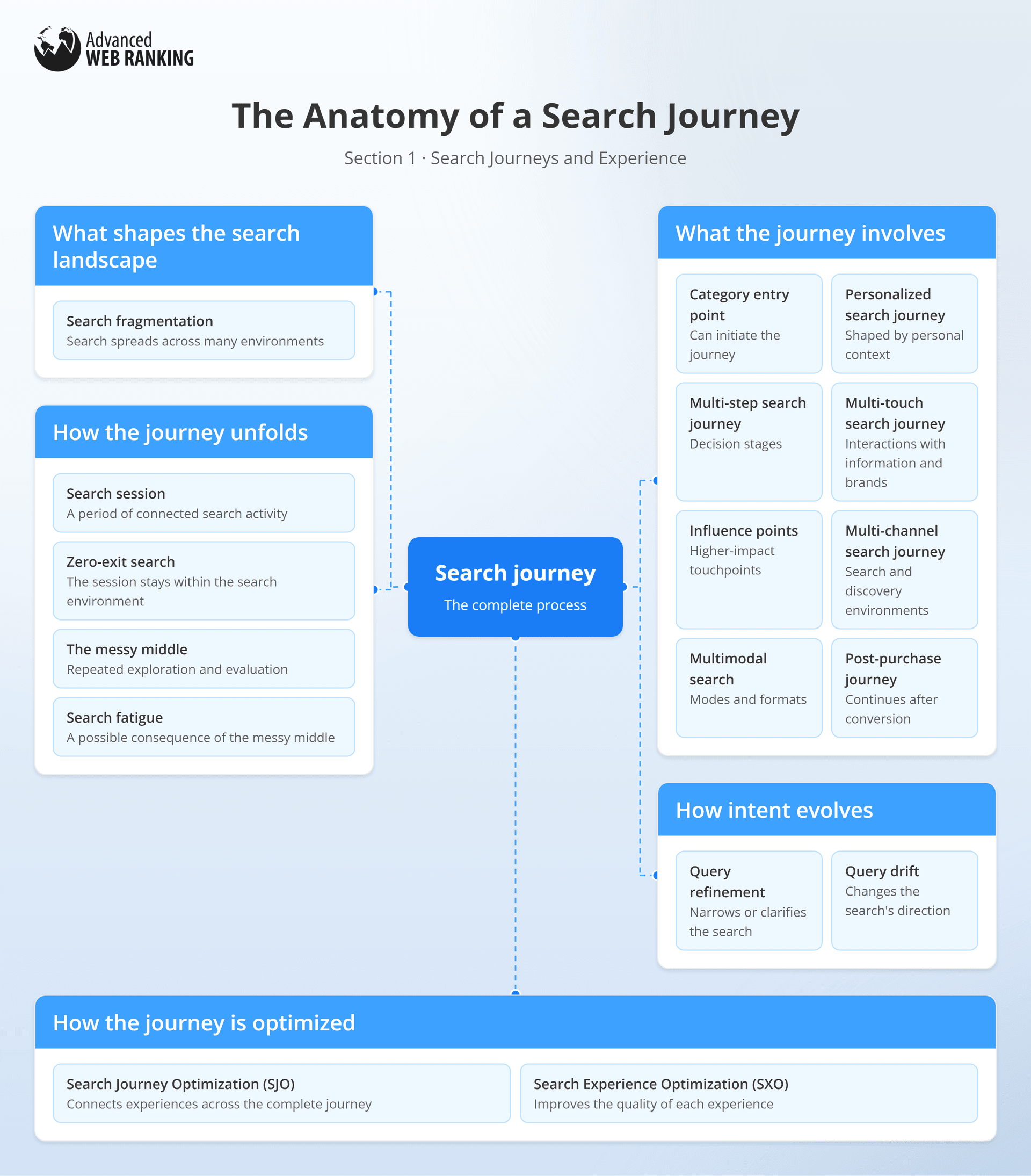
What has changed in how we understand search? Search is no longer seen as an isolated query-and-click event but as a fragmented journey spanning sessions, touchpoints, channels, and modes. It can unfold through the messy middle, evolve through refinement, drift, and personalization, and continue after purchase. Optimization should therefore improve individual search experiences, connect them across the complete journey, and support the person’s broader experience with the brand.
Search fragmentation
The distribution of search behavior across a growing number of platforms and discovery environments: Google, AI assistants, social platforms, video platforms, forums, marketplaces, and other surfaces. “Search doesn’t just happen on Google. There are many surfaces where people now search for information.” Each surface may satisfy different information, format, perspective, or trust needs.
Creates the context for: multi-channel search journeys that move between different search environments.
Category entry point (CEP)
A situation, need, motivation, or occasion that makes someone think about a product or service category and can initiate a search journey. “A category entry point is a situation where somebody will think of your type of product.” It shifts the focus from isolated keywords to the circumstances and user intents that make a category relevant.
Can initiate: a search journey when someone begins seeking information, exploring alternatives, or considering a decision.
Connects to: brand salience, which increases the likelihood that a particular brand comes to mind at that category entry point.
Search journey
The complete process through which someone recognizes a need, searches for information, explores alternatives, and makes a decision. It may consist of a single search session or unfold across multiple sessions over minutes, days, or weeks and can continue after conversion. A journey can involve multiple steps, touchpoints, and channels.
Personalized search journey
A search journey shaped by both the details someone explicitly provides and the implicit context available to the search system, such as previous clicks, location, device, search history, interests, or personal data. Because “the query fan-outs are personalized now,” the same initial question can lead different people toward different follow-up questions, sources, brands, and recommendations.
More specific form: hyper-personalized search uses richer personal data and context to adapt the experience more closely to an individual.
Multi-step search journey
A search journey involving several connected goals or decision stages, such as discovering options, gathering information, comparing alternatives, and choosing a solution. Each new answer can generate another question, comparison, or validation task. These steps may occur within one search session or be distributed across several sessions.
Multi-touch search journey
A search journey involving several interactions with information, sources, or brands before a decision is made. These touchpoints may include discovering a video, reading a review, saving a location, opening a comparison, or visiting a product page. Several touchpoints can occur within one channel or across different channels.
Closely related terms: multi-touchpoint search journey and multi-touch customer journey.
Higher-impact touchpoints: not every touchpoint has equal weight. Influence points are the interactions, sources, or channels that meaningfully shape how someone thinks or decides. Because “influence happens subtly, across multiple touchpoints,” it should be evaluated across the complete journey rather than attributed only to the first or last interaction.
Multi-channel search journey
A search journey that moves between several discovery environments as someone pursues the same need or decision. People may “bounce between platforms—and each one plays a different role,” from discovery and comparison to verification and action. The journey may return to an earlier channel as the person’s understanding develops, with one or more touchpoints occurring within each channel.
Multimodal search
A search experience in which people can use different modes to express and explore what they need. “Before it was all text; now users can do searches with video, with images, and with voice.” It can also incorporate audio content and interactive applications, with these modes used individually or combined within the same search, reflecting “the way users are going to search moving forward.”
COMMONLY MISUNDERSTOOD
Step: a decision stage.
Channel: the environment where that interaction happens.
Touchpoint: an interaction with information or a brand.
Mode: the format used to search or explore results.
Post-purchase journey
The part of the journey that begins after someone converts or becomes a customer. It includes “questions about support or how to do something,” such as onboarding, product use, troubleshooting, integrations, upgrades, or renewals. People may get “everything they need directly from the search results” without contacting the company.
Search session
A period of connected search activity focused on a particular need or task. Rather than consisting of one query followed by an immediate click, it may involve moving “from query to query” as “we refine it and search again,” ask follow-up questions, and interact across different search and discovery environments. A website click may occur later in the session, while a directly provided answer may remove the need for one.
Part of: a search journey.
Zero-exit search
A search experience in which users continue clicking, refining queries, asking follow-up questions, or exploring results without leaving the search platform for an external website. “There’s a lot of clicking going on. It’s just that the clicking is staying with Google. It’s zero-exit search.” The same behavior can occur within AI assistants, where the journey continues through follow-up prompts and generated answers.
Different from zero-click search: zero-click describes the absence of a click to an external website; zero-exit describes the complete session remaining within the search environment.
The messy middle
The non-linear part of the journey in which people repeatedly explore possibilities and evaluate alternatives, often described as consumers who “spiral” between sources or move through “an infinite loop of exploration and evaluation.” New information can introduce another option, change a preference, or return the user to an earlier decision stage.
Can lead to: search fatigue.
Search fatigue
The frustration or mental exhaustion caused by prolonged searching, excessive alternatives, repetitive answers, or conflicting information. It can emerge during the messy middle when users cannot determine whether the information they find is “believable, current, or trustworthy” or sufficient to make a confident decision. As a result, they may pause the journey, abandon it, or choose the easiest available option.
Query refinement
The process of changing a search to make it more specific, accurate, or useful. It usually happens as new information helps the user adjust the original search. “Alternative sources to Google are being used, often to gain clarity or better define what someone is looking for, before returning to Google.” Refinement can therefore happen across channels, not only by rewriting a Google query.
Query drift (user intent)
The movement of a search away from its original question or intention as new information changes what the user wants to understand or accomplish. Instead of making the original search more precise, it shifts toward a related question, different topic, or new objective, creating a different path within the broader journey.
Also used in: content interpretation, where query drift (content relevance) describes a search system associating content with unintended queries, topics, or entities.
SAME STARTING POINT, DIFFERENT DIRECTION
Query refinement narrows or clarifies the original search.
Query drift shifts the search away from its original focus or objective.
Search Journey Optimization (SJO)
The practice of aligning content and search strategy with the user’s complete search journey rather than optimizing individual keywords or isolated interactions. It reflects the shift from “optimizing for keywords, to optimizing for entities, and now […] optimizing for journeys.” This means supporting the questions, needs, sessions, decision stages, touchpoints, and channels involved as someone works toward a goal.
Combines: SEO, content strategy, journey mapping, and cross-channel planning.
Search Experience Optimization (SXO)
The practice of improving the experience people have when discovering and interacting with information through search. It makes content “not just visible and searchable but nice to interact with” and challenges the idea that “once you get the click, the job is done.” SXO considers the usefulness and outcomes of both the website experience and the experiences offered in the “different places where people are searching.”
Combines: SEO, UX design, and business outcome optimization.
OPTIMIZATION FROM SCOPE
Journey optimization focuses on the connections between experiences.
Experience optimization focuses on the quality of each experience.
Entities, Semantics, and Knowledge Organization
Search systems do more than match the words in a query with the words on a page. They interpret meaning, identify entities, examine relationships, and retrieve information that fits the user’s context.

What has changed in how search systems understand information? Search systems combine lexical matching with semantic approaches to interpret meaning and intent, identify entities, and retrieve relevant information in context. Taxonomies, ontologies, knowledge graphs, and structured data can make concepts and relationships more explicit, supporting machine interpretation.
Information retrieval (IR)
The process of finding, selecting, and ranking information from a collection to satisfy a user’s specific intent. In the era of modern AI, systems “might pull from an existing index […] or they might actively discover new information in real-time to generate a response.” While traditional search engines stop at retrieving and ranking static matching documents, modern generative and agentic systems use these indexes to gather relevant sources before dynamically synthesizing an entirely new, tailored answer.
Semantic search
An approach to information retrieval that interprets the meaning, intent, and context behind a query. Unlike traditional keyword search, which primarily matches words in the query with words in indexed content, semantic search examines concepts, entities, and their relationships. This enables it to retrieve relevant information even when the query and the content use different vocabulary. It evaluates semantic relevance, or how closely the meaning of the content corresponds to the query’s meaning and intent.
One comparison method: embedding similarity compares numerical representations of queries and content to estimate how closely their meanings correspond.
Query fan-out
A process in which an AI search system expands a user’s query or prompt into multiple related searches to gather information for its response. These searches can rephrase the request, explore related entities and subtopics, compare options, or incorporate relevant user context. Systems “execute a bunch of related searches in real time,” then assemble the results, extract relevant information from the retrieved pages, and synthesize it into an answer.
This expansion may “take you further away from the core intent,” retrieving information about related questions or needs that the user did not explicitly express.
Different from query refinement: query refinement describes a user clarifying or narrowing a search; query fan-out describes the system generating multiple searches from that request.
Relevance engineering
A multidisciplinary practice for designing, structuring, and distributing digital information so search engines and AI systems can understand, retrieve, and surface it for the appropriate user needs and contexts. It moves beyond keyword optimization by aligning content with intent and meaning and combines AI, information retrieval, content strategy, UX, and digital PR. Acting as “the conductor of an orchestra,” relevance engineers coordinate these disciplines across a brand’s digital presence to help “translate the brand for machines.”
Query drift (content relevance)
A loss of alignment between what content is intended to communicate and how a search system interprets it. Ambiguous wording or distracting passages can result in “mapping to the wrong queries.” At the website level, this can extend to topical drift, where coverage of peripheral subjects shifts the site’s perceived focus away from its core expertise.
Addressing drift involves clarifying language and improving, separating, or removing outlying content. “Resolving those ambiguities is key to maintaining focus,” helping pages and the wider website reinforce their intended subjects and support topical authority.
Different from query drift (user intent): a shift away from the user’s original question or objective as new information leads them to explore a related question, another topic, or a different goal.
Ontology
A formal model of knowledge within a particular domain. It identifies the concepts that exist, defines what they mean, specifies their properties, and establishes the relationships and rules that connect them. Within an organization, it creates “a shared meaning […] about its data and its content,” helping departments, tools, and AI systems interpret the same information consistently.
Role in search: ontologies can support knowledge graphs and internal information systems, but they are not required for search visibility. Search engines and LLMs can interpret meaning directly from natural language and unstructured content. Their value lies primarily in consistency and governance at scale rather than direct ranking or citation gains.
SEOntology
A proposed ontology that represents SEO concepts, definitions, and relationships in machine-readable form. “SEOntology is designed as an extension of Schema.org, specifically focused on concepts relevant to SEO.” It standardizes definitions across the SEO domain because “one of the core goals of SEOntology is to provide this interoperability,” allowing SEO tools and AI agents to interpret and exchange data consistently. More broadly, it is intended to become “the language that enables AI agents to build memory for SEO decision-making.”
Taxonomy
A system for classifying concepts into categories and subcategories, usually through hierarchical relationships. A taxonomy can organize products, topics, content, or entities into a structure that is easier for people and machines to navigate.
In SEO, it helps organize a website around the concepts and relationships relevant to the brand and align its information architecture with how people search. Once the relevant entities and relationships are defined, “you build your information architecture and taxonomy, aligned with how people search around those entities.” Taxonomies can also support “things like keyword grouping” or classify query fan-outs as “expansion queries, related queries, personalised queries.”
Knowledge graph
A structured network of entities and the relationships between them that helps people and machines interpret how information is connected. Creating one means “creating invisible connections and using tools to make these connections more evident.” By connecting information scattered across content, catalogs, documents, and systems, a knowledge graph can show what a website or organization is about and become “the semantic layer that can also be shared across different departments.”
Built from: entities, their properties, and the relationships between them, which may be defined through an ontology or shared vocabulary.
ORGANIZING KNOWLEDGE
Ontology: defines concepts, their properties, and how they can relate.
Taxonomy: classifies concepts into categories and subcategories.
Knowledge graph: connects actual entities and facts through defined relationships.
Internal knowledge graph
A knowledge graph created and controlled by an organization using its own data, such as products, services, people, policies, documents, and content. It connects information that may otherwise remain scattered across catalogs, spreadsheets, websites, knowledge bases, and internal systems. It supports “better governance of your own information about your catalog, your services, your knowledge base, and so on,” creating internal value through improved search, decision-making, automation, and AI systems.
Language graph
A developing concept, rather than a standardized technical framework, used to describe how a language model connects words, concepts, entities, and meanings based on patterns learned from large amounts of text. As traditional web signals become less useful, “instead of a link graph, we’ve got like a language graph of how codified language fits together.” It helps explain how a model interprets queries, connects related ideas, and generates responses.
Entity
A uniquely identifiable person, place, organization, product, event, topic, or concept. An entity represents the thing itself rather than the particular words used to describe it. It is “a concept that isn’t tied to any specific language,” with attributes and relationships that allow search systems to recognize it across different words and contexts. Entities therefore help communicate the subjects associated with a website, page, or brand.
More specific forms:
A brand entity represents a brand’s identity, attributes, offerings, topics, and relationships in a form machines can understand. Building a brand involves identifying “the entities that you are known for, that are important, that you want to rank for, and that define you as a brand in the online space.”
A topic entity represents an identifiable subject connected to related content, entities, and areas of expertise. It serves as the broad thematic anchor for content hubs.
Structured data
Information organized in a defined format so its parts can be identified and used consistently. In SEO, the term usually refers to structured data markup, more precisely called semantic metadata. It consists of “annotations made in a certain syntax,” such as JSON-LD, Microdata, or RDFa. Traditionally, it was designed “to help [search engines] understand the meaning of a webpage.” The syntax determines how the data is written; a vocabulary such as Schema.org supplies its meaning.
Role in AI search: structured data markup can feed knowledge graphs, but it is not required for LLM visibility: “LLMs are created to deal with natural language.”
Schema.org
An open, shared vocabulary for describing entities, their properties, and their relationships in machine-readable form. It provides terms such as “person,” “product,” and “author” that can be used in structured data markup to communicate what information on a page represents. “Schema.org is a standard that helps search engines understand the meaning of web pages.” By defining how entities relate, “you bring context and clarity when you define relationships between things.” Organizations can also extend their shared model to describe concepts specific to their domain.
DESCRIBING INFORMATION ON A WEBPAGE
Structured data markup expresses information in a machine-readable format.
Schema.org provides the vocabulary that defines what that information means.
Search Visibility and Discoverability
Search visibility is no longer limited to a website’s position in traditional organic results. Brands can now appear through search listings, SERP features, AI-generated answers, videos, social platforms, marketplaces, forums, and other discovery environments.

What has changed about search visibility? Visibility is becoming distributed across channels, formats, and interfaces. As search results provide more complete answers and journeys move between platforms, brands must consider their overall presence across the discovery ecosystem rather than rankings and clicks alone.
Cross-channel discoverability
The ability of a brand, product, or piece of information to be found by people and surfaced by search and AI systems across multiple discovery environments. These may include search engines, AI assistants, social and video platforms, forums, marketplaces, and publisher websites. It reflects the idea that “all platforms [can act] as search channels” when the audience uses them to find information. Cross-channel discoverability therefore depends on maintaining recognizable and consistent signals while adapting content to each environment.
Ambient visibility
A brand’s broad, repeated presence across the platforms and sources its audience uses. It involves “being everywhere” by creating focused content around related searches and distributing it across websites, YouTube, Reddit, social platforms, and other relevant environments. Because AI systems combine information from multiple sources, brands should aim to “be ambiently visible across all of it.” The more consistent surrounding content a brand has, “the clearer that picture becomes” for search engines and LLMs.
Achieved through: content ubiquity, or maintaining relevant content across the environments and formats where the audience searches and engages.
LLM discoverability
The ability of a brand, entity, or piece of content to be accessed, understood, retrieved, and surfaced by LLM-based systems in response to relevant prompts. Technical accessibility comes first because “if it is not crawled, it can’t be surfaced in search.” Content must therefore be available to LLM crawlers or live retrieval systems, without being blocked or dependent on technologies they cannot process reliably.
Once accessed, the information must clearly communicate its entities, attributes, relationships, and subject matter, allowing LLMs to “extract entities […] so you can win those citations.” Originality, authority, corroboration, consistent brand information, and inclusion in trusted sources can then increase its likelihood of being retrieved and trusted.
Ultimately, “being found in LLMs is all about either being the source, being mentioned in the source, or replacing the source.” Successful discoverability can therefore result in a brand or its content being mentioned, cited, linked, recommended, or used as supporting information in an LLM-generated answer.
Zero-click marketing
A strategy for influencing audiences directly within the platforms where they discover and consume information, without requiring them to visit the brand’s website. It uses “native, platform-specific content that provides standalone value,” giving people the complete message even if they do not click away. It can be applied “in search, in social, in email, in your content, [and] in your video marketing,” as well as through offline channels, with the goal of being “visible, consistently present, and truly remarkable” wherever the audience encounters the brand.
Different from zero-click search: zero-click search describes user behavior; zero-click marketing is the strategy used to influence people when no website visit occurs.
Liquid search
A concept describing how Google can separate information from its original format and reshape it across different search surfaces. Rather than optimizing independently for web search, image search, Shopping, Discover, or AI-generated results, “what you really need to do is focus on the source of your data, the source of your page—and optimize that from the beginning.” Optimizing the source helps Google understand the underlying content, entities, and structured data, then “deliver it in the shape it chooses.” Once that information has been collected and stored, Google can “reshape it however it wants” for different formats and search experiences.
Different from content repurposing: with content repurposing, the brand actively adapts content for different channels. With liquid search, the search system reshapes the source information into different outputs.
Search real estate
The amount and prominence of space a brand occupies within an individual search environment. On a search results page, this footprint can include organic listings, ads, images, videos, local results, knowledge panels, and other SERP features. In an LLM-generated answer, it can include brand mentions, citations, linked sources, recommendations, and supporting details. This visible presence acts as the brand’s “digital storefront,” communicating what it offers and represents. How effectively a brand manages its wider digital presence influences “what information LLMs pick up” about it.
Connection to business outcomes: as “there’s less real estate to show up on,” brands must work harder to secure prominent visibility. There is a “direct correlation between occupying a lot of rich real estate—whether in LLMs or Google—and an increase in revenue and customers.”
Pixel position
The vertical location of a search result or SERP element, measured in pixels from the top of the results page. Unlike traditional rank, it accounts for ads, AI Overviews, images, videos, and other SERP features that appear before a result. A result can therefore rank first organically but still appear “way below the fold,” meaning “you have to scroll to see the first result.” This lower placement can reduce its visibility and traffic potential: “if half of those keywords are out of the first scroll, you’re actually making less than half.” Pixel position therefore shows a result’s actual visual placement and potential visibility, which ranking position alone cannot capture.
Agentic Search and Readiness
AI agents can retrieve information, compare options, and interact with websites and services on a user’s behalf. Understanding agentic search means distinguishing the environment in which agents operate, the goals they pursue, and the readiness businesses need to support them.

What does participation in the agentic web require? Businesses need accessible, accurate data and reliable interfaces through which agents can discover information and perform permitted actions. Clear instructions, guardrails, and appropriate human oversight help make these interactions dependable and accountable.
Agentic web
The broader digital environment that enables AI agents to discover data, understand available capabilities, and interact with websites, applications, and services. It provides the data, functionality, interfaces, protocols, instructions, and guardrails through which activities such as agentic search and agentic commerce can operate.
As “the technical aspects of SEO are going to be much more important with this movement to an agentic web,” websites must make their information and functionality reliably accessible to agents. Existing standards may contribute to this infrastructure. Schema.org is unlikely to disappear, but “a new vocabulary [may emerge], one that perhaps aligns better with the agentic web” as agentic use cases develop.
Agentic search
A process within the agentic web in which AI agents act on a user’s behalf to pursue a particular goal. It involves “different components doing various operations on behalf of the user, then coming together to produce a result or response.” These components may retrieve information, compare options, monitor changes, and interact with websites or services.
Agentic search therefore extends conventional search from providing answers to performing actions. To support this process, websites must provide agents with “not only data but also instructions and reliable guidance,” together with appropriate guardrails, verification, and protocols.
Agentic commerce
A transactional application of agentic search in which AI agents participate in the buying journey on behalf of consumers or businesses. Agents may discover products, compare offers, evaluate prices and policies, select options, and complete purchases. The defining shift is that “the one that is going to make the purchase is an agent, which is a machine; it’s not a person.”
Although trust and adoption remain limited, it is expected to “be commonplace in the future,” following an adoption path similar to e-commerce. To participate, merchants must provide agents with accurate, accessible information about products, prices, availability, specifications, return policies, fulfillment, and brand value.
AGENTIC SCOPE
Agentic web: the environment and infrastructure in which agents operate.
Agentic search: the process through which agents pursue users’ goals.
Agentic commerce: the application of that process to buying and selling.
Agent readiness
The organizational and technical preparedness of a business to be discovered, evaluated, and interacted with by AI agents acting on a user’s behalf. “The good old traditional SEO practices you would find in an audit also set the baseline for agentic inclusion and optimization,” including performance, content accessibility, clear site structure, and structured information.
Readiness also starts with strong data foundations: “You need to get your house in order, meaning you need to get your data in order.” That data must then be exposed consistently by “making it accessible through a unified interface” and kept reliably available. Because most agentic requests occur in real time, agents cannot include or interact with a business if its systems time out or cannot be reached.
Beyond these foundations, businesses may expose their data, skills, and permitted capabilities through agent-friendly formats, APIs, API catalogs, or other relevant protocols.
Agent-ready websites
A website that puts agent readiness into practice by making its content and functionality as accessible to machines as they are to people. As search becomes increasingly agent-led, websites should make “the agent user journey at least parallel to the human user journey.” This builds on accessible content, strong performance, clear site structure, and structured information.
Reliable technical access is essential because “if those requests time out or the agents can’t reach you, they can’t include you in the first place.” Where appropriate, the site should also allow agents to perform permitted actions—such as submitting forms, making bookings, or completing transactions—through suitable interfaces and guardrails.
AGENTIC READINESS
Agent readiness: the organization’s overall preparedness to participate in the agentic web.
Agent-ready website: the website-level implementation of that readiness.
Human-in-the-loop automation
An approach to automation in which people remain involved in directing, reviewing, or approving the work performed by AI systems. It combines the efficiency of automation with human judgment and accountability because “if you delegate something to an agent, that agent may not do what it is supposed to do.” Instead of operating fully autonomously, the system maintains “human oversight or human approval in the loop in different ways, shapes, and forms” at appropriate stages of the workflow.
Related term: human-in-the-loop content applies the same principle to content creation.
Content Strategy, Quality, and Topical Authority
Content strategy connects how information is planned, created, organized, and distributed. Quality gives individual pieces value, while focused, interconnected coverage helps establish credibility on a subject.

What has changed in content strategy? AI makes content easier to produce, increasing the importance of original insights, firsthand evidence, and human oversight. Building authority requires focused, interconnected content that addresses related questions and earns trust over time, supported by relevant links, mentions, and citations.
Omni-media content planning
A content strategy designed to build relevant brand coverage across multiple queries, formats, languages, and channels. It is multimodal because it is “not just about text. It could be videos, it could be images.” These modes can be combined and adapted for articles, social content, communities, owned media, and PR coverage.
The objective is to be “present across a variety of channels with the right messaging,” producing more relevant passages that AI systems could select and cite across their probabilistic reasoning chains. Coverage alone is insufficient: every asset or mention must be relevant to the queries, topics, and audiences the brand wants to influence.
Related approaches: the Thanksgiving approach and create once, distribute forever.
The Thanksgiving approach
A content-repurposing approach that treats a substantial original asset—such as an article, podcast, report, interview, or video—as the main meal. Just as Thanksgiving leftovers can become several new meals, the source content is “sliced and diced to fit all the different formats and channels.” Its ideas, examples, quotes, and insights are transformed into platform-appropriate assets such as short videos, social posts, newsletters, visual summaries, or follow-up articles. The goal is to extend the content’s reach, lifespan, and value without producing every asset independently.
Focuses on: transforming one substantial asset into multiple channel-appropriate assets.
Create once, distribute forever
A content-distribution philosophy centered on extending the value of one high-quality asset across the platforms its audience uses. It involves identifying the relevant channels, adapting the content to their expectations, and continually distributing or resurfacing it through environments such as email, LinkedIn, Reddit, Facebook, and Quora. The goal is to “distribute it across the right platforms to maximize its reach and impact,” rather than treating the initial publication as the end of the content’s lifecycle.
Focuses on: adapting and distributing valuable content across appropriate channels and over time.
RELATIONSHIP BY FUNCTION
Omni-media content planning: the strategic coverage map.
The Thanksgiving approach: the tactical repurposing method.
Create once, distribute forever: the operational distribution philosophy.
Human-in-the-loop content
An approach to creating content in which AI assists with research, drafting, editing, and revision, while people remain responsible for the content’s direction, accuracy, expertise, quality, and final approval. “Once you get an output from the AI, you have to review it” by editing, refining, or asking the system to revise and reason again. This makes AI part of “a creative, strategic process” rather than allowing it to generate content without oversight.
“Human oversight becomes more than just a safety mechanism. It becomes a knowledge design function.” This governance is essential because “automation without governance does not work. It almost becomes entropy.”
Information gain
The additional value a piece of content contributes beyond what is already available about a subject. In practical SEO terms, it is “information that either doesn’t exist or exists only in a very thin way across the web.” It reduces an information gap by contributing original data, firsthand experience, expert analysis, new evidence, useful connections, or a genuinely different perspective. Information gain can also come from “using a different type of format” when that format reveals something existing content does not.
Information gain does not require rejecting established knowledge. Content can reflect the accepted consensus while adding something distinctive because “if you are not bringing something new or a different perspective,” it will not stand out. These contributions matter to audiences and AI systems because “LLMs are attracted to unique insights, and so are humans.” Without that differentiation, “there is no purpose in crawling you if everything that you have to say can be found on any other site.”
Firsthand content
Content grounded in direct experience, observation, testing, or practical work by the people or organization creating it. It goes beyond summarizing existing sources or producing only “perfectly optimized content” by presenting original evidence, examples, data, processes, outcomes, and personal perspectives. It often features “people talking about how they did something, injecting themselves into the conversation.”
By incorporating “real-life insights and real project inputs,” firsthand content becomes more distinctive and trustworthy, because “people want firsthand perspective and real users’ point of view.”
Can include: user-generated content (UGC) when users document their direct experiences with a product, service, or brand.
Content memorability
The degree to which content or its central message remains recognizable and retrievable from the audience’s memory after exposure. Visibility may attract initial attention, but “if you’re going to earn attention, the content itself needs to stick.”
Novelty is an important driver of memorability, but it does not always require introducing new information. Content can become memorable through a counterintuitive idea, an unexpected example, emotional relevance, compelling storytelling, or a fresh way of framing something familiar. These approaches help “intentionally engineer novelty and, in turn, memorability into your content.”
RELATIONSHIP BY FUNCTION
Information gain: the new value content contributes.
Firsthand content: one way to produce that value through direct experience and evidence.
Content memorability: the audience outcome when valuable content is communicated in a way that sticks.
Consensus content
Content that reflects the established information, claims, or viewpoints repeated across multiple sources. This shared agreement helps search engines and LLMs determine what is broadly accepted or reliable.
Consensus provides an important factual foundation, but content that only repeats it offers little reason to be selected, cited, or remembered. It becomes “content that just says the same thing as everyone else,” with numerous pages repeating essentially identical information. Effective content, therefore, needs balance: “You need to have some level of consensus—otherwise, you probably won’t rank. But you need to have the information gain to stand out. You need to strike that fine balance.”
AI slop
Low-value AI-generated content produced with insufficient human judgment, originality, or editorial oversight, often quickly and at scale. The problem is not AI itself, but using it to “generate things that have no utility because they don’t add anything new.”
Although it may appear polished, AI slop is often generic, repetitive, inaccurate, or disconnected from audience needs, offering “no unique value.” The ability to generate numerous articles, videos, podcasts, or other assets does not mean they should be produced. Content creation should therefore not be fully automated, because doing so can “just create more AI slop.”
Topical authority
The credibility and recognition a website or brand develops as a reliable source on a particular subject. It is built by consistently publishing useful, current, and interconnected content that demonstrates clear expertise, covers the subject comprehensively, and serves relevant user needs. This means “covering key topics from multiple angles, genuinely helping the customer,” supported by semantic consistency, internal linking, and external signals such as links and citations.
Consistency and recency also matter: a “consistent history of creating content about a topic” can increase search engines’ and LLMs’ confidence in what the website represents. This can create a “rising tide effect,” in which a broad, well-connected body of relevant content strengthens the performance of related pages across the site.
The broader objective is to become “the source that provides all the information someone needs when they are first looking into a topic” and remain useful throughout the customer journey.
Topical coverage
The breadth and depth with which a website or content collection addresses a particular subject. It involves “making sure you have the right topical coverage” by addressing its relevant subtopics, entities, relationships, semantic variations, questions, and search needs. The objective is to own a clearly defined niche by “covering all of those different areas,” rather than targeting isolated keywords or publishing disconnected pages.
Strong topical coverage anticipates the questions people ask—or could reasonably ask—and provides “enough content and context around that on the website.” It should be comprehensive but selective, remaining aligned with the website’s expertise and purpose rather than expanding into loosely related subjects.
Topical focus
The degree to which a page, section, or passage concentrates on one clearly defined subject and includes only information that meaningfully supports it. Content should “have clarity—from top to bottom in any piece” because otherwise “it’s not really relevant to anything.”
Topical focus means maintaining a coherent direction, separating distinct subjects where appropriate, and organizing related information together rather than combining disconnected ideas. This makes the content “more relevant—to both LLMs and search engines” and is ultimately “good for search, good for humans.”
THE QUICK BREAKDOWN
Topical authority: the credibility and recognition a brand earns by consistently maintaining focus and coverage over time.
Topical coverage: a collection of content that addresses all related subtopics and questions.
Topical focus: keeping an individual piece of content locked on one clear subject.
Topic cluster
A structured collection of interconnected pages covering a broad topic and its relevant subtopics, questions, and search needs. It involves “clustering content around a topical theme” and ensuring that “you write all of that and you interlink them together.” It commonly follows a hub-and-spoke structure, with a central pillar or hub page connected to more focused supporting pages.
The objective is to create “proper information hubs about the topics that we actually want to rank for,” rather than publishing isolated pages. Together, these pages establish topical focus, expand topical coverage, and can contribute to topical authority.
Also called: a content hub or topic hub, although these terms sometimes emphasize the centralized destination, while topic cluster emphasizes the relationships among its pages.
Keyword clustering
The process of grouping keywords and queries that represent the same or closely related search need, even when they use different wording. It helps determine “for which other keywords I can rank with that same page.” A common method uses SERP similarity, grouping keywords when Google returns substantially the same kinds of pages for them.
Keyword clustering can also reveal “the same question being asked a hundred different times” in different forms. The resulting clusters indicate which queries can be addressed by one page, which require separate pages, and how those pages can be organized around a broader topical theme.
Role in AI search: although commonly treated as a traditional SEO method, keyword clustering can help organize content around the related queries and questions that AI systems may retrieve when generating answers.
What it produces: a keyword cluster, or the resulting group of keywords and queries that represent the same or closely related search need and can generally be addressed by the same page.
Brand identity defines who a brand is and what it represents. Clear, consistent communication helps people recognize and remember it, while brand salience brings it to mind in relevant buying situations. Experiences and public information shape its reputation and the trust it earns.

What has changed in brand building and reputation? AI-generated answers can represent a brand using information from across the web, including reviews, third-party mentions, and outdated sources. Businesses therefore need to earn trust and build memorable associations among people while maintaining accurate, consistent information that helps machines represent them reliably.
Brand identity
What a brand visibly and verbally is: the defining characteristics through which it establishes who it is, what it offers, and how it wants to be recognized. It includes its purpose, values, positioning, personality, and promises, together with expressive elements such as its name, logo, colors, characters, tone of voice, messaging, visual style, and sounds. Because it is expressed through every interaction, “consistent branding and a strong, recognizable persona” help audiences recognize the same brand across channels and formats.
Brand clarity
The degree to which people and machines can easily understand and distinguish a brand. It starts by “clarifying the brand, its values, and what it stands for,” including what it offers, whom it serves, and how it helps them. The brand communicates this through specific, consistent language and recognizable visual and verbal signals across its website, content, products, profiles, and other touchpoints. In search and AI, entity management can reinforce this clarity by “being specific about what the brand means and making that meaning more accessible and clearly defined.”
Brand alignment
The consistency between what a brand promises and how it is represented across its website, content, social profiles, search results, and third-party sources. These sources should be “aligned with that same message,” so that search results and AI-generated answers reflect the promises made in branding campaigns. Without a holistic and consistent presence, “LLMs also don’t necessarily represent [the brand] correctly.”
Brand depth
The amount of specific, consistent, and interconnected information available about a brand across the web. It follows the formula:
“Brand Depth = Density × Consistency × Coverage of Interlinked Entities.”
This creates “specific, granular, atomic, verifiable detail” that helps AI understand the brand without guessing or borrowing assumptions from competitors. Brand depth does not develop only on the website; it emerges from the brand’s entire digital presence, including social media, third-party sources, and older documents that LLMs may retrieve. Conflicting or outdated information across these sources weakens its consistency.
Brand familiarity
The degree to which a brand feels known and recognizable to an audience. It acts as a cognitive shortcut through which “people default to what they know best,” reducing the effort required to evaluate a choice. Following positive experiences, people do not need to “evaluate it from scratch every time,” making them “far more likely to click,” trust, or choose the brand again. Smaller brands can develop familiarity through accurate localization, culturally relevant messaging, and consistently positive experiences.
Brand salience
The connection in a person’s mind between a brand and a relevant category entry point—the need, occasion, or buying situation that brings the brand to mind. It develops when people recognize an impression’s branding and “connect those brand assets to the category entry point.” Strong salience makes the brand more likely to enter consideration when that situation arises.
Memorable brand
A brand that “sits and sticks in someone’s mind” and remains recognizable after exposure. Memorability ultimately depends on human recall because “for something to be memorable, a human has to remember it.”
One of the most important factors in building memorability is “emotion,” while humor and consistent messaging can reinforce it. “Another way to build memorability is with brand characters,” alongside colors, slogans, jingles, and sounds. These recognizable visual, verbal, and auditory elements are known as “unique brand assets.”
Brand resonance
The strength and depth of the connection a brand develops with its audience, allowing it to remain meaningful rather than merely being seen. Unlike reach, which describes how many people encounter the brand, “resonance is about recall” and about “staying power, alignment, and depth.”
In other words, a resonant brand is remembered, remains relevant over time, and aligns meaningfully with its audience. Furthermore, “resonance leads to memory,” which can encourage visits, advocacy, and additional visibility through search histories and other signals available to search engines and LLMs.
Brand reputation
The collective perception of a brand’s credibility, quality, and trustworthiness, shaped by customer experiences, reviews, media coverage, brand mentions, and other public information. “Reputation is at the base of trust,” influencing whether people consider, choose, or recommend the brand.
It extends beyond visibility: being widely seen creates exposure, while the sentiment and credibility attached to that exposure determine reputation. This increasingly affects discovery because “brand reputation… is increasingly going to drive how you show up in AI search surfaces.” Strong reputation can improve mentions and recommendations in LLMs and contribute to conversions from pages “that are not even ranking on Google.”
Online reputation management
The practice of monitoring and influencing how a brand, organization, or person is represented across search results, AI-generated answers, reviews, social platforms, directories, news sources, and other external environments. Its scope extends beyond the brand’s website because “the sentiment around our brand is so much more influenced by our entire digital footprint.”
In AI search, online reputation management involves regularly checking what search engines and LLMs say about the brand, which sources they use, and what facts, opinions, or associations they surface. “It’s important to monitor online reputation” through unpersonalized searches and private browsing. When problematic information appears, the organization can request its removal, contact the publisher, correct the original source, or publish accurate information that addresses it.
Information governance
The organizational practice of keeping information accurate, consistent, accessible, and current. It defines who owns particular data and content, which sources are authoritative, how information should be structured, and when it must be reviewed or updated. This requires teams to keep “modifying, updating, and assigning ownership over” important subjects and information domains.
In search and AI, it covers websites, structured data, knowledge graphs, analytics systems, and third-party information. A central part of the work involves “governing owned and cited data” so that outdated or conflicting information does not accumulate and distort how machines interpret the organization.
Zombie information
Outdated, superseded, or forgotten information that remains available online and is resurfaced by search engines or LLMs as though it were still current. It may come from old pages, directories, articles, profiles, product data, or structured markup that was never updated or removed. Because “LLMs ingest everything, even things that have been forgotten,” information published years ago can be retrieved, recombined, and made to “resurface like zombies” in generated answers.
Zombie information is not necessarily a hallucination because the information may have once been accurate and still exists in a source. It is often a governance and data-cleansing problem. Eventually, outdated data can appear in LLMs “like zombies biting you and causing drift in usability and brand perception.”
MANAGING BRAND INFORMATON
Online reputation management: monitors and manages how the brand is represented externally.
Information governance: keeps the underlying information accurate and updated.
Zombie information: outdated information that escapes maintenance and resurfaces as current.

Article by
Irina Diaconu
I’m a passionate content writer who loves researching and exploring new topics. With a keen eye for detail, I am dedicated to creating well-informed pieces that captivate and inform readers. Sharing knowledge and arousing curiosity is at the heart of my writing journey.


