


Hi! I’m Gianluca Fiorelli. In this episode, I’m speaking with Gaetano DiNardi, Growth Advisor for B2B SaaS. Together, we break down how AI is changing where users search, how they convert, and what kind of content actually earns attention today. It’s a discussion on making smarter decisions as search spreads across Google, LLMs, and new formats like video.
These are the topics that guide our discussion:
Client concerns about SEO’s value: reframing traffic decline and shifting visibility to AI platforms as traditional attribution models fall short with Google Analytics 4.
Evolving role of SEO: aligning brand positioning with AI trends through cross-team collaboration, highlighted by Gaetano’s AI analysis to compare brand salience across competitors.
Traffic and conversion dynamics: comparing user behavior across LLMs and traditional search engines, especially in B2B SaaS, where low-volume AI traffic drives high-intent conversions.
Dark funnel behavior: exploring how users research via LLMs and platforms like YouTube but validate and convert via Google, hiding real influence and challenging traditional attribution models.
Video content in SEO strategy: elevating YouTube and video assets as core visibility drivers in SERPs and AI Overviews, powered by better content chunking and repurposing, despite low use in B2B SaaS.
Subdomain and content strategy in SaaS: addressing why product knowledge sits in support subdomains and why ungating and repurposing it now matters in an LLM-indexed world.
AI Mode and evolving SERPs: how Google’s AI Mode, Web Guide, and Gemini could reshape rankings, engagement signals, search behavior, and content visibility.
Informational content quality in SaaS: the need to shift from generic, top-of-funnel content to product-led, experience-driven content that shows real expertise.
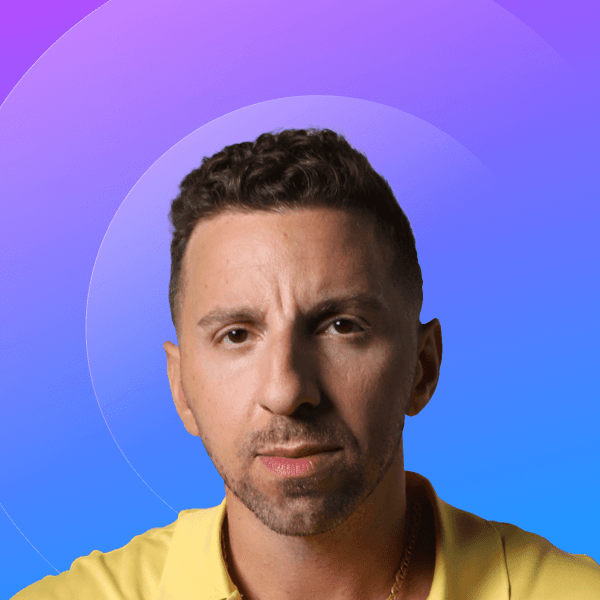
Gaetano DiNardi
Principal Consultant at Marketing Advice, Growth Advisor for B2B SaaS companies
Gaetano DiNardi is a B2B marketing advisor specializing in AI-driven SEO, demand capture, and inbound growth for SaaS companies.
He has over a decade of experience helping more than 50 B2B software brands win in highly competitive categories, from VoIP and LMS to security and employee monitoring.
Gaetano is the founder and principal consultant at Marketing Advice, an advisory and consulting practice that helps B2B SaaS companies build a sustainable pipeline using SEO, paid search, and full‑funnel growth strategy.
Video Chapters
Transcript
Gianluca Fiorelli: Hi, I’m Gianluca Fiorelli. Welcome back to The Search Session. Today, we’re going to talk with a fellow consultant. Italian, but Italian-American. He was born in New York and is now living in Miami. He defines himself formally on LinkedIn as a growth advisor, and he’s one of the most experienced specialists in SaaS growth consulting. The person is Gaetano DiNardi. How are you doing?
Gaetano DiNardi: Ciao, Gianluca. Thank you for having me. I have to start by saying that you’re one of my SEO heroes. I’ve looked up to you for many years.
Gianluca Fiorelli: Don’t make me blush!
Gaetano DiNardi: Yes, I remember reading all your masterpiece articles on Moz and all the great pieces you wrote, even way before AI started. And I thank you so much for inviting me to your podcast. It’s an honor, so thank you.
Gianluca Fiorelli: So, you’re living in Miami? I think it’s still hot there?
Gaetano DiNardi: Oh yes, it’s hot and beautiful.
Gianluca Fiorelli: Okay, so you’re a growth advisor. Why don’t you want to…? Well, I’ll ask you that later. Let’s start with a classic question of The Search Session: How is SEO treating you lately?
Gaetano DiNardi: That’s an awesome question. And I’ll say that it’s been great.
There are a couple of aspects to it. One is that there’s this new excitement, this new life, that’s been injected into the SEO space. Of course, there’s a lot of craziness and maybe, in some cases, misinformation, but I’m enjoying all the new and exciting ways that SEO is evolving.
And then on the business side, demand is high. In fact, I’ve retained all my clients from last year into this year, and I’m helping them transition through the changes happening with SEO and AI.
So for that reason, companies still want to keep pressing the gas on SEO. They’re not giving up on it, despite what some of the counter-narratives are saying, like “SEO is dead” or “it’s only about AEO or GEO.”
But overall, SEO has been exciting. It’s changing fast, of course, but overall, great and very positive.
Gianluca Fiorelli: Yes, cool to know. It’s also reassuring to hear, for once, a very positive impression from someone like you. Because usually, the bad humor is the more constant thing.
I think you may represent, let’s say, a sort of change that I’m perceiving. Before, people were really nervous about the changes we were experiencing. But now, I see people, let’s say the “old guard SEOs” and some of the younger generation, somehow showing some nerve and saying, “Okay, we are maybe the most entitled to drive this kind of change and eventually to educate clients through it.”
The Traffic Paradox: Attribution in the AI Era
Gianluca Fiorelli: In fact, I want to start there, because you shared with me a document where you basically put on paper the tough questions CEOs are asking about AI and SEO.
Substantially, these are the questions I think you’re receiving almost daily, and they are probably very common for all of us. So, what’s the one question you constantly hear from your clients? Or even from potential clients, people outside of the search industry who are reaching out to you?
Gaetano DiNardi: Yes. It’s something you’re also familiar with, Gianluca. It’s really the question about traffic. So, “How do we know that SEO is still worth investing in if traffic is going down?”
In fact, it’s this sort of linear progression from classic SEO to revenue. The classic CFO mindset, where you have a ranking for a keyword position. Then, based on that ranking position of that commercial intent keyword, you can estimate, to some degree, the click-through rate.
From there, they expect click volumes to website traffic, and then, using some kind of conversion rate formula, you can do the prediction or the math: “If I rank here and I get this many clicks, and we do CRO on the website, we can predict this many leads coming from the organic channel.”
But that linear progression is breaking because clicks are going way down. So that’s the biggest question I’m getting: “How do we know if SEO is working if traffic is going down?”, “How should we think about investing in SEO if we’re not going to get the traffic on the back end of that?”
Gianluca Fiorelli: Yes, but I think this actually isn’t something new. I think it’s something that the eruption of Google Analytics 4 started to disrupt.
If you remember, in the old classic Google Analytics, we could eventually see the contribution of SEO, of organic traffic, to a conversion that was finalized through another channel, like, let’s say, paid. So, someone first comes to our website from organic, and then after a few days, they return by clicking on an ad, or coming from a referral, or from social media. But part of that first journey started with organic. So, there was somehow a contribution from organic.
And I think that not having—at least not in the default views of Google Analytics 4—that kind of vision, we lost attribution. We lost that kind of information, especially businesses lost that kind of information.
So it’s harder for them to understand that SEO organic traffic may not be directly bringing you a conversion, but it’s helping with awareness. So people return when they see you on other surfaces, which can even be a referral from ChatGPT.
Gaetano DiNardi: That’s right.
Gianluca Fiorelli: And then they convert. Yes, I think this is really a problem of how to measure things. And I think we should understand that maybe the classic attribution model is disappearing.
In some sense, it’s like—when I was working in television—we trusted Nielsen to understand how many people were watching our channel instead of others. I mean, Nielsen was basically a focus group, with interviews or a machine in their house that recorded when someone changed the channel on the TV.
Gaetano DiNardi: Yes, exactly.
Brand Entities: "How Do I Rank on ChatGPT?"
Gianluca Fiorelli: I also see there’s another classic question. How many times are you asked, “How can I rank on ChatGPT?”
Gaetano DiNardi: Oh, this is a nightmare question. Yes, it comes up a lot. Even worse than that is when the CEO searches for a thing we do on ChatGPT, and our brand is not associated with that thing. And therefore, we don’t get the recommendation from ChatGPT after the CEO searched for that.
I regularly get those kinds of messages in Slack from, say, the head of marketing. And now the CEO is breathing fire down their neck because they searched for a thing we do in ChatGPT, and the brand wasn’t recommended.
And now I have to think about how to explain that you're missing the necessary co-occurrences on the web because your brand was known for this one thing for a very long time. And now you want your brand to be known for a brand new thing, but you haven’t done the foundational marketing work to make that happen.
So now I have to have those conversations, which I know you are like the grandmaster of when it comes to entity-based SEO, semantic search, and all that. I’m spending a lot more time talking about brand entities now and missing co-occurrences, which really need to be a broader part of marketing. It’s not something SEO teams can solve on their own. So, what do you think about that?
Gianluca Fiorelli: Well, I think that we’re not innocent. We’re a strange community.
Gaetano DiNardi: Yes.
Gianluca Fiorelli: Because on one side, we’re very proud and we basically think that organic—and SEO—is the king of all digital marketing channels. But maybe the real king is email marketing, if we want to be serious, because it's the one that never dies.
And so, from this proud position, many in our industry never really cared about other channels. Omnichannel is clearly the way to go now. I mean, all marketers in different specialties must collaborate together, in order to do the classic things where one plus one is not two but three.
Gaetano DiNardi: That's right.
Gianluca Fiorelli: And I think this is also somehow—as people in Spain say—is a “reality bath.” You’re put in a bath full of reality, and you wake up from your dreams. So I think this is the real situation. The real wake-up call that people are starting to have now.
But then, that’s also why I urge the SEO community—especially when it comes to search in, for instance, LLMs—to drive the conversation.
To not let this opportunity to drive the conversation be taken over by newly invented “AI search gurus” who never did anything in search before, but are now trying to tell us what we should do.
Gaetano DiNardi: That's right. That’s right, yes. The AI bros, as you’ve been calling them—which I find very funny! But it’s also an accurate description.
You know, for example, I have to collaborate more with PR teams now than I ever have before. And one example that happened recently—a CEO was worried, or concerned, that a top competitor had a better AI association with their brand and product. That they were more AI-forward, that they seemed more innovative.
And I had no way of figuring out how to prove or disprove that. But then I came up with this little hacky method, and I’d love to know what you think about it, Gianluca.
Basically, I took all the entities that were associated with each of the brand terms. Then, I had Claude go through a comparison of those entities associated with each brand.
I had to do an analysis of which brand had more AI entity salience. And it did a spectacular job, way better than I could have ever done manually. And based on the analysis it did, I was able to bring real data to the conversation with PR and say, “Look, here’s where this brand is outshining us in the AI conversation.”
And that was extremely valuable, rather than just trying to, maybe cherry-pick stuff off the website or do it manually.
So yes, I kind of had some of that idea based on some of your writing, actually—but I’d love to know what you think about that method.
Gianluca Fiorelli: I think of it as really the way to go. I think competitive analysis is really becoming a critical asset.
Gaetano DiNardi: Yes.
Gianluca Fiorelli: Using—like you do—Claude… I tend to use Gemini. But the model you use isn’t the most important thing. What matters is the fact that you're supporting your work with the reasoning of AI models.
Yes. And this also means another thing, that sometimes SEOs have done it, but very fast. Which is really about spending time with the client—or with the boss, if the SEO is in-house—to truly understand the business model of the client, and also the business model of the industry where the client is operating.
It’s about understanding and being able to see the priorities. Being able to understand why the brand is using a given tone of voice and why a competitor might use a completely different tone of voice.
And especially, it’s about understanding and asking for a very detailed—I never really liked the term—buyer persona. Not only the buyer persona, but also the audience persona.
Because when we think about this—again, it's not something new, but it’s even more important now—buyer personas are the people we want to target to become our subscribers. In the case of SaaS, for instance.
But the audience personas are the ones that, through collaboration with digital PR, we can connect with in order to earn links, mentions, and so on. So we can build that kind of entity connection between AI and our services, for instance.
So yes, it’s the job that must be done before, because if not, you're basically just inventing stuff.
Gaetano DiNardi: That's right. And I’ll be honest, I used to think this was fluff. When I first started doing SEO, I used to think, “Let me just do this on my own. Let me just pound backlinks through my network or through outreach. Let me just build pages and forget about all this.”
I didn’t really understand how important all this stuff was until later in my SEO career. When you're dealing with higher-level executives and all that, you have to think way more strategically than just keywords and backlinks. And obviously, we’re seeing that today.
In the example I told you about, there were three things that the competitor did differently from my client that explain why they were perceived as more AI-innovative. Two of those reasons were part of their feature set, like you were saying. They had something called predictive analytics and predictive modeling.
So I realized that, because they have a distinct feature set with this concept of predictive, it automatically fits into the AI story beautifully.
And they also did something genius: they have a branded AI product line, which my client does not have.
So I was able to take those insights into that discussion, and I think it really opened their eyes. And probably, this is stuff they already knew deep inside, but they needed someone like me to reinforce it for them.
But yes, I’ve matured a lot throughout my SEO career, understanding how to bring these sorts of insights to higher-level conversations. And how you collaborate with PR, for example, is a very important part of the job. Especially now with AI, you have to do it.
Gianluca Fiorelli: Yes, and this also opens up other types of collaboration between channels. For instance, with email marketing—because with email marketing, you can understand what kind of content or what kind of newsletter, based on email statistics, is getting the highest open rates, the best feedback with any kind of leads or lead generation things that the newsletters can organize in connection with paid search or paid social. Because paid social, especially, is really strong on everything: friends, word of mouth, and how people really talk when referring to your services.
So, it’s really about creating this sort of very strong synergy with the other channels. By doing so, we can offer a better-informed SEO and AI search strategy and more effective tactics to achieve the purpose of the strategy. But one of the purposes is obviously—as you were saying—conversion or lead generation.
LLM Conversion Rates and The "Dark SEO Funnel"
Gianluca Fiorelli: And now I’m coming to a Substack that has been written, and you shared it with me. And it’s about the classic question… because we are living in strange days. One person says one thing, and they can prove it, and another person says the opposite, and they can prove that too. Let’s go to the big question: How much LLM traffic actually converts?
Because we know that traffic is—well, I mean, we always blame Google because the traffic is shrinking, zero-click, and AIO is stealing traffic. But ChatGPT? The traffic is ridiculously very, very low. Aleyda Solís recently shared another study, which is fun because I think it was done by Profound. And it said that the highest CTR for the most visible URL is a miserable 1%.
Join Aleyda Solís for a clear-eyed look at AI in SEO
From chunk-based content to LLM-powered workflows, Aleyda Solís shares how she’s navigating this new AI-driven search era—without losing sight of strategy, users, or business goals.
Gaetano DiNardi: Yes.
Gianluca Fiorelli: So, the traffic is fairly small. But what about the conversion rate? What’s your experience?
Gaetano DiNardi: Yes. For the context of B2B software, the website conversion rate from ChatGPT is very high. It’s actually even higher than Google Search, Bing Search, or organic search as a channel.
I have some theories on why that might be. Some of them are obvious, some are less obvious. I think the obvious one is that because ChatGPT is so good at fulfilling very specific intent, and it can drive you directly to the pages you want to go to—after a lot of back-and-forth in the conversation, you're more likely to be more informed.
You're going to go right to a page—perhaps even deeper in the site—than the homepage, for example. And you may be able to convert more easily because of how targeted it is.
I think maybe a less obvious insight is that Google Search sends a lot of top-of-funnel traffic that is not commercial or buying intent traffic. And so, therefore, it’s going to skew the conversion rate in the opposite direction.
So I don’t think it’s fair, first of all, to just look at ChatGPT conversion rate versus Google Search conversion rate and say that Google’s conversion sucks—because it's different buyer types, different stages, and different mindsets going to the website.
So just doing that comparison off the bat wouldn’t be fair. But I would wager that, if you isolated Google Search traffic to just the bottom-of-funnel pages and compared that to ChatGPT, you'd probably be on par.
So we can start there, Gianluca, and see what you think.
Gianluca Fiorelli: Yes. I think that obviously it also depends on the type of industry. Some types of industry tend to have a bigger weight on informational, conversational queries, for instance. So people can be, honestly, totally satisfied by the answer given, maybe by an LLM.
For instance, recently, I was working with a website, and I used Claude to understand how it shapes answers for certain types of questions. These questions are usually considered informational—but they can often be the start of a potential customer journey, not just informational.
Gaetano DiNardi: That's right.
Gianluca Fiorelli: But Claude doesn’t trigger the search part. Claude is just relying on models, and when you ask it directly—very candidly—“Why are you not linking to any sources?” It says, “Because this is common core knowledge. So I don’t need to search for new, fresh content.”
So, I think this is sometimes the reason. In certain industries, there’s a real need for a longer stage of informational queries before eventually triggering the commercial part of the customer journey.
Gaetano DiNardi: Yes.
Gianluca Fiorelli: In SaaS, I think there are two main reasons. One is cultural. I think people searching for software-as-a-service are usually more aware of how things work. And so, they tend to use an LLM to go directly…
Gaetano DiNardi: … to what they want. Yes.
Gianluca Fiorelli: To what they want. So they don’t need to do tons of Google-style queries in order to eventually find search results that answer their questions. Instead, they go directly to an LLM, write a very verbal prompt, and ask.
And secondly, this kind of buyer persona—when they start to search—they’ve already scouted websites directly. So they're going to an LLM in that classic micro-moment of “I want to buy, but I need help.” Because they’ve already seen everything, but now they want to find, somehow, a “judge” able to tell them, “Of all these things, which is the best for me?”
It’s like going into a shop and asking the seller, “Okay, I know all these PCs—but which one is really the best for what I want to do?”
Gaetano DiNardi: Yes.
Gianluca Fiorelli: So I think this is why, maybe in the SaaS niche, the conversion rate is higher than in Google Search or Bing.
Gaetano DiNardi: I think personalization has a lot to do with it—absolutely, yes.
Gianluca Fiorelli: Obviously.
Gaetano DiNardi: There’s another aspect I’d love your opinion on, Gianluca, because maybe in other industries this isn’t the case. But in SaaS, I really believe this is the case. There’s a dark SEO funnel. These searchers also don’t fully trust the LLMs just yet.
And they often need to validate through Google what the LLMs are recommending and what they’re telling them.
I saw a great study from a company called Wynter, and it was a collaboration with Omniscient Digital, another services agency. They found some great data through qualitative research.
So they were asking people in their study, “If an LLM recommends a brand that you're unfamiliar with, what do you do?” And the overwhelming majority said, “Oh, we go to Google. We search the brand, we look at their reviews, we check out their site, and like we’ll manually check it that way.”
So I do think that this dark SEO funnel that’s emerging, particularly for B2B SaaS, is a lot of exploration and narrowing down happening through LLMs. But then, when it’s time to really fact-check—and probably even convert—they're still going to Google.
And maybe Google is getting the attribution credit, we could call it, for when they are ready to buy. They did all the research through LLMs and other platforms, and then they just went to Google to convert.
And so maybe, as Rand said, Google is like the pizza shop that's just getting the flyers from people who are already hungry. And, you know, there could be a good amount of that happening. So, what do you think?
Gianluca Fiorelli: Actually, you’re describing the messy middle. The messy middle, what is it? Before, it was just considering Google. So, moving from one SERP to another SERP, from one Google property to another Google property.
But the messy middle actually is every place where a search can be done. Because—we’re talking about LLMs here—but for instance, in hospitality or travel, it can be TikTok, it can be Instagram. You see a reel on Instagram—about, I don’t know, a wonderful restaurant on a terrace, looking out over the roofs of Rome—and obviously you can save it, you can trust it. But you also know that this is somehow BS that reel. And so you go to Google in order to understand. You go to Google Maps to see the reviews.
To see the website—obviously, you search the website to see the reviews, maybe from magazines about restaurants in Rome. And so that’s it—and then maybe you return to Instagram, or you go to TikTok, in order to see what people commented. Or if other people shared things that are not the official reel promoting the roof. This is the messy middle.
So that’s why—as Rand Fishkin promoted it very well, even if it wasn’t his original definition—we really must do SEO as Search Everywhere Optimization. Because you have to be visible everywhere.
Hear more from Rand Fishkin on the evolution of SEO
Is SEO still about rankings and traffic or something more? In this episode of The Search Session, Rand Fishkin joins Gianluca Fiorelli to explore the shift from traditional SEO to brand-driven influence, zero-click results, and the rise of AI in search.
"Search Everywhere": The Role of Video and Multimedia
Gaetano DiNardi: Yes. You know, you reminded me of video—because in SaaS, video is very underutilized. Most B2B SaaS companies are still very heavy on written content. And I just thought about my own conversion journey. I drink a lot of coffee—as you might expect, you know, Italians… we love coffee. And I bought an automatic espresso machine. I started my search on YouTube for this. I also checked Google for things like “best automatic cappuccino machines.” But I felt that all those affiliate sites were fluffy and just trying to make money from the affiliate links.
So I actually used YouTube to see the product demonstration, where somebody was making cappuccinos and macchiatos live—and showing the details of the machine. And then from there, I decided which one I wanted to buy. I went to Google, and I converted—I bought the cappuccino machine that way.
But I did not click the affiliate link from YouTube to the checkout page. So they’ll never know that YouTube was the reason why I bought that machine. That’s the messy the dark funnel in real life.
Gianluca Fiorelli: Yes, totally. And I think this thing about video—just to bring in another example, not really from SaaS. It was an editorial website, all about the Microsoft world and speaking to developers.
It was the classic kind of site, explaining things with really strong, solid, content-based information. And what we actually discovered was that videos were the best thing. In fact, especially when it came to everything related to the Helpful Content Update and all the Core Updates—you know, the horrible end of summer 2023 (yes, it was 2023)—this site started to shrink.
I mean, for no clear reason, it started to lose traffic. But we saw that the YouTube channel was still working very well. And the YouTube channel was essentially just one person doing the videos—the main journalist of the company doing all the content.
So we started to not just embed the YouTube videos into the website but repurpose the video in the form of Shorts…
Gaetano DiNardi: Nice.
Gianluca Fiorelli: … or creating other formats. It was a pain because the resources weren’t that big. It wasn’t a big publisher. But it was working well. So yes, video is important. And now, even more so, if we think about AI Mode or Gemini in general. Maybe because it’s Google, we know that videos, and YouTube in particular, are very important. Because they immediately transcribe the speech, everything can be parsed and optimized. And so, everything is parsed and optimized, allowing parts of the video to be “chunked” as answers.
Gaetano DiNardi: Absolutely.
Gianluca Fiorelli: In fact, especially in AI Mode, now with Gemini 3’s Deep Search pumping AI Mode, the presence of video is going to boost.
Gaetano DiNardi: 1000%. I’ve even seen so many of them in the AI Overviews, in the SERPs themselves. I mean, that’s the biggest foreshadowing clue you can have, right? So, I would love to get more of my clients to invest in video, but the logistical aspects of it turn them off.
Sometimes I present what I’ve done with other clients in the past that’s been successful—like, you can have someone come in with a bunch of scripts, you block out a studio for the day, and then you just make as many videos as you can. I’ve found that to be effective.
But in general, I think it’s tough to switch the conversation with clients—on how to get out of the written content hamster wheel and more into the video and multimedia mindset.
Gianluca Fiorelli: The quality must always be very good.
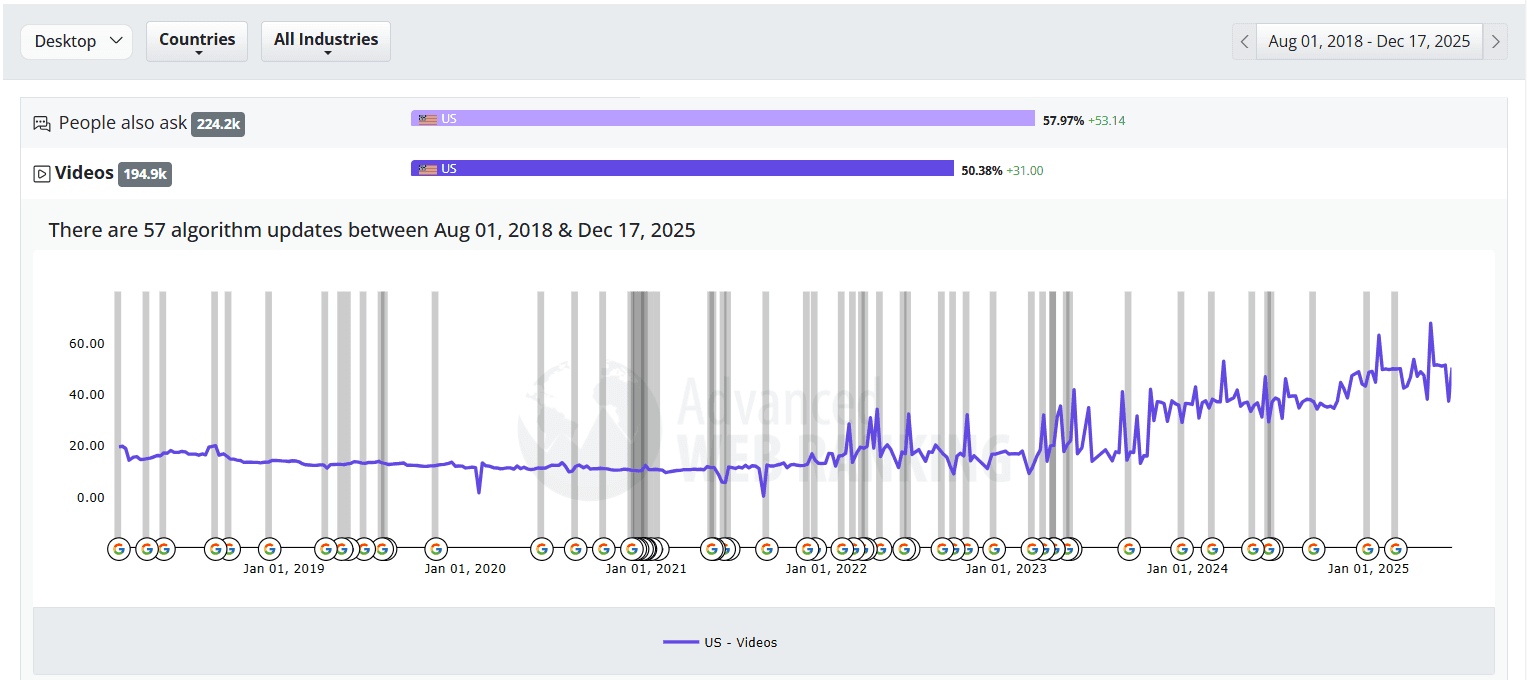
If you are struggling to convince clients to pivot to multimedia, show them the numbers.
Data from AWR’s free SERP Features tool reveals that over the past couple of years, video presence has exploded. Currently, video results appear in over 50% of desktop SERPs in the vast majority of countries.
Explore the prominence of video and other features (including AI Overviews), daily with AWR’s Free SERP Feature Tool.
SaaS Content Strategy: Ungating the PDF
Gianluca Fiorelli: But I think there’s an area—and this is also a question, because it’s something that always drove me crazy: Why, in the SaaS world, is all the most interesting content always hidden in a developer subdomain or the support subdomain?
Because, when I work with SaaS companies, I usually say, “You already have all your content!” It’s the same as when you work with B2B; usually, the best content is sitting in a PDF.
Gaetano DiNardi: Yes.
Gianluca Fiorelli: You don’t need to create new content. You just need to repurpose the content you already have in that subdomain to create the product-led and SEO-type of content that you need.
Gaetano DiNardi: Yes.
Gianluca Fiorelli: So, do you ever discover why SaaS loves using subdomains for everything?
Gaetano DiNardi: Yes, yes. I've seen this over and over and over again for so many years. The answers are always the same. The first reason they do it is because they want to gate the content behind a form. They want to collect the contact information of the people who want to consume that content, and then they want to remarket to them, send them emails, and stuff like that. It’s the classic, classic enterprise B2B motion.
And depending on how “enterprise” they are, I’ve even seen paid search campaigns that don’t send traffic to a product demo request form. Instead, they send it to a research guide that’s locked, so you have to fill out the form to access it.
Gianluca Fiorelli: The classic inbound marketing aspect.
Gaetano DiNardi: 1000%. But it’s a cultural problem too. For a lot of classic, more traditional B2B marketers—especially product marketers—they just default to PDFs. That’s the culture they were raised in. They love it. I don’t know why.
A lot of the work I do is actually taking that PDF content, ungating it, and turning it into SEO-led, ungated HTML content. So there’s a lot of repurposing that can be done. But back to your point, it’s a cultural thing. And they want to do the classic inbound marketing motion.
Gianluca Fiorelli: Or at least, if you really want to have your PDF indexed, remember to add UTM campaign parameters and links to your website. Because if not, every browser makes it so easy—people just search, find the PDF, open it directly in the browser, and download it.
Gaetano DiNardi: And that’s exactly what’s happening now with LLMs. I’ve been showing clients, “Hey, you know that LLMs are finding your gated PDFs and sharing them out for free?” That’s actually happening quite a lot. So, yes, I don’t know. I think gated content will eventually die. Now you have to offer something really compelling. It has to be a great, unique report with amazing data or something like that for people in B2B to complete a form and engage with it. I just don’t think that method works well anymore.
Google’s AI Future: AI Overviews, AI Mode, and Web Guide
Gianluca Fiorelli: And speaking about the elephant in the room—because we were talking about ChatGPT—but probably, in the long run, the winner is going to be Google. I mean, it has the mass to resist and to spend what must be spent to do good AI in search. And it's not dependent on investors, somehow. They even built their own processor with TeraFLOP, and so they don't even depend on Nvidia.
We are SEOs, substantially, even if we want to call it by different names. But most of the time, the traffic still mostly comes from Google. Google is having AI Overviews, and now it's pushing a lot—very much—AI Mode.
Now with Gemini 3, AI Mode is starting to seem like something that is going to be useful and usable, mostly. What do you think? Because I know you're a fan of a blog post—a really long blog post—that I wrote about how AI Mode could be transferred from being just a mode to becoming the default search surface.
I think that my mistake in that post was still thinking in the old way—of how to transform the features we see in Google—and not considering that models would evolve so fast. But now, we can see Gemini creating charts in real time with just a question—just by asking it.
But do you think Google will really abandon, even partially, the classic search?
Gaetano DiNardi: I have to believe someday, yes. How far away are we? Who knows? At least a few years away still, because I think there are a lot more kinks they need to work out. But, you know, I’ve been wondering about this for a long time. And actually, I wanted to ask you because I knew I was talking to you today.
If they do roll out AI Mode as the default, the thing that they lose is their moat on engagement data from CTR. Because that is one signal for traditional ranking. If there’s a lot of pogo-sticking, people going back into the results, or the searcher ends their journey here on this result—that's usually a sign that this is a positive answer and that they like this page because it concluded their search journey.
So that is the thing I wonder: What are the things Google will do to make up for the lost engagement tracking that they get from CTR? Because there is going to be no more CTR or probably very, very, very little. Will it be links? Will it be topical authority? Will it be some combination of overall brand association with an entity? What is your take on that?
Gianluca Fiorelli: First, remember that it’s me inviting you to talk, okay? This is not an interview for me. But let’s continue the conversation. What do I think? I sincerely think that I’ve slightly changed my perspective compared to when I wrote that very long blog post. And the reason is the appearance of Google Web Guide.
There are two things. One characteristic of Google with respect to AI, and especially in the case of Gemini, is the specialization of the models. We see Gemini in general—now we have Gemini free—but then we have very specific Geminis (between brackets): one for legal, one for health, and one for very specific models that sometimes, when generating answers, are called by the general Gemini in order to give a more precise and less hallucinated answer.
This attitude is similar to the classic behavior of Google, of really segmenting with the classic filters in the menu. So we have Image, Video, we have Shorts—even Shorts is not put in the same bucket as Video. We have News, Books, Flights, etc., etc. And then we have Web.
So what I think is that we will still have “Web” as it is now, not the Web Guide, but the feature that Google is testing as Web Guide, probably is going to be moved into the classic “All” search filter. This, plus things from deep AI Mode, will eventually be pushed inside AI Overview. So, combining a sort of hybrid of the two.
Why? Because Web Guide is still offering all this—even a bigger list of URLs—because they’re not the classic 10. They can put 95 search results in one long page with no pagination. So, that is going to make SEO more difficult—because if you're not on that one unique page, you're invisible.
If you use Web Guide and you go to the end of a Web Guide page, you can see Google say, “I analyzed 120 sources, and I selected 86.” So, 86 out of 120 is already a big search, but that 120 is a selection out of millions of documents.
Gaetano DiNardi: Yes
Gianluca Fiorelli: So if you are number 121, you're not even being considered for that search.
Gaetano DiNardi: You missed out. That's right.
Gianluca Fiorelli: And what’s cool is that the Google Web Guide is a pillar page, substantially. So it’s segmenting, and it’s giving you a deep dive into the topic that you’re searching for. You can eventually go directly to the part that you’re interested in. And then, our meta descriptions do not exist.
Gaetano DiNardi: Yes, that’s gone.
Gianluca Fiorelli: The meta descriptions we’re starting to see in normal search are created by Gemini. And they’re actually telling you why this search result is relevant. So for me, this can even increase CTR.
Gaetano DiNardi: Yes.
Gianluca Fiorelli: In some cases, no. And this happens, interestingly, especially with forums. Google is maybe surfacing a Reddit thread because it’s relevant. Maybe the thread is from 2014, so it can still be relevant because it’s this, this, and this, but please be aware that it is…
Gaetano DiNardi: Old.
Gianluca Fiorelli: Old. It’s 10 years old. So, you can say, “Okay, I don’t care.” It’s already this ranting against Google. So I think that kind of search results page is going to be the one that becomes the default. With AI Overviews, all the things I was saying, “Okay, maybe in AI Mode, the ‘People Also Ask’ can be follow-up questions.” But we’re already seeing it. Because now almost all of the ‘People Also Ask’ are AI Overviews.
Gaetano DiNardi: That’s right.
Gianluca Fiorelli: They are not the classic snippet of the classic search anymore. And AI Mode will be another thing—maybe still very pushed from Search to do deep research using AI Mode, but not really for… for Search itself. Because it's relevant.
Gaetano DiNardi: Yes, this is super cool, man. You know, I agree. As you were talking, you made me think about mobile as well, because I actually love the ChatGPT mobile app. So I do wonder if, over time, Google user behaviors will change where, say for mobile, instead of going to Google.com on your mobile device—or even the Google app—you'll just start using the Gemini app, or an AI Mode app, if they develop that or something.
Because I do think that the AI Mode style is very good for mobile. I find it just easier, quicker, and more convenient. But on desktop, I kind of do like the blended experience. Or if I need to go up and down and go deep, I can do that. But if I decide to use AI Mode, I can do that as well. I like the optionality. So maybe that's the way it will unfold. We'll have to see.
Gianluca Fiorelli: Well, and if we connect this bit of our conversation to the one at the beginning—talking about how people maybe start on ChatGPT and then go to Google—the fact of having AI Mode separated from the main search is a catch-all.
Gaetano DiNardi: That's right.
Gianluca Fiorelli: Because people can start on Google Search, then go deeper with AI Mode, and then return to Google, without needing to leave and open a new application. And then talking about mobile, Siri is going to be somehow killed by Apple and reinvented with Gemini. So we are going to have Gemini as the default on Android and iPhone.
Gaetano DiNardi: Very exciting.
Gianluca Fiorelli: The mobile ecosystem is going to be Google.
Gaetano DiNardi: That's right.
Gianluca Fiorelli: And I mean, maybe they can even try to say, “Okay, you must choose which system you want to use.” But I mean, it's not really so simple, because you cannot ask Apple users to choose which system, which intelligence they want to use. This is still Siri, even if it’s powered by Gemini, but it's Siri, not Google, formally.
Rethinking Top-of-Funnel Content
Gianluca Fiorelli: And there was one thing you were saying. Sometimes I don’t fully agree with you. You're talking—obviously—from your perspective and as a specialist in the SaaS world. So you're saying we should stop creating top-of-funnel content.
I can agree to a certain degree, but you know—we’ve discussed this on social media, and I think it was X or LinkedIn, I don’t remember. But actually, owning the top-of-funnel space is still valuable for E-E-A-T. So maybe, and I want your opinion here, it's not really about losing ourselves in a semantic discussion around whether informational content is still useful or not.
But what kind of informational content? Maybe for SaaS it should be product-led informational content. Not talking about—let’s say—you have an application about weather, and not talking about how weather is calculated through very complicated mathematical algorithms, but more about the product: how it works, what it’s using. So, talking about the informational content for the right person, not for the universe.
Gaetano DiNardi: Yes, so I’ll tell you my beef, Gianluca, with informational content for SaaS specifically. So much of it historically has been that generic fluff, where it is so far away and so disconnected from the product storyline.
So, to your point on maybe it should be product-led—yes, it absolutely should have ways throughout the storyline of the content where the product gets injected, and you can explain how to do something with the product throughout the content.
So my beef has been that very generic-style fluff, where you can’t even connect the dots to the product storyline at all—or only a very, very, very small amount of it. And then my other beef with it too is that—I feel, Will Reynolds had a great post on this too—if you are just doing informational content to drive search traffic, but you don't have the pride in that content to where you will promote it on social with your profile attached to it, and you put your name behind it, you stand by it and you're proud of it.
If you're not doing that, then it's likely just generic fluff. So, that is my beef—is that there's not enough personality, there's not enough unique insight, and it takes away from the value of the content.
Gianluca Fiorelli: So I totally agree with this. I mean, it's also something that I say, why should you have to put in your editorial calendar to write, again, another ‘What to do in Valencia’ or ‘in Miami’?
Gaetano DiNardi: It makes no sense.
Gianluca Fiorelli: Instead, and this is maybe where all the people working in the publishing niche should try to focus. It's hard because it's not easy, but rediscovering investigative journalism, rediscovering data-informed journalism, is the kind of content that, for instance, AI cannot embed.
Gaetano DiNardi: That's right.
Gianluca Fiorelli: And eventually it's the kind of content that—even if it's using AI or using a mention—probably is going to find it. And now I'm going to try to explain myself.
I was investigating a couple of days ago, a behavior, a test that is happening on Google with AI Overview. I think that you saw it too. Sometimes, Google presents the classic blue link inside an AI Overview. And I was wondering why it's doing that. So, that is because Google is probably considering brand names as a destination and not as a mention. Maybe becoming that destination is the purpose—one of the purposes—for an SEO to work on all the strategy and practice.
But then I started to investigate another thing. Why, for instance, when we are going to AI Mode or AI Overview, and we click the mention in the column “source,” sometimes you see that Google is highlighting the chunk that it used for the answer, and sometimes not? And what I discovered is that the chunk that is usually highlighted—many times—is copied verbatim, so exactly as it is, into the answer. So that means that you are the source, the perfect source for that kind of answer.
So maybe it is also a way to eventually combine it with the other one, which is hopefully the way that Google will deal with links and real attribution links inside AI Overview and AI Mode. Instead of the classic column or the stupid, minuscule icon of a link.
And yes, maybe the fact that so many websites are losing traffic because of AI should not be considered as AI stealing traffic but as a self-conscious understanding that we had life easier. We need to restart doing things like when paper news magazines existed—because nobody was going to buy a National Geographic Magazine that was filled with fluff, even if it was proposing the classic “What to do in Valencia with your family.”
You knew that a journalist really knew what to do in Valencia—because they experienced what to do in Valencia. The photography was not stock photography, and so on.
This is harder. It takes a long time. You know that Google is probably going to scrape it, ChatGPT even more, and maybe you’re not going to get the traffic anyway. But it will make you stand out.
Gaetano DiNardi: I love it, man. Yes, ah, I think—what you’re reminding me of is the consensus versus information gain. So, you need to have some level of consensus—otherwise, you probably won’t rank. But you need to have the information game to stand out. So you need to strike that fine balance.
I think what you said about “What to do in Valencia” is great. Like, you probably need to have some of the things that people would expect. But then, if you are the local guru of Valencia—you know all these cool things—then I would definitely trust you more than some random guy with Stock photos.
Gaetano’s Life Outside of Work
Gianluca Fiorelli: Indeed. Well, one hour! So now, let’s stop talking about AI. Let’s stop talking about SEO.
I’m opening your camera a little wider now, and as you can see—if you’re watching this on YouTube—there is a wonderful electric guitar behind you. I’m curious: what is your relationship with music? Is it your passion? Is it a way to express yourself? What is it? What is your relation with music and the use of that guitar?
Gaetano DiNardi: Yes, you know, I used to be in the music business before SEO. And I’m not in the music business anymore, but I still love it, and I like to jam out. I like to shred. And it’s a great way for me to de-stress and take my mind off of work and SEO, and AI. I can just put my phone down and jam out to my favorite songs—or just play some rhythms and play some solos on top.
It's like one of the biggest things I do for stress relief. So I just love to play. I'm a musician at heart, and I've been playing since I was a kid. So this is one of my favorite things to do.
Gianluca Fiorelli: Cool. And I have, you know, the classic question—maybe silly or maybe it can be interesting for understanding someone better. But you were born in New York. I mean, I'm a European, so when I think of an American Italian in New York, I just think about all the mythology created by Martin Scorsese, Robert De Niro, and Al Pacino—all this kind of... I know that it’s not really like that.
But the question is: what made you move to Miami? Because—talking in stereotypes—you start to think of Cuban salsa, Latin culture, the connection with the Caribbean and Latin America, and the States, and so on. So, somehow, an American Italian looks or seems a little bit out of place in the classic stereotypical vision a European may have of the United States.
Gaetano DiNardi: Yes, it's a great one. Well, I actually left New York because I wanted to step outside of my comfort zone. Everything became so predictable. You know, I love my family to death, of course. And you know how Italians are with family—it’s like we’re inseparable. But I felt it was time to step outside my comfort zone.
Go do something different. And also, one of the big factors was that I hate the cold weather. I absolutely hate it. So I thought, what is a place that is not so far from home, where if I want to take a quick flight, I can do that, but also be in a warm environment year-round? Where can I go where I can wear shorts and a t-shirt every day?
And Miami obviously was like top of the list. And of course, let’s not forget the tax benefits as well, because they charge you way less here than they charge you in New York. So I said, “You know what, this seems like it has all the right components to it.” And my younger brother, Antonio, also wanted to move at the same time.
And so we decided to do it together. And so because I had somebody to go with, it just made all the sense in the world. This was in 2017—so like way before all the COVID stuff happened. And it was a great time to do it. And I never looked back, I’ve had a great life down here. So you can make of it what you want, depending on your lifestyle choices.
Me, I’m like an outdoorsy kind of guy. I like to play tennis, so I’m doing that like every week. And I like to cycle as well—things you can’t do in New York so easily, around the clock. So, that’s really why I did it, honestly.
Gianluca Fiorelli: Okay. Thank you, Gaetano. It was really a nice conversation, this one. And I hope to have the occasion to have a new conversation, maybe in the future.
Gaetano DiNardi: Absolutely. Thank you, Gianluca, again. This was awesome. I really enjoyed talking to you and hearing your perspective as well. And we’ll have to do this again sometime as AI evolves, and we’ll see where things end up.
Gianluca Fiorelli: Thank you very much. And also thank you to all of you who have listened to this conversation or watched it. Remember, ring the bell, subscribe, and help our little podcast grow. Thank you. Bye-bye.

Podcast Host
Gianluca Fiorelli
With almost 20 years of experience in web marketing, Gianluca Fiorelli is a Strategic and International SEO Consultant who helps businesses improve their visibility and performance on organic search. Gianluca collaborated with clients from various industries and regions, such as Glassdoor, Idealista, Rastreator.com, Outsystems, Chess.com, SIXT Ride, Vegetables by Bayer, Visit California, Gamepix, James Edition and many others.
A very active member of the SEO community, Gianluca daily shares his insights and best practices on SEO, content, Search marketing strategy and the evolution of Search on social media channels such as X, Bluesky and LinkedIn and through the blog on his website: IloveSEO.net.