


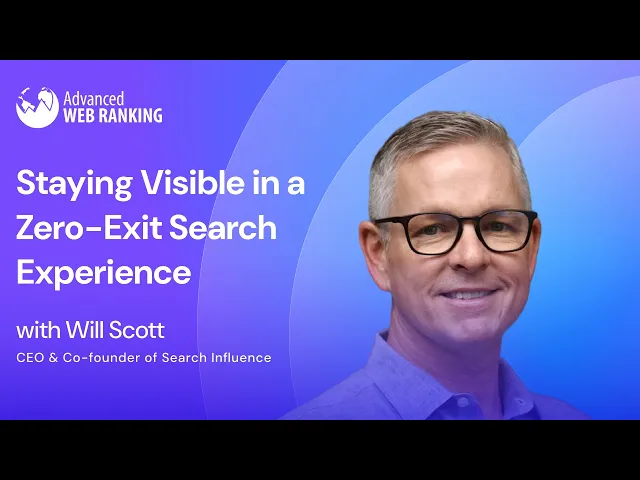
Welcome to The Search Session. I’m Gianluca Fiorelli, and my guest is Will Scott, an AI SEO expert based in New Orleans, Louisiana.
We talk about the renewed energy AI has brought to SEO and the shift from traditional search toward a more agentic, semantic, and personalized web. Will shares his view on brand visibility across search surfaces, the limits of prompt tracking, and the need to be present throughout the full search journey.
We also discuss custom SEO tools, query fan-out, content repurposing, and the role of human judgment in AI-assisted workflows.
What you’ll learn in this session:
What the “three users” shift means for websites: sites now need to work for humans, bots, and agents, and tools like Google Lighthouse are already deducting points if a site isn't set up for agentic use.
Why entities matter more than words for global SEO: semantic web history shows the field has been shifting from strings to things for over a decade, and now multimodal AI is pushing that same entity-based thinking into video, audio, and text combined.
Why “ubiquitous” beats “present” or “famous” in the SERP-features era: brand visibility now depends on appearing across search surfaces and channels often enough for users to remember you.
How to interpret personalization without overestimating its impact: search tracking data is more like a windsock than a GPS, showing the broader direction of change rather than an exact path for optimization, content creation, and channel choices.
Why repeated prompt tracking can mislead: running the same prompt many times may reveal variation but can produce data without useful context and say little about whether a brand is present for the right audience at the right moment.
How query fan-out expands what SEOs need to track: visibility should be measured not only for the initial query but also across the follow-up questions and refinements generated from it.
Why “zero-exit” may describe search better than “zero-click”: users still click through filters, follow-up questions, and related results but increasingly stay inside Google or an AI platform instead of leaving for another website.
How custom tools turn data into usable answers: lightweight workflows built around APIs and AI can reduce information overload, solve specific tasks faster, and combine query fan-out, information gain, and semantic structure into practical content processes.
Will brings decades of search experience together with a practical curiosity for what comes next, making this a conversation worth hearing.
Topics covered: AI search · agentic search · semantic SEO · entities · multimodal search · brand visibility · search personalization · zero-click search · prompt tracking · query fan-out · custom SEO tools · AI-assisted content workflows
About the Guest

Will Scott
CEO and Co-Founder of Search Influence
Will Scott is an AI SEO expert and digital marketing leader with more than 30 years of experience in websites and search. He is known for practical work across SEO, local search, semantic strategy, and AI search visibility.
In 2006, he co-founded Search Influence, a New Orleans digital marketing agency that helps organizations grow through SEO, paid media, content, and analytics. In 2017, he also founded UpScribed, a platform for managing content creation, publication, distribution, and reporting, where he serves as CEO.
Beyond his agency work, Will also publishes The Visibility Report, a weekly newsletter covering AI search, tools, measurement, and visibility strategies. He coined the term “barnacle SEO” in 2008, contributes regularly to Search Engine Land, and speaks and teaches at industry events.
Video Chapters
Transcript
Full conversation between Gianluca Fiorelli and Will Scott.
Gianluca Fiorelli: Hi, and welcome back to The Search Session. I'm Gianluca Fiorelli, and today our guest is coming from the US, from the beautiful city of New Orleans, Louisiana.
He is one of the senior practitioners of search, and now he's also presenting himself as an AI SEO or GEO expert, but it is not just a title. He is actually one of the most skilled people in this new field, or let's say new facet of SEO.
So I'm really glad he agreed to be my guest. He is the CEO and founder of Search Influence, and if you go to his LinkedIn page, I think it's very easy to find the link to the newsletter he produces and publishes every week, The Visibility Report. It is a very good one because it mixes news about search and AI search with insights and his point of view on this news, as well as really smart ideas about things that can be done.
Our guest today is Will Scott. Hi, Will. How are you doing?
Will Scott: I'm great, Gianluca. Thank you so much for having me, and thanks for the shout-out to The Visibility Report. I'm excited for that to come out each week, and I'm glad that people are finding it useful.
Gianluca Fiorelli: Indeed, it's useful. I subscribe to many newsletters, as I think many of us do, but I only read a few of them regularly each week. One of them is yours.
Others are obviously Aleyda's, because it's a very well-curated kind of newsletter. The other one is the Mark Williams-Cook newsletter, because it's a good place to find that kind of news about Google, search, and other search engines you may have missed. Then there are a few others. Yours is one of them.
How are things going in New Orleans? I've never been there. I traveled quite a lot in the States, but I've never been to New Orleans. How is it?
Will Scott: There's a quote that's attributed to Tennessee Williams: “There are three cities in America: New York, San Francisco, and New Orleans. Everywhere else is Cleveland.” New Orleans is one of those cities that, if you're coming to America, you should definitely see. And please don't blame us for the rest of the state.
Gianluca Fiorelli: Ah, okay. I remember that once there was an SEO event in New Orleans, if I'm not wrong.
Will Scott: Before COVID, PubCon actually came here, and we had a number of halls in the convention center. It was fantastic because, you know, you can't take your whole team to a remote conference, but when PubCon was here, we sponsored an event. We bought around 10 tickets and rotated people through the sessions they were interested in. So it was great. I would love it if a proper conference came back here someday.
Gianluca Fiorelli: I think that because it's somehow in the center, between the two coasts, it could maybe be easier for everybody instead of having one conference on the East Coast and another conference on the West Coast. Sometimes the same conference is duplicated because you have to cover the two coasts and the people in between.
Will Scott: I like what Brighton is doing. They're doing two coasts, right? It's just that one is the coast of California, and one is the coast of England.
Gianluca Fiorelli: The coast of England is the classic BrightonSEO. Some people say that it is still the original experience, somehow. I've never been to the San Diego one, but the classic BrightonSEO has become something even more than just a conference.
It's a real SEO search happening; let's call it a "search" in wider terms. Sometimes you spend more time outside talking with friends, making new friends, networking, sharing ideas, and drinking a lot of beer—because obviously we are in the UK—than actually staying inside the conference center and watching people talk.
Maybe because I know so many people, you go and watch them, cheer for them, and support them as if you were in a stadium, like in the recently concluded FIFA World Championship. Yes, it's a really nice experience, especially because of these kinds of things surrounding the event. This is maybe the best of these kinds of events.
Rediscovering Passion for SEO in the Age of AI
Gianluca Fiorelli: But let's come to you and do the classic question that I ask all my guests. How is SEO treating you lately?
Will Scott: I'm having a renewed love affair with SEO. I've been doing this work for a really long time. I put my first website online in the mid-'90s. Search Influence turned 20 last year, so I've got plenty of reps in SEO.
But I tell the story like when I first discovered ChatGPT, I was on a plane flying cross-country. I asked it a stupid question because I was watching videos. I had just gotten access to ChatGPT, and I asked, “What was the beef between Vin Diesel and The Rock?” I got this really nice answer, and I thought, “Wow, that's cool. I now understand this medium.”
Because I'd been making my living with Google for the preceding 20 years, I asked Google the same question, and I got 10 blue links and a job to do. From that point forward, I knew for a fact that this was where I needed to be spending my energy. After more than 30 years working online, I'm as excited today about SEO as I ever have been.
Gianluca Fiorelli: Yes, this is a sensation that a lot of people share with me. It's like returning to those sensations you had when you were starting with Google SEO; let's call it Google SEO.
There was no schoolbook about SEO, so you needed to experiment. You needed to burn dozens of domains trying to understand. You were spamming the web like crazy, but not because you were a spammer at heart. You needed to understand how things worked.
It's like when you are a kid, and you play with something. Sooner or later, you're going to break your game to understand how it works.
Will Scott: Yes, there's a fine line between experimentation and spamming. You try to stay on the good side of that, but you don't know where the envelope ends unless you test it.
Gianluca Fiorelli: Yes. In fact, I usually say that I don't want to enter into the classic ethical discourse because I don't think that is the correct way to think about it. It's more about convenience. Is it convenient to use spam tactics, let's call them that, tactics that can manipulate search or manipulate AI answers now, at the risk of your client being penalized or banned? That is the real question that you have to ask.
If you are doing it for experimentation, let's call it that, somehow you have to do it. Otherwise, you are just following or accepting the canonical book from the vendors.
You can do it, but many times, and I think you agree, after all the years of experience you have, best practice is not the best solution in many cases.
Will Scott: Right. I mean, I like to treat what we hear from the search engines as a signal. They're not the law. They're not the police. You're not going to go to jail. But I think that they're good signals.
Recently, in the last month or so, Google updated its webmaster guidelines, saying that to show up in Google results, you don't need to do any of these fancy things. You don't need to chunk your content or have an LLMs.txt or any of these things, right?
Two weeks earlier, on their developer blog, they published how to build agent-friendly websites, which said you should do all of those things. To me, it's like, which side do you listen to?
Gianluca Fiorelli: Yes, I hear you, but in this case, I think there are more nuances of gray to the two things than people usually read at first. The fact that one thing has been published by the Google Search team and another thing has been published by the developers, the core developer team, who are even closer to the Chrome team than the Search team, tells us at least one important thing: two teams are doing different things at Google.
One is the Search team, which is for classic search and eventually also for AI search and tangentially also for AI Mode. So, these are the things that are somehow connected to Google Search Console. Then there is the developer team, the one that is taking care of the agents.
There is a third alternative to what is correct. Both are correct. It's just that the Search team's recommendations about AI search are for search.
Will Scott: Right.
Gianluca Fiorelli: For search, because AI Overviews, especially, but also AI Mode, are directly relying on the index corpus, you don't need to have an LLMs.txt. It's okay. It's the classic thing that you can have. It's not a bad thing to have it. It's not going to damage your website or your visibility in classic search.
But it somehow sounds like when we were using rel prev and rel next. We were convinced, and Google simply forgot to tell us that it wasn't using them anymore.
Will Scott: Right.
Gianluca Fiorelli: On the other side, the LLMs.txt is needed for agents. It's somehow connected to the well-known subfolder files and so on in order for the agent to understand how things are organized on a website.
Entities, Semiotics, and the Evolution of the Web
Will Scott: I found it particularly telling that Google's Lighthouse, the accessibility and speed-testing tool they make available, actually deducts points from your score if you don't have an LLMs.txt file, as of about two or three weeks ago.
Gianluca Fiorelli: But it's correct, because the thing that some of the hardest, let's say, conservative SEOs are forgetting, or maybe still haven't properly understood, is that now the users are three: humans, bots, and agents.
Every testing tool must respond to how your website is compliant for these three agents. Now, for instance, if you are not using the LLMs.txt, it's going to cost you some points from one to 100 for the agentic experience.
Will Scott: Yes. I think, arguably, certainly based on my usage, but also if you look at the way the industry is going, the agent use case is going to become a lot more prevalent.
I say that because we can look at the CEO of Google getting up on stage and saying the future of search is agentic, which, by the way, Mike King said at least three years ago. So Google's a little behind Mike King.
But to me, the issue is when it's in your Siri, when it's in your Google Chat, when it's in WhatsApp, right? That's the interface. That's going to become the new search interface, and it's going to involve long queries and be agent-led.
If we are not making the agent user journey at least parallel to the human user journey and are thinking about the future of the web, then I think we're going to fall behind. That's before you get to the fringe, where people are using OpenClaw, Hermes, and that kind of stuff that starts to really mediate their experience of the internet.
Gianluca Fiorelli: Indeed. But I think that Google was already thinking about AI and eventually agentic systems for many years.
Surely you remember, it was even before COVID. I think it was already around 2018. Sundar Pichai was already the CEO of Google, and Google came out with the domain Google.ai.
Why? Because with BERT and then with MUM, and even before with RankBrain, if you think about it, it was already using machine learning, which is the base of AI. Then they invented the transformer, and they started to do things.
What OpenAI obliged Google to do was make these things public, in the sense of making them usable by the end user and not just something working in the background of Google Search. But it was already working in the background of Google Search.
Think about things that go even further than the featured snippet. I'm thinking about the explosion of People Also Ask, which is substantially passage ranking, which is substantially chunking.
It was already there, and then everything started to move very fast, very fast, very fast. Now Google is somehow in this sort of secret-war-level fight with OpenAI to see which one will be the most used.
Google, I think, is following the same steps it took with Apple when it was iOS versus Android.
Will Scott: Right. I think there are a couple of things that I like to remind people about. The Google Webmaster blog post about the move to the semantic web, “Strings versus Things,” was in 2012. Schema.org, 2014.
Gianluca Fiorelli: Schema.org was even before that. I remember a talk by Duane Forrester in 2011, when he was still working at Bing, presenting Schema.org.
Will Scott: I’ve talked to Duane about the fact that Bing, Google, and Yandex all came together around this format. I'm sure they were talking about it before, but from what I've seen, and I could be wrong, I thought the launch was in 2014.
But then you can go even further back to Tim Berners-Lee and his paper on the Semantic Web. I know that you're a fan of semantics, right? His paper on the semantic web was around 2000.
So it has been moving in this direction. Another thing that I know you're a fan of is semiotics, right? Think about the intersection between semiotics—sign, symbol, and language at their core—and the way that we're starting to think about the web.
You and I talked before we started recording about international SEO. How much easier is international SEO when we're talking about entities rather than words? The entities are going to be the same regardless of where you are. I think that's a core concept that we should all start thinking more about.
Gianluca Fiorelli: Yes, and it's one of the main characteristics of MUM, as Cindy Krum was also telling us at the time.
An apple is an apple, no matter whether you are naming it in Spanish, Italian, English, or French. There are a few things that are complicated to translate in terms of entities because they don't exist as an entity in some cultures.
For instance, certain types of white are simply white for us, but for an Inuit, there are 50 types of white. So how can you create this matching in terms of entities or sub-entities?
But yes, I'm also a big fan of semiotics. I had the fortune to have Umberto Eco as a professor, so that's why I'm a fan of semiotics.
It is already entering the discussion, especially because one of the big promises of all the LLMs is that they are going to be multimedia, so multimodal.
Then there is also the question of what multimodal really means, whether it means different types of formats or something else. But let's say it is multimodal in terms of presenting not only text but also videos and interactive applications, which is the way AI Mode is substantially evolving.
In that case, semiotics becomes really important. We can see it with videos, for instance. This video that we are recording is a good example. It's a very simple framing divided into two frames, so we can even create a classic vertical video for Shorts.
When we produce a short for The Search Session, we usually have the large face of the person speaking in the center. Then, below or above, depending on whether you want it to be more or less important, you have a transcription so people can read the text without needing to turn on the audio, especially on mobile.
Video is also evolving. YouTube is now fed with Gemini, and Gemini is detecting or combining all three signals: video, text, and audio.
All these signals help create a stronger context. That's why I think video and video sources are the best natural-language sources of information and for creating answers, and that's why Google is using YouTube so much.
Building an AI Voice & Tone System
Will Scott: Absolutely. I actually went through a project, and we've done this for clients, but just describing what I did for myself, I wanted to create a voice and tone document that was truly representative of how I write and speak.
So I took all of the pre-2023 articles that I had and fed them in. Then I scraped all of my podcasts and presentations from YouTube to actually get my spoken voice.
The combination of those two is now this reference document that I use when I'm writing, primarily with AI. Or if a team member is writing for me, the first thing I'll do is they'll hand me the thing they've written, and before I even read it, I'll pass it through my voice and tone document.
What comes out the other side—and these are people who've been working with us for years and know what I sound like—they're like, “This really sounds like you.”
I think the spoken aspect of it is much more important because we tend to get a little more formal when we write. Anybody who knows me knows that I'm a pretty informal person, so I prefer the spoken side.
Gianluca Fiorelli: Your technique is the same thing I did. I recorded all the things I wrote and all the available videos where I speak, and I did the same. I created my brand voice for the LLMs to use.
I needed something like this because I'm Italian, I live in Spain, and I write and communicate about SEO and AI search in English. SEO and AI search are not simple topics to write about. I have so many things to say that if I followed my classic process for writing a single post—and unfortunately I'm logorrheic; I write a lot—it would take me one month to do a single post.
Finding the idea, writing it down, sometimes making a schema on paper, then translating the schema into a Word document, reviewing it, and then maybe I would have started in Italian or directly in Spanish.
It's not a problem for me now, after 20 years, to jump from Italian to Spanish. But I would have started with both languages and then eventually localized and refined it in English. So it's a lot. But with the same methodology you described, I substantially created my Gianluca Fiorelli writing style bible.
Will Scott: Yes.
Gianluca Fiorelli: One of the things I told Claude—I used Claude in that case—was that one of my characteristics is that it would be very strange for people reading me if, all of a sudden, they didn't see any spelling or grammatical mistakes from me, because I'm not a native English speaker. So at least I must have one mistake. Not because I want to sound natural, but because I want to sound like me.
Thanks to this, I write everything like this and then let Claude do the localization for me. Obviously, it would be crazy not to do a manual check afterward to see whether it is really true to you.
Will Scott: I think that's one of those big enablers. I'm personally really glad that you write more because I enjoy your writing and I find that I learn a lot from it. So I'm glad that you built that tool for yourself.
I think that we who are native English speakers are a little spoiled because the rest of the world tends to come to us in our language. That's neither here nor there, but I do feel a little spoiled in that regard.
Winning AI Search Through Content Ubiquity
Will Scott: But I think that technique, identifying the voice and tone, whether it's for ourselves, our client, or a brand, means that we can now be more present in all the places where the AI machines are looking.
Because if there's one thing that I believe, it is that the only way to win AI search is by being ubiquitous. You look at the data, and it shows that between the LLMs, something like 73% of the sources are different from one to another.
Even within the Google surfaces, I pulled this statistic for my last SMX Advanced presentation. Even within the Google surfaces, there's only a 20% correlation across the references they cite in AI Mode, Gemini, and AI Overviews.
So if there's one thing I think we need to get comfortable with, it's content repurposing. This idea of developing my brand, developing all of my brand assets, and then building a machine to turn those into appropriate content for each of these places is one of the ways that I think we get closer to winning AI.
Gianluca Fiorelli: I think it's not just a matter of the diversity of sources used by LLMs. Again, in this case, with the explosion of SERP features, Google was already telling us where search was going.
One of the classic tropes of today's search is the 10 blue links, and I wonder why. It hasn't been 10 blue links, at least since Universal Search. Universal Search was 2010.
With the explosion of zero-click searches and the increase in SERP features, aside from all the business reasons why Google expanded all these features for its own interests, all these features were telling us that there is video, there are Shorts, there are forums and discussions, there is Top Stories if you are in the news.
Will Scott: There are images; there’s local.
What’s showing up in Google SERPs?
Curious which features are showing up in your market right now? Try AWR’s free Google SERP Features tool to see daily, industry and country-specific data on active SERP features.
Gianluca Fiorelli: There are images, yes, and so on and so on. You already needed to pay attention to all the verticals because it wasn't anymore just a matter of classic organic search.
Until LLMs and AI Overviews, because of Google, the CTR was still very strong for classic organic search, but it was diminishing. There is a lot of discussion about how important it is for a brand to be visible, but it was also important in classic search.
Classic search is feeding the memory of people who may eventually come from LLM search and then go to Google or vice versa, helping them retain your brand. If your brand is just a tiny search snippet, maybe they aren't going to remember you.
But if you appear with a video, you appear with an image, you are cited in a discussion or forum, and you also appear when we scroll and open People Also Ask, then your brand is going to be imprinted in the user's brain.
Will Scott: Right. I went back and forth with Lily Ray on this. I don't recall whether it was in person or in comments somewhere. I said, “You've got to be present.” She said, “No, you've got to be famous.”
And because I needed to skyscrape her, I said, “No, no, you've got to be ubiquitous. You've got to be everywhere, all the time, whenever a user is looking for the thing.”
It brings me back to Condé Nast, the magazine group that publishes Condé Nast and Vogue, among others. Their CEO got on stage somewhere in the last several months and said, “Imagine we live in a world where there is no Google, where Google sends us no more traffic,” responding to the zero-click challenge.
Gianluca Fiorelli: Yes, it was a famous talk.
Will Scott: In a world where Google sends zero clicks, and you know that the only way you're going to be able to influence the outcome is to be present in all these places, wouldn't it also be great if those places gave you some traffic?
Pinterest, Google Images & Discovery
Will Scott: I'm working with a publisher right now. They work with a lot of lifestyle and recipes brands, and they get a tremendous amount of traffic from Pinterest. One of the things we're working on is we know we do well on Pinterest, so how can we scale that?
It's all their own unique, original, human-created content that we now need to load into the AI surfaces so that they're everywhere for that content.
Gianluca Fiorelli: Because of this client, you are surely very interested in how Google has just evolved Google Images.
Will Scott: Yes.
Gianluca Fiorelli: It's funny because Google always copies Pinterest. Back in the day, Pinterest was the first one to have tags for filtering, which, and I don't know if you agree with me, is one of the best ways to do a very quick entity search about something because they are entities or attributes of an entity you're searching for.
Will Scott: I think anytime they give you a disambiguation mechanism, right? Even in local search right now, I don't know if you're seeing this in Europe, but in local search, they're now adding this layer of “known for.”
Gianluca Fiorelli: Oh, yes.
Will Scott: And so there are the little pills that you can click on to re-sort. If Google is showing you those, that's probably a good indicator that you should include them in your content or your self-reference. Just like in image search, the various facets of image search are probably related to entities as Google understands them.
Gianluca Fiorelli: In fact, in this sense, I was very lucky because Italy, Google.it, when we still had regional TLDs for Google, was the testing country for Google Image Search for these things.
It was even better in the very beginning because they were testing not just putting the tags, but the tags were just text, and there weren't any images. Now we have a very small miniature representing the entity of the tag or the attribute, but it was just text in colored blocks.
So you could see a sort of embedding map between entities because the entities that were related to them were a different shade, for instance, of red. Another group of entities related to the main entity was maybe in blue because they were not related to the others but were related to the main one.
So it was even better for doing this kind of search. Returning to Pinterest and Google Images, Pinterest was already using this, and Google copied it. Then Pinterest came out with object recognition, and Google copied it. Then Google went on alone and started with Lens, Circle to Search.
One of the things that you may find more interesting is that Google has pushed the collection part of images even further in front of the user. It is something that users usually don't know about because Google was very stupid and never really pushed it, but now it is pushing it.
Personalization, Search Sessions & Prompt Variability
Gianluca Fiorelli: You can save images as you are scrolling Pinterest on mobile. You can save them in this collection and substantially create Pinterest boards inside Google Images.
They are saved, and because of personalization—maybe we can now start talking about the problem of personalization also in terms of agentic search—this is going to feed the personalization of search even more.
Will Scott: This is one of those things where, as I'm sure you feel the same way, as you get to be a certain age, you start thinking more in metaphors, right?
I know there is a lot of concern about personalization, but forever I've been saying about any analytics that they're wrong. We know they're wrong. Google Analytics uses sampling. Search Console only goes back so far.
So I like to think of any of those tracking tools as more of a windsock, like at an airport, rather than a GPS.
I agree that personalization should be some marginal concern, but I think you can look at which way the wind is blowing universally and still have a good idea of how that should affect your optimization, content creation, channel selection, and all that.
Gianluca Fiorelli: Yes. I think that, maybe because it comes from my background and experience as an international SEO, depending on the market, one thing could result in a different type of SERP than, for instance, on Google.com in the US.
I think the case of personalization is really strong, but it's more of a strategic thing that we have to consider. If search is going to be very personalized, then as a brand, we must be really good and able to speak exactly to the persona we are targeting. Not just the generic persona, but a nuanced persona.
Inside a broad definition of one persona, let's say a demographic around our age, there are many different types of subpersonas, even if they like the same thing. So being able to craft your content and target all these nuances is more strategic than practical.
The other big difference is that, even before, when you wanted to have some statistical correctness in the data, you needed to obtain a huge amount of data. The problem now is that the amount of data is even bigger.
Prompt Tracking vs. Query Refinement
Gianluca Fiorelli: I don't know if you remember seeing the proposal about how to do prompt tracking correctly. It was saying not to track just one prompt, the same prompt every week, but to track that prompt 20 times within the same hour to obtain the broadest range of potential variations in the answer to the same prompt.
Then, after two weeks or one month, do the same thing again to see whether something has changed.
Will Scott: Yes, which I think is—I don't know how much time you spend in Google Search Console, but I'm starting to see evidence of that behavior.
Gianluca Fiorelli: A lot.
Will Scott: At first, I thought it might be query fan-out, but what I think it is now is prompt tracking. You'll see: “How does X do A? How does X do B? How does X do C? How does X do D?” You'll see a stack of those types of questions in Search Console, which, to me, says maybe we want to lighten up a little on the query-tracking tools and prompt-tracking tools.
But I also think that, back to my assertion that it's a windsock versus a GPS, I hate the idea of running the same prompt 20 times. I know it's probabilistic, right? I love having this conversation with normies because they don't get it. They go to ChatGPT or whatever and they're like, “Oh, this is just like Google.” I'm like, “No, it's very much not like Google because it's probabilistic. It's not deterministic.”
Even in an AI Overview in Google, there is a right answer for each of the assertions, right? Whereas on an AI surface where the back end is an LLM not grounded in retrieval, it's just—I think it's Mark Williams-Cook who described it as spicy autocomplete.
My favorite example these days is "Why did the chicken cross the Atlantic?” It's not going to happen, right? You're never going to see that unless I say it enough that it makes it into the corpus. But the right answer is always going to be, “Why did the chicken cross the road?”
This is where, for me, I get why they're saying to do the searches 20 times in a row and see what you get. But I just think that it gives you information divorced from context. It's data for its own sake.
I don't think it necessarily tells you how to address the user intent, the user needs, and all that kind of stuff, which, to me, is vastly more important. If you can be present for the persona at their time of intent, then that's a much more winning stance.
Gianluca Fiorelli: There is one thing I actually miss. We are hosted by Advanced Web Ranking …
Will Scott: And we've been a client of theirs for 20 years, so we’re fans.
Gianluca Fiorelli: … and I think they have quite good tools for AI search and so on, especially to connect it with classic search, which is something that other GEO-native tools don't have.
Will Scott: Right.
Gianluca Fiorelli: But I miss something that I was already missing before LLMs. Before LLMs, I was missing the fact that even though we have this tracking and we track how visible we are for this keyword or query, we don't have any tools telling us the other queries Google is suggesting through query refinement within the same SERP we are ranking for.
Doing this manually is really a pain because you have to scrape the Google SERP and then track these refined queries to see whether you are visible in the escape route that Google is suggesting to users.
One of the conceptual things I don't like about zero-click SERPs is that zero-click usually considers the landing SERP when you're doing a search and landing on the SERP results. Actually, we should think in terms of a zero-click session. Is the session generating any kind of click? If the answer is yes, it's not a zero-click session.
Because I might enter Google and click on a topic filter, a YouTube search result, a related search, or one of the many query refinements that open a new SERP. It was also happening in AI Overviews. The gray links were query refinements opening a new SERP, and I wanted to know whether I was visible in that new SERP.
Redefining "Zero-Click" to "Zero-Exit"
Gianluca Fiorelli: Now it's the same with AI answers. They are telling me that I'm visible, maybe with my brand, through a mention or citation, with a link or without a link, for that answer. But I want to know whether I'm visible for the follow-up questions that all the LLMs are proposing at the end of the answer.
Will Scott: Yes. This is really interesting, and it ties into this query fan-out idea. It's not just the query or the prompt. It's all of the queries and prompts that follow.
Back to the idea of People Also Ask, there's a bit of a mapping, at least visually, between People Also Ask and query fan-out. One of the cool things—I feel like we're a commercial for Mark Williams-Cook today—but he has this tool, AlsoAsked, which is available by API.
It will show you, for each of the People Also Ask questions, all of the fan-outs from there. One of the things I find really interesting is that it will tell you which of those People Also Ask questions now return an AI Overview. You can get pretty deep into this stuff, but there is this idea of what Google thinks is relevant.
Listen to Mark Williams-Cook on The Search Session
Mark’s episode continues the conversation around People Also Ask, query fan-out, and the follow-up questions that shape a full search session. It offers a practical look at how you can connect an initial query with the questions and search paths that follow, then use those insights to improve content coverage and search visibility.
Will Scott: You just made something occur to me, which is that we might want to stop calling it zero-click because there's a lot of clicking going on. It's just that the clicking is staying with Google. It's zero-exit search.
Gianluca Fiorelli: That's why—and this is not just me; it's something that first came out in the Italian SEO community—we were saying years ago that maybe "click" is not the best definition. The definition is "session" because a search is a search session.
We never really do just one search. Obviously, if we are searching for a very quick answer, it's just one search. But when we are searching, for instance, to buy a new car, it is not just one search. It's one search, and then from there we refine it and search again.
Before, there was a lot more clicking because we were clicking and then returning to Google Search. Now Google Search and the LLMs are pushing us to continue the session inside them.
That's why it's so important, as you were saying before, to be visible not only everywhere in the same answer or the same SERP, but everywhere. What was the title of that movie that also won the Oscar?
Will Scott: Everything Everywhere All at Once, or something?
Gianluca Fiorelli: Exactly. Like the title of that movie, you have to be constantly visible. That's why there are so many people saying we don't need to spend any more time creating informational content, and that is such a big mistake for me.
Will Scott: The revolution for me over the last couple of years has been that when I'm looking for a solution, and there isn't an answer, I go to the tools. Originally, it was Make.com and n8n.
Probably two years ago, I built a questions tool in Make.com. With the URL of one of our clients and a query, it goes into Google Search Console and looks for question-related searches. It goes to the Semrush API and looks for questions and related searches. Then it goes to the AlsoAsked API and gets the expansion of those prompts and queries.
It's really cool, but it's a little esoteric and doesn't necessarily fit into a workflow. The other thing I built was something I called the Ontologizer.
Gianluca Fiorelli: Yes, I was going to ask you about this.
Will Scott: With the Ontologizer, the problem I was trying to solve was that I wanted to look originally at entity salience and then the presence of entities on a given page.
The first piece I built was extracting the entities from a page using the OpenAI API and then connecting them, where possible, to Wikipedia, Wikidata, and so on.
From there, I thought, “That's interesting. That would probably be helpful for creating schema.” So it auto-generates schema. Is it perfect? No.
Then the final piece that I plugged in—and I blame Metehan. Do you know Metehan Yeşilyurt? He shared a repository in which he did a query fan-out expression. I thought, “That's really cool. I'm going to steal that.” I've told him. He knows. It's not theft. It's more inspiration.
The Ontologizer first extracts the entities and tries to identify the primary entity. Then it gives you an idea of what a good schema might look like for that, a good, connected schema. Then it shows you the query fan-out and how well the page covers each of those.
It's on a page-by-page basis, but where I see the real value is when we start to map this across the whole website and its off-site references. That's where, going back to this idea that you have to be everything, everywhere, all at once, if I can start to map the query fan-outs to all the places where I have a presence and all the places where I've been able to distribute my content, that becomes really interesting to me.
In a world where Google isn't going to send me traffic anymore, that becomes, I think, the new old face of SEO, if you will.
Building Custom AI Tools & Workflows
Gianluca Fiorelli: Yes, I totally agree. You mentioned the tools you're creating, and you also said at the very beginning that you're more inclined toward the technical side of the work.
As SEOs, we love tools. That's true. If a tool is very well made, it makes our lives so easy. But sometimes, as I was saying before, because we are such creative people, we need to create our own tools, which are substantially a sort of patchwork of all the things we see in other tools.
Before, it was quite complicated, but it was doable. You could do it using Python or APIs, combining things from different data streams. The big problem was the different names that tools usually use for the same things.
But now, with things like Claude Code, Codex, and Antigravity, even people who are totally inept—and I'm absolutely not a person coming from the technical side of computer science; I'm coming from the content side—even someone inept like me can create something.
Nothing that can be commercially usable or even shared, because it just works for me.
Will Scott: I want you to share it. I want to see what you're creating, Gianluca.
Gianluca Fiorelli: I'm going to share it. Today, when we are recording, is the 21st of July. Tomorrow, the 22nd of July, I'm going to participate in an SEO charity online conference.
I'm going to present something that is not a tool, because I decided not to transform it into a tool. It's a very elaborate prompt that I worked on with tooling in order to make it perfect for me, and it works. It works really well.
Tomorrow, I'm presenting a fictional case study and sharing all the prompts for people to see, use, copy, and make even better.
I don't think it works as a skill, because using a skill somehow always resets the context for me. But if people want to transform it into a set of skills or further optimize the process I use for creating content, or especially for updating content, they can.
I'm going to share it, but this is a very rare thing for me to do. Maybe call it impostor syndrome. I see so many good examples like yours. Explain how you rediscovered the pleasure of creating your own tools and your own stuff.
Will Scott: Part of it was that I wanted a simpler answer to a lot of questions than you get from the traditional tools. You go to Semrush, Ahrefs, and so on, and it was kind of like my experience with ChatGPT versus Google: they give me all of this data, but they don't necessarily give me answers.
What I wanted to create—and I think I can remember when I created it—was this AI website grader. I wanted to be able to answer the question of how a site is doing across a number of factors without having to go into four different tools and pull all those things out.
The other thing I was trying really hard to do was make it completely free, so it doesn't use APIs or AI tokens. I iterated until I was able to simulate programmatically the kinds of answers I was getting from Claude in an AI answer.
For me, building tools is about either getting a quicker answer or distilling the information.
I've described myself as post-UI because I don't want your UI. Upgrade your UI all you want; just give me the API. If I have the API, I can do whatever I want with it.
I had this crazy experience where I'm using podcasts in a couple of projects and publishing them through BuzzStream. I'm sitting in the passenger seat of the car, my wife is driving, and I was trying to figure out whether I could publish directly to BuzzStream from these audio files we were creating. Of course, they're automatically generated audio files.
I went to Claude Code and said, “Hey, does BuzzStream have an API?” It went out, thought about it for a minute, and said, “Why, yes, it does. These are the things you need.”
I said, “Okay, that's really cool, but I don't have all those things. I have this audio file and I have this Word document.” Claude looked at my audio file and my Word document, said, “No problem,” and then published it directly to BuzzStream.
That's where I get so energized. I have this job to do, and the tools can make it so much easier. They can remove that data overload and the problem of having too many choices that we often have with traditional tools.
I can say, “This is the thing I need to get done. Now let's figure out how to hook it up.” I created a process for our content team to produce a first draft of client content. The first thing it does is query fan-out and determines what the machines are looking for.
The next thing it does is research and assembles it into something original. Within one piece of content, you're addressing the query fan-out challenge, and you're also potentially addressing the challenge of…
Gianluca Fiorelli: Information gain.
Will Scott: Information gain, exactly. You've got your information gain, your query fan-out, and really nice semantic chunking. Then the human being comes in afterward and says, “Does this conform to what I understand about the client?”
Gianluca Fiorelli: Yes, my prompt is substantially something similar. In fact, one of the things I'm going to explain is that the problem is not AI slop. AI slop is not generated by AI, but by humans using AI incorrectly to create content. AI slop starts even before the first word is written.
I dedicate a large part of the presentation, which is only 20 minutes, to preparing the data for AI to work with in order to strategize the content. Then there is a mandatory stop and a conversation with the writer to create the perfect outline. Once the outline has been refined, the content is created chunk by chunk, from H2 to H2.
Will Scott: Hopefully in a question-capsule format.
Gianluca Fiorelli: In this case, I'm not so rigid. If everybody uses the same question-and-answer style, we are creating a new commodity. It's a format commodity. It's boring, sincerely.
As someone coming from content, I also understand the point of view of the people writing things.
I still have people saying, “Okay, using this prompt, you can create a brief that can be used for co-creating content with AI, but please also give me the brief as if I weren't using AI, because in some cases I prefer to write it myself.”
I know everything that our teachers taught us about how to write things so they are readable for humans and understandable for search engines, bots, AI, and LLMs.
But sometimes I think there still needs to be space, especially for certain kinds of content, for pure creativity and, let's call it, rhetoric.
I agree that there are parts where you can decide, “Okay, this specific part of this content or landing page should be presented in a question-and-answer format.”
But for other parts, the important thing is that they are well-structured. Not a classic wall of text, but well-structured, using paragraphs and monosemantic paragraphs focused on one thing, and so on. That's fine.
Sometimes I think it's like the very early years of SEO, when SEO copywriting was a thing, and we scared the shit out of journalists and copywriters because of how rigid we were. I fear that many people are going to do the same thing now with writing for AI.
Will Scott: Yes. I think there's still value for humans and machines in some element of storytelling. I do believe there's value in prose if it's consistent with the search intent.
Gianluca Fiorelli: Obviously. If it's just rhetoric, obviously it's not.
Will Scott: Yes. But what I find funny is that a lot of the same things we talk about as being good for AI content were recommended by one of the big web copywriting websites way back in the day. It was a lot of the same stuff: bulleted lists, short paragraphs, make it easy to read. We keep rediscovering these things over and over.
Gianluca Fiorelli: Also because, at the end of the day, we talk about LLMs and go into mathematics, cosine similarity, Chamfer, and all these kinds of calculations because that is how a machine must translate things. But at the end of the day, we are talking about natural language processing, and the keyword is natural language.
Will Scott: Yes, and I think that when we get all the way down to cosine similarity, we've probably gone too far for most of the websites we work with, right?
It's still much more about whether we are addressing the search intent and creating the kind of content that's going to resonate with the user or the robot they've dispatched. Once we get down to vector mapping our entire site, we may have gone too far.
Gianluca Fiorelli: Yes, it's somehow like changing the phrase, “When everything is exceptional, nothing is exceptional.” Rephrasing this phrase: too much optimization is no optimization.
Will Scott: Yes, totally agree. That's a great closing line, Gianluca. Too much optimization is no optimization.
Information Gain: Will Scott's New Orleans Recommendations
Gianluca Fiorelli: Let's close it here because it has been one hour and five minutes. It has gone fast because I didn't notice the time until now, but it's a very long episode.
So let's stop here. You are from New Orleans, and let's do some kind of information-gain tourist trailer for your city. What are the things people should see that nobody is talking about but that you like?
Will Scott: One of the things I always do when somebody comes to town is take them to a restaurant outside the French Quarter, because when people think of New Orleans, they think of the Old Quarter.
We have a jewel called City Park. It's acres and acres, and there's a restaurant right on the edge of City Park from one of the great New Orleans restaurant families, the Brennan family. It's Ralph's on the Park.
So, Zeph Snapp, who you may know by name, was in town.
Gianluca Fiorelli: I know him personally too.
Will Scott: I picked him up and took him to Ralph's on the Park because it was very much off the beaten path.
The other thing I like to tell people, if the weather is right, is to rent a bike. New Orleans has a big reputation, but it's actually a pretty small city. You can see a large part of the city in a couple of hours on a bike that would not be nearly as accessible if you were doing it by car or on foot. Those are my two bits of information gain.
Gianluca Fiorelli: And now is hurricane season. How is it going?
Will Scott: It is. We actually have a tropical storm in the Gulf right now named Bertha, but it doesn't appear that she's going to have too much impact.
Gianluca Fiorelli: Well, okay. It would be horrible to experience something like what happened in 2005, right?
Will Scott: Oh, yes. We don't want to do that again.
Gianluca Fiorelli: No, I don't wish it.
Thank you, Will. It was a great pleasure to finally have you here at The Search Session. For the record, we remembered when we met in real life at PubCon. Let's see whether we have the occasion to meet again in real life too.
Will Scott: Let's make that happen. Thank you for inviting me, Gianluca. I really appreciate it.
Gianluca Fiorelli: You're welcome. And thank you to all of you for having the patience to stand for us talking about all these things until now.
And remember, let me do the YouTuber influencer: subscribe to the channel, help this channel grow, and ring the bell to be notified when new episodes of The Search Session are published. Thank you, and bye-bye.

Podcast Host
Gianluca Fiorelli
With almost 20 years of experience in web marketing, Gianluca Fiorelli is a Strategic and International SEO Consultant who helps businesses improve their visibility and performance on organic search. Gianluca collaborated with clients from various industries and regions, such as Glassdoor, Idealista, Rastreator.com, Outsystems, Chess.com, SIXT Ride, Vegetables by Bayer, Visit California, Gamepix, James Edition and many others.
A very active member of the SEO community, Gianluca daily shares his insights and best practices on SEO, content, Search marketing strategy and the evolution of Search on social media channels such as X, Bluesky and LinkedIn and through the blog on his website: IloveSEO.net.