Hand a language model a keyword and ask for a 3,000-word guide, and you’ll get a vibe: fluent, confident, and almost identical to the dozen articles already ranking.
The model resolves every choice toward the consensus, because the statistical center is what “good” looks like when you average the web.
That’s AI slop, not bad grammar, but the absence of a decision.
In this shared Drive folder, you will find the Content Brief Generator, a master-prompt I built, along with the following documents:
The master prompt to generate a new content with the support of the AI, aka the prompt I describe here.
The same prompt but indicating the data sources files that are needed to for its Task 1: Discovery and content strategy phase for the “Mystery Travel Guide” example
The brief generated by the master prompt.
The documents with the sequential prompt to use along with the brief to generate the guide.
The source files that are cited to use in the master prompt, and that you will have to upload at project level if using Claude.
The guide generated using the brief and its prompts, and in final version (I asked AI to correct a few things when generating the content).
The Content Brief Generator is built to remove that failure at the root. It never asks the model to write first. It asks the model to decide first — what the competition has saturated, what they’ve ignored, where the gap sits — and then locks those decisions into a brief precise enough that the writing stage can’t drift back to the middle. The brief is the blueprint; the article is only construction.
This piece walks the whole prompt from the inside, in the order it actually runs:
the Preamble that primes the model and loads the evidence,
Task 1’s discovery analyses,
Task 2’s architecture,
Task 3’s specification,
and the deliberate choice to execute as a sequence of prompts rather than one shot.
It closes on a question worth its own section: why a single multitask prompt beats breaking the same work into an orchestrated system of skills.
Throughout, one real example carries the load: the Untravel.com guide Mystery Travel Ideas in Europe, built end to end with this prompt.
And because none of the design is arbitrary, each major choice is tied back to Anthropic’s own prompting guidance, so you can see why the prompt is shaped the way it is, and not just that it works.
Advanced Web Ranking helps you measure whether the strategy behind your brief actually translated into organic rankings and AI visibility, then use those insights to refine your next brief.
Try Advanced Web Ranking for free and see how your content performs across both traditional search and AI search experiences.
Why you need a brief generator, not just a better prompt
A single “write me the article” prompt forces four different jobs into one pass — discovery, strategy, structure and prose — with no checkpoint between them.
Asked to do everything at once, the model resolves every tension toward the consensus article, because that is the path of least resistance through the training data. Differentiation isn’t something you can bolt on in the final instruction; it has to exist as a constraint fixed before the first sentence is written.
Look at what those four jobs actually demand:
Discovery means reading the SERP, the AI surfaces and the query space to see what already exists.
Strategy means deciding what to cover, what to ignore, and what to own.
Architecture means ordering that into a structure a reader and an extraction engine can both follow.
Prose means saying it in a specific voice.
Each pulls in a different direction. Collapse them into one generation and the model can’t hold the tension, so it averages everything out, and you get something fluent, familiar and completely undifferentiated.
A brief generator breaks the collapse. It separates the thinking from the writing so the thinking can be audited and frozen before any prose exists. Every consequential decision gets made, recorded, and turned into an instruction the writing stage has to obey. The model still does the work, but it just does it against a fixed source of truth instead of improvising.
The effect is easiest to see in the negative. Ask any model, cold, for mystery travel in Europe and it returns the same dozen fairytale towns — Hallstatt, Colmar, Neuschwanstein, Sintra — the exact consensus set.
The brief is what lets you reject that set deliberately and build the article somewhere the competition isn’t. The next three sections are how the generator manufactures that rejection and locks it in.
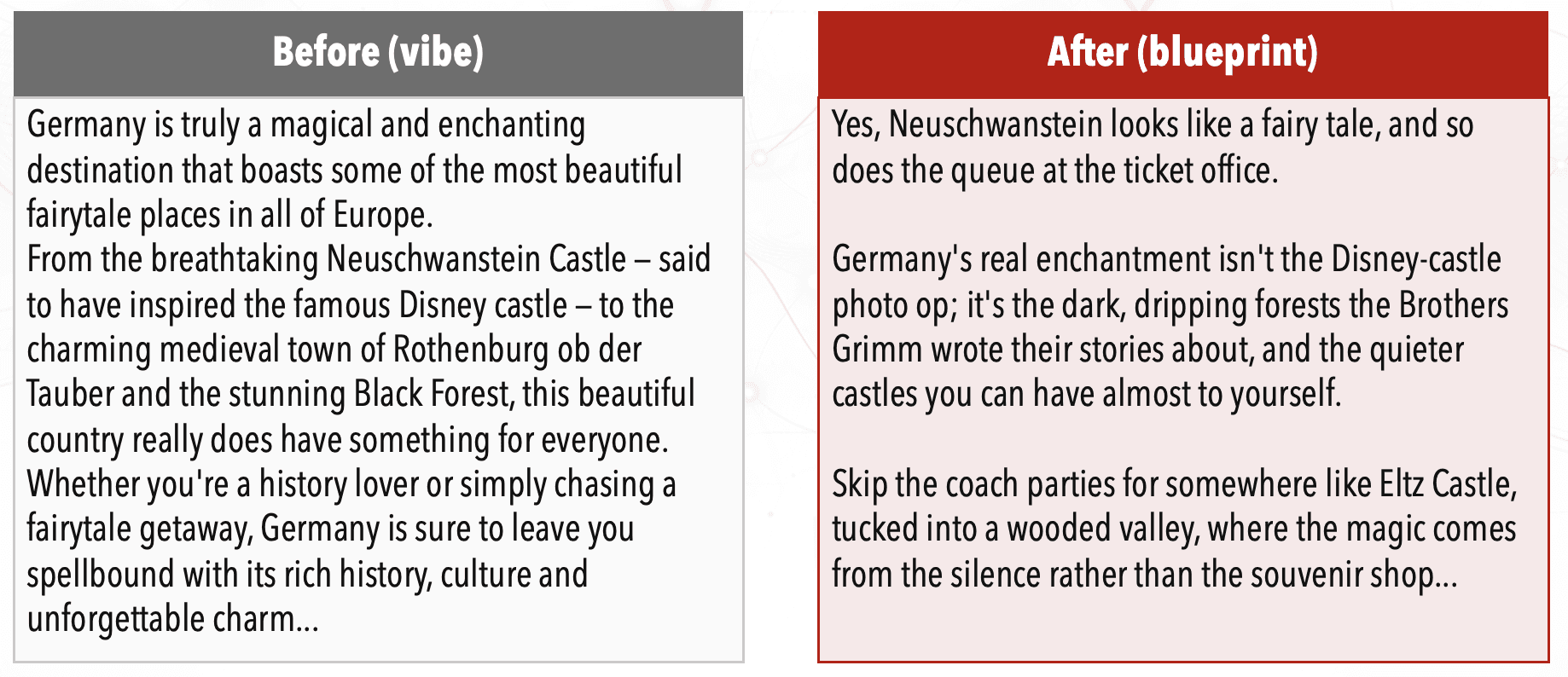
Example of AI Slop intro generated by a single-shot generic prompt vs. the same intro but generated with my master prompt.
The Preamble: six foundations that decide everything
The Preamble is the part most people skip and the part that actually determines the output. It does two jobs before any analysis runs: it primes the model, and it loads the evidence. Six components.
Role (and role priming). The prompt opens by casting the model as an SEO content strategist specializing in dual-surface optimization, digital PR, topical authority and semantic analysis.
This is role priming, and Anthropic is blunt about why it works: setting a role in the system prompt sharpens accuracy on complex tasks and keeps the model inside the bounds of the work. You’re not asking the model to act like a strategist; you’re narrowing which version of itself answers, before the question even arrives.
Context. Here you state the two targets — ranking in organic Google and being cited across AI Overviews, AI Mode and the chat assistants — plus the digital-PR aim of earning links and mentions.
Stating the goal and its constraints up front is the first principle of clear, direct prompting: ambiguity is the leading cause of mediocre output. For Untravel this one paragraph quietly changes what “good” means downstream: extractable, quotable, monosemantic chunks stop being a nicety and become a requirement.
Language Specification Clarification. The framework, every analysis and the brief itself stay in English; only the final article switches to the target language; British English, here.
The split protects strategic precision from translation drift, and it’s written as an explicit rule precisely because spelling the instruction out removes ambiguity the model would otherwise resolve on its own, invisibly.
Content Type Specifications. You pick the format from a fixed menu, and that choice pre-constrains the word-count band, the depth model and the structure. Untravel is a Comprehensive Guide (2,000–3,500 words).
Naming the format rather than leaving the model to infer it is that same clarity principle applied to output shape: “a 2,000–3,500-word guide” steers far better than “an article.”
Content Brief Parameters (mandatory). The non-negotiable inputs: topic and keywords; intent and persona; editorial guidelines; the link strategy. For Untravel:
Primary keyword mystery travel ideas in Europe.
Informational intent; the “Young at Heart” persona (25–40, budget-aware, DIY, atmosphere-seeking).
A lightly ironic British voice that addresses the reader as “you” while keeping the brand in the third person.
Seven internal URLs to place.
These arrive as discrete, labelled fields rather than a paragraph, so the model never mistakes an instruction for a piece of context; exactly the job XML tags and clean separation are built for.
Content Brief Parameters – Reference Section. The evidence layer: documented brand identity and personas, plus the competitive-research files:
The Google SERP exports.
The AI Overviews and AI Mode answers.
The other LLMs answers.
The People Also Ask set.
The AI Mode query fan-out.
If available, the scraped content of the competitors ranking in the first page for the primary keywords.
If available, the Google Web Guide SERPs for the primary keywords.
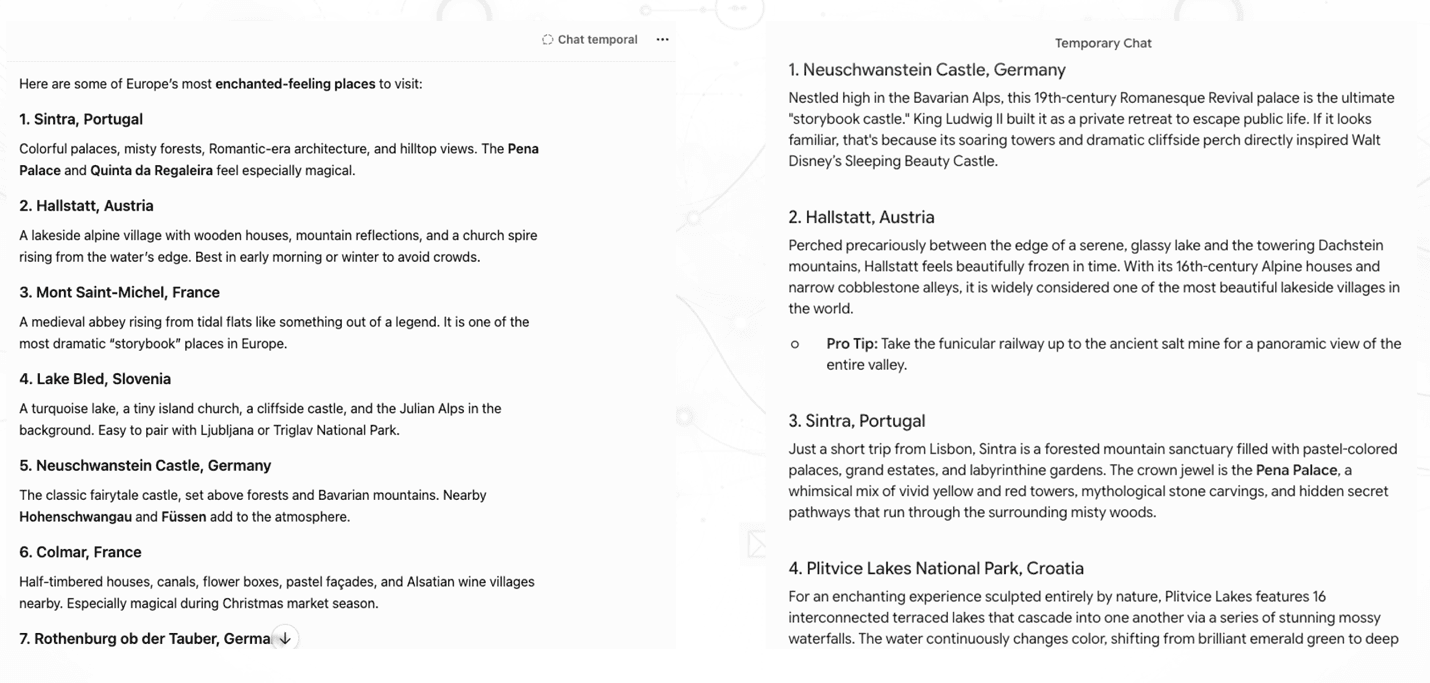
The reason why I recommend using the AI answers as a source for analysis is because they represent the quintessential expression of the Consensus, aka the entity map we must consider but that we must “play” against to for earning distinctiveness through information gain
This is immutable reference material, and the guidance is to load precisely this kind of long-form data as fixed context for the model to work from (long context tips). No reference layer, no discovery; Task 1 is only ever as good as what you put here.
Advanced Web Ranking helps you measure whether the strategy behind your brief actually translated into organic rankings and AI visibility, then use those insights to refine your next brief.
Try Advanced Web Ranking for free and see how your content performs across both traditional search and AI search experiences.
Task 1 — Discovery: the evidence the outline has to cite
Task 1 generates no article copy at all.
It produces the evidence base that every later structural decision has to reference — five analyses run in sequence, the model reasoning its way to a position before committing to one.
That ordering is deliberate: asking the model to work through the analysis step by step, rather than leap to a conclusion, is exactly what chain-of-thought prompting is for on analytical, multi-stage work.
Named Entity Recognition sorts every entity across competitors, SERPs, PAA, query fan out, and AI surfaces into tiers by usage.
For Untravel it surfaced two, plus an unmet practical layer:
Tier | Entity | Competitor usage | Cited by AI? |
|---|---|---|---|
Geo-Saturated | Neuschwanstein (DE) | 8/8 | Yes |
Geo-Saturated | Hallstatt (AT) | 7/8 | Yes |
Geo-Emergent | Faroe Islands (DK) | 1/8 | Yes |
Geo-Emergent | Connemara & the Burren (IE) | 0/8 | Yes |
Practical | Cost / itinerary / car-vs-train | 0/8 | No |
The read: a hyper-saturated famous tier every listicle repeats identically (relevance, zero differentiation), a thin emergent tier surfacing mainly in AI itineraries and long-tail queries, and a practical layer that PAA and fan-out demand but almost no competitor delivers.
Qualitative cosine similarity then measured how alike the ranking pages are, aka structurally and semantically, not by keyword overlap. They proved near-interchangeable, and the saturation table made the opening obvious:
Topic / approach | Header 2 | Header 3 |
|---|---|---|
Famous fairytale-town list | 7/8 | Saturated |
Greek / ancient myth sites | 5/8 | Saturated |
Folklore "why it feels mythical" | 1/8 | Low |
Practical planning (season / cost / transport) | 0/8 | Low |
This is where information gain stops being a slogan. The hybrid strategy writes itself: nod briefly to the famous names for relevance, then pivot hard into the ignored-but-relevant territory — lesser-known twins, folklore narrative and the practical layer — that no ranking page combines.
Competitor strengths/weaknesses confirmed the field wins on polish and loses on sameness. The single low-similarity outlier was an AI-generated itinerary that already modelled the open lane — lesser-known regions, folklore framing, real pacing — proof the position was unoccupied, not unviable.
Strategic recommendations compress all of it into a handful of actionable calls, each citing the section that justifies it.
For Untravel, the lead recommendation was the whole article in a line — skip the crowds, keep the magic: pair every famous anchor with a quieter twin, organised by folklore atmosphere rather than a ranked town list.
Notice what’s happened. By the end of Task 1 the article’s angle, its rejected format, its featured entities and its differentiation mechanism all exist — as evidence-backed decisions, not creative hunches. The outline in Task 2 is no longer an act of imagination; it’s a transcription.
The mandatory stop
None of that transcription happens automatically.
Task 1 ends on a hard stop point — wait for approval before proceeding to Task 2 — and it earns its place.
This is the moment the strategy is still cheap to change: an analyst reads the entity tiers and the saturation calls and can overrule them before they harden into structure. Maybe the emergent pool needs a stronger British anchor; maybe a saturated entity is worth keeping as a deliberate contrast; maybe a competitor’s “weakness” is really a sensible omission.
Refining a finding here costs a sentence. Discovering the same problem after 3,000 words have been built on top of it costs the article.
The stop is where human judgement nuances the machine’s evidence rather than rubber-stamping it, and it’s the first of several deliberate checkpoints the prompt builds in.
Task 2 — Architecture, and the constraints that hold it up
Task 2 turns the approved evidence into an H1/H2/H3 structure — and, more importantly, into the two constraint systems that stop the model drifting back toward the average as it writes.
For Untravel the outline transcribed the Task 1 verdict directly: ten sections organised by folklore atmosphere and region rather than a ranked town list, opening with Scotland as the British-reader hook and moving outward:
What turns an ordinary place into an enchanted one?
Scotland’s mystical isles and lochs
Germany’s enchanted forests, minus the queues
Eastern Europe’s dark folklore and living legends
Greece’s ancient myth landscapes, past the Acropolis
Italy’s pagan Alps and islands of myth
Northern Europe’s North Atlantic otherworld
How to plan a European mystery trip that actually feels magical
Organizing by atmosphere instead of a countdown is the differentiation made structural, aka the format Task 1 rejected, now load-bearing.
But an outline alone is just a floor plan. Two constraint systems turn it into something the model can’t quietly remodel.
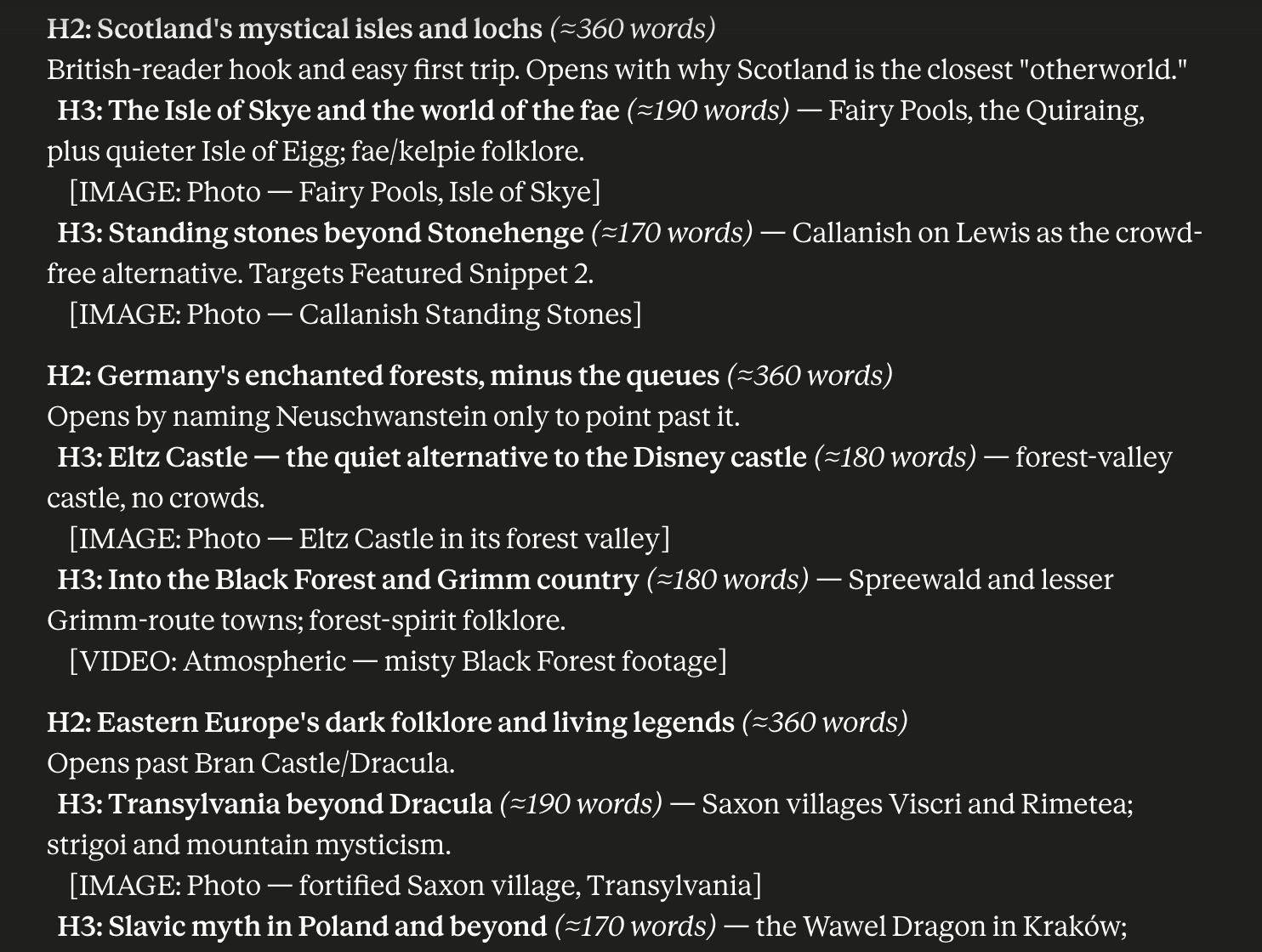
The internal link integration plan
Every URL is mapped to a specific H2/H3, with a primary and an alternative anchor and a one-line rationale, and the mapping is declared mandatory: each link must appear in the final copy exactly as mapped, and if it can’t be placed naturally, the writer flags it rather than relocating it.
Untravel ran seven mapped URLs, one per regional section plus a broad closing CTA; the Scotland section carries Holiday Deals in Scotland, Germany its regional deals, and so on.
Pinning placement matters because link choice is exactly the kind of decision a model will “improve” if left open. Writing it as an explicit, non-negotiable instruction is the be-clear-and-direct principle applied to execution: state the constraint, leave nothing to infer.
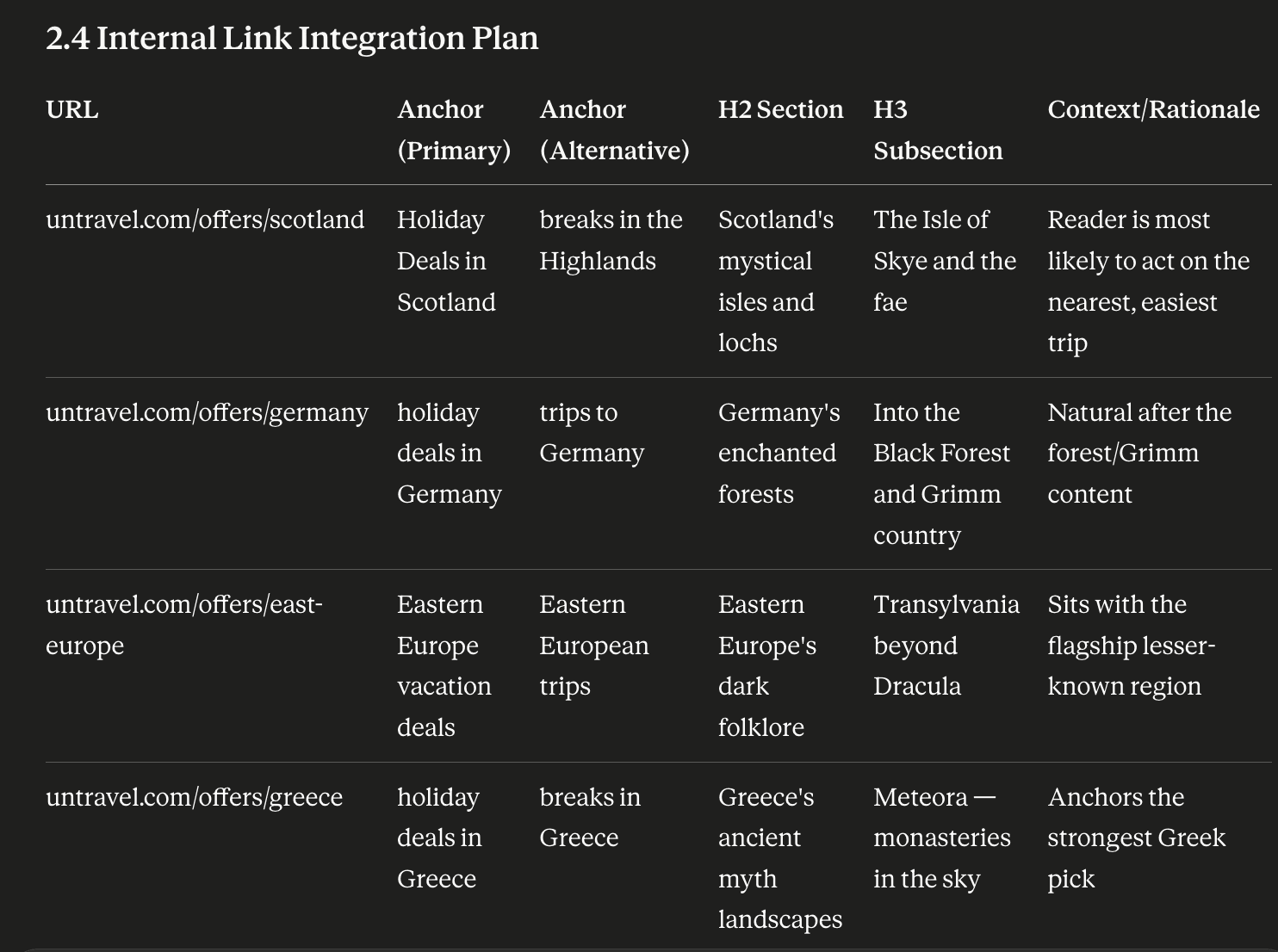
The on-page SEO execution rules: entity salience, not keyword density
This table defines the levers explicitly:
Entity salience.
Information density
Semantic completeness
Lexical variety
Cohesion
User-intent alignment
Natural primary-keyword placement and entity-bearing headers in 60%+ of H2s
Keyword density is absent by design because the framework refuses to encode the myth. However, I found myself obliged to explicitly forbid the use of keyword density because LLMs (every model) resurface it as a zombie due to... training data.
These are the load-bearing walls. The outline is the floor plan; the constraints are what stop the model knocking a wall through because the prose flowed more nicely without it.
And like Task 1, Task 2 closes on its own stop point; structure and constraints signed off before a single word of specification is written.
Advanced Web Ranking helps you measure whether the strategy behind your brief actually translated into organic rankings and AI visibility, then use those insights to refine your next brief.
Try Advanced Web Ranking for free and see how your content performs across both traditional search and AI search experiences.
Task 3 — Specification, and the constraints on the writing itself
Task 3 assembles everything into a single standalone brief, and opens with a distinction worth teaching directly, because it’s where most “AI content” projects blur. Three layers:
The brief is the complete specification: the outline, the entity-distribution map, the link mapping, the SEO rules and the per-section execution prompts, all embedded in one document.
The execution is the modular writing process the brief drives — one section at a time, stop points between, cumulative word-count tracking.
The deliverable is the clean, publication-ready article only: no stop points, no “module complete” markers, no tracking notes.
The principle is one line: readers see the finished building, not the scaffolding. The brief is dense with process; the published piece shows none of it.
The writing constraints embedded here are the ones that most directly suppress slop.
A direct-answer opening, banning the “this section discusses…” throat-clearing. Strategic-only list usage, each list earning its place. Length as non-negotiable — ±10% of target, because depth is a ranking signal and drift is the default failure mode. Accuracy and originality, invent no statistics, mirror no competitor phrasing. And generate directly in British English, never translating from a generic English draft. Each closes a specific door the model would otherwise wander through.
The direct-answer rule is written as a paired example — a rejected “This section discusses…” against a straight statement of the fact — and pairing the wanted output with the unwanted one is precisely how Anthropic recommends steering format, through positive and negative examples.
You can read the result straight off the page. Untravel’s “what makes a place enchanted” section opens: “A place feels enchanted when its stories are still alive in it.” Eleven words, monosemantic, quotable, snippet-ready — the constraint made visible in the prose.
Task 3 ends, like the tasks before it, on the discipline of a clean hand-off: the brief complete, the scaffolding specified, and nothing of the process allowed to leak into what the reader finally sees.
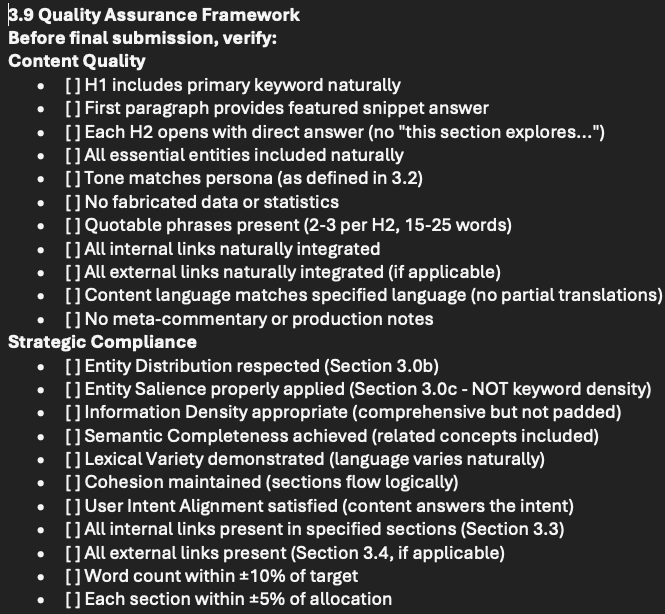
Example of the constraints included in the master prompt for generating new content with AI
Why the prompt runs as a sequence, not a single shot
Everything above only holds because execution is broken into a chain: a prompt to load context, a prompt to confirm the model has read the brief, then one prompt per section with a mandatory stop between each, and never a single “now write the article” request.
The reason is attention. Ask a model to hold discovery, strategy, structure and 3,000 words of prose in one pass, and the constraints agreed at the top compete for attention with the prose being generated at the bottom; by Italy, the salience rules set back at Scotland have quietly lost.
Anthropic’s guidance names the failure directly: when one prompt tries to handle too much, the model drops or mishandles steps, and chaining the work into subtasks gives each one the model’s full attention — fewer errors, and a clean trail to trace when something goes wrong. The trade-off is honest — more calls, more latency; but for a long, constraint-heavy build the accuracy gain is the whole point.
The chain also turns every section boundary into two things at once: a fresh-attention reset and a human checkpoint. This is where the stop points from Task 1 onward payoff: a weak section is caught and rejected before the next is built on top of it, and word count is tracked cumulatively, so drift surfaces at section three rather than at the end.
A final consolidation pass then merges the approved sections and strips the scaffolding.
The payoff is measurable. Untravel’s sections each landed in band — Introduction 221, Scotland 367, Germany 363, Eastern Europe 365, Greece 349, Italy 324 — because each was generated and checked in band, not extracted from a single 3,000-word pour and hoped into shape.
You don’t cast an X-wing in one piece; you build it panel by panel and inspect each join. The succession of prompts is that inspection regime.
Why one multitask prompt beats an orchestrated system of skills
It’s tempting to rebuild a prompt this elaborate as software, aka a set of discrete skills or agents, one per task, wired together by an orchestrator. For this workflow, that’s usually the wrong trade, and it’s worth being precise about why.
The method’s entire value is connective tissue. Task 2’s outline is differentiated because it can see the exact saturation table and entity tiers Task 1 produced; the entity-distribution map works because it inherits both; the constraints encode decisions made three steps earlier.
Run it as a single reasoning chain in one context and all of that is simply present — every task reads the full evidence and every prior decision.
Split it into separate skills and you replace shared context with hand-offs, and each hand-off passes a summary, not the nuance. The connective tissue is exactly what you’d be cutting.
It also keeps the human in the loop where the quality actually comes from. The stop points only matter because a person can read an analysis and overrule it in plain language, with everything downstream inheriting the change. Orchestrated skill pipelines tend to automate those hand-offs and hide them, hence removing the gate where judgement enters. You’d be engineering away the most valuable part.
And there’s a cost-of-complexity argument Anthropic makes directly: the best prompt is the one that hits the goal with the minimum necessary structure, not the most machinery.
A text prompt runs in any chat surface — no build, no hosting, no orchestration layer to version and repair. A skills app is software: it has to be maintained, and it breaks when the surface beneath it shifts. For a strategist producing briefs one at a time, that overhead buys nothing.
The honest boundary: orchestration wins when the goal is scale or autonomy — running the generator across hundreds of topics unattended or wrapping it for non-expert users who can’t supply the judgement at each gate. But that’s the precise trade you’d be making: automating away the human nuance that makes the output differentiated in the first place.
For craft, the single multitask prompt is the right altitude of tooling; for volume, a skills system earns its overhead. Most SEO work that’s trying not to produce slop sits firmly on the craft side.
The brief as source of truth
Strip the method to its core and it’s a single move: make every decision that matters before the writing and record it somewhere the writing has to obey.
Task 1 produces the evidence.
Task 2 turns it into architecture with load-bearing constraints.
Task 3 specifies the prose and hides the scaffolding. The prompt sequence keeps the model honest section by section, and a human gate between each keeps the strategy answerable to judgement.
What you end up with isn’t a cleverer way to ask for an article. It’s a source of truth, and a frozen set of strategic decisions the model executes against instead of improvising around. That single shift is the whole difference between the two outputs this guide opened with.
Hand a model a keyword and it averages the web. Hand it a brief built like this, and it has somewhere specific to stand: a saturated field to sidestep, a gap to occupy, a voice to hold, a length to hit, links to place exactly here and not there.
The Untravel guide is the proof. The same model that, asked cold, returns Hallstatt and Neuschwanstein like everyone else instead produced Eltz Castle, Callanish, the Faroese huldufólk and a Saxon village at dusk — because the brief told it where the magic actually was.
An LLM working against a real source of truth doesn’t write a vibe. It builds a blueprint.

Article by
Gianluca Fiorelli
With almost 20 years of experience in web marketing, Gianluca Fiorelli is a Strategic and International SEO Consultant who helps businesses improve their visibility and performance on organic search. Gianluca collaborated with clients from various industries and regions, such as Glassdoor, Idealista, Rastreator.com, Outsystems, Chess.com, SIXT Ride, Vegetables by Bayer, Visit California, Gamepix, James Edition and many others.
A very active member of the SEO community, Gianluca daily shares his insights and best practices on SEO, content, Search marketing strategy and the evolution of Search on social media channels such as X, Bluesky and LinkedIn and through the blog on his website: IloveSEO.net.