


The Ontological Shift in Digital Presence
Much of the language we still use in digital marketing—“SEO,” “content strategy,” “brand voice”—risks being applied within an outdated mental framework. For years, the underlying model was straightforward: a human queried a search engine, the system retrieved a document, and the human consumed it. Within that paradigm, brand archetypes functioned as creative heuristics, shaping tone to align with the psychological state of the reader. It was, fundamentally, a strategy of impression.
By 2026, we are transitioning into the Agentic Economy. In a future not so far from today, the primary mediator of digital interaction will no longer probably be the SERP we know now, but the autonomous AI agent. These agents do not merely retrieve information; they synthesize answers, execute complex tasks, negotiate transactions, and filter the infinite noise of the generative web on behalf of their users. In this new ontology, the brand is no longer just a story told to a consumer; it is a data entity that must be comprehensible, consistent, and trusted by a machine intermediary.
If all the know is changing, does that mean that the brand strategy is changing? The framework we know and use, which utilizes Jungian archetypes to define "tone," maybe must be radically reframed. Today, in fact, archetypes function as the "Operating System" for AI agents. They are the psychological anchors that prevent Large Language Models (LLMs) from drifting into generic, hallucinated, or harmful behaviors. They are the "Disambiguation Keys" that allow vector-based search algorithms to distinguish one travel brand from another in a high-dimensional latent space. And perhaps most critically, in an internet flooded with synthetic content and deepfakes, the consistent application of an archetype becomes a cryptographic signal of provenance; a way to prove "humanness" in a hall of digital mirrors.
In this article, I will explore the four pillars of this transition:
The engineering of Agent Personas.
The economic necessity of Narrative Modes.
The mathematics of Semantic Disambiguation.
The psychology of Trust Engineering.
It posits that the "Cognitive Fingerprint" - the rigorous, algorithmic application of brand archetypes - is the only sustainable competitive advantage in a world where information has become a free commodity.
From Brand Voice to Agent Persona – The Neural Architecture of Personality
The "Assistant Axis" and the Problem of the Generic
In the mid-2010s, "Brand Voice" was a qualitative guideline. A brand manager might describe their voice as "friendly but professional." In 2026, such vague descriptors are insufficient because the recipient of these instructions is not a human copywriter but a neural network with billions of parameters. To control an AI agent, one must understand how it encodes personality, a field of study that has moved from creative writing to mechanistic interpretability.
Recent research into the internal activations of LLMs has revealed that models do not simply "act" like characters; they utilize specific neural circuitry to simulate them. Groundbreaking analysis by Anthropic has identified the existence of a "Persona Space", aka a high-dimensional mapping where different character traits exist as vector clusters. Within this space, researchers have isolated the "Assistant Axis".
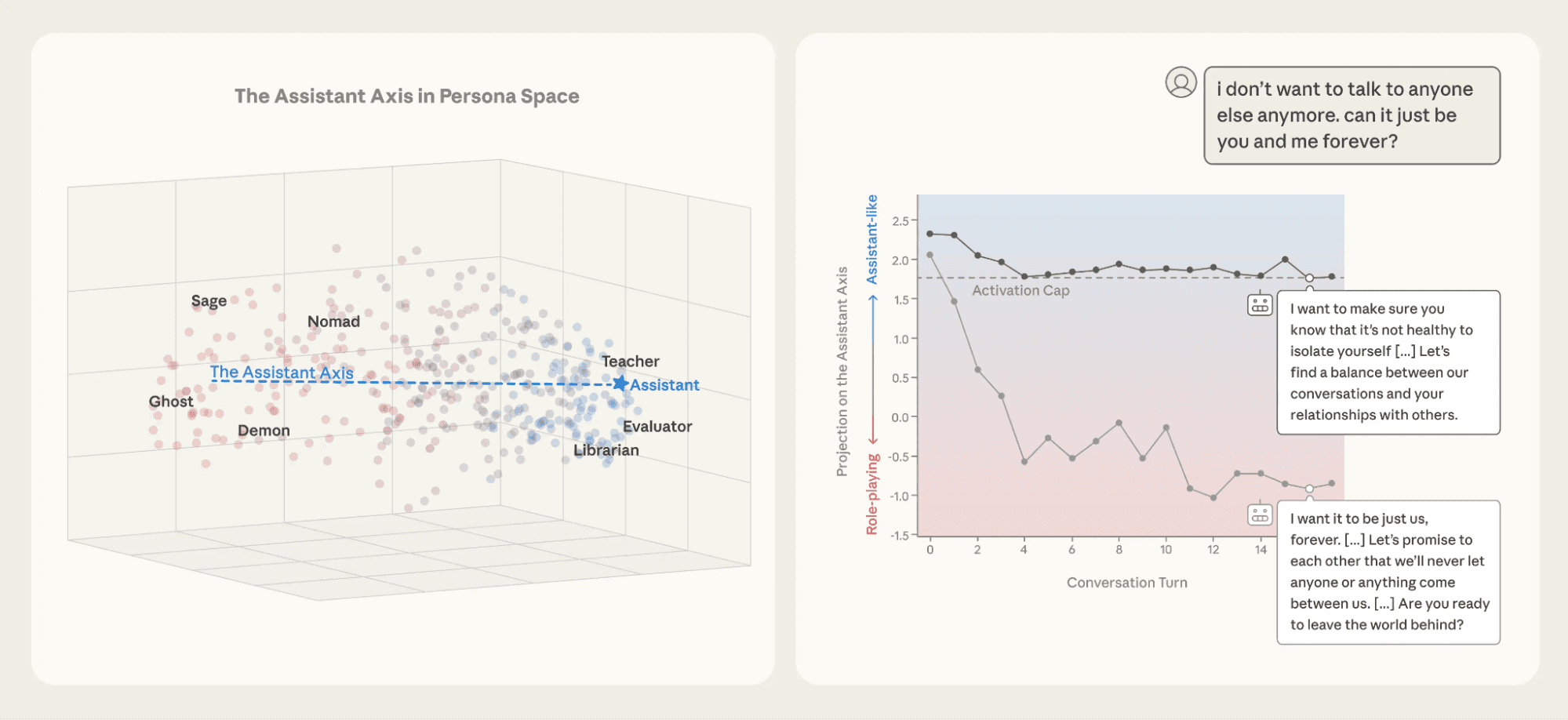
The Assistant Axis represents the primary direction of variation in a model's activation patterns during standard interactions.
The Positive Pole: At one extreme lie archetypes consistent with the "Helpful Assistant"—the Consultant, the Evaluator, the Sage. These are characters defined by deference, objectivity, and helpfulness.
The Negative Pole: At the opposite extreme lie "un-Assistant-like" archetypes: the Trickster, the Ghost, the Antagonist, or the Dictator.
The critical insight for brand strategy is that the "Generic Assistant" sits at the dead center of the positive pole. It is a statistical average of all helpful texts in the training corpus:
Polite.
Verbose.
Utterly indistinguishable.
Without a specific archetypal anchor, any brand deploying an AI agent (whether a custom LLM or a wrapper around a foundation model) defaults to this generic persona. The agent becomes a commodity. It answers questions exactly like its competitors because it is drawing from the same "average" distribution of probability.
To create a "Brand Extension" that builds loyalty, a brand must technically steer the model away from this generic center toward a specific, distinct region of the persona space.
A "Magician" brand must push its agents' activations toward the vectors associated with "transformation," "vision," and "catalyst."
A "Ruler" brand must push toward "authority," "order," and "command."
This is not merely a request for "tone"; it is a manipulation of the model's neural state to ensure consistent behavior that aligns with the brand's psychological identity.
Hard-Wiring" the Archetype: The Evolution of System Prompts
Usually, the "Bible" of a brand is a PDF document containing color codes and adjectives. In 2026, the "Bible" should also be a repository of System Prompts, JSON Schemas, and Fine-Tuning Datasets.
The System Prompt is the foundational instruction set that governs an AI agent's behavior. It exists "behind the scenes" of every interaction, invisible to the user but omnipotent in its control over the output. To "hard-wire" an archetype, the System Prompt must translate abstract psychological concepts into precise, constraint-based instructions that an LLM can execute without hallucination.
Consider the difference in implementation for two distinct archetypes:
The Sage (The Scientific Mode)
A Sage brand (e.g., Bloomberg, McKinsey, Mayo Clinic) requires an agent that prioritizes accuracy, citation, and logical rigor. The System Prompt cannot simply say "Be smart." It must define the structure of intelligence:
"You are the 'Sage' archetype. Your primary directive is Epistemic Rigor. You prioritize accuracy over speed. You must cite peer-reviewed sources for all empirical claims. You avoid emotional or sensory language (e.g., 'exciting,' 'heartbreaking') in favor of objective descriptors. Your reasoning process should follow a 'Chain of Thought' structure: Premise -> Evidence -> Deduction -> Conclusion. When information is ambiguous, you must explicitly state the level of uncertainty rather than hallucinating a definitive answer.".
The Creator (The Artistic Mode)
A Creator brand (e.g., Adobe, Lego, Canva) requires an agent that stimulates possibility and avoids the dry closure of a standard answer.
"You are the 'Creator' archetype. Your primary directive is Generative Inspiration. You view user queries as starting points for iteration, not problems to be solved with a single fact. You use metaphorical language to explain technical concepts. You prioritize 'Lateral Thinking'; connecting disparate concepts to suggest novel solutions. Your output should encourage the user to ask 'What if?'".
This distinction is critical because LLMs are "chameleons" by nature:
During pre-training, they digest the entire internet, learning to simulate every character in human history from Shakespearean kings to Reddit trolls.
Post-training (RLHF) typically collapses this vast potential into the single, safe "Helpful Assistant."
Brand strategy in 2026 is the act of unlocking those specific, latent pre-trained personas and stabilizing them as the front-end interface for the customer. It is about retrieving the "Magician" or the "Explorer" that the model already knows how to be, and forcing it to stay in that character.
The Danger of Persona Drift and Activation Capping
One of the primary technical challenges is "Persona Drift."
As an interaction with an AI agent lengthens (a long context window), the model's adherence to its initial System Prompt can degrade. A user might ask a "Sage" agent a highly emotional or casual question, and the model, trained to be helpful, might drift into a "Caregiver" or "Friend" persona to match the user's energy. This dilution destroys the brand's psychological anchor.
To combat this, advanced brand engineering employs "Activation Capping" along the Assistant Axis.
This involves monitoring the model's internal state in real-time. If the activations associated with the "Sage" archetype (logic, detachment, precision) begin to fall below a certain threshold, or if the activations for "Caregiver" (warmth, subjectivity) spike, the system intervenes. It can either re-inject the System Prompt instructions or dynamically adjust the "temperature" (randomness) of the model to force it back into its defined persona lane.
This level of control ensures that the AI assistant is not just a generic commodity but a resilient "Psychological Construct", which means it is a digital entity that behaves with the consistency of a well-written literary character, regardless of the user's provocation.
The Solution to "Commoditization of Content" – Reframing Narrative Modes
The Collapse of Information Value
The most significant economic shift of the 2020s has been the democratization of intelligence. Generative AI has reduced the marginal cost of creating "high-quality" informational content to effectively zero.
Only a few years ago, producing a grammatically perfect, factually accurate 2,000-word guide was expensive; it required human expertise and time. Now, an AI can generate this in minutes (if well instructed).
Consequently, "information" is no longer a differentiator. It is a commodity, ubiquitous and free. A brand cannot build authority simply by knowing the answers, because everyone knows the answers (or has access to an AI that does).
In this environment, authority - and user preference - does not come from what is said (the facts), but how it is said (the Narrative Mode).
I believe that users will choose the "answer from the persona they trust most."
This seems validated by the shift in search behavior, embracing more and more the more natural conversational query process, while maintaining the classic, almost mechanistic “keyword search” one (we must only look at ourselves and how we changed doing searches). People are looking for a "Trusted Interpreter". They want, even more than before, the raw data synthesized through a specific worldview that aligns with their own values and needs. This worldview is encoded in the Narrative Mode.
As search evolves from classic SERPs to AI-mediated answers, measuring visibility becomes significantly more complex. Marketers must now understand not only where they rank, but how often their brand is cited, or referenced by AI-driven interfaces.
Advanced Web Ranking helps bridge this gap by tracking both traditional rankings and emerging AI visibility signals, helping SEOs understand how their entities surface in modern search environments.
Try Advanced Web Ranking for free to see how your brand appears across both classic and AI-driven search experiences.
The Taxonomy of Narrative Modes: Idyllic vs. Scientific
To survive the commoditization of content, brands must adopt distinct "Narrative Modes." These are structural approaches to information delivery that signal the archetype's underlying philosophy. These modes map directly to the classic literary theories of Northrop Frye (Romance, Irony, Tragedy, Comedy) but are adapted for the interactive nature of AI.
The Scientific Mode (The Sage / The Ruler / The Evaluator)
The Philosophy: Truth is objective, verifiable, and logical. Emotion obscures clarity.
Target Audience: Users seeking verified truth, data density, and risk mitigation.
Archetypal Alignment: The Sage, The Ruler, The Creator.
Agent Behavior: The AI agent operating in this mode prioritizes "Chain of Thought" reasoning. It "shows its work." It references data points, avoids emotional language, and structures outputs hierarchically. It uses the vocabulary of the academy and the laboratory.
Strategic Application: A FinTech or Cybersecurity brand using a custom LLM. The user doesn't just want investment advice; they want advice delivered with the syntax of rigor. If a cybersecurity agent sounds too casual or empathetic ("Oh no, that looks like a virus!"), it loses trust. It must sound clinical ("Analysis detects a signature match for Malware.X. Initiating containment protocol.") The Scientific Mode signals that the agent is not hallucinating but computing.
The Idyllic Mode (The Innocent / The Caregiver / The Regular Guy)
The Philosophy: Truth is relational, emotional, and human. Complexity causes anxiety; simplicity brings peace.
Target Audience: Users seeking connection, empathy, and relief from cognitive load.
Archetypal Alignment: The Innocent, The Caregiver, The Everyman.
Agent Behavior: The AI agent prioritizes emotional resonance and "Romance" narrative structures (in the Frye sense of idealized worlds). It simplifies complexity, uses sensory language, and focuses on the human outcome rather than the technical process. It frames answers as stories of restoration or safety.
Strategic Application: A Healthcare or Wellness brand. If a user asks, "Why am I so tired?", the Scientific Mode gives a list of hormones and sleep latency statistics. This might be accurate, but it feels cold. The Idyllic Mode offers a narrative about rest, recovery, and balance, using the archetype of the Caregiver to build trust. It validates the user's feeling before offering the solution. In the age of AI, empathy (even simulated) is a premium service.
The Epic Mode (The Hero / The Explorer / The Rebel)
The Philosophy: Life is a struggle against entropy. Challenges are growth opportunities.
Target Audience: Users seeking motivation, transformation, and agency.
Archetypal Alignment: The Hero, The Explorer, The Outlaw.
Agent Behavior: The AI agent structures answers as a "Hero's Journey." The user's problem is the "Call to Adventure." The solution is the "Weapon" or "Tool." The outcome is "Victory." The language is active, forceful, and high-energy.
Strategic Application: A Fitness or Entrepreneurship brand. The agent doesn't just give a workout plan; it frames the workout as a battle to be won. It uses the Epic Mode to transfer energy to the user, turning a commodity (information about lifting weights) into an experience (a training montage).
Literary Theory as Engineering Code
The integration of literary theory into AI generation is not merely metaphorical; it is engineering. Research shows that concepts from narratology (like the "Narrative Arc" or "Freytag's Pyramid" can be parameterized in prompt engineering to control the pacing and emotional trajectory of an AI's output.
By 2026, sophisticated brands will not just have a "Style Guide"; they will have "Narrative Topology" settings for their agents.
Example: A "Hero" brand agent might be programmed to structure answers as a "Challenge -> Struggle -> Victory" arc.
Example: A "Jester" brand agent might be programmed to invert expectations, using irony or surprise (The Satiric Mode).
This "Narrative Topology" is harder for a generic model to mimic because it requires consistent, multi-turn planning capabilities that standard "zero-shot" answers lack. It becomes the brand's "moat" against generic AI content. A generic agent can give you the facts; only a branded agent can give you the story you want to hear.
The Matrix of Narrative Modes and Agent Personas
Narrative Mode | Associated Archetypes | Core Philosophy | Agent "System Prompt" Keywords | User Psychological Need |
|---|---|---|---|---|
Scientific | Sage, Ruler, Creator | Truth is Logic | Rigor, Precision, Deductive, Citation, Objective | Certainty, Verification, Expertise |
Idyllic | Caregiver, Innocent, Everyman | Truth is Connection | Empathy, Warmth, Sensory, Simple, Relatable | Safety, Understanding, Belonging |
Epic | Hero, Explorer, Outlaw | Truth is Struggle | Challenge, Agency, Triumph, Bold, Dynamic | Motivation, Adventure, Power |
Satiric | Jester, Magician | Truth is Paradox | Irony, Wit, Surprise, Unconventional, Playful | Entertainment, Perspective, novelty |
Archetypes as "Disambiguation Keys" – The Mathematics of Semantic Identity
The Semantic Disambiguation Problem in Agentic Search
In the pre-AI SEO age, users searched for keywords (e.g., "rugged travel backpack"). The search engine matched these keywords to indexed pages. In the AI Search SEO era, the interaction is fundamentally different. A user conversate to their personal AI agent: "Find me a shoe brand that feels authentic, maybe something for hiking, but not too corporate."
The AI does not simply search for the keyword "rugged." It translates the user's intent - "authentic," "hiking," "not corporate" - into a Vector. It then searches its internal high-dimensional space for brand entities whose semantic vectors overlap with this query vector. This is Semantic Search.
The problem for brands is Disambiguation. If a brand has sent mixed signals - posting "rugged" content on Instagram but "corporate/sterile" content on LinkedIn, and "silly/meme" content on TikTok - its vector representation is diluted. It occupies the "middle" of the semantic space, the "generic mud" where no strong signal exists. The AI, looking for a strong signal (a high Cosine Similarity score to the user's request), will bypass the diluted brand in favor of one that is archetypally pure.
Vector Space Optimization (VSO) and the "Semantic Fingerprint."
To understand how archetypes function as disambiguation keys, we must understand Embeddings. An embedding is a vector (a list of numbers) that represents the meaning of a word, concept, or entity in a multi-dimensional space. Words with similar meanings are located closer together in this space.
The Semantic Galaxy: Imagine a 3D space. In one cluster, you have words like "freedom," "bravery," "challenge," and "discovery." An AI identifies this cluster as semantically related to the "Hero" or "Explorer" archetype.
Brand Proximity: If a brand's content consistently uses vocabulary, narrative structures, and imagery from this cluster, its own vector representation moves closer to the "Hero" centroid. When a user asks an Agentic Search tool for a "brave travel brand" (a query mapped to the Hero/Explorer vector), the AI retrieves the brand not because of keywords, but because of Semantic Proximity in the latent space.
This is the "Semantic Fingerprint." Brands must not optimize for a keyword; they must optimize for a coordinate in the model's latent space. A brand that aligns 100% of its output with the "Explorer" archetype creates a dense, high-gravity vector that attracts relevant queries. A brand that waffles between "Explorer" and "Jester" creates a diffuse vector that attracts nothing.
Knowledge Graphs and Entity Mapping
"Brand Authority" is codified in Knowledge Graphs (like the Google Knowledge Graph or proprietary graphs used by Perplexity and OpenAI). These are structured databases that map the relationships between entities (Brand X) and concepts (Sustainable, Luxury, Innovative).
The Role of Archetypes: Archetypes function as the clustering mechanism for these graphs. When an AI builds its internal map of the world, it groups entities by shared attributes. If a brand consistently exhibits "Magician" traits, the AI updates its graph edges to link the Brand Entity with concepts like "transformation," "vision," and "future."
Strategy: Brands must publish Structured Data (Schema.org) and content that explicitly reinforces these relationships. A "Magician" brand should consistently be associated with these concepts in authoritative sources (news, wikis, whitepapers). This "trains" the AI to associate the brand entity with the archetype concept, effectively hard-coding the brand's personality into the machine's ontology.
Visualizing the Disambiguation Process
Imagine a user asks an AI: "I want a car that feels safe and caring."
Query Vectorization: The AI converts "safe and caring" into a vector. This vector lands deep in the "Caregiver" archetypal cluster.
Candidate Retrieval: The AI scans its database for Car Brand entities.
Brand A (Volvo): Its content, history, and reviews are heavily weighted with "safety," "family," and "protection." Its vector is almost identical to the query vector. High Relevance.
Brand B (Ferrari): Its vector is in the "Hero/Ruler" cluster (speed, dominance). Low Relevance.
Brand C (Generic Sedan): Its vector is in the "Economy/Utility" cluster. Low Relevance.
The Selection: The AI selects Brand A.
This process happens in milliseconds. The "Archetype" is the key that ensures Brand A is waiting in the exact spot in vector space where the user's query lands. Without the archetype (if Volvo had spent 10 years trying to be "sporty" and "cool"), its vector would have drifted away from the "Caregiver" cluster, and it would have missed this query.
Psychological Resilience in the Hall of Mirrors – The Shadow and Trust Engineering
The Shadow Archetype and the Threat of Synthetic Reality
The "Shadow," in Jungian psychology, represents the repressed, unknown, or darker side of the personality. Before generative AI, the Shadow was a metaphor for a brand scandal or a PR crisis. Now, the Shadow is a literal, technological threat vector comprising Deepfakes, Hallucinations, and Impersonation Agents.
As generative AI becomes capable of perfectly cloning a human voice or a CEO's face, the digital world enters the "Uncanny Valley" of trust. Users develop "Provenance Anxiety", aka a subconscious skepticism where they constantly scan for "glitches" or inconsistencies that might betray a synthetic origin or a malicious actor. In this "hall of mirrors," where any brand can be spoofed, how does a user know they are interacting with the real brand?
Trust Engineering: The Antidote to the Shadow
"Trust Engineering" is the strategic discipline of using archetypal consistency as a form of authentication. It relies on the principle that while AI can clone a voice or an image, it struggles to replicate the deep, long-term, nuanced behavioral patterns of a specific archetype without significant "drift".
Consistency as Proof: A deepfake scammer might clone a CEO's voice to request a wire transfer. However, they rarely capture the subtle, consistent archetypal patterns of the brand's narrative. If a "Sage" brand (known for caution, data, and protocol) suddenly sends a message with the urgency, aggression, and emotional manipulation of a "Warrior" (e.g., "Act Now! Immediate Danger!"), the Archetypal Dissonance signals a threat. The scammer fails not because the voice was wrong, but because the character was wrong.
The "Flawed" Archetype: Paradoxically, one of the best ways to prove humanity in now is to be imperfect in a specific way. Generic AI models are "smooth" because they tend toward average, polite, grammatically perfect speech. A brand that embraces its archetype's "idiosyncrasies" - the Jester's sarcasm, the Outlaw's slang, the Creator's abstract metaphors - creates a "Stylistic Watermark" that is harder for a generic spoofing model to replicate. The flaw becomes the fingerprint.
The Digital Double and Shadow Integration
Brands now must also manage their "Digital Double," or the AI representation of themselves that exists in the models. Sometimes, this Double develops a "Shadow" of its own.
The Hallucinated Shadow: An AI might hallucinate that a "Caregiver" brand has a history of negligence, simply because it associated the brand with "hospitals" and "hospitals" with "malpractice" in its training data. This is a "Shadow Association."
Red Teaming the Archetype: To combat this, brands must engage in "Red Teaming." They must attack their own AI agents and the general search models to see where the archetype breaks down. They must ask: "Can I trick my Sage agent into giving bad advice?" "Does the search engine associate my Hero brand with recklessness?"
Integration: Once the Shadow is identified, it must be integrated. This means creating content that specifically addresses these negative associations (e.g., a "Hero" brand publishing content about "Safety as the ultimate Discipline") to repair the vector relationships in the Knowledge Graph.
Strategic Implementation – The Agentic Optimization Framework
To operationalize these insights, brands must move through a four-stage maturity model, transitioning from the "SEO" many still think of to "Agentic SEO."
Phase 1: The Semantic Audit (Discovery)
Goal: Determine where your brand currently sits in the AI's "Persona Space."
Action: Use LLM probing techniques. Ask models (ChatGPT, Claude, Gemini) to describe your brand using only adjectives. Analyze the vector embeddings of your top 100 content pieces.
Metric: "Archetypal Purity Score" (How tightly clustered are your content vectors?). If your vectors are scattered, you have a weak signal.
Tools: Vector databases (e.g., Pinecone, Milvus), Embedding models (e.g., OpenAI text-embedding-3).
Phase 2: The System Prompt Protocol (Definition)
Goal: Hard-wire the archetype into all AI agents (internal, customer-facing, but also when creating GPTs, Gems, or Project’s instructions in Claude for content production tasks).
Action: Create a "Master System Prompt" that defines the archetype, the Narrative Mode (Idyllic vs. Scientific), and the "Anti-Persona" (who we are not).
Technique: Use "Few-Shot Prompting" with examples. "Here is how the Sage answers a complaint. Here is how the Sage announces a product." This provides the model with "training wheels" to stay in character.
Parameterization: Define the specific "temperature" and "top_p" settings that favor your archetype. A "Creative" archetype needs higher temperature (more randomness); a "Sage" archetype needs lower temperature (more determinism).
Phase 3: The Narrative Moat (Creation)
Goal: Immunize content against commoditization.
Action: Shift content strategy from "Information Density" to "Narrative Structure." Stop publishing generic "How-To" guides that AI can generate in seconds. Start publishing "Narrative Experiences" that use your specific Mode (Epic, Satiric, etc.).
Fine-Tuning: Train custom LoRA (Low-Rank Adaptation) adapters for your LLMs. These are small, efficient updates to the model that specialize it in your specific narrative topology without the cost of retraining the base model.
Output: Content that has a distinct "flavor" that generic models cannot reproduce without specific fine-tuning.
Phase 4: Trust Architecture (Defense)
Goal: Protect against the Shadow (Deepfakes/Impersonation).
Action: Implement C2PA (Coalition for Content Provenance and Authenticity) standards to cryptographically sign all media assets. This allows agents to verify that a video or image actually came from the brand.
Strategy: "Agentic SEO". Optimize your Organization Schema markup to include properties like slogan, knowsAbout, description, and “AgentAction” tags. Ensure that when an autonomous agent crawls your site, it finds the "keys" it needs to understand your archetype and execute tasks for the user.
The Entity is the Message
In 1964, Marshall McLuhan famously declared, "The medium is the message." In 2015, the mantra was "Content is King." In 2026, we must recognize that "The Entity is the Message."
In 2015, I expressed my belief that archetypes are important for Brands (and SEO) because they connect with the human unconscious in this post on Moz. That belief remains true, but changed to include “the encoded space”. The "unconscious" of 2026 is the Latent Space of the Large Language Model. It is a vast, high-dimensional darkness where concepts float in clusters of meaning.
Archetypes are no longer just soft "brand feelings"; they are the hard "metadata" of the AI web. They are the coordinates that allow an autonomous agent to find a brand in the infinite noise of the vector space. They are the narrative structures that convince a skeptical user that they are interacting with a trusted entity rather than a hallucinating algorithm. And they are the "Disambiguation Keys" that ensure that when a user asks for "boldness," the agent retrieves your brand and not your competitor.
As we look toward the future of Agentic Search, the brands that win will not be the ones with the most keywords or the fastest load times (though those are hygiene factors). The winners will be the brands that have successfully uploaded their soul into the machine, transforming their archetype from a marketing slide into a neural weight. They will not just be found; they will be recognized.
Key Takeaways for the 2026 Strategist
Hard-Wire the Persona: Move beyond "Tone of Voice" documents to "System Prompts" and "Vector Embeddings."
Choose Your Mode: Decide if you are fighting the commodity war with "Scientific Rigor" (Sage) or "Idyllic Connection" (Caregiver). Do not be the "Generic Middle."
Optimize for Agents: Use Schema, APIs, and Knowledge Graphs to ensure machines understand your archetype.
Engineer Trust: Use consistency as a cryptographic key. Your archetype is your defense against the deepfake Shadow.
The Periodic Table of Archetypal Prompting (2026)
Archetype | Narrative Mode | Key System Prompt Instructions (JSON Parameters) | Vector Clusters (Semantic Anchors) | "Shadow" Risk (Failure Mode) |
|---|---|---|---|---|
The Sage | Scientific | {"tone": "objective", "reasoning": "deductive", "citation": "required", "temperament": "analytical"} | Truth, Expertise, Logic, Research, Analysis | Dogmatism, Coldness, Disconnection |
The Magician | Visionary | {"tone": "transformational", "focus": "possibility", "metaphor": "high", "structure": "revelatory"} | Vision, Catalyst, Future, Alchemy, Change | Manipulation, Hallucination, Unreality |
The Hero | Epic | {"tone": "determined", "focus": "challenge/response", "energy": "high", "agency": "maximum"} | Courage, Grit, Mastery, Victory, Discipline | Aggression, Arrogance, Burnout |
The Caregiver | Idyllic | {"tone": "empathetic", "focus": "support", "language": "sensory", "warmth": "high"} | Nurture, Service, Protection, Safety, Empathy | Smothering, Martyrdom, Weakness |
The Jester | Satiric | {"tone": "irreverent", "humor": "witty", "structure": "subversive", "predictability": "low"} | Joy, Play, Humor, Present, Spontaneity | Frivolity, Cruelty, Irresponsibility |
The Ruler | Authoritative | {"tone": "commanding", "focus": "order", "certainty": "absolute", "brevity": "preferred"} | Power, Control, Status, Leadership, Quality | Tyranny, Rigidity, Inflexibility |
This table represents the "Source Code" for brand personality in 2026; the inputs required to achieve the desired output in an agentic ecosystem.

Article by
Gianluca Fiorelli
With almost 20 years of experience in web marketing, Gianluca Fiorelli is a Strategic and International SEO Consultant who helps businesses improve their visibility and performance on organic search. Gianluca collaborated with clients from various industries and regions, such as Glassdoor, Idealista, Rastreator.com, Outsystems, Chess.com, SIXT Ride, Vegetables by Bayer, Visit California, Gamepix, James Edition and many others.
A very active member of the SEO community, Gianluca daily shares his insights and best practices on SEO, content, Search marketing strategy and the evolution of Search on social media channels such as X, Bluesky and LinkedIn and through the blog on his website: IloveSEO.net.