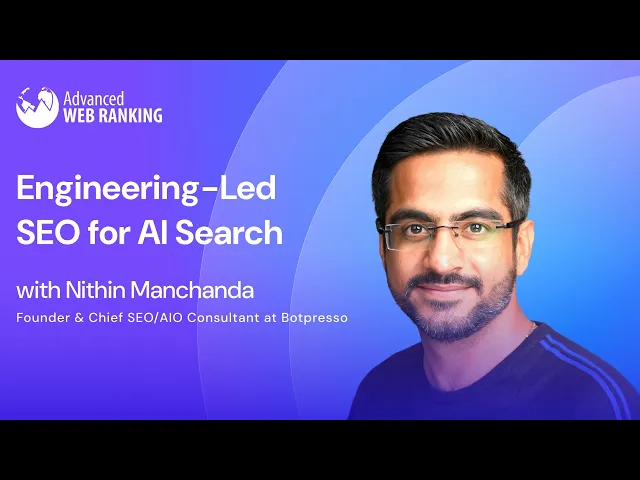
You’re listening to The Search Session. I’m Gianluca Fiorelli. My guest is Nitin Manchanda, an international SEO expert, based in Germany.
We discuss engineering-led SEO, working with developers, and adapting agency services as search changes. We also explore international SEO, programmatic content, building SEO solutions at scale, and the shift from earning search visibility to being selected by AI agents.
What you’ll learn in this session:
How client mindset and SEO foundations shape AI search growth: committed clients who look beyond quick wins can build visibility across SEO and AI search with accessible, discoverable, well-structured content.
What helps an agency adapt and keep growing in the AI era: agencies can identify underlying issues, fill capability gaps in content, technical SEO, or link building with proven expertise, and scale without compromising quality.
What helps SEOs collaborate better with developers: SEOs can build trust by understanding technical constraints, explaining SEO work in terms of architecture, effort, cost, prioritization, and impact, and testing practical solutions with developers.
How AI-powered internal linking balances link equity and semantic relevance: it uses page similarity and business value to find opportunities, then applies contextual anchors, human review, and ongoing measurement.
Why backlink evaluation now goes beyond links in AI search: it considers relevance, referral traffic, mentions, and citations alongside links and DR/PR metrics.
How to make international content work in the AI era: brands can adapt content to local search intent, culture, and user needs, using local SERP data and scalable workflows with native-speaker reviews.
What separates useful programmatic SEO from scaled content abuse: pages built around real search intent and unique product data, with helpful features and a gradual, technically sound rollout.
What Nitin is most intrigued to explore: agentic commerce—how to help AI agents find products and complete purchases on e-commerce sites.
Listen, learn, and expand your perspective through Nitin’s experience.
Topics covered: agency growth · engineering-led SEO · developer collaboration · internal linking · backlinks and digital PR · international SEO · programmatic SEO · crawlability · agentic commerce
About the Guest

Nitin Manchanda
Founder and Chief SEO/AIO Consultant at Botpresso
Nitin Manchanda began his career as a software engineer and moved into SEO early on. He has about 14 years of experience and is known for technical, international, enterprise, and AI-driven SEO, using engineering and automation to solve complex search challenges and grow organic visibility.
He founded Botpresso in 2021 as an independent freelance venture focused on technical excellence and measurable, sustainable growth. He leads client engagements and SEO roadmaps for startups and established brands in e-commerce, SaaS, and travel. In January 2026, Botpresso brought GrowthSRC Media into the agency through an acqui-hire, adding expertise in content, digital PR, and link building.
Nitin is also an international speaker, presenting at SEO conferences around the world, and regularly publishes articles on Botpresso’s blog.
Video Chapters
Transcript
Full conversation between Gianluca Fiorelli and Nitin Manchanda.
Gianluca Fiorelli: Hi, I'm Gianluca Fiorelli. Welcome back to The Search Session. Today, we are going to have an SEO—let me try to be creative—hero and an SEO from two worlds, a mix of India and Europe, because our guest has been living in Europe for many, many years, and maybe in the most European country of all Europe, which is Germany.
Jokes apart, he is one of my friends. I'm biased. He's a friend of mine, but you're surely going to recognize our guest as one of the most influential people in SEO. He's the founder and chief SEO/AIO consultant at Botpresso. Last year, his agency won one European and one global search award, which is a testament to the quality of work. He also worked for Flipkart, Trivago, Omio, and wonderful clients—the clients that we would always love to have. Our guest today is Nitin Manchanda. Hey, Nitin. How are you doing?
Nitin Manchanda: Hey, Gianluca. Thank you so much for having me. Loved that introduction. Nobody ever introduced me like this, but I'll take that. Half Indian, half European, yes.
Gianluca Fiorelli: Yes, yes. How many years have you been living here in Europe?
Nitin Manchanda: I'm completing my 10 years in a couple of months. That's more than 70% of my professional life. So, you rightly put it.
Gianluca Fiorelli: Yes. And sincerely... I have known you for many years…
Nitin Manchanda: For 11 years.
Gianluca Fiorelli: … but I never heard you talking in German. The next time, I will ask you, because it's somehow like asking me to talk in Spanish. I don't know if you've ever heard me talking in Spanish, in a language that is not English, which is what we use every time. So, Nitin, how is SEO treating you lately?
Nitin Manchanda: Was that again?
Gianluca Fiorelli: How is SEO treating you lately?
Nitin Manchanda: Oh, lovely. I'm loving this AI wave, and I think there is much more to do. The good part is that the foundation is still the same, which we have been practicing for years and years. But thankfully, now everyone cares about it more, right? You talk about technical SEO, and everyone is like, "Hey, is that related to GEO, AIO, AI, or whatever?" When you say yes, you get all the support, right? So I think it's beautiful. I'm loving this.
And AI has given you wings, right? Whatever you want to do, you can do it at a much faster pace, which means you have more time for yourself to do stuff that you always wanted to do. So I am totally loving it.
How Client Mindset Shapes Growth in AI Search
Gianluca Fiorelli: Yes, well, I'm glad to hear this from you because, indeed, there is this enthusiasm. But sometimes, also in past episodes, I hear or feel a sort of fear about the evolution of search, especially about the uncertainty of everything we have been living through for four years now, and especially in the last two years. I'm glad to hear this enthusiasm from you, not just as an SEO, AIO, GE, or whatever you want to call yourself, practitioner, but also as an agency founder.
Nitin Manchanda: Yes.
Gianluca Fiorelli: And, I must be honest, we all know a lot of other agency founders, agency CEOs, or people with high responsibility in agencies, and we understand that many agencies are also struggling with this situation.
I have a question I probably wasn't going to ask you, but I think it's important. From your experience on the agency side, what is the best way for an agency to tackle and surf this new situation created by the eruption of AI in search?
Nitin Manchanda: Well, we also see a lot of fluctuation. There are brands, especially younger brands, that are a bit skeptical about what will happen, right? A lot of brands, especially micro-SaaS, are struggling big time. Publishers are almost gone, right? So there is a lot of skepticism in the market about whether it is working or not.
But if you look at serious brands, in the last 12 months, we got a lot of prospects. They reached out to us and said, "Hey, we want to be the front runners of GEO." That is where the conversation started. Then we started working with them. We are still working with them, and they're not just growing tremendously in AIO, AEO, and GEO, but also in SEO because the foundation is the same.
Of course, we also lost some clients along the way. These were brands that were skeptical and rather early-stage startups that were very impatient, I would say. They wanted to see results now, and any movement in the SERP bothered them.
I think it depends a lot on the mindset: how you think about search. If you're just following the news and SEO is one of the checkboxes in your marketing strategy, probably you would take a step back. But if you're serious about it and understand how it works, you would invest more in that.
It's also very important to understand that whether we're talking about traditional Google, those 10 blue links, or chatting with ChatGPT, Claude, or whatever, you have a machine pulling content from your website. But does it know what to extract? Does it know where this content is? Of course, machines can understand much better, as you can see. But you need a layer of SEO and AIO understanding: how they would understand your website. Everything in technical SEO plays a huge role there. You want to make sure that you not only have amazing content on your website, but that your content is also accessible. If it's hidden behind some JavaScript, crawlers would not be able to see it. That's very important to expose or ensure that they are able to see it.
Then there's discoverability. That's important not just for Google but for LLMs as well. You want to make sure your content is easily discoverable. And then I mentioned content. To make this content beautiful and easy to digest, you also want to structure it so it's easy for any machine to understand what you're talking about, what the best answer you have is, and how that's connected with your inventory. I think connecting multiple of these dots—which are still, I would say, traditional SEO—plays a vital role in your AIO and GEO strategy as well.
How Botpresso Adapted and Grew in the AI Era
Gianluca Fiorelli: Yes, indeed. I totally agree with this. It’s substantially what we all work on and practice, because no schoolbook exists on how things work. As in the early days of SEO, the schoolbook, the manual, is written on the go and changes every day.
But I want to return to my question and reframe it. When I asked you, I meant as an agency owner: what did you do? What kind of approach did you take? We’re seeing you have great success with Botpresso, despite what we’ve said. But other agencies, especially in the US, are really struggling to maintain or even survive because of AI. Clients rely on doing things in-house because they can do many things in-house with AI as a tool, or because they’re hooked by AI bros. I call them AI bros. There’s some fear that agencies are losing market share.
So, when AI became a thing, what did you and your colleagues at Botpresso say to yourselves? “Okay, the situation is changing. We need to do this to keep Botpresso as relevant as it was—and as it is now.” Maybe even take this opportunity to make the agency more relevant. What did you discuss that could help agencies still struggling to find a new position in this changing situation?
Nitin Manchanda: One thing that was a big advantage for us is that I come from an engineering background. Whenever I’m solving a problem—when I was at Flipkart, Omio, Trivago, or any company or client I worked with—I’m not just thinking about the problem in front of me. I try to find the patterns, understand the root cause, and then fix it so I don’t have to solve the same problem again. I think that mindset helped me a lot. We were always growing as an agency with that mindset, and it was really helpful when working with enterprise clients in particular.
Whenever I think about building an SEO asset, I think about how I can build something by following a pattern and making it scalable. I’m not just solving a problem for 10 or 100 pages. I’m thinking about billions of pages. This mindset was there throughout the company. When you work at a large scale, it helps build a solid SEO foundation, which also works for AIO.
Honestly, when everyone started talking about LLM visibility, they said you also need link building, digital PR, and content at a large scale. But we were doing only technical SEO. We didn’t have that capacity in our team. I said, “Okay, let’s continue working on technical SEO.” Even with that, we have some solid case studies where our brands did fantastic—not just good—in AI visibility. That was a confidence booster.
At the same time, I read a lot of case studies about link building and digital PR done the right way and how they were boosting results. I spoke with a lot of SEOs. I think we also had a chat about it at one of the conferences. I discussed with my team what elements we were missing if we wanted to totally conquer the search landscape. We found that we didn’t have a solid content team in-house. We were working with a couple of partners for link building and digital PR. But the problem is that when you work with partners, you don’t know the quality inside out. You can’t control it. That was the biggest piece we were missing.
I was working with a guy called Swapnil Pate, who used to run his own agency called GrowthSRC. One nice evening, we started chatting: “Hey, what are you working on?” He told me about how they were scaling content, digital PR, and link building. I thought, “Wow, that’s amazing.” What I really liked were their values, their core values. He was also focused on delivering the best possible outcome to clients. I thought, “Man, this is my guy.” So I started the conversation: “Hey, we have a common vision, but we’re running on different tracks. How about joining hands and tackling this together? This is our expertise, this is yours, and together I think we complete each other, just like in our marriage.”
I spoke with him, and he kindly agreed to have a detailed conversation. There was one month of back and forth. We discussed a lot, and fortunately, he joined Botpresso with his whole team. That was our first acquisition, or acqui-hire—I don’t know; maybe acqui-hire is the right word, because we hired the whole team. It was a team of 15, and they became part of Botpresso. Now we had content, link building, and digital PR as well. The challenge was scaling while keeping the quality intact, because that’s our number one principle and has been absolutely non-negotiable since the day I started Botpresso.
We discussed it a lot, and since then we’ve onboarded a couple of really amazing clients, including Amazon, and Delivery Hero here in Germany. They’re headquartered here, but we’re working with them in six countries. We’re working with them not just on SEO but also on GEO, supporting them with content and digital PR. So far, the progress has been magical. I never expected to be running the show where digital PR would be one of the key deliverables.
I think this is how we’re growing as a team. Honestly, I never think about exponential growth, where we ask, “Hey, how do we grow 10X in revenue?” I don’t care about that. The biggest thing I’m chasing is how we can ensure that the quality we deliver stays absolutely top-notch as we scale. That’s the principle. Our growth rate is probably around 70%, 80%, maybe 100% year over year. I’m really happy with that. I don’t care about 1,000%. I’m happy that when we talk to our clients and ask for a testimonial or what they think about a call with us, the feedback is mostly positive. That’s also part of our vision. There’s a lot of commonality between our vision and the testimonials we get. That’s something I’m really proud of, and this is how we’re tackling the AI search era.
For more on how agencies are adapting and growing, explore these conversations on The Search Session:
Heather Physioc and Kevin Gibbons discuss using AI to improve workflows while keeping strategy human-led and retaining talent.
Tory Gray shares how agencies can guide clients through change, collaborate across disciplines, and build strong teams.
Gianluca Fiorelli: And it’s an interesting story. If I had to take two things from this very nice story about Botpresso and how you were able to tackle and grow in this situation, they would be engineering the problems to understand what they are and how to solve them, and working with quality. As you said, that means bringing people into the agency who have already proved they’re experts at what they do. Rather than relying only on your team, you can address gaps in areas you haven’t worked in before, like digital PR, by bringing in the right people—not trying to solve those gaps with AI.
I think that’s a very good approach if you want your agency to survive the AI era. I’d also say that as an SEO consultant, you have to expect more of yourself than before. You have to upskill and invest in growth rather than cut investment and rely on cheap tools or AI tools to scale. I think this is a wonderful lesson from you.
What a Developer Background Teaches About Shipping SEO
Gianluca Fiorelli: Talking about engineering, I think you’ve used the term “engineering-led SEO” more than once. You said you come from an engineering and development background. So let’s play a game: imagine you’re wearing a developer’s suit again. What has your experience as a developer taught you about talking with developers and making them your biggest allies, especially in technical SEO, so you can get things shipped?
Nitin Manchanda: Oh yes, I think that was a massive help. When I started my professional career, I was told I was part of the SEO technology team. I had no idea what that meant. I started with a Google search to find out whether SEO really stood for search engine optimization. That’s where it began.
The good part was that my team at Flipkart didn’t have an SEO manager. But my engineering manager was the best manager one could ever expect. He said, “Do your research, come up with topics, and run calculated risk experiments. I’m with you.” I ran a lot of those experiments. Some of them worked and motivated me to do more, and that’s how the journey began. Gradually, I managed to grow the traffic a lot, even massively in some cases, because I was very nerdy. I would also take on projects that seemed like interesting problems to solve, and work on them over the weekend. On Monday, I’d say, “Look, I’ve solved this. This is what I’m going to publish. Is that okay with you?” And he’d say, “Yes, let’s go.” Then came the impact.
I’ll tell you a quick story about the brand pages. It’s one of my favorite projects. Flipkart still has them, and when I checked a couple of months ago, they were still generating millions of sessions every month. That makes me very happy because it was a weekend project, and I solved it in a weekend. The category team had, for example, shoes, with men’s and women’s subcategories. Then there were filters like Nike, Adidas, and so on. There were two pages for Nike shoes: one under men and one under women. If both pages were indexed and you searched for “buy Nike shoes online,” you’d expect to land on a page with both men’s and women’s filters. But you landed on the women’s page because they had two pages and no control over what would rank.
I thought, “This is a problem,” and spoke with the category team. I said, “This is a mess. We need to fix it.” They said it was a three-month project. I told them we needed to fix it. This wasn’t a one-off case; multiple subcategories were built that way. When I searched for Nike shoes on Flipkart, I landed on a search page with filters. I thought, “I’ll take that controller, put a wrapper on top of it, and change everything I see.” It wouldn’t say something like “Nike shoes, 5,000 results.” I built the wrapper and launched a new page because I wanted to keep the URL clean. I used flipkart.com/q because I called them query pages—very boring name—and then /q/nike-shoes.
It was a search page with SEO improvements: updated meta tags, an H1, and a changed page structure. On Monday morning, I showed it to my manager. He said, “This looks good. We can go live with these pages. Maybe let’s start with five.” I said, “Perfect. Five is a good start.” We launched the pages, and within six hours they were ranking in the top three for all the terms. At Flipkart, we usually came up with creative names for projects. But this was a weekend project, and I’m the least creative person on Earth, so I couldn’t think of a name. Because of the impact, we started calling them “magic pages.” They’re still there and working well. That’s the engineering mindset I was talking about. It helped me then and has continued to help me since.
It also helped my relationships with developers and product managers when I joined Trivago. When I spoke with the marketing team, I could speak their language. They wanted to talk about impact and timelines, and I had those answers.
The engineering team wanted to understand the architecture, how we built something, the development cost, and prioritization—the biggest thing missing in the SEO world, especially in enterprise SEO. I knew those parameters because I had been practicing this myself, and I could have those conversations. They started appreciating that.
When I spoke with product managers, I talked to them like a product manager, because SEO is essentially product management: you think about users, and search engine bots are also your users. That’s a new user base you’re considering.
Gianluca Fiorelli: Now agents.
Nitin Manchanda: Oh, yes, of course. So, I started having conversations at that level, and it really helped. I also remember that during my first week at Omio, we had a rough conversation with the tech team. There was a lot of finger-pointing between tech and marketing. I thought, “I’ve joined the wrong company.” But six months later, we were sitting together at lunchtime, discussing a problem we wanted to solve. That’s when we started talking about graph theory-based internal linking. I have an article published about it, too. We solved our internal linking problem with graph theory, and that conversation happened over lunch.
The relationship we had with engineering changed a lot. We were discussing SEO over lunch, and they didn’t even want to see us during meeting hours before. It really helps when an SEO can have conversations at the right level with engineering, product, marketing, and management. That was something that worked in my favor and has continued to help us.
Balancing Link Equity and Semantic Relevance in Internal Linking
Gianluca Fiorelli: Yes, indeed. It’s the man in the middle, substantially. And talking about links and internal linking, at SMX Advanced Berlin, if I’m not wrong, you talked about internal linking and how to use AI to optimize it—not only to improve the flow of link equity from page to page, the classic link equity flow, but also to improve semantics and help machines understand how the website is structured in terms of content architecture. Can you tell us something about how to make classic internal link equity flow coexist with semantic optimization through internal linking and, therefore, through architecture?
Nitin Manchanda: Yes, absolutely. Internal linking is a topic I’ve been working on for, I think, maybe 10 years or so, going back to my Flipkart days and those pages I mentioned.
Gianluca Fiorelli: Yes.
Nitin Manchanda: And then at Omio as well, where I mentioned graph theory-based internal linking. I think that was around 2018 or 2019. To answer your question about SMX Advanced, what I presented was AI-powered internal linking and page architecture. I presented the whole process we’ve been using for our enterprise-level clients. We crawl their website using a crawler. You could use Screaming Frog, for example, because it’s easy and gives you all the data. I’m personally a big fan of Oncrawl. I’ve been using it for the last seven or eight years, and it works great for me.
Then we convert the data into page embeddings. You can use any sentence transformer for that. We were using all-MiniLM-L6-v2, or something like that, and cosine similarity to find the candidate source pages. Once you have those details, you can create your target pairs. Then comes a very important part: business value. You want to tell the machine which pages are important to you—perhaps the pages driving more revenue or, in e-commerce, the pages with more inventory. You can bring that business value into the process. Then an LLM picks the passage and drafts a contextual anchor. You’re not telling it, “For this category page, use this specific anchor.” I don’t want to do that. I want to keep it contextual and meaningful. LLMs do a great job there.
To make the process successful, it’s important to have a human in the loop who reviews every step and gives it a thumbs-up if everything looks good. Then you deploy in batches. That’s important because if you deploy the whole system at once, you don’t know where it’s going right or where it’s going wrong. You deploy in batches and measure continuously. Measurement plays a huge role. When I started working on the big project at Omio—and with clients after that—it wasn’t a two-week project. We worked with a brand called Headout and spent about six months on internal linking. We still weren’t saying it was done, because it’s a process where you’re always finding new opportunities and improving.
What’s really important in the entire process? The scoring model. That’s your secret sauce. You need to understand what the target needs: which pages you want to target. You might choose pages ranking from positions 4 to 20, pages generating more revenue, or pages that barely have any links. You think about all of those factors. That’s the target need. Then you also consider source strength: pages that are already performing well, with a lot of traffic, authority, external links, and a high crawl frequency. These are strong pages that can help other pages. Along with that, we look at similarity, because that’s the number one thing here.
Gianluca Fiorelli: Yes, exactly. The semantic consistency to make an internal link justified in terms of placement. It’s also true that, as you say, you’re still working on this. That’s a fact about many things we do. We’re very good at saying that SEO is always ongoing work that you have to review and update. But at the end of the day, when we do a major internal linking project, we often ship it. The client is happy, and we never update it. Meanwhile, the client has introduced new products and services. And a page that was once weak may now be a super page because a digital PR campaign boosted it. But the internal linking is still the same as it was a year ago.
This is something we SEOs need to sell better to clients. It’s great to do an audit or a specific major project, like internal linking or international SEO optimization, but clients need to understand that these things can’t stay as they are. Things change as Google Search changes and AI search changes.
Why Backlink Value Now Goes Beyond Links
Gianluca Fiorelli: And now, let’s talk about backlinks. How has their value changed from the classic search era to the AI search era? Backlinks are still important, but the reason for their importance is changing. What has changed?
Nitin Manchanda: As you rightly mentioned, backlinks were always important. But we used to talk only about backlinks. There was no variation: just links. We talked about DR, PR, and all those fancy KPIs. The good part now is that people have also started talking about mentions and citations. Context is very important. It was important before, too, but I’ve seen a lot of reports that discuss links, DR, PR, and all these KPIs without mentioning relevance. Now, I think the whole relevance side has become much more important, as has referral traffic.
That’s the major change I see. People weren’t talking about mentions before. They talked about links, and that they should be follow links. That was it. There wasn’t any other conversation around it. Now people understand the value of a mention. They can also trace how it helps with AI visibility: what gets cited, what gets mentioned, and how that affects brand visibility.
This has become a topic in itself, which I think is really good. Even a traditional backlink, from the right semantic perspective, is primarily a brand-building exercise. Now, when we focus on citations, mentions, links, and all of that, it’s essentially about making sure people are talking about us. That’s important, because it gives crawlers more confidence to mention us or choose us over competitors for a particular prompt or query. That’s the fundamental change I’ve seen, and I think it’s all for the good.
Gianluca Fiorelli: Yes, I totally agree. There’s another aspect of link building and digital PR. I tend to call it brand amplification because it can include unlinked mentions. These campaigns also help a brand build sentiment.
And this is very important right now because AI can discover things that we used to hide in the wardrobe. It crawls and discovers everything and brings it to the surface. Digital PR campaigns and collaborations—for instance, when a CEO is asked to contribute as an expert on specific topics—are important for building not only authority but also trust. That wasn’t as closely connected to link building before.
Gary Illyes put it plainly: links were for authority, not trust. Trust was more associated with a brand’s own site or, on third-party sites, with forums, reviews, and so on. Brand sentiment is something we can craft—engineer, to use that word again - through campaigns, not only through our own website.
Why International SEO Needs Localization, Not Just Translation
Gianluca Fiorelli: We’ve talked about engineering-led SEO, architecture, and campaigns. Let’s talk about the third strategic leg of AI search: content. I don’t want to talk about the usual things, like content needing ontology, entities, and all of that. You also have a lot of experience in international SEO, so I want to talk about how difficult it has become to do good international SEO because of AI.
Nitin Manchanda: Okay.
Gianluca Fiorelli: For instance, you search for something and see an LLM or even an AI Overview present the answer in your language. But it’s been translated by search from English, based on a website that actually has content in your language. The misalignment in search has become a very big problem. How do you deal with what’s also known as geo-localization drift?
Nitin Manchanda: When you talk about internationalization, you’re putting more focus on localization: how do we serve a localized experience? It’s very important for us SEOs to understand that localization is not just translation. That’s a mistake I’ve seen repeatedly, at least a hundred times in my career. Even leaders say, “Use DeepL or some other translator because they’re great, and you’re ready.” But it doesn’t work like that. Localization involves much more.
Football versus soccer is my favorite example. If you search for “football shoes” in the US, you’re looking for something different from what someone in the UK is looking for when they search for “football shoes.” These queries can have completely different meanings. It’s important to understand what you’re talking about, what it means in that geography, and how best to present it.
People are talking about clean design, black and white, as a new trend. But let’s take an e-commerce website. If I say, “I want to launch this in India,” I might think about the color blue. I follow cricket, and the jersey is blue. Whatever sport you follow, the jersey is blue. Blue has a connection for me. When I see it, it gives me a sense of calm and belonging. If I ask you about Spain, you’d most likely say red is the color you’re associated with.
Gianluca Fiorelli: Yes, because it’s also the color of a team shirt, and the flag is red. I’m Italian, so I prefer blue.
Nitin Manchanda: You’re more Indian, then. My point is that people have default associations with certain colors. Think about payment methods, too. Here in Germany, I might have a different payment method. In India, there are platforms like PhonePe and Paytm. They don’t exist here because they’re country-specific payment solutions. If I’m launching a product in India, I should think about integrating those payment methods. That’s part of the end-to-end localized experience.
Stripe is a good example. It operates in multiple countries. Even the screenshots and short videos on its homepage and other pages are localized. In the Indian version, you see Indian names and details that feel relevant to India. That gives you the feeling that the product is meant for you, rather than being another global product that has simply launched in your country.
Localization plays a huge role. Now, specifically on translation, which is one of the biggest problems people get wrong, I’ll give you an example of how we tackle it. We’re working with one of the biggest e-commerce brands in Bulgaria. It operates in four countries: Bulgaria, Croatia, Romania, and Hungary. We’ve been working with them for quite some time. One problem we were solving was optimizing meta tags. The existing meta tags were very basic. We could use Google Translate or DeepL and assume they’d do some of the job, then have a human-in-the-loop review the translations. We tried that. It wasn’t scalable, and I wasn’t sure what the tools were producing because I don’t speak the languages. If the basic translation isn’t optimized, I can’t expect the result to be optimized either.
So we tried several approaches, starting with keyword research. That took a lot of time and money. We ran a small test, and on average, it cost about 10 euros per URL. For 1,000 URLs, that came to 10,000 euros. Imagine if the client asked us to do it for one million pages. I couldn’t do that. To solve this, we built a smart solution. My engineering background came into play. I sat down with my teammate Mahendra Choudhary, who’s fantastic. We started with the seed keywords in the local languages—the basic meta tags we already had. Then we searched for them on the relevant local Google sites, such as Google Bulgaria, and gathered the ten pages currently ranking. We pulled those pages, converted them into page embeddings and vectors, and used those to understand what they were about. Then, based on the entities covered and the guardrails we set, we generated our own meta titles and descriptions.
That was the first version. We gave the results to a native-speaking language expert, who said, “This is brilliant.” The feedback and revisions needed for each row dropped significantly. We had minimal changes to make, and the client approved it. They also gave us a lovely testimonial about how we solved the problem. Now the system is up and running. We still need a person to improve the output and make sure we’re not missing local nuances or anything else needed for localization. The results are fantastic. The cost has gone from 10 euros per URL to about 30 cents per URL. The goal is to improve it further, because it’s not only about cost; it’s also about time. That’s how we’re solving the translation problem, and it’s giving us a really good outcome. Meta tags are an easier starting point, but scaling this to other languages and more content—perhaps FAQ content on landing pages—is a good challenge. We’re working on it.
Gianluca Fiorelli: A good idea. I do something similar: before AI, some of us were already using competitive analysis to inform keyword research and on-page optimization. When we don’t know a language, we’ve always used tools like Google Translate to understand what something means. But another thing that’s become more important is including local details in the content, such as on a category or product page. Those details help an LLM understand that the content is for one geography and not another.
If people land on the wrong page, you could use a classic 302 redirect: “We see you’re visiting us from the US. We have a US page for you.”
What Separates Good Programmatic SEO From Scaled Content Abuse
Gianluca Fiorelli: Still on content, this time I want to talk about something from another talk you gave, I think in Shenzhen, about programmatic SEO. On the day we’re recording this episode, Google is still running the September 2026 spam update. Programmatic SEO can be wonderful if it’s done well. The problem is that 99% of the time it’s done badly, just to chase visibility and traffic.
How can an e-commerce site scale with programmatic SEO? E-commerce sites can have thousands, tens of thousands, or even millions of product SKUs. Programmatic SEO is needed if you don’t want to go crazy doing all that work. How can you scale it well and avoid seeing your website tank because of scaled content abuse?
Nitin Manchanda: Great question. I’m also writing a detailed article on good versus bad programmatic SEO because there have been a lot of bad case studies lately. Since people started using AI for content generation, they’ve been generating content with whatever LLM and calling it programmatic SEO. But that’s not how it works.
The first thing to consider from day one is how you can generate high-quality content at scale—content that you, as a user, would want to read on that particular page. When we talk about content, we don’t just mean text at the bottom of a page. We also mean content that improves engagement and gives the page a good look and feel, so that users feel welcome. It’s important to understand the unique value your product offers on your website and on each landing page. Those unique values become your variables. Then you think about the template you want to use, based on the search.
Take Omio, a travel platform, as an example. You can search for trains, flights, and other options from Berlin to Paris. Through research, you learn that people search for flights, buses, and trains. They want to know the cheapest or fastest option, the distance, and other details. Now you understand what your users care about. You also have your own data. As a travel platform, Omio knows the options available for each route and which one is fastest. You can use that information because it comes from your inventory and you control it. If the travel time changes from one hour and 30 minutes to one hour and 45 minutes, you can update it. Your information is mapped to what you offer.
You can compare the prices and options in your inventory and use different combinations of the data that you own. Because the data is not copied from somewhere else, it isn’t generic information; it is not data that you’re training LLMs on, and then it’s basically spitting out the same content for everyone. It’s data that you own. Then you think about how to better present it.
Wise is another great example. I love how they scaled programmatic SEO. They have calculators with useful text and a lot of variables. Because they’re calculators, they also encourage engagement.
Look at the FAQs on a page. Coming back to Omio, that was a major project I worked on, and it had a magical impact. You might see FAQs such as, “How far is Berlin from Paris?” or “What’s the cheapest rate?” The answers come from the company’s own database. They aren’t copied or pulled from a generic database; they’re unique to the company.
You can also include features that engage users. For example, you could show the cheapest fare and explain that the current price is a little higher, then offer to notify users by email when a cheaper option is available. Those kinds of features can make a programmatic SEO campaign successful.
It’s also important not to go all in at once. You might check five pages, decide everything looks fine, and then launch one million pages. That doesn’t work. If you have hundreds of pages today and then tell Google tomorrow that you have one million, that’s a lot of capacity it would need to crawl and index them. Take it gradually. Launch some pages, see how they perform, and then increase the set over time. Use internal linking and other discovery methods. Think about technical SEO. Make sure the pages are easy to access and don’t depend on heavy JavaScript that Google has to render, and they’re crawling them, and they are like, “The crawl budget is consumed in a few thousand pages."
Gianluca Fiorelli: And LLMs will thank you if you don’t use too much JavaScript.
Nitin Manchanda: All of this together is what makes your programmatic SEO either successful or a big failure.
Gianluca Fiorelli: So, substantially, you’re saying—and I can only agree—that programmatic SEO is about engineering content at scale, rather than using every combination your database offers just to make your website bigger and get more traffic. Maybe you’ll get that traffic, but you may lose it again because that kind of scaled content is going to be penalized.
Nitin Manchanda: Absolutely.
Preparing for Agentic Commerce
Gianluca Fiorelli: Okay, one last question, and then I’ll let you get back to your kids. What are you finding most intriguing in the search landscape right now? What can’t you wait to explore and see if you can implement it on your own website or a client’s website? Of all the things that appear in the search sphere every day, what are you most interested in right now?
Nitin Manchanda: I’d talk about two things. First, building tools is so easy now. You think about the concept, and then you have Claude Cowork working for you. By automating a lot of boring work that takes up your time, you can buy some time back for yourself. You can use that time to explore what’s happening around you.
We’re running experiments, but one thing in particular that I’m interested in—and you asked me to name one—is agentic commerce. A few years ago, the question from an SEO perspective was, “Where am I ranking?” Now we ask, “Am I mentioned? Am I cited?” In the near future, we’ll be asking, “Am I the chosen one?”
With agentic commerce, you might say, “Get me an iPhone cover,” and the order is placed. You get the product. That’s it. Today, you go to an LLM and say, “I want a cover,” then give it more details. It gives you options, and you’re concerned about whether you’re mentioned or cited—whether you’re one of the five options, for example. But tomorrow, when the LLM chooses which site to use to place your order, there’s only one choice. I think that’s going to be very exciting. Last year at SMX Advanced, I spoke with Jes Scholz. She’s fantastic, and she talked about how you can prepare for that agentic flow.
Listen to Jes Scholz’s on The Search Session
She and Gianluca discuss personalization, brand salience, and creating content that earns attention, offering a wider perspective on how brands can stay visible as search evolves.
You build machines. When you think about SEO, you might say, “I have a crawler, like Oncrawl, that crawls and gives me all that information.” That’s great. But do you have a crawler that runs the whole process for you? If you say, “I’m on the homepage; find me an iPhone 18 cover,” can that machine find the product and complete the whole conversion? If it can’t, you’re not there yet.
That’s something you should be optimizing for, and it’s something I’m working on now. We work with a lot of e-commerce brands, fortunately in the US market, where you get to experience everything new as it launches.
Gianluca Fiorelli: Yes, because Europe has all the boundaries put in place by the European Community.
Nitin Manchanda: Exactly. We’re fortunate to work with a couple of these clients. We’ve been working with them for four or five years, so they trust us. When we suggest even some wild experiments, we get a green light. We’re working with a couple of them to see how it works, how we can make the best use of Google Merchant Center, and how we can use agentic commerce. That’s my shiny stone of this era right now.
Gianluca Fiorelli: It’s a fascinating area, agentic commerce. Thank you, Nitin. It’s been a wonderful hour. The conversation flew by, and you shared a lot of ideas and recommendations. It was inspirational. Thank you, Nitin. I really hope to see you soon, maybe in person. Are you going to any conferences in winter or early next year?
Nitin Manchanda: I’m not planning to attend any conferences for the rest of this year because I have some personal commitments. We’re also working on some business initiatives, and I want to focus on those. But the feeling is mutual. I’d love to see you somewhere. Maybe if you’re coming to Berlin, that would be great. If I’m coming to Valencia, I’ll ping you, and I’d love to catch up.
Gianluca Fiorelli: Let’s hope to see you more online, maybe on podcasts like this or in webinars. I’m also looking forward to your future articles. Thank you, Nitin, for being my guest and the guest of Advanced Web Ranking.
Nitin Manchanda: It was a pleasure. It’s always a pleasure speaking with you, Gianluca. Thank you. Keep inspiring.
Gianluca Fiorelli: Thank you. And thanks to all of you, too. Remember to subscribe to the channel, give it a like so it can grow, and ring the bell to be notified when a new episode like this one with Nitin appears on YouTube. Thank you, and bye-bye.

Podcast Host
Gianluca Fiorelli
With almost 20 years of experience in web marketing, Gianluca Fiorelli is a Strategic and International SEO Consultant who helps businesses improve their visibility and performance on organic search. Gianluca collaborated with clients from various industries and regions, such as Glassdoor, Idealista, Rastreator.com, Outsystems, Chess.com, SIXT Ride, Vegetables by Bayer, Visit California, Gamepix, James Edition and many others.
A very active member of the SEO community, Gianluca daily shares his insights and best practices on SEO, content, Search marketing strategy and the evolution of Search on social media channels such as X, Bluesky and LinkedIn and through the blog on his website: IloveSEO.net.