


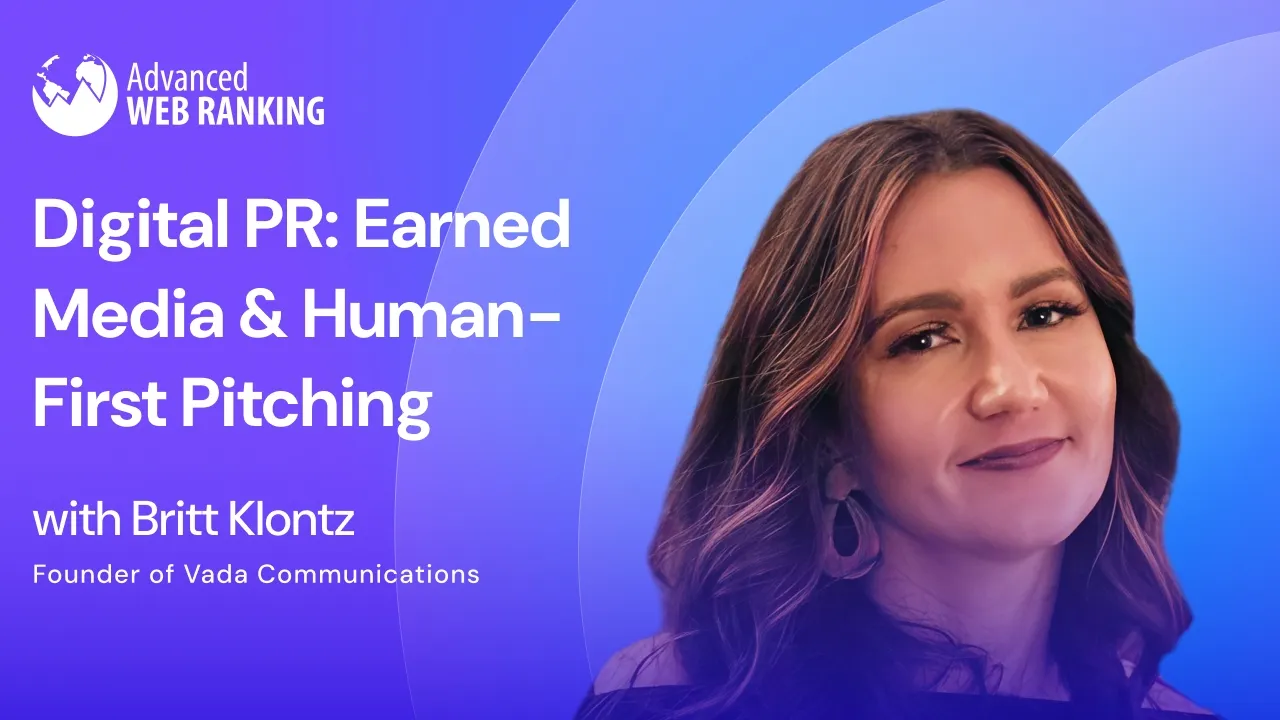
A new episode of The Search Session is here. I'm Gianluca Fiorelli, and today my guest is Britt Klontz, a PR consultant based in Seattle.
Digital PR is taking on a bigger role in the AI search era, and Britt is here to explain. She talks about the link between earned media and AI visibility, the value of quality pitching over volume, and the effort behind genuine journalist relationships.
We also get into the more human side of PR: relationships, community, resilience, and gaining trust in your own abilities.
What's in this episode:
How AI is raising the bar for PR: earned media can shape what AI says about your brand, but short-term tactics like listicle manipulation are losing ground to quality pitching and consistent, authentic brand signals.
How AI can support PR work: AI helps with brainstorming, trend monitoring, reporting, and summarizing pitch activity, but strong media outreach still depends on human research, journalist understanding, and pitches that avoid generic AI-speak.
How PR measurement is changing in AI search: in a zero-click world, trusted, audience-relevant mentions matter more than volume, while spray-and-pray outreach can damage your reputation over time.
How subject matter experts become your best AI-era asset: credible experts, real experience, and non-salesy insights can turn company knowledge into content journalists value, and AI can’t easily replicate.
How to make PR campaigns last longer: repurpose fresh data into bylined articles, podcast pitches, newsletter collaborations, and other relevant formats that keep the story alive beyond launch.
Why connection and rejection are both part of the job: being a helpful resource creates trust with journalists, while a rejected pitch can still become a future opportunity when it’s relevant, memorable, and easy to find later.
Why investing in yourself matters as much as investing in your clients: local meetups, online communities, and a record of your own wins help build the confidence and connections that sustain a long-term PR career.
If digital PR is part of your work, this is an episode worth making time for. Enjoy!
Topics covered: digital PR · AI search · earned media · pitch quality · brand visibility · PR measurement · journalist relationships · subject matter experts · AI-supported PR workflows · campaign repurposing · online communities · personal resilience
About the Guest

Britt Klontz
Founder of Vada Communications
Britt is a PR and content marketing consultant with years of experience helping brands earn media attention through thoughtful outreach, strong storytelling, and journalist-first pitching.
In 2019, she founded Vada Communications, a digital PR consultancy specializing in earned and owned media campaigns, with consulting, training, and workshops for agencies and in-house teams of all sizes.
She is also the host of Digital PR Explained, a podcast where she interviews journalists, editors, and PR professionals to break down what actually works in modern media outreach.
Video Chapters
Transcript
Full conversation between Gianluca Fiorelli and Britt Klontz.
Gianluca Fiorelli: Hi, I'm Gianluca Fiorelli, and welcome back to The Search Session. Today, we are going to have a guest from the other side of the pond compared to me. She lives in a city that I know very well. I visited it many, many times in the past. She's a wonderful person.
I had the pleasure of knowing her quite recently here in Valencia, and she's a PR consultant, as she says on her LinkedIn. She helps brands earn media and attention, and considering the media she shares in this classic image on LinkedIn, where you can see Huffington Post, Forbes, NBC News, Real Simple, NerdWallet, USA Today, so on and so on, she is the person who we need to talk about digital PR today.
She is the founder of Vada Communications, and she is Britt Klontz. I hope I pronounce your name and surname well. Hi, Britt. How are you doing?
Britt Klontz: Hi, Gianluca. Thank you for such a wonderful introduction. I'm so excited to be here. You've interviewed so many search legends, and I'm honored to be here as your guest. Thank you.
Gianluca Fiorelli: Well, I invite people whom I esteem in their work and also as human beings. That's the only requirement to be a guest of The Search Session. You don't need to be a super guru or a super nerd in AI, for instance. But you have to have my respect for the work you do and have to be a nice person. Someone I respect as a human being. And you fill in the two things.
How AI is Raising the Bar for PR
Gianluca Fiorelli: I'm going to change my usual starter question, my icebreaker. Obviously, I'm not going to ask you how SEO is treating you lately, but let's focus on your specialty. How is digital PR treating you lately?
Britt Klontz: Honestly, it's treating me well, but it's asking a lot of me in return. PR is basically one of the only channels left that can influence what AI tells people about your brand or who you are. So the job got bigger, but it also got more defensible, and I will take that trade.
Also, the bar for what's actually worth pitching has never been higher, and I think that's a really good thing. The era of volume and all of that, like spamming and spraying and praying, is ending. And whether people like it or not, the PR pros who are leaning into quality pitching right now are going to be really well-positioned, in my opinion. So all that to say, I'm busy, but I'm super optimistic.
Gianluca Fiorelli: That's cool. That's cool. And yes, digital PR and PR, without even the digital, I always remember that digital PR substantially is public relations done well, also for the digital space. But many times, things that are happening offline have an echo on digital. So they are interconnected.
And people usually, I don't know why, forget that classic marketing can be a powerful driver for online visibility too. And yes, you are saying that digital PR is one of the few things that really, really matter for earning the right visibility, also in AI search.
And you were saying there's no longer time for spamming, and I think we saw it already in these last few months. People who try to trick at least Google with listicle spamming, or with mass production of content generated by AI are seeing the dark side of that kind of tactic.
And I'm curious, when you are approached by a potential client, how many of these clients actually ask you, "Can we do something that can trick AI?" Or not?
Britt Klontz: Well, let's see. I think that would be a red flag for me.
Gianluca Fiorelli: Well, yes, but in the first email, let's say.
Britt Klontz: If they have that question, I think, of course, there are ways to "trick AI" that have or might have short-term benefits. Short-term wins, like the listicles that you mentioned.
I believe this is a little more SEO-focused than what I'm used to speaking about, but I believe that the listicles were, you know, Google was pulling listicles, and you were able to rank in AI based on the lists that other blogs and websites have out there for best X software, best X company, etc.
But as you mentioned, Gianluca, those listicles are no longer performing well, or at least not as well as they used to. And Google, AI tools are also reading your consistent messaging across the web, and I think generic corporate speak, coming back to PR, doesn't lose the journalist; it also loses the algorithm too, at the end of the day.
Great digital PR creates more than backlinks, it builds the brand authority that search engines and AI platforms rely on.
Influencing what AI platforms say about your brand is the new organic battleground, but you can't optimize what you don't track.
Advanced Web Ranking helps you track how media coverage and brand mentions contribute to your visibility across search results and AI platforms, so you can see what's actually moving the needle.
Try Advanced Web Ranking for free and measure the real impact of your earned media strategy.
Gianluca Fiorelli: Yes. I think you said something very important. You said it’s the corporate of a brand. You're substantially implying the brand voice, the correct tone of voice of the brand, able to be consistent in the messaging with all the brand principles, instead of trying to mimic a language that, unfortunately, quite a few people still insist should be used to be retrieved by AI.
Like, you know, this complicated, misunderstood concept of chunking, or this concept of writing very simply with a tone of pointed lists or something like that. And I think that, actually, consistency of branding on your site, on your social media, and on third-party sites, forums, and so on, is what makes AI, as well as normal people, understand that this brand is this brand because of this, this, and this.
So I totally agree with you on this. Maybe I'm going to put it very simply. I hope it's not simplistic, but to make people understand, actually, Google first, and then also AI, what they want to do is try to mimic how people think in order to offer what people want to see as search results. So why fake? Be consistent and be the answer that AI and Google want to give, a consistent one.
How Britt Uses AI in Her Digital PR Workflow
Gianluca Fiorelli: And talking about AI, as a digital PR, how do you use AI for your work?
Britt Klontz: Do I use AI for my work?
Gianluca Fiorelli: Yes. I mean, as an SEO, for instance, I use AI for doing certain types of work, like identifying patterns in a huge list of URLs, etc. Maybe you are using AI for some specific background work that you have to do when you are searching for something, ideas, etc.
Britt Klontz: Yes, definitely. I think I'm on the whole idea or thinking that AI should be used as a tool, but not as something to do your job. I think that's how I'd sum up my approach to AI.
So I do use Claude, and I used to use ChatGPT a little bit to brainstorm ideation and new content ideas. I use it sometimes to monitor certain trends. Right now, I use it a lot for reporting, and I do trust it with syncing to my Gmail.
And when, at the end of the day, I've sent X amount of pitches, it's a lot of work to then look at the pitches that I sent and then summarize to my clients what was said in them and what angles I took, because I'm not templating any of my pitches.
I'm truly taking the time to read the journalist's work and understand what they like to write about and what their audience likes to read. So that's maybe one of my favorite uses of AI at the moment, to say, "Please check out..." It's all about what you prompt it, right? So be very specific about what types of emails you want it to analyze, and ask it to summarize what sorts of pitches and angles and types of outlets were pitched to today or in the past two weeks.
Typically, I'm reporting bi-weekly or monthly to my clients. So it's hard for me to sit down and accurately say, "Here are all of the different angles and pitches that were sent over the course of a two-week or four-week period." And AI is fantastic at summarizing that for me and iterating that to my clients in a concise way, in a way that makes sense and doesn't bombard them with all of the details either.
And again, I can sync it with my tool that has open rates. I use Mixmax and ask it to then let us know what the open rates are. Response rates, I don't really care much about. Journalists will often write about something you've pitched them and not tell you at all. So, response rate can be a really bad indicator of success.
Spotting AI-Generated Corporate Speak
Britt Klontz: So I really like to use AI right now for that purpose, but I don't lean on it at all for writing my pitches. I don't lean on it for writing press releases if I ever need to write one. Journalists will see right through the corporate AI-speak trap, and there are just so many telltale signs that they'll be able to spot right away.
Gianluca Fiorelli: What are the most common?
Britt Klontz: So, usually there's no specific human detail. It's hedged language that commits to nothing. And they're compliments that are so generic they can apply to any journalist.
There's a Barron's analysis that I read a couple of weeks ago. I forgot the name of the report, but it basically looked at corporate documents, earnings calls, and SEC filings, and it found certain phrase constructions had essentially just exploded since 2024.
So phrases like, "You know them well, I'm sure," "In today's rapidly evolving landscape," or "We are committed to fostering a culture of X."
Gianluca Fiorelli: It's a classic.
Britt Klontz: Yes, the classic ones. But I mean, a lot of PRs are incorporating that into their press releases right now and their pitches. It's crazy.
Gianluca Fiorelli: “The always-changing landscape.”
Britt Klontz: Yes, exactly. And these phrases barely existed two years ago, and now they're everywhere.
Gianluca Fiorelli: I’ll tell you one story: there’s a verb that I never saw, and I mean, it's 22 years that I've been doing SEO and mostly working and connecting with the English-speaking SEO world and clients. And before that, I was working in television. Obviously, I was speaking a lot of English because I needed to contact, I don't know, Metro-Goldwyn-Mayer or Warner for buying TV rights for movies and TV series.
And one verb that I never heard of was "delve." And I discovered it because I saw a fantastic story shared by a linguist, where he said the English language that AI uses can tell you who the people were that worked on training the model with English.
And he said, "Because 'delve' is something that nobody in the US uses and nobody in the UK uses, but it's used a lot in Nigeria." So that means that probably a massive amount of training data has been built, thanks also to the work of third-world countries, like Nigeria, or other countries that were substantially cheaper for OpenAI and all the other models.
And that is quite amazing, to have seen this language, because you can understand why, all of a sudden, we started to use it. Because then people started to speak like an AI.
Britt Klontz: Yes.
Gianluca Fiorelli: Like "thrive." I had never heard it so much before, and so many others.
Britt Klontz: I didn't know that.
Gianluca Fiorelli: Yes, it’s coming from a linguistic study, which was quite a surprising and fascinating finding for me.
How PR Measurement is Changing in AI Search
Gianluca Fiorelli: Okay, so you use AI for reporting. You were saying that sometimes you use tools, for instance, for understanding the operator and things like that. So, the KPIs for the outreach phase of a digital PR campaign.
But before AI, a classic KPI was links. How are the KPIs changing now that links are still very important, but they are not the only metric to track? How are the KPIs changing for a digital PR campaign now that we also have AI?
Britt Klontz: I recently had the honor of talking to our friend Rand Fishkin, and he and Amanda Natividad coined the term zero-click marketing. And I think my answer aligns a lot with their thinking around this topic, and that's that in a zero-click world, in this AI world that we're living in right now, I believe that where you get mentioned matters just as much as whether you get mentioned.
And another thing, or I guess report that I'll reference right now, is one that BuzzStream published, Vince Nero, and it was about spraying and praying. And what they found is that sending more pitches, more quantity over quality, really doesn't drive more results. What it actually drives is more blocks and more unsubscribes, and it will give that PR a worse reputation on the next pitch that they send. Your media list is not a renewable resource.
And when it comes to framing that actually lands with agency leaders or your bosses, like reporting, framing the wins, and framing the value, two-thirds of all queries now get answered without a click.
So 15 okay mentions on sites or blogs that no one reads, they're not just bad for your client's brand, but they can sometimes be invisible to the AI tools that are shaping what people actually believe.
So one great placement in a publication that your audience actually trusts and actually reads—that's what gets cited, and that's what's feeding the answer. But I'm not just talking about The New York Times and The Wall Street Journal of the world, and I'm not talking about all blogs. There are very valuable blogs out there.
Let's just talk about SEO and marketing for now, right? Because that's what we're experts in, and most of your listeners are, and we all know the HubSpot blog. That's not one of those blogs that I feel is worth overlooking. That's an important blog that a lot of marketers read.
So if you represent a company in the marketing space, a software company in the marketing space, or if you're a marketer yourself who wants to become known as the expert on AI search, I would prioritize getting mentioned, or I would prioritize building relationships and helping the writers at the HubSpot blog out, versus a journalist at The Wall Street Journal, for many reasons.
But I feel like right now, if you search for perhaps a very specific topic about AI search, Google will be pulling, I'd bet, HubSpot blog posts to help answer that question. Am I making sense?
Great digital PR creates more than backlinks, it builds the brand authority that search engines and AI platforms rely on.
Influencing what AI platforms say about your brand is the new organic battleground, but you can't optimize what you don't track.
Advanced Web Ranking helps you track how media coverage and brand mentions contribute to your visibility across search results and AI platforms, so you can see what's actually moving the needle.
Try Advanced Web Ranking for free and measure the real impact of your earned media strategy.
Gianluca Fiorelli: You're totally right. This is the old classic of targeting the places where your audience is substantially.
Britt Klontz: Yes, exactly.
Gianluca Fiorelli: The New York Times could be cool once because it's prestigious.
Britt Klontz: Of course, yes.
Gianluca Fiorelli: But it should be done with a lot of attention. So understanding who the journalist is who constantly talks about Google, for instance.
Britt Klontz: Yes.
Gianluca Fiorelli: Who is in what section? With what frequency? Inside the Google world, what kind of specific topics does he talk about? Search, or just Google, as a corporation, as a company, part of Alphabet.
Britt Klontz: Bingo.
Gianluca Fiorelli: In that case, you can try to craft a piece of content that can just target the journalist more than the people who are influenced by the journalist. So you can, let's say, put the foot in the door and eventually, obviously, if he's going to cite you, he's going to influence also the people that you really want to target.
Combatting Pitch Fatigue and Getting Creative with Content
Gianluca Fiorelli: But I want to ask you something. Yes, the spray-and-pray tactic, so bombarding journalists, made me remember one thing that was shared in a conference where I was talking recently in Manchester, HiveMCR. And your UK colleagues, you know that UK digital PR is very strong, were saying that they noticed something like this. Probably because journalists are being pitched continuously and with such frequency, we’re starting to see emails bouncing more and more. Is this a consequence of the spray-and-pray tactic?
Britt Klontz: I would say so. I would back that theory.
Gianluca Fiorelli: So it's the classic; it's not about how many campaigns you do, but how good the campaigns you do are. No?
But you were also saying something before. Now, AI usually gives the answer directly. So, if anything has changed in your way of working, how are you working in order to say, “Okay, I know that these topics could be used by AI in their answer, but I want to at least have a link inside to my client website where the campaign is living.”
For us, SEOs, this would be information gain. To create such compelling content that cannot be replicated in the same way by an AI. So what is your process to say, “Okay, we need to up the game?” How do you up the game?
Britt Klontz: There are a lot of different strategies. It depends on what the company does that you're representing or that you're brainstorming around. It can depend on whether you have subject matter experts at that company who are credible and credentialed. That's key. They're not fake experts.
And can have some media training; can confidently speak on maybe a podcast, maybe to a journalist over the phone, over a Zoom call, maybe go in person and have a meeting with a journalist, and can talk about what they're an expert on in a way that's not salesy but in a way that is them being a resource to the journalists who are writing about the industry that they are experts on.
So that's one way that I think subject matter experts, and really prioritizing and taking advantage of their expertise and their knowledge bank and creating content with that, are a goldmine of opportunities that perhaps a lot of content marketers aren't taking advantage of at the moment.
Gianluca Fiorelli: I remember that the classic is the so-called data-driven content, so retrieving a lot of data to then create a piece of content that narrates this data. And I think it's great. It's a great strategy. Also, because I'm a judge for the Content Search Awards, I saw so many campaigns where I started to get bored with all these kinds of campaigns made of data, data, data.
Sometimes I think that, for instance, if you have a good opportunity with your clients, also with developers and designers and so on, maybe a tool, increasing your tool based on the things they sell, if they are e-commerce or real estate, creating better maps, creating things that are also going to serve for better conversion at the end of the day. That can be a good way to combine a campaign with the internal conversion rate.
How to Make PR Campaigns Last Longer
Gianluca Fiorelli: But I wanted to ask you something. One of the classic old criticisms of digital PR was, and maybe still is, that you are creating a campaign, the campaign is a success, but when the campaign passes... In your opinion, and I'm going to cite another friend of ours, which is Ross Simmonds, what is the best way to make the campaign that you put so much effort into creating, promoting, and launching last, not maybe evergreen, but more than the classic 15 or 20 days of virality?
Britt Klontz: I love Ross Simmonds' work, and yes, I think a lot of agencies will make that mistake. They'll invest so much time and money and effort into creating one report, and there's so much more value in that report than just pitching it to journalists who might want to talk about it or might want to report on the findings.
With my clients personally, whenever we do invest that time into creating a report, especially if it's using and referencing proprietary internal data, I always encourage them to repurpose that content. You can repurpose it by thinking about what other topics relate to this report that we can perhaps fashion or repurpose for a bylined contributor column in a trade publication.
So, Search Engine Journal, let's stick with search, I guess, in this instance, and Search Engine Land, maybe the Moz blog. What other stories can you tell with that data that you can then pitch to write about at these publications? Because then you're repurposing all of this work and time and money and effort that you put into creating this big report, and you're continuing to talk about it.
I mean, this byline might go live three months after the report has been published. As long as the information is still fresh and it makes sense to write about it still, that's a great way to repurpose report content.
Another way is, of course, basically the same strategy but a different format, thinking about what podcast topics you can pitch. If you have a qualified search subject matter expert at your company who's confident enough to speak on a podcast about this topic, what podcast topics can you pitch to relevant podcast hosts who want to hear more about this topic from a qualified expert who can share more insights and go deeper into that specific topic?
So yes, bylined contributor column opportunities and podcasting. Sometimes there are also a lot of newsletters out there, and people who run and write these newsletters are just so steeped and devoted and knowledgeable in the industry, and there are opportunities to perhaps partner with them. Sometimes it might be a sponsored fee, but I'm not against that.
Like, I know I'm a PR, and I do believe that earned media... I still rely on many earned media tactics, but I don't discount or overlook certain pay-for-play opportunities, especially if it's a newsletter that's read by hundreds of thousands of people in that industry.
I think it makes sense to pay the newsletter author whatever fees they might be asking sometimes to collaborate with them. And in that collaboration, you might be able to use the report data.
Gianluca Fiorelli: Yes.
Britt Klontz: Those are just a few tactics.
Great digital PR creates more than backlinks, it builds the brand authority that search engines and AI platforms rely on.
Influencing what AI platforms say about your brand is the new organic battleground, but you can't optimize what you don't track.
Advanced Web Ranking helps you track how media coverage and brand mentions contribute to your visibility across search results and AI platforms, so you can see what's actually moving the needle.
Try Advanced Web Ranking for free and measure the real impact of your earned media strategy.
Building Authentic Relationships with Journalists
Gianluca Fiorelli: Yes, totally, totally. And another great digital PR, and I'm sure you know her, Lexi Mills, once told me that the best strategy for a PR professional is to create bonds with journalists. Not only having a sort of contractual relation with them, so I prepare this content, and I give you this content, and you promote this content. Not just this kind of cold relation, but something deeper, like really starting to know them, to be a “friend for a journalist.” So, helping them with the creation process. Okay, you don't have to worry about the multimedia assets for this piece of content because it's here; it's prepared already. You just have to check and verify.
And eventually, she was saying to try with the ones you really care about to be your co-author for certain kinds of campaigns. So, asking them for opinions about the topic, etc.
Gianluca Fiorelli: So, how important is it to create a strong relationship with a journalist for digital PR?
Britt Klontz: I think it's important. But I also think that there are journalists right now, whether they're in-house, whether they're freelance, or whether they're running their own Substack or newsletter, who are managing far more variables than we ever see.
And the ones who build good PR relationships are the ones who respond even when they can't use you right now, because they know the good ones come back. So one of my favorite, I guess, my motto, when it comes to PR is just to be a resource, be a helpful human.
And a lot of times, you can ask some journalists to be put on their source list, and they might have an email whenever they're in need of a source, whenever they're writing a story and need more data or information. They send out an email to their source list and their contacts, and they ask. They say, "Here's what I'm working on. Here's who I'm looking for. Here's what I'm looking for. Pitch me."
And one of my favorite things to do, and it helps other PRs out as well, and other people that I know and love, is to be like, "Oh, yes, I actually know somebody who..." Let's just say, this is so random, but, "I know somebody who created an ultrasonic knife, and they'll be a great source for this journalist. I have no clients myself in this space, but I know somebody who has his own data, who can confidently and passionately speak to the product and the topic.”
It's a no-brainer. Just connect them with the journalist, and they'll remember when you, as the PR, introduce them to somebody who is going to be a great source and likely contribute to the story that they're writing.
And that just helps build that bank of trust over time. It might not give you immediate value for your clients or your job, but it builds that trust over time.
Listen to Ross Simmonds and Lexi Mills on The Search Session
Gianluca Fiorelli also explored these ideas with Ross and Lexi, discussing how content consumption is shifting, what AI means for brand visibility, and why the “create once, distribute forever” mindset matters more than ever.

Why Rejected Pitches Aren’t Always Lost Opportunities
Gianluca Fiorelli: Yes, totally. And in a recent podcast, because I forgot to mention it when introducing you, but you are also a podcaster, and I really recommend everybody here to go to Britt's website and see her podcasts there. And they are shorter than mine, so you don't have any excuse for not watching them.
In one of your episodes, you were talking with, let's see if I pronounce it well, Shara Seigel of Mission North. She was talking, synthesizing it, about rejection as redirection. How can you transform an initial rejection into a win when it comes to digital PR?
Britt Klontz: I love talking to Shara. Yes, I interviewed her for Digital PR Explained. That's my podcast, many months ago. But her episode continues to be one of the most popular ones because it's an evergreen topic, and there are so many valuable learning lessons that PRs can take away from her conversation and her incredible insights.
A lot of it was around how a rejected source pitch is not a failed pitch. A freelancer or journalist, reporter, or whatever you might title them—whoever's writing this piece, whoever you pitch—might be developing that story for months, and some of them do store away or organize your client's information for a future story.
Maybe it's not a good fit for the story they're writing at the moment, but months from that pitch, they'll remember, or maybe they might not even remember that you sent this pitch. They might go into their inbox and look up certain keywords, right? SEOs know keywords super well and could use them in emailing and use them in your pitching because a journalist will go back to their inbox, put in these keywords, and review the old pitches that they received if they are in need of a new source who's credible and has the expertise.
And they're likely to pull up that email you sent months ago and be like, "Oh, yes, this person is a great fit for the story that I'm working on." And you'll get an email out of the blue, and you might have totally forgotten that you ever sent the pitch, but it happens all the time.
And none of that honestly has anything to do with the quality of your pitch, per se. What I've learned from interviewing journalists on my show is that they're just really hard to get.
They're usually the ones doing the interviewing and, like I said before, they're managing far more variables than we ever see. So yes, rejection, even if you're hearing crickets, don't give up and keep your head up because it is likely, if you're sending the pitch to the journalist and they actually cover the gist of what you're pitching, like that is actually their beat, relevance is key, they are more likely to come back to you in the future and respond to your email months later.
The Power of Networking, Communities, and Serendipity
Gianluca Fiorelli: We are going to talk about this topic, like women in tech and all the community stuff, just after, in a few minutes. But let's say you are going to mentor someone who wants to be a digital PR. What are the first things you would say to this person to somehow instill this idea about how to do digital PR, how to be a digital PR person from the very beginning?
Britt Klontz: Gosh. Oh my goodness, that's such a good question. Right now, personally, I'm really leaning into encouraging others to go to in-person events. They don't have to be big conferences, just look locally. Here in Seattle, I try to attend once a month; it's the Digital Marketing Collective, and it used to be called SEO Beers. It's run by Shawn Huber, and it's a great way to not only, of course, network and meet other people in the industry, but also to bounce around ideas and have more conversations about what's working and candid conversations too. What's working? What's not working? What are you excited about? What are you not so excited about?
While also, a lot of our chats might not even be around SEO, marketing, or PR. We're just there to connect as human beings first and foremost. But those conversations, those local meetups, that's where the magic moments happen, in my opinion. They're, again, trust-building environments. So right now, I'm encouraging people to get out more, and that includes myself. I can be a hermit, so...
Gianluca Fiorelli: Yes. And for me, not that I'm the most extroverted person in the world, but I immediately knew that, even though I live in a wonderful city, which is Valencia, which you visited, Valencia is not really in the center of the world for the digital landscape.
So I always forced myself and started first attending, and then pitching, and then creating connections. And even if, in my case, the in-real-life moments are not as many as I would love to have, at least be always present within the private groups, for instance, like the Facebook group, the Slack group, or all these things.
And something that I learned from the very early days, when I was a Moz Global Associate, also because it was my committee, was to comment. If someone is saying something interesting, comment on their post. Comment on their LinkedIn post, Twitter post, or whatever, and start a conversation.
Don't be afraid to start a conversation, even if the things that you are going to tell—and it happened to me many times in the past—are totally bollocks or stupid. Do it. Because if not, you are not going to take the initiative, the behavior, to talk with others and to exchange ideas.
And usually people are not so bad as sometimes the events of life and what's happening, what's becoming viral on social media, can make us believe. Usually, especially in our industry, people are quite gentle, and they may tell you that you said a stupid thing, but the really aggressive ones telling you this are a very small minority.
So I would suggest the same. Go out; try to force yourself; create a habit of interacting with others. And, citing our friend Rand on serendipity again. Serendipity is so important in our job.
Britt Klontz: It's so true. And you mentioned Facebook groups like Women in Tech SEO. They have a wonderful Slack community, and so many people there, myself included, spent years interacting on Slack and with the community there before ever going to a conference.
And it's such a great way to dip your toes into networking and make connections with people before meeting them in real life. That way, when you get to the conference, you're like, "Oh yes, I know so and so," and you meet them in real life, and it's like you've known them forever.
So if you are introverted and quite shy like myself, Slack groups like Women in Tech SEO are such a great way to not only learn from others if you don't have the opportunity or the ability to travel or maybe leave your house, but they're also a great opportunity to build your personal brand as well if you really want to become known as an expert on whatever topic interests you and whatever topic you study.
Celebrating Small Wins and Tracking Success
Gianluca Fiorelli: Yes, totally, totally. And let me go through my notes. On your LinkedIn, you shared that you have a specific folder—I don't remember if it's on your PC or a physical one—where you put the things that you have done and the successes that you have achieved.
How important is this folder for you? And when you open this folder, what is the campaign that you remember with more pleasure?
Britt Klontz: Oh, that's such a hard question. My folder goes back decades, probably 11 years. So it's so hard to choose my favorite email or my favorite win.
I'll just say, I think there's so much power in reminding ourselves of the little wins, especially in today's digital marketing world, where an algorithm or some Google change or change in the way we search sounds so scary and could be so detrimental sometimes to our future or might seem that way in the moment, right?
I think it's so important to just remind yourself of those small wins that made you proud because they build up over time. And it's so easy to forget about those wins, especially if you're someone like me who can be pretty negative. So I think that's one reason why I have this folder.
I like to call it the "humble brag folder" or the "little wins folder." And when it comes to campaigns that I'm proud of, I will say the one that I'm talking about a lot recently, and it's fresh on my mind; I'll tell a little bit about that story.
I keep it anonymized right now, but basically, it was for a client of mine in the freight factoring space, and it's a regulatory data campaign that we worked on together.
There was a ruling in their industry, and there was a whole forum with over 8,000 public comments in the Federal Register. The client I worked with used AI sentiment analysis to find the actual story inside all of this data. And it wasn't to write the pitch; it was more to read the room and gather the feelings and, again, the sentiments of that industry.
And we created a whole article that lives on their blog about how the industry felt about this ruling. And I found an executive editor at a trade publication that covers freight trucking news specifically, and he had been talking about this ruling. He actually had an article that interpreted the feelings of the industry differently.
So I went to him with this data, saying, "Here's an unbiased look based on an AI sentiment analysis of this forum saying how the industry's feeling," and we bucketed the feelings and broke it down further. And the executive editor actually did respond to me, and I'm going to be talking to him for my podcast as well.
I never hear from editors usually, unless maybe they've published it, and then I thank them for writing about it, but typically they'll just write about it, and they won't let me know.
This editor, he responded, and he was like, "I usually don't like AI stuff, but that was a really good use of it." And that's the proudest I've been of a campaign because the strategic hurdle wasn't the pitch; it was just convincing ourselves that the data was the story before we ever talked to a journalist. And I love how it all came together.
From Journalism Dreams to Digital PR Reality
Gianluca Fiorelli: That's cool. That's a cool story. And yes, I think that again, it's also a perfect conclusion for our talk. But before concluding our talk, let's stop talking about digital PR and so on.
I'm a curious person, and this is somehow a classic question that I usually ask face-to-face. But for instance, when I was young, maybe because I'm that generation that grew up with Indiana Jones, I wanted to be an archaeologist. Then I understood that maybe it wasn't really my kind of work. Not because I don't like history, but because ancient Greece didn't like me.
But in your case, before entering digital PR, when you were a younger student, what was your idea of, “I want to really work, I want to do this kind of job”? Maybe you're going to tell me, “I want to be an astronaut.” That would be really fun. But what was the kind of job that you dreamed about?
Britt Klontz: When I was really little, I loved musicals, so something in musical theater would've been an absolute dream. But I'm shy.
Then I actually studied journalism and went to school with the idea of becoming an investigative journalist or perhaps a journalist of some sort, maybe a meteorologist even. I really am fascinated by weather trends, and living in Florida, I loved the idea of studying a hurricane.
Gianluca Fiorelli: Yes, it's somehow a need.
Britt Klontz: Yes. So now I'm here, though. I guess sometimes journalists call it going to the dark side, bringing it back to Star Wars. I thought I'd become a journalist, but I ended up becoming a PR.
Gianluca Fiorelli: Maybe the fact that you studied to be a journalist…
Britt Klontz: Yes. I think it helped.
Gianluca Fiorelli: Yes. This skill is one of the many things that help you win the journalism profession.
And of all the classic journalists, who was your role model? Saying, “I really love this journalist. If I had to be a journalist, I would really love to be like this.”
Britt Klontz: I've always loved Katie Couric. A lot of people know her. And then back in my hometown, I really respected a journalist. I think she recently retired, but her name was Laurel Stowers. I loved watching her on the local news station. So those are two of my favorites.
Gianluca Fiorelli: Yes, the local news, which are the classic forgotten people. Sincerely, I never did digital PR seriously. But in the very beginning, when as an SEO I was doing everything, I remember that I was always looking at local news for inspiration because sometimes nationwide newspapers or magazines usually put very, very little, just a footnote, for this kind of news that actually is the really meaty ones, that can open an idea, and usually this kind of thing you can only find written by some amazing local journalist who really got deep into a specific weird case.
So I remember one; it was for a very weird campaign, but it was cool to do it because it was a client of mine who sells the lights in the taxi, in the airport, you know, all the lights. The company manufactured this kind of light for airports. So I remember that, in one of the local news here in Valencia, there was news about, I don't know how to call them, but UFOs; once they were called UFOs.
So I started to say, "Okay, that could be a good idea." There was the airport, but it was a very, very random idea. So I started to investigate, and probably because this journalist was really into this kind of topic, I discovered another article where he was talking about all the patents that the US government created for creating OVNIs.
Okay, this is fantastic. So I created from this. I talked to him. I substantially asked him to write it for me in a more extended way. I worked with a designer to recover all the drawings and so on and so on. It was really fun.
Britt Klontz: That sounds so fun.
Gianluca Fiorelli: It had quite a success. It was for an Italian company, so it had quite a success also because, as we are going to cite Rand, it's not really to target everybody but the ones that are really into this kind of stuff as your first audience.
In order to make them make the story go viral, so that it's going to be picked up somehow. That was why I always liked this kind of local journalism. Sometimes they really are the forgotten heroes, and they're unpaid heroes.
Britt Klontz: Yes. It's so true, and they're working crazy hours. So many downsides, but they do such an important job. And isn't it funny how just the foundation of good storytelling is really what we're talking about as well? And how, as long as you're doing that in marketing, you're doing a good job if you can really be a storyteller.
Gianluca Fiorelli: Yes. That's why I really like it when I have clients, and I know that they need to improve the visibility and the recognition of their brands. I like having so many friends in the digital PR industry and eventually recommend them to do a good job. I always have for myself a sort of executive production role, but it's a great way.
I know that I couldn't do it. It's a job that needs full attention and full concentration all the hours of the day, and that's why I always go with people like you, or a boutique agency, or a big agency if you are that kind of enterprise company that is really able to do and know how to do that kind of job.
Before concluding and saying hello to you, behind you, on the couch...
Britt Klontz: He's gone now, but yes, he's my dog, Corbin. He's an 11-month-old half border collie, half cattle dog, half Australian shepherd, half Boston terrier absolute mutt who's insane, but I love him to death.
Gianluca Fiorelli: Cool. And he was really gentle and didn't interrupt us.
Britt Klontz: Yes, we had a long walk this morning, so he's good.
Gianluca Fiorelli: Okay. So Britt, it was a pleasure to spend this hour with you. I hope that maybe in the future, we can have a second conversation. Maybe, I don't know, invent a small panel of digital PR people to discuss ideas, brainstorm, and have a good, constructive discussion about this topic.
Thank you again a lot, and I wish you a wonderful day.
Britt Klontz: Thanks, Gianluca. You too. It was an honor. Thank you so much.
Gianluca Fiorelli: And thank you all for your patience with me and for listening to Britt until the end of the episode. I hate this part, but remember to subscribe to the channel so we can make it bigger and grow, and ring the bell to be notified about new episodes coming. Thank you and bye-bye.

Podcast Host
Gianluca Fiorelli
With almost 20 years of experience in web marketing, Gianluca Fiorelli is a Strategic and International SEO Consultant who helps businesses improve their visibility and performance on organic search. Gianluca collaborated with clients from various industries and regions, such as Glassdoor, Idealista, Rastreator.com, Outsystems, Chess.com, SIXT Ride, Vegetables by Bayer, Visit California, Gamepix, James Edition and many others.
A very active member of the SEO community, Gianluca daily shares his insights and best practices on SEO, content, Search marketing strategy and the evolution of Search on social media channels such as X, Bluesky and LinkedIn and through the blog on his website: IloveSEO.net.