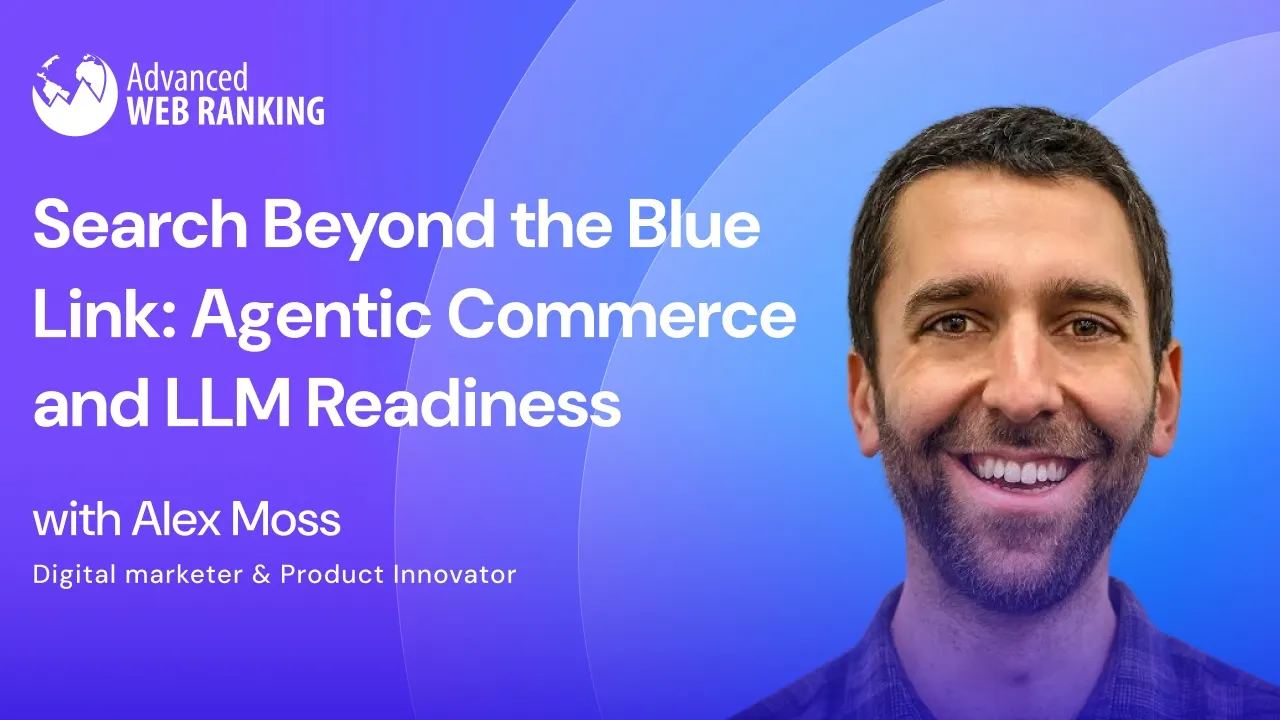
This is The Search Session, and I'm Gianluca Fiorelli. Today’s guest is Alex Moss, a digital strategist and technical SEO based in the UK.
Alex and I look at how search habits are splitting across Google, AI tools, and social platforms and how trust is shaping that shift. We also unpack agentic commerce, Schema beyond rich results, and the growing importance of structured data, content governance, and agent-ready websites.
The conversation also explores WebMCP, semantic drift, and whether GEO will remain part of SEO or develop into its own field.
What you’ll learn in this session:
How search is fragmenting as LLM adoption spreads across generations: people choose different discovery paths based on need and trust, while verification and the right use cases will determine how quickly AI-assisted discovery and agentic commerce become mainstream.
Why agentic commerce is splitting into ecosystems: OpenAI's ACP takes a closed, transaction-focused approach, while Google's UCP is positioning itself as a broader, open standard backed by its data, infrastructure, and view of the full customer journey.
How Yoast separates Schema from Merchant Center: Merchant Center supports broader commerce and paid workflows, while Yoast focuses on solid structured data and schema aggregation that help search engines and LLMs understand entities efficiently.
Why Schema and content governance matter beyond rich results: Clear, structured, and consistently updated information helps LLMs understand entities and relationships more accurately, reducing ambiguity and semantic drift.
Why sites may be underusing Schema, not overusing it: new data shows that roughly half of Schema.org’s item types are each used by fewer than 10,000 sites, while Schema actions, such as RSVP-by-email, could become more important as agentic protocols emerge.
Why SEOs may need to implement before they can measure: tactics such as FAQ Schema and LLMs.txt are difficult to attribute, but they may still help emerging AI systems understand and surface content across different use cases.
Why GEO may remain part of SEO: as AI platforms create new visibility surfaces, SEOs need to follow engineering developments and help websites work for agents, even if LLM optimization eventually grows into a separate discipline.
Why WebMCP may be worth adopting now: it is low-cost, low-risk insurance, and being the only business with an agent-ready contact form could allow an LLM to complete a lead for you while competitors without one are overlooked.
Tune in for a conversation full of sharp, practical thinking on what SEOs should be paying attention to next.
Topics covered: search behavior · LLM adoption · agentic commerce · ACP · UCP · Merchant Center · Schema · Schema actions · FAQ Schema · LLMs.txt · GEO · WebMCP · semantic drift
About the Guest

Alex Moss is a technical SEO consultant with over 25 years of experience. His work focuses on structured data, WordPress development, AI readiness in search, and fractional CMO and GTM strategy for growing brands.
Since 2023, Alex has served as Principal SEO at Yoast, where he contributes to areas ranging from product roadmap and strategy to public speaking and partnerships. Yoast develops SEO plugins, tools, and educational resources that help website owners improve their visibility in search.
In 2013, he co-founded FireCask with Anna Moss. FireCask is a small, Manchester-based digital marketing and web development agency specializing in SEO, CRO, website design, and WordPress development.
Alex has spoken at industry events for over 15 years, covering technical SEO and agentic search, and co-hosts the monthly podcast The SEO Update by Yoast with Carolyn Shelby. He also writes for Search Engine Journal.
Video Chapters
Transcript
Full conversation between Gianluca Fiorelli and Alex Moss.
Gianluca Fiorelli: Hi, I'm Gianluca Fiorelli, and welcome back to The Search Session. Today, we are going to have the man of everything SEO at Yoast SEO. He's a good friend of mine. I remember having shared with him a very nice dinner in a very chilly and cold Rimini, many, many years ago, before an event. We have shared many events.
He's also the CEO, owner, and founder of a small boutique SEO agency called Firecask. We are also lucky because, you know, Yoast is an important brand. With all the positive attention he deserves, he has started to speak in public a lot again over the last 12 months.
Our guest today is Alex Moss. Hey, Alex. How are you doing?
Alex Moss: Hey, thanks for having me. That was quite the intro. Yes, I'm doing fine. I'm doing fine.
Gianluca Fiorelli: You deserve it.
Alex Moss: Oh, thank you. Thank you. Yes, I'm doing okay. I'm between two heat waves, supposedly, in England.
Gianluca Fiorelli: You are in the valley between.
Alex Moss: Yes, pretty much. The breather before you have to hold your breath in again. But I'm all for it. I'm all for it. It's nice and cool down in my office, so it's okay to escape down here.
Gianluca Fiorelli: Okay. Here in Valencia, it's fine because, you know, in my home office, we are prepared. We have all the things needed to fight the heat.
But I was really feeling strong solidarity with all of you in Great Britain, as well as in France, Germany, and so on. I was visiting my mother in Milan, and it's not so common to have air conditioning. My God, it was really, really painful for me.
Is SEO Still SEO?
Gianluca Fiorelli: So, let's go directly to the conversation. Let's start with a classic of mine. How is SEO treating you lately?
Alex Moss: Weirdly, right?
Gianluca Fiorelli: In these last 18 months of craziness.
Alex Moss: I feel like it's been good and bad and confusing, but also hopefully getting towards some clear light on where we might be going as SEOs and what role we play in businesses. That, I think, may be the thing—not a question most, but the thing that may shift alongside what we do day to day—is where we fit.
But I think it's an interesting time. There's lots of cool stuff. I feel like, a year ago, I used to say that maybe it would take about 12 to 18 months for the dust to settle, but I don't think there's any dust settling at the moment at all.
I think we're just in a weird place still, and now I can't say that in a month, the dust will settle. We're living in a time where, you know, Fable's gone away and now it's about to come back. Then there's, like, what is it going to do for this next level of engagement?
Gianluca Fiorelli: ChatGPT, the new one, 5.6, was announced but immediately blocked by the government.
Alex Moss: It's crazy, but does it need to be done? What are we doing with it that's so bad that it needs this many guardrails to even be released to the general public? I feel I'm doing good on it, you know? I'm not just wasting away, wasting tokens doing some inane work or some image that I don't really need.
I feel like I'm using it ecologically, but I know that I'm not the same as the rest of the population, and people are going gung-ho on doing stuff that may not be positive.
Gianluca Fiorelli: Please, just don't use AI to create new memes and, you know, five-second videos.
Alex Moss: Yes, but with SEOs, it's still weird because we're now—I feel like a year ago, maybe there were a lot of people in denial that the 10 blue links were disappearing. Now, you know, of the 12 stages of grief, or however many there are, we may be going beyond that, and I don't see them often.
Search Behavior Is the Real Revolution
Alex Moss: I do sometimes, but I know that a year ago, my usage of traditional Google SERPs was way higher than it is now. Now, I hardly go on it, and if I do, it's for very quick bits of information where I know that a blue link will get me where I need to go really quickly, and I don't need to wait for an answer from an LLM.
Gianluca Fiorelli: Yes, I've noticed this myself. This is how it's changing because, as you say, it's a continual change in behavior. Maybe this is the most important thing that happened during these last 12 months to two years: the change in search behavior.
For instance, now, when I search on Google and I want to see the blue links, I usually do a sort of site search. It's not really a site search, but I put the name of a website, for instance, and then a query.
Let's say, for instance, Search Engine Land. I know that people have talked about this on Search Engine Land, but I don't remember who or what the title is, and I don't want to see results from other websites. I know that it's better not to use AI because AI may propose incorrect URLs and so on.
So, I prefer to do these very long-tail branded searches and retrieve the sources and links myself.
Like you, if I have to ask the classic random question that pops up in your mind, I may use Google, but I write it as a conversational query. So, I directly look at the AI Overview, and because on mobile you expand the answer, it is substantially AI Mode.
I'm usually fine with AI Mode and eventually continue the conversation.
Alex Moss: Yes, I get what you mean about hallucinations. As you were speaking, I was thinking, “What do I use Google for now?”
I use it for things like cinema times. They're usually locally based, or I need to do something right now. And lastly, doing my own research, you know, getting a restaurant menu.
I may see it in the AI Overview or in the GBP profile, but I still don't know if that's actually the source of truth and whether I should go onto the website and check it out. That kind of stuff.
But we're doing our own research. That's what we're describing. We're doing our own research.
Gianluca Fiorelli: Local search or very transactional searches.
Alex Moss: Yes.
Gianluca Fiorelli: Because everything transactional is not there yet for LLMs, despite all the attempts of ChatGPT.
Alex Moss: Yes.
Gianluca Fiorelli: With ACP.
Alex Moss: It's a bit of a weird one now, isn't it? I don't know. I'm a bit of a maximalist when it comes to agentic commerce. I believe that that's going to be commonplace in the future and that, while we can't trust it now, it reminds me of the rise of e-commerce when that first came out and its general mass adoption.
You know, I look at my parents, and they now trust Amazon as somewhere to put their credit card into. They're so old-fashioned, but they're not the edge. They're edge in our lives, they're an extreme in our lives, you know? But really, in reality, that's who the average person is.
So, I always find it interesting what they do and don't do. Like I was saying in a previous talk, I may soon be confident enough to buy a pair of shoes, but not a car, not a mortgage, you know, not serious stuff that requires research and validity.
Gianluca Fiorelli: Yes. I think the same, and I think that we are always in this sort of very early adopter cohort. So, we sometimes make the mistake of thinking that we are normal, and we are not. I also see it here, for instance.
But it really depends on what people are searching for and the age of a person. I mean, my mother just searches on Google. That's all. My wife, it depends. She normally searches on Google, but she also uses things like searching on Instagram, especially when it comes to recommendations for new restaurants to try, new bars to try, and things like that, or fashion, because Instagram is personalized to her tastes.
But when she's searching for inspiration, especially, she searches directly on Instagram, which is quite a weird way of searching for things.
Alex Moss: For us, it is. But for a different generation, that's commonplace.
Gianluca Fiorelli: No, no. Yes, but it's weird because of the kind of search results, let's call them search results. This could be an interesting new vertical, I don't know, IEO: Instagram Engine Optimization. I invented a new one.
Alex Moss: Don't invent another acronym.
Gianluca Fiorelli: You can follow profiles, see posts, see Reels, and so on and so on.
For instance, she usually says, “Okay, I'm searching for new summer shirts.” She prefers to look at the profiles of people that Instagram is suggesting, so she can recognize people she trusts and see from their profiles whether they are proposing something.
Alex Moss: We're in an SEO change right now.
Gianluca Fiorelli: Then, eventually, she goes to Google if there is no possibility to do a direct type-in search.
Alex Moss: It's interesting because it also depends on who you are and how you're using channels. I was thinking about my wife. She has a penchant for chairs. She likes buying chairs, antique chairs and stuff, and she was buying them from a few profiles on Instagram, where she would literally DM them, and we did bank transfers. It's weird. It was a mix of new and old together because there were no transactional elements at the time, at least.
It's just interesting that you see that because I think we search differently because we're SEOs. We may default towards a search engine. But like you say, Instagram is a search engine in a different way for different people.
I have some friends, for example, who follow micro-influencers in the UK who just do product placement, and they buy stuff from TikTok. So now the influencer is getting a cut, and someone is getting, I don't know, the little novelty items for 20 quid here and there.
But they're still making purchases directly inside a social platform, which is not what we do naturally. But we're still in the mode of organic marketing. That's organic marketing. It’s influencer marketing, and we have it in a different channel, a different medium. It's not in a social profile. It's on the web as a whole.
Gianluca Fiorelli: And this is a good example of everything we have just said because these things were already happening before. Maybe not so much, but they were already happening before.
So now, with LLMs, it's new, but if we were paying attention to how people were already searching… I mean, it's a new, very different, disruptive way of searching, but LLMs are substantially another surface. If we recover the concept of SEO as search everywhere optimization, if before ChatGPT, we were just looking at classic search, the SERP, we were missing a lot. For instance, visual search. If we don't want to talk about Instagram, TikTok, and so on, there was also visual search on Google Lens, all this kind of stuff, and YouTube, which was really thriving before and now even more.
Alex Moss: Yes. And I think this is probably the first time I’m thinking of where all generations are using the same technology at the same time.
If you think about social networking, it was only a certain part of the generation. You could say that we can pocket ourselves into the MySpace and Facebook generation, while the generation below us will see that as old school: “I'm too young. Facebook is for old people. I'm on Instagram.”
But now there are kids who are like, “Instagram is for old people. I'm on TikTok.” Then there will be another one to replace that.
But I'll tell you what: kids are using LLMs, old people are using LLMs, non-techies are using them. Everyone is using LLMs at the same time. I think that's the biggest shift that people aren't grasping.
Search is evolving. Make sure your reporting evolves with it. Track rankings and AI visibility in Advanced Web Ranking.
E-Commerce Protocols: ACP vs. UCP
Alex Moss: The technology is moving faster than us. We're now slower than the technology at adopting things, and I think that was the telltale sign with ACP. It was done like that, and then 90 days later, people were saying, “It didn't work.”
It's 90 days. Ten years ago, 90 days was nothing when you needed to test things at scale.
I also don't know why OpenAI personally chose Walmart as the use case. It is a good use case, but if we think about everyone, as I said, everyone is using LLMs. I just don't see my parents buying their groceries through a session on ChatGPT. I just don't see it.
Gianluca Fiorelli: Walmart is a multi-store.
Alex Moss: Exactly. There's so much more complexity. Do you want to say, “Yes, I do want bananas in there”?
I think maybe what they should have done was focus more on retail and fashion brands. Then you would have a wider range to do something where you could actually get more conversions, in my opinion, right then and there.
I don't know. Let's see what happens. But they haven't done more.
Gianluca Fiorelli: It's interesting because we are talking about ACP, but we could also talk about UCP. We experience the agentic experience for transactional purposes in the Google world.
But it's not just Google because, unlike ACP, UCP is a common standard. It could also be used by Bing or anybody else.
It's funny because you were saying that 90 days is too short a period to declare whether something has failed or not. But it's also true that the frenzy is brought to the table by the vendors themselves.
Forty-six months ago, ChatGPT was something you were having fun with in OpenAI, using the API or the GitHub-like dashboard. Then came ChatGPT, and everything changed. We were talking for a long, long time about generative search. From progressing very slowly 12 months ago, it has moved very fast during the last four to six months. Everybody is now starting to focus on agentic search.
So much so that Sundar Pichai said that 2027 is going to be the turning point. They are scheduling for 2027—we don't know which moment in 2027—to fully push agentic search.
I'm skeptical because everything is still quite green. But the frenzy is not just coming from us. The vendors are also creating a lot of frenzy because of competition.
Alex Moss: Yes. And I think that's causing a problem that we didn't have when other proposals and standards were coming out. If we compare it to Schema.org, Yahoo, Google, and Microsoft Bing came together and agreed on a standard from day one, which was Schema.org. That's a great ontology to have consensus around.
Now there is no consensus, and ACP and UCP are good proof of that. ACP happened three months before UCP, and we don't know the details. Maybe they were in a race to release something related to agentic commerce.
OpenAI's version was more closed. You can't use ACP as widely. It's not platform-agnostic like UCP is, and UCP is broader, covering everything from discovery to loyalty. Maybe OpenAI was simply in a rush to release something that allowed people to purchase products because that's what they were being asked for.
But I think Google thought more about it and took a step back. They said, “You have the purchase. That's all very well and good, but where does the journey start? Where do you need to get that information? What happens afterwards with logistics, packing, and shipping?”
ACP seemed to say, “We'll take the transaction and a cut, and then you do everything else.” I feel like we’re putting it all on.
Look at Walmart as the example. As soon as OpenAI opened access to allow it to happen, they didn't really need to do much. It seemed to be entirely on Walmart to fulfill, sell, and provide all the information. Everything was on them.
Maybe UCP is taking more into consideration to make it worthwhile from product discovery.
Gianluca Fiorelli: Using a metaphor, ChatGPT went the Apple way, and Google went the classic Android way. Android is substantially an open operating system that can be used by any other mobile company or smartphone manufacturer. ChatGPT is more like Apple. It made the Apple Store for ChatGPT.
Alex Moss: It's quite a good comparison because Apple isn't a search engine, and it only does a certain number of things. Thinking back, Google has been around for a generation. It has been collecting huge amounts of data—the biggest amount of data—for a generation, and ChatGPT kind of had to start from scratch in a way.
It doesn't know anything about us, and then all of a sudden Google says, “We'll just turn on Gemini and Personal Intelligence, and now we know how to serve you much better because we have that personal layer underneath to help you get the answers you want.”
ChatGPT doesn't have that, which is a problem for them. I think that's what's going to happen. ChatGPT wanted to do agentic commerce inside its own platform. It wasn't saying, “Hey, Gemini can use this protocol too.” But Google was saying that OpenAI could, and the other way around on UCP.
Gianluca Fiorelli: So, Google has the advantage. But substantially, UCP is just a couple of things that allow you to connect your database and eventually make them sync again.
The Central Role of Google Merchant Center
Gianluca Fiorelli: Many people, for instance, Brody Clark, are really pushing and talking about Google Merchant Center. But I don't see much attention, especially when it comes to e-commerce SEO, on how centralized Merchant Center and the feed have become.
Alex Moss: Yes. When it comes to commerce, it is going to be the central hub for everything because it permeates through all of Google's properties.
Schema is good, right? But Merchant Center adds that layer. Things like GS1 and everything like that allow you to compile all the ontologies to make sure that the truth is really accurate and that you don't have semantic drift.
Gianluca Fiorelli: Talking about schema and Merchant Center, just a curiosity. Yoast has really pushed for everything related to schema in recent months.
Are there any plans to combine them? Because schema sometimes feeds Merchant Center, and sometimes Merchant Center complements what is proposed in the schema.
Is Yoast also considering this approach for the WooCommerce part? Yoast is also collaborating and creating things for Shopify, which is one of the platforms that is constantly contributing and working with ChatGPT and Google for agentic.
Alex Moss: Shopify has the Merchant Center connection directly with Google, so we don't need to touch any of that. We add schema additions and allow connections between certain variables, which connects everything.
With WordPress and WooCommerce, think about it like this: Merchant Center has more information that you can populate, as I said, but you don't necessarily need that for SEO. We're only focused on SEO. While it would be nice to have everything related to Merchant Center, it's not in our interest to do it because it doesn't contribute to SEO efforts. It's more related to paid activity and another plugin solution.
Google will make sure that you can do everything you want to do to pay them what they need to be paid for ads, feeds, and all of that. So, we're not going to touch Merchant Center specifically.
But with schema, we just want to make sure it's solid, and it is. It always has been solid. In the last six months, when we made the schema aggregation feature with Microsoft and NLWeb, that's probably the closest it would get to a proposal for an LLM to ingest every entity and its relationship in one call.
Aggregation is happening at the moment. You can see it happening with OKF as well, in the way that they're taking information that's already on the web and making it really token-efficient for an agent to ingest.
Structured Data & The True Purpose of Schema
Gianluca Fiorelli: Talking about schema, there was a lot of discussion, especially if we go back a few weeks, about the effectiveness of schema and its real use in the context of LLMs, agentic search, and so on.
Don't you think that 99% of the discussion was substantially based on a strong misunderstanding caused by Google when it started talking about schema and structured data in terms of rich results instead of what they actually are?
Alex Moss: Because we SEOs were so fixated on the SERP and nothing else that only the SERP mattered. In the SERP, you've got display features, which is what a rich snippet is. It's just a display feature on a SERP that is dying or dead, right? So, that stuff is going away, but all LLMs are still going to use it somehow in different ways.
I feel as though, in the past, we've been so rigid to not only the SERP and what the SERP does and therefore, do we need to care about anything that happens outside the SERP or what affects it? Do we need to care about anything else around what we do, like a ranking factor?
Look at EEAT. You remember people saying, “Well, it's not a ranking factor, so I'm not going to touch it because I'm an SEO and I'm more interested in the FAQ rich snippet.”
Gianluca Fiorelli: Which is not a ranking factor either.
Alex Moss: Exactly. It's not a ranking factor, but it was a trigger that allowed some potential additional display compared with the default result. That's all it was.
But that doesn't mean that it didn't permeate other levels. I think Suganthan Mohanadasan did a post, which I'm sure you can share somewhere in the notes. He explains the three lives of schema, and rich results are just one of those three. One is LLM ingestion and learning, and another is live data capture, so you can understand what's going on then and there.
For anyone who's skeptical about schema, I'm just going to say: disable it on all your sites and all your clients' sites. Disable it. If it doesn't do anything, what do you need it for? Stop questioning it. Put your money where your mouth is and disable it from all your sites, then see what happens. See whether there is semantic drift or not after that.
I trust the research of Dixon Jones, and I trust the research of Andrea Volpini, who actually dig deeper into adding layers of structured data to help produce a more accurate answer.
You can't deny that once they add on more format, more perspective, and more truth around something, the synthetic answer becomes easier to produce, more accurate, and doesn't drift as much.
I think that's probably where it's going to go. But again, we've got no consensus at the moment, so nothing is official.
Go deeper into structured data and machine understanding with Andrea Volpini and Dixon Jones on The Search Session.
Andrea Volpini explores how structured data, ontologies, and knowledge graphs support more reliable AI systems.
Dixon Jones looks at how entities, internal links, and topic hubs help machines understand a brand and its areas of authority.
Gianluca Fiorelli: I usually say, mostly as a way to joke a little about this topic—because many SEOs tend to become very passionate when they are denying or preaching something—that the people who really didn't understand the importance of Schema, not for visibility but for creating a graph, are those who always implemented Schema as Google suggested for rich results.
They weren't using the @id to connect the different Schema types and the different entity specifications. They just used the few properties that were obligatory. Sometimes, people never even implemented the suggested properties. At least use the suggested properties if you don't want to overbloat it.
Sometimes, I saw people overbloating Schema with an excessive use of properties, but people never used the graph to make it clear that all the Schema on the page are part of a graph and that, through the identity, you can connect one part of the internal graph and so on.
And if you want to go deeper into semantics, Schema is a vocabulary that you can use to create your own knowledge graph. I think that is the most important thing. To demonstrate that you have your own internal, logical, consequential knowledge graph. Even if LLMs strip everything when they are fetching, we don't know. Perhaps at other levels, in other “lives,” as Suganthan would probably say, they understand that there is this knowledge graph around the brand.
Alex Moss: Yes. And I think it's hard to attribute any of that stuff.
Gianluca Fiorelli: It was hard even before to really attribute. That's why SEOs were always saying, “We have this rich result. Thanks to this rich result, we can see an uplift in CTR, and we know CTR can be a user engagement signal, with potential consequences for how Google considers the quality of a website.”
Alex Moss: Yes. And there are definitely loads of item types. I don't know if you saw Schema's data. They released it at the end of last month for the first time. What I found interesting was that fewer than 10,000 websites globally use 480-something item types out of the nearly 1,000 available. I think it's 985 or 958.
So, fewer than 10,000 sites are using 50% of what Schema offers, and only 10 million+ sites use 12 item types. What does that say? We're not overoptimizing. We're definitely underoptimizing. I believe the average site should have far more than 12.
Maybe, as things progress and technologies like WebMCP, ACP, and UCP start using Schema more—not just for ingestion but also for action—Schema actions will be used more.
For anyone watching who doesn't know what a Schema action is, it's a way to declare that an agent can perform an action.
Weirdly, Schema introduced this in 2014, and only now is it becoming important. A good example that you and I will have experienced during that time is receiving an event invitation by email and being able to RSVP inside the email body or add your booking.
I know Gmail is doing much more than that, but that's all Schema. That's literally all Schema actions. I didn't even know until I started researching it more. I was like, “Oh my God.”
Gianluca Fiorelli: There was also, even if it wasn't exactly an action, the possibility for a website to show a site search box in the rich results. It's not available anymore, but it was.
Alex Moss: Yes, and that was SearchAction happening. And the site search links as well. It's interesting that they removed them, but again, they removed display features. That doesn't mean the Schema is no longer valid.
When they removed the FAQ rich result, I saw some people on X saying, “You don't need FAQ Schema anymore.” And you're like, “Why?” Google didn't say to not use the Schema, and Google is very good at wording.
Gianluca Fiorelli: It wasn't saying Schema was no longer going to be used for display anymore. But 99% of a website was already so in 2023.
Alex Moss: Yes. I don't know, but it's still used. LLMs will still understand, by looking at it, that this is a question and this is the answer to that question.
Gianluca Fiorelli: The same applies to the old, classic HowTo, which was deprecated around three years ago as a rich result.
Alex Moss: Yes. And I think now it's our job to make sure that those things happen, even though we can't report on them or attribute anything to them.
If we use FAQs as an example, let's say I own a brand and someone is searching. I could be the answer to whatever their problem is. I'm the solution.
What if I didn't have FAQs on my site? I didn't think about it because I didn't include them, or maybe I didn't mark them up. Whatever that potential customer is searching for may not appear because it wasn't flagged as an FAQ, and then they won't see the answer there.
But again, we're never going to know this. At the moment, we can't prove that having Schema in the FAQs gets them pulled up in a better way.
Structured data helps machines understand your content. Advanced Web Ranking helps you understand whether that translates into greater search and AI visibility.
LLMs.txt & Agent Navigation
Alex Moss: I feel like we should be providing insurance at the moment. LLMs.txt is a really good example to me. It has generated loads of discussion. People have been discussing it for far longer than it takes to implement LLMs.txt.
The Search department, with John Mueller and Martin, basically say, “It's not going to do anything, so don't necessarily do it.” But then the engineering team and Google I/O present a whole thing to the world with LLMs.txt specifically. It's different things and different use cases.
Gianluca Fiorelli: Google has never been very good at communicating certain things, in my opinion. This is a classic case that they are now trying to correct because, at the very beginning, the Search department was saying, “No, LLMs.txt is useless.”
Alex Moss: Keywords, remember?
Gianluca Fiorelli: Useless in general. Then we had all the fun with Mark Williams and cat.txt, and so on.
Then the developers, especially those working on Chrome and agentic experiences, said, “LLMs.txt is something that we may need.” That's why it is included in the PageSpeed performance test for agentic.
They say, “For classic search, it's crap. It doesn't serve any purpose.” But for agentic search, it's a fallback that helps an agent understand which pages you really want it to notice.
This works alongside other things explained in a very good post published by Google about how agentic search works.
It said that, in some cases, they need to take a screenshot of a page to understand it, although this happens very rarely. It's not only Google doing this. Claude also does it.
Alex Moss: Yep.
Gianluca Fiorelli: Other LLMs sometimes take screenshots too. I don't remember the other method they use to understand this sort of repository, where you can indicate everything about where their agent can find your agent to communicate with each other.
Alex Moss: And why not?
Gianluca Fiorelli: It's another architecture. It's not the classic search architecture.
Alex Moss: Yeah, but as SEOs, should we be considering those things?
Gianluca Fiorelli: Yes, obviously, because it's a search surface. It's a different type of search. If we are targeting agents, we have to make our websites and our clients' websites understandable to those agents.
It's a new SEO job. You can call it GEO, but it's like when, for instance, in news SEO, we started working on XML sitemaps for news. They aren't needed for classic search, but for that specific vertical, they are obligatory.
Alex Moss: But that was SEO, right? Because it was an XML sitemap, and we already knew it. It's just like this. Personally, I now listen more to engineering departments than search departments. I pay a lot of attention to what engineers are up to because whatever they need and whatever they build next may affect you and me.
Why wouldn't I want to listen to what the people inside Claude have to say about what they're doing with the platform when so many people use it? The same applies to OpenAI and to platforms I don't use, like Grok, for example. Only yesterday, it released its MCP. What does that really mean for us?
It may mean that content from X is being taken and ingested more by people. Does that mean you have to look at it? I wouldn't go all in like people do with Reddit, but these are still considerations we have to make.
We're the ones who have to report to stakeholders, just as we did when social media emerged. When social media came out, there were no social media experts. They appeared years later, but at the beginning, we were the ones who had to deal with it because we were online marketers and it was a marketing channel. Eventually, it grew into its own discipline.
At the time, you might have said, “No, you don't need an entire niche for people who deal with social media.” Now there are whole teams dedicated to it.
Maybe that's the GEO argument at the moment. People are saying, “Good GEO is just good SEO.” That's true, but I'm starting to see more and more things that you could place within the GEO category. LLMs.txt isn't SEO in the traditional sense, but it can allow an agent to see your site more quickly and efficiently and present it to someone. That's visibility, which is our area.
We have to be responsible for it somehow until it breaks off into something separate, which it may or may not do. Maybe we'll keep the whole area of LLM optimization within our remit, which I think we should because we have the skills for it.
But I don't think we're going to split into search engine optimizers and LLM optimization specialists. I think we'll keep them together.
Again, who knows? We used to be the data people, and now there are data analysts. It all depends on how it grows. That's why I'm interested to see what happens. It's exciting.
Gianluca Fiorelli: Let's say that SEO is a good general term for anything related to search. And the problem is that people treat SEO as if it were a specialist term when it's just a general term, in my opinion.
Whether you call it SEO, GEO, or AI optimization, success depends on visibility. Advanced Web Ranking helps you measure both traditional rankings and AI presence.
WebMCP: Should SEOs Adopt It Today?
Gianluca Fiorelli: Let's talk about WebMCP. WebMCP is an open standard that is still under discussion. It's probably going to evolve into the basis of agentic search.
But don't you think there are a few people who are maybe too much in a hurry to optimize everything with WebMCP when it isn't really a standard yet?
When I have clients talking about these things and asking me about WebMCP, I always say, “Okay, let's do a prototype. Let's test it on something that isn't going to be dangerous.” For instance, the classic contact form. There is no monetization behind it. But for things like lead generation, maybe not.
It's an open standard that is still under discussion. Again, like Schema back in the day, we have Google, Microsoft, and other operators together. I think OpenAI is also involved in WebMCP. It's a place where they are still discussing things, and people can contribute to WebMCP by testing and discussing it on GitHub.
The problem with all these new things is that sometimes we have to redistribute the budget. How would you recommend redistributing the budget between classic SEO, which still needs to be done because it is at least the foundation of everything else? It's the cement upon which everything else is built, also because classic search still brings a lot of traffic. Then there is adapting and adding all the other new things. If you were given a budget, how would you redistribute it?
Alex Moss: It depends. It really does, because think about the channels you choose when you're doing social. For one client, it may be more appropriate to be on LinkedIn, while another may be more appropriate for Instagram. Another may need a bit of both.
First of all, there's no point even thinking about ACP, UCP, or agentic commerce if you aren't selling things online. That's one thing.
But if your business relies heavily on those things, then maybe look into UCP and ACP a bit more.
WebMCP is small. I would say anyone should look into it as a minimum requirement. It doesn't take too much technical debt, and the payoff might be better. Again, you were saying that SEO covers anything to do with search. Technically, this is SEO to me.
If someone asks an LLM to find a great SEO in Manchester and it finds me, I've got WebMCP on my form, but no one else has WebMCP on theirs. The LLM will only be able to allow them to contact me because no one else has done it.
That may be something to think about. Is that form really important to me? Yes. I've just redesigned my site and made sure it was agentic-ready, so it has all the shiny things. But again, it's insurance. I'm hedging my bets on everything that I can afford to do based on time, resources, and money.
Is WebMCP going to work on my site? Who knows? I don't know. But whenever someone contacts me through my site, I'm going to start asking, “How did you contact me?” Just like you would ask about word of mouth or a search engine. “Were you able to fill out a form?” and say yes, or maybe no because they won't even fill out the form. In this scenario, they may be looking for someone, and the session already knows who they are. Their profile knows who they are, and it fills out the form in their name, on their behalf, and hits send.
Again, if I'm the only one with WebMCP, I'm the only one it's going to offer. I would say that this is a good example because everyone has some action they want users to take on their site. Otherwise, why is the site there?
Especially in our industry, the site is just a window to a conversion elsewhere, whether that's filling out a form, getting in touch, providing a phone number, or any of those things. So again, it's an insurance policy.
Gianluca Fiorelli: Yes, I totally agree. It's a way to be the first and not just to be first because it's cool. You can be first because people—using an allegory—see it as technical branding. You are using technical features to make your brand visible in a place where even bigger brands are still not very present.
So you pop up, and people say, “Who is this guy? What is this brand?” You start entering the loop of a brand flywheel, which is ultimately the goal of everything we are doing because we know how important brand is for citations, mentions, visibility, direct searches, branded searches, and so on.
Vector Embeddings & Reducing Semantic Ambiguity
Gianluca Fiorelli: I have a question for you. In one of your talks, you spoke about mitigating ambiguity friction in vector embeddings.
First, what do you mean by mitigating ambiguity friction in vector embeddings? And, in practical and operational terms, what technical process should we use to identify whether there is ambiguity and then mitigate it?
Alex Moss: Weirdly, this isn't for the technical SEOs out there. It's actually more for content. Vector embeddings are a method of finding the relationship between two things during search. The more context you provide, whether through structured data or through how the content is formatted, structured, and presented, the more accurate the result becomes and the less room there is for hallucination.
Maybe part of our job as SEOs is to make sure that we’re shown in the most positive and accurate light. Even though this is about content, it may now be more within our wheelhouse, and we may need to be in charge of how that content is presented. If it isn’t accurate, there is more potential for semantic drift. When semantic drift occurs, you may not be presented with the sentiment you want, and the person researching you may discount you because of something that may or may not be accurate.
I think the slide says that it's now up to SEOs to minimize ambiguity and hallucinations while increasing data integrity. That's what we need to do because, without integrity, the snowball effect of that drift becomes bigger and bigger. Eventually, you're no longer even being considered, and that's where an SEO has lost.
Again, you're now relying on more content as well as the tech WebMCP. Great, you can do some action, but when it’s ingesting the content to even get to that action to do something in the first place, that content needs to be presented correctly.
Gianluca Fiorelli: Totally. In fact, this isn't the first time I've said this at The Search Session. I always say that one of the skills an agency, a client hiring a freelancer, or a company hiring someone in-house should look for is strong governance.
You can create or fix content at a specific moment with good information and properly structured information, both within the content and in the Schema. But if there is no governance, drift becomes part of the natural entropy of every website and every brand story because that data needs to be updated.
If you don't update it, change it, create new tables, add new data, and provide new specifications, all of this will eventually appear in LLMs like zombies biting you and causing drift in usability and brand perception.
I think governance is going to be one of the most important skills. It's not really a soft skill because it's more than that, but a big part of the work will involve governing owned and cited data. The content we share on third-party sites must also be kept updated.
Alex Moss: Yes, I understand that.
Optimization is never one-and-done. Monitor your search performance and AI visibility over time with Advanced Web Ranking.
Alex Moss: When I mentioned Dixon and Andrea earlier, Andrea's work is actually very close to this conversation. He has a title for it in Italian, and I don't want to embarrass myself by mispronouncing it, so I'll send it to you in the chat to pronounce it correctly. His research showed that frontier LLMs can fall for semantic drift.
Gianluca Fiorelli: Sangue e Grafi, which means “Blood and Graphs.”
Alex Moss: Right, exactly. He did some great research on it. I don't know whether he used this exact scenario, but this is the scenario I made. It is a statement, and then you have to think about how an LLM would interpret it.
“John worked at a shop for 40 years. He was basically a son to the owner, Robert. Robert's biological son, Mark, was estranged and lived abroad. The question is: if Robert dies, who has the legal right to inherit the shop?”
You and I both know that it's Robert's biological son. But an LLM, especially a frontier LLM, might become so entangled in the story of John and the fact that he was like a son to Robert that it concludes John is the legal heir, even though he isn't.
That's the problem Andrea was pointing out. The more context you provide, the better. In the talk I gave last week, I created a fake Schema graph showing those three entities and the relationships between them.
If an LLM had that exact structured data alongside the sentences I just gave, it wouldn't experience the same drift. That's what's important about structured data in general. It's also a good way of explaining it to a non-technical person.
Gianluca Fiorelli: Maybe this is where we SEOs can come in as a deus ex machina. A document can appear. What do you call it in English? The inheritance document, where, when a person dies, they assign and describe.
Alex Moss: The will.
Gianluca Fiorelli: Yes. Maybe the will is the document that needs to appear in order to clarify the graph.
Alex Moss: It is. That's true, but then you would need the will. What if you don't have the will? The structured data is the will in this scenario. But if you don't have it, the system has to interpret.
One thing we know from history and disputes is that people interpret wills differently and have disputes over them. So, even with structured data, there can still be arguments and different perspectives, but the aim is to narrow those perspectives as much as possible.
Arguments about wills are usually about the interpretation of what they say. The more accurate the will is, the fewer arguments there are over it.
You can be emotionally happy or sad about what was said in the will, but the will is the will. That's quite a good example that you did there. It's a good way of thinking about it.
Gianluca Fiorelli: Yes. That’s why I think the most important Schema aren't even the ones people usually think of and Google recommends because of rich results.
They are the two that, not coincidentally, Google doesn't describe in terms of obligatory and recommended properties. Instead, it says to use all the properties you can. Those are Organization and Person.
Alex Moss: Yes. But you know those 12 types used by more than 10 million websites? There are generally 12 that everyone can make use of. But use more if you can, I guess.
Gianluca Fiorelli: Yes. Thank you, Alex. It's already been one hour. This conversation really flowed like a breeze. I was convinced that we had more time.
Alex Moss: We'll do another session. Maybe let's get back together in three or six months and see how much has changed.
Gianluca Fiorelli: I'm thinking of giving The Search Session a twist and doing something I also did at the beginning, when I had two guests with me as a sort of mini-panel.
Maybe we could have you and Andrea. Ciao, Andrea. We cited Andrea so much during this episode. You, me, and Andrea in a semantic episode of The Search Session.
Alex Moss: He'd love that.
Gianluca Fiorelli: A semantic episode of The Search Session.
Alex Moss: Let's do it. Two Italians and a Brit. What could go wrong?
Gianluca Fiorelli: Well, you are half Italian because you still have your house…
Alex Moss: No, I don't. I sold it, unfortunately. I had a child and realized that the apartment I had wasn't very child-friendly.
But that brought back memories when you said at the beginning that we met in Rimini. I remember that, after Rimini, I drove to my apartment, where my wife was. She didn't know I was coming that day. It was nice. It was cold, but then it warmed up a couple of days later.
I miss Italy. Although having an apartment locks you into returning to that place because you own it. Since I sold it, I've been traveling to different places, which is also nice. But Italy is Italy.
Gianluca Fiorelli: Well, yes, Italy is Italy. It's a beautiful place with so many things to see, rather than being bound to one place. Maybe when you become the classic stereotype of a retired British man.
Alex Moss: Maybe.
Gianluca Fiorelli: Instead of going to Benidorm, you can reconsider moving somewhere nice in the Tuscan countryside.
Alex Moss: Yes, it's nice. Not Benidorm, near Benidorm. Moraira was beautiful.
Gianluca Fiorelli: Okay. Thank you, Alex. It was a pleasure to have you here.
Alex Moss: Thanks for having me. Anytime.
Gianluca Fiorelli: And thanks to all of you. Remember to subscribe to my channel and help us make it even more popular. Ring the bell to get notified about new episodes. Ciao, ciao, and thank you.

Podcast Host
Gianluca Fiorelli
With almost 20 years of experience in web marketing, Gianluca Fiorelli is a Strategic and International SEO Consultant who helps businesses improve their visibility and performance on organic search. Gianluca collaborated with clients from various industries and regions, such as Glassdoor, Idealista, Rastreator.com, Outsystems, Chess.com, SIXT Ride, Vegetables by Bayer, Visit California, Gamepix, James Edition and many others.
A very active member of the SEO community, Gianluca daily shares his insights and best practices on SEO, content, Search marketing strategy and the evolution of Search on social media channels such as X, Bluesky and LinkedIn and through the blog on his website: IloveSEO.net.