

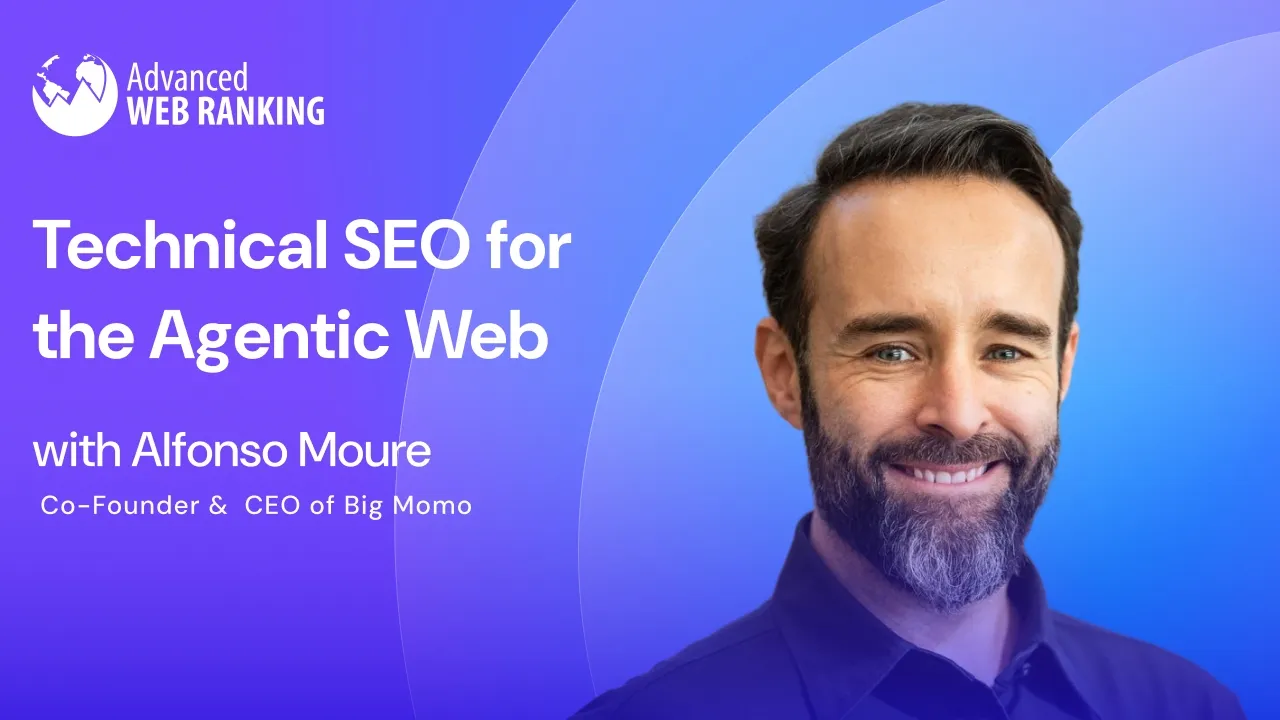
You’re here with The Search Session. I’m Gianluca Fiorelli and my guest is Alfonso Moure, technical SEO consultant based in Santander, Spain.
We look at where SEO is heading as AI becomes part of search, websites, and online buying. Alfonso brings a technical but practical view on what is changing behind the scenes, from the way bots access content to the way SEOs and developers work together.
We also talk about custom tools, agentic commerce, and the bigger question of what happens when websites are no longer built only for human visitors.
Your takeaways from this episode:
How AI changed SEO faster than expected: ChatGPT made AI impossible to ignore, but the bigger shift is how Google is now putting AI at the center of search, catching even experienced SEOs unguarded.
Why custom SEO tools matter: standard SaaS platforms can limit analysis, while AI-assisted development lets SEOs create their own tools faster and query the data they actually need.
What log files reveal about the changing web: a growing diversity of AI bots, crawlers, and agents access websites, including smaller bots created by people building their own tools and SaaS services while Google optimizes how it crawls content.
How SEO and development teams need to work together: as developers move faster with AI tools, SEOs need stronger governance, clearer priorities, precise technical requests, and better communication around the business "why."
Why agentic commerce changes online buying: Google is pushing toward an agentic web, but technical debt and user trust still need to be solved, while brands must rethink persuasion, upselling, product discovery, and product information.
What AI agents may consider beyond price: product specifications, return policies, availability, brand value, and the quality of product information can all influence how agents choose between options.
Why technical SEO becomes critical for the agentic web: AI agents often cannot rely on JavaScript, so websites need faster server responses, stronger web performance, and product information served directly in the first response.
How agentic search could make front ends less central: if agents interact directly with feeds, machines, and other agents, websites may become less necessary, while interfaces and workflows evolve incredibly fast.
If you work on the technical side of SEO or want to understand where the agentic web is heading, this episode brings both sides together.
Topics covered: technical SEO · AI search · agentic search · agentic commerce · web performance · log file analysis · AI bots and crawlers · custom SEO tools · cross-team communication · e-commerce SEO · product discovery
About the Guest

Alfonso Moure
CEO and co-founder of Big Momo
Alfonso is a technical SEO consultant with more than 20 years of experience. His work focuses on web performance, Core Web Vitals, log analysis, indexing strategies, tracking, first-party data, and collaboration with development teams.
In 2014, Alfonso co-founded Big Momo, a digital marketing agency specialized in SEO, PPC, CRO, web analytics, and development projects. He currently leads Web Analytics & Data and works on the agency’s most technical and strategic SEO projects.
He is also known for teaching, speaking, and writing about technology and digital marketing. Through his personal site and newsletter, he shares practical ideas on technical SEO, marketing data, web performance, AI, and automation.
Video Chapters
Transcript
Full conversation between Gianluca Fiorelli and Alfonso Moure.
Gianluca Fiorelli: Hi, I'm Gianluca Fiorelli. Welcome back to The Search Session. Today our guest is from the north of Spain, from the beautiful city of Santander. He's a very well-known SEO here in Spain, and he has also started to explore and communicate in English, especially thanks to his bilingual Substack. It's a super interesting one, and I really suggest you subscribe to it.
He is a deep, deep technical SEO, with strong knowledge in everything JavaScript, development, web performance, Core Web Vitals, and all these kinds of things that tend to be tricky but are substantially the infrastructure of a well-functioning website.
And like many of us, in the last few months, he has started to specialize and go much deeper into everything agentic. He's the CEO of his agency, Big Momo, with clients in Spain, in France, and in Belgium, and he's a good friend of mine. This person is Alfonso Moure. Hey, Alfonso, how are you doing?
Alfonso Moure: Hi, Gianluca. It's nice to see you again. How are you doing?
Gianluca Fiorelli: How are things going in Santander?
Alfonso Moure: Well, it's going good. We are barely starting the summer, so it's beginning to get a little warm. But because we are in the north of Spain, it's well.
AI Caught SEO Off Guard
Gianluca Fiorelli: Yes, well, and what about SEO? How is SEO treating you lately?
Alfonso Moure: It's going well, but “it's going well” depends on a lot of things, I guess, but I think mostly it's going well. Last month has been a little harsh for us because of the late updates in May.
Gianluca Fiorelli: Okay, yes.
Alfonso Moure: But yes, not bad, I guess.
Gianluca Fiorelli: And what about all the frenzy? How did all this frenziness of SEO take you? The artificial intelligence in SEO, which now seems so normal, but actually, if we think back, it’s just 18 months ago when everything started. And how much did you feel this kind of change was coming, or did it catch you unguarded, without saying, “Oh, what is this thing? How are these things changing so fast and so radically?”
Alfonso Moure: I think it took us, everybody, unguarded. I don't care what anybody says about that. It was a surprise, not how it got to us, but how Google is trying to put it into our lives. I'm going to go deeper on that. I think that as a technical role, like the one I used to work on, it's not a surprise that AI has entered our lives so strongly. But I think it's interesting to see how Google is trying to put AI at the center of the search engine, even though we already knew that Google was very good at AI. That's not a surprise for any of us.
But in 2023, when ChatGPT got to the spotlight, I think we all thought that it was going to change many things. But maybe we were too busy thinking about how to generate content or help in our investigations, our research, and our work.
And even if we knew that Google was the leader in AI, I think, at least I, didn't stop to think about how Google was going to put it there. I know it sounds stupid because I've been working on SEO for such a long time. I think I should have thought about it, but I didn't.
Gianluca Fiorelli: Yes, because I mean, Google is substantially the inventor of word2vec, which is at the base of everything we are working on and optimizing right now, and it was already using AI in the backstage for the classic search.
And yes, me too, I think that if it weren't for ChatGPT, maybe Google would have started to introduce AI into classic search, but not in a chat box. I think that the chat box was something that it was forced to introduce because it saw how ChatGPT, with a chat box, was gaining market share and popularity and especially not only as a competition factor but also as how people were reacting to that kind of product. So Google said, "Okay, we need to put it, too."
Alfonso Moure: Yes, I think the same. I think Google was pushed to go further into the chat box idea. I don't know if they would have chosen that option, at least when they were starting to roll it out. When Google finally deployed the voice search services, I think that's where Google was really trying to put AI at the center of search. It didn't work…
Gianluca Fiorelli: Yes, as we all know.
Alfonso Moure: Yes, we all know. I think that's a very interesting point, to think that maybe we would be on a different path right now.
Gianluca Fiorelli: Yes. Maybe something similar to, I don't know if you have tested it, the Web Guide, which is still just a lab test and probably, with my sadness, big sadness, will likely be sunsetted sooner or later because it's that kind of use of AI. For me it's perfect, but it's not the one that is winning clearly.
And now the model is going to be AI Mode, and with the classic search, as, using a metaphor, you know, as when the CD for music came out and then the streaming, that is the new search.
But still, people were and still are buying classic long-playing discs. So I think that classic search is going to have that kind of future. For the nostalgic, everyone who wants something “analogic search”, and still wants to use a classic search with blue links.
Alfonso Moure: Yes, I guess they need to push it into the mainstream, right? Because not everybody's used to using an AI chat box to look for things, maybe just to exchange ideas with an AI. That's enough for many people.
I think the search box with the SERP is going to stay there for a long time. Maybe AI Mode is going to be the standard, but not right now. And I think like you, that Web Guide sounded pretty good to me. But yes, it's not the time.
Whether you need to monitor AI Overviews, keep an eye on dynamic SERP features, or harmonize rank tracking data with your own internal tools, Advanced Web Ranking provides the precision and API flexibility that experienced technical SEOs rely on.
Try Advanced Web Ranking free and see how it fits with your workflow.
Building Better SEO Tools with AI
Gianluca Fiorelli: And as someone who has always liked to create their own tools, also using both third-party tools, like commercial tools present in the market, and using their API, combining all the information, and creating your own tools, as many of us are doing, to have a better vision of what is happening on your website and on the website of a client.
The evolution of AI is obviously, from one side, let's say in the frontend, what we want to optimize for. But in the backend, we know with Cursor, with Claude Code, with Codex, with Antigravity, with all the opportunities of substantially creating... I don't want to use the word "vibe code" because "vibe coding" somehow has also assumed a negative meaning. But let's say using the force of AI for creating faster and maybe better tools that you were already creating to make them evolve. How much are you using this kind of made-up, just-for-you, unique tools?
Alfonso Moure: Like a lot. I'm currently using mainly my own tools, except for a couple of SaaS solutions to extract information. Because I think that when you are using standard tools, you are generalizing by design. So you are just using something that is on the standard line.
And when you try to answer really tricky questions, or at least questions that only you will answer, it's insufficient to use standard tools. So you need to go a little further.
I'm not trying to say that I don't pay for SaaS subscriptions or that I'm anti-SaaS, but I think if you want to go a little further and to do a little more when compared with your competitors, and that's what a good SEO needs to do to do his job, you need to go a little further to push that line.
Gianluca Fiorelli: Yes, I totally agree; one of the classic problems was the nonstandardization of SEO terminology, for instance. So one tool was calling one thing in one way, while another tool was calling the same thing in another way.
I'm thinking about my specific case because I'm really working on SERP analysis, so I'm really understanding how SERPs change over time due to seasonality, changes in search intent, and so on. A very silly problem I had was that I was using different tools to get a better view, and these tools were calling the SERP features in different ways. So it was really complicated, even if I was using the APIs of these tools, to harmonize the data together. So I was needing to create a sort of "vocabulary," a sort of Rosetta Stone, for saying, "Okay, this means this for these tools," etc.
And actually, they use a facility because I'm the contrary of you. I'm not coming from a development or computer science kind of background. I'm coming from more, let's call it, content-side background.
The help of AI was where this kind of tool was, for me, quite complicated. They took me a very long time to create. Now, not that they are coming quickly, but still, I'm saving time. I'm happy to spend one week making it exactly as I want, even if I'm using AI, because I know that after all the time I spent reconciling the data, it's going to disappear and be saved.
Alfonso Moure: I was going to say that I think it's a very sweet moment for people that have development skills, especially if they work on digital marketing in this case, because like I said before, you can go a little further.
Like you said, something that maybe in the past took you two months to build, if you know where you are going, you can do in two hours, maybe four.
For example, I work a lot with log files from servers, and I always found that the tools I was using were very focused on KPIs instead of real metrics, or they were very constrained, I think that's the word, because you can't query exactly what you are looking for.
So as soon as I was able to do that by myself without investing a lot of time, it was life-changing, I think, for me and for my clients. It's a very sweet moment.
And also, if you don't have that development background, that technical background from the start, I don't like to say that you don't need to know some stuff, some technical aspects of a project, but I think you can, like you said, build your own tools from scratch and really solve very difficult problems with them.
Gianluca Fiorelli: Yes. In this case, I think the most important thing, obviously, is that having 20 years of SEO taught me a few things about technical stuff. But as always, in any kind of problem—not just in SEO, but in every kind of work—the important thing is always to be very clear about what you want.
Alfonso Moure: That’s a real question.
Gianluca Fiorelli: Yes, what do you want? What do you want to achieve with this tool? And then be very stubborn, especially if you are co-creating that tool with an AI, to say, "No, I want this, this, and this, because..." and ask, "Why are you doing this, that, and that?"
So really be very clear about what you want, because if not, you start going sideways and obtaining things that maybe are interesting, but not exactly what you wanted.
Custom workflows still depend on reliable data.
Advanced Web Ranking gives you a flexible foundation with highly customizable rank tracking, detailed SERP features, and AI visibility tracking, so you can combine trusted ranking data with your own analyses instead of relying on one-size-fits-all reports.
Try it free and explore the data yourself.
Reading AI Crawlers in Server Logs
Gianluca Fiorelli: You were citing logs. Let's do a sort of game. From analyzing logs in the past two years, what kind of history or story of a change of the web are you seeing from analyzing, for instance, the logs from one year ago and the logs now?
Alfonso Moure: That's a very good question, actually, because I think since last summer—a year; I always forget that we are in June; sorry—it changed a lot because we are seeing a lot more diversity of agents working on requests, not only on server logs but also on CDNs like Cloudflare.
And you can see very different agents working on sites. And depending on the type of content you are publishing on the web, you can see different species. It's like a zoology class of the internet.
For example, in places where you are publishing content that is more aligned with transactional projects, you can always see Google, of course, and Microsoft ones. OpenAI, you can see they're flying around. Claude, or Anthropic bots, is always present. Doesn't matter the type of content.
But you can see a myriad of other bots and agents with very strange names, I have to say. I know this is not very scientific, but there are different random names, and when you look for them, you can just go to Google and check the user agent, and you can see small projects of people developing their own tools, their own SaaS services.
And I think that's very funny. I think it's like everybody's trying to build new things, and you can see how they spread through the internet depending on the content you are deploying. So that's very interesting to me.
You can really see that Google is trying to optimize how it's working the web, reducing the number of requests they need to check what you are publishing and all the other agents or biofauna.
Gianluca Fiorelli: This can also explain why one of the most common and growing complaints many people have—I just saw it in a Spanish group too yesterday—was how much time Google is taking to index things, whether you are publishing, creating, or updating. And I think that you are somehow explaining this new behavior of Google. I mean, crawling the web is expensive.
Alfonso Moure: Extremely.
Gianluca Fiorelli: And now, with AI and query fan-out, for instance, it's even more expensive. And indexing things, especially when things become passages—what everybody calls "chunks," but they are passages—is even more expensive. So obviously, Google is also creating super-sophisticated algorithms for compressing the information crawled and so on, so as not having to substantially spend all the earnings of the year on servers.
Communicating Business Value to Developers
Gianluca Fiorelli: And another question that I have: usually, a technical SEO always lives somehow on the edge between the creative part of the work a brand has around its website and how it proposes and wants this website as an expression of the brand itself outside in the wild, and the technical and developer aspects, and so on.
I imagine that, obviously, we all know we as SEOs started to use AI a lot for creating our own tools, and surely, even more developers are using AI to develop their own tools.
So, how much is governance becoming critical for having a website work correctly? I mean, governance and making a conciliation between the things you are doing as an SEO and the things developers are doing for their work using AI. How do you make this conciliatory?
Alfonso Moure: That's a tricky question.
Gianluca Fiorelli: It was already difficult before AI came along.
Alfonso Moure: Yes. Of course. Well, I think that we need to remember that technical people are optimizing for performance, I guess, from a systems perspective. And we SEOs, if we are doing what we should do, we're optimizing for another type of performance, in this case, business performance.
So I think now with the AI tools that we are using, especially developers are getting more productive, so their hourly work is getting cheaper from the business perspective because you can do much more with that time.
And I think that we SEOs have not always been very good, to be polite, at working with developers. And I think it's a good time, though, to reconcile, like you said before, and to focus more on being more strategic when building our sprints, our backlog of tasks for the development team.
And because of that, especially developers and technical people are going to receive more pressure from above to move more quickly. So they are going to need us to be more specific about what we need and to really justify what we are asking for and why.
And the "why" is the important part because we are not used to using that when speaking with the development team. We use that kind of language when we are talking with business, with the CMO, and with the product manager, but not with developers.
And I think that is going to change. And I also think that—this is a theory of mine—developers' role is going to mix somehow with the product manager role, maybe. I don't know. So it's going to get trickier to justify what we need to do on a technical project. We will need to be more specific, like I said before. And it's going to be even more difficult to do our job, but I think in a good way. We need to push on that.
Gianluca Fiorelli: Yes, a few things here. Surely we shouldn't take everything as a high priority—it was not safe doing it before, but even less now. If everything is a high priority, then nothing is a high priority. This is what developers go crazy with.
And you were really right about justifying things with the “why.” So, translating the business “why” into something that resonates with how this business translates to what you have to do.
So, for instance, I'm just making an example. Let's say that, on a website, we want to start going very deep with UCP, Universal Commerce Protocol. So you, as an SEO, can explain how to do it, etc. But then it's the developer itself, the development team, that must do it. So if you explain it like “We must do this because we must maintain this kind of information, etc., in order to expand the possibility of growth for the business.” That can be a way to explain to them why.
For this purpose, we must be super precise, not just test how it works or check that nothing is broken. In the past, for instance, when we discussed JavaScript, we could concede a few mistakes because they weren't breaking the web. I mean, depending on where the JavaScript was, because if it was, for instance, in the head, Google was substantially stopping to fetch the page. But normally it wasn't such a huge, huge, huge critical priority.
But now, for instance, doing all the triage and all the testing before shipping the live final work is giving them that responsibility that can make them feel that they are not just working class, let's say, but they are in the same main room where decisions can be made.
Alfonso Moure: That's a very important aspect of what we have to change. It seems that we always see technical teams as some kind of enemy, and they are not the enemy. They are building the scaffolding to support everything we do on the internet, including us SEOs and marketing people. So that's important.
And we should care about how we communicate with them and what we ask them to do. And yes, I think it's going to be key to do that properly.
I don't know if you know Andrew Grove. I don't know if I'm pronouncing it correctly, the Intel CEO. He used to say that the... I know I'm not going to properly quote him, but something like "How well we communicate is determined not by how well we say something or how well we explain something"—maybe on a ticket in the case of an SEO professional—" but by how well we are understood by the receiver." So I think it's something very important that we always forget, we SEOs especially.
Gianluca Fiorelli: Yes, and I can say that especially because I work a lot on the content side too, with copywriters; sometimes this is also a kind of mistake that is made with copywriters. Somehow, just giving a copywriter something like, "Okay, you have to do this," but not really explaining why.
Alfonso Moure: Yes. It's like “What should I do with this?”
Gianluca Fiorelli: Yes, and then we have all this kind of content that was lobbed even before the existence of AI-generated content.
Google's Agentic Strategy Is Accelerating
Gianluca Fiorelli: Now, like many others, I'm really putting my head into agentic search. And is it just me, or has Google really doubled down on everything agentic in these very last four or five weeks? I mean, it never really talked about agentic, and yes, it was something that was going to come.
But then, you know, they start saying, "Okay, in 2027 everything is going to be agentic," said the CEO of Google. First came ChatGPT with ACP, and then immediately Google came with UCP. ACP is substantially a platform thing because it works just for ChatGPT, and UCP is substantially universal. So okay, bye-bye ChatGPT.
And then it comes with Web MCP. And now with all this sort of ODK. I think these are the things very recently announced. So, to create a substantial wiki about everything on a website just for the agent, with MD files, the famous MD files.
And then the search team says, "We don't use LLMs.txt for search," but the developer team says, “For agentic search, and especially for checking out where things are for the agents, we may use the LLMs.txt.” Therefore, it's a good thing to have eventually.
And then so many things came out. Haven't you noticed all this frenzy, how Google is really accelerating to double down on agentic search?
Alfonso Moure: Yes, I think that they are really pushing forward. I don't know how fast they are going to do that. Maybe a couple of months before Google I/O, I was thinking about that because of UCP, as you said before. And yes, it seems like Google is trying to do that, but I guess there's a technical debt on the internet that needs to be addressed before they can do that.
And maybe LLMs.txt is a way to do that, I don't know, for example, for content websites. But it's going to be very tricky for everybody to move forward without an agentic view of the internet.
I think it's very good news for the heavy users of the internet, like I am. I think it's going to be much easier for people like me, you, and other people who are always working on the internet to move around, to do things, and not to rely on that terrible, terrible website that you need to operate with, like, I don't know, Renfe, if you are based in Spain. We are always making jokes about our main train provider here in Spain. It really sucks.
Yes, because we are moving in that direction, maybe in the future we are going to be able to interact with services without a web, and that's a huge change for everybody. And it's a very important change for how we interact with the internet and also the world, of course. But as I said before, we have a very big technical debt in this case to be able to do that.
Keep building your understanding of AI search with more episodes of The Search Session:
Metehan Yeşilyurt on AI bots, log files, and crawl mechanics and why understanding how different bots access and interpret your content is becoming a core technical SEO skill.
Will Kennard on JavaScript frameworks, developer collaboration, and AI-assisted workflows and why technical SEO is not just about fixing issues but about shaping better web experiences.
Andrea Volpini on agentic AI, semantic SEO, and structured data and what websites need to build so machines can better understand and use their content.
Will AI Agents Change How People Buy Online?
Alfonso Moure: And in this new scenario, the one that is going to make the purchase is an agent, which is a machine; it's not a person. As you said before, I've been trying to think about how that will impact everyone, not just the technical aspects of the internet but also the human side.
When we are offering a service or a product, and we try to offer that from a website, we usually try to rely on psychological aspects of how we offer that service. For example, what's the word in English? Scarcity, or how many products are in stock.
Gianluca Fiorelli: Yes. For instance, like in the classic trick of Booking.com, where they say…
Alfonso Moure: “Just five minutes to buy that."
Gianluca Fiorelli: “This is the last room. People are watching this room in this moment," and you're thinking, "Ah, I need to reserve it."
Alfonso Moure: Yes, “I need to buy this.” Yes, or even FOMO. Okay, but an agent is not going to be affected by that.
Gianluca Fiorelli: No, in fact. But there is also another thing apart from the human side: how is this going to change, and how fast is it going to change?
Because sometimes I think we live in a big bubble and tend to believe others will do the same things we can do. But I discovered that even in this bubble, there are things I don't want to do, even if I'm pushed to do them.
But I’m thinking of non-technical people. And I'm not thinking of people in Generation Z.
Alfonso Moure: Digital natives.
Gianluca Fiorelli: Yes. People took a long time to understand and trust e-commerce and to feel comfortable buying something online. Ultimately, it was COVID that made e-commerce really boom. It became something that even my mom can now do without a problem on an e-commerce website.
I mean, okay, there are a few models. I think the only real model we can use as a precursor is marketplaces like Amazon, in the sense that we go on Amazon, on the app. Sure, we are the ones buying, or something like this, but we are used to staying on a platform that sells every kind of brand.
So maybe in this sense, for instance, Google presenting you products is going to look like Amazon, which is something that, for me, it wasn't able to do with Shopping.
Alfonso Moure: Yes.
Gianluca Fiorelli: But now it's possible to say, "Okay, I saw this product; buy it," or "Tell me more about this product and then buy it."
There are problems that I see on the business side. Because, for instance, one of the classic things in e-commerce is that before you buy something, you are offered something else too. It’s the same thing every airline is doing, or even Renfe, which is not working well, to do upselling.
So where is the upselling? At least now, it’s not previewed in agentic e-commerce. It’s just buying one product directly.
Alfonso Moure: Yes, and you don't get the same effect as when a customer scrolls through a list of products. So it’s not just upselling; it’s also about giving new ideas. Maybe the customer is looking for one T-shirt, and they go out with five different T-shirts. So I don't know how Google is going to fix that.
I guess that big e-commerce are going to try to push them to work in a different way, and maybe the UCP and how it integrates with AI Mode is currently just a test. Maybe they are just testing how people react to that kind of interface and how they interact with it.
And maybe, I guess, in the future we will see something similar to the fan-out feature when you use AI Mode or AI Overviews. Maybe something similar to that, more in the e-commerce way of things. I don't know.
Gianluca Fiorelli: Okay. So associating, or usually two of these products are associated with this.
Alfonso Moure: Yes, maybe something like that. I don't know. I don't really know.
Gianluca Fiorelli: Products. That could be, yes.
But you were also saying before, now selling things, from the classic clerk in a physical shop to the copy of a website, is usually based on persuasion, trying to sell you something, persuading you with all the things that you were saying.
Obviously, these are things that may or may not interest an agent. So I wonder how this kind of commercial language is going to be translated to e-commerce.
Because until now, for instance, e-commerce is trying to—and that's why there is such use of forums, for instance—compensate the claim of a product with what people say about the product. But there is no gray zone. So there is no "why you should buy this product according to us," etc. So it's something that is going to be missed. The art of selling things and convincing.
Because if not, it's like when you're in another industry, travel, and you see the list in hotel ads. If it was for them, they are identical to the hotel snippet. The only thing that maybe can convince you to go for one hotel or the other is going to be the price. So I wonder, is the price going to be the biggest ranking factor in this case?
Alfonso Moure: I don't think so. I think that agents are going to also… I was going to say "keep in mind," but what mind?
Gianluca Fiorelli: It could come from personalized memory, yes.
Alfonso Moure: Yes, I think that was discriminatory. But I think that maybe price is going to be a key aspect of how the agent is going to choose between two or three options. But also how the place offering that product represents the technical specifications of the product. For example, the return policies of that e-commerce and the availability of products are also something that is very important nowadays. Well, it was for a long time, but it's now in the spotlight. It's the brand value and the brand message of the provider.
So I think we should also put more effort into how we communicate our brand's values related to the product. In that sense, I was thinking that maybe marketplaces are going to have a harder time adapting to this scenario because they are offering different brands. And now, with that in mind, it's going to be trickier to use your brand to compete with other providers.
But also, if they focus on the quality of the information they provide about the product, how well they show their return policies and product availability, and other aspects of their service, they may compete at a different level than just price.
Gianluca Fiorelli: Which is already what Merchant is asking. If you want to be considered a top shopper, you must have all these kinds of things.
Alfonso Moure: But you have to show them in the front end and very close to the product,,
Gianluca Fiorelli: Yes, but Merchant is pretending them to be in the front end. If you have a return policy, you must have a page specific to the return policy that is eventually linked from any product page and declared in the product schema.
And what I see in agentic, and maybe this is the ODK, I still haven't really dug into ODK, so this creation of a sort of wiki knowledge base for agents on your website, I think that is a good example of how things are going to be. In the sense that you must maintain a strict... It seems contradictory because you can be everything creative. Just think of, let's say, citing a Spanish brand, maybe not the best website, but a very well-known Spanish brand, Zara.
Let's say all the products are put there with their own brand vision, brand image, and branding for everything. Huge photos, small description, almost no description, blah, blah, blah. And then what you see in the front end, which is so sharp and cool, behind it is going to need an even deeper and stronger technical base. Because it's not just how it works in terms of pure code and development, but also all the scaffolding of data that must be fed to the agents.
Why JavaScript May Become a Limitation
Alfonso Moure: Yes. I think that's very important also. I also think that, in the technical part of the problem, as you said before, web performance will be a very important aspect of how we serve that information.
Specifically, I think it's going to be very important, the TTFB, the time to first byte. That's the time that the server takes to serve the information to the requesting entity. It can be an agent; it can be a browser with a user behind it.
And because many of the agents and bots that are crawling the internet are not able to use JavaScript... Google is able to do that, not always, and not for all the bots used by Google, but Googlebot, the one we are concerned about for organic search, can execute JavaScript. But the others are not able to do so.
Executing JavaScript is very expensive, so for things like showing a user a product, for example, clothes, like you said before with the Zara example, you will need to show that information directly in the first response given by the server, without using JavaScript.
And a lot of websites are nowadays relying on solutions that use JavaScript to serve that content because it's easier for them, specifically when they need to update stocks in real time, for example, or when they need to show you information, like we said before, scarcity indicators of the product. They need JavaScript to do that.
But they can't interact with an agent relying on that type of technology. So from the technical point of view, we are going to lose a lot of tools to work, to sell to our users. And agents working from a search result page or working from AI Mode or from Google Spark, like they presented in Google I/O, are going to be very difficult.
And like you said before, the technical aspects of SEO are going to be much more important with this movement to an agentic web.
Gianluca Fiorelli: Yes. In fact, I have an anecdote related to a client of mine in the travel space, where they're really, really visible everywhere, including in AI search. But we are working and starting to consider very, very strongly one problem. They have a wonderful dynamic feature on the website, all based on JavaScript, and they are the ones presenting substantially the mini excerpt about top resorts with the price starting from… and so on, but because the price is changing daily, they cannot make it server-side immediately. And that's going to be problematic.
Alfonso Moure: Very problematic.
Gianluca Fiorelli: Because what we are seeing for UCP, from what I know, is going to be soon translated also to this kind of industry, like travel, lodging, and everything like this. Because they are so important. I mean, after e-commerce and shopping merchants, all travel is a huge market for Google already.
Alfonso Moure: Yes.
Gianluca Fiorelli: And so this is going to be a huge problem. Apart from that, there are also still very, very small niches, for instance, in Italy, clients who still don't want to show the price, which is crazy because they think people are going to compare prices. People are going to compare anyway. But this is some sort of Web 1.0 remnant that is still there sometimes, which you can find.
Websites that are really strong, really powerful brands are going to have these kinds of issues. On the other side, smaller brands, maybe more tech-wise, tech-aware brands, can put a foot before them and start occupying, and just because they are visible, they are going to take place.
Alfonso Moure: I think that's a very interesting perspective, but I think that maybe Google is not going to have an incentive to let those small businesses do that.
Gianluca Fiorelli: I was not saying small businesses, but new brands that are coming.
Alfonso Moure: Okay. Yes, I understand.
Gianluca Fiorelli: I need to talk with someone at Booking, Hotels.com, or a similar company to understand how they are planning for the future, obviously from a work perspective.
Will Websites Still Matter in an Agentic Future?
Gianluca Fiorelli: But let's return to agentic. What is the thing that you are finding most interesting, of all the things that you are touching now when you're looking at agentic search? What are the things that you say, "Why are people not talking about this? Why are people not paying attention to this?" Because I think these are important.
Alfonso Moure: Well, I usually say that I'm a little concerned about maybe not right now, maybe not next year, but maybe the next one. Why are you going to need a front end to do things?
If agents are going to interact directly with other agents and machines, maybe the ambiguity of human language will get in the way. So why do we care about websites?
I'm going to rephrase this. Are we going to still be concerned about the front end in the future? And I think that we need to think about that, not only because of our profession but also from a technical perspective.
Because maybe Google is trying to go in that direction. What is going to happen with our technical profiles when Google tries to keep the user on the search results page, or even inside AI Mode, and only interact with your website using a feed or another agent? That’s scary.
Gianluca Fiorelli: Yes, and now it's coming to my mind that you say something. We are talking about zero click, but in reality, we should start talking about null click.
Alfonso Moure: I think so. Yes. I think we need to talk about that.
Gianluca Fiorelli: You're right. I think that surely it is one direction we are going to take. But then I also think about human beings, and I think that for human beings, maybe there is something in the middle.
Not the same things we are seeing now with former websites and so on, but maybe not something that is only living somehow in the server where agents are talking and substantially everything is visible on many different platforms that are going to be some sort of oligarchy of the web, or oligopoly of the web, where big platforms are going to dispatch everything.
I think that maybe there is also a possibility in the middle, which is somehow an evolution of edge, substantially. So where things are living on the edge and it can be dynamic in some sort of way. I don't know; in this sense my technical knowledge is not so big, but that can somehow create snapshots that real human people can visit personally.
For instance, we are talking a lot about agents and so on, but one classic channel that is never dying and is even growing more is newsletter marketing, which is a kind of owned traffic. Where are you going to send them?
Alfonso Moure: Yes, I think that your perspective of having a middle ground solution is much better. I think it's a more secure place for our freedom and autonomy.
For example, the other day I was in the gym. Yes, I go to the gym. This is something that you should do after the 40s. And there was a guy there who was talking with his phone. And just out of curiosity, or maybe of cotilleo in Spanish, I removed my headphones. I was like, "Is he talking with someone or, I don't know?"
And he was giving instructions to a development agent. He was instructing, through his phone, an agent, maybe at his home, that was programming for him. So he is a developer, a heavy user of the internet and artificial intelligence, but he doesn't need a computer anymore to do his job.
Gianluca Fiorelli: Yes, probably he was using the function of Claude that Claude pushed a few months ago, which is the possibility to use Claude Code with voice and synchronize the mobile app with the desktop app, probably.
Alfonso Moure: Yes.
Gianluca Fiorelli: Yes, that's very heavy.
Alfonso Moure: Yes, a little terrifying maybe, but I don't know. Let's see. I think we are going to see pretty different interfaces in the coming months and ways to use them, so let's see.
Gianluca Fiorelli: Maybe we are going to be really entering the cyberpunk era.
Alfonso Moure: Oh, interesting. Ready Player One.
Gianluca Fiorelli: Or something like that. Okay, Alfonso, one hour has really run fast, maybe too fast. I still have many things I would like to talk with you about, but maybe let's make a promise for a future time. Next time we can really get into it and say, "Oh, you know those things we were talking about back in June 2026? Nothing happened or even more happened.”
But to conclude this conversation, just sell Santander to all the people listening to us.
Alfonso Moure: As a closure, do you mean?
Gianluca Fiorelli: How would you sell your hometown, Santander?
Alfonso Moure: Oh. Well, it's a good place to enjoy a sunny summer, a kind of sunny summer, without the high temperatures of southern Spain. It's a good place to be, I guess.
Gianluca Fiorelli: Yes, and I think it's a beautiful city. And you were living before in a huge, big city.
Alfonso Moure: Yes, I lived in Madrid.
Gianluca Fiorelli: And going back home, you are recovering the roots.
Alfonso Moure: Yes.
Gianluca Fiorelli: But also it's a kind of life that is different and less stressful.
Alfonso Moure: Yes. I think the quality of life is very high from that perspective. So yes, I think it's a good place to be right now.
Gianluca Fiorelli: Yes. And if you are listening to us and want to visit Spain to discover a new place, you can contact Alfonso when you are there. Say, "Hey, Alfonso, I'm here. Have a beer together and talk about agentic and search and so on.” I really recommend visiting Santander.
Thank you, Alfonso. It was a real pleasure to have you here.
Alfonso Moure: Thank you, Gianluca.
Gianluca Fiorelli: You're welcome. And thank you to everybody. Remember to subscribe to the channel, to The Search Session. Your subscription will help us grow. And remember to like this episode and subscribe to the channel, so you get notified when new episodes come out. Thank you and bye-bye.
Key Questions Answered in This Episode
What is the agentic web?
How are AI agents changing technical SEO?
Why are custom SEO tools becoming more useful?
What do log files reveal about AI bots and crawlers?
Why do SEOs and developers need to work differently?
What might AI agents look at when choosing a product?
Why can JavaScript-heavy websites limit AI agent access?
Why do TTFB and server-side responses matter more?
How can SEOs prepare for the agentic web?

Podcast Host
Gianluca Fiorelli
With almost 20 years of experience in web marketing, Gianluca Fiorelli is a Strategic and International SEO Consultant who helps businesses improve their visibility and performance on organic search. Gianluca collaborated with clients from various industries and regions, such as Glassdoor, Idealista, Rastreator.com, Outsystems, Chess.com, SIXT Ride, Vegetables by Bayer, Visit California, Gamepix, James Edition and many others.
A very active member of the SEO community, Gianluca daily shares his insights and best practices on SEO, content, Search marketing strategy and the evolution of Search on social media channels such as X, Bluesky and LinkedIn and through the blog on his website: IloveSEO.net.