


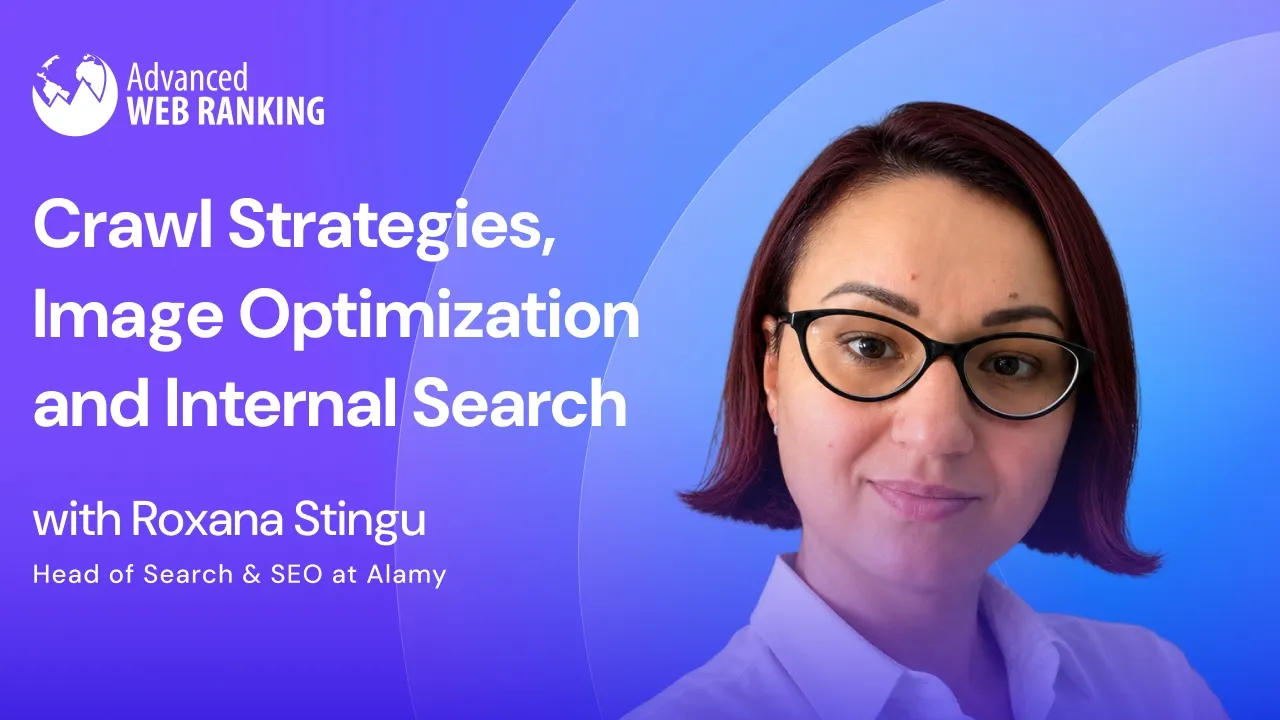
The Search Session continues. I’m your host, Gianluca Fiorelli, and my guest is Roxana Stingu, an SEO specialist based in the UK.
In this episode, we explore how SEO connects to engineering, product, business decisions, and user behavior after the click, from crawl strategy at enterprise scale to internal site search as an intelligence layer.
The conversation also moves into visual search, multimodal embeddings, automation, and the role communities play in helping SEOs grow with more confidence.
Ideas worth taking away:
Why AI search feels new even though it isn’t: Google has used machine learning, embeddings, and multimodal search for years, but more accessible information makes many things feel new all at once.
How internal site search becomes an SEO intelligence layer: it reveals user vocabulary, unmet needs, and broken journeys, helping SEOs improve content, navigation, and website architecture.
Why crawl and internal linking strategies need to evolve at scale: on large websites, bot access, image URLs, and orphan pages create business and engineering trade-offs, so discoverability and page usefulness matter more than perfect linking.
What having a product mindset in SEO means: SEOs should treat the website as the product, work closely with engineering, product, QA, and UX teams, and adapt strategy to the business model.
Why image search matters for conversion: visual search users often convert better because they see the product before clicking, making image optimization, page performance, and surrounding content essential.
Why image relevance now works like content relevance: embeddings place images and text in the same vector space, so stock photos can work if they’re close in meaning to the content.
Why visual search is still limited in Google and LLMs: reading images at scale is expensive, so LLMs rely mostly on text, while Google may analyze images more selectively.
Why automation needs both ambition and limits: constructive laziness removes repetitive, low-value tasks, but automation still needs documentation, monitoring, fail-safes, and human judgment.
Why SEO communities have real career ROI: strong communities create safe spaces to ask questions, build confidence, discover opportunities, grow your professional presence, and learn from the work and expertise of others.
Join us for a conversation that goes deeper into images, crawl, and the realities of how search works at scale.
Topics covered: technical SEO · enterprise SEO · image search · visual search · AI search · multimodal search · internal site search · crawl strategy · internal linking · product mindset · automation · SEO communities
About the Guest

Roxana Stingu
Head of Search & SEO at Alamy
Roxana has over 15 years of experience in SEO, with a career built around technical SEO, enterprise-scale websites, and image search.
Since 2019, she has been working at Alamy, a global stock photography, video, and live news platform where customers can license visual content from photographers and agencies around the world.
Roxana is a regular speaker at SEO, digital marketing, and technology conferences, covering technical SEO, image search, AI, performance optimization, and e-commerce search.
She also serves as a judge for search industry awards and mentors AI innovators at lablab.ai, where she works with startups and developers on digital growth, marketing, and SEO.
Video Chapters
Transcript
Full conversation between Gianluca Fiorelli and Roxana Stingu.
Gianluca Fiorelli: Hi, I'm Gianluca Fiorelli, and welcome back to The Search Session. Today we have as a guest someone I wanted to speak with and finally had the opportunity to meet, even if it's not in person; at least we did it virtually. Also, because she has been working for a company for quite a long time now, Alamy, which surely all of you know, and which is all about images. And as you know, image search and video search are my pet peeves.
This person is Romanian, but she actually lives in the UK, like many, many people we know. She has more or less 15 years of experience in the industry and also has a wide experience as a consultant, if I'm correct, and has a strong background in technical SEO, not only because of Alamy but also with clients.
She's very keen on enterprise SEO, obviously image search, and she's also one of the many members of Women in Tech SEO who have already been guests of The Search Session. And talking about the SEO community, she's also a judge for Search Awards, and she writes blog posts and participates in webinars. She's a person you surely are going to recognize. Our guest today is Roxana Stingu. Hey, Roxana, how are you doing?
Roxana Stingu: Hi, Gianluca. I'm great. Thank you for having me.
Gianluca Fiorelli: So, as I ask all my guests here at The Search Session, how is SEO treating you, especially in these last 18 months, where everything all of a sudden changed?
Roxana Stingu: You say all of a sudden, but I think every year we keep saying there's a big change in SEO, SEO is dead, and yet here we are so many years later still doing what we call SEO, right? So I think it's keeping me on my toes for sure, giving me a lot of new things to learn and a lot more new things to experiment with.
Visual discovery is becoming a bigger part of the customer journey, but visibility in image results can be hard to monitor at scale.
Advanced Web Ranking lets you track image-related SERP features and Google Images rankings, helping teams identify where visual optimization creates opportunities.
Track your image search performance with AWR, try it free.
Gianluca Fiorelli: Oh, that's true. That's true. If we remember, I think that more than 10 years ago, everybody was scared by the mobilegeddon. Do you remember? Everything is going to be mobile, and mobile is going to be the main index for SEO, for Google. And then, before we even had the HTTPS fear, so everything related to secure navigation is going to be...Then it was page speed.
But it is true that of the many big changes that we have experienced, obviously AI can be considered a before-and-after moment because if it's true that Google was already using machine learning even before the appearance of a chatbot, now this is so present, not only on Google, Bing, LLMs, and so on, that what is changing is the search behavior of the people.
So maybe this is the true change more than anything else. I mean, how people are searching now, maybe the nuances or the specifics of how a search works. There are changes, obviously, but maybe not so dramatic for a skilled and experienced SEO. What do you think?
Roxana Stingu: Well, we say it's new, but it's not that new, and you're very well aware that Google, as you said, has been using machine learning, but not only. Google invented Word2vec, which is kind of the father or mother or whichever sibling you want to call it, for embeddings that we use today, creating vector spaces to put information in and understand it better.
They've talked about multimodal search a couple of years ago, when we still didn't know much about AI as we know today. So I think the difference is that in the past two years, we got so much more information. The field opened up to everybody, where it used to be more gated, and then we'd get little information about it, and there were just a few people who would dig deeper and understand it a bit better.
But now any SEO has access to this information. Any SEO can understand how it works, what it is. It kind of takes that secret side of Google away. It's still there. We still don't know everything about ranking and other mechanisms, but it just gave us part of the field that Google uses that we can actually understand and dig deeper, and it's accessible to everybody.
That's why I think it feels so new. But it's been there, and it's been evolving for many, many years. It's just now accessible to all of us. You can just go to ChatGPT and ask, "How does this RAG thing work? How does this embedding thing work?" And then you can get all that information in any format you want, so anybody can understand it.
Gianluca Fiorelli: And talking about embeddings, you cited “magic word," one of the most cited words in the last almost two years, which is a word that I actually remember from 2018; it was a JCON. There, it was maybe the first person to start talking seriously about embeddings.
And he was saying, "This is why we are starting to see Google presenting so many different features, and it’s able to do this because of how it’s using embeddings for better understanding the relationship within topics, subtopics, etc." And also, he was one of the first, if maybe not the first, to openly suggest using embeddings for SEO in order to improve the quality of our work.
Internal Search as SEO Intelligence
Gianluca Fiorelli: And talking about AI search, you talk about a couple of things that, for me, are interesting. Considering a website like Alamy, for which internal search is hugely relevant and important. You talk about how to use internal site search as an SEO intelligence layer and how this works. It was very important before, and now maybe is improved in its importance, considering that AI search is a search that goes far beyond the classic long tail and is going to be a really super precise and surgical search.
Roxana Stingu: Internal search definitely opens up the world, especially if you're an SEO, because a lot of the great information that we get, we think it's happening on Google, and we get it from Search Console. But actually, the best information you get about users happens after they click, when they come to your website.
And it's a bit ironic because we've had website data for so long, and as SEOs, we do use it to report on things, on what users do on the website. But we don't necessarily use it to understand from the SEO point of view.
With internal search, it really makes it a bit clearer. You can understand user vocabulary that you can then go and use in your content to make that content seem more familiar to users and easier for them to understand.
You can look at search data and kind of see queries that are not about your product but about their need as a user, because users tend, if they see a search box, to use it for everything. They don't care what the search box is for.
And for anybody watching now, especially if you work on an e-commerce website, I urge you, go to your search team and ask them, in their internal search data, if they are seeing questions about delivery times, about returns, about getting help, or about getting more information, even though your search bar is for products.
Because I can guarantee you, people will use it, and that's great information. Imagine somebody uses the product search bar to search for returns, for instance. See what page they were on when they did that, because it means from that point, the journey is broken. They can't find the information about returns.
So that kind of informs you how to fix your website architecture because something's not working in some places. And it's the kind of information that on large websites, it's really hard to find. You can't just crawl the website and then put that information on every single page because then it would be a very messy website, right?
You would have a very heavy menu or a heavy footer. So it kind of gives you extra information about what users need and where journeys are broken, and it's not just about the product they search for.
Gianluca Fiorelli: And talking about internal search, just to generalize, there have always been two philosophies about how to take a look. One is to give total liberty, total freedom, to the user to do the internal search with what they want. And the other one is the one that also presents a very strong auto-search suggestion inside the internal search to guide the person.
Visual discovery is becoming a bigger part of the customer journey, but visibility in image results can be hard to monitor at scale.
Advanced Web Ranking lets you track image-related SERP features and Google Images rankings, helping teams identify where visual optimization creates opportunities.
Track your image search performance with AWR, try it free.
The Engineering and Business Reality of Bot Crawling
Gianluca Fiorelli: The technical implementation is not as simple as it may sound; essentially, you are creating an internal search engine. What is your preferred way to deal with internal search, apart from the classic not letting search parameters be indexed by Google? What are the things that you would recommend to other SEOs to check and to control and to own with strong attention when it comes to internal search?
Roxana Stingu: My role here at Alamy is Head of Search and SEO, and everybody assumes search is PPC, paid advertising, because it's tied to SEO, but it's actually our e-commerce search engine. So our engine that powers the whole platform.
And that gives me a rare opportunity of seeing how search is built from an engineering point of view, so everything that happens there. But also seeing how search influences customers from a more business-side view, and trying to match the two.
And in doing that, there's a lot that comes out of it, and then you realize things that maybe mattered for SEO don't matter as much in the bigger picture when you also look at it from an engineering point of view and from a business point of view, not just the SEO side of things.
You mentioned parameters and facets and things like that, and I think there's a lot of information out there on how to deal with this effectively and get rid of duplication and not waste crawl and things like that. But I think one of the things that people don't really look at is that crawling is not necessarily just an SEO problem. It's an engineering problem. It's a business problem because crawling a massive website requires a lot of resources and requires a lot of scaling based on how crawls increase, and that is a cost, right?
So when you look at it from an SEO point of view, you think, "Oh, Google just needs to use its crawl budget more effectively." But it's not just Google, is it? We have all of these crawlers. We have everybody crawling nowadays for information.
You have the six search engines. You have the AI search engines. You have Apple crawling for no good reason because they haven't put up anything out there that we would be able to use from an SEO point of view.
You have a lot of crawlers nowadays that come in and pretend to be users, and they're very efficient at it because they manage to fool any kind of blockage you would have on your servers to identify bots. They manage to fool even analytics. So even Google doesn't see them as bots and lets that traffic go into your analytics as humans, although it's bot traffic.
So all of this becomes a problem that is an engineering problem, but it's usually SEOs who discover it because, as I mentioned, you see it in analytics, and who uses Google Analytics if not SEOs? You see it in your log file stats, and who monitors those every day if not SEOs?
And of course, DevOps, but SEOs can see it and recognize it as "I have this bot with no value for anybody crawling us massively. Maybe we should block it." And it's also us who understand robots.txt very well, and we understand how to use it to block these.
And how this ties into search, through search, right? You create all these pages, you create all this content, everything, and I think it's an SEO's problem to understand what value some pages will have to what bots. Because not all bots will get the same value.
So, to give you a better example, maybe you want to let Google crawl everything, but then when it comes to AI bots, you don't really want them to go down the filter routes because then it's so many more pages, so many more parameters, so many more crawls, but you're not seeing the value coming back. Will somebody searching in ChatGPT need to find that very specific page that has like a 30-feature combination of parameters in the URL? Will that be an actual scenario that will happen?
So, I think one of the things is that we need to become more granular with how we block and what we block and what pages we let people see and what pages we don't, even when it comes to search.
And maybe that wasn't a good example because if I am on ChatGPT, I will probably get very granular before I click. So I will want to see that product in that color and that size and everything. That would help me if I clicked once and I get the exact product I've been talking about. So maybe we do want to let AI search engines crawl very deeply, while maybe for Google, there's not much value because there's a lot of duplication.
Gianluca Fiorelli: Or maybe if we talk about AI models, we can decide, okay, for ChatGPT, it may have a value because it's also, along with Gemini, which is Google's, the most consumer-faced type of LLM.
And instead, maybe we can be more conservative in the crawling by Claude, for instance, or even Perplexity, mostly because Perplexity doesn't have such a big user base. So in that case, the combination of search opportunity and business opportunity is going to suggest to us that some kinds of pages shouldn’t be crawled so deeply by Perplexity, for instance.
And then obviously there are so, so, so many other AI bots, and then let's see when the agent bots are going to occur; they are already starting to be there and visiting our website. So there is, let's say, a plethora of this kind of non-human user for our website.
Visual discovery is becoming a bigger part of the customer journey, but visibility in image results can be hard to monitor at scale.
Advanced Web Ranking lets you track image-related SERP features and Google Images rankings, helping teams identify where visual optimization creates opportunities.
Track your image search performance with AWR, try it free.
Adopting a Product Mindset in Enterprise SEO
Gianluca Fiorelli: And before, you were talking about SEOs not just thinking about SEO, but strictly collaborating with the engineering side of a company, and also with the business side. And if I'm not wrong, this is what you define as SEO having a product mindset. So, can you better explain what this product mindset is and what the best advantages are of making this mindset ours?
Roxana Stingu: I used to think just like any SEO, right, that I'm optimizing for Google because that's kind of the main search engine that was dominating everywhere. And I used to work in web hosting, like GoDaddy. And it's very content-heavy as a niche. It's a lot of information. It's a lot of personal touch in the content you create, and you have to put a lot of thinking into it and how to make it useful and everything.
And then I made the jump from that, from almost like a SaaS, to e-commerce and enterprise. And all of a sudden, I'm dealing with programmatic and automations and things like that. So the human touch is not there as much as it was before. And this is when I kind of had this mind shift because I'm not optimizing for Google anymore. Google is not my product anymore. My website is. That's the product that I have, and I need to optimize it to sell it.
And then my customers or my clients or my users are search engines and AI engines and any other kind of discovery system that needs my website to discover what information we have. So this is when I'm not seeing it as optimizing for Google anymore. I'm seeing it as I have this product and what I need to do with it to make it better for consumption for users like Google, for instance.
And I think, if you just flip it the other way around, it opens up a different type of thinking but also different types of opportunities, because now, if this is my product, my new team has become the engineers, the product people that we have in the company, the QAs, like everybody who touches and has influence over the website.
And that's why I've pushed for the SEO team not just to be one of the teams involved in things but actually be part of the delivery team. Anything that happens on the website, there's an SEO team member in every team who has the power to change it. And it's not just that we have product engineering, SEO, and UX. That's how our teams are built because those are the people who need to be in the room anytime we discuss changes to the website.
Alamy: The Intersection of E-commerce, Marketplace, and SaaS SEO
Gianluca Fiorelli: I see, yes, totally. And talking about working with an enterprise, before you cited GoDaddy, and now you're working at Alamy. I have a question regarding Alamy because you also talk about Alamy substantially selling as e-commerce, which is not something that immediately comes to our mind, because we see images and so on. But maybe because they are not shoes, we don't consider them in the same way, even if the value of a PDP is the same as any image that you are selling the rights of.
First of all, because this is from my ignorance, I'm totally declaring my ignorance here. Is Alamy also using Google Merchant?
Roxana Stingu: No. So it's a weird combination of things. It's quite unique to be in this industry because of the way the business is set up. Because we sell property that belongs to photographers, we're a marketplace where search is at the core of it.
In terms of how we sell our products, because you don't actually buy an image, you license that image, so you're actively buying a service, not a product itself. From that point of view, we somewhat act like a SaaS.
But then, from how the website is structured, where you have PDPs and category pages and stuff like that, it acts like e-commerce. So it's more from my point of view as an SEO, in optimizing, I have to think about all three when trying to make this website work for search engines and users alike.
Because in some situations I have to think like it's e-commerce and go for that. In others, I have to think it's a marketplace and go for that.
Gianluca Fiorelli: And the third case would be, as you were saying before, you also have to think of yourself as software as a service, somehow.
Roxana Stingu: Yes, we're not selling the product.
Gianluca Fiorelli: Yes, it's a very uncommon combination because usually we always think, okay, for a marketplace we have to consider this thing. For e-commerce, we have to consider this thing. But somehow they are, let's say, siblings.
But software as a service is usually considered a totally different kind of thing. So it's more about selling the service, not just the product. So we have to balance between how to give the right visibility to the different natures, in this case, of Alamy as a brand.
Roxana Stingu: And I think this is why Google Merchant doesn't actually apply to us because even though the website is structured like e-commerce, the product itself is SaaS. So then it doesn't really work in there. You don't expect to find stock photography for licensing when you go to the product tab in Google.
Gianluca Fiorelli: Yes, it's right. And somehow this is similar to an experience I had with a client of mine in the past, who is a marketplace for educational courses. And they actually tried the Merchant way, and actually, it wasn't working that much because Google wasn’t really pushing Google Merchant organically.
Maybe Google Shopping was different because it was a better product for selling advertising space, but in the classic organic Merchant feature, it rarely appeared because Google was not considering this a formal mainstream type of product like retail products or B2B industrial kinds of products.
Visual discovery is becoming a bigger part of the customer journey, but visibility in image results can be hard to monitor at scale.
Advanced Web Ranking lets you track image-related SERP features and Google Images rankings, helping teams identify where visual optimization creates opportunities.
Track your image search performance with AWR, try it free.
Image Search as a Conversion Channel
Gianluca Fiorelli: But obviously, and this is surely one of your specialties, you sell your PDP, you have a Google PDP, which is in image search when people click on an image with your product label, and especially, as I always said, when you are on mobile, that expanded unique view in image search of an image actually looks very similar to a product page. How do you work in that sense? Google Image also has a potential first step to a conversion.
Roxana Stingu: It's a very difficult one. There's a theme here. I do like my challenges. You don't get a lot of information on image search as a search facet, right?
You're very aware of all the SEO tools, and probably half of them know me because I always ask, "Are you going to introduce image search in there?" You get some information in Search Console, but you know what limitations it has.
You can't really break it into image and web search in analytics, so you can't really quantify sales from just image search. But there are patterns that kind of confirm that image search works best for us more than web search.
So web search might be more discovery, but we know that people coming from image search will convert better every time. And it makes sense because we have images. They have to see them before deciding that they want to come to our website.
I always say optimizing for image search is pretty much optimizing, period. You need a good website even for image search. You need good page speed performance. You need great content around your images.
You'd optimize your images anyway in terms of sizing to get that page performance. So there are things that you would do just for image search, but pretty much, if you do the things that just make your website great for users, then you'll be fine in image search as well.
And it's not just for us in the stock industry, but a lot of retail websites that are online, that have a presence, will showcase their products in image search as well.
And I think if you go now and search for any product, you will find that the majority of results come from websites like Temu, Shein, or these sites. And that's because they are so good at optimizing, and they know a lot of people are very visual, and they don't necessarily search in web search. They search in image search for the product they want.
So they're very, very aggressive in being present there, unlike a lot of maybe more classic e-commerce websites that appear in web search a lot, but when you switch to the image tab, you don't really see them anymore.
So I think this is an opportunity for a lot of websites to consider, even though you can't really measure that easily if image search is converting for you. I can guarantee it is. People are just very visual, right?
Google gave us Google Lens, and they kept improving it for so many years. There's a reason there. They wouldn't invest if it wasn't something that a lot of people use. And then they even gave a Circle to Search, which again is a visual search that ties into Google Lens, because people are very visual.
Gianluca Fiorelli: Yes, the importance of visual shopping is something that I also really stress a lot because it's even more evident when you just look at the search menu in the universal search and you see the image box in the universal search. Once they were more present, now Google seems to push more on video SERP features.
But anyway, the same search menu presents AI Mode and All tabs, and then it immediately presents Image. That means that, for instance, if you are, I don't know, furniture like IKEA or this kind of e-commerce, or you are a fashion brand, or you are an apparel brand, even if you are a real estate brand, image search matters because people want to see the apartments, the inspiration for the type of apartment, the plans, and so on. Image search is very ignored.
And you are introducing, substantially, Google Lens and Circle to Search, which doesn’t really exist for Mac or Apple users. But we can still do something similar with the function of Google Lens in image search. So we cannot really circle, but create our things inside, searching for an object in an image.
It's very important to have very different types of product images. Not only the classic product image, which is again in Google Merchant recommended and obligated with a black or very clear background, the front, and the lateral view, but also the real-life type of image and so on because people searching are looking at an inspirational image, and when they see something inside the image, they want to look for that specific something, an object that they found inside the image.
Visual discovery is becoming a bigger part of the customer journey, but visibility in image results can be hard to monitor at scale.
Advanced Web Ranking lets you track image-related SERP features and Google Images rankings, helping teams identify where visual optimization creates opportunities.
Track your image search performance with AWR, try it free.
Ensuring Cosine Similarity Between Copy and Images
Gianluca Fiorelli: I think that for people like you and me and others who are so fond of image search, image search is so interesting. Maybe we were the first ones that started to consider, returning to the very beginning of our conversation, the "embedding," let's say, embedding, entity closeness, and so on, value inside of an image because of the relationship between the components of an image. At least this was my experience. Was it the same for you or not?
Roxana Stingu: Yes. With multimodal, it kind of changed things because the image wasn't just one element on the page. It brings in information alongside content in the same way because both can live in the same vector space, right? Because you can embed both and get that information. So now, as you're searching, your image becomes the information itself. It's not just an object anymore that exists somewhere.
And I think this is where people need to understand that before you could slap any image on a page and it didn't necessarily have to be relevant to the topic, that doesn't work because the information from the image needs to be in a very small, right cosine similarity distance from the content of the page. And now it's so easy due to embeddings to check if that's true or not.
So I think this is where, because I'm in stock photography, the question comes: can you use stock photography for content and still rank well with those images? And the answer is yes, if that image is relevant to your content. It's not about where the image came from, if it's stock photography, whether you took it on your phone, or whether you stole it from somebody's website. It's about whether that image and that content will be in the same space, very close together, because the image is relevant for the content or the content is relevant for the image.
Because if you just use generic photography that has nothing to do with the content you have, like all these industry websites, they talk about marketing; they just use a picture of people in an office. How does that represent marketing? I don't know, right? So that image in that case doesn't really bring any value. Why don't they use a schematic of something that they're talking about, like visualizing what they're putting down in bullet points or things like that? That would bring some value visually to that article.
But going back to stock photography, imagine you're a travel blogger, and you're writing about the unique layout of Lisbon, how it's built, and its quarters and everything, and you don't really understand how that layout is significant until you see it from above.
But you, as a travel blogger, can't really afford a helicopter to go on a ride above Lisbon to take a proper picture. So you will license an aerial picture of Lisbon from a stock photography website to be able to drive that point across and talk about the structure of the city.
Gianluca Fiorelli:Totally, totally.
Roxana Stingu: In that case, it's very relevant. You've provided value to that article because you talk about something visual, and without the image, you can't really drive that point across well.
Google won't care where that image is coming from. In that context and on that page, that image is highly relevant and useful.
Gianluca Fiorelli: Especially because sometimes stock imagery is not bought directly by an SEO, who can eventually inform how to buy this kind of image. This is something that, in plain language, we can tell the people responsible for this part: “Okay, if you are going to spend on licenses for a stock image, choose beautiful ones, but follow our suggestions.”
So make them relevant, not just decoration, because if not, we are not going to take any advantage beyond the sensation of having a cool website, a cool page about, I don’t know, Rome or Valencia.
And a question. Now that LLMs have come, I want to make it easy: not just talking about ChatGPT or others, but talking specifically about how images are used. Not really in AI Overviews, because I don’t see images there. At least in two years, I’ve never seen images in AI Overviews, but sure, in AI Mode.
Visual discovery is becoming a bigger part of the customer journey, but visibility in image results can be hard to monitor at scale.
Advanced Web Ranking lets you track image-related SERP features and Google Images rankings, helping teams identify where visual optimization creates opportunities.
Track your image search performance with AWR, try it free.
Visual Query Fan-Out: How AI Search Expands Beyond Text
Gianluca Fiorelli: In ChatGPT, for instance, if you are talking about travel, and I work a lot with travel brands, images are very present. Because we always talk about query fan-out for text, what about visual query fan-out? So, how do LLMs combine them both, expanding the search also for multimodal elements to use in the answer?
Roxana Stingu: Oh, great question. It's an area I'm trying to get more information about because there doesn't seem to be enough. So when it comes to how LLMs are treating images, my research so far kind of tells me they're just secondary things. They're not necessarily being brought in as main content.
So it would still be the page that brings in the content and the image with it. So I don't think there is a lot happening on image search specifically. I still think it's textual search, and then once websites are identified, the images come with them.
I would be very glad if somebody told me I'm wrong and showed me different research or proof, because this is what I've been looking for, and I can't seem to find much.
Gianluca Fiorelli: Yes, I think that the only person who did some kind of study in this sense was our friend, Andrea Volpini, who already talked about visual embeddings and so on. In the past, they even created a quite experimental tool for visual embedding on WordLift.
And yes, I think it's easier for video content because video content also has three layers. It has image, it has sound, and it has transcript, so words. And in this sense, for instance, for AI Mode, it's easier to recommend a video about the specific question we have asked in AI Mode. There is the answer, and then if you want to know more about this thing, this video treats it. Because there is a big context for, in this case, AI Mode Gemini, to suggest a video.
Learn more about video as a visual search signal
In the episode with Myriam Jessier, the conversation goes into why video give LLMs richer signals than text or images alone, how brand visuals affect AI recognition and recommendations, and what brands need to do to show up correctly across visual and AI search surfaces.

Gianluca Fiorelli: In the case of images, I think it is really doubling down on the classic image SEO best practices. Not just the alt tag, classic alt tag, or the name, but also, as you were saying, the image must be relevant for the content we are presenting the image in, and therefore the content surrounding the image is gaining even more importance, eventually for being the one that is picking up the image instead of the image of another page.
Also, because these images are not just there for decoration of an AI answer, they are linkable assets, so they can be maybe even more important for click-through rate in an AI answer, because they invite you to click on the image. There is this sort of unconscious impulse to click an image more than clicking the icon emoji that is put at the end of a phrase.
How Search Engines Decide Which Images to Understand
Roxana Stingu: Sorry to interrupt you. I think we want to believe that Google will read all images, that it will understand the image itself for all images across the web, and that LLMs will do the same.
But being part of the search team that's built a search engine, a new one for Alamy that's a hybrid engine, that uses vector embeddings for all of our images to be able to search in both our metadata and inside our images, I can tell you how expensive that is, how time-consuming, and how many resources you need to embed that many images, and we only have like 400 million.
Imagine how many images Google or LLMs come across every single day on the web. And not to mention that our images are coming from photographers; they're worth it. But a lot of the stuff that's online is not even worth the computing power to understand what's inside the image because the internet is full of bad images or things that nobody should see anyway.
So I think as much as we want to believe that anybody will go and read every single image, I don't think that's happening. And especially with LLMs nowadays, I think they're very, very basic in how they treat things. Even how they crawl the web, they're very basic. Even how they understand the page, they're very basic. A lot of them don't even render JavaScript because that's computationally expensive. And I doubt they actually read inside the images.
And if they do, they must do it in very specific situations because otherwise it would be so expensive and the ROI wouldn't be there for them. So why would they do it from a business point of view? It would be an expense that doesn't necessarily give them back the money. And even with Google, I think Google does it to a degree, but I also think they have very strict filters when they do it.
I talk about image search, and in my slides, I have an example. If you search for "pizza with anchovies" but in French, you find this picture of a woman coming back in the image search, and she's a woman. How is that happening?
And it's actually a very, very, very old experiment that somebody did to see if Google understands what's inside my image. And this was way before we were talking about embeddings and things like that. But that example still works today, and I think that's because the domain where they published this experiment has so much authority. Google doesn't feel the need to invest more in understanding the image because it trusts that domain already. And on that domain, all images are relevant except this one, that they did as an experiment. So this image is the only one that doesn't quite match that trust that Google has. So that's why it keeps getting missed, I think.
But imagine you're a new domain that just doesn't have enough signals, doesn’t have enough authority, and doesn’t have enough history with Google. I think in that case, it will try to understand if what's inside your image matches what's on your page to see if you deserve that trust. And I think you get to a point where Google says, "I'm not going to spend more money understanding your images because you've always been trustworthy from this point of view."
But that's only my opinion, so if anybody quotes it, please mention that's Roxana's opinion. It's not fact.
Visual discovery is becoming a bigger part of the customer journey, but visibility in image results can be hard to monitor at scale.
Advanced Web Ranking lets you track image-related SERP features and Google Images rankings, helping teams identify where visual optimization creates opportunities.
Track your image search performance with AWR, try it free.
Crawling and Indexing Millions of Images at Enterprise Scale
Gianluca Fiorelli: Yes. And image is so important for a site like Alamy. And yes, we always talk about things like crawl budget, how to indicate correctly to Google what to index and what not to index.
And if we usually think of big enterprise websites as websites with a huge amount of URLs, many times people don't really have a consciousness of how many of those URLs are image URLs. So how do you decide, okay, we must sell this image, we need this image in image search, but how do you guide Google’s crawl correctly through this massive amount of image URLs?
Roxana Stingu: I have the answer you're looking for. Are you ready for it?
Gianluca Fiorelli: Yes.
Roxana Stingu: You don't.
Gianluca Fiorelli: Ha! Imagine. You pray.
Roxana Stingu: You could. So, you know, there's graph theory, how to connect things, how to get everything connected to each other, and stuff like that. So you could come up with an algorithm that connects everything. But if you look at how that experience turns out to be for users, it wouldn't be a good one. You'd have random pictures showing up as related just because you needed to create a link to it.
If you only do internal linking based on relevancy, there's always going to be a part of that massive, massive collection of images that will not get links. It is what it is. And it's also going to be clusters. So you'll have a cluster that links and another one, but these clusters are not necessarily connected because they're so far away. And this is exactly how a vector space works. You will have a cluster of information here and another one here, and there won't really be a connection between them because that distance is too big.
So you could do it if you wanted to, but it's not necessarily a good user experience in the end. And I think search engines like Google know this, that the bigger the website, the harder it is to create that internal linking to the degree we'd want it. Like, if we're thinking classic Page Rank back in the day, it would be really hard to obtain that and have a high PR for every page. It would be a really messy experience for users.
So I think because they know that, sometimes it's enough just to make sure all your pages are in a sitemap and discoverable that way. And people will say, "Yes, but Google doesn't really like orphan pages." And I think that's right on smaller websites. But when it comes to this size of a website, I think orphan pages are not a problem because Google understands it's impossible to create that internal linking for everybody without sacrificing experience.
So then they will index orphan pages if they're not orphaned through backlinks, but you can actually find them in sitemaps, and they're discoverable. But it all comes down to, is that page useful? It doesn't matter if it's linked or it's not linked. If it's not useful, even if it has links, it won't really show up in the index anyway.
"Constructive Laziness" and Smart Automation
Gianluca Fiorelli: Yes, totally. And let's move to another topic quickly, but I'm curious to know, because you talk quite a lot about it. What is your definition of constructive laziness? I found it fascinating because I tend to be, unfortunately, in some cases, a procrastinator and quite a lazy person.
I don't want to define myself as lazy; it's not cool. But I take my time; I do not rush. So what is this constructive laziness?
Roxana Stingu: So I am a lazy person by nature, but I'm also very ambitious, and the two don't really work together because I want to get a lot done, but I'm lazy, and I don't want to do a lot of work.
So I'm lazy, but in a way where I automate things I don't like doing. So I take away work from my plate, but work still gets done, and that's automation, right? So any kind of repetitive task that I'm bored with, and I'm thinking, "Oh, I don't want to do this again," I automate, and then I never have to do it again, but the work still happens. My output is still great.
And it's not just in work, it's also in life. I'm very organized. Everything has a place. Everything has a system. And a lot of people look at my closets, and they're very organized by type and colors and things, and they go, "Oh, you must be OCD or something."
And I'm like, "No, I am the most disorganized person you know, and I know that's not efficient, and this is why I'm now organized, because this way I'm not going to waste a lot of time finding things in my closet because everything has its place. It's very easy for me to pick what I need."
Gianluca Fiorelli: Yes, I totally see myself taking this way.
Roxana Stingu: Right, exactly. But I'm not organized at all. It's not something that is a trait of mine. I do it because I know it's efficient and it will save me time down the line, and I can be a bit more lazy in the morning, picking up my outfits or whatever.
So it's the same with work. If I've done something a few times by myself and I'm not finding more value in it, so I'm not growing from it, I'm not learning new things, I'll automate it if I can. And even that automation itself is something that teaches me something new. And that's what I mean by the constructive side. It's that I don't do the work anymore, but the work still gets done. So this laziness drives me to find automations for things.
Gianluca Fiorelli: Two questions, but in reality, it's just one. How much automation is too much? And the second one is, what are the things that you would never automate?
Roxana Stingu: So you could have too much automation if not done right. So if you just go automate things and create no documentation, you don't have any failure systems in, you don't do any of that and just automate the work and leave it, you have no monitoring way of knowing if it's working or not, then you went too far.
You need to go back and improve the automations you have instead of building new ones. You need to be able to monitor if they're working because with automation, if it's silent and in the background, you have no idea what's going on.
But you need fail-safes. So if it's not working, you should get an email, or you should get an alert or something. You need to make sure it's useful. So, if you're going to put in two days of your time to automate something that only saves you five minutes every month, is it worth it?
You could use that time better elsewhere, right? So automating just for the sake of it is not really necessary.
There were stories about this person who even automated the coffee machine in their office. They'd go in, and the coffee machine would pour the coffee exactly as they were walking into the kitchen or something. That's a bit overkill. It's fun, but it's overkill, right?
And in terms of what I would never, ever automate, I think anything to do with human creativity and human thinking strategy should not be automated. That should always be something that we take the time to think about, develop, and come up with.
Anything that's mind-numbingly boring and gives you no value whatsoever, automate it immediately. Get it off your plate and never look at it again, unless the automation breaks, and then you have to fix it.
Gianluca Fiorelli: Yes, I totally agree. Even if you can automate a certain part of a creative workflow, in those cases, always, as you were saying, have very strong guardrails to avoid producing incorrect things through automation, and especially have many stop points to review. Have you as a human reviewing the outputs. I usually do it with tasks. I really segment a workflow into tasks, and every task has its own guardrails and a stop point for me to review what it has done, asking why you have done this and not that, and so on.
Roxana Stingu: And especially with AI, it's so easy just to think, "Oh, I'll just let an LLM build this or think about this or whatever." This is a problem we have. We rely on AI to build content, so we automate content building, and then we're like, "Why doesn't it work on Google?"
Because there's no thought to it. LLMs seem great, but if you kind of look at what they produce, it's just what already exists because that's their training material. That's where it learned from. They can't produce really new ideas because they don't exist in their training.
So I think that kind of stuff should come from humans. And yes, you might put your really good ideas on paper in a messy way and then give it to an LLM to make more sense of it. That's fine. But don't fully automate content creation because you will just create more AI slop, and boy, we have a lot of that.
Continue exploring
The conversation with Roxana is part of a broader thread on The Search Session about how AI systems actually access, process, and understand content. Two other episodes go deeper into different parts of that picture:
Aimee Jurenka expands on AI search, entities, and SEO systems, looking at how websites can build clearer connections between content, structure, and machine understanding.
Metehan Yeşilyurt goes deeper into AI bots, log files, and crawl mechanics, showing why technical SEOs need to understand how different bots access, interpret, and use website content.
The Professional ROI of Communities and Industry Awards
Gianluca Fiorelli: Yes, and it's clearly penalized now. And last question. As I mentioned when introducing you, you're part of the Women in Tech SEO community, and it's likely not the only community you're involved in. I mean, there are so many communities in the SEO space and maybe also out of the SEO space. And you talk about the ROI, return on investment, of the community. Can you explain it?
Roxana Stingu: Well, a lot of people join communities not knowing what to expect, but I think we should be more purposeful in the communities we join and kind of understand what I can give and what I get back.
Because it's a two-way street, right? With Women in Tech SEO, which is such a great example, I think it's one of the communities that doesn't just help; it builds careers. It offers so many opportunities for people, job roles, and all sorts of things, like who's putting out a podcast, looking for speakers.
You said you've had a lot of women from the community come over. I'm sure that was advertised somewhere in the community that you're looking for people to talk to.
Gianluca Fiorelli: Well, not in this case. Probably in the community, they talk about this podcast, but in this case, it was me who already knew many members.
Roxana Stingu: Even having that confidence to come and talk to you, right? Because you're one of the people who don't just ask the same questions as everybody. You go deeper, and you ask questions in a very different way, and it can be quite intimidating.
But even having the confidence to speak to you could come from a community like that because it's a safe space where you can ask anything without fearing that you're going to be judged or that people will say, "But you've been in the industry for this long. Why are you asking these questions?" It's a place where you can ask any level of question without people saying, "But that's stupid," which we know happens quite a bit on the web, unfortunately.
So having that safe space to grow, I think it helps a lot. And as part of that growth, it comes with knowledge; it comes with confidence. It can help build a career; it can help build a web presence. It can do a lot. It just opens up a lot more opportunities.
And I know it's called Women in Tech SEO, but that's how it started. Now I know Areej AbuAli has opened it to everybody; once people understand these are the rules and this is how you respect others, and if you do so, you can be part of it.
Gianluca Fiorelli: Yes, I know. And it's a very good example of how a positive community should be.
Roxana Stingu: And there are other communities as well that are maybe not as obvious that they're a community, not necessarily acting under that umbrella.
But think about all the industry awards, right? There's a community of people who come together to celebrate all this great work that they're doing that's not necessarily visible all the time. But through these awards, you get a chance to see all the cool stuff that people are doing. You learn from it as well as give your feedback in your area of expertise.
Gianluca Fiorelli: Yes, as a judge myself, I know that people may not realize how hard it is to be a judge.
Roxana Stingu: It is a lot of work.
Gianluca Fiorelli: One, because it's a responsibility. I mean, it's a true responsibility, and then you must also be responsible to say this is not a good entry, but without obviously diminishing the work that is being presented. And this other one, maybe this entry is for this other type of category, not for this one, et cetera. It's complicated, and it takes a lot of time to judge something for real.
And that's why maybe the community of judges is becoming quite strong. And that's why also the celebration, for instance, of a European Search Award, of a Global Search Award, of a UK Search Award, and so on, is a very nice party, in every sense of the word "party," because it's the reunion of people thinking more or less the same way about SEO, about search, and about what excellence for search is. And they have a lot of fun. That is also a facet that cannot be denied. It's a lot of fun.
Roxana, thank you a lot. It was a really nice conversation. I'm very glad we finally had the opportunity to meet, even if just virtually. Let's hope for it in real life in the near future.
Roxana Stingu: Same as well. Real pleasure and an honor, Gianluca, and I hope we'll continue with conversations like this even if we're not recording.
Gianluca Fiorelli: Oh, sure. Well, we can set up, as I'm also doing with other previous guests, sometimes a chat just off the record.
Roxana Stingu: Exactly.
Gianluca Fiorelli: Okay, and let me finish with the classic closure. This is almost a stereotype, but it's a gag that I do practically at the end of every episode, playing the role of a YouTube influencer.
Remember to subscribe to the channel and to ring the bell to be notified about new episodes of The Search Session. Thank you and bye-bye.

Podcast Host
Gianluca Fiorelli
With almost 20 years of experience in web marketing, Gianluca Fiorelli is a Strategic and International SEO Consultant who helps businesses improve their visibility and performance on organic search. Gianluca collaborated with clients from various industries and regions, such as Glassdoor, Idealista, Rastreator.com, Outsystems, Chess.com, SIXT Ride, Vegetables by Bayer, Visit California, Gamepix, James Edition and many others.
A very active member of the SEO community, Gianluca daily shares his insights and best practices on SEO, content, Search marketing strategy and the evolution of Search on social media channels such as X, Bluesky and LinkedIn and through the blog on his website: IloveSEO.net.