


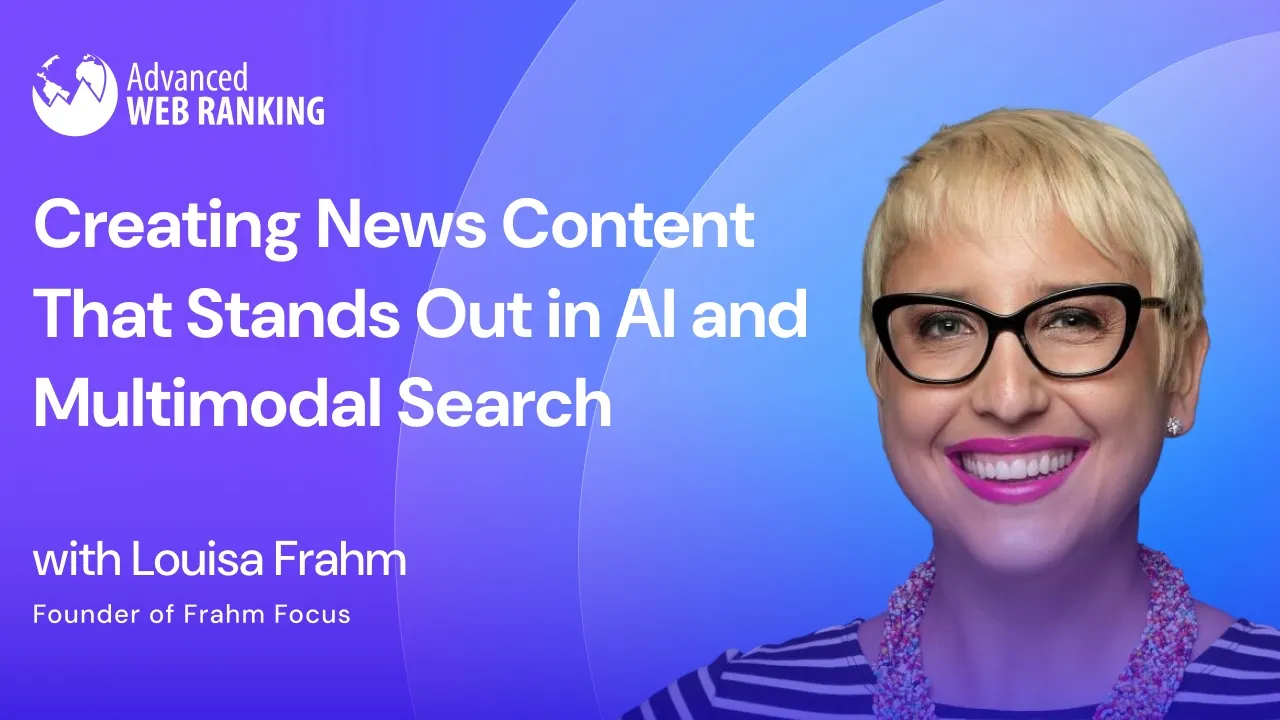
You’re listening to The Search Session. I am Gianluca Fiorelli, and my guest is Louisa Frahm, a search and AI consultant based in California.
We talk about matching the content format to the story, creating evergreen content that remains valuable in AI search, and what Google’s shift toward Top Stories and preferred sources means for news publishers.
Louisa and I also step into the newsroom to discuss trust between SEOs and journalists, then take a detour through what original movies can teach us about creativity and calculated risks. We finish by looking at what mentors learn from the people they guide.
What you’ll learn in this session:
How to rethink SEO for multimodal search: expand search-friendly content beyond Google, connect with audiences across formats and channels, and turn declining clicks into new opportunities.
How to choose the right content format: let the story, topic, and audience determine whether text, video, audio, or a combination will make the content more useful, engaging, and visible.
What makes evergreen content valuable in AI search: simple presentation, distinctive expertise, and regular updates that keep information accurate, useful, and visible.
How to respond to shifting search trends: balance broader industry changes with your brand’s specific audience needs without abandoning valuable channels or expert content.
How SEOs can build stronger relationships with journalists: establish mutual respect, provide consistent training and support, create newsroom advocates, and demonstrate the impact of collaboration.
What the rise of AI means for news SEO: address limited attribution and missing context while using Top Stories, preferred sources, digital PR, and distinctive expertise to strengthen audience connections.
Why technical performance matters more than ever: with shrinking attention spans and endless content choices, speed, mobile optimization, and reliable rendering can determine whether audiences stay or leave.
What brands can learn from unexpected movie successes: original ideas, calculated risks, and genuine audience connections can help brands stand out and inspire further innovation.
Why mentorship is a two-way street: guiding early-career professionals gives experienced leaders fresh perspectives, deeper self-reflection, and continuous personal growth.
Listen to the full episode for valuable ideas on search, storytelling, and standing out.
Topics covered: AI search · audience strategy · multimodal search · content formats · evergreen content · newsroom collaboration · news SEO · Top Stories · preferred sources · technical SEO · brand differentiation · information gain
About the Guest

Louisa Frahm
Independent consultant at Frahm Focus and adjunct professor at USC Annenberg
Louisa has more than 11 years of experience in enterprise news SEO. She helps brands simplify SEO and AI strategy, improve discoverability across platforms, and develop content and editorial workflows that respond to changing audience behavior.
Before founding Frahm Focus in June 2026,, Louisa served as SEO Director at ESPN, SEO Editor at the Los Angeles Times, and SEO Manager at Time Inc. She also worked as a Google Trends Curator. These roles gave her extensive experience in news SEO, newsroom training, audience insights, and content strategy.
In fall 2026, Louisa joined the USC Annenberg School as an adjunct professor. She teaches future journalists and communication professionals, bringing her experience in audience engagement and search strategy into the classroom.
Video Chapters
Transcript
Full conversation between Gianluca Fiorelli and Louisa Frahm.
Gianluca Fiorelli: Hi, I'm Gianluca Fiorelli. Welcome back to The Search Session. Today, we are going to have a guest from very far away from where I live. She lives in California. Until March, she was working at ESPN, which is... I mean, who wouldn't love to work at a company like ESPN? But recently, in March, she quit and started a solo adventure as a consultant.
She describes herself as someone who simplifies search and AI strategy. She writes for Search Engine Land and has more than 10 years of experience in enterprise news SEO. And this is something that I really like: she describes herself as a life enthusiast. If you know her, you can see this enthusiasm for life in her photos, in the things she shares, and everything like that. This characteristic of our guest is very, very clear.
And our guest is Louisa Frahm. Hi, Louisa. How are you doing?
Louisa Frahm: I am doing well. How are you? Thank you for that nice intro.
Gianluca Fiorelli: I'm fine. I'm fine. It seems that today, here in Valencia, Spain, the weather decided to be very awful. But it's also something that we can be thankful for after a few days with 40 degrees, which was like living in hell, or Mordor if you want. But I'm fine. I'm fine.
Louisa Frahm: I get it. I studied abroad in Spain when I was in college, and I did it during the summer, in Sevilla, actually.
Gianluca Fiorelli: Where were you in Spain?
Louisa Frahm: I was in Sevilla for six weeks.
Gianluca Fiorelli: Oh, so yes, I can understand that.
Louisa Frahm: And it was incredible. So I really can relate to what you're talking about because we absolutely had the heat. I remember siestas being built into the schedule. Everything shut down because of the heat. It was a part of the lifestyle there.
But that was one of my favorite times of my life. It was so beautiful there. And yes, I definitely can relate to that summertime vibe. We've been having quite a heat wave here in Southern California as well, so I feel you there.
Gianluca Fiorelli: Yes. Now that I've revealed who you are, your company is Frahm Focus.
Louisa Frahm: My baby company.
Gianluca Fiorelli: Well, I'm a consultant too, so I'm my own employee.
Louisa Frahm: It’s quite a life, huh?
Gianluca Fiorelli: Oh, yes. But it has its perks too.
Louisa Frahm: It does. It definitely does. I've been learning that. I only launched at the beginning of June, so it's been a few months, and it's been great. I've been onboarding a lot of clients and learning the lay of the land. It's an interesting time in the search industry in general.
It's been really fulfilling to help people navigate all of the changes with AI and other developments. I've actually been enjoying it a lot.
Gianluca Fiorelli: Yes. So it seems that SEO is treating you well, isn't it?
Louisa Frahm: Yes. It's a great introductory question. Something that I learned very early on in SEO is that you don't get into this industry if you want a straight line. It's always been tumultuous. There have always been algorithm updates and grenades being thrown in, and how do you adjust to it.
That's why, when all of those articles came out in the last few years saying, “SEO is dead, SEO is dead,” that was never how I felt. We've been used to this sort of ride in this industry. I have industry colleagues who have many more years of experience than I do who have really shouted that message to me from the very beginning: “You need to be resilient and able to withstand these kinds of changes.”
I do think SEO is undergoing possibly the biggest evolution it's ever had with this AI era that we're in. It's really redefining what SEO looks like. But going back to your question of how I feel about that, yes, there absolutely are concerns. You can't get around the drop in click-through rate and the fact that websites can't get the same sort of traditional visibility that they once did from the front door of Google. That is a very legitimate concern. I would just say that I don't think any brand is immune to that. I think it's been affecting people pretty much across the board.
But as you pointed out in your intro, which was nice, I am an enthusiast and an optimist at heart. I like to flip that on its head, even though it is a legitimate concern, and say that it also opens up a lot of opportunities to think bigger than perhaps you ever have before with your search strategy.
Why Multimodal Search Changes the Content Strategy
Louisa Frahm: I think that's going hand in hand with the rise of multimodal search. People are now thinking about search in bigger terms. It's not just the text. It's also about how we are optimizing our images, video, and audio across the board. I think that's something people have been thinking a lot more about in this era.
So I really think of this as an opportunity. I've said this in many places, but I'll say it again: SEO people really need to be more than just SEO people. We need to be audience strategists and think about the bigger picture. This era we're in doesn't take away the need for search-friendly content.
As long as people are still searching for things, we should have jobs, right? We have a function that we need to fulfill. But the operation was once, “Hey, you create search-friendly content, and your performance is primarily defined by the first page of Google.” That's no longer true, right? That's just not true.
So you have to think bigger. That's how I've been speaking with my clients over the last several months, and I was working on that at ESPN as well. If we create this search-friendly content, yes, we're going to attempt to get cited, and you aren't disregarding the first page of Google and how it's set up. But also, how can you expand the reach of that content?
It's really going to vary depending on what your brand is. There's no one-size-fits-all approach. But if you have an app that gets really great performance, that can be an excellent place to cross-share that type of search-friendly content and reach a very friendly audience.
Social media channels are another really big and exciting area right now. I love it, but search is becoming increasingly social, right? In this era of personalization in search and what we're seeing in AI Mode, those channels are becoming much more interlinked.
We also see that in the case of Google Search Console integrating more social data. So, yes, I think the lines are getting a lot more blurred. Yes, that comes with certain challenges, but I also think it opens up more opportunities.
In terms of creating this type of content that we once did for Google, I think we just have to think bigger about how to connect with our audiences anywhere and everywhere they consume content.
One other thing I would say in connection to that is that I've spoken with a lot of people who have worked at big companies as I have. Oftentimes, the workflows within those places can be very siloed. Perhaps this is how it once was for you: SEO has its own sandbox over here, social has its own sandbox over there, and everybody is separated. That may have worked in the era before the one we're discussing. I don't think it works anymore in this era of AI search, where these lines are very blurred.
Another thing I would bring up for anyone working at a company of substantial size is that you need to break down those silos and have everybody playing in the same sandbox. Now that visibility can be compromised on the first page of Google, you need to make sure that all those other business capacities are working in tandem to maximize your connection with your audience through every other channel.
The strategies you're employing on the search side need to complement social, newsletters, and everything else. That's always been a priority. That's always been very important. But now I think we've entered an era where playing in the same sandbox is no longer optional.
You really need to have everybody well integrated to maximize that one-on-one connection with your users, readers, and fans. That's what the AI era is really forcing us to do: prioritize your brand authority and your brand connection with your users and audience base on a different level.
Gianluca Fiorelli: Yes, indeed. You touched on so many things in this first answer, and I want to go deeper into one of them. You were talking about the extremely important role of multimodal content in search right now.
Louisa Frahm: Yes.
As multimodal search and LLMs increasingly rely on video content, measuring visibility requires more than tracking traditional SERP features.
Advanced Web Ranking helps you monitor video performance across Google, Perplexity, and ChatGPT, track video features, and measure the impact of video citations on your cross-platform visibility.
Start your free Advanced Web Ranking trial to track video visibility across search engines and AI platforms.
What ESPN Taught Us About Content Formats
Gianluca Fiorelli: I think that, because of your experience in news and especially your most recent experience with ESPN, multimodal content was surely something you were already dealing with.
As someone who also worked in television, although not as a search marketer, I was perhaps part of one of those silos. I was buying TV rights for movies, TV series, and things like that. I know well that what sells on TV are the images, videos, teasers, promos, and all these kinds of things. The people hosting the program are also important. It's television, so the main content is video.
Sometimes, the website is more like something that you have, but what you really need to work on is everything around the website and everything that populates it, including a constellation of microsites dedicated to a program or something else.
What did your experience with ESPN teach you about how to find the right balance? In the classic old days of SEO, people always thought about content as something textual. For me, that was a mistake.
Multimodal search is already complicated because we have to think beyond Google and Bing. We have all these additional surfaces where we need to work, monitor our performance, and be visible. But now we also have to dedicate at least the same attention to all the potential formats in which content can be distributed.
Louisa Frahm: Yes.
Gianluca Fiorelli: What did your experience at ESPN teach you about not feeling overwhelmed by the amount of work you may have to do? Maybe you have a team, maybe you don't, or perhaps your team is small and includes junior people whom you have to teach how to do the work.
Louisa Frahm: Sure. Since you specifically asked about my time at ESPN, I would say that my experience there could be applied to many other brands. So I'll speak about it on a more theoretical level and explain how it influenced my ideology about these things.
If you're a sports fan, and I think this can be applied to many different brands, what I really learned from that experience was that you need to be very aware of the particular story angle you're pursuing and, based on that, determine the best format in which to present it. This is particularly important when working in news SEO. I guess you could say it applies to brands at large, but it is especially relevant in news.
That was something I was always thinking about in my last role because there really wasn't a one-size-fits-all approach. Depending on the breakout angle, you might want to use an article format or a video. Obviously, video plays a very, very large role at a place like ESPN because much of what brings sports to life is that visual element, right?
But there could be other times when the audio component is what fans most want to hear. So it was really important to understand what the particular news angle called for and then decide how it should be presented.
A fun example is one of the explainers that my team created. At the time, we were very focused on this type of content. It was interesting because it preceded the AI era, in which these systems take that type of information and extract it.
We put together an explainer that I believe was specifically about dunks. It was a roundup of dunks that had happened during the March Madness tournament, bringing them together in a single piece.
Originally, we just had it as text, saying, “Okay, here are the dates when they happened.” But then we looked at it and thought, “I think we really need a visual component for that.” Just writing about the dunks didn't seem like enough. There was absolutely a reason why people would want to see them. So we took the time to find the social links from when the dunks first occurred, bring the story to life, and provide more context. It was so much better.
We had another roundup of buzzer-beaters where it was the same thing. If the topic is a buzzer-beater, you're going to want to see that, right? You're not just going to want to read about it. Having the visual makes it more engaging.
So I would bring that up as an example from my specific experience. We had to consider which topics made the most sense with a visual component and which ones would be fine with just text. I was always thinking about that.
In this next era, for any brand that's out there, I think it's about giving AI platforms more material to parse through. That's why you're trying to diversify the content consumption experience and bring things to life in a bigger way.
With the clients I'm working with now, I think it's interesting that I've been seeing more infographics recently. They've been having an interesting kind of resurgence in this era.
Why Simple Content Can Still Be Powerful
Gianluca Fiorelli: I think we also have to look at Google Notebook. Somehow, it made infographics popular again because it's so easy with Notebook or any LLM to create a first-grade infographic. Many people use it directly. Sometimes I do that too, or I use it just to have an idea: “Okay, I want this infographic. This is the model I want.” Then you can give it to a graphic designer and make it better.
I think it's useful because I'm not sure that Google, for instance, always does OCR recognition of text, but sometimes it does. So it's an image with text.
In the discussion with Myriam Jessier, for instance, we considered that video is the best format for an LLM because it has video, images, audio, and also text through transcription. It has everything needed to provide wonderful context. This video we're creating is an example; it’s pure natural language. It's not something fabricated through writing rhetoric.
Louisa Frahm: Yes, I totally agree. That's been interesting because I never really went off infographics. I always thought they were fun and interesting and could bring things to life. But in this era we're talking about, I've seen more and more people using them again. They wouldn't work for every single topic, but for certain things, such as a timeline approach, I think they can really bring the content to life and make it more engaging.
In general, it all goes back to what I was saying in the introduction. I think this swing toward AI is pushing us to think bigger about how we present our content to different audiences. I have this phrase that's come up throughout my search career. I can't remember the first time I said it, but it's something I always think about now: simple is not stupid when it comes to audience engagement. I really believe in that.
I think the key with multimodal search and the way you present content is to always be hyper-aware of how your audience is approaching that particular topic. If you're very in tune with your audience and its needs, I feel like you can't go wrong. You really shouldn't overcomplicate it.
Depending on the specific topic, you need to be very connected to your audience and understand how they want that information to be delivered. I brought up the examples from ESPN, where those things were more visual, so you would obviously want to include an image or video component.
But there are other topics that might be better served through a long, in-depth narrative feature or an explainer divided into subheadings and presented more like a guide. It's always very important to be in tune with the audience's individual needs.
Another important consideration when creating this type of content is service journalism, which is something I worked on extensively throughout my news SEO career. It still has a place, but how do you create it efficiently?
The New Role of Evergreen and Informational Content
Louisa Frahm: You need to be very aware of when you can update and refresh that kind of content. I know evergreen content has been a major topic of conversation in this AI era because it has really shifted. The way you approach it has changed if you want to make it worth your time and investment.
But I believe there is still value in guides that are closely connected to your individual expertise and highlight why you have distinctive experience in a particular area.
Gianluca Fiorelli: Me too.
Louisa Frahm: But I think it's critical to update that content regularly. People used to say that you could “set and forget” evergreen content. You could create something, and then it could drive traffic on its own with minimal updates.
I think that era is far behind us. If you're going to invest in that kind of content, it needs to be very distinctive to your expertise and highlight your firsthand experience in the subject area. Regular updates and refreshes are also critical for appearing in AI modules and on other search platforms. I would stress that too.
Gianluca Fiorelli: Yes, I totally agree. There is a lot of discussion about whether informational content, which usually includes guides, is something that should no longer be prioritized. For certain things, I can agree with that statement.
But if we want our brand to be associated with certain topics, and we only create content that is substantially transactional, such as product pages or middle-of-the-funnel content, if we are thinking in search journeys or customer journeys, how can we expect Google and AI models to understand that we're associated with those topics if we never create content about them?
I don't mean that you have to cover the entire blue ocean of information. For instance, on a sports news site, an evergreen guide could explain a soccer rule to beginners, such as how the offside rule works.
But you're right: you cannot simply create a guide like that and leave it untouched because the rules can change every year. Sometimes the update is very simple, while other times it is more radical. You may also find that a guide that worked in one format now needs to be complemented with other formats. Then the guide becomes the perfect pillar page.
Louisa Frahm: Yes, sorry. Go ahead.
Gianluca Fiorelli: No, no, just that. I think there has always been this trend in SEO. For instance, now that Reddit is not cited as much as before because its citations have decreased with ChatGPT 5.6.
Louisa Frahm: I did see that this morning.
Gianluca Fiorelli: And now many people are saying, “Okay, let's forget Reddit.” Why? If your audience is on Reddit, are you going to ignore Reddit just because ChatGPT doesn't use it as much anymore? Sometimes we have this very tactical way of thinking that forgets the real substance.
Louisa Frahm: I totally understand what you're saying. There have been many waves of that. When you see a certain change, you think, “Oh no. Okay, that must mean we should forgo all of that.”
I think this goes back to an age-old principle within our work: there is no one-size-fits-all approach to this kind of strategy. You really need to look at your individual brand. Depending on what your audience needs—and I'm probably going to repeat this many times during our conversation—if you're prioritizing those needs and are very aware of what your audience is interested in, you don't want to let these broader industry changes take away from that.
Building on what you just said, if you know that your brand still has a very strong connection with Reddit, you wouldn't want to throw out that entire strategy because another update is happening.
It's always a matter of balancing those things. The wider industry changes matter. They really do, and I'm always very aware of them. But you have to balance those changes with your individual brand's position and how you're building your audience strategy.
There can be differences between those two things. That's why it's really important to understand both the external and internal sides and how they meet in the middle.
Larger updates have always been a part of working in search. But even with AI, I was never on the side of saying, “This means SEO is dead, so you need to abandon your search strategy.” It just means you need to evolve it. It's always important in this industry to have thick skin and be very adaptable when these changes occur.
Throughout my news SEO career, particularly with guides and evergreen content, there has been a significant evolution. I'm very aware of how this content must be treated in the AI era.
With my clients right now, I always emphasize that there is still a time and place for this content. We can still incorporate it into our overall strategy, but it needs to present firsthand experience and distinctive expertise that shows why the brand stands out from the pack. That's the key to creating content with AI citation potential.
As you pointed out, I'm a big believer in this. I'm willing to discuss it with anybody, but I'm not in favor of simply forgoing this kind of content. If we do that, I don't think we're doing our jobs as brands. It's really important to show our users, readers, potential customers, and clients what our expertise is. I don't want that to get lost in the shuffle. It's mostly about adapting your approach.
I've always been a big cheerleader for this kind of content. The approach is certainly evolving a lot, but there is still a time and place for it when supported by the right strategy.
Building Trust Between SEOs and Journalists
Gianluca Fiorelli: Yes. I have a question for you that may be fun. Having worked for so many years with journalists as an SEO, what tips can you give SEOs who try to contact journalists to co-create stuff, promote content, or do a classic digital PR campaign, for instance?
What are the common mistakes you've seen from the other side, as someone working at a company with journalists who may receive this kind of outreach of potential collaboration?
Louisa Frahm: Sure. I've said this before, but I think it bears repeating: the first step toward establishing a positive relationship with journalists when you come from the SEO side is creating mutual respect between the two parties.
And the best way to do that, having been the SEO person entering many different newsrooms, particularly when starting something from scratch, is to be very aware of level-setting in the beginning. You don't want to come in and steamroll people.
Something you need to recognize immediately, even if it doesn't feel that way, is that you're coming from very different worlds. Journalists have different editorial priorities, which can vary significantly from the objectives you're trying to achieve on the search side.
It's important to have initial conversations in which you're trying to build a foundation. If you're the new SEO person and the newsroom hasn't previously had an SEO workflow, ask them questions such as, "What do you know about SEO? What have you previously been told? Are there any gray areas you want me to clarify?”
Getting those things out into the open immediately can be very important because you can address them while introducing the best practices you want journalists to follow.
I would definitely recommend having those introductory conversations and leading with mutual respect: “I understand that we come from different worlds. I respect what you're bringing to the table. This is what I'm trying to achieve. Let's try to meet in the middle.” That approach is very effective.
After that, establishing best-practices training is essential. You don't want to be the SEO person who only appears during tentpole events and isn't present otherwise. It's critical to be there daily so journalists know they have a consistent resource they can rely on.
You provide foundational best-practices training, ensure that everybody is on the same page, and then maintain consistent communication on an ongoing basis. That's what helps establish greater trust over time.
Depending on what your company uses, it could be Slack, Teams, or something else. Having a regular communication channel where you can interact about stories is very helpful for further ingraining those best practices with your journalists.
Something else you'll quickly realize in these roles is that you cannot do everything yourself. As the SEO person, you simply can't. There aren't enough hours in the day.
One of the key objectives is to create advocates in the newsroom who understand what you're discussing. They will implement it independently and encourage their teammates to do the same. Regular communication can really help you build that support.
Make communication accessible and create a channel where anyone can come to you for advice, whether you're working alone or as part of a small team. Facilitating that regular communication is very important.
Once you start providing enough suggestions and become more integrated into the process, you should also attend regular meetings with the editorial teams. Again, it's all about consistency.
I've found that this is particularly important for journalists, who can be very black-and-white thinkers. They want to know, “Is this someone who will be here when I need them?”
If they have a weekly editorial meeting, you should be represented there. You should bring trending insights and report on content performance. Getting them more invested in the process is critical.
After establishing that regular correspondence, reporting naturally comes next. Obviously, we're SEOs. Once you start making suggestions, go the extra mile. If you helped with a story, provide those types of… I'm a big fan of receipts. Go into Top Stories and Google Search. If a headline you helped create enabled the story to appear in Top Stories or secure an AI placement, take a screenshot and share it with the journalist. Say, “We worked on this together. Look, we got this placement.”
Really emphasize the value of what you're doing. That helps journalists become more invested and encourages them to do more of it in the future. I would recommend all of that. The final stage, although it never truly ends because training never really ends. I would say that to anybody in the industry. We all know that the world we work in is constantly evolving, especially in the era of AI.
So keep that correspondence going. And then the bigger part of it is that you’re going to have that day-to-day interaction with journalists in the newsroom, but you also want to conduct similar educational efforts with editorial stakeholders at a higher level.
One way I found helpful was to create a newsletter highlighting major industry developments that could affect the work you're doing every day. I really find that having that sort of an outlet for educating the wider group on "Hey, we have our internal processes and initiatives, but these external developments can directly affect them.”
That was helpful for general education, which I really believe in. It also meant people were more aware of developments as they happened, so you might receive fewer worried emails saying, “We had a giant traffic drop. What is this?”
You're keeping people informed as changes roll out instead of receiving a red-alert email after a major traffic drop. I'm a big fan of keeping people in the loop and educating them throughout the process so they feel more empowered by knowledge as you navigate these ebbs and flows together.
Gianluca Fiorelli: Yes.
Louisa Frahm: Those are a few things I would highlight. But at the end of the day, it all comes back to mutual respect, positivity, highlighting when things perform well, and ongoing education.
You can learn from each other in really beautiful ways. Trying to find that common ground was always the most fulfilling part of the experience for me.
Great digital PR creates more than backlinks, it builds the brand authority that search engines and AI platforms rely on.
Influencing what AI platforms say about your brand is the new organic battleground, but you can't optimize what you don't track.
Advanced Web Ranking helps you track how media coverage and brand mentions contribute to your visibility across search results and AI platforms, so you can see what's actually moving the needle.
Try Advanced Web Ranking for free and measure the real impact of your earned media strategy.
How AI Is Changing News SEO
Gianluca Fiorelli: Indeed. Talking about all the frenzy changes we're experiencing, I remember an episode with Barry Adams from around a year ago. At that time, the news niche was not as influenced by AI Overviews, and AI Mode wasn't even available.
But now we're seeing Google increasingly present timely news information in AI Overviews and AI Mode. We're also seeing changes in how Discover works. It's becoming increasingly common to see social posts about news topics in the Discover feed.
How do you see news SEO evolving because of these recent changes, and what do they suggest about the future?
Louisa Frahm: I think it's interesting. This is something I thought about even when it was still called the Search Generative Experience and was in beta.
Gianluca Fiorelli: Oh, yes.
Louisa Frahm: I would reflect on that period to understand the bigger picture. When it was first rolling out in beta, you really have to think back to the beginning of how Google had far more guardrails in place. It was very cautious about Your Money or Your Life content, including finance, legal, and health topics. You saw warnings such as “I can't report on this,” much more frequently.
But slowly, even during that first year in beta, you saw those guardrails disappear one after another. By the time it rolled out as AI Overviews, it had become more of a free-for-all and wasn't staying away from many topics.
Even when I saw it in beta, I felt that news would eventually make its way into it. I couldn't see how Google could avoid taking a bite of that apple. I never thought it would stay away from news entirely.
I think it's good that Google has been relatively cautious with news compared with other topics. I was encouraged to see Top Stories being featured within AI Overviews because one of the biggest complaints we had as publishers was the limited attribution.
AI Overviews would appear for certain topics and provide a large answer with very little attribution. For some of the things I was tracking, I sometimes saw answers with no links. It was pretty bad. The fact that Top Stories can now appear within AI Overviews is a positive development. At least Google is trying to integrate the two worlds and make it clear that the information comes from somewhere.
I've surveyed many friends and colleagues about this, including people working in other industries, and people want that context. They really do, especially when it comes to news. So I think it has been important for Google to introduce that.
But there is still a lot to be desired when it comes to bridging the two worlds. One of the biggest things I found while closely tracking AI Overviews across different news cycles, since it was launched, was that it can get most of something right but still miss some very important context.
They might get 80% right, but the missing 20% really matters, and it will miss the context. I regularly tell people that if they're looking at anything news-related, they should take the AI Overview with a grain of salt and verify it against another source. That's good general advice for AI Overviews, but context and nuance are things it still struggles with.
It'll give you a good overview, to use the exact word, but it may miss a nugget of information. In news, that nugget can make a very big difference.
Gianluca Fiorelli: Yes.
Personalization and the Direct Relationship With Audiences
Louisa Frahm: So I think there are still things to be desired. I like seeing Top Stories in AI Overviews. I've also been emphasizing preferred sources. In this era, search is becoming increasingly personalized, while the visibility we were accustomed to has been compromised. You can't reject any of the other bones Google gives you.
Google introduced preferred sources, and I think every publisher should focus on that personalization element. As I said before, publishers should try to increase that one-on-one brand connection with their readers.
Preferred sources are a great way to do that. Make it clear to readers that they can select you as a preferred source. I've conducted different studies on this, and it really does affect how often you appear in relevant searches. You want to present that option to your target audience.
In this era, whether it's preferred sources, following publishers in Google Discover, or other features, it's important to capitalize on all of them.
Another thing I haven't mentioned yet is that digital PR is experiencing a kind of resurgence. Not that it ever went away, but as brands think more about that one-on-one relationship with users and readers, emphasizing brand reputation becomes critical. You need to ensure that you're using all your corresponding channels effectively. Digital PR is much more important in this era.
For publishers, it's tricky. But I would again ask: What is your individual expertise? What can you bring to the table that's genuinely distinctive? What do people know you for? Go all in on that and create content that serves your audience effectively and engagingly.
On the other side, understand what your target audience is interested in and focus on that. I feel like that can never steer you wrong. Don't overcomplicate the process. Present your content through the channels where your audience consumes its day-to-day information, and remain aware of how that behavior evolves.
Gianluca Fiorelli: Yes. First of all, one stupid thing I was thinking about when you said that an AI Overview can correctly provide 80% of an overview of a news event happening in real time: from what I've experienced, there is sometimes still latency. Usually, it's that latency causing the 20% of mistakes.
That then becomes news because it's immediately picked up by journalists: “AI Overview is saying this, and it's not true.” It's the classic funny search news that reaches the public.
Louisa Frahm: I wouldn't say that's true for every single thing. I'm just saying that, for a lot of the things I look at, that's what I find. To me, being 20% off is still a big deal.
Explore more perspectives on news SEO
John Shehata examines the growing impact of AI Overviews and Google Discover on publishers, along with the need to distribute journalism across multiple formats and channels.
Barry Adams explores how AI Mode could reshape news discovery, traffic, and revenue while explaining why clear editorial direction and strong journalism remain essential.
Gianluca Fiorelli: Yes. But then I was also thinking about the personalization topic you were discussing. It's clear that search is becoming more personalized, and not only on Google. ChatGPT's memory is persistent.
Louisa Frahm: It's always listening, yes.
Gianluca Fiorelli: So personalization is going to a very big extreme. Yesterday, when I was recording an episode with Garrett Sussman, we were talking about this and trying to understand whether personalization is also a way of keeping people inside their bubbles. How can we give people some space to discover new things? We were thinking about Personal Intelligence in Google, for instance.
Regarding personalization, one thing I've seen some news sites try in the past was this: if we want our readers to become recurring readers, the ultimate goal would be for them to subscribe to the app.
Louisa Frahm: Right, right.
Gianluca Fiorelli: I've seen this many times in the past, but less now: essentially creating the front page based on detecting the types of news that a particular user usually consumes.
In my case, for instance, it could maintain the breaking news because I want to know about it. But perhaps I'm not so interested in gardening. Push that out and give more space to culture, movies, theater, or something like that.
I think this also relates to the technical side of our work because, with the support of developers and the product team, we can explain how these things can be useful. For instance, they will probably improve the conversion rate for subscriptions or newsletter sign-ups.
It's about creating a good ecosystem that turns a casual reader coming from Discover into a loyal reader who downloads the app and opens it directly on their phone or types the website's name and arrives through direct traffic.
Why Technical SEO Matters More When Attention Is Scarce
Louisa Frahm: Sure. One note I would add, because I agree with you, is that we're in an era when attention spans are shorter than ever. We have very little time to hook someone when it comes to content, even if we're serving them what they want.
So the point you just raised about back-end efficiency, site health, page speed, and the related technical elements is even more important in this era for that reason. The window for capturing people's attention is much smaller.
These days, if I encounter a website that isn't mobile-optimized, I instantly think, “I can't deal with this,” because we have so many other things that we are dealing with.
That's how I would connect it to the bigger picture. These things have always been important, but their importance is now amplified because the window for connecting with your audience has become much smaller.
If a page struggles to render, an image doesn't appear properly, or a new project on a news site isn't indexed correctly by Google, you have to troubleshoot it. These things now exist on a much higher plane because you're already under pressure to connect with your audience within such a tight window.
Those things never stopped being important, but now they play a critical role in maximizing your ability to connect with your audience in a very tight, competitive window. If your competitor is excelling at those technical elements more than you are, that can be a major differentiator in the overall user experience. People only have so much time and focus to dedicate to accessing content and deciding which content to choose.
I would definitely say to any brands out there that, if you've been neglecting that side of your work, it's going to catch up with you now. You can't just rely on people naturally coming to you through the front page of Google. If you want to create that one-on-one, “I love you” type of brand experience, you need to deliver an optimal experience in terms of your presentation.
Those things never stopped being important. But in this environment, where people are inundated with different types of content from different sources, you need to provide an optimal experience if you want to stand out. If you've been neglecting it, the window for continuing to do that is over.
What Backrooms Teaches Us About Standing Out
Gianluca Fiorelli: Indeed. There is one thing you posted on LinkedIn that I really liked. You were talking about the sudden success of a movie like Backrooms, which is a wonderful movie.
Louisa Frahm: I loved it. It was great.
Gianluca Fiorelli: Yes, it's a great movie. I know all the mythology around Backrooms because of my sons. It's something that substantially came from Discord and YouTube.
Louisa Frahm: That's really interesting, actually. I knew about that background.
Gianluca Fiorelli: What was really interesting was how you translated this into trying to understand why it became such a success.
If you want to compare it, the big blockbuster is Spider-Man. But Spider-Man was conceived as a blockbuster, while Backrooms was not. Comparatively, if we look at the percentages, Backrooms is earning more money than even Spider-Man or DC.
You were saying that we should try to understand—and I think that's the big lesson from something like Backrooms, but if we look at the past, The Blair Witch Project is a prototype.
Louisa Frahm: I remember that.
Gianluca Fiorelli: …—how these kinds of independent movies suddenly become successful because of how they communicate and touch a sensitive nerve with the public. They have a community behind them and are able to go viral in a good way. They can offer a win-win situation for the producers and creators of the movie, as well as the creators who promote it.
I think this is a very meaningful lesson for the present, when we consider that visibility in AI is perhaps one-third based on our content and two-thirds based on how people talk about our content, brand, formats, and so on. That is something we don't really have in our hands.
I don't think this is only a matter of running a good digital PR campaign. As you said at the beginning of the conversation, it's about having a very good understanding of our audience, including its values and tastes. We need to connect with the sometimes subconscious values, pleasures, and needs that our audience has.
Would you like to explain your idea about this inspiration or example from Backrooms, as well as other pop culture icons? I think I remember you mentioning Prince.
Louisa Frahm: Do we have two more hours? Because if you want me to rip on pop culture, I could do that.
Gianluca Fiorelli: Let's try to wrap it up in 10 minutes.
Louisa Frahm: No, I know. I'm really happy to jump into this part because pop culture is always a huge inspiration for me. It was partly what brought about this new chapter in my life.
I launched my consultancy, but I'm also teaching at USC Annenberg starting this fall. Pop culture was definitely connected to that as well because I always want new ways to connect with younger generations. What are they interested in, and what really represents the next era?
That's something I'm really excited about with teaching audiences there: identifying the next wave of trends. What is the younger generation interested in right now, and how can we incorporate that into our work? I think that's always really important.
As a lifelong pop culture person, I love this question. Regarding that post I made, it was Obsession and Backrooms that came out at the same time. They were both viral hits, and there were a few different things about them that I loved and thought could apply to our industry.
The first thing is that both directors were very young and inexperienced compared with other people in the industry. People had to take a chance on what they were doing. I think that says a lot about experimentation and how there is still a place for it.
In the movie industry, and no offense to comic books because I love them and think they're great, we have these massive series that we keep repeating. Original ideas are harder to come by. I should say that they're harder to get green-lit because there are many original ideas out there that never make it to the big screen.
That's something I loved about both movies: they were so original. They weren't really connected to any other source material. They stood on their own. I think that connects quite well to what we were just discussing about how brands, publishers, and anyone trying to present themselves to an audience need to approach their work today. What is distinctively you? What expertise makes you stand out from the pack?
I loved that both movies stood on their own and made a big splash. I also liked that they weren't afraid to be different. Backrooms, in particular, had a very unique approach that reminded me of The Blair Witch Project.
I think that shows how taking a risk can pay off. They didn't have a formulaic approach. Technically, there were a few actors in Backrooms whom I recognized, but it wasn't really about big names. It was more about the narrative and the story.
I think that can also apply to marketing. Creating a genuine connection with your audience isn't always about putting a big-name promoter in front of something.
Another important idea I've discussed throughout my career, because I love mentoring, is the value of calculated risk. It can affect your career in major ways if you're willing to embrace it at the right moments. For me, it has played a significant role in the growth I've experienced at every stage of my professional life. That's another thing I would connect to those movies.
I'm sure the people backing them before their release probably thought, “This is a calculated risk. We don't know what will happen. We aren't banking on another Marvel film here.” But look at how far they exceeded expectations in terms of the number of people who showed up.
Another thing I absolutely loved about both movies is that I'm a movie person. I love people going to the theater and watching movies. I'm old-school. It isn't that I don't like watching movies at home. I just really love the experience of being in a theater, and those theaters were packed. That was event cinema. People wanted to react in person. They were genuinely connecting with the content.
In this era, we can all feel desensitized to content sometimes because we scroll and scroll. That's something I loved about being part of both audiences. People weren't scrolling on their phones. They were reacting to jump scares and were fully invested in what they were watching.
I think that presents an awesome side of the industry. It inspires and motivates me in terms of the content I want to create. I want people to be genuinely engaged with what I'm doing. I don't want them to feel like they're mindlessly scrolling through something, although there is always a time and place for mindless scrolling. We all like it occasionally.
Gianluca Fiorelli: Yes.
Louisa Frahm: That was another important thing those movies taught me: there is still a time and place to connect powerfully with your audience. It isn't just about getting a passive click here and there. You're genuinely engaging people.
I thought those directors did a great job of connecting with a younger audience in particular because both audiences were pretty young. There was also a fairly wide range of ages.
With the YouTube connection that you mentioned, those roots really shone through. I thought there was also something beautiful about honoring where you came from in the latest creation you're presenting to the world. So there were many different things I loved about both of those movies. I think a lot of those lessons translate into marketing, how we should present content as brands, and how we can genuinely connect with our audiences.
We are in an era where there is so much content to consume at any given time that it all starts to blend together. Both movies exemplify that there is power in standing out, absolute power in standing out. I love that about them, and I hope to see more of it in theaters in the future.
Calculated Risks, Original Ideas, and Information Gain
Gianluca Fiorelli: The funny thing is that A24, a small movie company, produced Backrooms, and the director was actually the person who created the Backrooms YouTube videos. This is not the movie podcast I wanted, but what this teaches me is that a story can be told in different ways. As you were saying, sometimes you have to take risks if you want to stand out.
Louisa Frahm: And grow. I think that's a really important differentiator.
Gianluca Fiorelli: I think this is also the substance of what even Google was saying when it warned people not to create commodity content. I think there is another interesting characteristic: both movies are horror movies. Horror has always been a relatively anarchic genre. Over the past 15 years, some of the biggest directors have made their debuts in horror movies. Just think of Peter Jackson, who started with pure gore and then made The Lord of the Rings.
I think this is interesting because it's a good example. I could create a horror story, a guide, or a website with a specific architecture that is substantially the same as every other website. That means not taking risks because this approach feels safe and reassuring, and people are used to it.
But if you want to stand out and grow, or become the alternative to the classic brands, you must be unique. This is the familiar discussion about information gain. In news, for instance, there are certain types of stories where you cannot be anarchic. You have to follow editorial processes and standards.
Louisa Frahm: Yes.
Gianluca Fiorelli: But you can also create fringe products in the news space. You may identify a journalist in your newsroom who could be this kind of Trojan horse. You could say, “This person could be interesting if we give them a column, but not in print or on television. Perhaps we could give them responsibility for an Instagram or TikTok channel where they can practice journalism with freedom.” There would be certain constraints, obviously, but they would have freedom. I think this is the biggest lesson from these pop culture successes that are suddenly exploding this year.
Louisa Frahm: One quick note. Another thing I really loved about both movies is that—my hope is, and this very much applies to our industry—when a breakthrough like this happens, it can inspire other people to innovate. These films made it. They were unique, distinctive, and outside the box, and they performed well.
I think that can inspire other people to do something similar and present ideas that aren't necessarily formulaic or simply follow everything else being released. I think it makes us better as people to think bigger and further outside the box. That could relate to our industry as well.
Gianluca Fiorelli: But there is another thing we must consider. Backrooms was the first one. It was the information gain moment for that kind of genre because it substantially reinvented it. Movies that come in the future and try to follow the Backrooms formula will become commodities.
Whenever we create something completely new that presents a striking difference from what others are doing, we must remember that, after a certain time, we will retain the recognition of being the first to do it, but it will become the new commodity. So, we must always maintain a creative mindset in how we present ourselves or our brands to the public, while also understanding how the public is changing.
Louisa Frahm: I agree with that. I think it's always about evolving and presenting yourself in a distinctive way. I was just saying that it's important to acknowledge the initial breakthrough that opens a new door other people can then walk through. That's how I would look at those movies. They could inspire other people to innovate and have similar breakthroughs.
It's obviously important not to simply duplicate their process, but it's valuable to recognize when that kind of success is possible. When you see an independent filmmaker achieve that kind of breakthrough, it may make other independent filmmakers think it's possible for them too. I think that's really important to acknowledge.
What Mentoring Teaches the Mentor
Gianluca Fiorelli: Before wrapping up, because we are already beyond our hour of conversation and I don't want to take up too much of your time, I have a question about mentoring.
You said earlier that you love mentoring. Usually, we love mentoring because it helps younger people or new professionals grow, and we want to support them. But I want to flip the question: what do you learn from mentoring other people?
Louisa Frahm: I learn so much from mentoring. For me, it definitely is a two-way street. I learn so much from the mentees I have in my life.
I recently took this to the next level by becoming a professor because I wanted mentoring to be more ingrained in my day-to-day life. I learn so much from having conversations with them about their interests, career aspirations, and current career concerns.
I reflect on my own life differently through the portal of learning about their lives. That makes me much more aware of what my journey has been so far and where I want to go in the future.
Every conversation broadens my perspective and gives me new insight into how I want to continue evolving. I really can't speak more highly of it. It should be a two-way street in terms of learning about the other person and their goals. I also get a lot of fulfillment from helping other people.
When I can better understand what a mentee or someone I'm connected with wants to do, and I know that I have people in my network who can help them advance, that's an ultimate gift for me. I feel very fulfilled knowing that my experience was able to help someone else.
It might sound corny, but that's really important to me. That's why I welcome those relationships into my life. I wanted to invest in that during this latest chapter at USC Annenberg by teaching because I wanted to elevate it even further.
Gianluca Fiorelli: Okay. Thank you so much. Maybe it's time for you to find some water.
Louisa Frahm: I'm fine.
Gianluca Fiorelli: Thank you, Louisa. It was a really wonderful conversation. It was a real pleasure because, as I told you off the record before starting this session, I was really looking forward to finally meeting you.
Perhaps we can record an episode in the future just about movies and pop culture, how they reflect on marketing, and how marketers can use that kind of information without being cheesy, creepy, or stupid. Let's promise to do it.
Louisa Frahm: I would love to do that.
Gianluca Fiorelli: I know it would be a wonderful episode. Thank you again, Louisa.
Louisa Frahm: Thank you so much. It was a pleasure.
Gianluca Fiorelli: Thanks to all of you for having the patience to stay with us throughout this one-hour-and-six-minute conversation. I'm sure you enjoyed it. If so, give the video a like, subscribe to The Search Session, and ring the bell to be notified about new episodes appearing week after week. Thank you, and bye-bye.

Podcast Host
Gianluca Fiorelli
With almost 20 years of experience in web marketing, Gianluca Fiorelli is a Strategic and International SEO Consultant who helps businesses improve their visibility and performance on organic search. Gianluca collaborated with clients from various industries and regions, such as Glassdoor, Idealista, Rastreator.com, Outsystems, Chess.com, SIXT Ride, Vegetables by Bayer, Visit California, Gamepix, James Edition and many others.
A very active member of the SEO community, Gianluca daily shares his insights and best practices on SEO, content, Search marketing strategy and the evolution of Search on social media channels such as X, Bluesky and LinkedIn and through the blog on his website: IloveSEO.net.