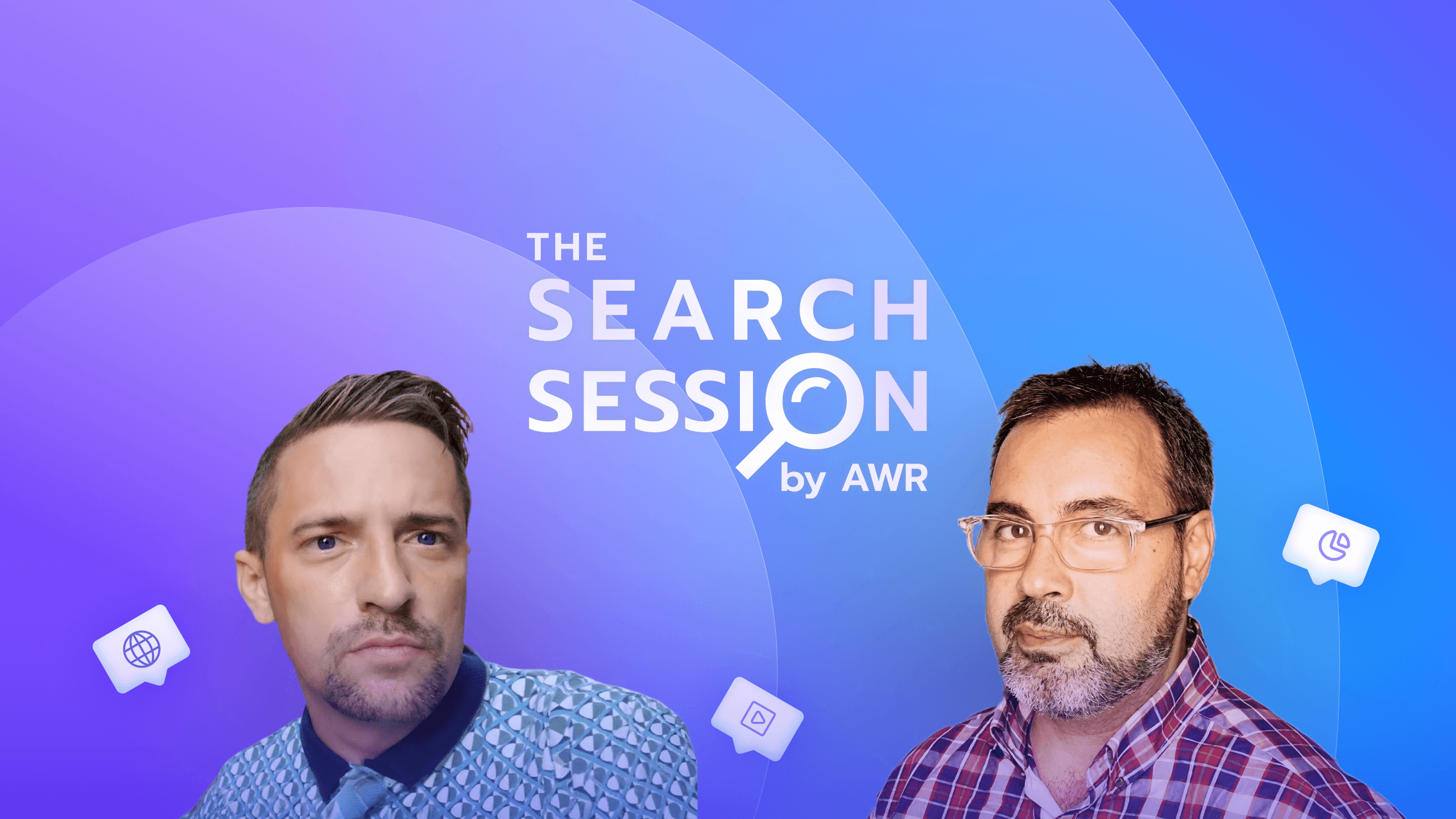


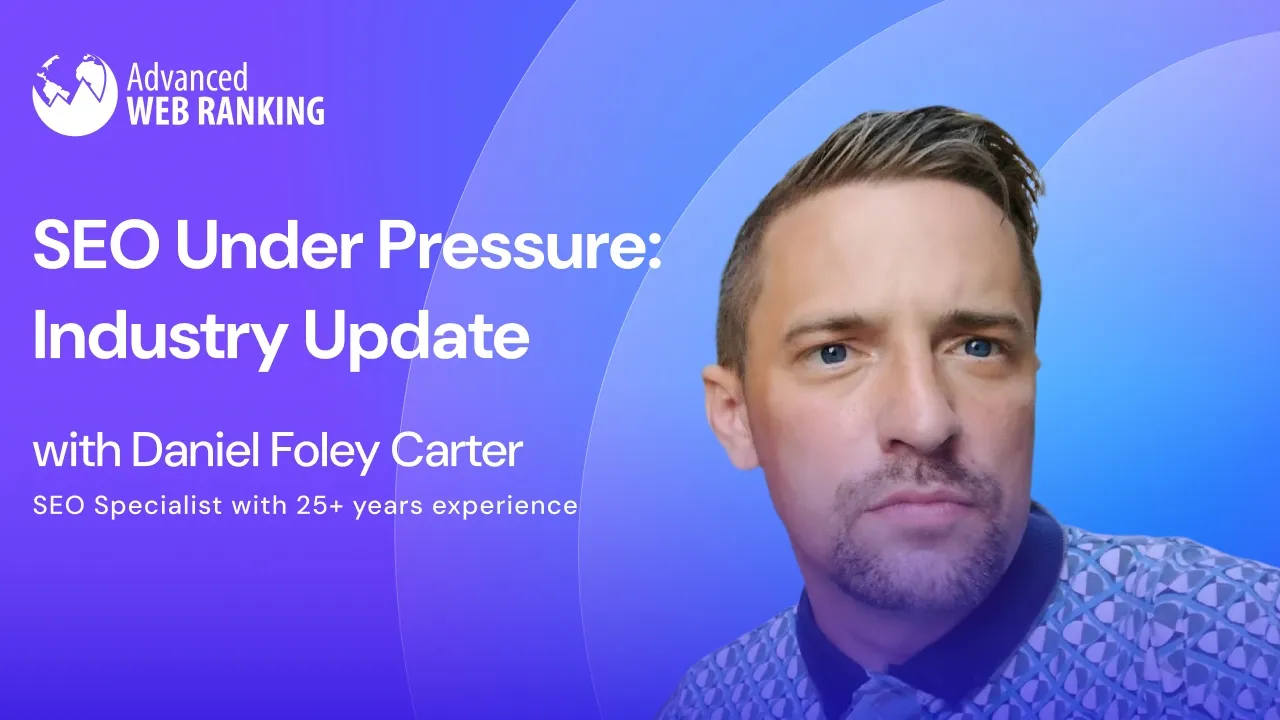
Welcome back to The Search Session. I'm Gianluca Fiorelli, and today I’m joined by Daniel Foley Carter, a UK-based SEO specialist.
SEO is under pressure from every direction right now. Daniel unpacks what's actually happening to the industry, why clicks are in freefall, why trust and links still drive visibility even in AI search, and what Google's shift toward de-indexing low-value content means for the future of SEO.
We close with a very honest conversation about burnout, uncertainty, and the human side of working in a fast-moving industry.
What we cover:
The state of the SEO industry right now: how agencies and freelancers are being squeezed from both sides, with clients cutting spending or turning to AI, and Google systematically reducing organic click opportunities.
What makes a site trustworthy enough for AI Overviews and AI Mode: why links, brand mentions, and brand citations remain the foundation for AI search visibility, and why trust is harder to fake than content.
What AI Overviews are doing to CTR and click depth: position-one click rates are down 40% and page-depth clicks down 70%, and Google's refusal to segment AIO data in GSC makes it nearly impossible to measure the true scale of traffic loss.
Why link context matters less than you'd think: how Google may rely more on whether a linking page is worth indexing than on judging every backlink by topical relevance.
Why good quality content isn’t always helpful content: Google may care less about how polished or well-written a page is and more about whether people actually use it, engage with it, and find it useful in a real search context.
How to evaluate the impact of a Google core update: start with query counts, compare pre- and post-update data, l identify lost query and page patterns, then check SERP volatility and indexing changes to understand whether the site was devalued, lost relevance, or stayed stable.
How to navigate burnout and uncertainty in a fast-changing industry: why it’s important to work hard without losing yourself, protect your health, and make space for life beyond work.
Join me for a clear and direct conversation with Daniel Foley Carter.
Topics covered: SEO industry · AI Overviews · AI Mode · CTR · click depth · backlinks · PageRank · indexability · core updates · content quality · user behavior signals · burnout
About the Guest

Daniel Foley Carter
Founder and Director of Assertive, SEO Stack, and SEO Audits IO
Daniel is an SEO specialist and entrepreneur with over two decades of experience in search. He has built his career across SEO auditing, strategy, execution, and training.
In 2007, he founded Assertive, a full-service SEO agency covering everything from technical SEO and content strategy to link building and international SEO.
In 2020, he launched SEO Stack, an AI-driven SEO data platform that helps SEOs work with Search Console and analytics data beyond Google's default limits.
Alongside this, Daniel founded SEO Audits IO in 2022, an independent auditing business built around detailed, manual SEO audits.
Daniel regularly shares SEO testing, industry analysis, commentary, and training on technical SEO, link building, AI search, and the real mechanics behind Google’s algorithm.
Transcript
Full conversation between Gianluca Fiorelli and Daniel Foley Carter.
Gianluca Fiorelli: Hi, I'm Gianluca Fiorelli, and welcome back to The Search Session. Today, we are going to have one of the most vocal SEOs for quite a long time. He's a very genuine voice, very open, very transparent and honest, and lives in the UK.
Sincerely, I don't know how he can do all the things he does. He has two business companies: one specialized in technical SEO audits and the other built around a tool.
And I think he was maybe not the first one, because I remember Martin McDonald already testing something like this, but surely he was the one who established this kind of tool. The tool I’m referring to, and maybe you are going to recognize who I’m talking about, is SEOstack.io. It’s a tool that is substantially making Search Console the tool it should be.
After him, we have seen many others trying to develop something similar, especially extensions, which are not really the same thing but try to serve the same purpose.
The person is Daniel Foley Carter. Hi, Daniel. How are you doing?
Daniel Foley Carter: I'm good. How are you?
Gianluca Fiorelli: I'm fine. I'm fine. Dealing with the heat of Valencia, but I know that the heat is also there in the UK.
Daniel Foley Carter: Yes, it's been 30, 32, 33, which is crazy considering it's still spring. But as with us SEOs, whether it's hot outside or not, being stuck inside in front of a computer when the weather's beautiful is one of the sacrifices that we make for our industry.
Gianluca Fiorelli: Yes, I know. Well, sometimes if you have air conditioning, it's a good sacrifice not to stay in the burning sun outside.
AI Hype and the Slowdown in SEO Client Business
Gianluca Fiorelli: So let me start with, as a first question, the classic question I ask all my guests. How is SEO treating you lately?
Daniel Foley Carter: Do you mean how is SEO treating me in regard to the impact of the stuff that is happening? Or do you mean the impact on work because AI's come along, or both?
Gianluca Fiorelli: Essentially, it's an open question. I mean, how is it impacting you as a professional, with the impact of AI on the work you are doing? For instance, within SEO Stack you have introduced a lot of AI in order to make the tool even better.
Daniel Foley Carter: Yes.
Gianluca Fiorelli: But also how it's impacting you on the client side. The perception you have seen, now that we have almost more than one year of introduction, for instance, of AIO in the mainstream. We have been collecting data, so we can say there was the same kind of reaction at first, and now the reaction has changed to these kinds of things. So, from the client side.
Daniel Foley Carter: So it's been okay. I think the biggest thing that I've noticed is just a slowdown in new business inquiries. For many years, the amount of work that came in, couldn't keep up with it, couldn't keep up with SEO inquiries and audit bookings. But in the last year, I've definitely seen things slow down, and I'm not the only one.
I speak to quite a few agency owners who have said that they've experienced a slowdown in new business, and some have even seen client losses because businesses are facing a lot of pressure at the minute because of global economics and global uncertainty.
So a lot of businesses are trying to cut spending, and at the same time, AI is coming along, and there's so much hype around AI being able to do everything.
I think what's happening is that the SEO industry is suffering to some degree from the client side of things. It makes sense that businesses that are or were investing more heavily in SEO are maybe reconsidering, and I think some of that is down to clients just not wanting to spend the same amount on SEO anymore, or diverting money into paid.
I also think a lot of clients are thinking that AI is going to displace Google; therefore, we want to be found in LLMs, and I think that's spurring on the SEO industry to be more AI SEO, GEO. So, there's that, and I also think there's the fact that some businesses are probably trying to take it in-house because they think, “Well, AI can do it for us. We don't need to pay an SEO or a specialist.”
And then the last part of it is obviously, if it's not the client side of things that's really being impacted by global economics and AI, SEOs are on the other side, where Google is systematically reducing the opportunity to generate a click. We can see clearly that their motive is really to keep people in search as much as possible.
And I think this stuff combined together is making it hard for a lot of SEO freelancers and SEO agencies. So it is an uphill struggle.
And without going too long into it, I think the other thing as well is that agencies and freelancers are under a great deal of pressure because they might be doing a really good job, producing high-quality content, getting good links, and having a really good solid SEO campaign strategy, and because Google's taking those clicks away, the good work doesn't translate into the same thing that it used to.
And I think anyone who's worked in SEO long enough will understand that a client will just see a downward line. They don't necessarily try to understand the mechanics of it. If they see a downward line and they're spending money every month, naturally, they're going to be more inclined to cut their budget or stop spending altogether.
So I really do feel for the industry. We've never seen anything like this, not to this degree and not from both sides. So that's how I see it at the minute.
Gianluca Fiorelli: Yes. Yes, this is true. The sad news is that this is not something that is going to be reversed, for obvious reasons, both economically on the side of the players like Google, and Bing, the new ones like OpenAI, Perplexity, and even Claude, which is a different kind of beast.
You are right saying we have never seen something like this before on this scale. But, somehow, we saw things like this. And maybe it's here where the SEO, let's say, industry or community or practitioner should not make the same mistake they did maybe in the past for other things.
So in this case, it's not allowing people who don't know anything, or know just a few things, about how AI search works, to steal what is their knowledge, the knowledge of SEO. That's why, sincerely, for instance, in my case, I am declaring myself as an SEO.
But, obviously, I also started, as everybody may know, publishing a lot, almost obsessively, about AI search. Even if I sometimes touch on the connection between classic search and AI search, AI search is ultimately still search at the end of the day. We are living in an interim moment where the two things are still mixing.
And by doing so, at least in my case, I was able to maintain a correct amount of incoming opportunities. Of course, I’m in a different position. I'm not an agency; I'm a consultant. Not all of them successfully became leads, but at least I was able to maintain the same pace.
And I think that maybe, instead of starting again and again and again, like in a flywheel, as we were the little animal, I don't know the name in English, but it's always running, discussing about the naming of the things.
Let's start discussing how to make a website visible in the correct way on every surface of search. So maybe this is the shift, and talking more about how to give solutions to these potential clients, these businesses. Because we are probably going to see them saying, “Okay, I can invest more in PPC, but how much do I have to pay for a click that maybe is not going to convert into revenue for me?" So CPC would boost like crazy.
And yes, you're right talking about websites losing traffic, which is true, especially in the informational publisher industry. But still, there are other types of verticals that are still working well.
For instance, e-commerce is still working well because it's not just search; it's also a merchant. It’s also in the future agentic search. There are industries that probably are not going to suffer that much, I guess.
Advanced Web Ranking is a professional SEO tracking platform, built for experienced SEOs who need precision data in the current era of redefined "search visibility".
On the traditional side: live rank tracking (not cached data) across Google, Bing, Baidu, YouTube, Amazon, and more, with localization down to zip code and device-level splits for desktop and mobile.
On the AI side: dedicated tracking for Google AI Overview citations, Google AI Mode, LLM rankings inside ChatGPT and Perplexity, and AI Brand Visibility - how models like Gemini, Claude, and ChatGPT actually represent your brand when no one is asking about you by name.
The full search spectrum, in a single platform.
From Traditional Search Engines to Rapid Content Consumption
Gianluca Fiorelli: But talking about AI search and classic search, what is your opinion about AI search, let's say specifically about Google, so AI Overview and AI Mode? What are the things that you see where good SEO is still valuable for these two types of surfaces? And what else, instead, with the passing of the months, have you seen and thought, “Okay, usually I wouldn't do it for classic SEO, for classic visibility, but it seems that it's working for being more visible in AI Overview or AI Mode?”
Daniel Foley Carter: I've been doing a lot of testing. I've been learning about AI Mode. I've been learning about Gemini's integration into search. I sort of followed it from day one with SGE before they rebranded it into AI Overviews. So I've got quite a lot of theories around this stuff.
I think there are a couple of things happening at the moment. I think that Google is trying to not allow other LLMs to take market share. We know that when ChatGPT came along, Google was like a horse that bolted out the door, completely in a mess, because I think the first iteration of their AI, if I remember correctly, was Bard.
Then, because ChatGPT came along and there was a fanfare about AI, Google was slightly late to the party, so they rushed out their integration of AI. And as I can remember from SGE, it was grossly inaccurate. It was generating dangerous information in many cases. It was just a complete mess.
But I think Google, being the size that they are, because they've got such a large ecosystem with Android and YouTube, it didn't take them long to catch up regarding the AI race.
But I think now they're at a juncture between, what do we look at for traditional search for the future? Because traditional search has only existed for so long, primarily because for Google, traditional search and paid search went hand-in-hand. It's how they built their revenue model.
I think a lot of it is down to adoption now, and I think that traditional search will persist for some time because everyone knows that if you want to find something, you Google it.
But I think where we're heading is that, like with any automation, performing a search on Google is still a very manual, laborious process because you do a search in Google, you go to one site, you go to another site, and you're spending time going through sites and browsing.
And if we look at shifting behaviors, the world is changing. So one really good example of this is that short-form content absolutely exploded. For years and years and years, we had YouTube, then we had Instagram, Instagram Reels, and then we had TikTok. And TikTok absolutely exploded because it almost felt like, as society has evolved, people have got less time to do each specific thing. So people consume content much faster by scrolling through TikTok videos. So we know that after TikTok was so successful because of their algorithm and because of short-form content, then YouTube released YouTube Shorts. So what that says is that there is a generational shift going on in how people consume content and how people access content.
And I think the problem with traditional search is that it's 30 years old now. We had search engines back in 1995 and 1996, basic search engines. The principle of search engines hasn't really changed. You're being served an archive of sites to pick through.
And I think moving forward, Google is obviously aware of this, but I think they're caught in a trap because they can't drop traditional search. I don't think they've yet figured out how they're going to do AI Mode with ads and how that's going to work.
So I think they're running two different things in parallel: traditional search and conversational search. But I think what's going to happen over time is that the decline of the organic click is by purpose because we know that Google gets more data by keeping people in its ecosystem.
So I think with traditional search, a lot of the ranking factors that sit behind that are still the fuel for Gemini, for inclusion in AI Overviews. And part of me wants to believe what Google said in one of their most recent Webmaster posts, where they basically were saying something like this, “You don't need to do this for GEO. A lot of what SEO is, is already what we use.” And I actually believed them for once.
I didn't believe Google for many years because, when I figured out that they were using user behavior as a ranking factor, I remember this clearly. For years and years and years, people said that I was a conspiracy theorist, and people would say to me, “Yes, but what happens if you haven't got GSC or GA4 enabled? How can Google get the data?” And I just used to say to people...
Gianluca Fiorelli: Chrome.
Daniel Foley Carter: Chrome. Yes? And I knew that they were using telemetry data, and it all came about from RankBrain.
So when they launched RankBrain, they used Chrome data, because at the same time they were doing RankBrain, they were also doing mobile-first indexing, and it transpired that Google was using Chrome on people's machines to do the rendering and sending that back to Google so that Google didn't have the insane processing costs.
So I lost all trust in Google when they were telling everyone that they weren't doing something, and they were. Then they finally got caught out in the DOJ trial, and then it transpired that actually they do use the data.
But I think with Gemini, this is a bit different because they've basically hoovered up the web already. They've trained Gemini on the web. So part of me feels like, what else is there that Google actually needs now?
Because you think about it, there was always that fair exchange of a click for many, many years. For every page crawled or two pages crawled, I forget the ratios off the top of my head. I think it was like two to one or something like that.
But Google needed the web. It needed content, and they trained and trained and trained because they had started the development of Gemini a long time ago. I think it was DeepMind. So their whole AI thing, they've been building it for many, many years. But if we actually look at Google now, does it need our sites the same way that it did? And I don't think it does.
How Trust Signals Define AI Overview Visibility
Daniel Foley Carter: So when it comes to things like AI Overviews and AI Mode, I don't think that they need to look beyond traditional things. And I think the biggest thing for them is trust, and we all know that that comes back to links and brand mentions and brand citations, and then any aggregated behavioral data over time.
And I was testing AI Overviews so much, and it just kept coming back to links. I tested a lot of things.
So anyone who knows me knows that I spent years ranking for SEO agency, SEO services, SEO consultant, and SEO audits, and the way that I ranked is I tested everything.
And with AI Overviews, it just kept coming back to links. And I even tested; I have a couple of test domains, and I even tested injecting false or wrong information in, and it didn't stop it from being cited in AI Overviews, even though the information was wrong.
So I do feel that for anyone thinking of a strategy moving forwards, I think AI Mode and AI Overviews are still going to heavily hinge on trust because it's easy now to go out and generate a thousand-page site with programmatic content, but it's a lot harder to gain trust.
And that's the one thing that Google has that can segment out garbage sites doing programmatic content generation versus a genuine brand, which is hard to build.
Gianluca Fiorelli: Yes, you're totally right. Before asking you a question about the value of backlinks and eventually also about your money, your life, and EEAT in general, I want to ask you something that was popping up in my mind before, when you were talking.
Not only with your clients, but especially with SEO Stack, you cannot anonymize everything, but you have substantial access to tons of information about how Google Search Console is measuring stuff. And I always had this idea, this conviction, but obviously, it was very hard to do so from the small set of Search Console properties that I have access to.
But for instance, in AI Overview, especially in AI Overview, we know that there are, formally, now less, but formally, three types of links. One is the classic icon, so this classic citation link on the bar, especially if you purposely click on the citation. Then there is the gray link, which is a zero-click feature that sends you to another SERP of Google. And then, more and more, I start to see the classic blue link.
And I had this theory because I saw it confirmed with a couple of clients of mine: while it’s true that people maybe are not going to scroll as they did before because there is an AI Overview, if inside the AI Overview there is a classic blue link, the classic behavior of clicking on a blue link is still there.
Because I saw, especially for certain types of pages that are constantly linked with a blue link in AI Overviews that they were losing part of the classic CTR for position one or position two, but not as much as if they were just linked like a citation link, the one with the icon.
Did you see something similar in all the data that you had the possibility to see?
Daniel Foley Carter: To a degree, yes. But the biggest issue that we've had, obviously, GSC, annoyingly, and this really frustrates me with Google, because they are deliberately withholding this information because they don't segment it out as a search appearance item, which they should, and they can. They just choose not to because they told the SEO community, “Oh, AI Overviews drive more clicks.” They don't. Absolutely, they don't.
Because the thing is, you can't actually segment GSC data in any way to get anything meaningful. The only thing that we can say is that overall CTR has fallen significantly for position one, position two, and the depth of click now, I think, the last time we did a check.
Still learning after 25 years: How Martin MacDonald tests his way through AI search
Martin MacDonald explains how to mine GSC for AI-driven query patterns, why GSC data is more sampled than most SEOs realize, and why server logs remain the only source of truth you can fully trust.
Daniel Foley Carter: So at the moment, to make this clear, at SEO Stack, we can't see client data. We have a very strict policy on data protection and things like that. But we do have a substantial subset of properties that we've got data for, and I'm actually going to do a blog post on this very soon.
But the issue is that CTR has been in free fall for nearly two years. And the problem is that it's hard to segment anything from it because, at the same time, traffic patterns are changing, and Google is systematically pushing more and more AI Overviews across the broader search.
And at the same time as that, we're also seeing quite a lot of AIO instability because AIOs are generated by Gemini, they change the model, and as we all know with AI models, they're constantly going through evaluations.
But from the data that I was looking at, the average drop in click rate for position one below an AIO now was down 40%, and the average click depth was down 70%.
That means for all the people that would scroll down page one, we're now seeing 70% fewer clicks in terms of distribution further down the page, which now means that position, let's say five, might have generated 100 clicks a month for a keyword two years ago. Now you're losing 70% of that.
So now, to compensate, you need to be in position one or position two. And AI Overviews are a nightmare to track. For all the tools that I've used to track them, they're not always overly accurate. So the data that we've got is alarming in terms of how much click loss there is.
But naturally, we don't see the same with impressions because people are still searching the same amount. It just means the clicks are falling.
Want to see how AI Overviews are affecting clicks in your industry? Check out these free tools from Advanced Web Ranking:
Organic CTR Tool — Benchmark your CTR against industry data and see how features like AI Overviews are impacting click-through rates.
Google AIO Tool — Explore weekly data on AI Overview prevalence and track how Google's AI experiences are changing the SERP.
Both tools are free and can help you better understand the trends behind your own performance data.
Gianluca Fiorelli: Yes, indeed. That's the constant.
Link Relevance vs. Link Quality
Gianluca Fiorelli: So let's return to what you were saying about the importance of backlinks. We know that they represent the A of authority in E-E-A-T. This is maybe the only official statement Google gave back in the day about E-E-A-T in relation to ranking factors, and it was given by Gary Illyes.
And so you would say that even in AI Overview and AI Mode, backlinks are very, very important. The medium of the backlinks is still so important.
But do you think that the placement of a backlink, the context of where the backlink is put, and everything else have more weight in AI search and Google than maybe they had before?
We know that for classical link building, the classic suggestion or recommendation was that a good link should be in a thematically related website and in a context that is obviously related to your page where it's going to be linked.
But sincerely, it was also working, to be honest, in not-so-precise conditions, let's call it so. Now, because of the semantic nature of AI search, do you think that classic link-building campaigns must pay more attention than before to these kinds of, let's say, factors of the backlink? What is your opinion?
Daniel Foley Carter: So I'd like to think that that's the case, but in my experience, it's not the case. I've done so many audits where I would export all of the domains, and then I would filter them by traffic. So we know Ahrefs is inundated with spam domains, and hundreds of millions of sites globally have all these random spam links appear, anything from DR 1 to DR 80 with no traffic.
What was interesting was that in so many cases, when I would export links from Google Search Console, because remember, years ago, I think it was Danny Sullivan who was saying that GSC wouldn't show all of the external link data, but it would show the best quality of links. And that couldn't be further from the truth.
So, in literally nine out of 10 cases, if not more than that, I would export external links from GSC, and then I would marry that data up against Ahrefs metrics and the amount of times that Google was reporting on just absolute garbage links as external links.
So what I think is that Google's assessment criteria is focused more on the quality of content than anything else.
And what we're seeing now is actually a massive pivotal shift because for years and years and years, the whole web, the whole point of the web, is one site links to another, which links to another. You have search engines crawling one site and crawling another. So links had to always be incentivized because if you incentivize links, you're encouraging one site to link to another, and that's how Google built its index. Like if sites didn't link, Google couldn't have built the index that it has. So the incentive to link has been left alone because fundamentally it's how stuff on the web becomes discoverable.
Google’s Indexing Strategy and Content Evaluation
Daniel Foley Carter: But I think Google is not focusing on link assessments based on context or anything like that. And the reason that I believe that is because of the amount of processing power that Google would have to use to make that distinction. They've probably got more than 100 billion pages indexed, right?
And you imagine the amount of processing power. We have known for years that PageRank was just mathematically calculated. PageRank didn't distinguish between a good site or a bad site. You could have a good site with loads of bad links and still get good PageRank. I think that PageRank model persists as it was.
How I think Google is playing it moving forward in terms of backlinks is that rather than worrying about the quality of the links between the pages, they are now making the distinction: do we need to index this page?
Which is why we are seeing huge de-indexation going on at the moment. And it's easier for Google to say, “Look, is this page good or not? Is it going to add any value to our index? No. Okay, well, we won't index it.”
And then if it doesn't index it, obviously, that PageRank, link equity isn't distributed to anything beyond that page. So Google can solve the problem by just not indexing stuff that it doesn't value, as opposed to worrying about each specific relationship between page A and page B.
And I've looked at so much link data over the years. There was never anything to suggest that our links should be from relevant domains or that our links should be within content where the surrounding content around that has the same context, so they're relevant for the end user.
And I think that that distinction is more based on, look, we can see that site A links to site B. Is site A any good? If the content is indexed on URLs on site A and it's linking to site B, PageRank will flow down.
But Google won't add an algorithmic weight to say, “Well, that page is good, and it links to that, but the content's irrelevant.” That, to me, is too much for them.
And we know, right? So the biggest thing that I always try when I'm doing webinars or I'm doing training or teaching, I say to people, "The way that you need to think about this is Google is a business. It has shareholders. It needs to make a profit. Now, for every single thing that Google does, it has to weigh up: Does this thing cost us money? Do we make revenue from it?”
And we know that Google has got progressively more greedy. They're literally not even hiding it. In the past, they used to hide it. Now they don't care. They're being ruthless.
So the way I like to see it is, is there a benefit to Google actually scrutinizing links or using Gemini to scrutinize the content instead? Because then it can just be a relationship of good pages linked to good pages.
The other one is that if, let's say, you go to Google and you type in "Limoncello recipe," right? How many limoncello recipes are there going to be? There might be 5, 10, 15 different ways you can make it, or things that you can add. So why does Google need to keep 10,000 limoncello recipe pages?
The HCU Impact: Purging Commodity Content
Gianluca Fiorelli: This is the concept of commodity content. And in this case, even considering all the false positives, don't you think that, retrospectively, this “fight” against commodity content, also as a way to save costs for Google, was actually inside the Helpful Content Update, which is now into the core algorithm?
The concept of the Helpful Content Update was sold as “you must create helpful content,” then we saw how much of a disaster that kind of algorithm did. But wasn’t that also when Google started to fight commodity content in order to clean up its own index?
Daniel Foley Carter: Yes. So I witnessed bloodbaths when it came to helpful content. I think the last thing behind helpful content that was anywhere close to it was Panda, then Penguin. HCU was absolutely ruthless.
The problem with helpful content is that people misunderstood what it was. People assumed that, “Oh, my content quality's good, and yet I got wiped out by HCU.” But it wasn't about how good the content was, and this is the problem. Helpful Content was a relationship between sheer brand authority and user engagement.
And we know that between RankBrain and Helpful Content, they were accruing huge amounts of real-world user behavior data because they had everything, didn't they? They had click-through rates; they had pogo-sticking. They had all of this data.
So when Helpful Content came along, it was like, “Right, we've got this huge data set now.” And as Google has gone on, more and more of its algorithm has become AI-driven.
But with Helpful Content, it was a mass purge. And one of the biggest things was that the web was being polluted with commodity content because everyone was doing it. Everyone was creating blogs and articles at scale.
And the problem is that all of this content is being produced, huge amounts of content, billions of documents, and people aren't reading it. No one's using it. I did so many audits.
Gianluca Fiorelli: Or even worse, nobody can really distinguish if it was written on one website or another website.
Daniel Foley Carter: Exactly. So, what you would find is that Google then made the distinction: “Is this content actually being used?”
Because what used to happen, and this was absolutely rife in the casino industry. The casino industry was the prime industry for this, especially affiliates. You would crawl an affiliate casino site, and you would have 15,000-20,000-word long-form articles.
And then, as soon as you got the GA4 data and you got some Microsoft Clarity data, you would just see time and time again people engage with it for 10, 20, 30, or 40 seconds. People scroll down 5% of this huge article.
So you think Google's getting all of this telemetry data, and then it's working out. “Well, what's the point in serving all of this content? People don't read it.” So Helpful Content was like, “What are people engaging with?” And this is the reason that UGC content did so well, because I remember it.
I had clients come to me for an audit, right? And they've spent tens, hundreds of thousands of pounds writing amazing content. But what they didn't understand was that it wasn't about the content being amazing; it was about how anyone can engage with it.
So when we look at stuff like Reddit, people are negatively biased. Like, if I'm going to buy something, I want to read a review. I'm more likely to engage with the negative aspect of that review than the positive.
Because if I'm going to buy a Google Pixel or a Xiaomi 14 or something like that, then I want to know, “Okay, well, has this phone actually got any problems with it?”
And UGC, because it was raw, unfiltered, and unbiased, people tended to engage with that content more, which is why huge long-form content not really getting any engagement got displaced heavily by Reddit threads.
Because you would go to a Reddit thread and people would be giving their real-world experience of having something or doing something, and that's where I coined the term "good quality content isn't always helpful content, and helpful content isn't always good quality content."
Gianluca Fiorelli: Yes.
Daniel Foley Carter: That was Google's lever to start purging all this content because every page that gets indexed has a carbon footprint because it costs money to fetch it, to render it.
And the other thing that's really fascinating is that I came up with my own terminology, and I called it “first-pass indexing." What I noticed Google started to do was, in the past, Google would just index everything. Then down the line, it would make a distinction: actually, this content isn't any good. We're not going to serve it. So they de-index it.
And then I started noticing that they would crawl a document and then just not index it, and it would go straight to not indexed.
And we can see that Google is now purging things at scale. I'm seeing it on LinkedIn, loads of people are showing indexed stuff going down.
And the problem that we've got, and this is why when I see people saying, “AI content agents go out and create content and post it to your website,” I'm just like, Google is systematically fighting this by just not indexing the content in the first place.
So people have got this idea that they can mass-produce content at scale with an agent or PSEO or something like that.
Gianluca Fiorelli: Yes. I totally agree with you. It's never been about it; maybe only in the very, very early years of search could you have thought in terms of quantity.
But since Panda, Penguin, the quality updates, and then the core updates or whatever, it's never been about the quantity of content but how well you choose what content must be created and how well you are able to make this content.
There is a concept that always comes up in the Search Rater Guidelines, which is the concept of beneficial purpose. For me, it is the true concept behind the helpful content, for instance, and behind the concept of quality content.
Beneficial means that the content responds to the search intent, to the pain point, which may be just curiosity. It should not feel like, “I need to buy” or “I need to go.” It's maybe just curiosity to know.
If you are creating that kind of content, which is able to resolve this kind of beneficial purpose well, then you are, because you have done the job to study your audience well; you know how to make them engage and remain on your website.
So you are going to have the DOJ metrics, like the long click, the good click, and so on. Because we know that after 13 months, Google will let go and say, “Okay, these are the DOJ metrics of this page. Are they shit? Yes. Crawl but do not index it.”
What Daniel Checks After a Google Core Update
Gianluca Fiorelli: And I want to touch on one other thing, one last thing, before finishing.
We are recording this episode, and we are just less than a week into a new Google core update. When this episode is going to be live, which is going to be in about two to three weeks maximum, the core update supposedly is going to end, and probably we are in the week after the end of the Google rollout, the Google update.
So, for the people who are listening and watching us, what are the first four things you always go look at on a website when a core update like this, or any update, has ended its rollout? The things that Daniel never fails to check.
Daniel Foley Carter: So, sorry. So phrase that again. Are you saying after a core update?
Gianluca Fiorelli: Yes. An update like a core update, and you say, “Okay, let's see what the effects of this core update have been on our website.” What are the first things that you never skip checking?
Daniel Foley Carter: Query counts. So I look at a domain's overall served query volume because that, to me, is the biggest indicator of whether the site has been impacted and whether it's a case of queries slipping in position or being lost.
I do that because, for so long, people would have rank tracking, and they would add 100, 200, or 300 keywords. And they would base their decision on ranking changes after a core update.
What I tend to do is look at the overall weighting of a domain based on how many queries it's served for. Primarily because it gives me a much clearer idea of whether the site has been devalued, has seen any slippage, or is stable. So query counting is the first thing that I look at.
Then what I typically tend to do, if I see that there's been an impact, is to compare 30 days pre-update and 30 days post-update, and then I dump that query and page data and now run it through AI to tell me what queries were lost and what's the pattern in the data? So I can start understanding if there's a relevancy issue, if there's a spam or trust issue.
And then, really, the other things are, because I use AWR, I'll look at volatility as a whole. I look at page indexing to see if there has been any sudden change in the volume of pages being indexed. Has there been anything like that?
Those really are the key things that I'm looking at to see if I need to worry, if I need to make the client aware, and what's happening. Those are the main key things that I tend to look at.
Want to go deeper on Google updates?
Cyrus Shepard breaks down what large-scale testing reveals about core and spam updates, why over-optimized, low-authority sites lose, and why brand reputation and authentic content win.
The Mental Health Crisis in SEO
Gianluca Fiorelli: Thank you. So, for the last five minutes, let's forget AI, let's forget search, even if this is maybe somehow related. I want to ask you one thing about you.
Daniel Foley Carter: Yes.
Gianluca Fiorelli: You have one agency, which is Assertive, but then you also have another business, which is SEO Audit, and then you have the tool, and you are the kind of person—because I had the luck, the fortune, to see you working—who is really deep into any kind of project.
And you spend so much time working, and in this sense, you are somehow a workaholic, an SEO workaholic. I'm asking this because you're very open about this thing. This led you to a deep, huge, gigantic burnout.
And burnout is one of the things that maybe lately in this past year people started to talk about more, but it's something that is quite common in our industry.
So, for the people listening and watching us, what kind of lesson did you learn from that moment in your life?
Daniel Foley Carter: It's no secret. After August last year, some pretty severe things happened in my life.
From a young age, from the early 2000s, I would work 14 to 16 hours a day. So what happened was that I used to work for SEO agencies back in the early 2000s, so 2003, 2004, and 2005. I was working at SEO agencies as an SEO executive, and I wanted to run my own agency.
And I would work at the agency during the day, and then I would get home at night, and then I would stay up all night building the agency. I'd sleep for three or four hours, then I'd go back to the agency the next morning. And for a long time, I started this habit of being able to work day and night.
My average day would be 9:00 or 10:00 o'clock in the morning till 7:00 in the evening, and then I would be doing 11:00 o'clock at night till 4:00 o'clock in the morning.
Now, what happened was that the agency started to grow, business started to pick up, and with it came the money, and the money was a side benefit. When I set out to do it, it was because I absolutely loved SEO. Earning good money was a byproduct.
I did this all the way through the 2010s up until the 2020s. I started to develop quite a lot of health problems. And then last year, in August, I lost everything. I can't go into too much detail, but everything that I had, I lost. My whole world fell to pieces, and I went to the darkest place I've ever been in my life. I lost my home, I lost everything, and I had done so much damage to my health.
The thing is that, for a long period of time, the money was good. So the money got so good that I decided to start SEO Stack with that extra cash that was coming in.
And the problem is that I went from doing 100% on one project to doing 30% on one, 30% on another, 30% on another. And whilst I did manage it, it was completely unsustainable, and I suffered burnout. I had a breakdown, and I fell to pieces, and I lost six months where I struggled to work, and my whole life just crumbled.
But I'm now rebuilding my life. I think, sadly, the burnout culture is going to get worse. And what I know people will be feeling right now, and I do know it, is that you've got people making a living, right? Now you've got people panicking because AI is taking this and taking that, and all the news is how companies are laying off staff because they're bringing in AI.
So what you've got now is mass uncertainty with, “Am I going to have my job in three months, six months, nine months, or 12 months?” You've got that uncertainty. Then on top of that, you've got the fact that it's nearly impossible to keep up with what's going on. Every five minutes, there's a new AI model, there's a new revision of this model, there's a new agent, and there are these new skills on GitHub. There's all these huge amounts of stuff.
And you've got people on social media, and they're seeing this stuff on social media: “How I built these agents that now run my business,” blah, blah, blah. All of this stuff, and you've got information overload coupled on top of worry and job security.
And when you bring all of this, what it tends to make people do is say, “Okay, well, what can I do? How can I stay up to date? How can I make more money?”
And sadly, this is why so much of the garbage that we see on LinkedIn, in terms of people that have a hidden agenda, you know, “How they revolutionized their business with AI agents,” and then they get you to comment so they can send it to you, and actually, you just get pulled into a sales funnel where you have to pay for something.
And I think the real danger with all of this is that it's creating a mental health epidemic. More people now are more stressed than ever, and a huge number of people have genuinely got concerns about their job security. So the danger is that it's very easy to get caught up in everything, and it doesn't lead anywhere good.
If I could share any advice, it would be that you can work hard, you can put your heart and soul into your work, but also consider the other things in your life away from work. Prioritizing family, prioritizing health, and prioritizing time to be a human and not just consuming all this content all the time and thinking, “How am I going to do this and how am I going to do that?”
And all I see around me are people doing all this stuff with AI agents, and I haven't caught up, and how am I going to do it?
And I think we are living through exciting times, but I also think we're living through very stressful times, and things go wrong for the best of us. And the reason that I share the stuff that I do on LinkedIn, I do realize some of it might not be appropriate for a business platform, but behind all the rants and the stuff that I do is a human.
And I want people to be able to relate to me because it's better to have people who can relate to you rather than people who see you putting AI slop out there with no care in the world.
Gianluca Fiorelli: Yes, that's why, when introducing you, I was underlining the fact that, even when you rant sometimes, and also myself, whether people agree or disagree with you, what cannot be denied is that you are an honest person. And this is maybe what makes Daniel Foley Carter valuable more than anything else.
Thank you, Daniel. Thank you also for these last five minutes talking about your personal life. It was very insightful for me, also, because I felt this kind of stress. In my case, it was especially when COVID came out because I had the terrible mistake of, somehow, specializing too much in one specific industry, travel, which was totally messed up by COVID. So imagine what my level of stress was in the first three to four months when COVID spread out.
Thank you again, Daniel. It was a real pleasure to have you here at The Search Session. And let's say, in the future, if something is changing in a positive or negative way, we are going to have a new episode with you.
Daniel Foley Carter: Fantastic. Thank you very much for having me on. Really appreciate it.
Gianluca Fiorelli: And thank you to all of you, dear watchers, dear spectators, and listeners. Let me do the YouTuber influencer thing. Remember to subscribe to the channel and ring the bell so that you will receive notifications about new episodes of The Search Session. Thank you and bye-bye.

Podcast Host
Gianluca Fiorelli
With almost 20 years of experience in web marketing, Gianluca Fiorelli is a Strategic and International SEO Consultant who helps businesses improve their visibility and performance on organic search. Gianluca collaborated with clients from various industries and regions, such as Glassdoor, Idealista, Rastreator.com, Outsystems, Chess.com, SIXT Ride, Vegetables by Bayer, Visit California, Gamepix, James Edition and many others.
A very active member of the SEO community, Gianluca daily shares his insights and best practices on SEO, content, Search marketing strategy and the evolution of Search on social media channels such as X, Bluesky and LinkedIn and through the blog on his website: IloveSEO.net.