

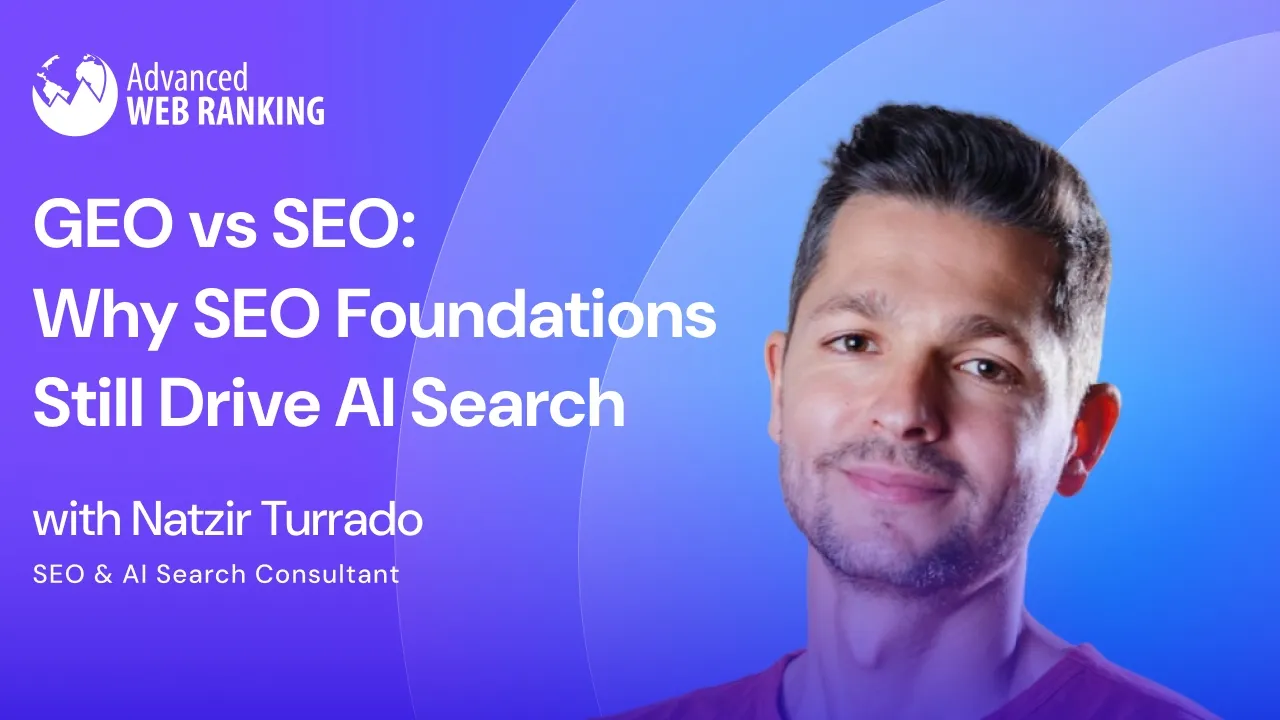
Hello, I’m Gianluca Fiorelli. On The Search Session today, I’m joined by Natzir Turrado an SEO and AI search consultant based in Barcelona, Spain.
Natzir questions the certainty behind GEO and AI search checklists and argues that, in the GEO vs SEO debate, strong SEO fundamentals still matter. We discuss how AI systems find and use content, how to measure AI traffic, why brand mentions can shape both model answers and query fan-out, and why writers shouldn't split pages into arbitrary chunks.
What you’ll learn in this session:
Why the GEO vs SEO debate creates false certainty: GEO vendors sell checklists as guaranteed ways to gain AI visibility while overlooking the harder work of building a brand's reputation.
What helps a website become visible in AI search: brand mentions across the web can influence what models learn, while useful, current content can be found when AI systems search the web.
What drives Natzir’s experiments: he connects ideas across different fields and likes to break things to understand how they work and find faster solutions.
How to measure AI traffic: piece together crawler and fetcher activity, chatbot referral clicks, AI feature impressions, and agent visits that may look like human traffic, since each leaves a different signal.
What’s known about AI agent conversion rates: there’s no official first-party data to confirm how well they convert, so claims that they convert better remain unverified.
What UCP and ACP have shown so far: they can improve product data accuracy, but there’s no data linking them to better rankings or conversions.
How query fan-out reflects a model's confirmation bias: models already have opinions about brands, so fan-out queries often check well-known brands instead of researching the market from scratch.
Why content chunking shouldn't drive how you write: answer the question upfront, keep one idea per paragraph, and avoid splitting strong pages into smaller ones.
What Natzir’s Ad Density Checker compares: a reviewer-style assessment of a page’s ads against Chrome’s detection, showing where Chrome misses or misclassifies ads.
Hear Natzir’s perspective as someone who tests search systems firsthand and shares what the evidence shows.
Topics covered: GEO vs SEO · SEO foundations · AI search visibility · training data and brand mentions · query fan-out · AI traffic measurement · AI crawlers and fetchers · AI agents and conversions · e-commerce protocols · content chunking · Chrome embeddings
About the Guest

Natzir Turrado
Technical & Growth strategist at natzir.com
Natzir has 16 years of experience helping brands improve their online visibility and business results. He is known for technical and strategic SEO, conversion optimization, and data-driven work for large brands and growing companies.
Since 2010, he has worked independently through Natzir, a boutique consultancy for SEO, AI search, and CRO. In 2021, he co-founded AdRanger.io, a tool that helps businesses monitor competitors’ paid search activity and protect their brands.
He teaches AI for marketing, sales, and unit economics at ISDI, including as a guest professor in its Executive Digital Business Program, and SEO and PPC in PUCRS’s postgraduate program in Digital Influence: Content and Strategy. He also speaks at industry events and writes about SEO, AI, and CRO in his articles.
Video Chapters
Transcript
Full conversation between Gianluca Fiorelli and Natzir Turrado.
Gianluca Fiorelli: Hi, I'm Gianluca Fiorelli. Welcome back to The Search Session. Today, we are going to have a person whom I've tried to have here at The Search Session for quite a few months now, but this man is very busy. I can understand it. Not everybody has the time to accept an invitation from The Search Session immediately.
But the wait, I assure you, is well worth it. This person is Spanish, lives in Barcelona, and defines himself on LinkedIn as a technical and growth strategy marketer. He says that he helps brands be visible in classic and AI search. He's a freelancer and has become quite vocal in English in the last 12 to 18 months, especially. He's a good friend. I've known him in real life at events like SEO on the Beach and other Spanish events. His name is Natzir Turrado. Hey, Natzir. Finally, we can do an episode together.
Natzir Turrado: Hi, thanks for having me, first of all. I think we met for the first time 14 years ago, maybe at a web conference.
Gianluca Fiorelli: Yes, yes. It was one of—I don't even remember the name.
Natzir Turrado: Was it Mozcation or MozCon, or something like that?
Gianluca Fiorelli: Oh, yes. The Mozcation event in Barcelona, the community event organized by Moz. At the time, I think it was already named Moz. It was at that event when we started meeting at SEO on the Beach, SEO Congress in Madrid, and other events here in Spain. Just out of curiosity, when did you start working as an SEO?
Natzir Turrado: As a professional?
Gianluca Fiorelli: Yes.
Natzir Turrado: 16 years ago.
Gianluca Fiorelli: So 2010.
Natzir Turrado: Yes, but in 2006, I started my own network, a blog network, spinning things like that, just to earn money to pay for my studies.
Gianluca Fiorelli: It was a noble purpose.
Natzir Turrado: Professionally, I didn't want to be anything. I didn't even know it was a profession itself. I wanted to be a neuroscientist, and I started as a neuroscientist. But that was my first entry into the work.
Gianluca Fiorelli: Yes. And this reminds me of one thing you shared many years ago about forums, but I will come to this later. It was about how you brought forums back to life. It was so funny when you shared it. Considering our forums have returned to importance because of LLMs, I mean, I won't suggest it as a tactic to follow, but I will tell you what they were doing in the past because it was really fun.
But before that, let me start with a classic question: How is SEO treating you lately?
Natzir Turrado: Very well. I think the GEO community is helping me get more clients because they are destroying the internet. My work nowadays is just to clean up the mess that others are making. I mean, that was my work. I'm known as an SEO recovery consultant, if you ask.
Gianluca Fiorelli: You are like that character in Pulp Fiction, Harvey Keitel, the Wolf. You are called when something must be cleaned up and repaired. That's fun.
GEO vs. SEO: Checklists, Shortcuts, and the Illusion of Certainty
Gianluca Fiorelli: Talking about GEO, let's try to be more positive toward people calling themselves GEO, AEO, relevance engineering, or other names. There are people who are good marketers. They are simply using bad terms for two reasons. First, it's a way to market themselves—a marketing strategy for selling themselves as something new or different from the maybe not-so-positive idea of SEO that many brands still have. Second, some people sincerely think that GEO has a strong SEO base but also has a few or many peculiarities, depending on the person, that may not be so important for SEO but are very important for GEO. Let's also consider that there are these types of people in the GEO ecosystem. Obviously, there are also many snake oils.
If I remember correctly, you position yourself as a classic SEO and AI search freelance consultant, and you talk about AI search without the smoke. What are some examples or forms of this GEO and AI search smoke that you fight or see when you have to recover a website?
Natzir Turrado: I try to separate myself from the term GEO because right now, I don't know if it's the same internationally, but here in Spain, among the people I know—maybe I'm biased because of the people I know, including my clients—GEO tends to come with all these bad practices that we know about, like doing bad things such as programmatic SEO.
Many vendors also sell checklists and tricks because they say they know exactly how the system works, but we really don't know yet. A typical GEO checklist says: add schema, add an llms.txt file, make markdown versions of your pages, and break your content into small blocks. Most of these tools also automatically create recommendations based on the gaps they find in your topics. They might tell you, “You need to do a listicle in this particular news media.” But this is often not possible. We don't know how Google has been treating all these listicles lately.
For me, the smoke is the fake certainty: the way they assure you they're going to give you AI visibility because of what the tool recommends. For me, this is very dangerous. Most of the examples we've seen are going up, and then they fall.
Gianluca Fiorelli: Yes. It was called the mountain graph.
Natzir Turrado: Yes, it works until it doesn't. What is happening? I think it's happening because what really matters to these systems is harder to sell. What people say about your brand on other websites—your reputation or your product—isn't something a checklist can fix. Clients need to do the work. That's why they're trying to find a shortcut to become more visible in AI, and that's why I'm against all the bad practices. I want to separate myself from this term. As you said, the term GEO, or whatever you call it, is a useful way to open doors with clients because everyone wants to be on these systems right now, even if they don't bring enough traffic or conversions. But this is hype, and everybody's talking about it, and there's a lot of money in it.
I understand why someone might want to be called a GEO specialist. You could get in trouble if you don't call it GEO inside your company. I've heard many stories about people losing their jobs because the person above them says, “You're not cool,” or “You're not advanced,” or “You don't know the new things that will make us appear in these kinds of systems.” I understand that someone might risk losing their job. They can choose that name to continue in their role. As long as you use it to continue selling good SEO, that's fine if you know what you're doing. But most of the time, what happens with the GEO term is that the people selling GEO have a strong skill issue, or they're taking advantage of the client's skill issue. The clients don't really know what SEO is about.
Gianluca Fiorelli: Yes. I think this is also an original sin of SEO in general, right? We had 20 years to make SEO more understandable to what we might call normal people, the rest of the world. I think this is also something we should blame ourselves for as an industry: letting certain kinds or versions of SEO, or certain visions of SEO, be considered canonical SEO.
Even before AI search, SEO was mostly about ranking and being visible for certain keywords. It was very simplified knowledge. We don't need to teach our clients and brand decision-makers how information retrieval works, but explaining in simple terms why Google is showing something in the SERPs instead of something else would have been useful. Sometimes we may have talked too much among ourselves instead of dedicating time to speaking to others in simple language. That's why I sometimes return to the idea that we need someone like a Carl Sagan of SEO, who could explain complicated astrophysics to people watching television.
Natzir Turrado: Yes.
Gianluca Fiorelli: That's why things like GEO and the smoke sellers are coming out, too.
Natzir Turrado: It's a bias we have. We always love the easy path. Our brain is lazy for these kinds of things. I blame myself because when I speak or write about something, I'm always talking about the theory, the patterns, and things like that. Maybe that's why it sounds like magic to someone.
Gianluca Fiorelli: Yes, yes. It depends on whether you're writing for someone who's supposed to know these things. You can write that way. I imagine that when you're speaking with clients, you don't talk the way you write.
Natzir Turrado: My target for my blog posts and things like that is technical: professional SEOs.
How AI Models Answer From Memory vs. Live Search
Gianluca Fiorelli: Yes. Talking about SEO, GEO, and the recent Google event in Barcelona, Google said again that good SEO is good GEO. When a client asks you, “We want to be more visible in ChatGPT, in AI Overviews, in artificial intelligence,” instead of proposing a list of places where they must be published, or saying they must create and implement every existing type of schema, what foundational things do you look for on a website to understand what they should do first?
Natzir Turrado: First of all, I try to explain to my clients what the real difference is, if there is any. A model can answer in two ways. It can answer from its memory, which is parametric memory, or it can search for information. When the model answers from memory, you need to be mentioned everywhere. These models learn from Common Crawl, Reddit, and other sources. If people talk about you online, you will be in the next version of the model. That's digital PR, social media, and earned media, and we have been doing this for years. You need to continue doing this kind of work.
What's happening right now is that we have a seat at the table with these departments, thanks to GEO. Now we can talk with them. That's something we were banned from doing years ago. You can talk with communications and PR. Right now, we work together, and I think that's good. We should continue doing so.
For most questions about facts or current things, the model can't use its memory because it's likely to invent things. It needs to search to avoid mistakes. Imagine someone asks, “What is the best media platform?” The model can't recommend something from two years ago.
Gianluca Fiorelli: Yes.
Natzir Turrado: It needs current information. I remember something Sam Altman said in a talk about a year and a half ago that has stuck in my mind. For him, the ideal AI is a small model with very good reasoning, a lot of context, and access to different tools. When it needs to know something, it searches because it's cheaper and always up to date. Searching also reduces mistakes or hallucinations.
In all the system prompts I analyzed, the labs tell the model the same thing: search when you need fresh or fast information. So you need content to appear in those searches. In AI Overviews and AI Mode, there's a correlation of over 70 or 80 percent between results in the top 10 and AI citations and mentions. That's not the case in ChatGPT, because it works differently. You need to shape the content so it answers the question, “Why is this brand appearing for this query?” Because it has the content and is ranking well. It's as simple as that.
Why LLMs Building Their Own Indexes Keeps SEO Relevant
Natzir Turrado: But searching is very expensive for these systems. For example, ChatGPT uses SERP API. Competing with Google is very difficult. In last year's trial, Nick Turley, the head of product at ChatGPT, said their goal was to cover 80 percent of their queries with their own index, and that the remaining 20 percent would take them years. In May, I tweeted that ChatGPT documentation says it has its own index with its own gathered content. Many people in GEO say, “No, LLMs don't have their own index.” They do. It's another search engine. If there's a search engine, we can keep doing SEO.
Gianluca Fiorelli: Yes. Perplexity certainly has its own index.
Natzir Turrado: ChatGPT does, too. Perplexity is another case. I don't know if it's going to survive forever.
Gianluca Fiorelli: And Claude uses Brave and at least explicitly cites Brave as one of its sources for live search. The others aren't officially known. I don't know if they're also creating an index.
Natzir Turrado: Claude is caching results, too.
Gianluca Fiorelli: Ah, okay.
Natzir Turrado: I found out that Claude is caching resources, too. It's not documented, but I found out.
Gianluca Fiorelli: What I would say is that creating and indexing things is not complicated, but maintaining the index is complicated: cleaning it of fluff and duplicated URLs and removing the millions of URLs that are essentially unusable for a real index. The problem isn’t getting to the point of having an index. It’s the work behind it. Google has more than 20 years of experience maintaining one. ChatGPT had, and still has, its agreement with Bing. Bing has an excellent index, and Brave has another index with its own peculiarities. I wonder why nobody is knocking on DuckDuckGo’s door, for instance. It seems forgotten by all these systems. But if there is an index, that’s another reason to think SEO is relevant for LLMs, too.
How Breaking Things Fuels Natzir’s Experiment
Gianluca Fiorelli: One thing I like about you—and it’s not something you’ve only started doing recently—is that you experiment and investigate a lot. I wonder how the idea to test something comes to you. Some tests are unusual. I don’t want to call them weird, but I do wonder how you come up with the idea to test them.
Natzir Turrado: I don’t know. It’s been happening since I was a child. I’m not an expert in anything, but I know a little about many things. I think this is called navigating liminality.
Gianluca Fiorelli: Oh, okay, navigating the borders.
Natzir Turrado: When you navigate the borders, you start to connect the dots through parallel or lateral thinking. I think it’s because I connect the dots: I know about several different and weird things. It’s also because I’m lazy. I always try to find a quick solution for everything. When I have to do the same thing again and again, I try to find a way to do it faster. And when there’s something new, I need to break things down to learn how they work. I want to know what would happen if I break something and whether I’ll learn anything or find an exploit.
That’s how I came up with solutions to scrape Google, even when Google puts up barriers. It’s also why I create a lot of tools to share with the community. My motivation is to break things. I love to break things.
How to Measure Traffic From AI Search
Gianluca Fiorelli: Maybe because of this habit of breaking things to see how they work from the inside, you discovered many things, including the Gemini iOS user agent. That led you to understand, or hypothesize, why people say it’s almost impossible to give a correct attribution to AI search. Maybe there’s a fog of war in the data we receive. It’s masked. Desktop traffic is one thing; how people use AI search on mobile is another. Maybe some of it passes as dark direct traffic or something like this. When your clients ask, “We’re doing all these things. How are we doing? How can we measure the results of what we’re doing?”
Natzir Turrado: For me, it’s like a puzzle. You need to put the pieces together. There are four or five types of traffic, depending on the type of business.
First, we have crawlers. This is foundational. Crawlers collect pages for training or for a search index. You can only see them in your server logs. That’s the source of truth. Then you have fetchers. When a user asks something, a bot visits your page at that moment. ChatGPT-User is one example. This is the only case where one visit in the logs is connected to one question, based on the fetcher’s user agent. Then there’s another type of traffic: people who click a link on a chatbot. That’s easy to measure because they’ve started adding UTM parameters. ChatGPT has been doing that for about two years, I think.
Gianluca Fiorelli: Yes, and it seems Gemini has started adding, too.
Natzir Turrado: I can’t replicate that. It doesn’t work even in the app. Gemini’s app doesn’t send a referrer, so it comes through as direct traffic. Also, the user agent for the Gemini app is Googlebot. Just Googlebot.
Gianluca Fiorelli: Yes.
Natzir Turrado: When you open a link from the web view in the Gemini app on iOS, there’s a new user agent that I discovered. It’s not documented. It’s called Gemini iOS. For me, it’s a shame because John Mueller said this week that he didn’t know Gemini doesn’t pass a referrer. You work for Google, and you don’t know? He was asking for examples of this being a mistake on Google’s part. How long has Gemini been working?
Another type of AI traffic is the traffic we can measure from AI features inside Google, or Copilot, and things like that.
Gianluca Fiorelli: The impressions in Search Console.
Natzir Turrado: Copilot is better. Clarity is insightful too because the data is grouped by topic and query. I love it. It shows the grounding query.
Then there’s another type of traffic: the agent itself. In GA4 or AMP, for example, agents can look exactly like humans. When they enter a webpage, they also accept cookies. I’ve done a lot of tests, including with Google Operator Atlas, when it still existed, and with Perplexity Comet. They accept cookies and are counted in Google Analytics. If you look at the logs, the user agent is a normal one, like Chrome. You’ll never know whether it’s an agent or not. They’re starting to create different protocols, like Web Bot Auth, to try to track this new situation.
Which AI Bots Cause the Most Problems in Server Logs
Gianluca Fiorelli: Talking about the Web Bot Authentication protocol, I like the things you share about security and agents. When we talk about AI crawlers and bots, we tend to think of the familiar ones: ChatGPT, Anthropic, and Googlebot, or Perplexity, but there are hundreds of them. People may not know how dangerous they can be, so they don’t block them.
They might block OpenAI’s ChatGPT bot because they don’t want ChatGPT to use their content for training, which I think is a mistake in many cases. But they may let AI scrapers access their websites freely, train on their content, steal their data, and create databases they sell to others. There may be even more dangerous types of bots. When you explore server logs, which bots do you see really causing problems?
Natzir Turrado: Right now, Meta.
Gianluca Fiorelli: Yes. I have a case with a client who said just a couple of days ago that they needed to block Meta on their server because it made 60,000 requests in two minutes.
Natzir Turrado: Yes, because Meta is building its own index. That’s why it’s happening. Applebot is showing up now, too. Until now, it was the typical CC bot and things like that. That’s the Common Crawl bot. Claude was a mess, too—the Anthropic bots. These things change from time to time, but right now, I think Meta is the most unuseful bot. You can block it for training. There’s nothing you can search with it. Well, there’s Meta AI.
Gianluca Fiorelli: Meta AI is normally more for creating things.
Natzir Turrado: No, but it has its own chat too, and Meta AI is connected with WhatsApp.
What the Data Says About AI Agent Conversions and Commerce Protocols
Gianluca Fiorelli: You were saying earlier that agents behave like humans. So now I’m talking to Natzir Turrado, who also works on conversion rate optimization. Is an agent bot’s conversion rate the same as a human’s because it’s trying to mimic a human or not?
Natzir Turrado: No. We don’t have an official report based on first-party data yet. I can check how these agents behave in my clients’ e-commerce sites, but that data doesn’t exist. We can separate those kinds of visits, though.
Think about what Amazon is doing. Amazon blocks these agents. It blocks Perplexity. It didn’t let you buy through Atlas in the past, and right now it doesn’t let you buy through Comet or Muse. They say this is because their business model also depends on advertising, and they think they’ll get fewer conversions because an agent is more goal-oriented. I don’t know.
But visits from these agent features during a conversation convert at twice the rate of Google Shopping, for example, in e-commerce. That makes sense if you think about it: the research is already done. It’s like someone who has already searched and is ready to act. They’re more direct. They want to do something and do it quickly.
There’s a lot of research based on third-party data, but there’s no public information about whether agents convert more. There’s also research on their behavior, which shows they act like humans. They can also be persuaded like humans. I remember some interesting research on Claude Sonnet 3.5 and how social proof can persuade it. Authority, on the other hand, makes the LLM less likely to buy. We can influence them, and they can influence us to buy something. But there’s no third-party data about agentic processes and conversion.
Gianluca Fiorelli: You’ve already started testing or implementing UCP and ACP site-wide with your e-commerce clients—not just as a test, but as something more permanent. Have you started? What results are you seeing in terms of conversions?
Natzir Turrado: Nothing yet. These are protocols, and, as I said, it’s very difficult to measure all of this. I started implementing them months ago for an international e-commerce business in the United States because it only works in the U.S. right now. You can add your feed and things like that. I don’t have any data about it yet.
We’re wasting a lot of resources trying to recommend these things to our clients, even though we shouldn’t be recommending them as something that will improve SEO. It’s not like that. It’s a product thing. It’s a business thing. I haven’t seen anything yet. It’s a pilot, and I don’t know. I don't have any data to share.
Gianluca Fiorelli: I’ve experimented with this too, and I’m still keeping it in the pilot phase. The goal is mainly to understand how things work and what changes would be needed to implement them at scale and to see what kind of information we can get from the feed data.
Natzir Turrado: So it does help with ranking?
Gianluca Fiorelli: No, not at all.
Natzir Turrado: What I saw is that it helps with the accuracy of your data, especially how quickly prices and other details are updated. But you’ll be in the same position. I can’t connect that to better conversions.
How EU Regulation Is Splitting the AI Search Experience
Gianluca Fiorelli: I have another question. I’m sorry to listeners outside Europe, but with the European Union spreading AI regulations and antitrust laws, we’ve recently seen changes, in the case of Google, to how things are presented. Some things that already existed, like shopping sites, are being given a new presentation. We’ve also seen the percentage of popular products for transactional queries decrease.
This will probably affect AI visibility. European countries are often the last to receive "improvements" to AI search from Google or ChatGPT. Do you think we’ll have two different AI search experiences because of regulation?
Natzir Turrado: We already have it. The SERP is totally different in the United States for transactional queries than it is for users in Europe. I don’t know if that makes the user experience worse. Anything that helps filter results in search first gives you a better visit—someone who is more likely to compare options. Instead, you’ll get fewer clicks because more users will stay on the SERP. The more functionality Google adds to the SERP, the more clicks stay there.
When did we get the most traffic? During the time of the famous ten blue links. When Google started pushing Universal Search, what happened to competing commerce sites? They lost half their traffic. So maybe the user experience could be better. I don’t know; I don’t have the data. But for businesses, the more functionality Google adds to the SERP, the worse it could be. It’s a question of clicks. What counts as a click, you know?
Gianluca Fiorelli: For me, when I worked with a lot of travel websites, these features were already a sort of mystery. I didn’t use them as a source of traffic because it was impossible to tell whether a click came from those features or from the classic organic snippet. But I used them as a signal: if your site appeared in a feature, that meant Google considered it relevant for that query. Usually, there was also a correlation between appearing in those features and ranking in the organic results.
How Parametric Memory Shapes Query Fan-Out
Gianluca Fiorelli: When it comes to content, you said that training data is mostly based on what other websites say about a brand. A few weeks or months ago, people started wondering—and I did too—whether a brand’s presence in the training data also benefits it when AI uses grounding and performs live searches. Does training data, or parametric memory, influence query fan-out?
Natzir Turrado: Yes, a lot. I think I was the first person on the internet to call it the model’s confirmation bias. I always say that fan-out queries show the model’s confirmation bias. The model already has an opinion about brands, and then it searches to check that opinion.
For example, I did a test last year in a webinar. I looked at Gemini’s fan-out queries for mattresses in Spain. The queries already included brand names.
Gianluca Fiorelli: Yes, I was asking for exactly that reason. In the query fan-out, you see brands cited, and so, you’re wondering where it is pulling those brands from.
Natzir Turrado: I ran several rounds in the same minutes—seven rounds. The best-known brands always appeared. Less-known brands only appeared when the model searched for each brand by name to check whether it was good or not. To me, the model isn’t really researching. It’s confirming what it believes.
Gianluca Fiorelli: Could the many site-specific searches people started seeing from ChatGPT be another confirmation of this behavior?
Natzir Turrado: Yes, for sure. That’s what happened with Reddit, too. Reddit lost a lot of its visibility in ChatGPT because ChatGPT decided to search less often using site:reddit queries. I think Dan Petrovic also discovered that Reddit decided to filter results after retrieval, even when they were cited.
I’m starting to see this more in newer models: they search for well-known brands because they can retrieve them. Brands are mental models. They save us time when we’re deciding whether something is good. It’s a brand—why wouldn’t I trust it? People love brands. That’s why ChatGPT loves brands, and that’s why Google loves brands.
Why Writers Shouldn’t Split Content Into Arbitrary Chunks
Gianluca Fiorelli: One of the many GEO myths—and returning a little to the beginning of our conversation—is that you have to create a 120-word paragraph, or you won’t have an optimized chunk. Myths usually come from something that has at least a little truth in it. That’s the wonderful thing about myths and legends.
There is something called Passage Ranking, which Google introduced many years ago. People Also Ask, and especially Featured Snippets, were substantially based on the same idea. It’s easy to understand if you look at your site’s ranking history. If you look at the Featured Snippets your website had, most likely you’re now in AI Overviews.
Natzir Turrado: Yes, that’s it. This is the switch. I have a client whose content replaced all the featured snippets in AI Overviews the day they started appearing here in Spain.
Gianluca Fiorelli: We know content is important. When you give a client a content recommendation, what’s the most important thing you tell them about how search engines and AI bots treat their content before telling them to forget all that and keep doing what they’ve always done?
Natzir Turrado: Regarding chunking: systems chunk content, but we don’t know how they do it. We don’t know the size of the chunks or which embedding model they use to create them and calculate cosine similarity. The models can also change their chunking systems without telling us. There are many types of chunking: contextual chunking and others.
If you write in blocks of, say, 400 tokens, you’re optimizing for a system you don’t understand. I did a small test with a RAG solution, using the same test in different ways and giving different chunk sizes the same query. I found that there’s no perfect chunk size. What I found is that if you answer first, the size of the chunk doesn’t matter as much. If your answer is in the first paragraph, it’s less likely to be cut off between chunks or windows. The biggest problem with chunking is when you try to split one page into smaller pages.
Gianluca Fiorelli: Yes.
Natzir Turrado: Google first finds pages, then selects them and writes answers based on them. If your page doesn’t rank, the models don’t see it. When you split one good page into ten small pages, you dilute it. The system may then have cannibalization or duplicate content issues, and users may go back to the search results to keep investigating. I think Danny Sullivan said in January, “Don’t make small chunks. Don’t make micro-content for LLMs or for other people.” Google’s new guide says the same thing.
What should writers do? Write well. Put the answer at the beginning. If I had to give one tip, that would be the best one. The text is less likely to be broken up, and this is also an old golden rule from Google News.
Gianluca Fiorelli: Yes.
Natzir Turrado: If you answer in the first paragraph, or in the first 400 characters of the page—
Gianluca Fiorelli: What we call entradillas in Spanish.
Natzir Turrado: Yes, the entradillas. That’s the trick. The system Google News uses calculates n-grams to show you the news based on the first paragraph, not the rest of the article. That was in a leak from Project Veritas a year ago, and I explained it to the news media.
Also, one paragraph, one idea. If someone can understand a paragraph on its own, a chunker can understand it too. Use clean HTML. I’ve done thousands of tests with HTML and reverse-engineered the Chrome chunker to understand how these things work. For me, the best chunking is the kind you don’t have to think about.
Gianluca Fiorelli: Yes. That’s why I was saying: learn how they work, then forget about it and go back to writing as you did before.
Natzir Turrado: We have smarter models now. There’s a new one called Exa, I think. It says you don’t need to worry about where on the page the answer appears; it will retrieve it wherever it is. I’ve been talking about the unchunking methodology for about a year. One of the biggest wins I’ve had with clients is fixing cannibalization.
Gianluca Fiorelli: Yes. Cannibalization and internal linking are, at the end of the day, the most classic remediation tactics.
Natzir Turrado: Yes.
What Natzir’s Ad Density Checker Reveals About Chrome
Gianluca Fiorelli: Are you running any experiments you might tell us about in the future? As we’ve seen, you can’t stop thinking, doing things, and breaking things.
Natzir Turrado: The latest one was the one I did with PassageLens. I used the embedding model and chunking system inside Chrome. It was an experiment, and it’s useful, but it’s still experimental.
I also published a new tool today. I created a tool that works like a reviewer for Google’s ad experience. I have clients who receive ad experience penalties, and the reviewers send them videos with examples. In one video, a reviewer measures the space occupied by ads with their hand. Based on that, the tool says, “Okay, 30 percent.” I automated this using the Better Ads Standards. I also used the internal tagging system in the new version of Chrome, with its ad metrics. I discovered that Chrome’s ad metrics are based on only a small portion of all the ads on the internet. The list is incomplete, so these metrics aren’t valid.
What you’re seeing in Chrome’s ad metrics is inaccurate because information is missing. A lot of ad networks aren’t counted. Even if you use your own Google ad network to serve your own ads, Chrome’s ad metrics don’t work. Also, the ad gate from Google doesn't come from Chrome. I discovered a lot of things, including ways to manipulate those signals.
When I receive a penalty for a pushy app or an ad experience issue, it’s always a manual penalty, not an algorithmic one. But if you have a new site with a heavy ad experience, you may be filtered automatically because of Navboost or something like that. The page is slow, users don’t like your site, and they don’t come back.
In the past, I’ve recovered a lot of clients by reducing the number of ads. I built these tools to understand how Google might automatically classify ads and to help me audit core updates. The tool shows you what a Chrome reviewer would see, based on the standards. It was a fun experiment.
Continue the conversation on The Search Session with:
Ryan Jones on testing AI search claims, running meaningful SEO experiments, and measuring what the evidence can actually support.
Jamie Indigo on AI crawlers and server logs, including how bot activity affects websites and why crawlability and technical SEO fundamentals still matter.
Gianluca Fiorelli: Cool. I’m sure that not only I, but everyone who follows you and discovers you through this conversation, will look out for more experiments and insights from you. It’s been an hour, so I think it’s time to let you go. It was a great pleasure to have you here on The Search Session.
Natzir Turrado: It was a pleasure too. Thank you for having me.
Gianluca Fiorelli: I hope it was the same for you. Valencia and Barcelona aren’t far apart, so I hope to see you again in real life soon.
Natzir Turrado: Same. Have a nice day.
Gianluca Fiorelli: And thanks to all of you, too. Like a YouTuber, I’ll remind you to subscribe to the channel, give this wonderful episode a like, and ring the bell to be notified about new episodes. Thank you, and bye-bye.

Podcast Host
Gianluca Fiorelli
With almost 20 years of experience in web marketing, Gianluca Fiorelli is a Strategic and International SEO Consultant who helps businesses improve their visibility and performance on organic search. Gianluca collaborated with clients from various industries and regions, such as Glassdoor, Idealista, Rastreator.com, Outsystems, Chess.com, SIXT Ride, Vegetables by Bayer, Visit California, Gamepix, James Edition and many others.
A very active member of the SEO community, Gianluca daily shares his insights and best practices on SEO, content, Search marketing strategy and the evolution of Search on social media channels such as X, Bluesky and LinkedIn and through the blog on his website: IloveSEO.net.


