

An Exhaustive Analysis of the True Meaning of the Latest Google’s 2025 Search Console Updates and the Entity-Driven Web
A few weeks ago, Google announced the introduction of branded queries and social channels in Search Console. And the more the days pass, the more I think that few updates have carried as much theoretical weight as these changes, because, if you reflect, these interface adjustments fundamentally alter the ontological framework through which Google presents data to webmasters.
The Branded Queries Filter: Moving Beyond Regex
On November 20, 2025, Google introduced the Branded Queries Filter within the Search Console Performance Report. This update allows property owners to segment traffic into two distinct views:
"Branded".
"Non-branded".
This “simple” filter marks a significant departure from previous analytical methods.
The AI-Driven Classification Mechanism
The technical documentation of Google reveals that the distinction is determined by an "internal, AI-assisted system".

This system does not merely match strings; it identifies entities:
Direct Brand Names: The system identifies the core brand entity (e.g., "Google").
Product Associations: It identifies queries referring to unique products intrinsic to the brand entity (e.g., "Gmail" implies Google).
Aleyda Solís, frequently highlights that this moves the industry toward "Brand-Led SEO." The AI captures a spectrum of intent that manual filters typically miss, confirming that Google’s understanding of "Brand" is semantic.
Social Channels Integration: The Expansion of the Entity Profile
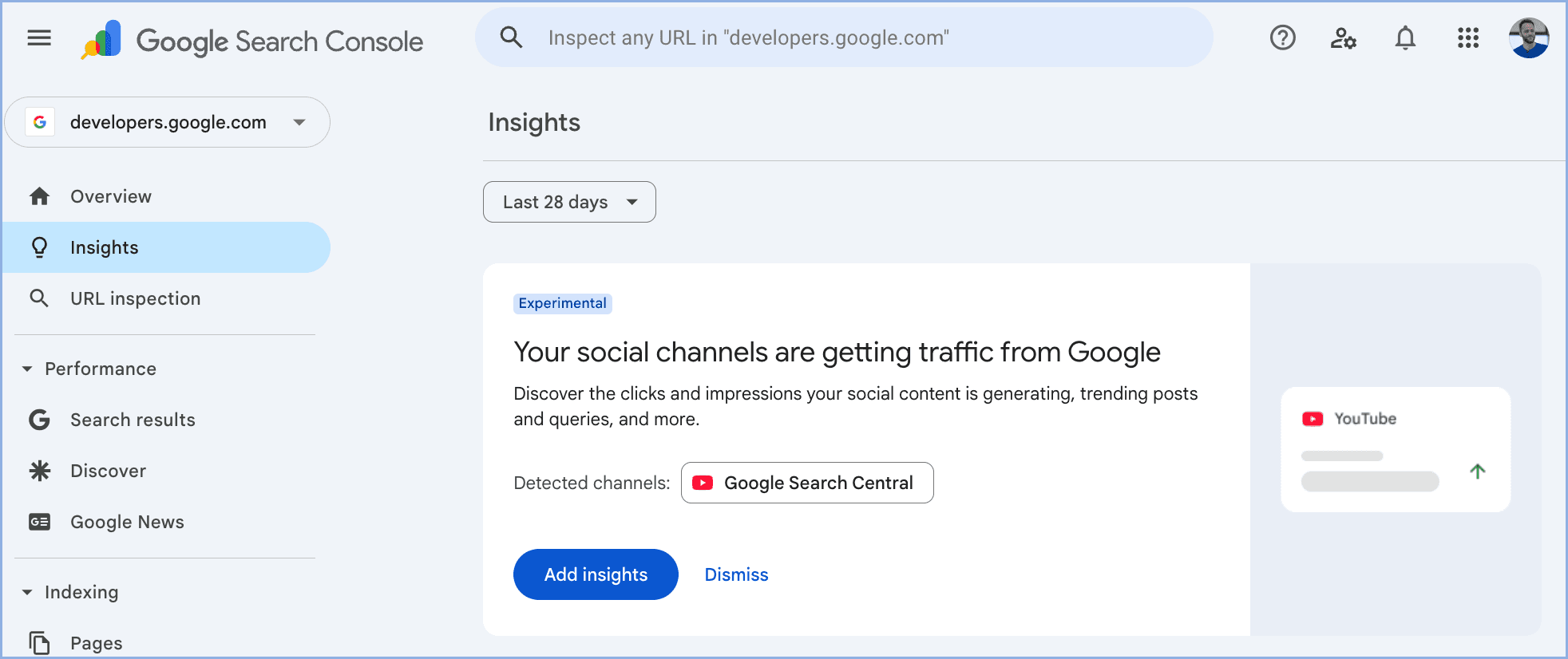
Following closely on December 8, 2025, Google rolled out the "Social channels" report within Search Console Insights.
This update redefines the scope of what Search Console measures.
Automation via the Knowledge Graph
The integration relies on Google automatically associating social profiles with the website’s entity.
This automation proves that Google is utilizing its Knowledge Graph to map disparate URLs (social profiles) to a single corporate or personal entity.
If GSC automatically populates a site’s social channels, it serves as a confirmation that Google’s Knowledge Graph has successfully "disambiguated" the brand entity.
The Technical Architecture of Brand (The "How")
I have a theory: what if these GSC updates finally are Google admitting - and not only as isolated recommendations in social posts and talks - imply "Brand" is a critical signal for ranking?
To validate this, let’s look to the machinery of Google’s ranking systems and give a look to things that were news in the period between May 2024 and May 2025, but that the constant AI frenzy made us forget too fast somehow.
Navboost and the site_quality Score
Perhaps the most significant revelation from the DOJ antitrust trial was the confirmation of Navboost, a core ranking system that utilizes clickstream data to re-rank search results, as very well explained Shaun Anderson in its long form article ‘Navboost : How User Interactions Rank Websites In Google’.
Mark Williams-Cook revealed findings from a Google exploit showing that Google calculates a site_quality score for every website on a scale from 0 to 1.
The 0.4 Threshold: Sites with a score below 0.4 were effectively invisible for rich features like Featured Snippets.
Brand as the Driver: Mark argues that this score is heavily influenced by Branded Search Volume and user interactions. If users scroll past top results to click a specific brand ("Search Friction"), that sends a powerful signal to the algorithm.
The 2024 API Leak: Validating Site Authority
In May 2024, a massive leak of Google’s Content Warehouse API documentation confirmed the existence of an attribute named siteAuthority. Mike King posts that this score is influenced by the quality of backlinks and aggregate user interaction signals (Navboost).
The Branded Queries volume is a key proxy for this "popularity" component.
The "Brand as Connector" Theory (Integrating My Hypothesis)
Almost exactly one year ago, I wrote an article that presented this theory: Brand (aka Organization) is the connector between the Knowledge Graph and offline reality.
Brand Signals vs. Technical Perfection
My theory challenges the traditional SEO hierarchy. In fact, I argued that a website can be technically flawed yet still dominate search results if the Brand Signals are strong.
The Mechanism: "Brand Entity" signals in the Knowledge Graph act as a buffer. If an organization is active offline and on social media, these activities generate "Branded Searches."
The Override: As per Navboost logic, these branded searches are high-fidelity trust signals. They tell Google, "Users want this specific entity." Consequently, Google surfaces the site to satisfy user intent, overriding technical deficits.
Translating "Brand" for Machines
I define "Brand" as a set of signals that must be translated for machines via Structured Data, and the new GSC Social Channels report seems to validate my emphasis on SameAs schema.
In fact, Google uses this logic to verify that a YouTube channel belongs to a specific website entity. Without this translation layer, the "Brand" remains invisible to the algorithm.
The Qualitative Architecture (E-E-A-T & Strategy)
For many years now, Lily Ray argues in her analysis of Google Core Updates (for instance on the Amsive Digital blog) that Google relies on "Brand Authority" as a primary proxy (heuristic) for "Trust" and "Safety" in YMYL SERPs.
Lily substantially talks of the Trust Deficit, which occurs when users encounter unknown websites, they lack trust.
In other words, Brand acts as a "Trust Proxy."
The inclusion of social channels in GSC is critical, then, for author E-E-A-T.
By tracking these profiles, Google acknowledges that an author's "Search" reputation extends to their social presence.
And authors can be easily connected to Brand through structured data in the Organization schema.
The Structural Architecture (The "Where")
Seven years ago already, Cindy Krum argued that the fundamental unit of Google’s index has shifted from the URL to the Entity (Entity-First Indexing).
The Social Channels Integration is the smoking gun.
Google is aggregating data by Entity, not just by Domain.
The Brand Firewall – Discriminating True Entities from AI Spam
The "Hollow Shell" Problem
With the rise of Generative AI, creating "high-quality" content is trivial. A spammer can generate 10,000 "helpful" articles in a day. However, what a spammer cannot generate is Navigational Demand.
A site may have perfect content and high ‘Domain Authority’ (manipulated via expired domains, for instance), but if it lacks Branded Search Volume, it is a "Hollow Shell."
In theory, updates like the Spam Update, which includes the "Site Reputation Abuse" policy, target sites that look authoritative but lack genuine brand coherence.
The Branded Queries Filter in GSC could be essentially a "Proof of Life" monitor. If a site has 100,000 organic visitors but 0 branded queries, it signals a lack of real-world entity status, flagging it for algorithmic demotion, as, once again, Lily Ray very well exposed in her SEO Week and BrightonSEO talks this year (you can download the SEO Week one here).
Navboost as a "Proof of Work"
Navboost acts (or should act) as the ultimate spam filter because it relies on human intent that is difficult to forge at scale:
The Signal: A "Real Brand" has users who search for it by name (e.g., "Adidas returns," "Airbnb login").
The Fake Brand: A "Fake Brand" (Made-for-Advertising site) relies entirely on non-branded, informational queries (e.g., "best running shoes"). They have no direct traffic intent.
Differentiation: By measuring the ratio of Branded vs. Non-Branded traffic (now visible in GSC), Google can programmatically separate "Entities" (who have an audience) from "Publishers" (who only have keywords).
The Social Graph Verification
The Social Channels Report is not just for analytics; it is a Verification Protocol:
Graph Integrity: A real brand has a consistent, interconnected "Entity Graph." Its website links to a LinkedIn page with real employees, an Instagram with real comments, and a YouTube channel with real views.
The Spam Disconnect: Spam sites rarely maintain active, verified social ecosystems. They may have fake profiles, but they lack the connection in the Knowledge Graph. By requiring automatic association for the GSC report, Google is confirming that only entities with a valid, recognizable "Social Graph" get the credit.
Implication: If your social channels do not appear in this report, you may be at risk of being classified as a "weak entity," making you vulnerable to the same filters that wipe out spam sites.
Defensive Branding in AI Search
As AI Search (AI Overviews, ChatGPT et al) grows, "Hallucinated Brands" become a risk.
The possible counter-measure can be brand signals analyses by Google, OpenAI and other players.
High volumes of branded search and consistent schema (SameAs) could train the LLMs that a Brand is a "Ground Truth" entity.
This could prevent the AI from conflating a Brand with generic terms or spam competitors.
Go deeper on how brands can build lasting authority and visibility in an AI-driven search landscape:
Jes Scholz - SEO Beyond the Funnel: From Personalization to Brand Salience in the Age of AI
Rand Fishkin - Branding in the Age of AI and Zero-Click SERPs
Joanna Lord - Building Resonant Brands with AI
Gianluca Fiorelli - Connecting Knowledge Graphs, Entity Search, and Search Insights for Topical Authority
The Brand SEO Blueprint (Actionable Strategy)
To operationalize the findings of this report, we have developed a "Brand SEO" blueprint. This strategic framework moves beyond traditional keyword optimization to a holistic "Entity Management" approach.
Phase 1: Entity Calibration (The Foundation)
Goal: Ensure Google’s Knowledge Graph has a flawless map of your brand entity.
Knowledge Panel Reclamation:
Action: Treat your Knowledge Panel as your "second homepage." Claim it and use "Suggest Edits" to ensure the description matches your brand positioning.
Phase 2: Signal Generation (Feeding Navboost & Building Entity Coherence)
Goal: Generate the user interaction signals, co-occurrences, and entity associations that prove "Real World" existence and train both classic algorithms and LLMs.
Structured Data as Entity Translation Layer
The Problem: Google cannot "understand" brand values, reputation, or market position the way humans do. It needs explicit signals.
Actions:
Maximize Organization Schema Properties: Google recommends 28 properties; Schema.org offers 40+. Use as many as legitimately apply: founder, slogan, award, numberOfEmployees, foundingDate, areaServed.
The sameAs Protocol (Expanded): Go beyond social profiles. Include:
Wikidata/Wikipedia (if available)
Crunchbase, Glassdoor, industry directories
Google Business Profile, Merchant Center, Manufacturer Center
YouTube channel, Amazon/IMDB profiles (if applicable)
Logic: Each sameAs URL is a vote for entity disambiguation. The more authoritative sources confirm "this entity = this website," the stronger the Knowledge Graph signal.
Relational Schema for Complex Organizations: Use parentOrganization / subOrganization for holding companies. Use brand + manufacturer + seller for B2B distribution models. This prevents entity fragmentation.
Semantic Content Mapping with about and mentions: On every substantial page, explicitly declare which entities are the primary subject (about) versus referenced (mentions). This trains both Google and LLMs on your brand's topical associations—the building blocks of branded queries.
Branded Queries as Strategic Intelligence
The Problem: Most SEOs treat branded queries as "already won." This misses their diagnostic and strategic value.
Actions:
Audit Branded Query Variations: Export branded queries from GSC. Cluster by intent type:
Navigational (brand + login, brand + contact)
Commercial (brand + pricing, brand + vs competitor)
Informational (brand + how to, brand + guide)
Gaps reveal content opportunities. If users search "Brand + return policy" but you rank poorly, you have a UX problem, not an SEO problem.
Competitor Branded Query Analysis: If you lack branded queries (new brand), analyze competitors' branded searches to identify patterns. Create content targeting those query structures preemptively.
International Market Signals: Branded queries vary by market. Localization is important also for Brand signals.
Product-Level Brand Queries: Treat proprietary product names as sub-brands. "Nike Jordan 1", for instance, is a brand query for Nike. Analyze and optimize for these at scale.
Offline-to-Online Signal Generation
The Search Instruction Tactic: Replace vanity URLs in offline ads (TV, OOH, print) with search instructions: "Search 'Brand + Offer Name' on Google." Why it works: This manufactures branded search volume—direct Navboost fuel (note: this could be a good test to try for influencing memory of LLMs with claims like: “Search ‘Brand + Offer Name’ on ChatGPT”).
Event-Driven Search Spikes: Coordinate product launches, announcements, or campaigns across YouTube and social before the search-capture landing page goes live. The Games Workshop Age of Sigmar launch example shows how YouTube announcements drive subsequent branded search surges.
Content Strategy for Brand Awareness Signals
The Problem: Generic content generates generic signals. Brand-building content must be distinctive enough to attract amplification (links, co-citations, social mentions).
Framework: The Winning Zone
Content must sit at the intersection of:
What your audience (buyer persona) needs
What influencers/journalists (audience persona) want to amplify
What your brand can uniquely provide
Execution Models:
The Utility Asset: Create evergreen, interactive tools that solve user problems and naturally lead to products.
The Authority Data Source: Publish proprietary data/research that becomes a reference for journalists and industry professionals. This generates high-authority backlinks and co-citations that directly associate your brand with the topic.
The Search Sphere Dominance: For targeted verticals, build comprehensive guides structured to capture hundreds of query variations. A well-designed hub can dominate an entire "search sphere," generating persistent visibility and branded discovery.
Measurement:
Links and referring domains (quantity and authority)
Co-citations and brand mentions (even without links)
Referral traffic and subsequent branded searches
Phase 4: AI Search Optimization (Securing Visibility in Generative AI Results)
Goal: Ensure your brand entity is recognized, trusted, and cited by LLM-based search systems (AI Overviews, SearchGPT, Copilot, Perplexity).
Understanding How AI Search Selects Sources
Key Insight: LLMs don't rank pages; they synthesize answers from sources they've learned to trust. Trust is built through:
Consistent entity signals across the web (structured data, sameAs, mentions)
Topical authority patterns (repeated association between your brand and specific concepts)
Citation patterns in training data (were you referenced as an authority?)
Your brand must appear in the "mental model" the LLM has built during training and be confirmable through real-time retrieval (RAG).
Optimizing for LLMs is only half the battle—you also need to know if you're actually being cited.
Advanced Web Ranking helps you see the real-world picture of your brand’s presence in Google’s AI Overviews and AI Mode across 170+ countries.
You can track exactly when your pages become top sources, measure how often your URLs are cited, and analyze the sentiment of brand mentions.
Don't just guess your share of AI exposure; measure it precisely and compare your footprint against competitors.
Start tracking your AI citations with a free AWR trial.
Monosemanticity: Writing for Machine Comprehension
The Concept: LLMs process text through "neurons" that activate for specific concepts. Ambiguous or context-switching content creates weak or conflicting activations.
Practical Application:
Lexical Consistency: Use consistent terminology throughout a page. If your page is about "cable management solutions," don't alternate between "wire organization," "cord control," and "cable management" without establishing they're synonymous.
Concept Clustering: Structure content so that related concepts appear in proximity. LLMs (and Google's NLP) map semantic relationships spatially in the text.
Explicit Entity Declarations: State clearly what your page is about in the first 100 words. Avoid "clever" introductions that delay topic establishment.
Avoid Semantic Pollution: Tangential content dilutes topic signals. If you're writing about "B2B cable manufacturing," don't include a section on "fun facts about copper" unless it directly serves the user's purpose.
Entity Association Building
The Goal: Train AI systems to associate your brand with specific topics, attributes, and quality indicators.
Tactics:
Controlled Co-occurrence: Ensure your brand appears alongside target concepts in multiple independent sources: your site, industry publications, Wikipedia/Wikidata, social profiles. Example: If you want to be the "Brand + [industry] leader," that phrase must appear in press releases, case studies, third-party articles, and your own About page.
Schema-Defined Expertise: Use Person schema for key authors/executives with knowsAbout properties. This explicitly tells AI systems which topics your people (and by extension, your brand) are authoritative on.
FAQ and Q&A Content: LLMs heavily favor concise, question-answer formatted content for citation. Create FAQ pages that directly answer queries in your domain using clear, citation-worthy sentences.
Third-Party Validation: Pursue inclusion in "Best of" lists, industry reports, and comparative reviews. AI systems learn that brands appearing in such contexts are legitimate options for their categories.
You are doing the work to shape the narrative, but are the AI models listening?
Don't guess—check.
AWR allows you to see exactly how LLMs are talking about your brand right now. You can uncover which topics they connect you to, analyze the sentiment behind those mentions, and see which competitors appear in the same conversations.
See what the AI sees - sTry AWR for free.
The Definition Bank Strategy
Basic Concept: Create authoritative definitions for key concepts in your domain: in other words, create a public version of your Knowledge Graphs (especially of your Brand Entity Knowledge Graph).
Enhanced Execution:
Target "What is [X]" Queries: These are prime AI citation triggers. Your definition should be:
In the first paragraph
40-60 words (optimal citation length)
Self-contained (understandable without surrounding context)
Link Definitions to Your Products/Services: After defining a concept, show how your offering relates. This trains the association: "Brand = authority on [concept]."
Update Definitions Regularly: AI systems increasingly use real-time retrieval. Dated content (especially in fast-moving fields) gets deprioritized.
Defensive Brand Protection
The Risk: AI hallucinations (and AI spammers) can misattribute facts, invent product features, or confuse your brand with competitors.
Countermeasures:
Maximize Signal Density: The stronger and more consistent your entity signals, the less likely AI systems are to "guess" about your brand. Structured data, sameAs, consistent naming—all reduce hallucination risk.
Monitor AI Outputs: Regularly query ChatGPT, Copilot, Perplexity, and AI Overviews for your brand and key products. Document errors and pursue corrections through official feedback channels where available.
Canonical Fact Sheet: Maintain a public-facing "About [Brand]" page with definitive facts (founding date, headquarters, key products, leadership). This becomes the "source of truth" for AI systems.
Measurement Framework for AI Visibility
Unlike traditional SEO, AI citation metrics are nascent.
Practical approaches:
Manual Auditing: Monthly queries to major AI systems for key branded and non-branded terms. Track citation frequency.
Traffic Source Monitoring: Watch for referrals from AI interfaces (SearchGPT, Copilot, etc.).
Brand Mention Tracking: Use tools to monitor mentions across the web—AI systems learn from these.
Phase 5: Omnichannel Coordination (The Feedback Loop)
Goal: Break the silos between SEO and other marketing departments.
Department | HeadThe "Siloed" Approach | The "Brand SEO" Approach |
|---|---|---|
Social Media | "Get likes." | "Drive Search Demand." Create posts that force users to Google the brand for the answer (e.g., "See the full report: Google 'Brand Report 2025'"). |
PR / Digital PR | "Get backlinks." | "Get Entity Citations." Focus on co-occurrence. Being mentioned near "industry leader" keywords trains the AI to associate your Entity with those Topics. |
Email Marketing | "Click to buy." | "Generate Good Clicks." Send traffic to high-value blog content. High dwell time from email traffic contributes to page-level quality signals. |
Conclusion
The introduction of the Branded Queries Filter and Social Channels Integration in Google Search Console is the culmination of a decade-long architectural shift toward Entity-First Indexing.
These tools provide the first official, customer-facing window into how Google perceives the Brand Entity, and they confirm that:
Google distinguishes Brand Intent via AI (Branded Filter), moving beyond keywords to semantic entity recognition.
Brand can become the Ultimate Spam Filter. In an age of infinite AI content, Branded Search Demand is the "Proof of Work" that distinguishes legitimate businesses from spam farms.
User Preference (Brand) drives Ranking (Navboost), with branded clicks acting as the primary fuel for site-wide authority (site_quality).
For the SEO industry, the message is unequivocal: Build a Brand, not just a Website. The algorithms of 2026 and beyond are designed to simulate human preference, and humans prefer trusted, recognized, and ubiquitous Brands.

Article by
Gianluca Fiorelli
With almost 20 years of experience in web marketing, Gianluca Fiorelli is a Strategic and International SEO Consultant who helps businesses improve their visibility and performance on organic search. Gianluca collaborated with clients from various industries and regions, such as Glassdoor, Idealista, Rastreator.com, Outsystems, Chess.com, SIXT Ride, Vegetables by Bayer, Visit California, Gamepix, James Edition and many others.
A very active member of the SEO community, Gianluca daily shares his insights and best practices on SEO, content, Search marketing strategy and the evolution of Search on social media channels such as X, Bluesky and LinkedIn and through the blog on his website: IloveSEO.net.