



This article is part of the Comprehensive Guide to Generative AI. Each chapter builds on the last to explain how modern AI retrieves, reasons over, and acts on information.
After establishing technical SEO as the foundation for AI visibility, this chapter shows how to design content for AI search using an entity-first, hub-based strategy.
What: Entity-First, Hub-Based Content for LLMs
LLMs and AI search platforms interpret the web as a graph of entities, relationships, and passages, not a bag of keywords.
Your content strategy should therefore be:
Ontology-driven – start from the conceptual map of your domain: products, problems, use-cases, personas, journeys.
Entity-anchored – every important concept you want to “own” should have a clear representation (page, section, or cluster).
Hub-structured – use pillars and clusters (content hubs) to show breadth and depth around each entity or topic.
This aligns naturally with a precise AI Search Optimisation Framework:
ontology → entity search → taxonomy → query mapping → hubs → tone/format → content creation → measurement.
Why: How LLMs Use Your Content
Across AI Overviews, Gemini, ChatGPT, Claude, Perplexity and others, the model:
Retrieves chunks that look semantically related to the user’s query and its fan-outs/reformulations.
Composes an answer by stitching together those chunks from multiple sites.
Labels entities and relationships in the background to maintain coherence.
Decides what to cite or recommend (links, sources, products, tools).
Content that is:
Entity-clear,
Structurally coherent (pillars + clusters), and
Written in semantic chunks (short, self-contained paragraphs or sections)
is much easier to retrieve, reuse, and cite.
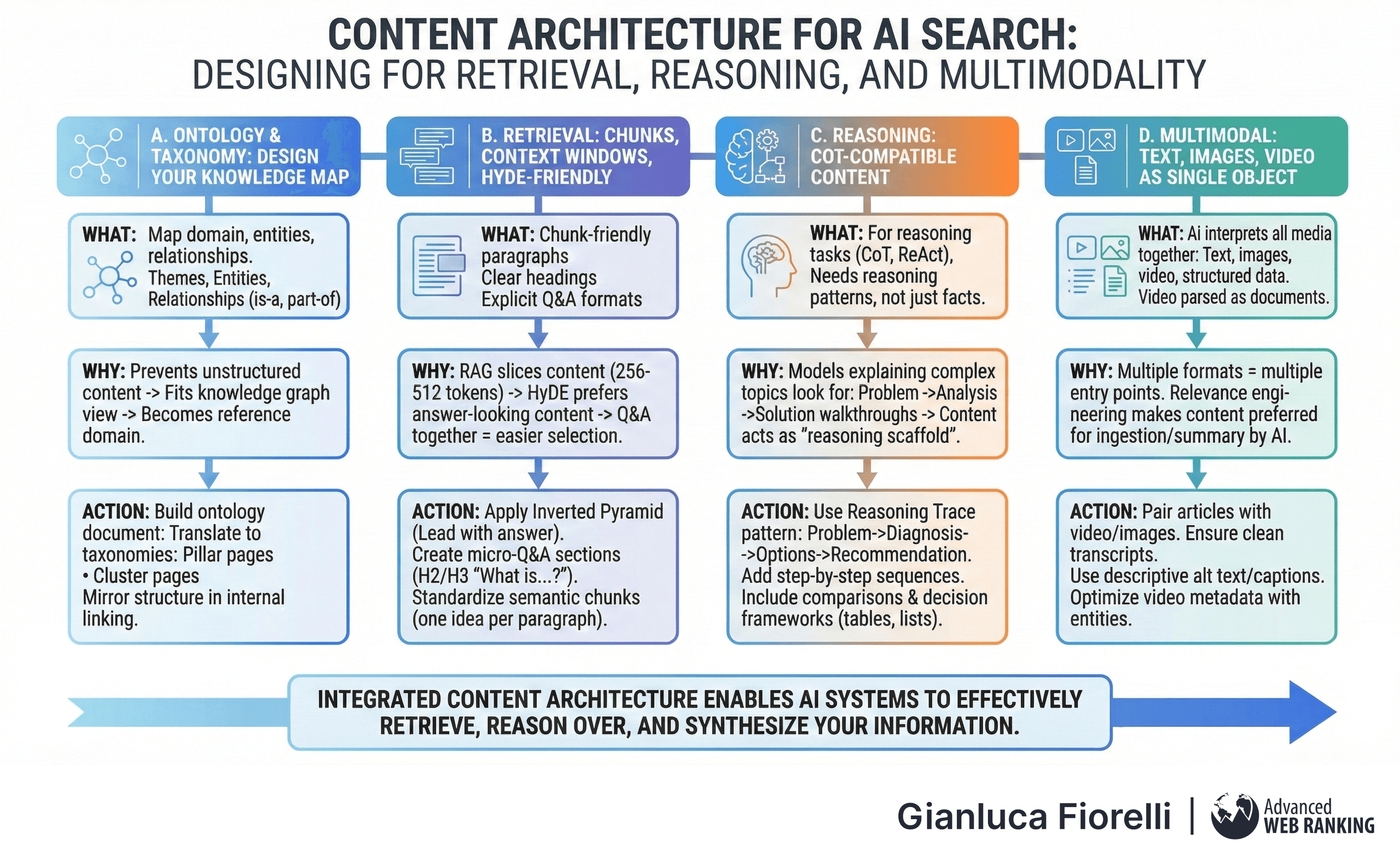
Action: Content Architecture for AI Search
A. Design your ontology and taxonomy
What
Map the domain of your brand:
Core themes and use cases.
Entities (products, services, locations, technologies, personas, problems).
Relationships (is-a, part-of, used-for, works-with, vs., etc.).
Why
A clear ontology:
Prevents random, unstructured content production.
Ensures that every piece fits into a knowledge graph-like view of your site.
Helps AI systems see you as the reference domain for specific topics.
Action
Build a simple ontology document:
Example (mini painting): Techniques → OSL, NMM, Weathering; Media → acrylics, oils; Factions → Rebel Pathfinders, Clone Troopers; etc.
Translate ontology into taxonomies and content hubs:
Pillar pages for broad themes (e.g., “Advanced Miniature Painting”, “Enterprise Learning Solutions”).
Cluster pages for specific entities or subtopics.
Ensure internal linking mirrors this structure:
Pillar ↔ clusters; clusters ↔ related clusters; hubs ↔ commercial/transactional pages.
B. Write for retrieval: chunks, context windows, and HyDE-friendly structure
What
Content must be chunk-friendly for dense retrieval and RAG:
Short, self-contained paragraphs that each answer a micro-question.
Clear headings aligned with intents and entities.
Explicit question-answer patterns (“What is…?”, “How to…”, “Pros and cons…”).
Why
RAG and answer engines slice content into chunks (e.g., 256–512 tokens).
Techniques like HyDE (hallucinating an answer to retrieve better documents) work best when real content looks like a good answer.
When question and answer sit together in the same chunk, it is easier for ChatGPT, Gemini, Claude, Perplexity, etc., to select that passage.
Action
Apply the Inverted Pyramid at both page and section level:
Lead with the definition, key fact, or primary answer. Elaborate later.
Create micro-Q&A sections:
Use H2/H3 “What is…?”, “How does… work?”, “Is… safe?”, “When should I choose…?”
Provide 2–4 sentence direct answers before expanding.
Standardise semantic chunks:
Each paragraph covers one idea and can stand alone if quoted.
Avoid long, meandering sections that mix multiple concepts.
C. Write for reasoning: CoT-compatible content
What
Reasoning-heavy tasks (diagnostics, strategy, comparison, planning) are handled by models using techniques like Chain of Thought, Tree of Thoughts, or ReAct.
LLMs need sources that encode reasoning patterns, not just facts.
Why
When ChatGPT, Gemini, Claude, or Perplexity explain:
“Which loan option is best for this case?”
“How to design an AI-ready content hub?”
“What’s the best painting workflow for a display miniature?”
they look for content that:
Walks through problem → analysis → method → solution.
Uses numbered steps, explicit trade-offs, and cause-and-effect relationships.
Offers worked examples and edge cases.
This kind of structure is extremely valuable as a “reasoning scaffold” for the model.
Action
Use the Reasoning Trace pattern:
Problem → Diagnosis (what matters) → Options → Recommended path → Caveats.
Add step-by-step sequences:
For how-to or workflows, always provide numbered lists with clear sub-steps.
Include comparisons and decision frameworks:
Tables and bullet lists that contrast options (“when to use A vs. B”) are frequently reused by answer engines.
D. Go multimodal: text, images, and video as a single semantic object
What
AI systems are increasingly multimodal:
They interpret text, images, video, and structured data together.
Video platforms (like YouTube) and image-rich pages are transcribed, parsed and embedded as additional “documents”.
Why
A painting tutorial, travel guide, or product demo that exists as video + article + images + captions gives multiple entry points for retrieval.
Relevance engineering for video (titles, descriptions, chapters, transcripts, on-screen text) can make your content a preferred source when Gemini, ChatGPT, or Perplexity ingest and summarise video content.
Action
Pair key articles with supporting videos and image galleries. Ensure transcripts are clean, structured, and available as HTML.
Use descriptive alt text and captions. Mention entities, locations, and concepts consistently.
For video:
Optimise titles, descriptions, and chapter markers around entities and intents, not just clickbait hooks.
Reuse the same ontology and taxonomy you use on the site.
Read the next chapter > Amplification for AI Search SEO

Article by
Gianluca Fiorelli
With almost 20 years of experience in web marketing, Gianluca Fiorelli is a Strategic and International SEO Consultant who helps businesses improve their visibility and performance on organic search. Gianluca collaborated with clients from various industries and regions, such as Glassdoor, Idealista, Rastreator.com, Outsystems, Chess.com, SIXT Ride, Vegetables by Bayer, Visit California, Gamepix, James Edition and many others.
A very active member of the SEO community, Gianluca daily shares his insights and best practices on SEO, content, Search marketing strategy and the evolution of Search on social media channels such as X, Bluesky and LinkedIn and through the blog on his website: IloveSEO.net.