



This article is part of the Comprehensive Guide to Generative AI. Each chapter builds on the last to explain how modern AI retrieves, reasons over, and acts on information.
Following our discussion of ontologies, semantic chunking, and reasoning-friendly content structures, this chapter explains how amplification builds trust and visibility in AI search by creating consistent, entity-rich signals across the wider web.
What: Teaching the Wider Web (and Models) Who You Are
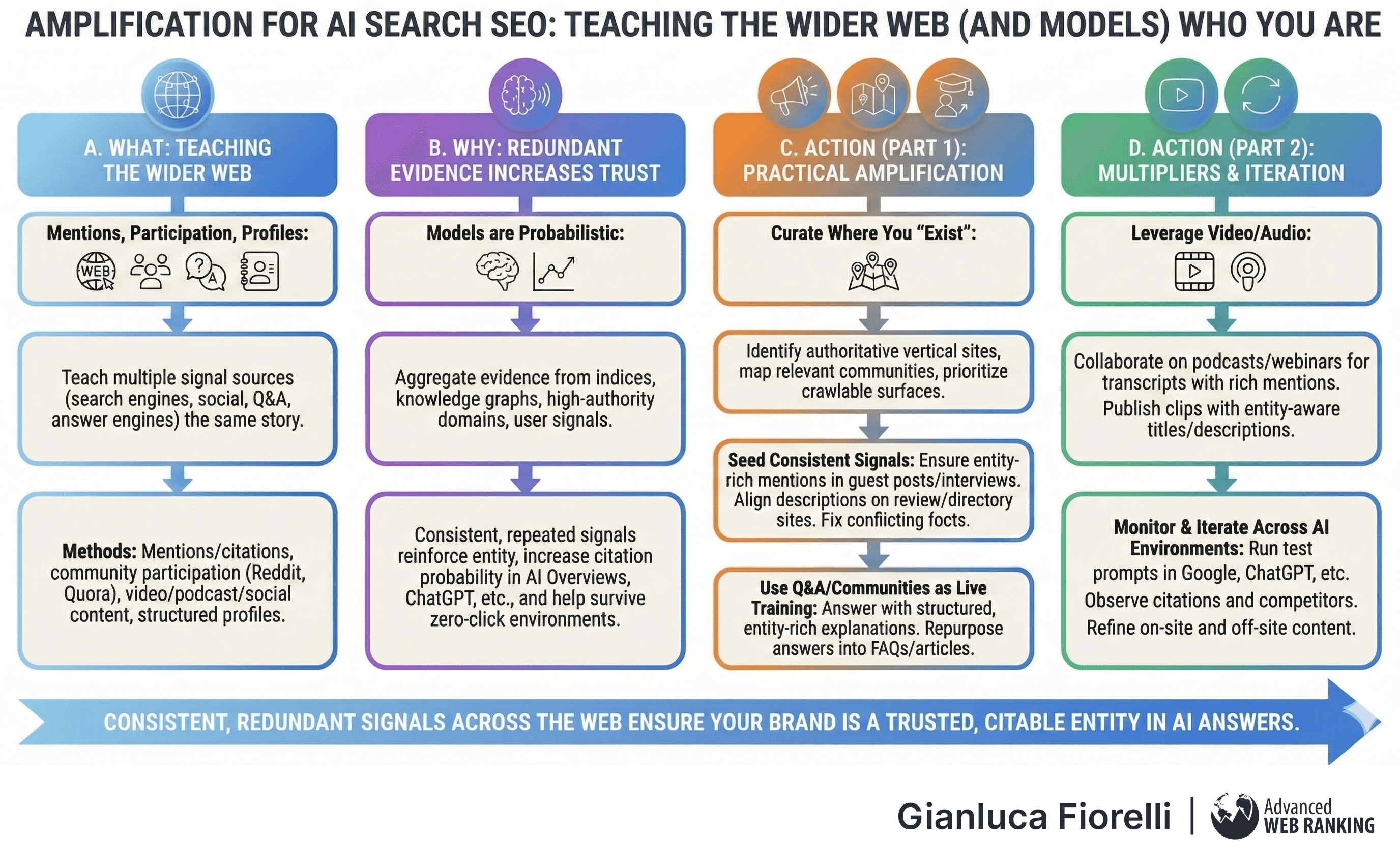
Amplification is not only “link building” or “brand building” in the classic sense. It is the process of teaching multiple signal sources — search engines, social platforms, Q&A sites, and answer engines — the same story about your brand and entities.
This happens through:
Mentions and citations on third-party websites.
Participation in communities (Reddit, Quora, StackExchange-like forums, niche communities).
Video, podcast, and social content.
Structured profiles (knowledge panels, business listings, marketplaces, app stores, etc.).
Why: Redundant Evidence Increases Trust and Retrieval Probability
LLMs and AI search systems are probabilistic. They aggregate evidence from:
Classic indices (web pages).
Structured knowledge graphs.
High-authority domains in a niche.
Sometimes, user behaviour and engagement signals.
Consistent, repeated signals across multiple surfaces:
Reinforce that your brand = a stable entity with specific attributes and expertise.
Make it more likely that you’re chosen as a citation or recommendation inside:
AI Overviews, AI Mode, Web Guide, Bing/Copilot answers.
ChatGPT, Gemini, Claude, Perplexity responses (especially when they browse or use RAG over the web).
Help your content survive zero-click environments by turning it into memory and salience, even when there is no direct visit.
Action: Practical Amplification for AI Search SEO
A. Curate where you want to “exist”
Identify authoritative vertical sites in your niche:
Trade publications, specialist blogs, industry associations, marketplaces, and review sites.
Map relevant community platforms:
Reddit subreddits, Quora topics, Discord/Slack communities, niche forums.
Prioritise surfaces where:
Your buyer personas are active.
Content is indexed and likely ingested by LLMs (public, crawlable, substantial text).
B. Seed consistent, entity-rich signals
When earning or negotiating guest posts, interviews, case studies, or mentions:
Ensure your brand name, key entities (products, services, topics), and location/vertical are clearly stated.
Aim for contextual paragraphs like:
“My Mini Painting, a specialist miniature painting ecommerce focused on advanced techniques like OSL and NMM…”
For review and directory sites:
Keep descriptions, categories, and attributes aligned with your ontology.
Fix conflicting facts (pricing, locations, product names) that might confuse models.
C. Use Q&A and communities as “live training examples”
In Reddit/Quora-style environments:
Answer questions with structured, entity-rich explanations that echo your site’s content hubs.
Where appropriate, reference your resources naturally; the goal is to show expertise, not spam links.
Repurpose high-performing community answers into:
FAQ sections on your site.
Supporting articles within relevant hubs.
These answers are often directly ingested and paraphrased by AI systems.
D. Leverage video and audio as authority multipliers
Collaborate on podcasts, webinars, and conference talks:
These create transcripts and show notes with rich, contextual mentions of your brand and entities.
Publish clips and talks on YouTube or similar platforms with:
Entity-aware titles/descriptions.
Links to your key hubs and pillar pages.
E. Monitor and iterate across AI environments
Periodically run test prompts in:
Google (AI features), Bing/Copilot.
ChatGPT, Gemini, Claude, Perplexity (with browsing or web access when available).
Observe:
Are you cited?
Which competitors are cited instead?
Which entities and angles are consistently used in answers?
Use these observations to:
Refine on-site content (fill semantic gaps).
Adjust off-site amplification (target missing entities/topics on third-party surfaces).

Article by
Gianluca Fiorelli
With almost 20 years of experience in web marketing, Gianluca Fiorelli is a Strategic and International SEO Consultant who helps businesses improve their visibility and performance on organic search. Gianluca collaborated with clients from various industries and regions, such as Glassdoor, Idealista, Rastreator.com, Outsystems, Chess.com, SIXT Ride, Vegetables by Bayer, Visit California, Gamepix, James Edition and many others.
A very active member of the SEO community, Gianluca daily shares his insights and best practices on SEO, content, Search marketing strategy and the evolution of Search on social media channels such as X, Bluesky and LinkedIn and through the blog on his website: IloveSEO.net.