



This article is part of the Comprehensive Guide to Generative AI. Each chapter builds on the last to explain how modern AI retrieves, reasons over, and acts on information.
With neural search and retrieval architectures covered in the previous chapter, now turn to visibility in AI-driven search. This chapter outlines the core levers—retrieval, reasoning, agency, and authority—that drive visibility inside LLM-powered search and assistants.
The Strategy: SEO for AI Search
What
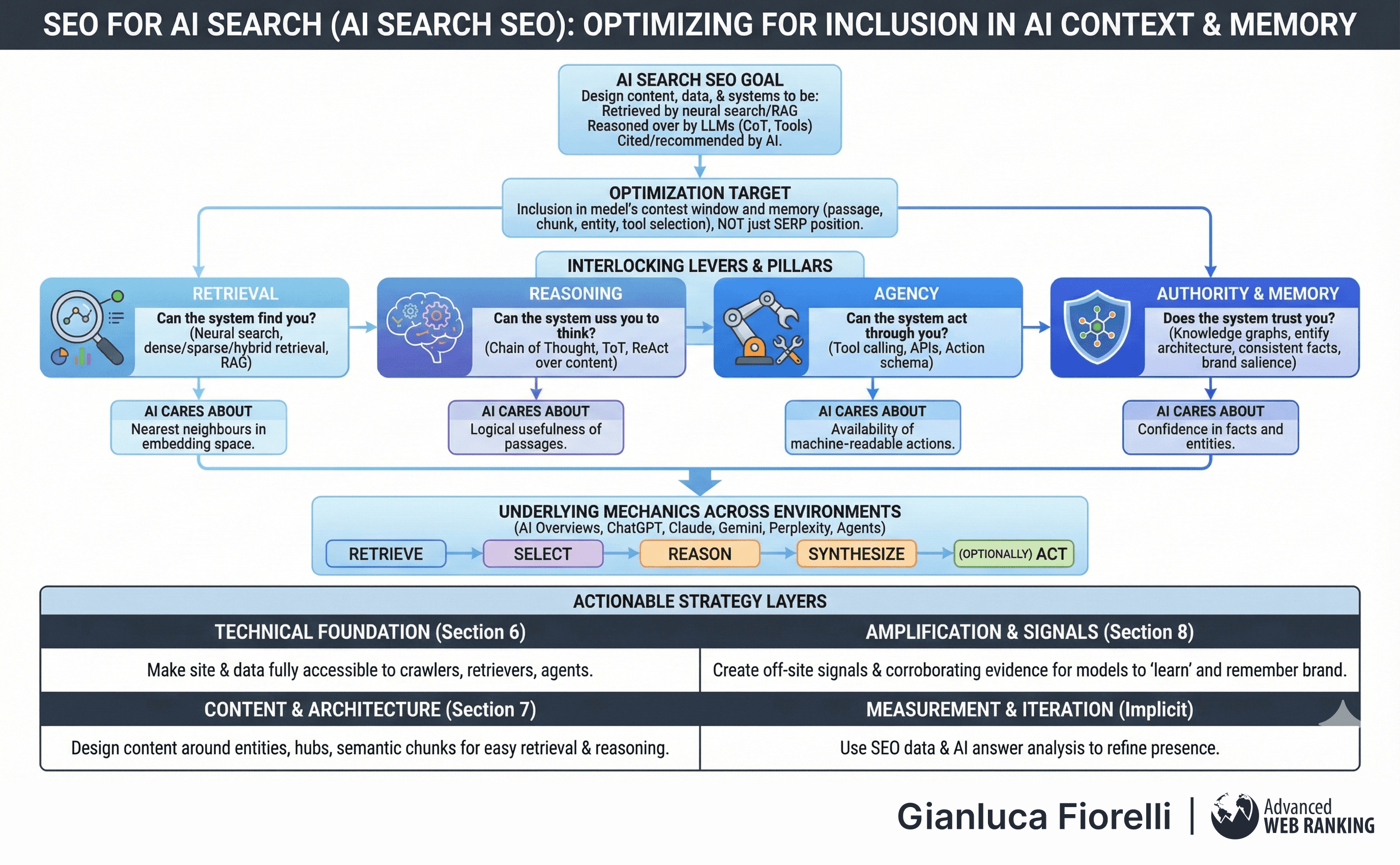
SEO for AI Search (AI Search SEO) is the discipline of designing content, data, and systems so that they can be:
Retrieved by neural search and RAG pipelines.
Reasoned over by LLMs using mechanisms such as Chain of Thought and Tool use.
Cited and recommended by AI systems across all environments:
Search-embedded AIs (e.g., AI Overviews, AI Mode, Web Guide, Bing/Copilot).
Stand-alone answer engines and assistants (ChatGPT, Gemini, Claude, Perplexity, and similar tools).
Domain-specific assistants built by companies on top of foundation models.
Instead of optimising only for “position in a SERP,” AI Search SEO optimises for inclusion in the model’s context window and memory: being the passage, chunk, entity, or tool that the system chooses when it constructs an answer or executes a task.
At a high level, AI Search SEO rests on four interlocking levers that mirror the previous pillars of this guide:
Retrieval – Can the system find you? (Neural search, dense + sparse retrieval, hybrid search, RAG).
Reasoning – Can the system use you to think? (Chain of Thought, ToT, ReAct-style reasoning over your content).
Agency – Can the system act through you? (tool calling, APIs, Action schema).
Authority & Memory – Does the system trust you? (knowledge graphs, entity architecture, consistent facts, brand salience).
Turn this into a working reference for your team.
Download the PDF to keep the full taxonomy, diagrams, and structured breakdowns handy for training, strategy, and SEO alignment.
Why
LLMs and AI search platforms do not care about “rankings” in the traditional sense. They care about:
Nearest neighbours in embedding space (retrieval).
Logical usefulness of passages (reasoning).
Availability of machine-readable actions (agency).
Confidence in facts and entities (authority/memory).
Whether the user is:
Seeing an AI Overview above a classic SERP,
Asking ChatGPT or Claude a question,
Using Gemini or Perplexity as a “meta-search engine,”
Or interacting with a domain-specific agent built by a brand,
the underlying mechanics are similar: retrieve → select → reason → synthesize → (optionally) act.
If your site, brand, and data are not aligned with those mechanics, you risk being invisible in all of these environments, even if you still “rank” in the old sense.
Action
Think of the rest of this strategy as four layers:
Technical foundation (Chapter 5) – Make the site and its data fully accessible to crawlers, retrievers, and agents.
Content & architecture (Chapter 6) – Design content around entities, hubs, and semantic chunks that are easy for models to retrieve and reason over.
Amplification & signals (Chapter 7) – Create off-site signals and corroborating evidence across the wider web so models “learn” and remember your brand.
Measurement & iteration (implicit across all sections) – Use both classic SEO data and AI answer analysis (from Google, ChatGPT, Gemini, Claude, Perplexity, etc.) to refine your presence.
The following chapters translate these principles into concrete actions.
Read the next chapter > The Technical Foundation

Article by
Gianluca Fiorelli
With almost 20 years of experience in web marketing, Gianluca Fiorelli is a Strategic and International SEO Consultant who helps businesses improve their visibility and performance on organic search. Gianluca collaborated with clients from various industries and regions, such as Glassdoor, Idealista, Rastreator.com, Outsystems, Chess.com, SIXT Ride, Vegetables by Bayer, Visit California, Gamepix, James Edition and many others.
A very active member of the SEO community, Gianluca daily shares his insights and best practices on SEO, content, Search marketing strategy and the evolution of Search on social media channels such as X, Bluesky and LinkedIn and through the blog on his website: IloveSEO.net.