

Since Google’s May 2026 core update, SEOs across the industry have been reporting the same thing: the positions in their rank tracker - any rank tracker - don’t match what they see in a browser. This is not a bug in one tool. It is a structural change in how Google serves search results, and it changes how rankings should be collected, read, and reported. Here is exactly what happened, why it affects the entire rank tracking industry, and how to verify your own data in AWR.
Key takeaways
Ranking discrepancies between tracked and manual results intensified after Google’s May 2026 core update and affect every rank tracker and SERP data provider, not just AWR.
Three mechanics drive them: hyper-localization (country-wide queries no longer resolve to a stable in-country viewpoint), the dual-SERP reality (Google serves different results to suspected automated queries than to people), and NavBoost-style clickstream re-ranking (the SERP a real user sees is increasingly shaped by aggregate click behavior that a clean, unpersonalized query never triggers).
Google Search Console is not a neutral referee: Average position blends every query, device, location, and AI Overview citation into one number that individual positions will always oscillate around.
The fix is methodological: track from precise locations, read positions as ranges and trends, cross-reference tracked data, GSC trends, and dated SERP snapshots - and verify any suspect position against the actual SERP AWR collected, which is stored with every update.
What changed, and when
“My tool says position 8, my browser says position 3” is as old as rank tracking, and the classic explanations (personalization, timing, location, SERP volatility) still apply. What’s new is the scale and the direction of the gap. Starting in late May 2026, agencies and in-house teams began reporting keywords that dropped sharply or vanished from tracked reports entirely while still ranking on page 1 in localized manual searches. The pattern shows up across tools and across data providers, and it has dominated SEO community discussions ever since.
Three dates matter for understanding where we are now:
January 2025: Google escalates its anti-scraping enforcement. A wave of blocking causes multi-day data outages across major SEO platforms — the first industry-wide signal that Google had begun actively separating automated SERP collection from human traffic.
April 2025: Google retires country-code domains. All ccTLDs (google.co.uk, google.de, google.ro…) redirect to google.com, and localization becomes fully dynamic - determined per query from location signals rather than from the domain serving the results. Country-level intent stops being something a URL can express.
May–June 2026: The May 2026 core update (completed June 2) reshuffles results at unusual depth - independent SERP studies measured roughly 76% of top-3 URLs changing position and nearly 20% of previously ranking top-10 pages disappearing from those SERPs. Immediately after the rollout, discrepancy reports between tracked and manual results spike industry-wide.
Each of the three causes below existed in some form before May 2026. What the core update appears to have done is expand their reach - deeper localization, more aggressive differentiation of automated traffic, and heavier weighting of real-user behavior in the results people actually see.
Cause #1 — Hyper-localization vs. country-wide tracking
Google’s results have been local for years, but the ccTLD retirement changed what a “country-level” search even means. There is no google.co.uk serving a British view of the index anymore; there is one google.com that decides, per query, how local to go. For a real person, that decision is easy Google knows their city, often their neighborhood, and serves results anchored to it.
A rank tracker asking for “United Kingdom, no particular place” poses a question that no real user’s browser ever asks. Google’s answer to it has changed: instead of consistently anchoring the query to a stable in-country viewpoint, it increasingly zooms out and composes a country-neutral page - closer to what someone searching the UK from outside the UK would see, drawing results from every geographic extreme of the country rather than from any one place a customer actually stands in.
The consequences for country-wide tracking are predictable:
Lower or missing positions for businesses whose strength is regional - the composite page averages away their local prominence.
Volatile results between updates, because the composite is assembled differently from query to query, while a locally anchored SERP is comparatively steady.
A widening gap between the tracked position and what anyone in Manchester, Munich, or Miami sees in their browser - because those people get the zoomed-in page, not the composite.
City- and region-level tracking does not have this problem to the same degree: when the query is pinned to a precise location, Google serves the page it serves locals there. This is why the same project so often shows a “wrong” position on Google United Kingdom and a near-perfect match on Google London - and it is the first thing to test when a discrepancy shows up (the step-by-step is below).
Cause #2 — The dual-SERP reality
The second cause is more uncomfortable, and it is the one the industry talks about least openly: Google no longer serves one SERP. Since escalating its anti-scraping enforcement, Google actively classifies where a query comes from - IP reputation, data-center address ranges, request patterns, browser fingerprints, redirect-following behavior - and it can respond differently depending on the verdict.
When Google is confident the query comes from a person, it serves the full, localized, behavior-informed page it wants that person to see.
When it suspects the query is automated, it can serve a simplified page - one where commercial and content-dense sites sit lower or drop out entirely.
Every rank tracker, and every SERP data provider behind the industry, collects positions through automated queries at scale. That is what rank tracking is. So when Google succeeds in classifying a collection query as automated, the page it returns - and therefore the position recorded from it - can genuinely differ from the page a human sees, no matter which tool recorded it. This is what SEOs have started calling the decoupling of scraped SERPs from human SERPs, and it explains the most confusing symptom of all: a site that “isn’t ranking” in a report while sitting mid-page-1 in every clean manual check.
A second-order effect makes this worse for parts of the industry. In late August 2026, Google rolled out google.com/goto tracking redirects on result links - the “goto URLs” whose deployment Google has since confirmed. The destination URL is encoded and can’t be decoded locally, so a naive collection pipeline has to request each redirect to resolve where results actually point. By community estimates, fully resolving a single five-page SERP this way takes hundreds of requests - a burst of follow-up traffic from the same address that no human search session produces. Collection infrastructure that behaves this way effectively identifies itself, and the IP ranges it uses accumulate a bot reputation that then degrades every query sent through them. Because large providers and many tools share collection infrastructure, one tool’s noisy behavior can poison the well for others using the same ranges.
Being direct about this
We would rather explain this mechanic honestly than pretend it doesn’t exist: there are collection conditions under which any tracker, AWR included, can be served a page that differs from what your customers see. What separates tools now is not immunity - nobody has that - but how faithfully the collection process reproduces the conditions of a real search, how it detects a suspect page before storing it, and how transparently it lets you verify the SERP behind every recorded position. That is where AWR has invested, and it’s covered below.
Cause #3 — NavBoost and the personalization gap
The third cause is the quiet expansion of behavioral re-ranking. NavBoost - the click-signal system Google confirmed during the DOJ antitrust trial and that surfaced again in the 2024 API documentation leak - re-ranks results using aggregate, real-user click behavior: which results get chosen, which get skipped, where users bounce back to the SERP. Google holds clickstream data at a scale no third party can approximate, and the May 2026 update visibly rewarded engagement-driven results - the same update cycle in which community content like Reddit expanded its share of top-3 positions across nearly every niche.
The implication for rank tracking is subtle but fundamental. A tracker’s query is deliberately clean: no history, no profile, no behavioral context. For years that neutrality was the methodological gold standard - the “objective” baseline SERP. But as behavioral signals gain weight, the baseline SERP becomes a page that fewer and fewer real users actually see:
A niche site with excellent engagement earns its elevated position through click behavior - visible in the SERPs of real users in its market, less visible on the clean baseline page, which falls back toward domain-authority defaults.
A big-brand site can hold a baseline position that real users’ pages don’t reproduce, for the same reason in reverse.
Neither page is “wrong.” They answer different questions: the tracked page answers “how does Google rank this market before behavioral context?”; the browser page answers “what does Google show people like me, here, now?”. The mistake is expecting one number to answer both - which is precisely why single-position thinking is breaking down as a reporting practice (more on that below).
Why Google Search Console can’t settle the argument
When tracked and manual results disagree, the reflex - one that Google’s own AI answers now actively encourage — is to treat Search Console as the tiebreaker: it isn’t scraped, it reports what real users were shown. That’s true, and GSC is a valuable cross-reference. But Average position is an average of a different thing than a rank tracker measures, and treating it as per-keyword truth produces its own confusion:
It averages the topmost position per impression across every search that showed your site in the selected date range — personalized and unpersonalized sessions alike. You can segment by device or country, but each segment is still an average that individual searches oscillate around.
It blends result types. An AI Overview citation counts toward impressions and position under the same rules as a blue link, so a site cited in an AIO and ranking organically lower gets one blurred number. AWR records these as separate occurrences - an organic position and an AIO citation - which is a more honest picture of where you actually appear on the page.
It reports your site only. There is no competitor context, no share of the SERP, no way to see who took the position you lost.
It’s an average over time, not a measurement at a moment - a keyword that ranked #3 for half the day and #9 after an index refresh reports something in between, matching neither your tracker nor your browser.
The practical rule: use GSC to confirm direction (is real visibility trending down, or is only the tracked number down?), never to adjudicate a specific position on a specific day. If GSC impressions and clicks are stable while a tracked position collapses, you are almost certainly looking at a collection artifact, not a real ranking loss — and you can verify which one it is directly in AWR, as shown below.
Source | What it actually measures | Best used for |
|---|---|---|
Rank tracker | The page Google returned to a controlled, consistent query at a specific moment and location | Trends over time, competitor context, SERP feature and AIO occupancy, market-level visibility |
Search Console | The average topmost position across all real impressions of your site in the date range, with every result type — organic and AI Overview citations — blended into one number | Confirming whether real visibility moved in the same direction; clicks and impressions |
Manual search | The page Google composed for one person, in one place, with one behavioral profile, at one moment | A localized spot-check - one observation, not a benchmark |
How ranking reports should change in this era
The deeper lesson of 2026 is not “tools are broken.” It’s that the object being measured — the Google SERP — has fragmented into many SERPs: by place, by person, by behavioral context, and by how the query was made. Reporting practices need to catch up to that reality:
Report positions as ranges and trends, not points. A keyword that oscillates between #4 and #7 is one fact, expressed properly as a band. A single daily integer invites a “but I see #3” argument that neither side can win, because both numbers are real observations of different SERPs.
Track where your customers actually are. If revenue comes from London, Leeds and Glasgow, those three SERPs are your reality — a country-wide composite is an abstraction on top of it. Precise-location tracking is no longer a nice-to-have for local businesses; it is the accuracy fix for everyone.
Lead with visibility, not position. Aggregate metrics — visibility, share of voice, top-N distribution — absorb single-SERP noise and answer the question clients actually have: is our presence growing? A single keyword’s position answers a question nobody asked alone.
Triangulate three sources. Tracked positions (with competitor context), GSC impression/position trends (real-user confirmation), and dated SERP snapshots (evidence of what Google actually returned). When all three agree, report with confidence. When they diverge, the divergence itself is the finding — usually pointing at localization or collection artifacts rather than a genuine loss.
Annotate algorithm events. Core updates now move SERP composition (features, AIOs, community content), not just ordering. A position change across an update boundary is a different data point than one inside a quiet period, and reports should say so.
Clients pushing back with a screenshot of their own browser aren’t wrong, and telling them their eyes deceive them is the fastest way to lose their trust. The right answer is the honest one: “your browser shows the SERP for you, there, now; we measure a controlled SERP under consistent conditions so trends are comparable over time — and here is the actual page our data comes from.” That last part is why SERP snapshots matter so much now: they turn an argument about whose number is right into a shared look at evidence.
What AWR is doing about it
Everything above affects the whole industry. What differs between tools is how the collection process responds. Here is what AWR runs today - stated plainly, because in the current climate methodology is the product:
Full browser rendering, not raw HTML fetches
AWR collects SERPs at real screen resolutions matched to desktop and mobile devices. This is a measurement-fidelity decision: today’s SERP is a JavaScript-rendered application, and the things that matter on it — pixel position, above-the-fold visibility, AI Overview citations, SERP feature layout - simply don’t exist in the raw HTML of a results URL. A fully rendered session measures the page as a user’s browser actually composes it; tools and providers that parse raw SERP code are measuring a page no user ever sees, in both senses - thinner in content and stripped of the layout the ranking lives in.
A retry mechanism for suspect SERPs
Google’s differentiated responses have a signature - pages that come back structurally thinner or inconsistent with the market being measured. AWR’s collection pipeline detects these sub-prime SERPs and re-queries the keyword before a position is stored, rather than recording the first response it gets. Since Google’s enforcement escalation, this single mechanism has been one of the largest contributors to collection accuracy - a suspect page caught at collection time never becomes a wrong number in a report.
Redirect resolution as post-processing
Where Google masks result URLs behind its goto URLs - the redirect wrapping covered in our Help Center - AWR resolves the true destination URLs in its own processing pipeline, after collection - one query retrieves one page, and URL resolution happens separately. That keeps collection lightweight and avoids the hundreds of extra requests per SERP that redirect-following otherwise generates - the overhead that has been degrading the reliability of the shared infrastructure much of the industry collects through.
An expanded and diversified IP pool
AWR has significantly expanded its collection IP pool and continues to diversify it, reducing dependence on shared infrastructure whose reliability has been degraded by the industry-wide turbulence described above.
Region-level tracking
The localization fix from Cause #1 is becoming product: AWR now supports region-level tracking behind country search engines. Anchoring a country engine to a consistent region keeps SERPs comparable between updates and much closer to what people in the tracked market actually see - without forcing every project down to city-level granularity.
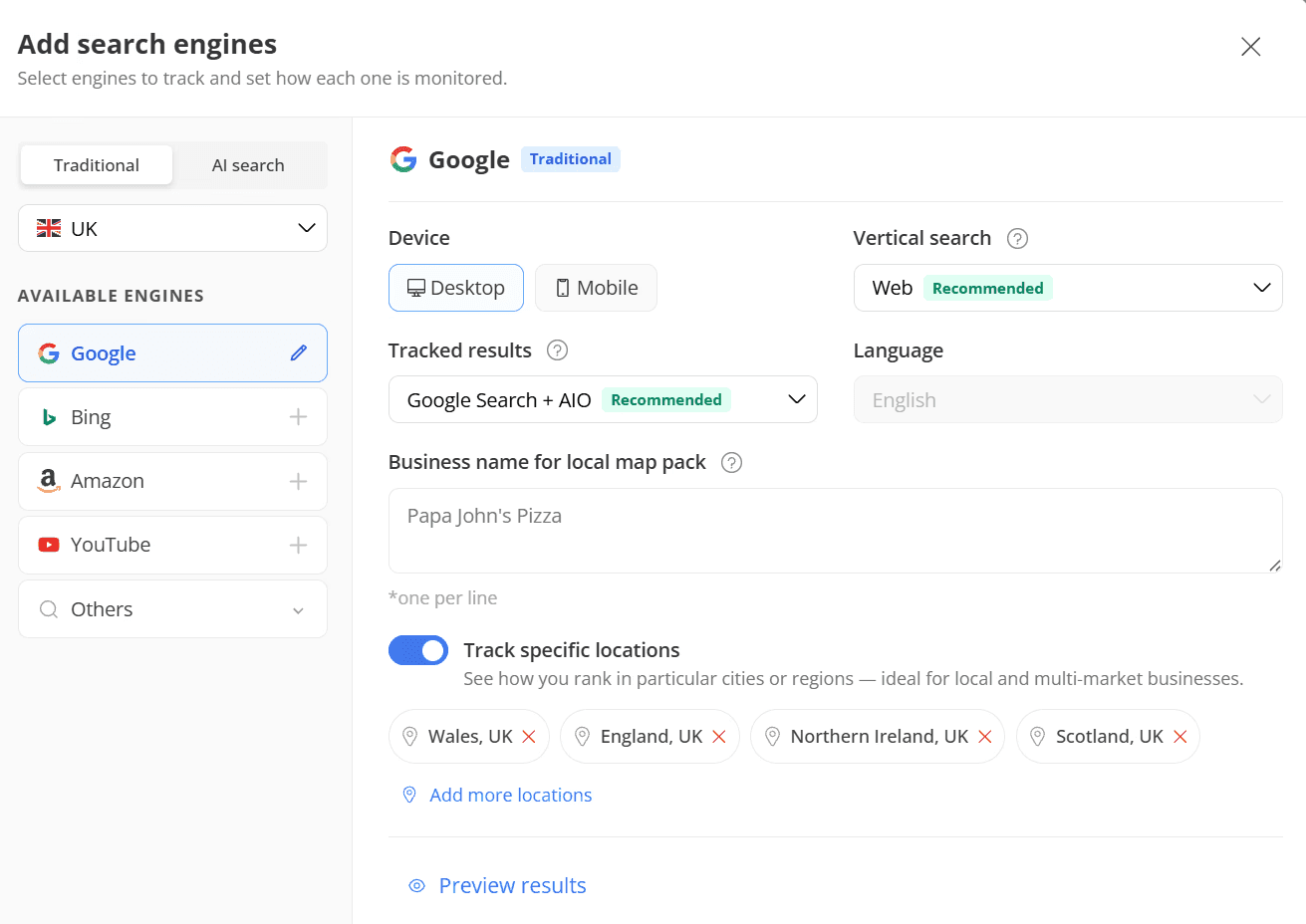
Region-level tracking anchors a country search engine to a consistent region.
How to audit a discrepancy in AWR, step by step
When a position looks wrong, don’t start by comparing numbers - start by comparing pages. Every AWR update stores the SERP it collected, so a discrepancy can be diagnosed in minutes rather than argued about for days. Work through these steps in order; each one isolates a different cause.
Step 1 — Open the SERP behind the position
In the Keyword Ranking report, click the keyword’s position to open the URL changes in SERP panel, then View SERP. This is the dated snapshot of the exact page AWR collected on that update - the ground truth for everything the report shows. Check: is your site on the page at the recorded position? Are the expected competitors present? Does the page look like a normal, full SERP for that market (features, ads, AIO, the usual mix), or does it look unusually thin?
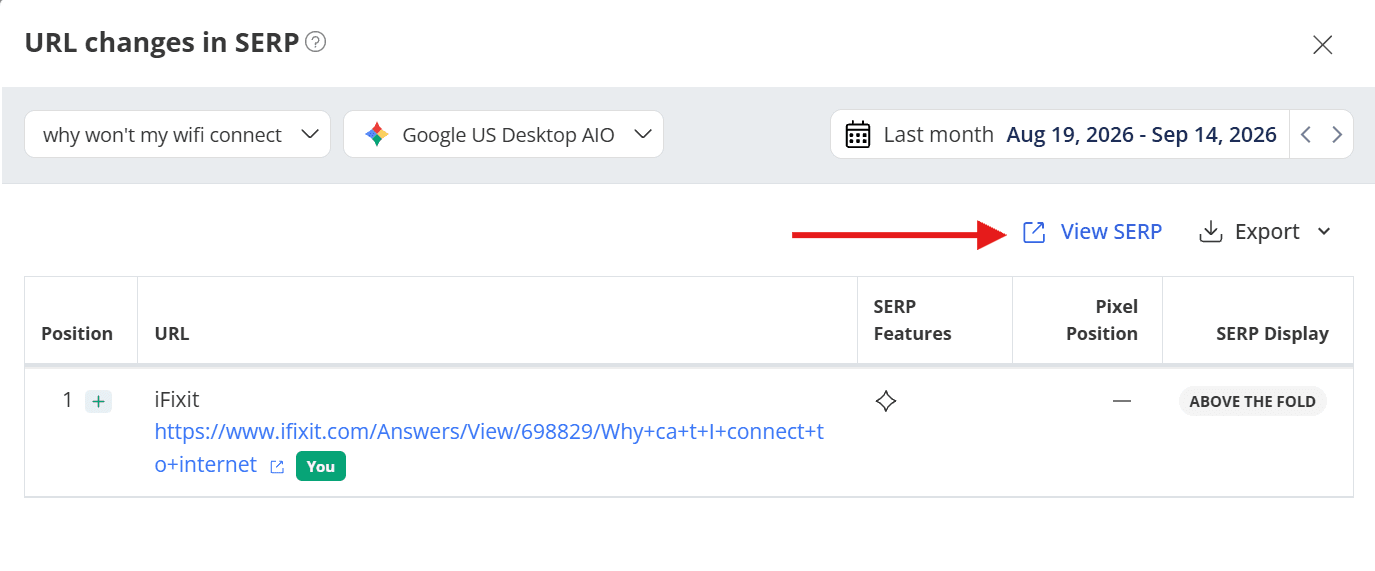
Every recorded position links to the dated SERP snapshot it was measured on - click the position, then View SERP.
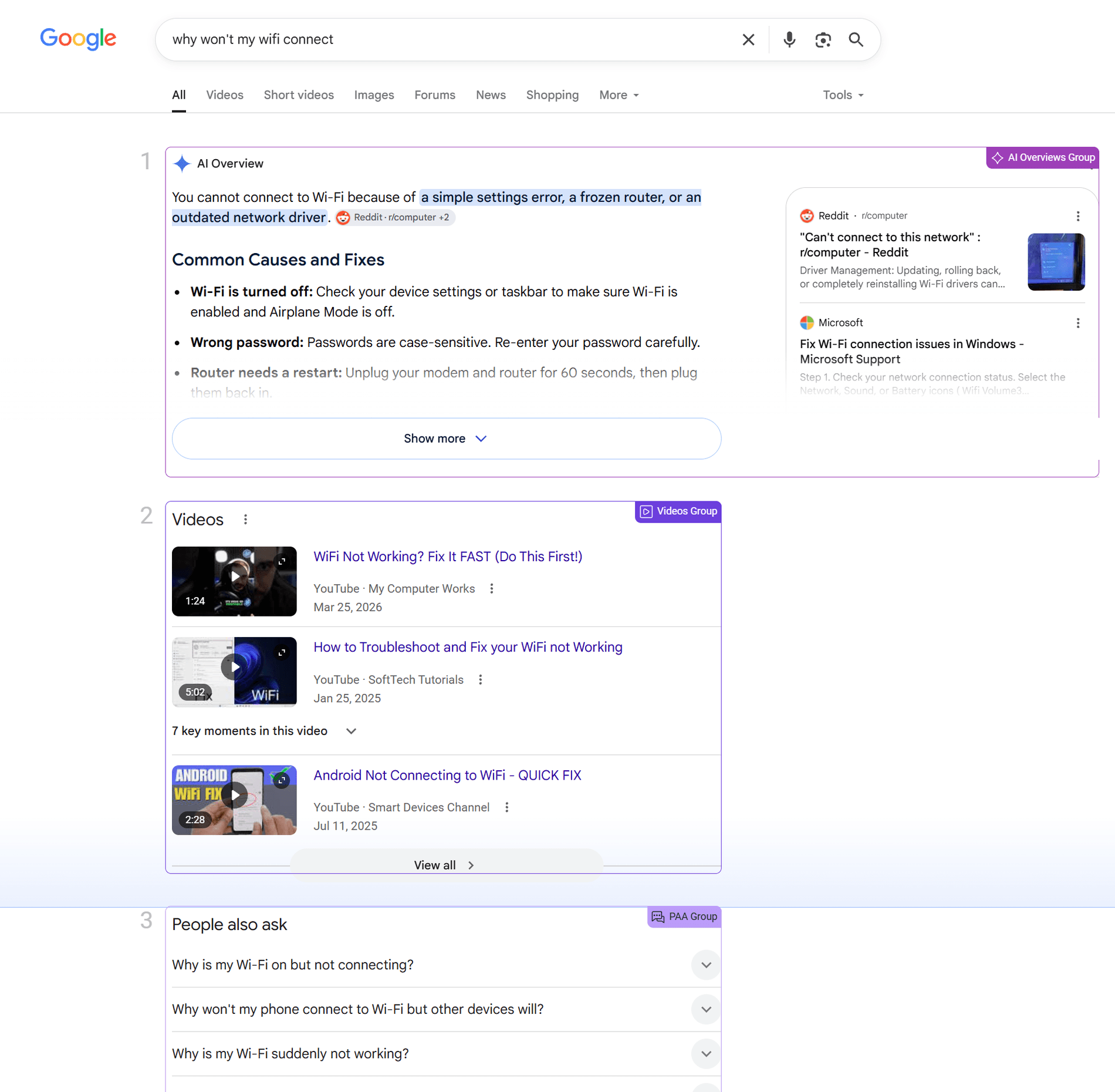
The snapshot shows the page as collected: positions, SERP features, and AI Overview citations included.
Step 2 — Cross-check with Top Sites
The Top Sites report shows everything AWR parsed from the top of the SERP for each keyword - your site, competitors, and everyone else. If the snapshot shows your page ranking but the ranking report doesn’t, check your website and alias definitions first: an alias scoped to site.com/uk/ will never match a page ranking under site.com/en-us/, and this remains one of the most common “false discrepancies” we see in support. If the alias is right and the parsed data still misses a page that is visibly in the snapshot, contact support - that is a parsing issue on our side, and we fix those.
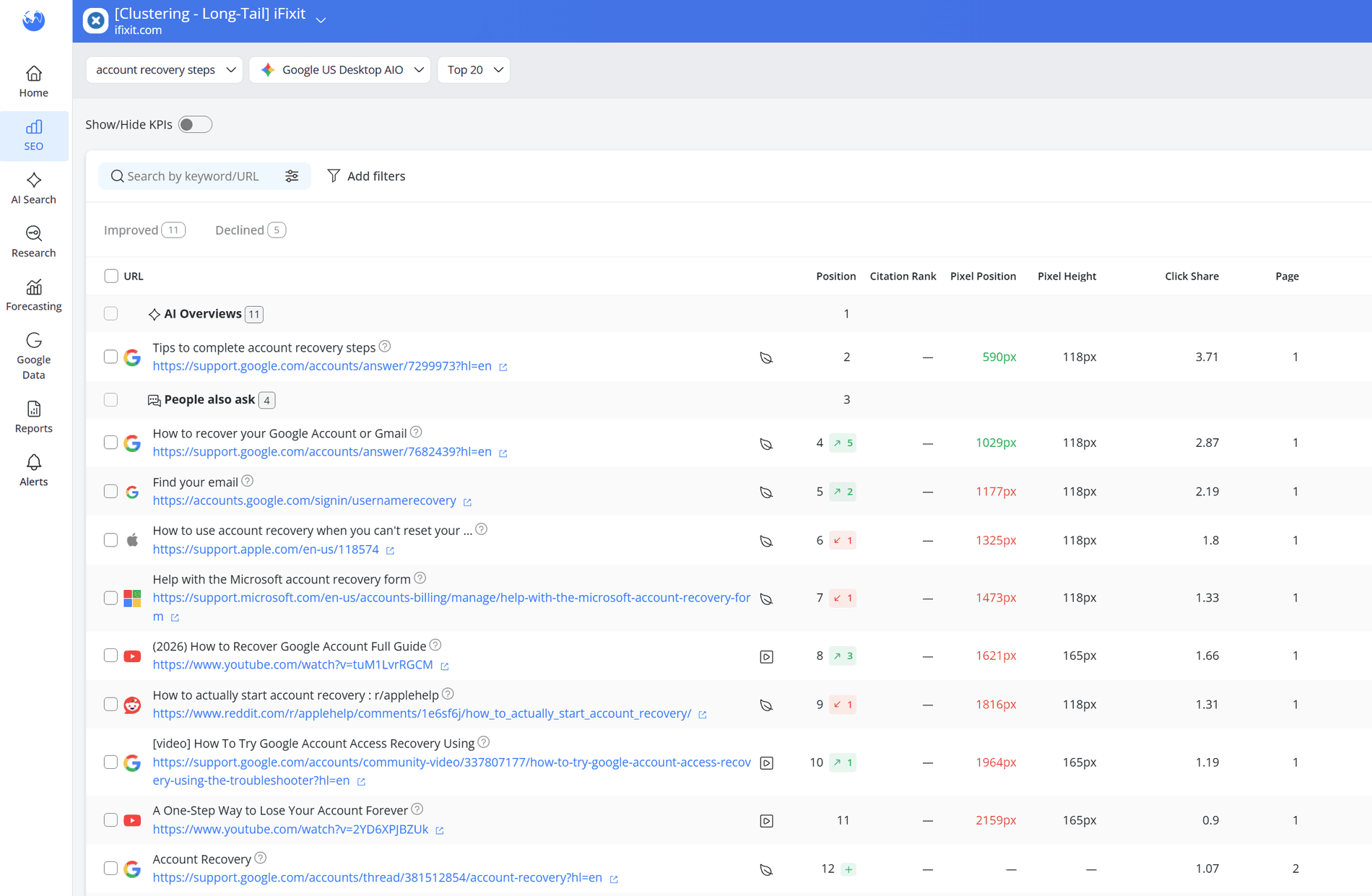
Top Sites shows the full parsed SERP - the fastest way to see whether a page was on the SERP but missed by a too-narrow alias.
Step 3 — Check whether the SERP itself is stable
The SERP Similarity report measures how much a keyword’s SERP changed between updates. A genuine ranking loss usually happens on an otherwise stable SERP; a low similarity score - the page reshuffling wholesale between updates - points at volatility, localization drift, or collection conditions rather than something your site did. Similarity trends also make core update impact visible per keyword, which is exactly the annotation your client reports need.
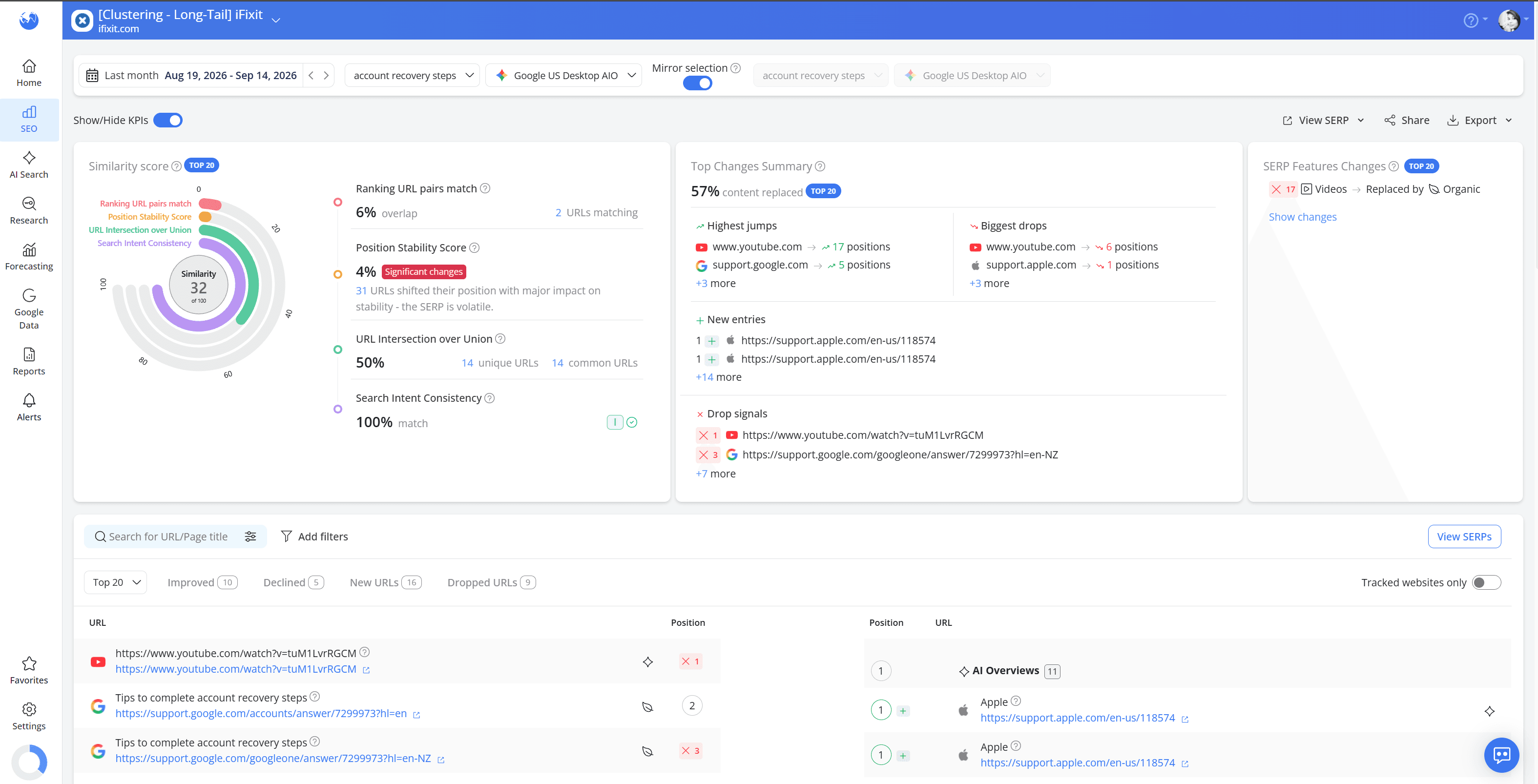
A wholesale SERP reshuffle reads very differently from a ranking loss - SERP Similarity separates the two.
Step 4 — Run the location test
If the snapshot page genuinely differs from clean, localized manual searches, isolate the localization variable:
Create a test project with the affected keywords on two engine types: the country-wide engine (e.g., Google United Kingdom · Desktop) and two or three precise-location engines in the markets that matter (e.g., Google London · Desktop, Google Manchester · Desktop).
Run an on-demand update.
Run manual searches localized to those same places - a location-emulating browser setup or VPN endpoints in-market - and compare against both engine types.
In most cases we’ve investigated since May, the precise-location engines land close to localized manual results while the country-wide engine drifts - Cause #1 confirmed. The fix is then straightforward: move reporting to the locations your customers are actually in (or to region-level engines where available). If even the precise-location engines disagree with clean manual checks, you are likely looking at Cause #2, and that specific case is worth a support ticket with the project and keywords - these cases feed directly into our collection-engineering work.
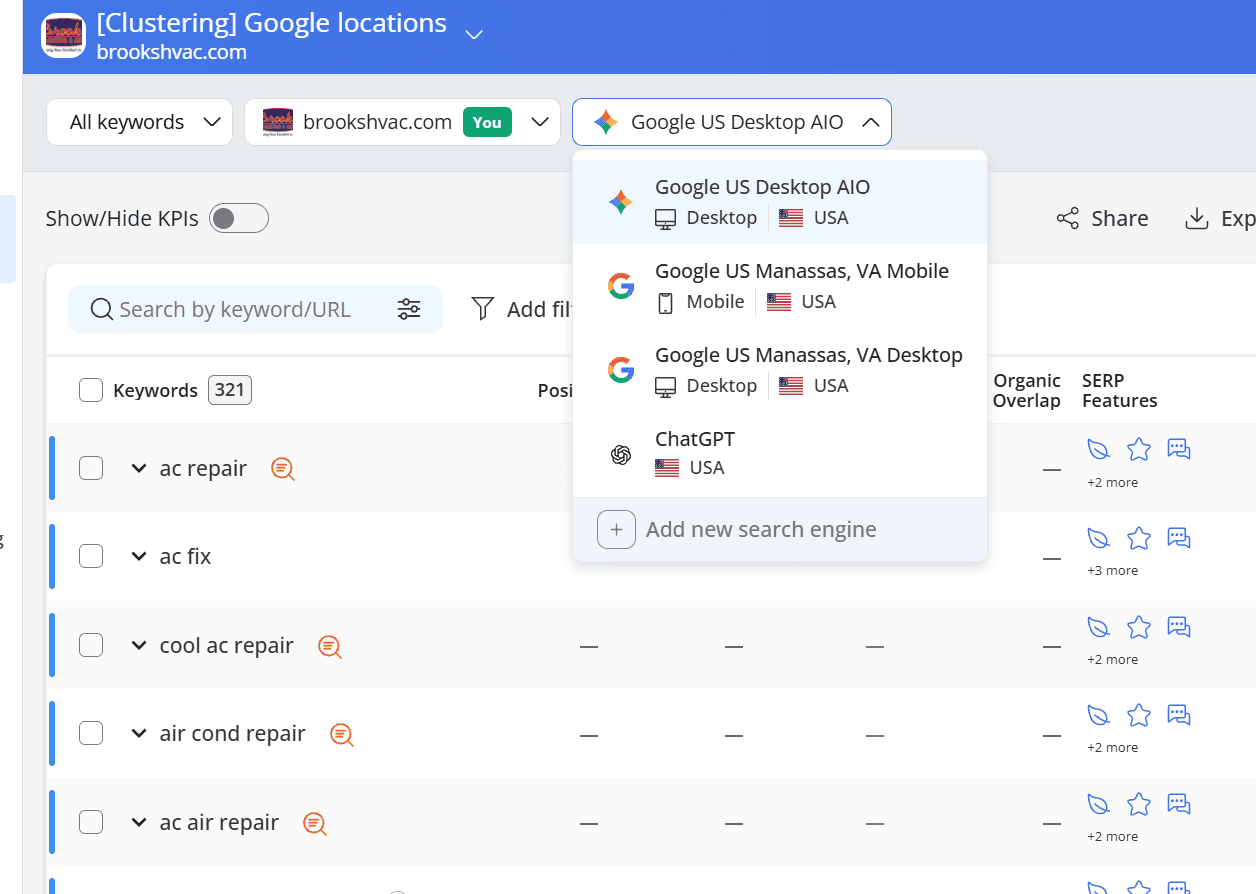
One project, two views of the same market: the country-wide engine tracked alongside precise city-level engines — the setup that isolates localization in minutes.
Related resources
In AWR
Why ranking results may vary: AWR versus manual searches, similar tools, and Google Search Console — the evergreen reference on the classic discrepancy causes
Tracking ranking volatility and feature shifts with the SERP Similarity report
Industry coverage
Google: an update on country code top-level domains — the official ccTLD retirement announcement
Search Engine Land on the ccTLD redirect and dynamic localization
Search Engine Journal: Google causes global SEO tool outages — the anti-scraping escalation
Search Engine Land: Google confirms deploying goto URL redirects
SE Ranking’s May 2026 core update analysis — the volatility data cited above
Whitespark: why reported and manual rankings differ — the local-SEO view of the same problem
Semrush and Ahrefs on the same question — evidence this is tool-agnostic
Community discussion
r/seogrowth: “Are rank trackers showing different results to what Google actually shows real users?” — side-by-side tests where sites ranking #2 in a live browser are absent from every automated data source
r/SEO: “Google confirmed the goto redirects. Rank trackers now need 500–1,000 requests per query.” — the August 2026 goto rollout, first-hand
r/localseo: “Why do Semrush and Ahrefs show completely different SEO metrics?”
r/bigseo: “Keyword Positions are Inaccurate: Actual Search vs Search Console”
Seeing a discrepancy you can’t explain with the steps above? Open the SERP snapshot for the keyword, note the update date, and send it to our support team — verified dual-SERP cases feed directly into our collection engineering, and they make the data better for everyone.
FAQ
Why do AWR keyword positions differ from what I see when I search manually?
Is this an AWR problem or an industry problem?
Should I just use Google Search Console instead?
Do incognito searches show my “true” ranking?
What is the most accurate way to track rankings in 2026?
My site is cited in an AI Overview but my organic position dropped. Which is right?

Article by
Iulia Lacriceanu
Iulia Lacriceanu is a Senior Product Manager at Advanced Web Ranking, where she turns market and customer signals into shipped production features. Much of her work now sits at the intersection of traditional SEO and AI search — AI Overviews, brand visibility in LLM answers, and what it means to rank when there's no blue link to rank for. That shift is the brief for every feature she concepts and designs for AWR.
She believes that truly understanding the core concept and the target audience's needs is fundamental to building software that solves real industry problems. That, and that time is never enough — it's just a matter of priorities!