A fact-checked walkthrough of the mainstream advice on optimising for AI search — August 2026
We have been here before.
Do you remember the "200 Ranking Factors" list? A document nobody at Google ever published, assembled from inference and wishful thinking, reproduced across a thousand blogs, treated for a decade as scripture. It was never a list of ranking factors. It was a list of things people believed were ranking factors, hardened into fact by repetition alone.
We SEOs are watching the same phenomenon replay, faster and with better production values, under the names Generative Engine Optimization (GEO) and Answer Engine Optimization (AEO).
The mechanism is always the same. A discovery surface appears, consequential and not yet understood. Clients want answers. Into that vacuum step a layer of confident voices — agency blogs, vendor content, LinkedIn carousels, gig listings — offering the one thing honest researchers cannot: certainty. A reasonable probabilistic principle ("clear, well-sourced content is easier for a retrieval system to use") becomes a deterministic recipe ("write 50-word answers and ChatGPT will cite you"). The recipe is more marketable. It is also not true.
Let me be precise, because this is not a rant against an industry I love. The problem is not that mainstream GEO advice is wrong. Most of it isn't. The problem is that it arrives wearing a causal certainty the evidence does not support, and that a few genuinely false claims travel alongside the sensible ones, styled and sold identically.
One note. The same distortion now appears inside the LLM tools themselves: ask a frontier model with deep-research capability to fact-check the GEO canon, and you can receive a document ratifying invented benchmarks and supplying confident retrieval mechanics that exist in no paper anywhere. Fluent, technical, footnoted, wrong. The format of an answer tells you nothing about its evidentiary basis, and that applies to machines and consultants alike.
How I am sorting the advice
Three categories were not enough. Some advice is neither true nor false but inert: correct, harmless, entirely without effect. Some is worse than nothing.
So, five:
Label | Meaning |
|---|---|
Real good practice | Supported by primary sources, official documentation, or replicated research |
To be confirmed | Plausible and reasonably evidenced, but the causal claim is an inference, not proof |
True but inert | Factually accurate, harmless, demonstrably without effect on AI visibility |
Myth | Contradicted by primary sources, or asserted with no traceable evidence at all |
Plausibly counterproductive | Evidence suggests it can actively reduce visibility or damage the brand |
One mental model to carry through. Classical SEO placed a document in a ranked list. AI search is closer to a librarian asked a question, who pulls a few books from the shelves, reads a paragraph from each, and writes a summary in their own words — sometimes crediting the books, frequently not.
Nearly every myth below confuses one stage of that sequence with another: being on the shelf with being pulled off it, or being read with being credited.
1. "Keep doing traditional SEO; GEO is a layer on top"
What is it? Crawlability, clean architecture, sitemaps, canonicalisation, internal linking, HTTPS, page experience. Then the AI-specific work on top.
Why is it recommended? Live AI systems retrieve from search indexes (their own, or a partner's). A page without conventional infrastructure cannot be selected by a generative one.
Is it a good recommendation? Yes, and it is the least contested item in the canon. Google's official guide to optimizing for generative AI features says plainly that, from Google Search's perspective, optimising for generative AI search is optimising for the search experience, and therefore still SEO. Eligibility requires a page to be indexed and eligible to appear with a snippet in the first place.
But two corrections to how this gets sold:
SEO is necessary and not sufficient. Ranking no longer implies citation. Ahrefs found the share of AI Overview citations coming from top 10 organic results fell from roughly 76% to 38% across eight months; a separate BrightEdge dataset places it nearer 17%. Ahrefs also flagged that its own citation-detection method improved between those measurements, so the numbers are not strictly comparable, which is a caveat with very few repeats. The direction, though, is not in dispute. The July 2026 critical survey of GEO research reports that around half the domains cited in AI Overviews do not appear in the organic top 100 at all.
This is not a settled consensus among people who study it. Mike King argues classical SEO is deprecated rather than merely insufficient, and his AI Search Manual reframes the discipline as relevance engineering across a multi-stage retrieval pipeline. Anyone presenting "good SEO is good GEO" as universally agreed is flattening a real disagreement.
My own position: the foundations remain, but the unit of competition has moved from the document to the passage, and from the page to the entity. That is not a tactical adjustment but an ontological one.
Verdict: Real good practice, with "necessary but not sufficient" stated out loud.
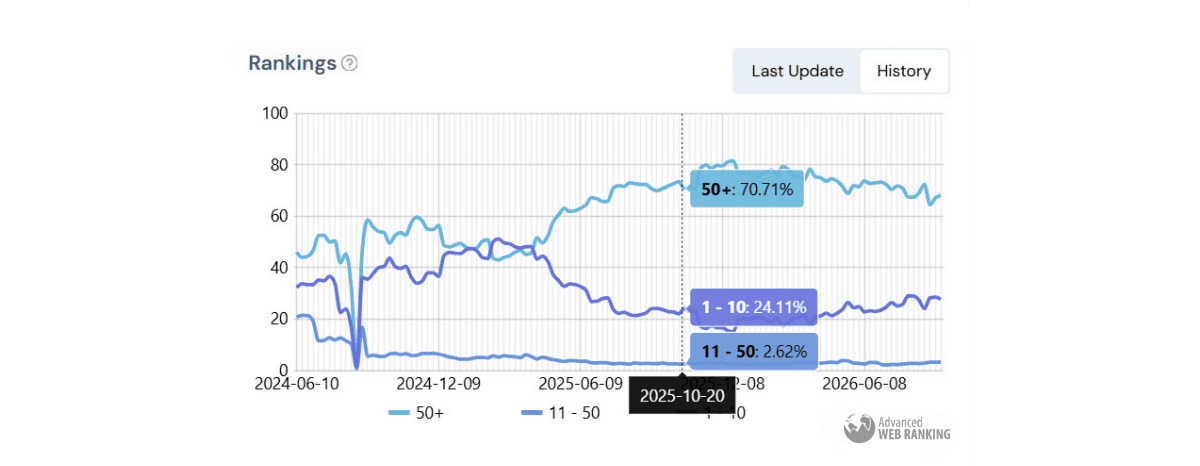
At AWR, we also track the relationship between organic rankings and AI Overviews, and how it evolves over time.
Every week, we check where the URLs cited in AI Overviews rank in traditional search and group them into three buckets: positions 1–10, 11–50, and 50+.
It’s a useful way to see, with fresh data, how often AI citations come from pages that also rank organically, and how that relationship changes over time.
Check out the free AI Overviews tool
2. "Unblock the AI crawlers"
What is it? Audit robots.txt, your CDN, and your WAF so AI bots are not blocked. Most checklists then list every agent they can name and tell you to allow them all.
Why is it recommended? You cannot be cited if you cannot be fetched. That much is simply true.
Is it a good recommendation? The principle is sound; the execution is usually careless. These agents perform fundamentally different jobs, and treating them as a single species leads to incorrect decisions.
User agent | Actual job | What blocking it costs you |
|---|---|---|
OAI-SearchBot | Index behind ChatGPT search | Removal from ChatGPT search citations |
GPTBot | Foundation-model training corpus | Exclusion from future OpenAI training |
ChatGPT-User | User-triggered live page fetch | In-session retrieval |
PerplexityBot | Perplexity's search index | Removal from Perplexity answers |
ClaudeBot | Anthropic model training | Exclusion from Anthropic training data |
Claude-SearchBot | Claude's search integrations | Removal from Claude's live search |
Google-Extended | Gemini/Vertex training and grounding | Nothing in Google Search or AI Overviews |
Two widely repeated instructions are outright false:
GPTBot is not the control for ChatGPT search visibility. OpenAI's publisher documentation identifies OAI-SearchBot and states that the settings are independent; you can permit search inclusion while declining training.
Google-Extended does not govern AI Overviews or AI Mode. Since Google shipped generative-AI reporting in Search Console in June 2026, a distinct Search generative AI control determines eligibility for AI Overviews, AI Mode, and Discover. Opting out removes those impressions without touching organic rankings.
The failure mode is not robots.txt at all but the edge. Default WAF and bot-management rules routinely challenge or rate-limit AI crawlers before robots.txt is ever evaluated. Perplexity's crawler documentation tells publishers they may need to allow both the user agent and verified IP ranges. Validating against published IP lists rather than trusting user-agent strings is the real work here, and it usually sits with a security team that has never heard of GEO. A perfect illustration of why treating this as an SEO-only problem fails: it is an infrastructure conversation, not a content one.
One nuance to keep: crawler access creates eligibility, not preference. Nobody was ever cited for being crawlable.
Verdict: Real good practice, but "allow all AI bots" collapses four separate decisions into one careless instruction.
3. "Write answer-first: 40–60 words, in the first 100 words"
What is it? Lead every page and section with a short, self-contained answer. The prescriptions get oddly specific:
40–60 words.
The primary answer inside the first 100.
An 80–200-word "answer capsule" beneath every H2.
Definitions cast as "[Entity] is a [category] that [function]."
Why is it recommended? A positional bias genuinely exists, and — unusually for this field — three independent methods converge on it:
Kevin Indig's analysis of roughly 18,000 verified ChatGPT citations found 44.2% came from the first 30% of a document, 31.1% from the middle, 24.7% from the final third. He calls it the "ski ramp."
A separate CXL analysis of AI Overview citations found 55% drawn from the top 30% of the page.
Dan Petrovic reached the same conclusion by an entirely different route, reverse-engineering Gemini's grounding pipeline and finding that only about a third of a page's content survives into grounding on average.
Is it a good recommendation? The direction is well supported. The numbers are not, and watching what happens to them in transit is instructive.
The 44.2% figure is a ChatGPT finding, routinely relabelled as an AI Overviews statistic. The 55% comes from a small sample (100 citations) about position within a page and gets restated as "55% of citations come from the first 100–200 words of a section", aka quietly changing both unit and threshold. And no provider publishes a word count, a token window, or an answer-capsule specification. Those numbers were not discovered. They were authored.
The strongest experimental check is What Gets Cited, a controlled two-document study running 252,000 trials across six LLMs and 18 content factors. Its finding: topical relevance and list position drive first citation; not formatting.
So, front-load your answer because it serves the reader, and because a system reading a third of your page should meet your best material first. That is craft, not a lever.
Verdict: Real good practice as a principle. Myth as a formula. Keep the instruction, discard every number attached to it.
4. "Chunk your content into atomic, self-contained passages"
What is it? Break pages into short, independently quotable blocks. Cap paragraphs at 120 words. Strip out phrases like "as mentioned above." Maintain a minimum density of standalone factual statements; some frequently shared agencies (unknown to me) and AI Guide frameworks even prescribe six per 1,000 words.
Why is it recommended? The mechanic is real. Retrieval operates on passages, and a chunk made entirely of connective tissue carries little standalone meaning.
Is it a good recommendation? Partly, and the prescriptive version is contradicted by the only provider that documents its position. Google's guide has a section explicitly labelled myth-busting, and content chunking is named in it: no requirement to break content into small pieces, no ideal page length, and its systems can handle multiple topics on a page.
Now look at the quantified versions:
Six answer nuggets per 1,000 words.
A 120-word paragraph cap.
A 3:1 ratio of listicles to how-to guides.
A "70% GEO adoption rate" across your revenue pages.
None has a traceable primary source. They are editorial governance heuristics, invented for workflow management and then dressed as machine requirements. As internal quality standards, perhaps useful. As measurements of anything, fiction.
And there is real downside risk. The July 2026 critical survey found GEO rewrites can reduce a page's retrieval; around 16% in the cases examined. Shredding a coherent explanation into disconnected fragments is precisely the intervention that might do this.
Note that King's passage-level work is directionally consistent with how retrieval operates; he presents it as an engineering model, not a disclosed scoring function. That distinction survived as far as the first agency blog that borrowed it.
Verdict: Plausibly counterproductive in its prescriptive form. Write clearly. Do not turn your pages into confetti.
5. "Add statistics, quotations and citations"
What is it? Enrich content with precise figures, named expert quotes, and links to primary sources, and usually with a promise of a 30–40% visibility gain attached.
Why is it recommended? This is the one piece of the canon with an academic anchor: the controversial GEO paper by Aggarwal, Murahari, Rajpurohit, Kalyan, Narasimhan and Deshpande, presented at KDD 2024. It tested nine content modifications across roughly 10,000 queries. Citations, quotations, and statistics produced the largest gains: "up to 40%" in the paper's own framing. Keyword stuffing, pleasingly, performed worse than baseline.
Is it a good recommendation? As editorial guidance, yes; evidence-dense writing is better writing. As the mechanistic promise it has become, no. And I say "controversial" deliberately, because the paper has been asked to carry far more weight than its design can bear.
The limitation is structural, and the authors were explicit about it. Much of the experiment measured how a model treated sources already sitting in its context window: which of five competing documents got used and emphasised. It did not test whether a newly edited page would be crawled, indexed, retrieved, reranked and cited in a live system. The abstract also notes effectiveness varied significantly by domain, which is a caveat that never survives the journey onto a slide.
The critical survey reaches the same conclusion: the famous uplift is valid inside its experimental conditions and should not be generalised to organic discoverability, sustained citation share, traffic or conversions. It is a single-author preprint, so treat it as a rigorous synthesis rather than settled consensus, but its central finding is blunt. No reviewed technique has shown a stable, longitudinal, cross-platform causal effect.
One more reason to hold the number loosely: a substantial share of AI answers never triggers a web search at all. Where the model answers from its own weights, your on-page work is irrelevant by construction, and what matters is whether the model knows who you are. That is a branding problem, not an SEO one.
Verdict: To be confirmed. Real research, honestly reported by its authors, systematically over-extended by everyone else.
6. "Add extensive structured data, and stack it"
What is it? Deploy JSON-LD everywhere. The aggressive version prescribes "schema stacking" — Article plus FAQPage plus ItemList on one page, wired into a single @graph. On the theory that more markup produces more citations.
Why is it recommended? A real correlation exists: Ahrefs' analysis of around six million URLs found AI-cited pages nearly three times more likely to carry JSON-LD. That number has been recycled industry-wide as proof of causation.
Is it a good recommendation? Then Ahrefs did the honest thing and tested it. Their controlled study tracked 1,885 pages that added JSON-LD between August 2025 and March 2026 against roughly 4,000 matched controls, difference-in-differences:
Platform | Change in citations after adding schema |
|---|---|
Google AI Mode | +2.4% (indistinguishable from noise) |
ChatGPT | +2.2% (indistinguishable from noise) |
Google AI Overviews | −4.6% (small, but statistically significant) |
The correlation was confounded by site quality. Sites that bother with structured data tend to do everything else well too.
I wrote about this at the time, arguing that Ahrefs is right and is testing the wrong thing, and I still think that is the necessary nuance. Every page in the sample already carried 100+ AI Overview citations before treatment: the study measures marginal effect on saturated pages, not entry into a citation set. And it does not test what schema's serious advocates claim it does: entity disambiguation and knowledge-graph construction. Measuring Organization markup by counting citations over thirty days is a category error. The value is real, but it is not denominated in that currency.
That claim has its own evidence, and it points somewhere more interesting. A controlled experiment by Volpini, Raad, Gamba and Riccitelli found JSON-LD added to plain HTML produced only modest retrieval gains, while restructured entity pages, with navigable links and dereferenceable URIs, improved accuracy by roughly 29.6–29.8%.
The authors state their limit clearly: the result is specific to one retrieval stack. Meaningful for custom RAG and agentic systems; not evidence that stacking schema types makes a public page more citable.
Google closes the loop: structured data is not required for generative AI search, there is no special markup to add, and it remains worth using for what it always did.
Verdict: True but inert as an AI-citation tactic. Real good practice for rich results, entity clarity, and machine-readable commercial facts. Do not confuse the death of a rich result with the death of schema as information architecture.
7. "Add FAQ sections and FAQ schema"
What is it? Build FAQ blocks, mark them with FAQPage, phrase headings as questions. Frequently accompanied by a precise promise: FAQ schema makes content around 60% more likely to be cited.
Why is it recommended? Inherited wholesale from misunderstood featured snippet and People Also Ask optimisation. AI answers questions; give it questions.
Is it a good recommendation? The 60% figure has no traceable source. It circulates in incompatible forms — 28%, 36%, 40%, "40–60%", 3.2×, 67% — the classic signature of a number invented once and passed along until it acquired authority through sheer mileage.
Where a vendor has published its actual numbers, they undercut the claim rather than support it. SE Ranking's analysis of schema types against AI citation frequency puts structural markup between −0.025 and −0.106 and content markup between +0.015 and +0.039 — correlations they themselves describe as effectively zero, with no schema type meaningfully raising citation odds on its own.
The provenance of the positive numbers is worse. Daniel Cheung went looking for the widely quoted claim that structured data and FAQ blocks lift AI citations by 44%, attributed to BrightEdge, and found no such study exists. BrightEdge has published a real 44% figure — about AI Overviews being likelier than ChatGPT to criticise brands — which has nothing to do with schema. A number was lifted from one finding, attached to another, and now travels through conference decks as evidence.
Worse, the tactic is sold against a target that already moved. Google restricted FAQ rich results to authoritative government and health sites in August 2023, then removed them from Search entirely in May 2026, with tooling and API support winding down through August 2026. FAQPage remains a valid Schema.org type, and Google says it still uses the markup to understand pages, but the SERP feature that justified the exercise no longer exists for any sites.
None of which makes FAQs bad. Answering the questions your audience genuinely asks is decent content strategy and always was. The causal factor, where one exists, is relevance to the user's task, and not a question mark.
Verdict: Myth as an AI-citation lever. The instinct beneath it is fine.
8. "Publish an llms.txt file"
What is it? A Markdown index at your site root — proposed by Jeremy Howard in September 2024 — giving AI agents a clean summary of your site and links to key content. Often paired with an expanded /llms-full.txt.
Why is it recommended? Intuitive by analogy (robots.txt for the AI era) and cheap to implement, which makes it an ideal audit deliverable. You can ship it, invoice it, screenshot it.
Is it a good recommendation? This is the canon's most prominent myth, and the evidence against it is unusually clear.
John Mueller stated publicly in June 2025 that no AI system currently uses llms.txt, comparing it to the long-dead keywords meta tag. Gary Illyes confirmed Google has no plans to support it. Google's generative-AI guide lists it among the things you can ignore: creating one will neither help nor harm your search visibility.
Then came the server logs. Ahrefs' study of 137,210 domains found that of roughly 38,000 sites with a valid file, 97% received zero requests for it in the month measured. Among the 3% that saw any traffic, SEO audit tools were the largest single requester category. AI bots never went hunting for the file on domains that lacked one — no probing, no curiosity. The industry is, in the most literal sense, mostly reading its own homework.
Let me be fair to the proposal itself, because it deserves it. llms.txt does what Howard designed it to do for coding assistants and documentation agents that are explicitly programmed to fetch it. OpenAI, Anthropic, and Perplexity all publish llms.txt files for their own developer docs. That is the specification working exactly as intended, and it is not evidence that their crawlers read yours.
Verdict: True but inert if you already have one. Myth the moment anyone charges you for it as an AI-visibility play.
9. "Demonstrate E-E-A-T with author pages and Person schema"
What is it? Named bylines, author bio pages at stable URLs, credentials, links to LinkedIn and Google Scholar, editorial policies, Person and Article markup.
Why is it recommended? Because "anonymous content is rarely cited," according to a genre of vendor content attaching remarkably precise numbers: 96% of AI Overview citations from strong-E-E-A-T sources; bylined content cited 58% more often; author systems raising citation rates 130–250%.
Is it a good recommendation? Follow one of those numbers and watch it dissolve. The 96% figure is quoted everywhere, but the vendor quoting it attributes the finding to a second vendor's analysis of 2,400 citations. Go to that second vendor, and the same 96% is sourced instead to research covering 15,847 AI Overview results across 63 industries (credited, in turn, to a third party). Two incompatible descriptions of the sample, three parties deep, and no accessible study at the end of it. A separate guide then attributes the 2,400-citation analysis back to the first vendor.
The number circulates freely; the research never surfaces.
The same vendor runs the contradiction in public. One of its pages describes E-E-A-T as a binary gatekeeper and reports that pages ranking #6–#10 with strong E-E-A-T are cited 2.3x more often than #1-ranked pages with weak E-E-A-T.
Another page names topical authority as the strongest predictor of AI citation at r=0.41 and attaches the identical 2.3x figure to topical authority instead.
One statistic, two different causes, one website.
The omitted context is fundamental. E-E-A-T is a concept from Google's Search Quality Rater Guidelines, not a ranking mechanism.
Google has stated there is no E-E-A-T score and that E-E-A-T is not itself a ranking factor; Mueller has said repeatedly that authorship is not a direct ranking factor. No provider states that a longer biography, a reviewer field, or credentials markup raises citation probability, and the schema half of the mechanism is undercut by the study in section 6.
What survives is the substance rather than the furniture. Expertise, accuracy, transparency, accountability: these are real qualities that produce material worth citing, and they are why Marie Haynes, Lily Ray and Aleyda Solís treat E-E-A-T as a conceptual lens rather than a dial. Converting a rater framework into a checklist of page elements is cargo cult work, aka building a control tower out of bamboo and waiting for the planes.
Verdict: To be confirmed for the underlying qualities. Myth for every percentage attached to author markup.
10. "Earn third-party mentions, not just backlinks"
What is it? Digital PR, industry roundups, review platforms, podcasts, expert commentary, YouTube presence, community participation. The slogan: mentions beat links.
Why is it recommended? The observational support is the strongest anywhere in the canon. Ahrefs' study of 75,000 brands, later extended to ChatGPT and AI Mode, measured Spearman correlations with AI brand visibility:
Signal | Correlation |
|---|---|
YouTube mentions | 0.737 |
Branded web mentions | 0.664 |
Branded anchors | 0.527 |
Brand search volume | 0.392 |
Backlinks | 0.218 |
Separately, Muck Rack's ongoing analysis of more than 25 million cited links found earned media accounts for around 84% of AI citations, with paid and advertorial content at 0.3%.
Is it a good recommendation? Directionally, yes, and if you forced me to protect one budget line, this is it. This is also where GEO stops being an SEO discipline and becomes what it always was: brand building, PR and communications, with a retrieval system as an additional audience. The SEOcentric framing is what makes teams execute it badly.
Two qualifications, though. Ahrefs states explicitly that correlation is not causation, and the confound is obvious: large, established brands naturally accumulate more mentions, search demand, reviews, and video. Nobody has shown that one additional mention produces a predictable gain.
And Muck Rack's "earned media" bucket is far broader than PR: academic sources, governments, NGOs, encyclopaedic sites, social platforms, third-party corporate content; journalism alone is roughly 27%. "84% earned media" is not "84% press coverage," and it is regularly sold as though it were.
The community-seeding variant deserves separate treatment. Reddit is genuinely over-represented in some engines and not others, and the share shifts by platform, category, and market. But AI paraphrases community content heavily, so brand messaging blends away into encyclopaedic neutrality, and Google explicitly advises ignoring advice to pursue inauthentic mentions, because its spam systems act on manufactured discussion. Astroturfing a subreddit is manipulation with a brand-safety downside attached. It is the 2026 equivalent of buying footer links.
Verdict: To be confirmed; the strongest correlational case available, no demonstrated causal mechanism. The seeding variant is plausibly counterproductive.
11. "Keep content aggressively fresh"
What is it? Display and update dateModified, refresh high-value pages on a schedule, replace stale statistics. Prescriptions range from quarterly to a 7/14-day cycle, usually paired with a claimed "citation decay" interval and an "18-month rule" for replacing cited sources.
Why is it recommended? Recency bias in AI retrieval is real, particularly in Perplexity and in time-sensitive query classes. Controlled testing confirms recent dates outperform clearly old ones.
Is it a good recommendation? Freshness matters when the query carries temporal intent. Prices, availability, regulations, personnel, product specifications, competitive comparisons: these should be current. That is the entire defensible claim, and it is a good one.
Everything quantitative bolted onto it is invented. There is no evidence for a universal 7-day refresh cycle, a 14-day decay window, a 3× citation-loss multiplier for un-updated pages, or an 18-month expiry on outbound citations. None appears in any provider documentation or peer-reviewed work.
Worse, the advice actively encourages a bad behaviour: moving a date without substantively reviewing the content. An explanation of Roman aqueducts does not become more accurate because its timestamp changed on Tuesday.
Verdict: Real good practice for time-sensitive content. Myth for every fixed interval.
12. "Track your AI visibility and share of voice"
What is it? A dashboard reporting citation rate, share of voice, sentiment, source attribution and — very commonly — your "ranking position" in ChatGPT or Perplexity, sold as a monthly subscription.
Why is it recommended? Because you cannot manage what you do not measure. This is the recommendation most often dismissed wholesale by sceptics, and I think the wholesale dismissal is wrong.
Is it a good recommendation? This debate has become unhelpfully binary. Measuring is legitimate and necessary. Ranking is not measurable. The second statement does not invalidate the first.
Start with the variance. Rand Fishkin and Patrick O'Donnell of Gumshoe.ai ran a study in which 600 volunteers (myself included) executed 12 prompts across ChatGPT, Claude, and Google AI a combined 2,961 times: less than a 1-in-100 chance of the same brand list appearing twice, roughly 1-in-1,000 for the same order. Any tool reporting a position is reporting noise.
Here is the part usually left out. Fishkin's own hypothesis — that this randomness made tracking useless — turned out to be wrong. Asked to recommend ecommerce marketing consultants, AI named one agency in 85 of 95 responses. The consideration set is stable even when the ordering is chaotic.
Kevin Indig has done the most useful work turning that insight into a method, and Make your prompt tracking more accurate is the piece I would hand a client. The reframing: prompt tracking should look less like rank tracking and more like polling: repeated runs, fixed sampling rules, confidence intervals, segmented panels, raw-answer audits.
Where standard tooling breaks:
Single runs are coin flips. Within-LLM sampling variance alone runs 10–34% on identical prompts, and across 815,000 prompt-page pairs only around 2% of citations survived three repetitions of the same ChatGPT prompt.
Monthly cadence is far too slow. SISTRIX tracked 82,619 prompts over 17 weeks and found Google AI Mode replacing 56% of its cited sources weekly, and ChatGPT 74%.
Blended cross-platform scores are meaningless. Averaging ChatGPT and Perplexity visibility is averaging your Google rank with your Bing rank.
Reasoning mode changes the engine. High versus low reasoning opens an 18-point citation-rate gap and fires several times more fan-out queries.
A single first turn misses the journey. Whether you survive into turn three, when the user asks about alternatives and pricing, is what matters commercially.
Citation is not Mention. Analysis of nearly 4,000 domain appearances found 61.7% were "ghost citations", aka source linked, brand never named. Indig's framing of the pattern matters if your reporting collapses both. Being used is not being known.
His practical configuration — around 40 seed prompts weighted toward problem-stage intent, tracked per platform, five repetitions each, weekly, with persona variants and multi-turn journeys — is a measurement system rather than a dashboard.
Aleyda Solís's 3-layer framework is its structural complement, separating Presence (are you appearing, and how are you described?), Readiness (are you structurally prepared to be surfaced?) and Business Impact (is any of this producing value?), and insisting the layers stay unblended, because readiness does not guarantee presence and presence does not guarantee revenue. Her companion guide on building a representative prompt library covers the input side most tools skip.
One caution across this section: much of the most-cited data in AI search comes from companies selling the tools that data justifies. That does not make it wrong, and some of the best research here is vendor-produced, including studies I have relied on. But demand published methodology, sample sizes, and per-prompt run counts, and weigh the commercial incentive before the conclusion. If a vendor cannot tell you how many times it ran each prompt, it is not measuring. It is decorating.
Verdict: Real good practice when run as polling; rates, repetitions, confidence intervals, per engine. Myth for any reported "AI rank."
This is also how we approach AI visibility tracking at AWR: alongside an overall AI visibility score, we track each platform separately (Google AI Overviews and AI Mode, ChatGPT, Perplexity, Gemini, Claude) and distinguish between citations and brand mentions, both above and below the fold.
Tracking frequency can be adjusted per platform (weekly or more often where sources churn fastest) and repeated runs can be performed to separate real shifts from normal fluctuation. AI visibility can be compared directly with traditional search visibility and how they overlap.
The result is less a single ranking number and more a way to monitor how your presence in AI search evolves alongside organic search.
Learn more about AI Visibility tracking with AWR
13. "Each engine needs its own content recipe"
What is it? A familiar table: ChatGPT wants dense factual passages and FAQ schema; Perplexity prefers statistics and bullets; Claude prefers long-form nuanced prose; Gemini rewards entity density; Copilot is just Bing with a personality.
Why is it recommended? Because output studies really do show engines citing different sources. The observation is sound.
Is it a good recommendation? The observation is sound; the inference is folklore. None of these stylistic preferences appears in any provider's documentation. OpenAI publishes no ranking-factor or formatting guide. Anthropic describes the search process — how Claude decides to search, forms queries, refines them, returns citations — but no content-scoring formula. Perplexity's documentation concerns access, not style. Every "engine preference" in that table is inferred from output samples that vary by date, location, personalisation, and stochastic generation.
The "ChatGPT is just Bing" shortcut is likewise stale. OpenAI has been building its own index via OAI-SearchBot, and its documentation now describes drawing on third-party providers and partner content. Suganthan Mohanadasan's network-level investigations of how ChatGPT picks sources are valuable precisely because they show how fast this plumbing changes.
Where engine-specific work is justified: crawler controls, whether live search activates at all, retrieval sources, citation interfaces, and measurement. Track platforms separately, always. Do not write for them separately.
Verdict: Real good practice at the systems and measurement level. Myth at the content-formula level.
Recap
Recommendation | Verdict |
|---|---|
Maintain traditional SEO foundations | Real good practice — necessary, not sufficient |
Unblock AI crawlers | Real good practice — but distinguish search, training, and user-triggered agents |
Front-load answers | Real good practice as principle / Myth as word-count formula |
Atomise content into chunks | Plausibly counterproductive in prescriptive form |
Add statistics, quotes, citations | To be confirmed: real study, over-extended |
Extensive / stacked schema | True but inert for AI citation; real value elsewhere |
FAQ sections and FAQ schema | Myth, and the rich result is gone |
llms.txt | True but inert at best; Myth as a paid deliverable |
E-E-A-T page furniture | To be confirmed for substance / Myth for the percentages |
Third-party mentions over backlinks | To be confirmed — strong correlation, no causation |
Community seeding/astroturfing | Plausibly counterproductive |
Fixed-interval freshness schedules | Real good practice when query is time-sensitive / Myth as a calendar |
AI visibility tracking | Real good practice as polling / Myth as rank |
Engine-specific content recipes | Myth at content level / Real good practice at measurement level |
Conclusion
Strip out the folklore and what remains is less thrilling, far more durable, and — I would argue — more strategically interesting than the canon it replaces:
Make your content available. Distinguish search crawlers from training crawlers from user-triggered fetchers. Check your CDN before you check robots.txt.
Be genuinely relevant to the task. Topical relevance is the most reproducible content variable in the controlled work that exists, and it beats every formatting intervention tested against it.
Have something worth citing. Original data, first-hand experience, real prices, real limitations, real specifications. The part the GEO paper measured, and the part that survives every critical review.
Keep your facts consistent. Across your site, feeds, business profiles, review platforms, and third-party references. Data governance and brand integrity, not entity stuffing.
Get corroborated where your audience already is. Legitimately. The strongest correlational evidence available, and the manipulation shortcut is the one tactic with a documented downside.
Measure like a pollster. Per engine, repeated, with error bars. Distinguish being cited from being mentioned from being recommended from being visited.
Notice what that list does not contain: a word count, a refresh interval, a schema stack, a file at your root directory, or a number that predicts revenue.
Notice also how little of it is SEO in the most narrow sense. Four of those six belong as much to PR, brand, and product as to search. That is not an accident, and not temporary. We are watching the same evolution we have watched for fifteen years — from strings to things, from things to entities, and now from entities to how a synthesising machine describes you when nobody is looking.
You are not optimising a document. You are managing a reputation inside a system that reads.
A final word on shelf life, because I want you appropriately suspicious of this article too. Gemini 3 became the default model behind AI Overviews in January 2026 and replaced roughly 42% of previously cited domains within weeks. Google published its first official generative-AI guidance in May 2026 and shipped Search Console reporting in June. FAQ rich results were completely retired in May. Any figure here could be superseded by the time you act on it.
That instability is the actual finding, and it is why a confident, quantified, permanent-sounding recipe is the most reliable signal that someone is selling you something.
The sincere version of this advice contains a great deal of "it depends," a fair amount of "we do not know yet," and very few round numbers. Which is precisely why it loses the attention war to the version that does not.
Harder to sell in a carousel. Also, as far as anyone can demonstrate, roughly what is true.

Article by
Gianluca Fiorelli
With almost 20 years of experience in web marketing, Gianluca Fiorelli is a Strategic and International SEO Consultant who helps businesses improve their visibility and performance on organic search. Gianluca collaborated with clients from various industries and regions, such as Glassdoor, Idealista, Rastreator.com, Outsystems, Chess.com, SIXT Ride, Vegetables by Bayer, Visit California, Gamepix, James Edition and many others.
A very active member of the SEO community, Gianluca daily shares his insights and best practices on SEO, content, Search marketing strategy and the evolution of Search on social media channels such as X, Bluesky and LinkedIn and through the blog on his website: IloveSEO.net.