


Most SEO content starts in the same place: the pages that already rank.
We analyse the top results, identify the recurring topics, build a brief, and produce a more complete version. It is a sensible workflow. It is also why so much content sounds like a polished variation of the same ten sources.
The problem is not limited to publishers or niche websites.
A SaaS company may have years of expertise hidden inside product demonstrations, onboarding calls, customer-support conversations, webinars, and interviews with developers. Yet its articles are often written primarily from keyword data and competing blog posts.
A large e-commerce company may have thousands of customer reviews, product returns, service enquiries, buying questions, and insights from its category managers. Yet its buying guides frequently repeat the same specifications and generic advice already found on competing websites.
In both cases, the company already possesses knowledge that could make its content more useful and distinctive. The challenge is retrieving it and turning it into something people can find, understand, and use.
I faced the same problem when I launched DanishWine.com from a default WordPress installation. I had no editorial team, limited formal wine education, and more than 70 Danish winemakers whose stories and expertise deserved proper coverage.
I could not win by publishing slightly different versions of the content that was already ranking.
Yet on Christmas Eve 2024, only 14 months after launch, DanishWine.com reached the number-one organic position for “dansk vin” (“Danish wine”).
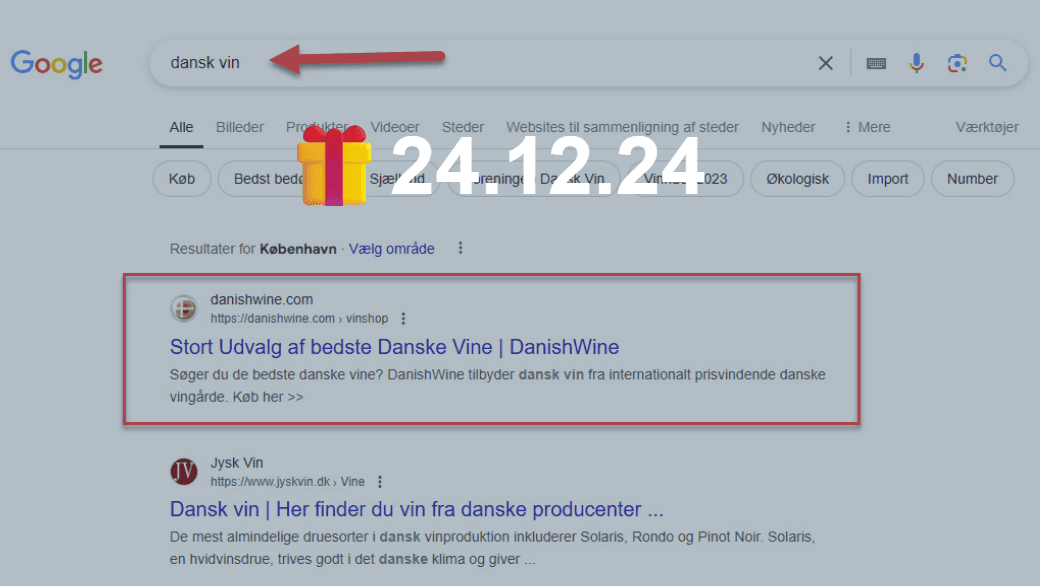
Reaching the No. 1 position for 'Dansk vin' (Danish wine) on Christmas eve 2024
The breakthrough did not come from writing longer articles. It came from changing where I looked for expertise.
The eureka moment arrived on an otherwise ordinary Wednesday.
I was reading my local newspaper when I came across an article about a nearby vineyard that had just won several prizes at the PIWI Wine Awards in Germany. The article contained specific details that were missing from the generic vineyard profile I had already written.
I wanted to add them, but I did not have a digital version of the article. So I took a photo and uploaded it to ChatGPT. Within moments, it had extracted the text, giving me a workable starting point for identifying and verifying the relevant details.
When I incorporated those details into the vineyard profile, the article became noticeably better. It was more specific, more authoritative, and more useful. Most importantly, it contained information that was not already circulating through the pages ranking in Google.
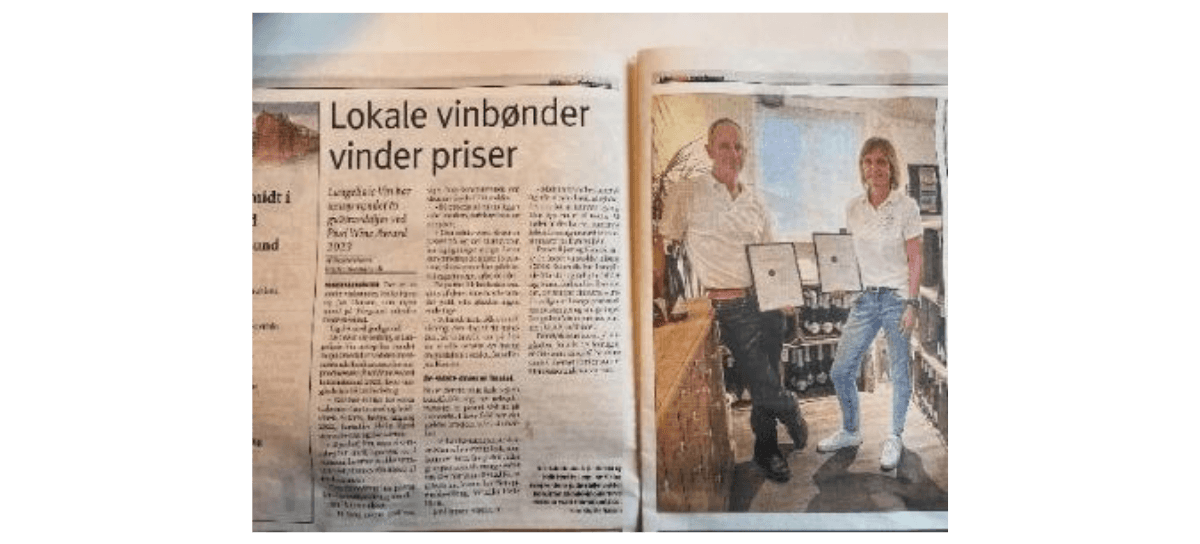
The local newspaper article about Langelinie Vin
An idea was born.
What if valuable expert knowledge was already available across newspapers, podcasts, webinars, YouTube interviews, regional television features, and recorded tastings, but remained hidden because nobody had converted it into useful, searchable content?
I began treating these conversations and recordings as research sources. I transcribed them, extracted the most valuable claims and relationships, verified the details, and transformed them into original written resources.

Example of a Danish wine podcast at Podcastindex.org
I call this the T-Method: a transcription-led framework for retrieving first-hand expertise from expert conversations and transforming it into useful SEO content.
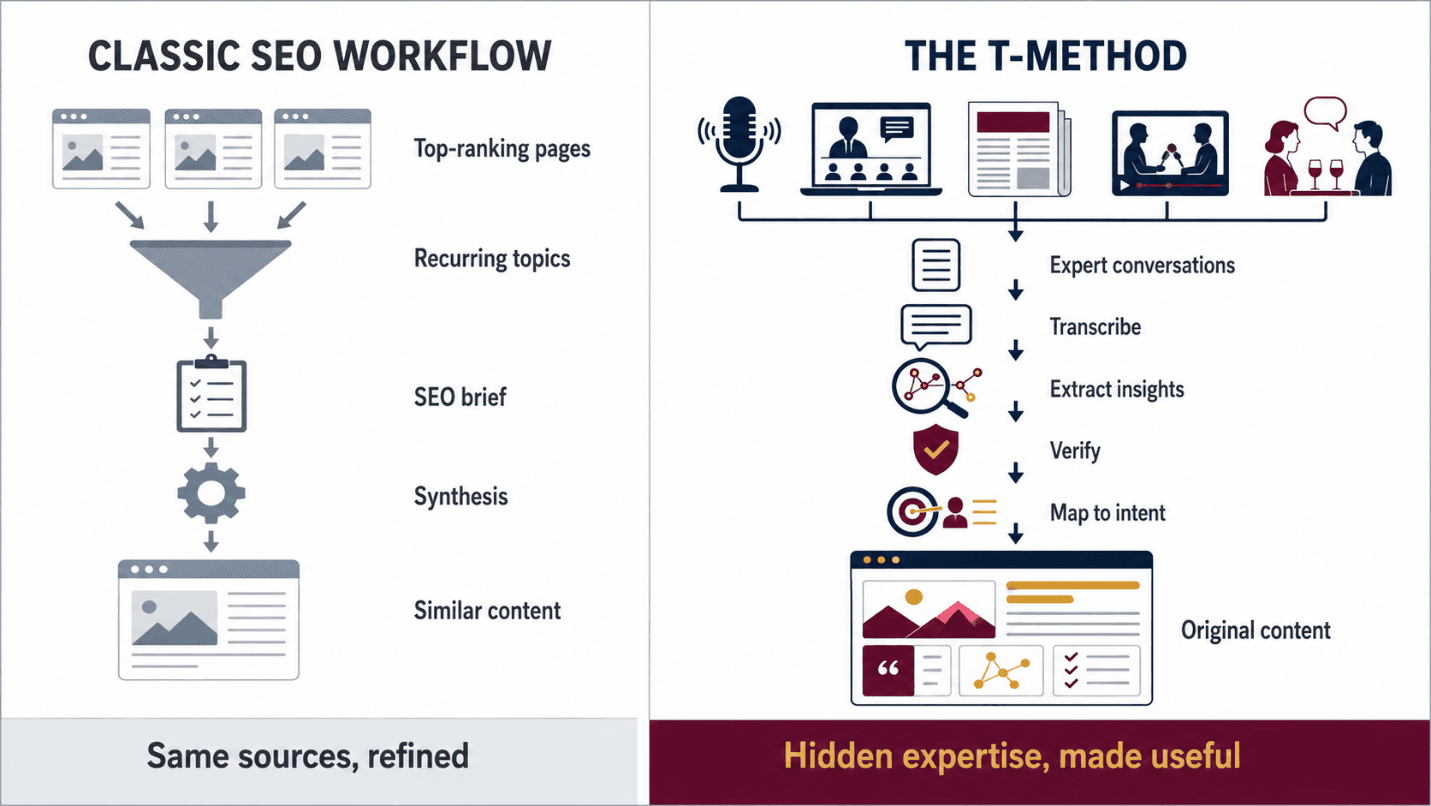
The classic content workflow and the T-Method
The method does not automate expertise. It makes expertise that already exists easier to find, verify, structure, and publish.
The real content shortage is not words
Content teams can produce words faster than ever. That has not solved the difficult part.
The difficult part is getting access to the observations, trade-offs, failed attempts, and decision logic that make an expert worth listening to.
A conventional SEO workflow is good at identifying the consensus answer. Keyword research and competitor analysis show us what people search for and what a page is expected to cover. But when every competitor works from the same ranking pages and the same generative tools, the process can become a closed loop.
I call the result secondary synthesis: content built mainly by rearranging information that is already easy to retrieve.
Secondary synthesis is not automatically poor content. A clear summary can be valuable when the existing information is fragmented or badly explained. But it becomes difficult to differentiate when anyone can access the same sources.
That leaves you with a more useful editorial question:
What can we add that was not already available in a useful written form?
Google’s people-first content guidance asks whether a page provides original information, reporting, research, or analysis. There is no simple “information gain score” to optimise. The practical principle is much simpler: give the page a reason to exist beyond reproducing what is already available.
This is where many content teams meet the subject matter expert bottleneck. The SEO team needs original input. The experts are busy serving clients, developing products, running laboratories, managing vineyards, or solving the problems the content is supposed to explain. Interviews are postponed. Briefs sit unanswered. The publishing calendar moves on without them.
The result is often accurate, professional, and interchangeable.
The T-Method reduces that dependency by making better use of expert conversations that have already taken place.
The expertise is already there. It is simply hard to retrieve
Experts speak differently from the way corporate articles are written.
In a long interview, an expert may explain the failed harvest that changed a production method, the soil condition behind a particular wine, or the small warning sign that an experienced practitioner notices before everyone else. These details rarely fit neatly into a standard content brief.
They are also easy to miss. A useful observation may appear 37 minutes into a podcast with generic show notes, inside a webinar recording, or in a regional YouTube interview with only a few hundred views.
Why spoken expertise remains difficult to discover
The problem is not that search engines cannot process audio. The problem is that spoken knowledge is not consistently available to them in a searchable, structured form.
There are three main reasons:
Processing spoken content requires considerably more computational work than crawling an ordinary text page. The audio must be accessed, transcribed, interpreted, and connected to the correct speakers and subjects. We therefore cannot assume that every recording will be analysed with the same depth as a well-structured web page.
Much of this content lives inside platforms such as Spotify and Apple Podcasts. These platforms are designed primarily as listening environments, not as open collections of structured information that search engines can easily retrieve.
The searchable representation of an episode is often limited to its title, description, show notes, and other metadata. A public transcript can expose much more of the conversation, but only when one exists and is published on a crawlable website.
As a result, the most valuable insight in a 60-minute interview may never appear in the information that search engines can easily retrieve. It remains trapped inside the recording.
I use the term dark data as shorthand for this valuable expert knowledge: information embedded in long-form audio or video but not readily available as searchable, structured text. This is narrower than the term’s broader use in information management.
The opportunity is not simply to publish raw transcripts. They contain repetition, false starts, ambiguous references, and claims that may be outdated or wrong. They are research material, not finished content.
That distinction matters. The T-Method is not an automated transcript-to-article generator. It is not permission to reproduce somebody else’s work. And it does not make every spoken claim true.
It is a repeatable way to retrieve useful insights that conventional competitor-led research often misses and transform them into verified, structured content that both readers and search systems can understand.
How a Danish wine project revealed the method
By day, I work as an SEO strategist. Outside client work, I build niche authority projects, including DanishWine.com.
The site presented an unusual content problem. Denmark has more than 70 vineyards, each with its own people, geography, grape varieties, production choices, and history. Useful coverage required much more than rewriting winery descriptions or compiling addresses.
My own subject knowledge was limited. My formal wine education stopped at WSET Level 1, and interviewing every winemaker was unrealistic for a solo project. So I looked for conversations that had already happened.
I found local podcasts, winemaker interviews, regional television features, webinars, and video tastings. Together, they contained an oral history of a young wine industry: why producers chose particular grape varieties, how they responded to the Danish climate, which experiments failed, and what made one vineyard different from another.
The material was public. The useful knowledge inside it was scattered.
I began transcribing the recordings and processing them systematically. The aim was never to republish what a winemaker had said word for word. It was to identify verifiable facts, first-hand observations, useful terminology, and relationships that could guide original research and writing.
Over time, that working practice became a four-stage process: retrieve, transform, map, and verify.
The Experience Retrieval Pipeline
The four stages turn an unstructured conversation into a researched content asset. Each stage has a different quality gate. Skip one, and you risk producing content that is fast but inaccurate, distinctive but irrelevant, or polished but impossible to verify.
Phase 1: Retrieve credible source material
Traditional SEO research starts with queries. The T-Method starts with both the audience’s questions and the people qualified to answer them.
For DanishWine.com, I looked for recordings featuring winemakers, vineyard owners, sommeliers, researchers, and other identifiable practitioners. In a B2B company, the equivalent sources might be engineering webinars, conference presentations, product demonstrations, customer interviews, or technical podcasts.
The goal is not to collect as much media as possible. It is to find first-hand observations that improve a specific topic.
For every source, I record:
the speaker’s name, role, and relevant experience;
the original URL, publisher, and publication date;
the recording date, when it differs from the publication date;
the topics and entities discussed;
whether a statement is a fact, an opinion, or personal experience;
any restrictions affecting quotation, reproduction, or attribution; and
whether important claims can be checked against another source.
This record matters. Once a transcript has been divided into fragments and reorganised, it becomes surprisingly easy to lose track of who said what and in which context.
Source quality matters more than production quality. A polished webinar can contain little original insight, while an informal interview can reveal years of accumulated experience. I prioritise proximity to the subject, specificity, verifiability, and relevance over follower counts or studio production.
Phase 2: Transform the conversation into a semantic map
A transcript is not an article. It is a record of a conversation, complete with repetition, unfinished thoughts, and references that only made sense in the moment.
This is where I use large language models, which is not to invent the expert content, but to help me navigate it.
I ask the model to identify:
people, organisations, places, products, and other named entities
distinctive claims and first-hand observations
relationships between entities
examples, numbers, dates, and technical details
disagreements, qualifications, and uncertainty
statements that require independent verification
passages that may be useful as quotations
questions the source answers that existing content does not address clearly
The result is a semantic map of the source, not a finished draft.
Every extracted claim keeps a link to its source and, where possible, a timestamp. A human editor can then return to the recording and check whether the summary preserved the speaker’s intended meaning.
The model is not replacing the expert. It is helping the editor find the relevant parts of hours of expert material.
Phase 3: Map the insight to a reader’s decision
Original information is not automatically useful information. A fascinating anecdote can still be irrelevant to the reader.
Suppose the broad topic is choosing Danish sparkling wine. That single topic conceals several practical questions:
Which production methods are used?
Which grape varieties perform well in Denmark?
How does Danish acidity affect taste and food pairing?
What distinguishes one producer from another?
How much vintage variation should a buyer expect?
Which bottles suit an experienced wine drinker, and which suit a curious beginner?
I connect the strongest retrieved insights to these narrower needs. If an interview does not improve the answer, it does not earn a place simply because it is original.
This is also where the article stops being a transcript and becomes an editorial product. Descriptive headings, focused passages, and unambiguous references help human readers follow the argument. They also make individual passages easier to understand when they are scanned, quoted, or retrieved outside the full narrative.
Phase 4: Verify, attribute, and connect
The final phase is the least glamorous and the most important.
A transcription tool can mishear a vineyard name. An LLM can attach a statement to the wrong speaker. An interviewed person’s memory can let them down. A claim that was accurate three years ago may no longer be current.
For every material claim, I return to the recording, confirm the speaker and context, distinguish opinion from fact, and check important details against an independent source where possible. I then decide whether the source should be quoted, paraphrased, or used only as a research lead.
Structured data can describe people, organisations, places, articles, and products already visible on the page. It cannot verify that a claim is true. I would never add reviewedBy simply to manufacture an appearance of authority. It belongs only where a real review occurred and the relationship is represented accurately.
On DanishWine.com, the visible information architecture does most of the work. A vineyard connects naturally to its winemaker, region, grape varieties, wines, and relevant sources through copy and internal links. Structured data supports those relationships; it does not create them.
What the process looked like in practice
The framework becomes clearer when you follow one source from conversation to article.
A recording might contain a winemaker explaining why a particular grape variety performs well on one site, what failed in an earlier vintage, and how that experience changed the production method. The transcript gives me the raw statements. The semantic map identifies the vineyard, grape, method, dates, causal relationships, and claims that need checking.
I then ask a practical question: which part of this helps the reader? The answer might belong in a vineyard profile, a grape guide, an article about Danish growing conditions, or all three provided that each page uses the insight for a distinct purpose.
After returning to the recording and checking the facts, I write a new passage in my own structure and language, attribute the source where appropriate, and connect the page to the relevant vineyard, grape, region, and wine content.
That is the transformation the method is designed to support: not speech turned mechanically into prose, but experience turned into traceable, useful knowledge.
What changed on DanishWine.com
DanishWine.com began as a new domain on a default WordPress installation. I had WSET Level 1 knowledge, no editorial team, and no practical way to interview every Danish producer before publishing useful coverage.
The established competitors had older domains, existing content libraries, and stronger link profiles. Producing slightly longer versions of their pages would not create a defensible advantage.
Instead, I treated the scattered audio and video record of the Danish wine industry as a research collection. For each relevant vineyard or topic, I identified credible recordings, transcribed the material, extracted entities and claims, and mapped the strongest insights to reader questions. I verified important details, combined them with additional research, and wrote original pages rather than edited transcripts.
The process helped me cover details that were often absent from conventional winery profiles: production decisions, local conditions, experiments, distinctive grape characteristics, and the reasoning behind a producer’s choices.
It also created a connected content model. Vineyard pages linked naturally to regions, grapes, producers, methods, and relevant commercial discovery pages. The architecture emerged from relationships in the subject - not from keyword volume alone.
The observed results
Within 14 months, DanishWine.com reached the number one organic position for its primary commercial target terms Dansk vin, danske vine (Danish wine, Danish wines). Already after 3-4 months we ranked no. 1 on Google for ‘Danske vingårde’ (Danish vineyards) and landed in the top 3 for many of the names of the vineyards.
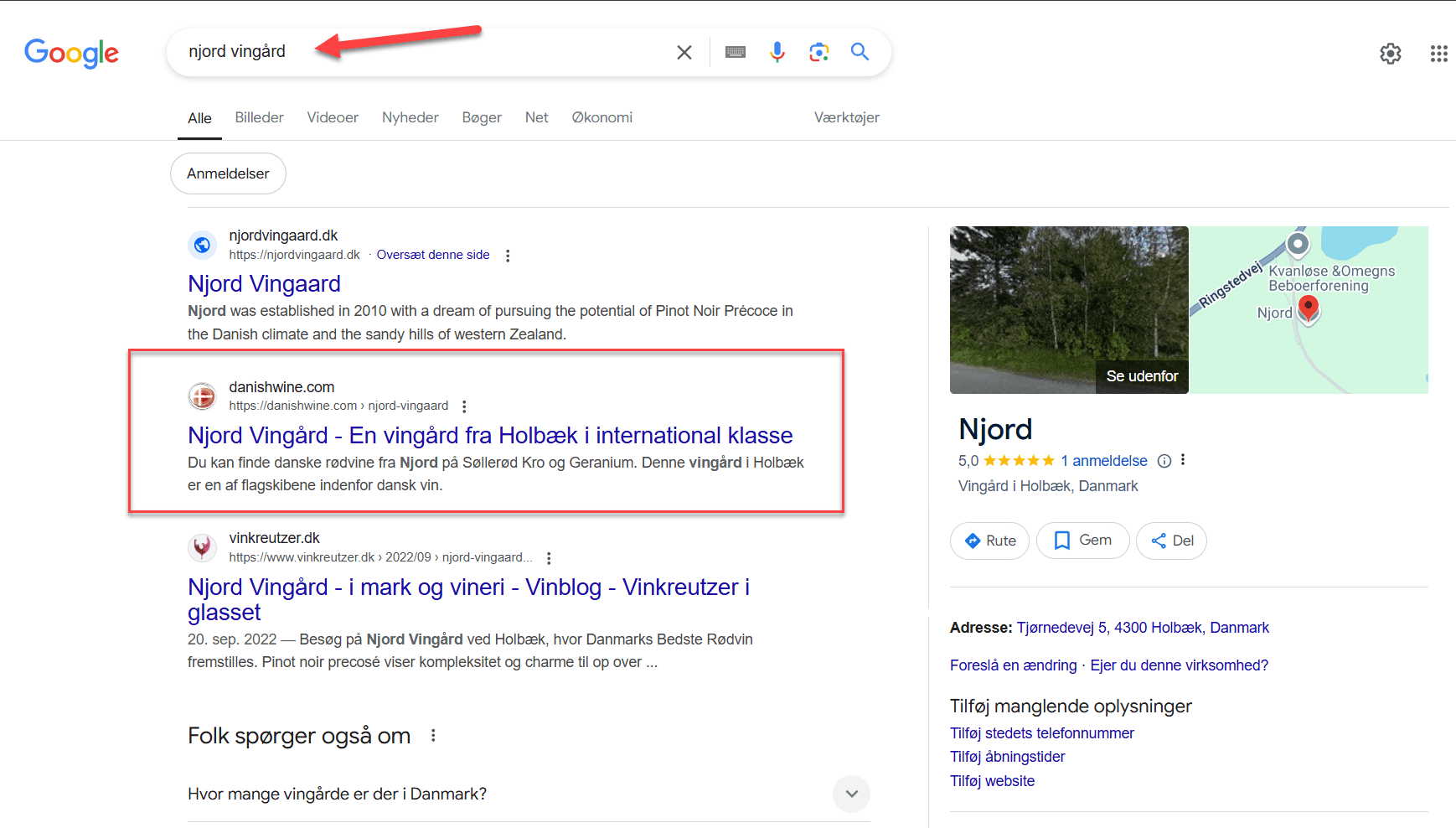
Example of ranking no. 2 just behind the local vineyard
The workflow also enabled one person to produce a breadth and depth of coverage that would normally require a larger research and editorial effort. Transcription did not make the writing instantaneous. It reduced the time spent searching manually through recordings and gave each article a richer starting point than the existing search results.
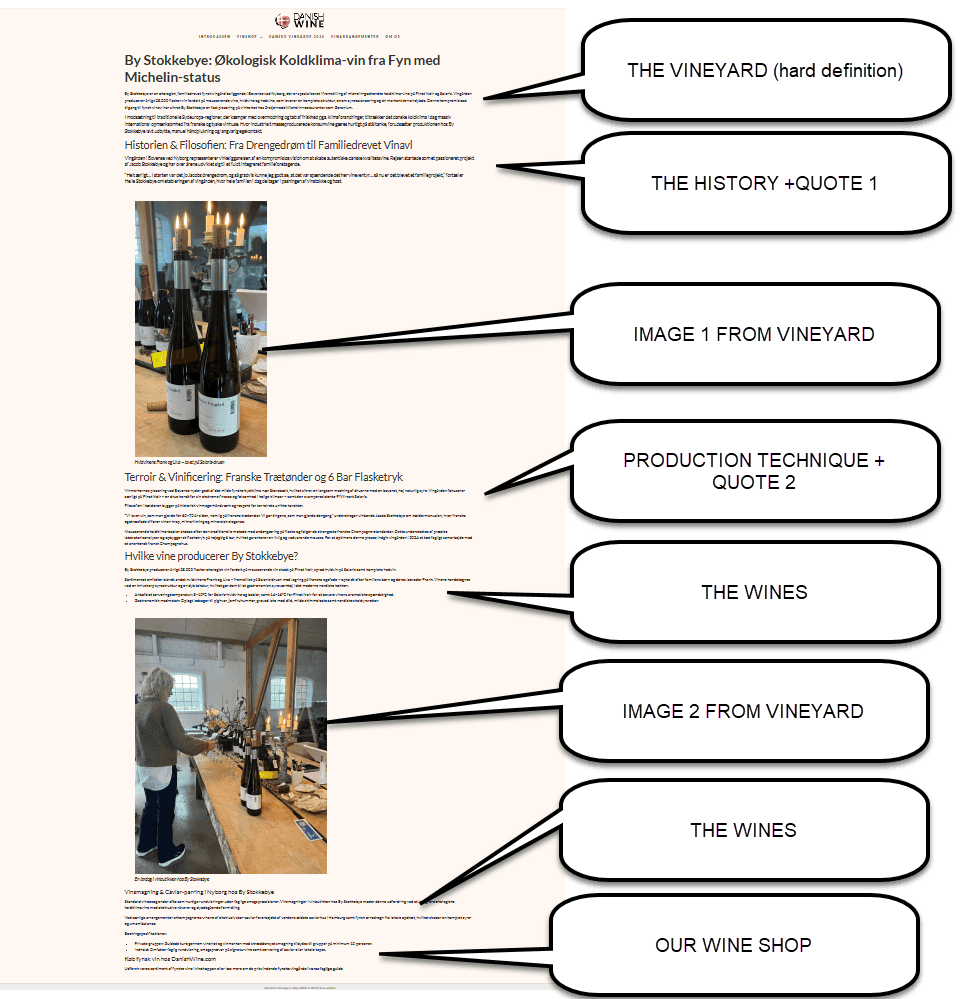
The retrieved insights did not become isolated facts added randomly to an article. I used them to create a consistent structure for every vineyard page on DanishWine.com.
Each page brings together four types of information:
The vineyard: Its history, location, people, production philosophy, and the decisions that make it distinctive.
The winemaker’s perspective: First-hand quotations that add personality, experience, and context to the factual description.
The wines: The grape varieties, production methods, styles, and individual wines produced by the vineyard.
Visits and events: Practical information about tastings, tours, accommodation, and other reasons to visit.
This structure serves different reader intentions on the same page. Someone researching the vineyard can understand its background. A potential customer can discover its wines. A visitor can explore tastings and events. Meanwhile, quotations from the winemaker provide details and perspectives that would rarely appear in a generic directory listing.
The result is not simply a longer vineyard profile. It is a page built around the real entities and decisions that define the vineyard—and the questions a potential customer might have.
I have also observed DanishWine.com being referenced by AI assistants in answers about Danish wine. That is encouraging, but it is not proof that the T-Method caused those references. AI visibility varies by platform, prompt, location, model, and date.
The failure modes matter as much as the workflow
The T-Method is efficient, but it is not set-and-forget automation.
Its main risk is citation integrity: preserving the source, meaning, and limitations of a claim as it moves from speech to transcript, from transcript to semantic map, and from semantic map to published article.
The most common failures are predictable: names and numbers are transcribed incorrectly, claims are attached to the wrong speaker, qualifications disappear during summarisation, opinions become facts, or an LLM fills a gap that was never present in the source.
Those mistakes have a credibility cost even when no search system detects them. They can mislead readers, misrepresent experts, and damage the publisher.
The answer is a human-in-the-loop editorial process. Every consequential claim should be traceable to a source, checked in context, and reviewed according to the risk of the subject. Medical, legal, financial, and safety-related content requires much stronger controls than a vineyard profile.
The prompt is not the system. Traceability and verification are the system.
A practical T-Method workflow
You do not need a complex technology stack. Tools will change; the quality gates should not.
Define the information gap. Identify what existing pages already explain and where readers still lack evidence, experience, comparison, or context.
Find credible conversations. Search podcasts, webinars, YouTube, conference recordings, demonstrations, and other sources featuring identifiable practitioners.
Create the source record. Capture the speaker, role, date, publisher, URL, rights considerations, and relevant topics before processing the material.
Transcribe with traceability. Preserve timestamps and speaker labels wherever the tooling allows it.
Build the semantic map. Use an LLM to extract entities, claims, examples, relationships, uncertainty, and verification requirements.
Map insights to audience needs. Connect the strongest material to real questions and decisions.
Verify and write. Return to the recording, check important facts, add attribution, and create an original narrative for the intended reader.
Connect the content. Use visible copy, internal links, and appropriate structured data to relate people, organisations, places, products, and topics.
Measure the outcome. Track production time, organic visibility, engagement, citations, referral traffic, and conversions separately.
I currently use GeminiNotebook (formerly NotebookLM) to interrogate source collections and ChatGPT as an editorial partner. The division of labour is deliberate: source-grounded tools help retrieve and organise material, while the final article still requires human judgement about evidence, structure, language, and relevance.
Why source-led content is harder to copy
No content strategy is disruption-proof. Search interfaces change. Citation behaviour changes. A platform can increase brand visibility while reducing referral traffic.
But some content assets are more defensible than others.
A generic summary can be reproduced quickly because its sources are available everywhere. An article built from attributable expert observations, original examples, and a coherent content structure is harder to reproduce without returning to the sources and repeating the editorial work.
That does not guarantee a ranking or an AI citation. It gives the content more defensible value than another synthesis of the existing top ten.
The SEO becomes a knowledge retriever
The T-Method changes, where content teams look for expertise and how they move it into a publishable form.
Instead of building every brief exclusively from the pages already ranking, you can retrieve first-hand knowledge from expert conversations, verify it, connect it to audience needs, and give it a useful home on the open web.
That requires more than prompting an LLM. It requires source selection, entity resolution, editorial judgement, attribution, fact-checking, and an understanding of how individual pages contribute to a larger content architecture.
In that sense, the SEO becomes part researcher, part editor, and part knowledge engineer.
So before you commission another article based on the current top ten, ask a different question:
Where is your industry’s best knowledge still trapped in conversation?
That is where the T-Method begins.

Article by
Christopher Hofman Laursen
Christopher Hofman Laursen is an international SEO strategist at HofmanSEO and co-founder of NoCoffee, a collective of independent digital marketing specialists. He helps B2B companies turn customer journey insights into practical SEO and content strategies. An international speaker and trainer, Christopher also created the popular T-METHOD course, which teaches marketers how to turn expert conversations, podcasts, and videos into original content.