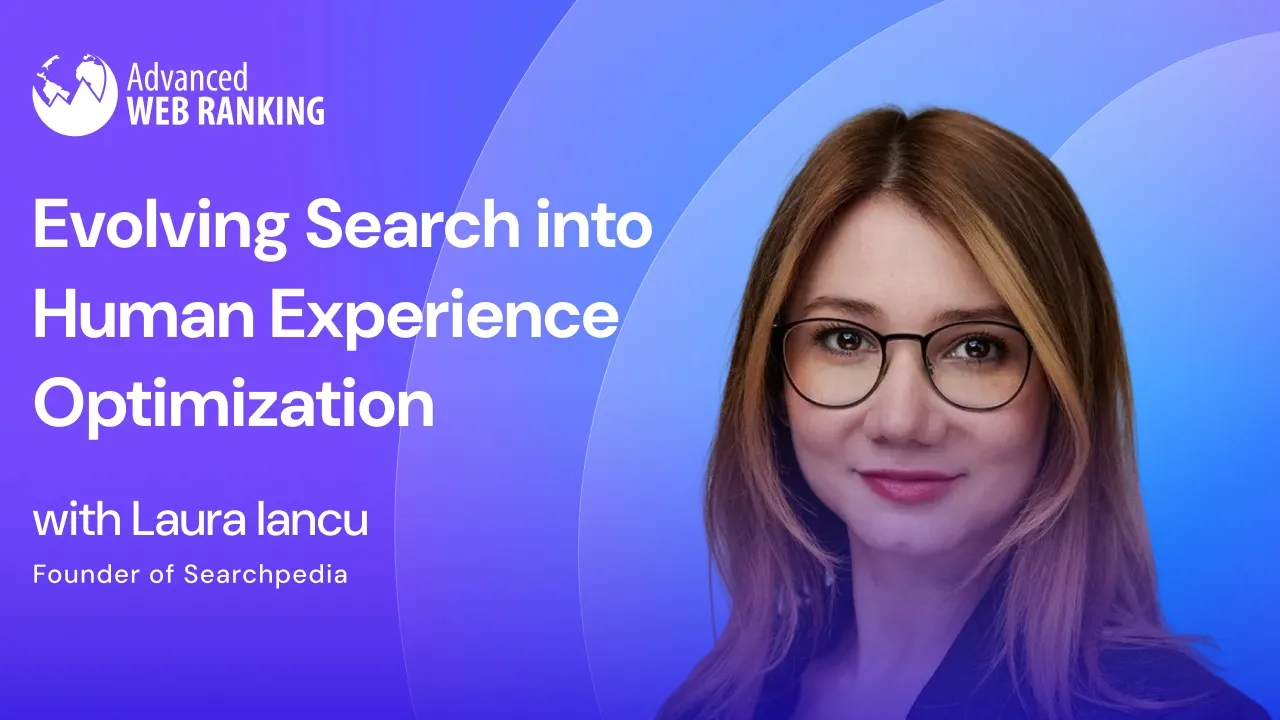
This is The Search Session, and I’m your host, Gianluca Fiorelli. Today I'm joined by Laura Iancu, an international SEO & AI search consultant based in England.
Search visibility now depends on much more than rankings. In this episode, we look at what SXO actually demands from practitioners: a clearer understanding of users, the way they move across platforms, and the signals that help brands become trusted, discoverable, and easy to understand.
From naming and entity building to legal content, community conversations, and LLM visibility, this conversation shows how SEO is becoming more human, more connected, and less tied to a single channel.
What we cover:
How gender inequality in SEO varies: representation is improving, but lived experiences differ widely, and open community conversations reveal problems that not everyone faces directly.
Why SXO means more than visibility: search experience optimization is about designing for real human interaction, not just clicks and conversions.
How to audit a page for SXO: start with the user, not the page; understand how different markets interact with a site, then reduce friction through clear taxonomy, fast load times, and context-aware design.
How entity building strengthens product naming: clear naming, community monitoring, and connected content help users and search engines understand product terms and strengthen brand associations.
Why legal and support content matters more in the LLM era: users can now surface, quote, and challenge terms, policies, and claims more easily, making once-overlooked pages critical for trust and brand accuracy.
How SEO visibility is becoming omnichannel: younger SEOs never saw search as a single channel, and brands now need to show up correctly in ChatGPT and Claude, even though LLM visibility is harder to manage and more volatile.
Why ethics matter: misleading visibility tactics may bring short-term gains, but they compromise trust, reputation, and the real purpose of SXO.
Why technical SEO terms lose meaning: “chunking” and “cosine similarity” are examples of concepts that get repeated out of context, and applying what you actually understand will always serve you better than mimicking others.
Don't miss a conversation that's as wide-ranging as SEO itself has become.
Topics covered: SXO · search experience optimization · SXO auditing · brand naming · entity building · legal and support content · omnichannel visibility · LLM visibility · online reputation · ethics in SEO · content clarity
About the Guest

Laura Iancu
Founder of SearchPedia, SEO Growth Specialist at Octopus Energy
Laura Iancu is a search activist and SEO & AI Search Consultant with over seven years of experience, known for her human-centered approach to search, content, and brand visibility.
Since 2025, she has led SEO Growth at Octopus Energy, a renewable energy supplier and one of the UK’s most recognised green energy brands. Laura is also the founder of SearchPedia, launched in 2023 as an online glossary created to clarify search marketing terminology and make the discipline more accessible.
Alongside her work at Octopus Energy and SearchPedia, Laura is an industry award judge for the European Search Awards 2026, Global Search Awards 2026, and US Search Awards.
Video Chapters
Transcript
Full conversation between Gianluca Fiorelli and Laura Iancu.
Gianluca Fiorelli: Hi, I'm Gianluca Fiorelli, and welcome back to The Search Session. Today we are going to have as a guest the founder of Searchpedia, which seems to be—let's see how it works—a sort of Wikipedia of everything related to SEO.
But obviously, this is not the only occupation this person has. She is also the SEO for Octopus Energy, a company that really scaled a lot in the electric and green energy field, I think also in Spain in the past two years, maybe before.
She's an international search consultant. She is also a judge in the European Search Awards, Global Search Awards, and so on. She recently spent a few days in Portugal to praise and welcome the winners of the European Search Awards.
And she's very, very young. Well, obviously, substantially everybody is younger than me. But she is one of these smart new SEO leaders in our industry you surely want to follow.
This person is Laura. Laura Iancu. Hey, Laura. How are you doing?
Laura Iancu: Hello. I love the fact that you said my name right. It just sounds...
Gianluca Fiorelli: Laura is just Laura for me. It is not Laura, Laura. And Iancu, I mean, off the record, we were discussing her heritage and all the things that can be discovered just trying to understand where a surname is coming from.
When I don't know how to pronounce a name, especially a surname, if I know whether the person is English or American, I try to pronounce it in American English or British English. But in this case, the best is to pronounce it how it is written and eventually be corrected. So I don't invent anything weird.
So how are you doing?
Laura Iancu: I'm good. Really good. I was just telling you before we started recording that I had a bit of a birthday party last night. Not for me. So yes, a bit of daytime drinking and all that. Feeling a bit heavy today, but other than that, I am ready to go. Hot in the UK, which isn't something that we're used to very much, so yes.
I honestly miss Porto at this point. You just mentioned I've been to Porto. Yes, I've been to Porto, and it was actually nicer than here temperature-wise, which is a bit strange because it's normally the other way around.
Gianluca Fiorelli: Well, what I think of it is because it's north of Portugal, it's close to the Atlantic, it's substantially on the Atlantic, and so the wind tends to be quite fresh.
And surely, from photos I've seen shared, the people who tried to have a bath in the ocean clearly understood why it is not a good idea to have a bath in the ocean, even if it's May, which is still too cold.
Laura Iancu: I did. I actually did. I didn't post a picture, but I did.
AI Fatigue and the Challenge of Keeping Up
Gianluca Fiorelli: Okay. So, coming to our conversation, let's do it with the classic question. How is SEO treating you lately?
Laura Iancu: Well, I would say compared to when I started, which would have been around now, seven years ago, almost, yes, I think it's treating me better.
I think we've built sort of an environment for everyone to have a say and express an opinion without judgment. And I feel like it's been easier to communicate, even though sometimes I perhaps had my doubts, right, on what I'm communicating or perhaps not having the full conversation.
I just felt it was easier and a bit reassuring to ask the questions and reach out to people. So I feel like it's been treating me way better lately from this perspective.
Whereas on the other side, with everything that's coming our way, right, from big corporations, big tech corporations releasing so many things at the same time, because obviously the age of AI and all that, I did feel a bit perhaps fatigued, if that's the word. Excited, but also a bit fatigued. So yes, I'm being really honest here.
Gianluca Fiorelli: Yes. I mean, I felt overwhelmed a few times because of all this flood of new information, and obviously, many times it's very difficult to just stay behind all the information.
And when you think you have finally grasped some news, some intelligence from all that we share, it comes back. I don't know, a new model is coming out, a new interface is coming out, and then you have to say, okay, so what is going to change?
And then there is still all the classic stuff. I mean, core updates didn't stop running. The spam updates are running even more. And so all the classic things that we knew and are used to are still there and are still very, very important.
So we cannot just forget one thing because there is this new thing, and finally, we have just 24 hours, and some of them should be left for sleeping, and at least another few hours for having a life outside of work. And personally, I'm of the kind that when I'm not working, I don't want to think about work.
So in this sense, yes, it's true, it can be overwhelming. Everything is happening, especially in the past two years.
And you were saying that, especially in the beginning, this is probably something I can relate to. Even if, sorry to say this because it is something that I wouldn't like to say, you also have the condition that you are a woman in SEO. So there are even more problems that we know are relics that still sometimes don't want to go away from the past.
But I can relate to the fact that maybe in the beginning, you were feeling, somehow or not, intimidated by the people.
Laura Iancu: Yes, it's a good word.
Gianluca Fiorelli: I mean, it was somehow also the same for me, more because I was not an SEO coming from the information technology field.
I spent more than 10 years working on television and in the movie industry. So let's say more on the marketing and content side. And yes, it was intimidating, especially in my early years, to confront myself with more technical SEO.
And I think that maybe we are lucky because, despite all the exceptions, our communities, the SEO community, the search community in general, are maybe one of the most welcoming communities.
And I think that you lived it, and you found the solution to this kind of problem you maybe had in the beginning, embracing the community and, let's call it, doing a sort of a taxonomy, the sub-community, the sub-community like Women in Tech, and so on.
Laura Iancu: Yes.
Diversity and Gender Dynamics in the Tech Community
Gianluca Fiorelli: So, do you feel that this sort of relic about how women are considered inside our industry is maybe slowly but definitely changing or not?
Laura Iancu: Yes, it's a very good question, and from my own experience, I wouldn't necessarily say that I felt a sex difference when I started in it, because my previous job was as a web designer and developer, so I was already kind of in an environment that was male-dominated.
So I didn't necessarily feel, "Oh, I've moved to a new environment where, you know, it is a bit different." It didn't necessarily feel different. And I had good experiences. I've always worked with really friendly people, and I think almost educators, if you want to call them that way. Intelligent people, educators.
Yes, I have had the experience of working with someone who wasn't necessarily a nice person. But I don't necessarily report it to it. I choose to look at the nice bit and what I've learned from it.
And yes, I understand the need to talk the talk and address the elephant in the room when it comes to this inequality between the sexes, in a tech environment dominated, regardless of whether it's SEO or software development or whatever you want to call it.
But I personally didn't feel it that way. I was made more aware of it when I became part of these communities. And read others' experiences and realized that I've perhaps been a tad lucky. So yes, I wouldn't know how to reply to you, to be 100% transparent, and say now, "Yes, I feel things are getting better," because I don't feel that way.
I feel that, yes, there's more talk around it, more awareness around it. I feel like when I go to a conference, I see an equal part, I guess. You've got males, females, and different genders. There's a mix, right? So I feel like it's more visible.
But I don't know how it's treated inside it because I don't have first-hand experience, so I can only give you a bit of a meh answer, and I don't want to do that.
From others' experiences and from what I see in chats and the talks I've been to and all that, it does seem to be the case that it is getting better. So hopefully that's the direction we're going towards.
Gianluca Fiorelli: Let's hope so.
From Web Design to Search Experience Optimization (SXO)
Gianluca Fiorelli: And you were saying that previously, before doing SEO, you were working as a web designer, right?
So here comes my second question. Is this experience you have as a web designer what makes you focus so much on the connection between SEO and user experience? I don't want to use the acronym because, for me, as an Italian living...
Laura Iancu: I know what it means.
Gianluca Fiorelli: Yes, talking about SXO is weird. But in fact, as I was also saying to Celeste Gonzalez in a previous episode, for me, search experience optimization was just another alternative acronym for SEO. So, a definition of SEO.
In fact, Matt Cutts was using SEO as search experience optimization. And my website, I Love SEO, in the older logo, had a tagline with "search experience optimization," and nobody was already still talking about SXO in that sense.
So, is this experience you had that made you see the importance of the connection between SEO and UX?
Laura Iancu: I suppose. I wouldn't say it's the only thing. I say it goes even back to my background in the humanities.
I'm someone who loves people. I've always been a bit of a... Yes, I welcome people. If you know me, you instantly know what I'm talking about. It's very easy for me to get people around me, talk to them, and, actually, listen. I listen a lot. I like to listen to people.
And again, it's probably back to how my grandmother raised me, who was an amazing woman, and it's kind of ingrained this quality in me. And I don't see it as something that I need to try. It just comes naturally, and it translates into the digital experience; it really does, because I do care about how people interact with things.
And I feel like, yes, you're absolutely right. Web design and, I suppose, web development really were the first kind of introduction to being able to influence that directly. And having that satisfaction a bit, you know, that it's working, that it's making a difference—that kind of thing. It's saving people time. It makes people smile. It's a nice color that will make someone smile on a bad day or whatever.
Or, you know, when the Flash little games started, and I remember back in the day, oh my days, it was so fun because people used to interact with them. I know now they see them as a bit cringe and all that, but when it started, it was fun. Like, people were buying it. It was something that was very nice to interact with.
But yes, I would say that probably this experience really helped me shape a bit how I think about SEO, and I completely agree with what you said about SEO being search experience optimization, because that's what we do.
Yes, it is about making things visible, so I understand; obviously, it starts from a different place, right? But in the end, that's the goal: making it not just visible and searchable but nice to interact with and to sort of get to those goals, right? Not just the goals that we track in Google Analytics, right? Clicks, bounce rates, and conversions—not just those, but to make someone's experience a nice experience. That's literally it.
Gianluca Fiorelli: Yes, and well, in my own definition, it was also not just a nice experience but a useful experience. In this sense, our work has always been something where we are improving the visibility of a client's website for a search term that people are looking for. Before, with classic two- to three-word keywords, and now more with conversational search.
But there is always a pain point, which may be just curiosity, not necessarily a pain point in literal terms. But our purpose has always been to make the search experience people have useful, and that my client is also useful, obviously. Let's say we pretend that we are useful, so we are trying to make this discoverable, indexable, visible, et cetera, et cetera.
And then, on the website, trying to make these things that nudge people to click on our search results to be satisfied by what they are experiencing as content, text, video, form, application, and so on and so on. So this was more about the usefulness of the search experience, not just making people feel good. I mean, obviously, if it's useful, you are feeling good.
But now that SXO, search experience optimization, is receiving the correct attention that it should, probably what it always deserved, what are the things that you usually...
Let's say you are working on the site, on Octopus, for example. Octopus can be a good example because it's the kind of website where the useful purpose, the beneficial purpose, is the main purpose. If I want to land on Octopus, maybe I want to see a good explanation of how it works because we know that electric companies sometimes are very hard to understand in terms of terminology, in how all the tariffs, for instance, are built, and so on and so on.
Laura Iancu: Correct.
Auditing a Page for SXO Across Global Markets
Gianluca Fiorelli: When you are looking as an SEO who knows well how important user experience is for having those kinds of user engagement signals that we know are so important for SEO too, what are the first things that you open a page and say, "Okay, let's see this, this, this, and this one can be considered after"?
Laura Iancu: Yes. That's a very good question, and I love that you refer to Octopus Energy because I work with this client on three different continents and seven different markets, so different cultures at the end of the day.
So I will give you a response that you probably don't necessarily expect, which is: start with a bit of market research before and see how users interact with it before you start thinking, "What could go wrong?" or "What is amazing?"
Because it's so different, right? If I compare how a user interacts here in the UK and the pain points and the urgency that they have, for example, with an energy webpage, right? If they want to change, for example, switch a tariff, or they are just in the research phase and all that, there are so many steps and so many avenues that they can take in that sense before you actually think, "What is good and what is bad?"
But for the purpose of this, I'll keep it simple, just because obviously we won't have time to go through millions of cultures and markets and how they interact with it.
And let's just say that the main goal would be, first, to build awareness around tariff naming, right? Because that could be quite confusing for people. You've got so many tariffs. Obviously, you've got the fixed, then you've got the variable tariffs, which are normally the regular ones that people will know about.
But then you have so many brand names and so many taxonomies, and it's getting really, really overwhelming, I think, for people.
And I think the first thing that I would advise to someone who is thinking, "I'm going to design something like this," is to understand how users understand the naming conventions. Look at the taxonomy, see where they pop on the page, and see how relevant they are and if it's confusing or not.
And funnily enough, this is something that was one of my first projects I worked on with Octopus because the namings were so similar that it was so difficult for people to understand and separate what they were looking for.
And then obviously, if you land on the website and you can't find what you're looking for, you become confused, and then that experience that we're on about, so forget about usability and functionality, that experience becomes frustrating, and you might just bounce and go look for a competitor. So that's a lead that you're pretty much losing there.
The answer, to keep it short and sort of sum it up, is that it depends on the market that you're looking at. It really depends on that.
Second of all, the first thing I'm thinking about when I'm looking at these things is: how do I avoid frustration? So that can come from PageSpeed Insights and all that, to actual product naming and segments on your website that are very hard to discover.
And the third one would be to kind of look at it as an overall and think about: how do I prevent a user from bouncing, from pogo-sticking, from getting them on and then back on Google?
So I guess it's less about best practices, I think. It's more about common sense. That's the first thing. It's instinct. It's a lot of gut instinct, and it's a lot of how I interact with it and knowing about the user before actually starting looking at the page.
More on SXO with Celeste Gonzalez
Continue the conversation with Celeste Gonzalez, where she and Gianluca Fiorelli explore how SXO connects rankings, user behavior, and real business outcomes in local search. From UX signals and testing to making every click count.
Brands, Knowledge Graphs, and Proprietary Terms
Gianluca Fiorelli: It's interesting that you talk about the naming. We could dig a lot into the topic because naming is substantially branding many times, and branding is substantially being able to create a knowledge graph for your brand, so that, in this case, Google, but also the other agents like ChatGPT, OpenAI, Anthropic, etc., can associate your brand name.
Usually, when people talk about a brand, I think they forget that a brand is not just the name of a company or the name of a product. A brand name for Nike is also "Jordan," you know, the sneakers. And so, how to make sure that when someone is searching for "Jordan," Google understands that you are the owner of the term "Jordan" related to sneakers because they are produced by me, and I am Nike. So I think this is sometimes a problem that people forget about. And this is why I often insist on discussing knowledge graphs for brands.
Now my age is coming out, but quite a few years ago, there was a good definition for using naming for SEO. For instance, when I was collaborating as a global associate for Moz, which was SEOmoz, we at Moz were experimenting a lot with the naming.
Let’s take a generic name, "whiteboard," for example. The old classic Rand Fishkin Whiteboard Friday. The naming was coming along so that people would start associating the naming with the thing behind the naming. And then people do that kind of brand search that you want Google to understand and record, and make it the other way around, from searching the brand naming. We were calling it a "prop word," which was a proprietary word.
So for searching the naming, for instance, in your case of Octopus, it could be a specific tariff name. If you're searching for this, then you are probably searching for an energy tariff. And if you are searching for an energy tariff, we are going to present you with the page with the tariff name. Are you also working in this sense?
Laura Iancu: Yes, of course. If we're talking specifically technical, yes, of course. I feel like entity building and entity reporting at this point, and product naming in general, should be part of your report hygiene. You need to know where they're served, the pages, the main page, the pillar pages, if you like, that are the most relevant.
Even the ones that people are currently serving on forum-based platforms like Reddit, for example, which is something that I've started working on a while back, actually, just to see if people connect it right in that sense.
So I'm not just relying on schemas and building knowledge graphs. I'm also relying on the additional content that I'm sending out there and how I connect it back to the mothership, if you'd like.
And obviously, we're very clear in our communications, in our press releases, if something's happening in that sense. We're trying to make it as simple as possible for the user before we're thinking, "Search engines might be confused."
Because it's not necessarily straightforward, but I think it's easier to implement these things for search engines than it is for users, you know? So I feel like the priority is to make the user understand better than the search engine what they're looking at.
Because, as I said, they'll be going on Reddit, they'll be speaking to their friends, they'll be communicating in their WhatsApp groups about it, and so on.
It's such a strong and huge community around these things that, yes, that's my main priority.
So I've discovered this new tool. I don't know if you do shout-outs for tools on your channel, so I'm not going to mention it just in case. But I've got a tool that I've been using for, I think, half a year now, where I'm actually analyzing everything that's going on daily on Reddit, on these namings and...
Gianluca Fiorelli: Oh, you can cite it, it's not a problem. Even if Advanced Web Ranking is our home for this video podcast, we have no problem. You can cite it. What tool is it? I'm curious.
Laura Iancu: It's Brand Radar. I've been using it for this purpose quite a lot. And I feel like, if perhaps a year ago there was still a bit of confusion around the naming, the terms, I feel like it's been way better. I don't necessarily see that negative sentiment that's associated with it.
Obviously, it's forum-based, so there's always going to be negative sentiment around certain topics. But yes, when it comes to the confusion that used to be present, that's diminished. That's completely diminished.
And yes, of course, I'm not going to say which one, technical or community-based, is more important.
Gianluca Fiorelli: I think that they are clearly connected. They are. I mean, for instance, when I say, "Well, we must communicate to the bots a better organization schema," obviously, it is also because this kind of information should surface to the public, for instance. And this is important. Maybe in some cases it is also a legal obligation. At least in Europe, you have to put in the footer all the classic company registration numbers and all these kinds of things that are less important for the user.
The Unexpected SEO Value of Legal and Policy Pages
Gianluca Fiorelli: But what I've seen now, for instance, is that there are certain types of content that we usually did not ever pay attention to, like the legal terms.
Laura Iancu: Yes.
Gianluca Fiorelli: Especially the LLMs, they are using them a lot because they are food for information for them, very specific information.
Especially, for instance, in e-commerce, a well-written shipping and return policy, which is something that, as SEOs before, we were probably telling our clients and companies, "Okay, we need this page because Merchant Center pretends it."
Laura Iancu: Yes.
Gianluca Fiorelli: But we really didn't care what was written.
Laura Iancu: No.
Gianluca Fiorelli: Apart from that, eventually, on the product page, yes, you have to put this kind of information because of rich results.
But now we must pay attention, also as SEOs, to what is actually written in those pages because they pop up like zombies into the LLM answer. And if what you have written doesn't correspond to what you are doing or what you are also saying in other pages, like the product pages...
Laura Iancu: Yes.
Gianluca Fiorelli: I've seen this kind of antithetical information offered by a website; you are going to have a problem because then the client is going to tell you, “You are very responsible for what is said by the LLM.”
Apart from that, our responsibility is also when a company is giving wrong information, incorrect information, so we must also take care of these kinds of things.
Laura Iancu: Absolutely. And I love that you gave this example because it isn't something that people necessarily think about.
As you said, it used to be something done once and updated by, I don't even know, maybe updated once in a while to kind of look over the claims and see they’re still legally sound.
So yes, that was kind of funny. But you're absolutely right. I feel like nowadays, because it's so easy to resume something or find little pieces of information in docs, like millions of pages of terms and conditions and privacy policies and all that, people feel more empowered, I think, to just use it with LLMs.
I feel like they give the regular folk this sort of invisible power to start speaking legalese and kind of understand their rights a bit better and quote it, as you said, for things like return policies or exchanges or consumer law-type things. I feel like you're absolutely right.
I've been very, very careful, to be fair, having claims explained properly, and we've always had a team. I've always worked with a team, right? It was never like an SEO job. To be fair, most of the time, they don't even bother to index these pages. They're just there.
So you're not thinking about it from an SEO perspective. I don't necessarily think about it that way. But you're absolutely right. Since we started mainstreaming LLM use, like ChatGPT, Claude, and so on, they've become a bit more powerful.
And I'm going to go back to Reddit just because, funnily enough, when I've extracted a list of URLs that are most commonly cited in Reddit for Octopus specifically, its terms and conditions were up there. So I was like, "Interesting. Okay, maybe it's time to revisit."
Gianluca Fiorelli: Yes, because obviously, these are the pages people who want to complain about or even sue a company are the first ones they are going to search or ask any information about.
Omnichannel Search and the Future of Brand Visibility
Gianluca Fiorelli: And you were talking about Reddit, but you were also talking about press releases, so appearing on a third-party website. And obviously, you have been doing SEO for seven years, but how much have you seen the importance, as an SEO, of thinking omnichannel rather than just the classic website and search?
Laura Iancu: I am part of the generation that was very heavily influenced and present on social media, I think, and YouTube, specifically YouTube. I think YouTube was quite a big thing for us. It still is, but back in the day, it was wow, you know?
And I'll tell you something which I don't know if you heard before, but even seven, eight years ago, probably even way back, my generation specifically started using YouTube as a bit of a search engine.
So we had that kind of experience of, "Wait a second. Google isn't... Bing isn't... Yandex and so on, DuckDuckGo."
I've always thought about it from that perspective. I want to be here, but I also want to be here. So I'd say that, in simple terms, that was the first insight of actually, "Wait a second, I'm not thinking I want to make my blog or whatever visible on Google only. I want it to be reinforced. I want a third-party. I want people to find me everywhere."
So I'd say I've always thought about it from this perspective. I don't think I've ever seen it as a singular channel. I've never had that. I think perhaps maybe generations before me. I honestly don't know how to respond to this, but I've never seen it as a singular thing.
Gianluca Fiorelli: Yes. And now, maybe not you as a person, but as an SEO who is asked to do things. For instance, in seven years, have you seen more clients in general asking you to focus also on channels that are not the classic search channels?
And now, for me, the classic search channels are not just Google and Bing or Yandex or Baidu or Naver, but classic search is also becoming the LLMs with chatbots.
So I was thinking, have you seen these clients asking you, and not eventually talking only to very vertical marketers or social media marketers, to pay attention and contribute to the success of the company's visibility, not only on YouTube, but it can be TikTok, it can be Instagram, which is a little more complicated, but then obviously Reddit, specific forums, not just Reddit, even if everybody's concentrating on Reddit because of the volume of Reddit, et cetera, et cetera?
Laura Iancu: Yes, absolutely. I mean, the proof is in the pudding. Everyone's talking about it and has been for a while now.
And I feel like, if we separate the classic channels, and then obviously social media and all that, which has been present for quite a while, I think most brands know where they want to be present already. They know, "We've got a community of 10,000 followers on TikTok, so we want to be present there," and so on.
So apart from that side, which has been happening for a while, you're absolutely right to point out that the whole LLM phase and craze has sort of penetrated in that sense.
I think it also made SEO individuals and professionals, regardless of whether you work with clients or in a company, a bit more visible in that sense. Because now they're thinking, "We use ChatGPT every day or Claude because it's mainstream now, so we want to be seen there, and we want to be seen correctly."
And I think that's where it starts getting a bit messy because you can't necessarily control the entire amount of information that goes into these platforms.
With social media and community management and all that, it's easy to manage, right? If you've got the right team and the right practice behind it, you can easily make it happen and portray the right brand guidelines and values and everything else.
Whereas with these platforms, I think it's challenging to say the least. Because yes, it's very volatile. It's not entity building as we know it. It's not brand guidelines as we know them, at least at the moment.
I don't know how we're going to get there specifically, and how fast we're going to get there to be able to control these platforms in that sense. But I'm also saying to myself that perhaps we don't need to. I don't know.
Gianluca Fiorelli: No, I think that for the moment, in this moment of our professional life, the most important thing is making LLMs talk about us as a brand with the correct information.
Laura Iancu: That's it. Yes.
Gianluca Fiorelli: And this is probably the urgent priority, not only because LLMs substantially use everything published since the start of the web for the training data, so they can surface, as if it were yesterday's news, something written 20 years ago.
Laura Iancu: Yes.
Gianluca Fiorelli: So in this case, I think that we should first treat LLMs as a huge, renovated online reputation management task. And then, when that thing is fine—and this kind of job never ends—then really sincerely start to be visible for the kind of answer we want to be visible for.
That's why I don't want to enter the polemic of prompt tracking, because I am very skeptical, if not for very specific kinds of things, about prompt tracking, but to rediscover something called marketing.
So, a deep audience analysis first. Starting from there, going forward, are we really talking to our audience, to our buyer persona? And from there, are our competitors talking to the same buyer persona better than us?
And so, starting from there, reviewing the content. This is also making our content speak a better language for this kind of buyer persona.
This is going to be eventually mimicked by the LLM when answering those kinds of buyer personas because we are not faking a language that we are not using, but using the language that we are using. And this is, for me, the correct way to work. But online reputation goes first.
Can AI-Powered PR and Outreach Go Too Far?
Gianluca Fiorelli: And talking about online reputation, the concept of E-E-A-T is also substantially related to online reputation. And this time, I won't cite vendors, but we recently saw a vendor selling something like an agent able to scout the web, find opportunities, contact the website, ask for inclusion, negotiate the payment for the inclusion, and send an optimized chunk for being mentioned on the website.
So, where is the limit? Because we know that our brand being mentioned on a site is valued a lot. Once, it was just links, so it was a little bit difficult to... I mean, we could buy links. We all did that. Whoever is denying it may not be telling the truth.
But we know that now it's easier because a mention is just a mention. It's not that hard to ask for a mention. And it's hard to talk about ethics in our work, but how much should we be ethical in the sense, okay, you talked before about search experience optimization. How can you justify a search experience optimization giving false information just because you bought it?
Laura Iancu: That's a very tough question, and you're right. I think that's where the limit is. I think if you have to lie to grab attention or sell something, that's something that, for me, is...again, my humanity side. That's something that I will plainly say no to.
And this is something that I recently spoke about with a few people in our industry who are making really good bucks, right? They've been able to keep working ethically and make quite a bit of money.
Whereas someone like me... I call myself a search activist in the sense that if I don't believe in your product, if I don't believe in something, and I feel like you're selling something that's not necessarily aligned with what I believe… Not the whole world; just speaking from my perspective, if I believe it to be a bit iffy or dodgy, I'm going to say no.
And we were joking about it because, like, "Oh, you're never going to get rich." And I'm like, do you know what? I'm comfortable. As long as I feel like I'm caring for the topic that I work for, and I don't create it into something that I love now but I'm going to end up despising later, I'm fine with not being rich.
So that is the most diplomatic answer that I can give you from this perspective. It's not something that I condone. I'm not going to judge other people for doing so because that's part of the person I am.
If that's something that you can do and completely detach yourself from and go live your own happy life and feel like, "Cool, fine!” good for you. I know myself; I wouldn't be able to go to sleep at night.
And I love the industry that I work in. It's one of the only industries that has tickled my brain in the right way for all these years, and I never got bored. I'm neurodivergent, so that for me was kind of like ticking all the boxes. And I wouldn't want to risk soiling it in my eyes by doing something that I don't necessarily relate to or vibe with, if you want to use more Gen Z language.
Gianluca Fiorelli: No problem. No problem.
The Great Misunderstanding of Content Chunking
Gianluca Fiorelli: And talking about your past studies in humanities, maybe the answer can lie in there. What do so many people misunderstand about what a chunk actually is?
Laura Iancu: God. They took it literally.
Gianluca Fiorelli: Yes.
Laura Iancu: Yes, they took it literally. That's what happened. "Oh, chunk. We're going to chunk." No? I think that's what they understood from the whole thing.
They're going to remain obsessed with it until something new comes up, I feel. And then perhaps interpret or misinterpret the same terms and propagate them in the sense that it's just losing their meaning.
And it's okay. Not all of us have to understand these things, and I feel like that's where people should be a bit more permissive with themselves, right? You don't have to understand the mathematics around it. You don't have to be a software engineer or a computer engineer to do this job. Just do what you know you can do professionally and efficiently.
You don't have to sound like 10 people you follow on LinkedIn just to sound smart. Because at the end of the day, that's not going to help you, and it's not going to help your product or the client that you work with if you're trying to impress or implement something you don't understand to begin with. So yes, it's just as simple as that.
We're different brains, and it's amazing. There's such a multitude of brains out there. We don't need to be copy-paste, and it doesn't mean that if you don't understand something, you're less than it. No, you've got your thing. Go do that thing.
You don't have to sound mathematical. I've seen people doing the same when the cosine similarity started popping up, and everyone's like, "What?" And it's so simple if you break it down, if you literally just look at the word and what it means, and then you put it in context.
You can easily understand what it can mean in a search context. But people just thought, "Oh, someone said that, so it must be true, so I'm going to go and run with this idea until it loses all its meaning."
Gianluca Fiorelli: Yes, for instance, in the case of chunking, people didn't understand that it doesn't mean that you have to start writing as if you were, I don't know, Hemingway or Bret Easton Ellis, who were writing their novels with very short, one- or two-line paragraphs. Or even worse, creating articles that are substantially a sequence of pointed lists.
Laura Iancu: Yes, I remember that.
Gianluca Fiorelli: But it is just about clarity, how you structure the content in a way that is clear and understandable for the human reader, the person who has to experience your content, and clear enough and unambiguous for, in this case, an LLM to understand that that phrase is referring to this thing and just this thing.
And then you have to create the connection. People were just thinking about the second thing, the clarity for the bot, but forgetting something, which is the connecting phrase, connecting the blocks, and totally forgetting the concept of narrative.
Laura Iancu: Yes. Oh, I love that you said that. The concept of narrative, the flow. That's exactly it. Yes.
Gianluca Fiorelli: And for cosine similarity, you have to understand that this is a mathematical representation because blah, blah, blah. But I don't care. I mean, I care about how I can use it to understand if my content is aligned with what other people are saying about the same topic, and what eventually the AI answers are already saying about a topic.
And to see if I'm close or, if I'm too close, I'm a commodity. And so I'm not going to be used. I'm not going to be cited, and I'm not going even to appear in a classic search result. Or if I'm too distant, so I'm not going to be cited because I'm too contrarian. So, I use the cosine similarity to find the balance.
I'm not using it for checking things like if this phrase is not here... I don't want to use a curse word, but I think you understood what kind of thoughts these are.
Chunking Explained: More Expert Perspectives
Ian Lurie - Chunking, Passage Ranking & Writing for Humans
Jes Scholz - Chunks vs. Cohesive Content
Shelley Walsh - Chunking & Writing for LLMs
Mike King - Chunkable and Multimodal Content Strategy
Beyond Search: Getting to Know Laura Iancu
Gianluca Fiorelli: Okay. Almost one hour, so let's stop talking about search. I want to talk about you. Yes, I want to know something about you.
It's something that we already talked about before starting this episode, off the record. I asked you about your surname, and you told me that you are, let's say, a wonderful mix of Romanian, Bulgarian, and Hungarian, if I'm correct.
Laura Iancu: A bit, but yes.
Gianluca Fiorelli: You're a Balkan melting pot, probably.
Laura Iancu: Yes.
Gianluca Fiorelli: So let's do this game. If you have to, let's say, look at your chromosomes and say, "I am part of this, or part of this, part of this," of all this heritage, what do you think are the things that make you connect with heritage if you think of this heritage?
Laura Iancu: Oh. I suppose the people. I myself, I feel that I am Romanian, right? I feel that because I was born there, I've got the citizenship of Romania, and I mainly grew up around the Romanian language and culture. To me, that's my core.
The people I love the most and the formative years of my life were surrounded by many cultures, though. So I would have Hungarians on my side of the family. I'd have Bulgarian heritage. I even had Moldavian, right? So I feel like it's hard to pinpoint me as a person in that sense. I feel like I'm the sum of everything.
Gianluca Fiorelli: For instance, what could be a Hungarian trait of Laura Iancu?
Laura Iancu: O, okay. So I think that my Hungarian trait is... And it's probably not right, but that's how I see it, my passion for metal music, for example.
Gianluca Fiorelli: Okay.
Laura Iancu: Yes. Because I was born in 1989, when Romania was still a communist country and sort of cut off from the West. And my family was lucky enough, because of the Hungarian part of the family, to receive different videotapes, posters, magazines, and stuff like that from Hungary, right?
So I grew up with the likes of Led Zeppelin, Black Sabbath, and Iron Maiden. By the way, this was not intentional. This is my lounge T-shirt. I feel like, for me, that's what I associate with Hungary. Also, some types of food that I like to eat from there. It's just a mix.
And I feel like all of us, especially in the age of globalization, with us traveling more and all that, adapt certain traits from the cultures that we interact with. I lived in China, for example, for a year and a half.
Gianluca Fiorelli: Oh, I didn't know.
Laura Iancu: Yes. I taught at the university there. I worked with adults. I had to adapt courses for software engineers and for network engineers. Teach these classes in English, even though I'm not a software engineer, am I?
The fact that I've been there in that kind of interactive environment with these cultures that, for me, felt like home, you know? I've got things from them as well. I've got the whole, I suppose, thinking strategically sometimes about what I'm going to say, quieting my brain a bit.
This is something that I've managed to get from the Chinese culture, for example. Something that, for my neurospicy brain, was a no. It was like, blah, blah, you know? I was that kind of person, and I still am at the core. But they taught me so much patience and respect.
Same here in England, right? The banter, the humor, it's just a mix of things.
But thanks for asking this question. I don't think anyone ever asked me this question.
Gianluca Fiorelli: Well, I have this kind of curiosity about people because I think that everything in our past, even the past of our past, in the sense of the life of our parents, substantially makes us who we are.
So this is, for me, the best way to understand, also because I'm a history buff, the best way to know who a person really is.
And I'm grateful you shared this information with us here in The Search Session, and also all the discussion and conversation we had until now.
Laura, surely we are going to meet up in real life sooner or later, in one of the many conferences that are popping up in Europe. And until then, I wish you a wonderful, wonderful, and maybe not so hot summer.
Laura Iancu: Thank you very much. Likewise, Gianluca.
Gianluca Fiorelli: Okay. And about you, dear friends, remember to subscribe to the channel and to give this episode a like, because it surely deserves a like. Thank you, and see you next time. Bye-bye.

Podcast Host
Gianluca Fiorelli
With almost 20 years of experience in web marketing, Gianluca Fiorelli is a Strategic and International SEO Consultant who helps businesses improve their visibility and performance on organic search. Gianluca collaborated with clients from various industries and regions, such as Glassdoor, Idealista, Rastreator.com, Outsystems, Chess.com, SIXT Ride, Vegetables by Bayer, Visit California, Gamepix, James Edition and many others.
A very active member of the SEO community, Gianluca daily shares his insights and best practices on SEO, content, Search marketing strategy and the evolution of Search on social media channels such as X, Bluesky and LinkedIn and through the blog on his website: IloveSEO.net.