


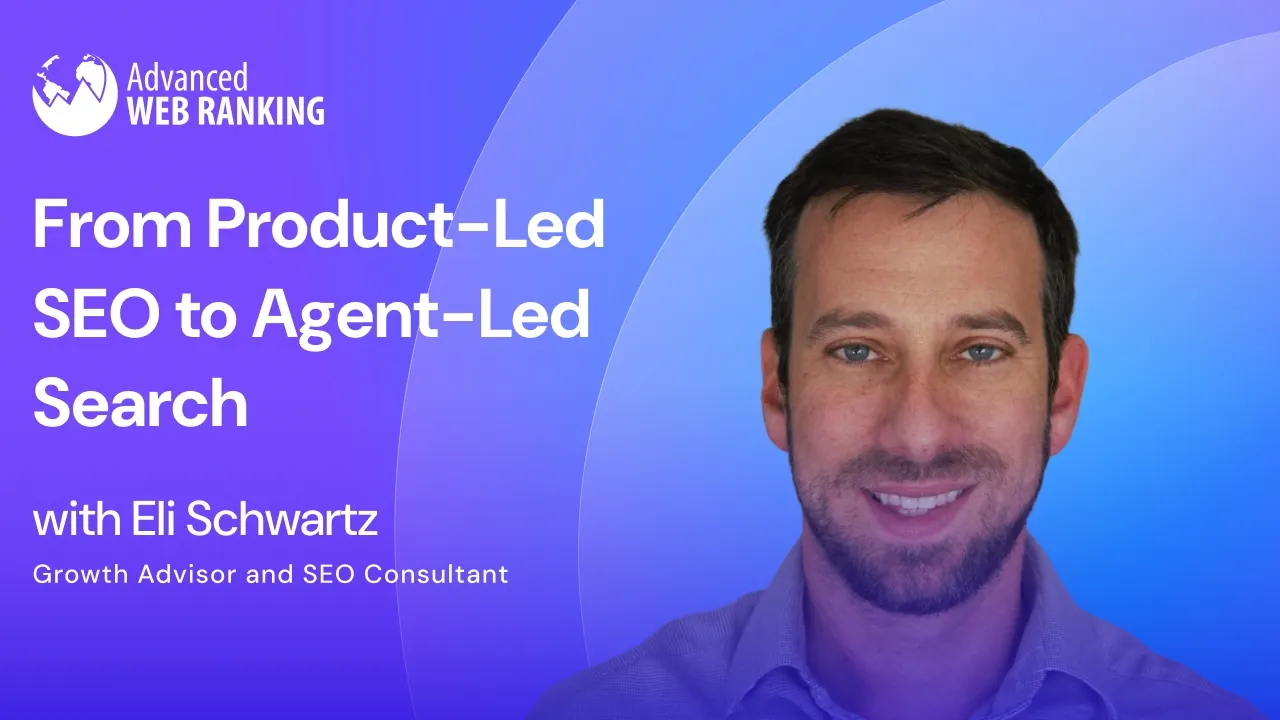
Hi, I'm Gianluca Fiorelli, and this is The Search Session. In this episode, I’m joined by Eli Schwartz, an SEO strategic consultant based in the San Francisco Bay Area.
Twenty years into his career, Eli argues this is the most interesting moment SEO has ever seen and the reasons are more complex than the common claim that “AI is killing search.”
We get into why traditional search is holding its ground, what agent-led search really means for how websites need to be built, and why brand may now be the most important signal in the visibility stack. We also cover what multimodal and international searches need from SEO strategy today.
What you'll take away:
How AI is really changing SEO: despite the hype, AI is creeping into search rather than replacing it, and traditional SEO may be more valuable now as spam content gets pushed out of organic results.
Why AEO is not replacing SEO: lots of AI visibility tools rely on the idea that Google will disappear, but AI supports discovery while traditional search remains essential in the middle of the funnel.
How agent-led search changes SEO: AI agents search, compare options, check details, and contact businesses on behalf of users, so websites still need strong SEO and accessible data.
Why SEO must serve both humans and agents: AI can summarize, filter, and extract key ideas, but people still read, explore, and engage with content, so optimizing for both experiences is the best strategy.
Why informational content should support the buyer journey: informational pages help users stay on your site and move toward conversion, but their value should come from the role they play in the full acquisition strategy, not from SEO traffic alone.
Why brand is the strongest signal in AEO: AI search looks at reputation, reviews, authority, and real-world recognition, making brand strength a key factor in how far SEO and AEO can go.
Why multimodal search needs strategy beyond text and keywords: As users search with images, voice, video, and AI, visibility is harder to win, increasing the value of highly skilled SEOs.
How international SEO is changing with AI: AI may understand local intent better, but global brands still need skilled SEOs to manage language versions, country targeting, scalable URL structures, and solve conflicts that automation cannot handle.
Join us for a conversation with Eli Schwartz, a trusted voice in SEO, as he helps separate the real changes in search from the AI hype.
Topics covered: SEO industry · AI search · traditional search · AEO · agent-led search · product-led SEO · informational content · SEO strategy · brand visibility · multimodal search · international SEO
About the Guest

Eli Schwartz
Founder of Product Led SEO and author of Product-Led SEO
Eli Schwartz is an SEO consultant, growth advisor, and author with over 20 years of experience helping companies build organic search strategies that deliver measurable business results.
After leading SEO and growth at SurveyMonkey, Eli became an independent growth advisor and SEO strategic consultant in 2019, working with B2B and B2C enterprises and startups.
In 2021, he released Product-Led SEO, a book that reframes organic growth around the product and the customer journey, rather than keywords and traffic alone.
He also writes The Future of SEO & AEO, a weekly newsletter where he shares his perspective on how search, AI, brand, and organic visibility are changing and speaks at search and marketing events around the world.
Video Chapters
Transcript
Full conversation between Gianluca Fiorelli and Eli Schwartz.
Gianluca Fiorelli: Hi, I am Gianluca Fiorelli, and welcome back to The Search Session. Today we are going to have a guest, whom I sincerely have been trying to have here for many months now. Not because this person is the type of snob guest you are trying to have, and they always say no.
But because he is a really smart guy, a really nice guy, and also a very busy guy. So finally, the stars aligned and we could record this episode. I’m sure you’re going to have a lot of fun and a lot of interesting things to listen to.
This is the person who, substantially, coined the term and also all the strategy and philosophy behind product-led SEO. He's also written a book many years ago about it. I have it on my shelves; maybe you can see it behind.
He is an international SEO at heart. He worked a lot in this area. In fact, we got to know each other because of international SEO.
But for many years now, he's been a full-time strategic consultant, and one of his clients is Anthropic itself. And this is very cool because an AI company having a product-led SEO as a strategic consultant is really, really comforting for all of us.
This person is Eli Schwartz. Hey, Eli, how are you doing?
Eli Schwartz: After that intro, I feel like we're done.
Gianluca Fiorelli: I always try to pamper my guests.
Eli Schwartz: Great to be here. I'm glad we finally did this. My apologies for making it so difficult.
To explain, I've been a full-time consultant for seven years, more than seven years. Yes, seven and a half years. The reason I love consulting is that I don't work eight hours a day.
So for anybody who is thinking of becoming a full-time consultant, I mean, I work 16 hours a day if I were counting up actual things I do for work, but I don't sit in front of a computer for eight hours a day. And I'm very strict with my time on how I end up on podcasts, because that requires that I sit at a computer.
Whereas if I'm doing some of my other work, I'm on my phone, or I'm sitting at the park with my kids. So I'm glad you kept pushing me to be here. This is really important, and we've found a time to have this discussion. We've had so many discussions, but I think this is our first recorded one, so I’m glad to do it.
What AI Actually Changes in SEO
Gianluca Fiorelli: So, besides the news about your consulting with Anthropic, how is SEO treating you lately?
Eli Schwartz: I think I've been doing this for 20 years. In my entire career, it's probably the most interesting time because we're in this moment where many people think that SEO doesn't matter, but at the same time, it does matter, and then there are many people who think it matters even more. So we have all these things happening at the same time.
And I'd say one of the biggest signals for how valuable this space is, are the companies that are raising money to say that the space is dead. So all these AEO visibility companies are basically making an SEO pitch, but an anti-SEO pitch. So there's money being thrown at them because they believe there's money to be spent, and we'll dive into it.
But I think that most of the thinking is flawed around the way it's supposed to work. So we're at this moment where nothing is tied to reality. I'd say the closest thing to reality of how this space really is right now is to go to family members, and most of my family members don't use AI. My parents don't use AI. My siblings don't use AI. Many people I know don't really use AI to discover things intentionally. They'll get AI Overviews, and that's the reality of where we are.
It's not the reality that is discussed on social media. It's not the reality that is showing up in these venture pitches for the software. Yes, AI is creeping into search, but creeping. We aren't in this moment where suddenly AI is more important than traditional search.
So traditional search, in my opinion, is as valuable or more valuable than it's ever been because the pie has shrunk. A lot of the spam has been pushed out, so there's less availability for companies to grab those traditional search results.
Gianluca Fiorelli: Yes, I agree, not 100%, but this is a conversation. And making the same example of a family, actually, in my family, they use AI. And sometimes I even tell my wife, and this is an anecdote, that if you are searching for something, don't just use AI because AI can troll you, telling you that something exists, but when you are going, for instance, to search for flight tickets and to buy them, there are no flight tickets for this precise destination from here in Valencia.
My sons use it a lot, but more as a tool, not as something that they use for search. They use other things for search sometimes. And maybe this is where SEO should finally start paying attention to search: that search is not just the search bar. The search bar is present on YouTube; it's present on so many surfaces, but usually, as consultants, we offer it as an option when it should be part of the core.
Eli Schwartz: Yes.
Gianluca Fiorelli: And I just read this morning, before starting, I think, one of your most recent LinkedIn posts, and you were substantially saying the same thing that you just said. You were saying that AEO, or Answer Engine Optimization, is more like a superstructure, if I remember well, which has SEO below it.
I agree. Usually, I tend to think the other way around. I say SEO is more of a framework, and it has many specializations. And for instance, AEO, GEO, when we just talk about LLMs, and LLMAO, if you want to be more generic, are just vertical specializations of SEO. Somehow, we can call it the last mile of SEO, the newest iteration of the overall integration of SEO.
Don't you think, and this is going to be the only question I ask you about the diatribe of acronyms, that the success of the companies selling tools for AI was that SEO always had such a bad name? That it was easy to pick up and rent from a quite obscure paper the terminology GEO, apparently presenting itself as something totally different? When in reality, if you dig into what they are proposing, nothing is really so different from what SEO has already evolved to now.
And they always refer to a sort of SEO, which is an SEO we were doing 10 or 15 years ago but not since RankBrain, not since BERT, not since MUM.
Eli Schwartz: I think one of the reasons for the rise of a lot of these tools is that they saw the old thing dying and disappearing and a new thing coming out. But there was no bridge, and none of them offered this bridge between the old and the new, except for the traditional tools. Semrush, Ahrefs and Conductor offer that bridge. But these new tools aren't offering the bridge. So the requirement for the new tools is that Google disappears, and I don't think that was ever valid.
One parallel that you might think about is that the company Tesla reinvented the entire idea of making a car. So all the traditional American car companies have their cars made in Detroit. There's a certain way they made cars. There's a certain way they sold cars.
And Tesla changed that whole thing. They made the cars in California. They sold them in retail stores. They sold online. The prices were fixed. They used purely electricity. There wasn't even a charging network. Everything was totally new. But there was a bridge to the past because they used the same designers and they used some of the same plants. The plant that they used to make the Tesla in California was a Toyota plant.
So maybe the VCs think this as like, “Oh, this is a total reinvention, and it is a winner-take-all. Whoever can go and build the biggest company in the space will be successful,” but they haven't built a bridge to the past and to the old way of doing SEO.
Now, I think the old way of doing SEO, traditional SEO, still matters way more than AEO. I use AI tremendously for discovering things, but, and we should dive into this, a lot of traditional search is becoming more mid-funnel.
So if you use AI, let's say in your wife's example, and I'm planning a summer trip, I'm using a lot of AI to get ideas, but then I use those ideas to do traditional searches. So if I decide I want to go to a certain city, AI helps me find a certain city I want to fly to, then I Google it. Or if AI tells me about hotels, then I Google it. So I'm going to those hotel websites. It becomes more mid-funnel, and that will likely always be the case.
Again, I think the challenge is Google was required to die in order for this entire concept of AI and AEO to be successful, and that will never be the case. And if you look at a lot of the tools and the messaging they have on their websites, they talk about—this is the biggest joke to me—Perplexity. So I think that's a joke, right?
If we're going to think about challenges to Google's dominance, it's really only ChatGPT and Claude. That's it. Yes, there are lots of other models. I would like Meta to be more successful. DeepSeek could be successful. Perplexity could be successful. There are hybrid models, but it doesn't matter because we're talking about not the functionality of the tools. We're talking about market dominance and market share.
The only ones that really matter in this case are ChatGPT and Claude. So anytime a website says, “We'll help you discover your ranking on Perplexity,” to me, that's like all those old SEO tools, where, like, you had to pay extra to find out how you're doing on Bing, and I don't know anybody that cared about how they were doing on Bing as much as Bing wanted to try.
So I think that's the state we're in, where there's this belief that SEO has changed, but I don't know that it really has that much.
The biggest challenge for SEOs today isn’t choosing between traditional search and AI visibility, it’s understanding how they connect.
As search expands to AI-powered discovery, and new user journeys, SEO teams need visibility into the full picture.
Advanced Web Ranking helps bridge this gap by combining trusted rank tracking with AI visibility insights, allowing you to understand where your brand appears today and how that visibility evolves.
Try Advanced Web Ranking free and see how your SEO visibility is changing across search.
Gianluca Fiorelli: Well, I agree. I agree in the sense that we must not forget that Google is also Gemini, and Gemini worldwide is getting very close to ChatGPT. For instance, in Italy, it's already the most used AI model.
And actually, what is somehow funny if we try to look from the distance is that the real battle we are seeing is between ChatGPT and Claude to see who is going to be second and especially who is going to be the dominant choice for business users.
So we recently saw this declaration by OpenAI that they want to substantially reinvent ChatGPT, somehow putting ChatGPT aside and transforming it into a sort of Claude ecosystem.
And yes, I agree with you on the fact that people can start discovery using AI because it's easier with conversational search to start asking precisely what we want and then go on Google for a deeper middle of the funnel or even directly to transactional.
Or, and this is maybe the relative success of big brands with very strong app usage, like Amazon, like Booking, directly searching. For instance, if some hotels are suggested to me, maybe I'm going directly to the TripAdvisor or Booking or Expedia application to see the price, to see the review, et cetera.
They don't even go through Google. But that is clear. Many studies are telling us that AI search is not subtractive but addictive. So it's not quitting market share, but expanding the market share of search.
How Agent-Led Search Changes SEO
Gianluca Fiorelli: And then there is also this: we can like or dislike Google and how it works, and how it treats publishers and brands, but we cannot deny that, from a business perspective, they are smart. I mean, they are the Catholic Church of search. They have existed for more than 20 years, and they are very smart.
And now they are the ones that really are leading the so-called agentic search evolution with WebMCP, UCP, and so on. So we are going to have an agent-led SEO. Can you explain better this concept and how it relates or stems from the product-led SEO concept you created?
Eli Schwartz: I think that agents are very powerful in general. And I don't know that we're going to get the full capability of agents unleashed anytime soon, but they will be very cool in general.
But now let's talk specifically about search. So I had the opportunity to go to Google I/O. I think you said you're releasing this in four weeks, so it'll have been eight weeks before this is released. I went to Google I/O, and this is my second time going.
I really enjoy going to Google I/O because I can directly talk to the product managers who are working on things. Whereas I know a lot of Googlers, I have many Googlers in my life that are friends and past colleagues, they're always guarded when I ask questions about search. But at Google I/O, the PMs show up to answer questions.
So I saw many of the features that Google demoed on the stage, and everyone watched in the keynotes, but the real advantage of being at Google I/O is going into these private demos. At one of them, I waited in line for over an hour to be able to see the private demo, to be able to do the demo myself, and then to ask the PM questions.
One of the coolest things that Google is doing is something that is kind of related to agents, but it's like a souped-up Google Search alert. So you can essentially build your own app, and this app is an agent. For example, what they demoed is, let's say, I want to find out about events happening near me. I live in San Francisco. I'm curious about comedy events. I'm curious about farm days. I'm curious about public hikes that are actually events. And I want to know the weather, and I want to pick which event to go to.
So to do this in a normal way, to find out what I should do this weekend, I would have to do a search, “What should I do this weekend?” I open up a bunch of websites, I find ideas, I pin them, or I have to find a website that actually curates these things, and I write them down. I save them in my Gmail or do something like that.
But what you're doing in Search with this new product—if Google will eventually release it—is I put in these parameters, and again, you could do this in Gemini today. I put in the parameters, “Give me things to do this Sunday in San Francisco. I have a four-year-old, and I have an eight-year-old, and I need it to be good weather.” You can put all those things in and it'll give you an idea, but that's a one-time search.
What this product is, is you create an app, which then essentially builds that website, which says, “Every Saturday morning, every Sunday morning, I want to open up this app, and based on all the parameters, give me the top three things to do, and then map me there, show me the live traffic, and give me the directions.”
And you can even tell me if I'm going to three different things, in what order should I go based on the hours that they're open, based on the predictability of the crowds, the traffic getting there. That's a really cool app, but that's happening in Search.
So where that comes into agents is that is an agent. Instead of doing one search, where should I go on Saturday? Where should I go on Sunday? You've asked an agent to go and deploy all these multiple searches to come back with an answer, and then Google builds that app.
So that's what agent-led search would really be: you now have something, but it could also be someone. In the past world, you might have had an EA. If you were a CEO, your EA would go do these searches and then text you on Saturday morning and on Sunday morning and say, “Here's where you're going, and this is the time you're going to go, and this is your route.”
But now an agent does it; an AI agent does this for you. So now when it comes to SEO, what this agent is doing is it's doing searches.
So if I am a farmers market, then I want to make sure I have a good website that the agent can go and explore, and I have all that information. Let's say I don't have the opening hours of my farmers market. An agent won't know the opening hours of the farmers market. Let's say I don't have the cost of entering the farmers market. The agent won't know.
So you want to do really good SEO because, the same way you did really good SEO for a human, let's say an executive assistant working with the CEO, you now want to do really good SEO because an agent is doing searches.
We will eventually be in a world where a lot of these searches, and I think travel is a great space where agent searches will happen, where you can say, “Go and find me places to go. Pick my hotel, pick my flight, then pick my itinerary.”
Google does this. This is even crazier. I forget what they call this product. But if you're doing a search…
Gianluca Fiorelli: Was it Spark?
Eli Schwartz: What? No, no.
Gianluca Fiorelli: No.
Eli Schwartz: Spark is—I wrote it in my newsletter. Everyone should read my newsletter, productledseo.com. Spark is more of an agent, but it's more related to Gemini.
Gianluca Fiorelli: Oh, okay.
Eli Schwartz: But this is something else. This is another kind of search, not related to the app thing I just talked about. Again, read. I wrote out all three of these things in my newsletter.
So this is a search where if I want to find out where I could get a haircut, it gives me a bunch of possibilities of where I could get my hair cut, but the information might not exist. So Google will call the barbershop and say, “Hi, I have a customer here that's interested in a haircut. What time are you open? How much does it cost? And can I make a reservation?”
So Google will do that for you; the actual search will do that. So that's also an agent. Again, your phone number needs to be available. All your information needs to be available. If you would like the agent to consider your business, then you need a website. You need to have a phone number. You need to have an updated phone number. You need to have an address.
So these are the things that, again, if we're thinking about how you do SEO today or how you did SEO yesterday, you did SEO for humans that are doing searches. In the future, you might do SEO for representations of humans, but they're still doing the exact same thing a human would do: go and search, make a phone call, gather information.
Gianluca Fiorelli: Yes. This is a kind of evolution I see myself. So we are going to need to think about website optimization also technically, because sometimes the technical side of the future of SEO is somehow hidden behind all the content stuff that is usually more popular to talk about.
Why SEO Must Serve Both Humans and Agents
Gianluca Fiorelli: And yes, we need to optimize both for the agentic experience, which is essentially having a wonderful infrastructure and presentation of all the data. And this is structured data in the generic terms of structured data, not only schema.
And then, obviously, for humans, because I don't know if you agree with me, but I also see somehow a trend, especially from the people who are rightly very enthusiastic about the evolution of the internet and of agentic search, that are substantially telling us that maybe the only user we are going to target is just agents, when I think it's not going to be so.
I think there are so many other surfaces for discovering brands on the internet that will see humans actually clicking on a link. Just think, you were citing your newsletter. A newsletter is this kind of surface where you discover something, you click, and you visit with your eyes a website, but also branded searches and so on.
So don't you think that sometimes there is such enthusiasm for agentic search, and I am quite enthusiastic, but with unrealistic enthusiasm, which is going to forget the human experience?
Eli Schwartz: I think that AI is going to be used for efficiency. I don't think that I'm competing with AI with my newsletter, the same way I don't think movies are competing with AI.
Someone wants to read a book; they want to read a newsletter. Hopefully now I have 15,000 subscribers and hopefully, somebody out there has an agent subscribed to my newsletter, and it takes my 800 to 500 words in each weekly newsletter and distills it down to like, “Here's three things you need to know.” Good. I hope people are doing that.
But for other people, they're reading it, they're skimming it, they're forwarding it, they're doing whatever it is, and I'm not competing with AI. If you want those three ideas, just get them. If you want to read it, then you read it.
It's the same way as watching a movie. I'm sure you could watch a movie in five minutes. You can get the entire trailer, the clip, clip, clip of the movie, and then here's the ending, but that's not why we watch movies. Imagine you did that on a plane. You had a 15-hour flight, and you watched like 60 movies with the five-minute clips. No, you want to watch a two-and-a-half-hour movie because it uses up a bunch of time. The same with reading a book.
I was actually moving. This is a good use of AI. I was moving and I had all these books I picked up from conferences that I never read, and I wanted to give them away because I thought about the cost of moving each book. Like, I'm going to have a box of books I'm never going to read.
So what I did was I took all the titles of all the books, I went into Gemini, and I said, “Give me the full summary of each book.” And then I had the summary of like 40 different books, and then I put that into NotebookLM and I said, “Now make me a podcast discussing each of the books so I can learn what was in the book.”
I've written a business book. I'm in the middle of writing another business book. Most business books can totally be summarized in one Google Doc. It's not a novel. You don't want to summarize a novel, but a business book, you totally can. And I think they're different experiences.
I think that, yes, there is the human experience. If you're writing a book, that needs to be read and learned. So there are business books, like one of my favorite books is Never Split the Difference. Could you learn all the ideas of negotiation from Never Split the Difference in a one-page doc? Of course, but I think it's a very enjoyable book. He's an FBI negotiator, and the stories help you actually learn the lessons.
So there's the human experience, and then there's the agent experience, and I think as SEOs, you need to be really focused on both. There are some people that are going to be humans visiting the website and searching for the website, and there are some that are going to be agents, but you need to do both.
Whether optimizing for traditional search, AI-driven discovery, or brand presence, SEO professionals need accurate data to guide decisions.
Advanced Web Ranking gives experienced SEOs the insights to track progress and adapt as search evolves.
Try Advanced Web Ranking free and see what’s driving your visibility.
Informational Content with a Business Purpose
Gianluca Fiorelli: Yes, totally. And before we were saying that people are substantially using AI for discovery—and sometimes discovery can be a very stupid question, but still, it’s discovery—and then they move. Sometimes I don’t see a direct path, but they move to search. Eventually they return to AI for asking a specific question and then return to search, etc..
And in your Product-Led SEO, you said—and actually, we can see that much of the evolution of quality according to Google is very tied to your concept—a brand should not talk about the sex of the angels. It should be tied to what the brand is, what it offers, what the characteristics are, what the topics are, and also, in terms of information, what are the things they want to solve.
And obviously, I tend to think of you as a strategic consultant, especially in the SaaS world, but I think that this concept is practical and efficient for any kind of industry.
On the other side, we know that if AI search is the first step where people discover things, brands would be better if they were cited in the correct way on AI search and sometimes popped up also for generic topic searches.
So when you are talking with your clients very generically, how do you create a good balance—I know that you don't like informational content as such very much, at least this is what I understand from reading you—the necessity to be informational enough in order to appear in the discovery phase and then doubling down with middle-of-the-funnel content and eventually also bottom-of-the-funnel?
Eli Schwartz: I convince brands when I talk to them; they're obsessing, not even just thinking about informational content for SEO. I walk them through a buyer's journey, and I walk them through a funnel of how users discover and then navigate their sites and then maybe make a purchase.
And the important thing that I have them consider is what happens if they don't have that informational content. Let's say it's a SaaS brand, it's an analytics product, and they don't explain a glossary term. Like, let's say they don't explain ROI. So if a user is navigating their site and they get to this page where they get to this term that says ROI, and they're like, “I don't know what ROI is.” If they can click on the word ROI and it goes to an informational page that says what ROI is, they stay on the website.
Now, if they scroll their mouse over the word ROI and it doesn't click, and then they search on the top of the site, there's no word for ROI. So what do they do? They go back to Google. And if they Google the word ROI, and let's say this brand is Google Analytics, and Google Analytics did not define ROI. They go back to Google, and the next thing they know, they find Adobe Analytics, and Adobe Analytics defines ROI for them, and this user decides to convert with Adobe. So informational content has an absolute purpose.
You want informational content on your website. The problem is that many companies I speak to want to have informational content for SEO, and then they want to have informational content for their website. So you end up having two pieces of informational content.
What I want them to do is think of this entire buyer journey and say, “Should you have this piece of content? Yes, you need this piece of content. Is there a way to optimize it for SEO? Obviously, yes. Maybe improve the title tag. Make sure that you cross-link this page. That's probably about it.”
And then if you get search visitors, that's great, but the justification for the budget of this page is not because of SEO. So that's what I always have them think about.
When it comes to SaaS, I don't even know that many SaaS tools should be spending as much on SEO as they do. And the reason why is because there's a finite amount of users that are ever going to come from search. So you need to model out how many of those users are going to come from search. How many pages could you potentially have that bring in search visitors?
And once you've achieved some sort of percentage of that, you've got your eighty percent of SEO done. There's no reason to continue investing in SEO. But the reason people continue to invest in SEO is because it becomes its own silo, its own investment bucket that you just invest in SEO.
So when I think of things holistically, here's my hundred percent of acquisition. Sixty percent of acquisition is going to come from brand marketing, thirty percent of acquisition is going to come from paid marketing, and ten percent is going to come from SEO. When you think about it like that, then you can say, “Ten percent of my budget should go for SEO.”
When you don't do that breakdown, suddenly you say, “Okay, SEO costs me ten thousand dollars a month. No matter what, I'm going to spend ten thousand dollars a month. Paid marketing costs me one million dollars a month. No matter what, I'm going to spend one million dollars a month. And brand marketing costs me ten thousand dollars a month. No matter what, I'm going to spend ten thousand dollars a month.”
Now you see that the distribution is broken up based on the way I just divided this up. You should be spending the most money on brand marketing and the least money on SEO.
So I always encourage, when I walk them through the journey first, that they can see this, and then we discuss SEO, and I don't even sell them. Obviously, I'd benefit personally if they wanted to hire me for SEO that they already wanted to spend.
When I break it down, a lot of times the conclusion is, “Oh, I don't really need you,” and I'm like, “That's fine.” I'd much prefer not having a client that is mad at me because we didn't achieve their expectations. I'd rather change their expectations to then decide if they need to do SEO.
The Ceiling and Floor of SEO Brand Power
Gianluca Fiorelli: I agree. I agree with you. I think that, especially in the beginning of a SaaS life, branding is the most important thing.
And eventually, in that case, SEO can help branding, but very specifically with a very specific project for SEO for branding. Like, you should have this kind of organization schema. When you are doing branding, you should always be able to associate your name as a brand or the name of your branded product with these specific words. People must start associating your product with things they are searching for. So this could be almost a project kind of work, not even maintaining or growing.
But then there is one aspect that maybe could be interesting, within obvious balancing in the budgeting of SEO, as a sort of online reputation management, as a companion of branding, especially now with LLMs that are so able to surface things that had been said and written 15 years ago, and people, because AI is pushing them out, think things are new.
So this is a good framing for SEO ongoing, eventually also for SaaS or brands in general, not just for discovery, not just for generating traffic, and not just for creating brand recognition thanks to specific types of work in semantics, entities, and so on, but also somehow as a sort of forensic, classic forensic SEO.
Eli Schwartz: Yes. I don't think enough people pay attention to brand. Again, mostly because they don't look at SEO holistically. They just think about how they all want to operate in this channel.
And I think when you look at SEO holistically, you can see where SEO helps brand, like you said. Where does brand help SEO? Where does SEO help paid marketing? All of this has to be paired together and work together and help each channel.
And brand is something I've been writing a lot about in my newsletter because I think that the primary thing that matters for AEO is brand. Because the way I think of AI and LLMs in search are an extension of that. So if you think about it, what is AI? AI is an imitation of human thinking. So it's as if you've asked an expert human to do something for you.
We've all done this with medical stuff. We've always wished we had a doctor we could ask all our weird medical questions, and here AI just does that thinking for us.
So the same happens with search. Whereas before you used to be able to optimize for search and rank on something you didn't deserve to rank on, with AI, it does more thinking, and what bubbles out of the thinking is brand.
I had a friend who had a T-shirt company, and he wanted to rank on AI for best T-shirt. Whereas in the past you could do SEO to rank as the “best T-shirt” without being the best T-shirt, you would optimize your title tag, you bought a bunch of links, you had your internal links, you did all the things you could do.
When it comes to AI, it's hard as a startup to be the best T-shirt if you're not the best T-shirt. And the reason why is because AI, again, thinking like a human, is looking for those signals of what is the best T-shirt. It's looking at reviews, but most of all it's looking for brand.
It is able to extract who are the best apparel makers, what's the highest quality, what are the signals. So when it comes to AEO, I think brand is the most important signal, and many in SEO don't think about that because they're only focused on SEO tactics.
So again, always, when you're doing SEO, SEO is, I call it a product, but really it's marketing. Because I think you need to think about it as a product and function like product, but really it's a marketing channel. You're acquiring customers.
So when you think about SEO, you want to think about it as a holistic marketing channel, exactly like we talked about before. How does it impact brand, and how does brand impact it? Again, I think so many more people need to think about the brand channel. What does the brand mean?
Going back to the T-shirt company, there's a ceiling on what many brands are able to do with SEO and AEO because their brand is not as well-known. But then there's a floor.
If I am consulting for a brand, let's say I consulted for Tinder, and when I consulted for Tinder, they were not ranking on dating site and dating app. Because Tinder was Tinder, I said, “Okay, here are the things we need to do, and in 48 hours we're going to be ranking on all these keywords.”
And that's exactly what happened. Now, if I was working for a startup in the dating space, I might not still have them ranking on dating. So that's the brand factor.
The same thing with Coinbase. I was consulting for Coinbase. They only ranked on the word Bitcoin. It was one of their primary words. I worked with them on a strategy that they could rank on all of the other crypto terms.
Now, for a startup in a crypto space, I'd say, “Well, you're unlikely to ever rank on any of these top cryptos. You're not going to rank on Ethereum. It's just impossible.” But Coinbase did not rank on Ethereum. By doing the SEO we did, within seven days we were ranking on Ethereum because they were the brand.
So I love consulting for brands because it's completely possible to do that, but if you're not the brand, you may never do that. So that's a really, really important factor in the floor of a brand, that it should absolutely be ranking, or the ceiling of a non-brand.
Continue with Miracle Inameti-Archibong’s episode, where she and Gianluca Fiorelli break down what brand-led SEO looks like in practice and why brand signals are now central to visibility in both traditional and AI search.
Gianluca Fiorelli: And I think that for SEO, the easiest way to understand the importance of brand and the importance of having a strong brand can be found just digging and looking at the query fan-out.
Let's say that we are searching for something. You were saying T-shirt. What are the best T-shirts now available for a young kid, seven or ten years old, and so on?
If you look at a query fan-out, the query fan-out usually is based on the training data. And if in the training data, let's say, are popping up ostensibly, constantly, and statistically in an evident way, determinate types of brands because of all the things we have said before, then these brands are also going to be used in the query fan-out.
And that's why, because of this query fan-out, we can see some brands immediately presented in the answer. And this is important to be understood because this is how working long-term for the training data, because we know the training data has a cutoff every X months, is important also for the search live experience of AI search.
And then obviously in Google, this is even more evident because they are based on the same Google search index, which substantially has at its base the knowledge graph, and the knowledge graph has all these things, and one of these things, casually, is our brands.
Eli Schwartz: Yes.
As AI systems rely more on authority, reputation, and recognition signals, brands need ways to monitor how their visibility evolves.
Advanced Web Ranking helps SEO teams track branded and non-branded performance, competitor movements, and search presence across markets.
Try Advanced Web Ranking free and start measuring your brand visibility footprint.
Rethinking SEO for Multimodal Discovery
Gianluca Fiorelli: And talking about synergic, holistic, there is a lot of talking about the multimodal experience that is slowly but steadily appearing also, for instance, in AI Mode.
But okay, there is a lot of talk about multimodal, but why does everybody just talk about text? How important is it to not consider content only text but also videos and images? Even software can be content.
Eli Schwartz: Yes, that's such a fascinating question. I think from a search perspective that it is really important to think of multimodal because that's the way users are going to search moving forward.
I do an insane amount of Google Lens searches. I have an Android. I think you have an Android too. I think last time we were together you had an Android?
Gianluca Fiorelli: No.
Eli Schwartz: You're all iPhone, huh?
Gianluca Fiorelli: Yes, well, Lens works very well too. I use Lens too.
Eli Schwartz: I spend my entire life with Google, so I am aware that they spy on me, and Google's going to weigh in right now on them spying on me. But I have all the Google products, so I get to see them doing things in the future.
I have Circle to Search on my phone. I do a ton of Circle to Search, which is one level before Google Lens. So if I get something in a foreign language, I can search it. If I get something in my email, I can search that specific object.
So I think multimodal is really important because that's what users are doing. The reason that SEOs don't think about multimodal is because we don't really know what to do with it.
So for the most part, it's easy to optimize for text, but I do think multimodal is important to think about because it's going to cut into search. Whereas before it was all text, now users can do search with video, with images, and with voice, of course.
So I think it's going to take away some of the text searches that our users are going to do, and that, again, is going to shrink the pie. Which, going back to an optimistic tone in the way we started the podcast, I think we're in an inflection point where search becomes more important. The pie has shrunk.
The value of search, and this is the way I like to frame it in whatever space someone is in, let's go with hotels, with travel. Software might be different, but in hotels, there's a finite amount of people that are going to travel and need to sleep in a hotel in a city.
Nothing about AI has changed the finite amount of people that must purchase a hotel room for a night. The journey has changed for sure. Everything about SEO for travel has changed and will continue to change and get maybe even easier for users. But the number of people needing to end up in a hotel, whether they search or not, does not change.
So the way I like to think about this from an SEO perspective, if you were in the travel space, for those same, let's just pick a number, let's say there are 10,000 people that need to sleep in Miami in a hotel room every single night.
So if you're in the travel space before and you're optimizing for Miami hotels, there may have been 20,000 searches you could optimize for, but only 10,000 of them are going to convert because there were only 10,000 people.
But there was a lot of SEO money to be made because you were optimizing for so many more searches. There was so much more traffic.
Now, SEO has become more efficient for a variety of reasons: because of LLMs, because of multimodal, because of spam updates. If you did a search on travel years ago, you would end up on these sites that then passed you to another site, and that was annoying.
But again, all these helpful content updates are kicking sites out of the index that didn't really deserve to be there. So you still have your 10,000 people, but the searches that those 10,000 people are going to do are going to be far fewer.
So the battle and the investment to be visible for those searches is now even higher. That's why I think we're in a good moment, because there's less real estate to show up on, which means that you need to work harder to show up on that less real estate, and the skill level of the people that can help you get there is very high.
So I love doing these searches on LinkedIn to see how many people have the word "SEO" in their title. There are hundreds and hundreds of thousands. But those hundreds of thousands of people probably can't help you get the very finite real estate on the searches that you need to show up on. There are very few people that have those skills to help you get there, and those people are now more valuable, and then it's easier for them to define why they're different.
When I first started consulting, well, I still had a job. One of the things that pushed me to even write my book was a company had reached out to me, and they asked me for an SEO proposal. And I guess the CEO is kind of a smartass. I don't even remember the name of the company.
And he says, “So you're going to pick keywords from Ahrefs or Semrush?” I'm like, “Yes.” And he's like, “And then you're going to write content?” I'm like, “Yes.” And then he's like, “Then you're going to link to it?” And I'm like, “Yes.” And he's like, “So why would I hire you when I can hire someone from the Philippines on Fiverr?”
And I didn't really have a good answer. So that's why I was like, “I have to write a book, so I have a better answer because then I could say I wrote a book.”
But the truth is, if you're doing basic SEO and you're just optimizing for spam, totally. Anybody can do it. You can just follow best SEO practices and you can do it. But now when it becomes more of a constrained market where it becomes more challenging, you can't just optimize with keywords; you can't just optimize with content; you can't just optimize with backlinks.
You actually need a strategy, and you need to understand what the users are searching. You need to understand their brand power. There are far fewer people who can do that. So for those that have that skill set, this is a very bright future. For those that don't have the skill set, I think they were just completely disrupted by AI.
Gianluca Fiorelli: Yes, I totally agree with you. I think that the value of experience is going to get even more important and more spendable.
International SEO Challenges in the Age of AI
Gianluca Fiorelli: One last question. I want to make you return to your times of international SEO, and I have a very candid question, a very direct question.
Are you satisfied by how AI, also Google in this sense, AI Overview and AI Mode, are, in my experience, totally screwing up everything that every international SEO optimization website and SEO have fought for many years to accomplish and to make real?
Because so many times it happens to me that I do a search in Italian or in Spanish, but Google is returning to me with answers citing and linking to English websites, but I know that they have a Spanish version or an Italian version.
What is your opinion, as a former and maybe still at heart international SEO, for these kinds of brands that are targeting a global market with specific country-level versions or language versions?
Eli Schwartz: First of all, the reason that Google doesn't do as well in international SEO or international search is because traditional search is just an algorithm.
People in SEO like to talk about the Google algorithm with a capital A, like, “Oh, it's the Algorithm.” It's actually many algorithms, and basically an algorithm is just computer code. And it's not AI. Well, there's a little bit of AI. But people follow rules, and those rules are not always correct, and they have bugs and make mistakes.
So in English, you have your hundreds of thousands of Googlers, and they're doing searches, and they find bugs, and they file a bug report, and then they fix it. I've seen many of those, and I've pointed them out to Googlers, and they fix things because code has bugs.
When it comes to international, there may not be that many Googlers who speak Italian, who are doing Italian searches or doing Spanish searches in Spain. Therefore, they never find the bugs, and it's the best it will be.
Now, I think AI will improve this because AI can now think like a human. So AI will take that extra level and say, “Gianluca wants an Italian site. He wants a Spanish site.” And it will override what the code would otherwise say.
Let's say the reason the code brings you an English website is because its brand or its domain authority, again, not the Ahrefs-level domain authority but the authority within the Google Index, is just much higher, and the Spanish website or the Italian website just appears to be lower quality or maybe even spammy when you are Spanish and you are Italian and you know it's not.
But they don't know that. The algorithm doesn't know that because it's only looking at raw signals. AI can override that and say, “Well, these signals say it's not a good website, but these signals say it is a good website. We're going to show the website anyways.” And they'll do that. So I think that's the challenge.
Now, going back to my earlier statement on the skill levels of SEOs, to be able to compensate for that and figure that out if you have an international client—and I have many international clients, and I actually love this as a challenge—to be able to think of how you do that is not something that you can pay $5 for on Fiverr or Upwork. Again, people that can come up with these solutions.
I have a client, they just revamped their entire international strategy. They only have one international office in Australia, and I need to come up with a strategy for what's going to happen when they have an international office in each country.
So everything I do for SEO has to be scalable to the point that we don't want to make a decision for what you do for Australia, and then when there's a decision about what you do for Mexico, you need to make that decision again.
So I had them redo their entire URL architecture for what do you do for Australia? What are you going to do for Latin America when you're only going to have an office in Mexico and Argentina, but you want to have separate instances of your domain for Colombia and Peru?
So we make those decisions now, so then you set up the structure. Now, if they end up with an office in Colombia and Peru, we already have a playbook. We don't have to go back and remake a decision, likely when they're not even paying me to be their consultant anymore.
So that's the way I'd approach it. It's not just about how you optimize for this word in Spanish? How do you optimize this word in Italian? It becomes strategic. How do you tie all this together? How do you make sure there's no duplicate content? What do you do if there is duplicate content? What do you do if the Colombian page is competing with the Mexican page? What do you do if the Spanish page for Spain, which maybe uses different language and wording than the Mexican page, is competing?
So it's all strategic questions. And I feel very optimistic that AI cannot solve these problems and will not solve these problems, and people will solve them, and very smart and eventually highly paid people will solve them.
Gianluca Fiorelli: Okay, let's hope so. I'm an international SEO, so let's hope so.
Eli Schwartz: Yes.
AI may change how users discover information, but international SEO still depends on understanding visibility by country, language, search engine, and market.
Advanced Web Ranking helps global SEO teams track performance across locations and identify market-specific opportunities.
Try Advanced Web Ranking free and monitor your international SEO performance.
Gianluca Fiorelli: Personally, for instance, what I try to do, but it's also one thing. Usually AI, and I notice this kind of behavior, even if you search in Spanish, and even if you have set up Spanish, for instance, as your language by default in ChatGPT, they tend to then retranslate the question to English.
And this is triggering sometimes problems because it's triggering a query fan-out from English sources. And this is a problem that comes down to how the models have been built.
This is not just me; it's also Motoko Hunt, who is talking about this kind of solution, which is really being able to put in the content, in this case, a smooth sign of geolocalization, using the content as really being able to make AI understand that you are targeting this specific country with this specific language.
Because when it comes to informational content, okay, it's not that big of a problem. But let's say that if AI is presenting to a user content that is about legal implications, pricing implications, or return policy implications in Mexico, but that is based on the US pages, that is a totally screwed-up experience and quite a bad brand reputation management risk for a brand.
So there are ways. We substantially need to reinstruct how to push down that geolocalization factor in the content, but usually it's not put under the correct attention by the brands because we are just obsessed with hreflang, for instance.
Life Beyond SEO: Travel, Curiosity, and Creativity
Gianluca Fiorelli: So, one hour of talk. Let's stop talking about AI. Let's stop talking about the future of search. I have a question about you. You were saying before, “I'm not working. I'm a consultant. I'm not working eight hours.” Maybe sometimes, “I'm not working eight hours sitting in front of a PC.”
But when you are not thinking about search, when you are not thinking even unconsciously about the future of marketing, digital marketing, and so on, what are the things that Eli Schwartz likes to do to spend time?
Eli Schwartz: I really like to travel. I try to travel as much as possible to go to interesting places and to see interesting people that I might never come across. It adds excitement to life.
You look forward to where you're going to go next, and then when you come back, you're always thinking about the things you did.
Hopefully this summer I can make it to Asia, so I'm going to do repeats of something I've done before, of going to China, hopefully. Not all booked and paid for yet, but going to China to see the Great Wall again. I went 10 years ago when I lived in Singapore and then either to Thailand or Vietnam after that.
And if anybody listening or watching is in any of those places, every time I travel somewhere, I do an SEO event, so something will happen in any of those places.
Gianluca Fiorelli: Yes. So it's a classic meetup where you meet people and peers in the location. That's a good idea. And well, I hope you can make it up. This looks to be an amazing travel plan.
And yes, I think that it's important to travel or, let's say, have things that make you expand your brain, not just go fixating yourself. Also because I don't know about you, but sometimes maybe my best ideas, what I consider my best ideas, pop up when I'm not thinking at all about SEO or AI search or digital.
Eli Schwartz: 100%.
Gianluca Fiorelli: Thank you, Eli. It was really, really a good conversation. I really appreciate your time. I know you're a very busy man, and I hope that next time we can have a second opportunity to see what we were saying a few months ago. Let's see what's happened now.
Eli Schwartz: Let's do it in person. I always love doing these in person.
Gianluca Fiorelli: Okay. Thank you.
Eli Schwartz: Thank you for having me.
Gianluca Fiorelli: And thank you to everybody for having stayed with us until now. Let me do the influencer thing. Remember to give this episode a like and to ring the bell to be notified about the new ones to come. Thank you and bye-bye.

Podcast Host
Gianluca Fiorelli
With almost 20 years of experience in web marketing, Gianluca Fiorelli is a Strategic and International SEO Consultant who helps businesses improve their visibility and performance on organic search. Gianluca collaborated with clients from various industries and regions, such as Glassdoor, Idealista, Rastreator.com, Outsystems, Chess.com, SIXT Ride, Vegetables by Bayer, Visit California, Gamepix, James Edition and many others.
A very active member of the SEO community, Gianluca daily shares his insights and best practices on SEO, content, Search marketing strategy and the evolution of Search on social media channels such as X, Bluesky and LinkedIn and through the blog on his website: IloveSEO.net.