



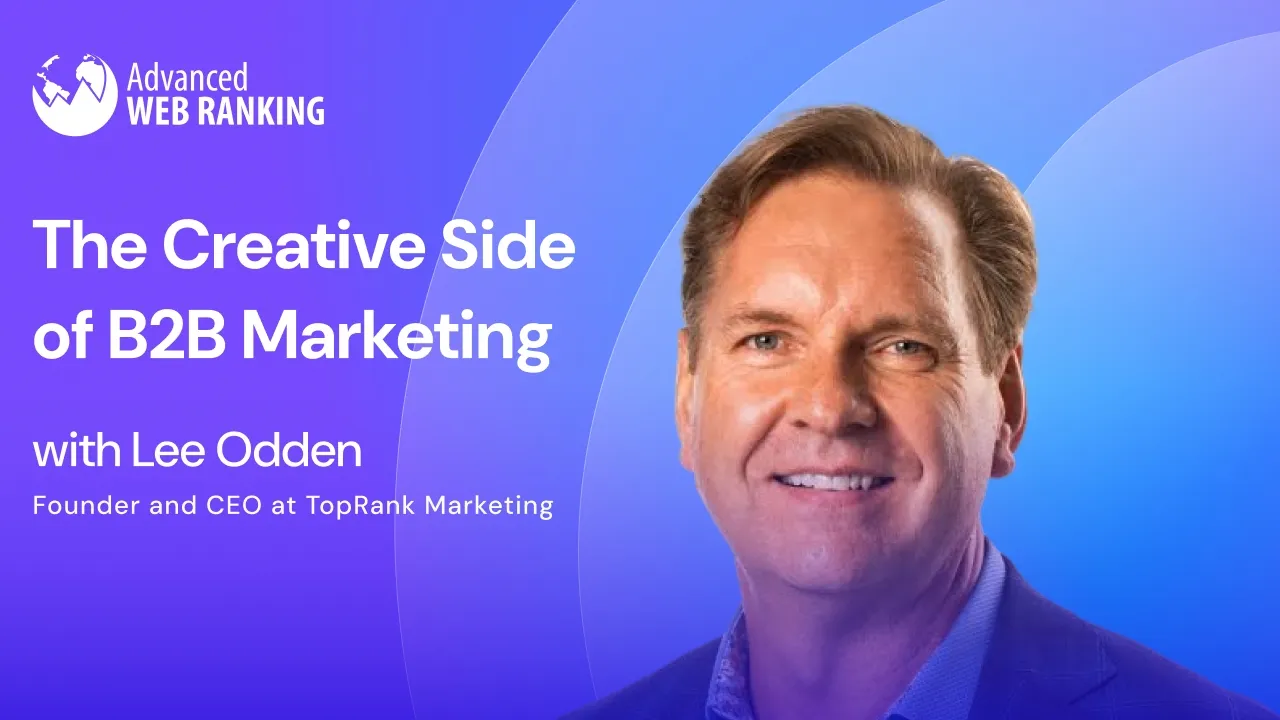
Back to The Search Session. I’m Gianluca Fiorelli, and joining me from Minneapolis is Lee Odden, a longtime B2B marketing strategist.
Our conversation looks at B2B as a space where creativity starts with understanding complex buying decisions, not simply producing more content. We connect that idea to creators, influencers, internal experts, and AI search, exploring how brands can build trust and stay relevant throughout the buyer information journey.
What you’ll learn in this session:
How B2B creates more room for content creativity: longer buying cycles, multiple decision-makers, and varied information needs give brands more opportunities to build trust through different formats, channels, and overlooked content assets.
Why the buyer information journey will matter more than AI formatting tactics: as AI search best practices become commoditized as old SEO tactics did, understanding how your specific audience discovers, validates, and consumes information becomes the real source of differentiation.
How to slow clients down on AI visibility pressure: when clients push to scale AI optimization fast, test first and refocus on revenue, customer experience, and retention and growth rather than chasing KPIs driven by leadership mandates.
Why prioritization drives implementation: SEO advice means nothing unless it gets implemented, so narrowing an audit down to a short list of priorities, then showing impact, helps earn buy-in for the rest of the recommendations.
How B2B brands build trust through influencer and creator collaboration: partnering with credible industry voices gives brands stronger content, access to trusted audiences, and a more effective way to influence conversations, generate demand, and support revenue.
How to match B2B influencers to specific marketing goals: relevance, resonance, expertise, content format, and distribution method matter more than popularity when choosing between high-profile creators and niche subject matter experts.
How B2B companies can build influence from within: developing executives and subject matter experts through conversations with trusted external voices builds credibility, unique content, and visibility while reducing reliance on scarce tier-one creators.
Why informational content still matters for topical authority: even without driving clicks, it builds mental availability before buyers enter the market and creates the credibility, entity associations, consensus, and unique insights that help brands appear in query fan-out and generated answers
Listen for a practical conversation on making B2B marketing more creative, credible, and useful.
Topics covered: B2B marketing · content creativity · buyer information journey · AI search · creators and influencers · B2B influencer marketing · executive influence · internal experts · informational content · original research · AI visibility
About the Guest

Lee Odden
Owner and CEO of TopRank Marketing
Lee has 25 years of experience in digital and B2B marketing. He is known for connecting search, content, social media, and influencer marketing to help B2B companies build trust, reach buyers, and generate measurable results.
In 2001, Lee Odden co-founded TopRank Marketing, a B2B agency serving enterprise and mid-market companies through content, SEO and GEO, thought leadership, and influencer marketing.
He serves on the Global Industry Advisory Council at the Digital Marketing Institute, helping shape professional standards and education in digital marketing. He is also the author of Optimize, a book about integrating search, social media, and content marketing, and the host of the Beyond B2B Marketing podcast. Lee has published thousands of articles and several B2B influencer marketing reports and regularly speaks at industry events.
Transcript
Full conversation between Gianluca Fiorelli and Lee Odden.
Gianluca Fiorelli: Hi, I'm Gianluca Fiorelli, and welcome back to The Search Session. Today, our guest is coming directly from Minneapolis, if I'm not wrong. He is the founder and CEO of TopRank, a B2B marketing agency.
We are going to talk a lot about B2B, but not just in the classic “Can B2B create content that isn't boring?” and all the usual things that are said about B2B. I also work a lot with B2B, and it's a fascinating type of need. Maybe it is not as sexy as B2C or D2C, but the challenges are the same, if not even bigger.
Our guest is, I would say, one of the most respected figures in SEO and search in general. He has so many years of experience that putting him just inside the SEO square would limit his knowledge. It is more than just SEO. I would say "digital marketing expert" is the correct definition for our guest, and our guest is Lee Odden. Hey.
Lee Odden: Hey.
Gianluca Fiorelli: How are you doing?
Lee Odden: I'm doing great, Gianluca. I appreciate you introducing me that way. I call myself a recovering SEO sometimes because my entry into the marketing world was through search, optimizing webpages for HotBot, Lycos, and Infoseek. You remember those names?
Gianluca Fiorelli: Yes.
Lee Odden: Back in the day. I evolved, like a lot of search people have, to expand into the broader mix of marketing tactics. Being the best answer, as I like to say, wherever customers are looking. It's great to be here.
Creativity in B2B Goes Beyond Written Content
Gianluca Fiorelli: Yes. I was saying that B2B is sometimes very frustrating. But when you fulfill the objectives and reach the goals you planned with your clients, it's even more satisfying.
Lee Odden: I agree.
Gianluca Fiorelli: Let's be honest. Having Nike as a client, for instance, means you don't have to care so much about promotion. It's Nike. Everybody knows it. You don't have to care so much about branded searches.
Yes, there are some peculiar things about branded searches for this kind of big brand because people know what Nike is. The problem becomes more of a project management issue in terms of getting things done by Nike, for instance, for technical work and other things.
But for a B2B company, even if it is very big and well known in its niche, it's more complicated, I think.
Lee Odden: Sure. Purchasing a new pair of running or tennis shoes is different from a buying committee of 10 people who all have to agree on a vendor recommendation, where the expense is a million dollars, implementation takes six to nine months, and the sales cycle is 18 months.
Gianluca Fiorelli: I have a client in the industrial cable industry, and it's terrific because whenever we need to change just a comma, it must pass through engineers to see if changing that comma might alter the meaning of the page. The page has to remain consistent with all the standard specifications that the cable must comply with.
Lee Odden: Yes, it's different. I think you said something about the satisfaction of seeing results. One thing that's interesting to me about B2B is that it's a longer chase, right? It's a longer period of time, which presents many more opportunities to create content and to create content that is findable in all the places where it needs to be.
Because B2B has this reputation of meaning “boring to boring,” and you nodded to that a little bit, it actually creates a lot of opportunities. I'm a glass-half-full kind of guy. It creates lots of creative opportunities because so much of what gets published from a content perspective in B2B is kind of mediocre. With AI, that's even more mediocrity at scale.
The truly creative messaging and storytelling opportunities are rich in B2B because, at the end of the day, the people behind those businesses are humans too. They go to Instagram, TikTok, and other consumer-focused channels. It's the mix that adds up to building trust and relevant visibility.
But in B2B, because it's such a large, considered purchase, you've got to have people who truly believe the brand content. They've got to believe the message and the promise that buying this or that type of software is actually going to deliver a return because jobs are on the line. If you make the wrong mistake by recommending a multi-year, multi-million-dollar software application, goodbye, right?
So there's a lot of due diligence involved in a B2B sales cycle, and that creates lots of opportunities for search, AI visibility, influencers, social, email, ads, and all the different channels. They all add up. That long chase is very satisfying when you really hit it.
Gianluca Fiorelli: Yes. You touched on an interesting topic, which is creativity in the context of B2B. I think creativity, also in our industry, SEO, but in general whenever it comes to the web, is considered in relation to content creation as something that, in B2B, is related to text. This is actually an old, classic mistake. Content is not just text.
Lee Odden: Of course.
Gianluca Fiorelli: Content can be a series of short videos explaining things in a way that is easy to understand and really speaking to the buyer persona the B2B company is targeting. It can also be a podcast with people working in the B2B niche and creating discussions.
Or, if you find the correct company to do it, you can even create your own B2B forum for your niche and own the UGC field around it, which we now know is very important. It can even mean creating software.
You were talking about multimillion-dollar software companies, and freemium was also invented for that. You can use it as content to promote yourself, not just to show off what you do, but as a way to attract potential clients.
See how B2B creativity shapes visibility and reputation with Viola Eva
After exploring creativity and trust in B2B marketing, Viola’s conversation with Gianluca looks at the role of original content, third-party sources, and clear brand associations in AI search. It also explores how brands can test new tactics without weakening the authority they have built over time.
Audience Intelligence & Tailoring Content to Stakeholders
Lee Odden: It really depends on the expectations and who the audience is. We’ve worked with a very popular project management software company. Small businesses might buy individual licenses or 10 seats, so there is a kind of consumer-oriented marketing vibe.
The visibility, keywords, topics, and problems to be solved lean towards consumer types of problems to be solved. You can therefore execute consumer marketing tactics.
From a creative standpoint, you may know that I lean very heavily into working with creators and influencers. For that particular project management software company, we’re focusing exclusively on TikTok and “how-to” content: how using this project management software can make your life or your work better.
That is very different from a large enterprise software application. Everyone has AI as part of their platform now, but there are large enterprise companies with complex businesses and business units where the software that runs what they do requires other software to make it work.
That kind of content and that audience are not for the user. They are for the senior-level executive who is going to sponsor the budget for that large expenditure. There are also other stakeholders. It could be legal, finance, procurement, IT, or HR. It depends on who is involved.
Having some understanding of who the audience is can help inform you about your options for creativity. If it is a user-buyer, you can get very creative. But if you are targeting a senior-level executive, they might not want to watch a cartoon or an animated representation of how enterprise software can solve business problems.
Gianluca Fiorelli: Yes. Sometimes, content for this very surgical type of targeting already exists, but it is buried in PDF support subdomains, developer subdomains, and so on. Many times, you do not need to reinvent the wheel. You just have to discover, like an archaeologist, where things have been buried.
Lee Odden: That speaks very well to the notion of optimization, doesn’t it? When you conduct an audit and inventory, what is it that you are working with? I’m sure you do this with your clients. What is our starting point? What is our current situation?
One of the things a content audit does is exactly what you described: it identifies unrealized or unoptimized content opportunities.
Gianluca Fiorelli: In fact, I call it exactly that. I don’t call it just a gap analysis. I call it a gap and opportunity analysis.
You may already have things there, but perhaps they are buried. Or they might not be buried and are directly in front of a potential customer, but they are not in the right format or shape to have an impact.
AI Search Optimization vs. Sustainable Information Journeys
Gianluca Fiorelli: I’m not talking about conversion rate optimization, although it is close. I always think in terms of semiotics and semantics. Why is this most important block at the bottom of the page and not pushed higher?
This is useful for the user to better understand the page, but it also gives more strength to search engines and AI models or LLMs because they use language processing. In Western languages, from the top left to the bottom right is how content is generally processed.
Lee Odden: Yes, and you’re obviously seeing a lot of the best practices for AI search optimization to include these summaries. You have platforms like Webflow and others that say they can automatically identify these opportunities and then actually make the content for you, which I’m not so sure I would trust entirely.
But the idea is, look, we go back 10, 12, or 15 years, when we were doing things in terms of SEO best practices, keywords, links, and all that sort of thing. Then everybody started to do that, right? These patterns became very recognizable.
I think the same thing will happen with AI search optimization in terms of the type of content formatting or reformatting that people are undertaking.
Ultimately, as the AI platforms monetize through ads or whatever, they go the route of Google in terms of how to make money. There’s going to be some reckoning, I suppose, in the types of things we do to make it easier for them to ingest our content.
Maybe it’ll be commoditized. I think there’s always going to be an opportunity to differentiate, and I think that’s a human-led effort. I think that is driven by a keen understanding of what we call the information journey, or the buyer information journey.
There’s the sales cycle, but the buyer information journey is about having insight, like audience intelligence and buyer intelligence, into how the audience you’re after discovers information. What are their preferences? Are they going to ChatGPT and then going to Google to validate? Are they asking a friend, or are they going to that private community you just talked about, the UGC private niche community that the B2B brand has created, to validate who the best solution is?
What are their preferences for content consumption? Do they like video? Do they like old-school PDFs and white papers? Do they like long-form video? What are the triggers that motivate them to take action? Having that information journey mapped out, I think, is the source of truth.
Today, we have these TLDR summaries at the top, FAQs, and all those sorts of things. That’s fine. But I think ultimately your source of truth has to be what the buyer preferences are, because then you’re continuously optimizing against what’s real, as opposed to the tactic du jour, the best practice, the silver bullet, or the shiny object of the day.
Gianluca Fiorelli: Yes, and that’s why testing is so important. Again, not shipping everything all at once, but always prototyping things, testing them live with real users, and seeing how they perform.
You can use Microsoft Clarity, for instance, if you don’t want to use a specific focus group beforehand, to understand if it’s really working.
One of the things that nobody is talking about, and now I’m going to sound like ChatGPT, is that people are refactoring their pages and forgetting that maybe those pages were already working well.
They were ranking well, they were already visible in AI answers, and they were already converting. Then they refactor them because of this idea that “you must chunk things,” without explaining what chunking really means for an AI model.
You can destroy all the visibility, rankings, traffic, and so on that you have already earned. I’ve seen many cases of this happening, just because people were trying to become more visible on ChatGPT and Perplexity, for instance.
Lee Odden: Yes. It’s been interesting.
How to Slow Down the AI Optimization Race
Gianluca Fiorelli: From a consultant’s perspective, how do you slow things down when clients are pushing you and saying, “We need to be present in ChatGPT,” and maybe asking for more? Do you say, “Okay, slow down”? How do you do it?
Lee Odden: We are seeing companies take a programmatic approach where they want to operationalize the whole thing. They’re making software investments, and they may be putting a certain amount of trust in AI visibility trackers, which, as we know, are not the same thing as how a search ranking situation might happen. But relatively speaking, they’re at least identifying the kinds of topics they feel they need to show up for, tracking those, reconciling that against the content they have, and operationalizing this whole thing through software. They’re trying to scale their AI optimization efforts accordingly. I’m talking about large enterprises, not small or medium-sized businesses.
Obviously, there are human milestones or touchpoints in that process for approval and whatnot. But that’s one situation where I say, “Hey now. Maybe this is something we can test first.”
You made a really good point about people making changes and then foregoing all the progress they made in the spirit of chasing something new.
Most mature marketing groups have a methodology for adopting new technologies and practices, hopefully. But the pressure to perform is making some businesses choose things that are not in the best interest of the business or their customers. They’re in the best interest of KPIs or leaders who have been mandated to say, “We need to get on AI. What is our AI strategy? How are we going to scale? How are we going to 100X our content?”
That’s one situation where I say, “Let’s pause for a second and focus on revenue. Let’s focus on actual customer experience, retention, growth, and those sorts of things, and implement these things accordingly.”
Gianluca Fiorelli: Yes, indeed. I think you touched on a good point. Maybe prototyping means being the wise person in this case. This is what I do. I usually say, “I’m enthusiastic about all these changes, sure, but let’s try to drink a coffee together, stop, stay calm, and see what it is really convenient for us to do. Let’s start with specific things instead of testing everything at the same time.”
For instance, “Let’s try these specific landing pages using this specific technique and these specific things that we think may be good, and then do an A/B test.”
You can use tools like SearchPilot, for instance, for this kind of testing. There are also other tools for doing this kind of test.
More on SEO Testing
Want to dig a little deeper into SEO testing? Here are a few useful reads and conversations to keep the experimentation going.
Ryan Jones - The Advanced SEO Testing Guide for 2025
Celeste Gonzalez - Integrating AI into SEO Testing Workflows
Adam Riemer - SEO A/B Testing Ideas to Improve Search Performance
Search Session with Ryan Jones - Mastering SEO Testing in the Era of AI Search
Lee Odden: Building a use case. Again, mature marketing organizations have a methodology for adopting new things. The challenge is that some organizations have a content ecosystem that is very locked down, and there’s really no room for them to experiment. That’s too bad because they have to make such dramatic decisions in terms of implementation. Whereas, if you do have a blog, you can experiment, for example.
Prioritization in SMB vs. Enterprise B2B
Gianluca Fiorelli: I used to work with B2B as well, but especially at the other end of the range, with medium to small B2B companies. I work a lot with Italy and Spain, and the industrial landscape in Italy and Spain is mostly, more than 90%, small to medium-sized businesses.
Sometimes, in that case, the problem is not scale. Unlike when you’re working with an enterprise, you don’t really need to have an organizational chart in front of you to understand whom you have to talk to and who is really making the decision.
But it’s different because, in this smaller situation, you may be working with someone who is even the founder of the company.
Lee Odden: Right.
Gianluca Fiorelli: So you also have to be able to use those soft skills to criticize the founder of the company you are working for.
Then you have a very small team, and maybe you have a myriad of external consultants or agencies doing one specific part. One is doing social media, one is the web agency developing the website, and so on.
In that case, it’s more complicated because you really have to plan things for them to happen. In an enterprise, it’s complicated because you have all these steps to go through before something happens. In small and medium-sized businesses, it’s because people cannot do so many things at the same time.
You have to plan accordingly. I think B2B is what really teaches you how to prioritize things, from technical implementation to content implementation and so on.
Lee Odden: That has been the case. This need for prioritization has been part of SEO for many years. You do an audit and come up with this huge list of opportunities, right? Whether you present that to the part-time developer helping a small business manage its website or to the IT department at a large enterprise, they’re going to say, “Wait a minute.”
SEO advice is worth nothing unless it gets implemented, right? Marketing advice is worth nothing unless it gets implemented.
That prioritization has been central to getting implementation. It’s like, “Okay, here are the top five things we need to tackle,” and you work through that with them. Once they start to see an impact, maybe they loosen up a little bit for the rest of the list.
Gianluca Fiorelli: Yes. One of the biggest nightmares, I think, for every marketer and SEO is that, in a Jira context, you’re always the last task. The SEO task is always the last task, so it’s pushed back every 15 days because it didn’t make it into the first block of the sprint.
Connecting B2B Marketing to the Creator Economy
Gianluca Fiorelli: But we were talking at the beginning about creativity, and recently you’ve been talking a lot about connecting B2B marketing with the creator economy. Can you explain your ideas a little better, with an example of something you have produced with these ideas in mind?
Lee Odden: Sure. For context, we’ve been involved with medium- and large-B2B companies that have engaged us to activate the most trusted voices in their industries as content partners since 2012 or 2013. It’s been a long time. Companies like LinkedIn, SAP, Oracle, Microsoft, NVIDIA, and so forth.
Why are these big brands so interested in partnering with these individuals? It’s because people don’t trust brands. They generally don’t trust brand advertising. Some of them make their way through, but people generally don’t trust formal marketing communications.
What they do trust is other people, other humans they follow who have earned their respect and have credibility, especially in B2B.
I would point out that, to me, there’s a difference between an influencer and a creator in B2B.
An influencer is someone who has earned credibility. They have credentials. They have been in the field. They have been recognized by their peers. They have a body of work, and that authority is very clear. There’s evidence of that authority.
A creator, which is a concept that came over from B2C, is someone really great at creating media. They’re charismatic. They can create content. They have a following. They aren’t necessarily bringing a high depth of expertise around a particular thing.
Increasingly, they do, though, and this is great for everybody. Everybody wins when we have an influencer who is also a creator at the same time. Everybody wins in that situation, and I’m happy to say there are more and more of them.
We have a methodology called Best Answer Marketing. Within that Best Answer Marketing framework, there’s a pillar called the Trust System. That means it’s a requirement that any marketing initiative has to understand how we can build trust for the brand, not just visibility.
What good is it to show up in the search results if no one trusts what they find after they click, right? One of the characteristics of inspiring trust, of course, is having trusted people as part of the conversation.
This morning, I was talking with a company that is launching a new product. They’re not known for this new product. It’s a very innovative product in the enterprise space, and it solves some really important problems in the marketplace.
What better way to quickly become relevant for a solution than to partner with people who already have the attention and trust of the audience you’re after around that topic?
You can architect a content collaboration where they talk about problems felt by that audience, your customers’ problems, solutions, channels, methods, and those sorts of things. What are all the questions buyers have around that topic? The brand can partner with those creators or influencers and collaborate on content around those ideas.
As a B2B brand, you get a couple of things when you do this kind of collaboration. You get content and attention, and you can start to influence conversations. You start to create an affinity between your brand and the solution. You’re working with people who already have respect and attention around that topic, and that starts to be imparted to you as a brand.
You also get distribution to their audiences. So, you have content you can use for your thought leadership, demand generation, or lead generation. But you also have a channel, meaning the community of influencers you’re working with, through which you can distribute that messaging to people who actually trust the source and are probably ignoring the ads you’re running.
They’re probably not even opening the emails you’re blasting. They might not even be clicking through to the answers they find when they search on Google because of AI Overviews.
A B2B Influencer Campaign That Generated 5,000+ Registrations
Lee Odden: You asked for an example. There’s a social media marketing platform called Sprinklr, which you may have heard of. Sprinklr was launching a new self-service version of its software. They’re an enterprise social media management platform, quite expensive, and a very robust system, not just for social media marketing but also for customer support.
They were launching a self-service version for mid-market companies. We worked with them to identify individuals who were very relevant in the social media marketing space. There was also an AI component to the solution, so we had some AI influencers as well, such as Paul Roetzer from the Marketing AI Institute.
We decided to create an event, sort of a masterclass. We conducted long-form interviews and brought film crews to the physical locations where these influencers were. They were all in the US. We filmed them talking about best practices. There was a shot list of topics they were meant to cover, and then everything was put together in post-production as an event.
We also held briefings with a larger number of influencers who weren’t part of that masterclass. We had meetings with executives from the brand and the influencers, and we did a real-time demonstration to show them what this new self-service platform could do.
Those people went out and shared their experience and what they had learned. The call to action was to go to the masterclass. We also did all the other promotions you would normally do to drive attention to the masterclass, including the influencers sharing it through their own channels.
There were over 5,000 registrations for this masterclass, and the contribution to pipeline revenue was substantial.
The comment we received from the marketing leader at Sprinklr was, “This is the best thing that’s ever happened to Sprinklr marketing.” It went really well. They don’t all go that well.
Gianluca Fiorelli: Yes, I know.
Lee Odden: We’re talking about around 20 influencers, but five or six of them were involved in the masterclass. That was a more robust, long-form video shoot with all the editing and whatnot. It can go really well.
The data-informed strategy is everything. That means understanding what the audience wants, what content formats they want, what topics they want to hear about, and what questions they want answered.
That is absolutely instrumental to the success of any marketing program, especially an influencer or creator program.
More Episodes on the Creator Economy
The creator economy is changing how brands approach content, influence, and community. Here are a few more conversations on the topic:
Joanna Lord - AI is Merging Creators with Brand Strategy
Tom Critchlow - Creator Economy in the AI Era
Giorgio Taverniti - YouTube, Creators, and the Future of Publishers
Barry Adams - What Traditional Publishers can Learn From Creators and Community Builders
Phil Nottingham - Why Brands Struggle with YouTube Compared to Creators
How to Find the Right B2B Influencers
Gianluca Fiorelli: When it comes to identifying these kinds of influencers, many of them could be considered micro-influencers within the broader context of influencer marketing because of their audience size, not engagement. What process do you use to identify the right ones?
Lee Odden: That’s a great question. It’s a question many people have and are challenged by. We’ve been conducting original research on B2B influencer marketing, and we’re about to publish our fifth report. Every single year, the number one challenge people say they experience with influencer programs is identifying and recruiting the right influencers.
So your question is very relevant. We have a methodology, and it’s obviously about more than popularity. These days, popularity is not even the second most important thing.
We need relevance. The topical relevance of what they publish and how they are known among their community or audience is the number one thing. Then there is resonance. That is a metric that communicates the degree to which the topic they are known for creates interaction and engagement among their community.
The whole idea is that, if we were doing work with an SEO software company and identified you, Gianluca, as an influencer, we would want to validate that through the content you publish and your podcast. We want to see that your community actually likes and engages with what you say on the topic for which you would be activated. Those are important things.
The other thing is, because we work with many different types of companies in the B2B space, we have also identified different archetypes, because the problem is that many people think of influence as zero or one. They think of it as a one-size-fits-all concept. Someone is either influential, or they are not. To be effective, you have to map the right type of influencer to the type of content and channel if you expect performance.
Gianluca Fiorelli: You have the wizard influencer, the jester influencer.
Lee Odden: Yes. You have situations where we have what we call a brandividual. A brandividual is someone who is basically a creator and makes all their money from being a creator. They are a professional.
In the B2B space, that is also the kind of person who gives keynote presentations, writes books, and appears in the media all the time within that industry. They are quite famous. They cost a lot, and they will get you a lot of awareness, but they are not going to get you conversions.
Gianluca Fiorelli: Yes.
Lee Odden: They operate at a very high level. Then you might have a micro-influencer or a subject matter expert, someone who lives and breathes the problems buyers think about every day.
That person is going to bring a level of credibility that is closely aligned with what gets people to buy things. So, you have to map the right kind of creator or influencer to the right type of content and, of course, the right channels.
Why would I go to someone in the B2B space who only publishes a newsletter and expect them to create fantastic videos, reels, or short-form videos for YouTube? They may not have what we need. When a company is paying influencers for deliverables, it expects performance.
In the B2B space, a great example of a brandividual is Corporate Natalie. She is tier one. She is an actor. She has the same skills as a professional actor working in television or movies, but she also has an audience within a business context. There is a time and place to engage someone like that, especially with that price tag. It will get you the performance you need from an awareness standpoint.
But there are other influencers who are super users of software. They are subject matter experts active in forums. People follow them because they answer questions and solve problems.
If you can get that person to talk about your product, there is a good chance people will sign up for a trial, request a demo, participate in a pilot, or download a resource.
You need to map the right influencer to the use case that will help achieve your marketing outcomes. Reach, relevance, and resonance are the starting points for identifying influencers. You need topical relevance and resonance, and you also need some threshold of reach if you expect them to distribute the content.
The other thing is brand-hosted or influencer-hosted. In the B2C and B2B creator marketing space, creators are often tasked with creating content and publishing it on their own channels. And that’s it. The call to action is to some brand page, and no one wants to click on that to go to a brand page, but companies are paying for that.
Brand-hosted influencer content is where you collaborate with influencers and their contributions live on the brand’s social channels, website, blog, newsletter, or especially at a physical event.
The combination of those two things is extremely powerful. The mistake many people make is doing only one or the other. Either they collect influencer quotes for a research report and stop there, or they ask influencers or creators to make videos, publish them on Instagram and LinkedIn, and stop there. You need both.
Gianluca Fiorelli: This approach reminds me of a very classic digital PR technique used a lot in data-driven B2C digital PR. It is substantially co-authoring data-driven research about almost anything with a subject matter expert on that topic.
You know the person is respected, so their involvement gives trust to the content even before it has been published.
Lee Odden: Of course.
Gianluca Fiorelli: With their support, you can substantially sell the digital PR piece to the right newspaper for promotion, first as an exclusive and then to others. So this approach is also a classic strategy.
Building Influence From Within the Company
Gianluca Fiorelli: But I want to ask you a question. We have just finished the football World Cup, and Spain won. In Spain, a classic approach is to develop talent from when they are very young, through the under-19s, under-21s, and then the senior team.
What about a B2B company discovering people inside the company who could become its influencers?
Lee Odden: Yes. We call it building influence from within.
Gianluca Fiorelli: Yes.
Lee Odden: We are running multiple executive influence programs right now. I think there are two parts to the answer to your question. One is outside, and the other is inside.
Outside, you can nurture up-and-coming influencers. In fact, there is an expression: if you contract a famous influencer, they are your friend for a day, but if you help someone become influential, they will be your friend for life.
Working with micro-influencers in this way, developing a relationship with them, and making them part of your overall influencer program can create a tremendous amount of organic exposure compared with the contractual obligations and deliverables that come with a professional influencer.
On the inside, you have individuals who are subject matter experts and key opinion leaders. You have executives who are public-facing. In the B2B space, people are hungry to hear from people at the company, not just corporate speak and formal marketing. There is demand for this internal influence, and it is not accomplished simply by the CEO starting a blog or a podcast.
One of the things we do, and we are very bullish on, is video podcasts with C-level creators, as you might call them. You might have a charismatic CEO or senior executive who hosts the podcast, or perhaps they partner with the head of communications, so you have two people from the brand.
Then they bring on customers, business unit leaders from their own organization, prospective customers, industry influencers, and thought leaders, and they have a conversation.
That is an opportunity for the brand executive, especially a C-level executive, to acquire influence and credibility because of the intelligence and competency they demonstrate while talking with a recognized industry leader from outside the company.
It is called borrow to build. You borrow influence from someone else to build your own. It is a PR concept.
Gianluca Fiorelli: Yes, and in classic SEO, that would be the famous Barnacle SEO. You use the influence of a website to promote your own brand and hopefully bring people to your website.
Lee Odden: Sure. I think we are going to see this area grow a lot more. We touched on this in one of our earlier reports. There is a whole section dedicated to executive influence. I think we are going to see more demand for this because the demand for creators is growing faster than the availability of tier-one creators.
One of the most common pain points I hear when companies come to us, because TopRank appears when you search for B2B influencer marketing, is that creators are not responding to them. They are trying to do it on their own, and the creators are simply not responding because they already have so much business.
If we cannot get all the people we want to be part of our influencer or creator program, what can we do? What you should do is simultaneously build influence from within.
You can invest in the footprint, credibility, and content of people inside the company. When we create content, it creates many hooks in the water, as it were, and many entry points, whether they come through search, social, email, PR, or another marketing initiative.
When we create unique content born out of conversations between experts, it is truly unique and very difficult to duplicate.
Gianluca Fiorelli: Right. As someone who worked for many years in audiovisual media, cinema, and television, when it comes to choosing the right format, you have to combine the format with the right influencer, whether external, internal, or both.
When Creativity Means Hijacking the Conversation
Gianluca Fiorelli: I do not want to ask how you decide which format is better because I think we could talk about that for a long time.
But has it ever happened that a format you were not really convinced by ultimately became the one that worked?
Lee Odden: So you are asking whether we tried a format that we did not think would work out…
Gianluca Fiorelli: A format where you were thinking, “Let’s try this. I’m not really convinced,” but it ultimately convinced you because of its success.
Lee Odden: Sure. Sometimes it’s not about the format. It’s about whether the format is appropriate for the situation.
Here’s an example. A lot of B2B companies are involved with events, trade shows, right? I guess this is related to the Barnacle SEO idea.
To participate in a trade show, you could be an organic speaker, a paid speaker, a sponsor, or have a booth. There are lots of things you can do.
But sometimes companies will say, “We want to launch something, and we know there’s a lot of excitement in the industry around this particular event, but we’re not going to the event. We want to talk about the event, but we’re not actually going to be there. We’re going to talk about things related to the event and see if we can get some traction, attention, and interest that way.”
On the surface, that sounds like, “I don’t know. I’m not sure that’s going to work.”
We tried something like that where we sent a couple of influencers to the event. The brand did not have a booth, a sponsorship, or anything happening physically at the event.
But we sent two influencers as on-the-street journalists, if you will. They were given tasks to do. They were asked to reflect on what was happening at the event that was relevant to the brand and identify people they could interview.
That created content that drove conversations connected to the event, but it was published by a company that wasn’t even there, and they benefited from it. They received attention. They were able to borrow the intelligence and relevance of the influencers physically attending the event without having to go themselves in order to be part of the conversation around it. Of course, that drove traffic and attention to their solution pages.
Gianluca Fiorelli: This is even more than Barnacle SEO. It’s a sort of vampirism.
Lee Odden: Yes. It’s something we’ve done for a long time.
Gianluca Fiorelli: It’s like using the impact of Comic-Con without even going to Comic-Con. You send someone to Comic-Con who is not formally related to you. It’s an interesting idea.
Does B2B Still Need Informational Content?
Gianluca Fiorelli: I have one question for you. We’ve talked quite a lot about creativity, so let’s talk about one boring thing, which is a classic in every kind of B2B: having the traditional informational section of your website.
Once, it was the classic blog section, perhaps used just to chase visibility in search results for a specific keyword and so on.
Especially in certain types of B2B, but also in certain types of B2C with specific end-user-facing products, the new mantra, perhaps also connected to the correct philosophy of product-led SEO, is that you should no longer create informational content. You should create only the right content intended to target the needs of your potential customers.
But if we want to be considered a topical authority on a specific topic, can we be considered an authority by machines if we don’t also create content about that topic at the top-of-the-funnel stage? It is somehow a rhetorical question, but what is your opinion?
Lee Odden: You need to be present and relevant, and the mechanisms through which that happens are content and entities.
It’s entirely possible, although unlikely, that people who are respected around an idea talk about you and your brand, even if you aren’t proactively creating content around that idea. But they are. They create social or editorial content that mentions your brand in that context, even though you’re not creating content about it at all or not substantially. That can create relevance and subsequently visibility for your brand around those ideas. That is hard to do. You have to give them a reason to talk about you, right?
However, there are elements of influencer programs that can make this happen. For example, when a new product or business has not yet been made public and is still covert, influencers may be given private information that they can then use and share publicly, even though the brand hasn’t published that information itself.
But here’s what I think about when people discuss informational content and whether we should produce it because it isn’t generating clicks. AI Overviews are just copying our information to create an answer.
There is an organization called the Ehrenberg Institute, and LinkedIn’s B2B Institute has shared this as well: 95% of B2B buyers are not in the market to buy anything at any given time. Only 5% are.
However, when someone moves from the 95% to the 5%, they already have a shortlist. They already have a small list of vendors they’re considering.
How do you think you get onto that shortlist before they start conducting a vendor search? It’s through informational content. From a visibility, click-through, and website-visit standpoint, the KPIs we as marketers often rely on are not necessarily satisfied by publishing informational content.
But the battle for the mind…
Gianluca Fiorelli: Memorability.
Lee Odden: … and mental availability is absolutely supported by informational content.
A company has to understand how relevant it wants to be and how much it wants to shorten the sales cycle, and it should invest accordingly.
It can put all its money into outbound sales and end-of-the-sales-cycle efforts, trying to compete with all the other vendors to be relevant at the moment of need, when it could have been relevant from the start.
I don’t think you have to waste money on this. You can be targeted about it, but informational content still has a role to play.
Gianluca Fiorelli: I think we can also find a more technical reason for advocating for good informational content, which can be onsite or offsite, with people talking about you in informational content. It’s the training data.
Lee Odden: Yes.
Gianluca Fiorelli: If a brand is constantly associated with what, in classic SEO, we would call the keyword you’re targeting- the branded keyword; in this case, it’s the branded entity. Your brand as an entity is associated with the entity you are selling or creating products about and around.
When it comes to query fan-out, the fan-out is generated from the things LLMs have in the training data. Then it generates the fan-out and searches for real data through live search.
It’s common to find that the query fan-out is already biased towards certain types of brands, the brands that AI considers worth ingesting into the training data.
If you are not creating content that is valuable for the training data or worthy of its attention, your brand is probably not going to be relevant to the training data, appear in the query fan-out, or be included in the generated answer.
Lee Odden: Absolutely. You’re speaking to the whole premise behind our Best Answer Marketing framework. It’s about creating and architecting the signals of credibility that establish your company as the best answer.
It’s the reason we’re strong advocates of original research. It’s also why we’re strong advocates of partnering with the most credible voices in an industry to talk about you, rather than just talking about yourself, because LLMs don’t care as much about the brand content on your own page. They’re looking for consensus.
Gianluca Fiorelli: Yes. I have my theory, which I think you know, about the right combination of consensus and information gain. Too much consensus makes you invisible, but being contrarian makes you be banned by Google or ChatGPT. The only one that is perhaps a little more moderate is Claude.
I usually call it the Trojan horse strategy. This is also the period when Odysseus is in movie theaters.
You use the horse by starting with consensus, and inside the horse you put your information and gain points. It’s one of the best ways to establish yourself, especially if you’re a new company trying to break into a market against established consensus brands.
Lee Odden: Right. Of course, everything I’m talking about is earned. I know you are not saying this, but we’re not buying links.
Gianluca Fiorelli: No, neither am I.
Lee Odden: We’re not buying placements. We’re talking about creating access to information that results in that kind of contextual relevance and those kinds of citations. It’s not just influencers. It’s also the media.
Gianluca Fiorelli: Yes.
Lee Odden: There’s a media relations aspect to this. When you publish original research, especially, it’s something that travels. When you have unique insights or proprietary data, it doesn’t have to be a survey of thousands of people.
You could have your own proprietary data if you’re the kind of company sitting on that type of information. If you share benchmark insights or anything like that, it’s unique. It’s unique to you, and that’s something that has gravity.
LLMs are attracted to unique insights, and so are humans. Everybody wins.
Returning to the Game: Lee Odden’s Marketing Comeback
Gianluca Fiorelli: Yes, indeed. Let’s finish with one last question, not about influencers, AI, or search, but about you.
In the introduction, I said that you are the CEO of TopRank for the second time. Off the record, you told me a little about your story.
What kind of thoughts did you have during the many marathons you ran throughout the year and a half you spent outside the business, happily retired, that made you want to return to the field of marketing?
Lee Odden: Are you asking whether there was a relationship between the running I was doing and the field of marketing?
Gianluca Fiorelli: It’s a metaphor. When you were running for two hours, perhaps you were thinking about something, but it was just a joke.
After a year and a half of running marathons and taking time for yourself, what made you want to return to work, if you can say publicly?
Lee Odden: What made me decide to come back? It’s kind of funny. When you’re running, you’re chasing something. You’re chasing speed or the completion of a distance. In a race, you’re chasing your peers.
I’ve always thought of marketing as a chase. You have clear objectives, KPIs, outcomes, ROI, and all those sorts of things, and I really missed that.
If I were to prioritize the things I missed most, that would be one of them, but it wasn’t number one. Number one was the people I get to work with.
The average tenure at TopRank is almost 10 years. The average amount of time people have been at this company is almost 10 years. I’ve gotten to know the people at TopRank very well over many years. There are some really talented, creative, and analytical people, and I really missed that collaborative environment.
We’re a distributed workforce, meaning that we don’t work in one physical office. Because of COVID, we started working from home, and we found ways to create a collaborative atmosphere.
Having a group of smart people working on the same thing is very exciting. Being able to express creativity, even in B2B, is very exciting to me.
I missed the chase of trying to get great results for clients and trying to land all these big logos. I missed that, and I missed working with really talented people.
While I am CEO, I still have my fingers in the pie, as it were, of marketing for ourselves. I host a podcast myself, I still write blog posts, and I do a little bit of speaking, although not very much anymore. I enjoy the craft of marketing.
Gianluca Fiorelli: Cool, it’s something like a vocation. Maybe that’s too big a word to use for a marketer, but it’s true that when you’re doing a job that doesn’t feel like a job because you like it, it’s something that’s hard to leave. We’re happy you returned.
Lee Odden: I appreciate that. I’m excited. I feel like I have another opportunity, a kind of 2.0, to create things the way I’ve always envisioned.
When I was at university many years ago, I had this vision of the kind of agency I wanted to have, and that’s exactly what we’re building right now. So I’m excited.
Gianluca Fiorelli: This is a wonderful way to close our conversation. Thank you, Lee, for sharing this hour with me and with everyone listening to and watching us.
Lee Odden: Fantastic. I appreciate the questions, Gianluca, and it’s been great having this conversation with you.
Gianluca Fiorelli: Thank you, and thanks to all of you too. We’ve been talking about influencers for the entire hour, so let me do the influencer part. Remember to subscribe to the channel so it can grow thanks to you, and remember to ring the bell to be notified when a new episode of The Search Session goes live. Ciao!

Podcast Host
Gianluca Fiorelli
With almost 20 years of experience in web marketing, Gianluca Fiorelli is a Strategic and International SEO Consultant who helps businesses improve their visibility and performance on organic search. Gianluca collaborated with clients from various industries and regions, such as Glassdoor, Idealista, Rastreator.com, Outsystems, Chess.com, SIXT Ride, Vegetables by Bayer, Visit California, Gamepix, James Edition and many others.
A very active member of the SEO community, Gianluca daily shares his insights and best practices on SEO, content, Search marketing strategy and the evolution of Search on social media channels such as X, Bluesky and LinkedIn and through the blog on his website: IloveSEO.net.