

Advice and answers from the Advanced Web Ranking Team
Search for articles
Advanced Web Ranking Overview: Top 12 Features Worth Knowing About
Rankings across 4,000+ search engines, visibility in AI Overviews, AI Mode, ChatGPT, Perplexity, or Gemini plus Brand Intelligence, ROI forecasting, white-label reporting and more.

Search has changed a lot. AWR hasn't stood still.
Most people come to Advanced Web Ranking for one reason: ranking data they can trust. But after a few weeks inside the platform, a common reaction is: "Wait, AWR does that too?"
This article is your map of AWR's top features. Whether you just signed up, you're evaluating AWR against other tools, or you've been a customer for years and suspect you're leaving features on the table, this is the overview to bookmark.
AWR has been doing this since 2002, longer than most SEO tools have existed. It's trusted by over 24,000 agencies and enterprise teams, from solo consultants to in-house teams managing hundreds of thousands of keywords. That track record isn't a marketing line; it's what 20+ years of continuous refinement looks like.
Advanced Web Ranking: At a Glance
What it is: Advanced Web Ranking (AWR) is an SEO and AI search visibility platform, built in 2002 and continuously updated for over 20 years.
Who uses it: Trusted by 24,000+ agencies and enterprise teams worldwide, from solo consultants to teams managing hundreds of thousands of keywords.
Search engine coverage: Tracks rankings across 4,000+ search engines in 170+ countries, on desktop and mobile.
AI tracking: Monitors brand presence across ChatGPT, Perplexity, Gemini, Google AI Mode, and Google’s AI Overviews including Brand Mentions, Citations, and AIO Citation Rank.
Unified view: Combines traditional SEO rankings and AI search visibility in the same dashboard.
Brand Intelligence: Maps the topics AI engines link to your brand, the brands they place beside you, and the sources they draw on, across ChatGPT, Claude, Gemini, and Perplexity.
Core features: Highly-accurate rankings (down to street level), SERP volatility analysis, SEO forecasting, white-label reporting, and competitor intelligence (up to 50 competing domains).
Data and integrations: Unlimited historical data, deep keyword insights, and an MCP Server for querying live your ranking data inside AI tools like ChatGPT and Claude.
Below, you'll find a breakdown of 12 of AWR's standout features: what each one does, why it matters, and where to go next inside the platform. These aren't the only things AWR can do; they're the ones that tend to make the biggest difference for the teams that use them. Think of it as your orientation guide, whether you're just getting started or finally digging into features you haven't touched yet.
1. Unified AI and SEO Performance Insights: One Project, Full Picture
Most rank tracking tools force you to check organic rankings in one dashboard and piece together AI visibility data from somewhere else. AWR brings both into a single platform.
You can track where your site ranks in Google’s traditional results and, in the same project, see how your brand appears in AI-generated answers, all filtered by country, device, and keyword group.
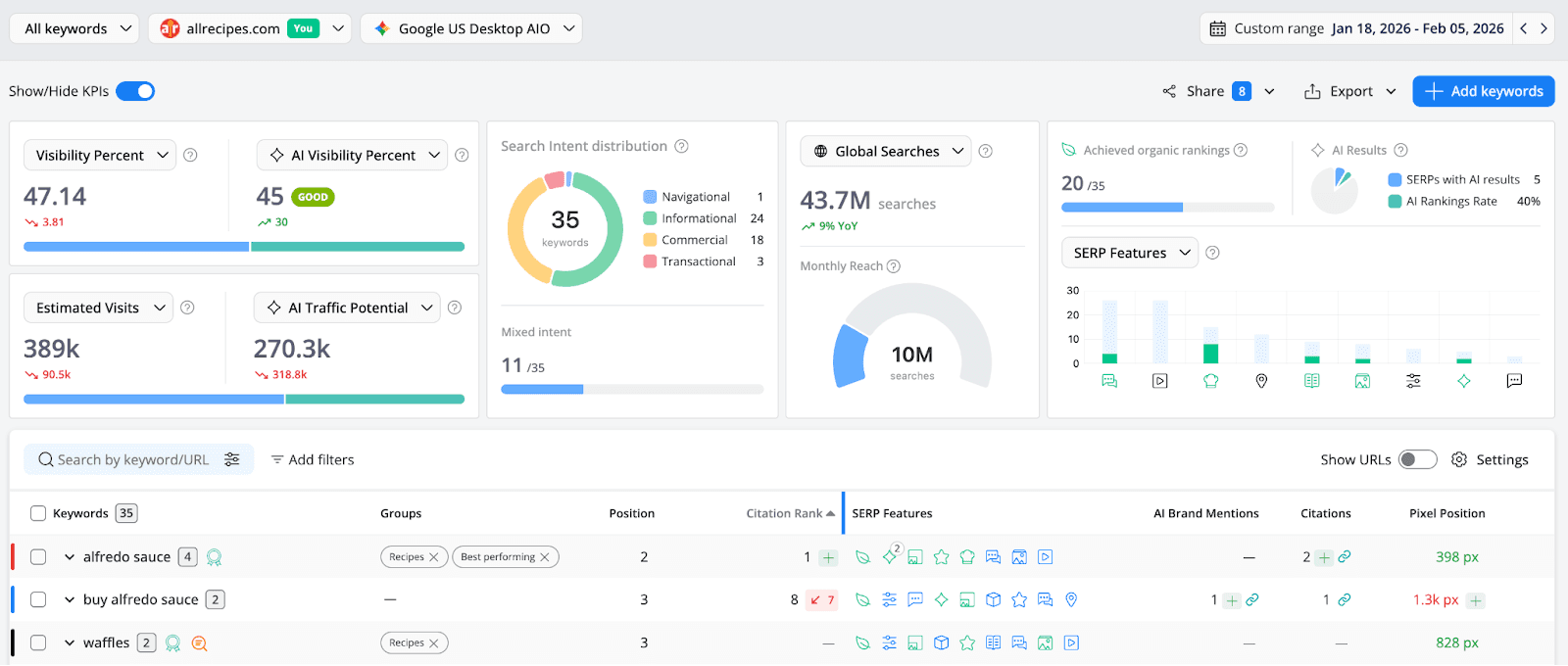
This unified view is essential for teams reporting to clients or leadership. Stakeholders don’t care where visibility or traffic comes from, whether it’s a blue link or an AI-generated answer. They care about the overall picture. AWR gives you one number, one dashboard, one story to tell.
Agencies managing multiple SEO clients can keep reporting and project setup organized by following these onboarding best practices for smoother client management.
Read more about AI Search & Brand Intelligence in AWR and the full Rank Tracker feature set.
On top of that, Brand Intelligence shows you how AI engines perceive your brand, across ChatGPT, Claude, Gemini, and Perplexity. There are three reports behind it.
Brands starts from the brand you're tracking. You either pick from the topics AWR suggests or add your own, and for each one you get the brands that come up alongside yours. You can narrow by location and language, as the set of brands you're compared to can look quite different from one market to the next. The Brands report is usually where you first notice a newcomer moving into your space.
Topics lists every topic AI engines connect to your brand, ranked by association strength. You find out what your brand is actually known for, and which nearby themes you could claim but aren't linked to yet, which makes it a good place to start when you're deciding what to write next.
Citations covers the sources. Every association an AI engine makes comes from somewhere, so this report lists the domains and pages it draws on when describing your brand, and you can see which sources influence its answers the most.
More detail on the Brand Intelligence feature page.
2. AI Mode and LLM Tracking
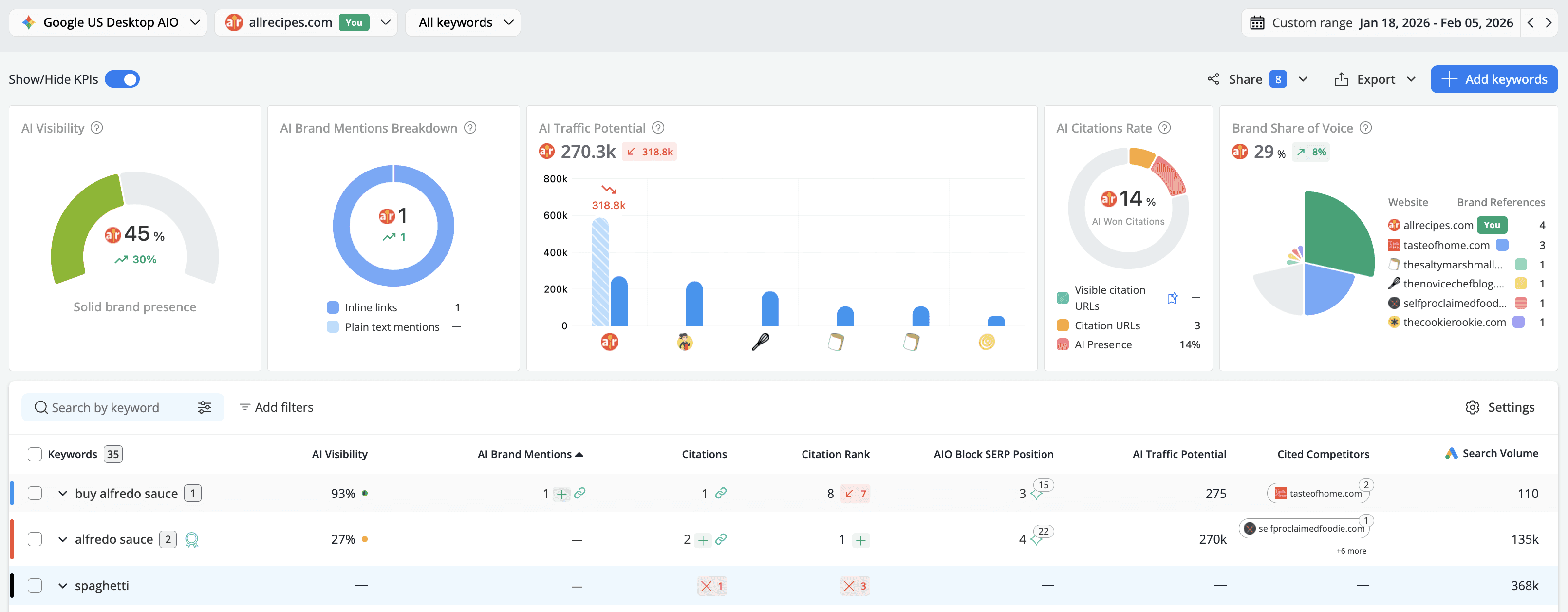
Google’s AI Mode, ChatGPT Search, and Perplexity are all generating answers that either reference your content or skip it entirely. AWR tracks your brand’s presence across these platforms, allowing you to analyze performance for each AI engine.
You can see which of your tracked keywords trigger AI results, how often your brand appears, and how your visibility evolves over time. AWR pulls real AI responses based on your keyword set, helping you understand where you stand in AI-driven search.
Explore ChatGPT Tracking in AWR, AI Mode tracking for Desktop & Mobile, and Perplexity Tracking in AWR to get started.
3. AI Brand Mentions, Citations, and AIO Citation Rank Reporting
Getting mentioned in an AI-generated answer is one thing. Knowing exactly how, where, and how prominently your brand appears is what actually moves the needle.
AWR tracks this at the keyword level inside the Keyword Ranking report and AI Search Tracking under Keyword Performance. These metrics work with Google search engines that report AI results: Google Universal, Google Search with AIO, and Google AI Mode.
AI Brand Mentions tracks how your brand appears in AI-generated answers triggered for your tracked keywords, whether as plain text mention, inline link, or cited URL.
Citations counts how often your website is listed as a cited source in AI answer snippets.
AIO Citation Rank shows your position within the Google AI Overview citation block, so you know not just whether you're cited, but where.

They give you a complete read on your AI visibility inside Google: from whether your brand gets mentioned at all, down to the exact position your content holds inside an AI Overview. Explore AI Brand Mentions and AIO Citation Rank for the full detail.
4. Highly Accurate Rankings, Down to Street Level
AWR has been tracking rankings since 2002. That’s 20+ years of refining data collection methods, proxy rotation, browser emulation, and search engine definition updates (refreshed every 24 hours) to keep accuracy as tight as it gets.
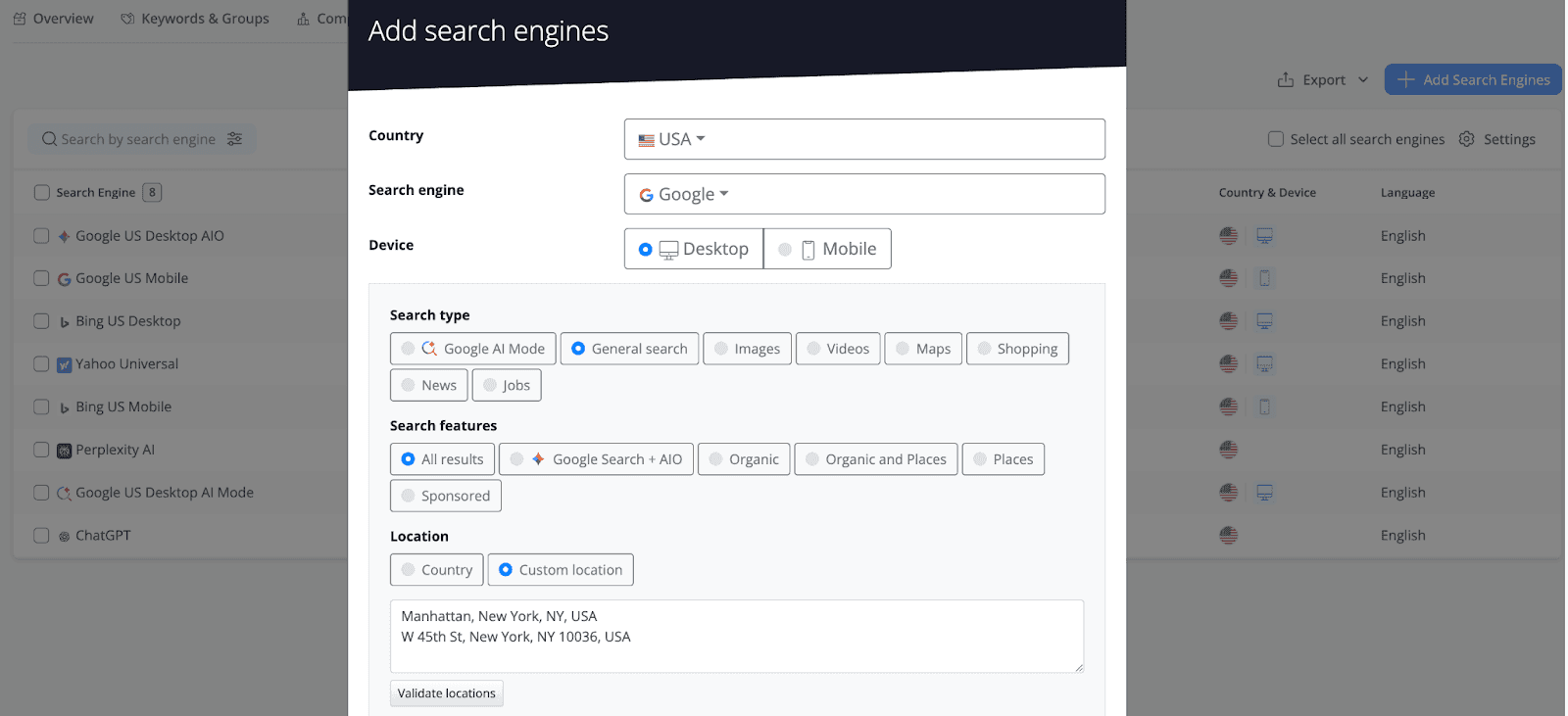
Rankings can be checked at the country, city, or even down to street level for precise local tracking. You can pull SERP HTML snapshots for manual verification, and track pixel positions to see exactly where your rankings are located on the search results pages: above the fold, below it, or pushed down by SERP features. Keyword Ranking KPIs and the SERP Movements feature are good places to dig in.
5. SEO Forecasting and ROI Projection
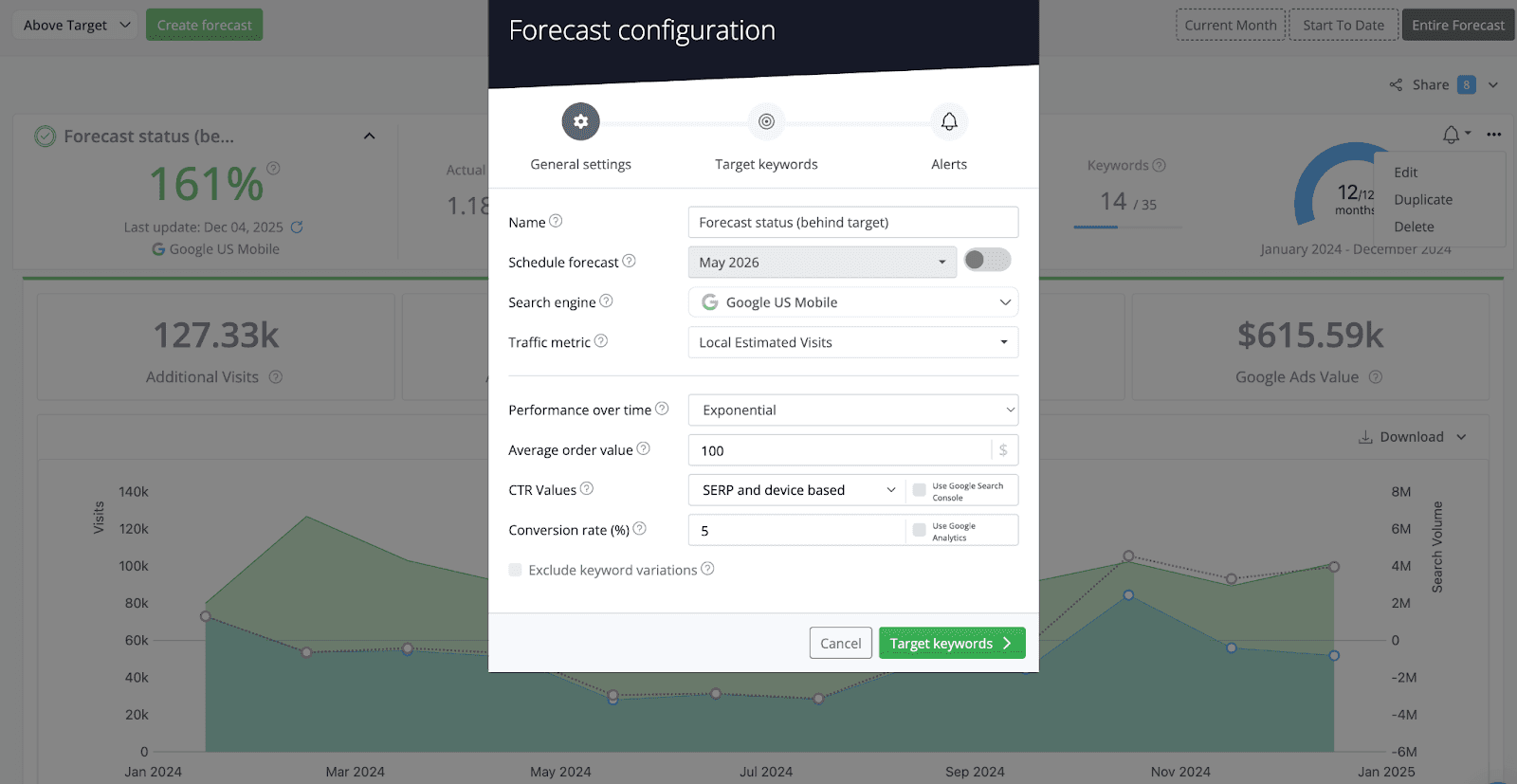
Winning new clients or getting budget approval requires numbers, not opinions. AWR’s SEO Forecasting tool lets you project organic traffic, estimate conversions, and calculate the revenue impact of ranking improvements.
You can build forecasts using first-party or third-party data (including Google Analytics and Search Console), factor in seasonality trends by device and location, and model linear or exponential growth scenarios for up to 24 months.
Start with Forecasting in AWR or visit the SEO Forecasting feature page for the full picture.
6. SERP Volatility & Similarity Analysis
Algorithm updates don’t announce themselves. AWR’s volatility metrics measure how much the top-ranking URLs fluctuate between updates for every keyword you track, giving you an early signal that something has shifted before your organic traffic tells you. High volatility signals that rankings are in flux, and that you need to act.
The SERP Similarity report lets you compare two SERPs side by side across different dates, devices, or markets to spot ranking changes, intent shifts, and SERP feature differences.
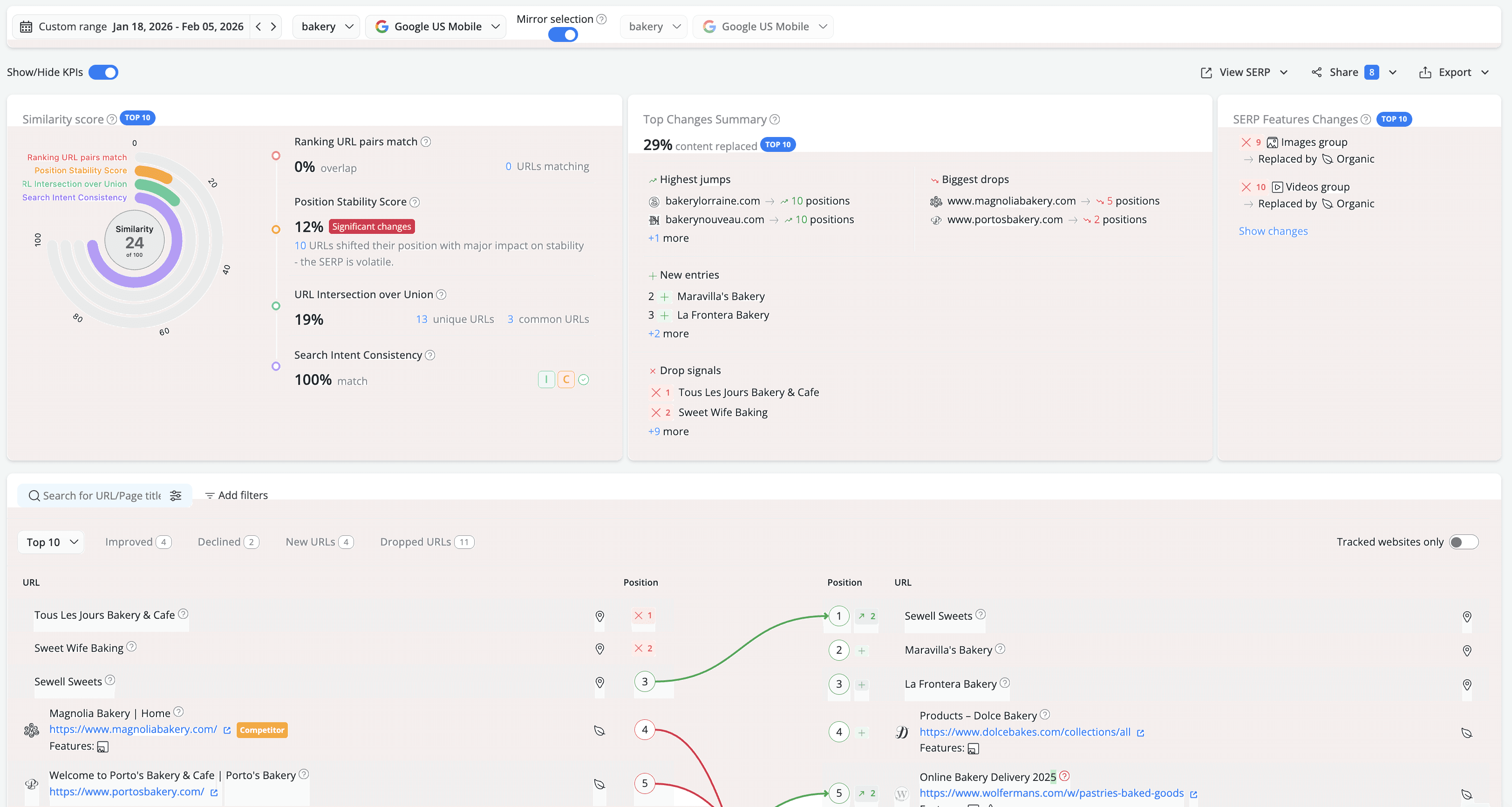
It's particularly useful for understanding whether a traffic drop is a ranking problem or an intent change. The SERP Similarity Report and SERP Volatility in Top Sites articles cover both in detail.
7. Unlimited Historical Data
Ranking trends only make sense in context, and context requires historical data. AWR stores your complete ranking history for as long as you're a customer, with no data retention limits on higher plans.
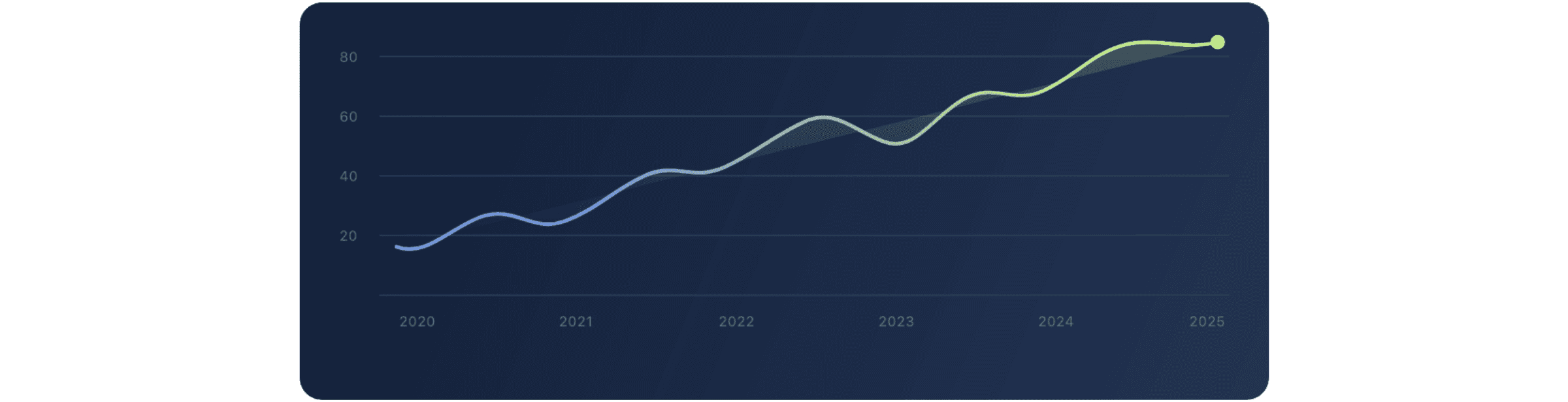
Switching from another tool? AWR has a dedicated migration team that can import your historical ranking data so you don't start from scratch and there's no gap in continuity. That continuity is critical for agencies managing long-running client campaigns.
The Getting Started guide has everything you need to hit the ground running.
8. Deep Keyword Intelligence
AWR goes well beyond basic rank position reporting. For every keyword, you get search intent classification, keyword difficulty scores broken down into URL Difficulty, Domain Difficulty, Content Score, and a Global Difficulty that combines all three, cannibalization detection, dynamic keyword groups, click share estimates, and CTR trends weighted by SERP feature presence.
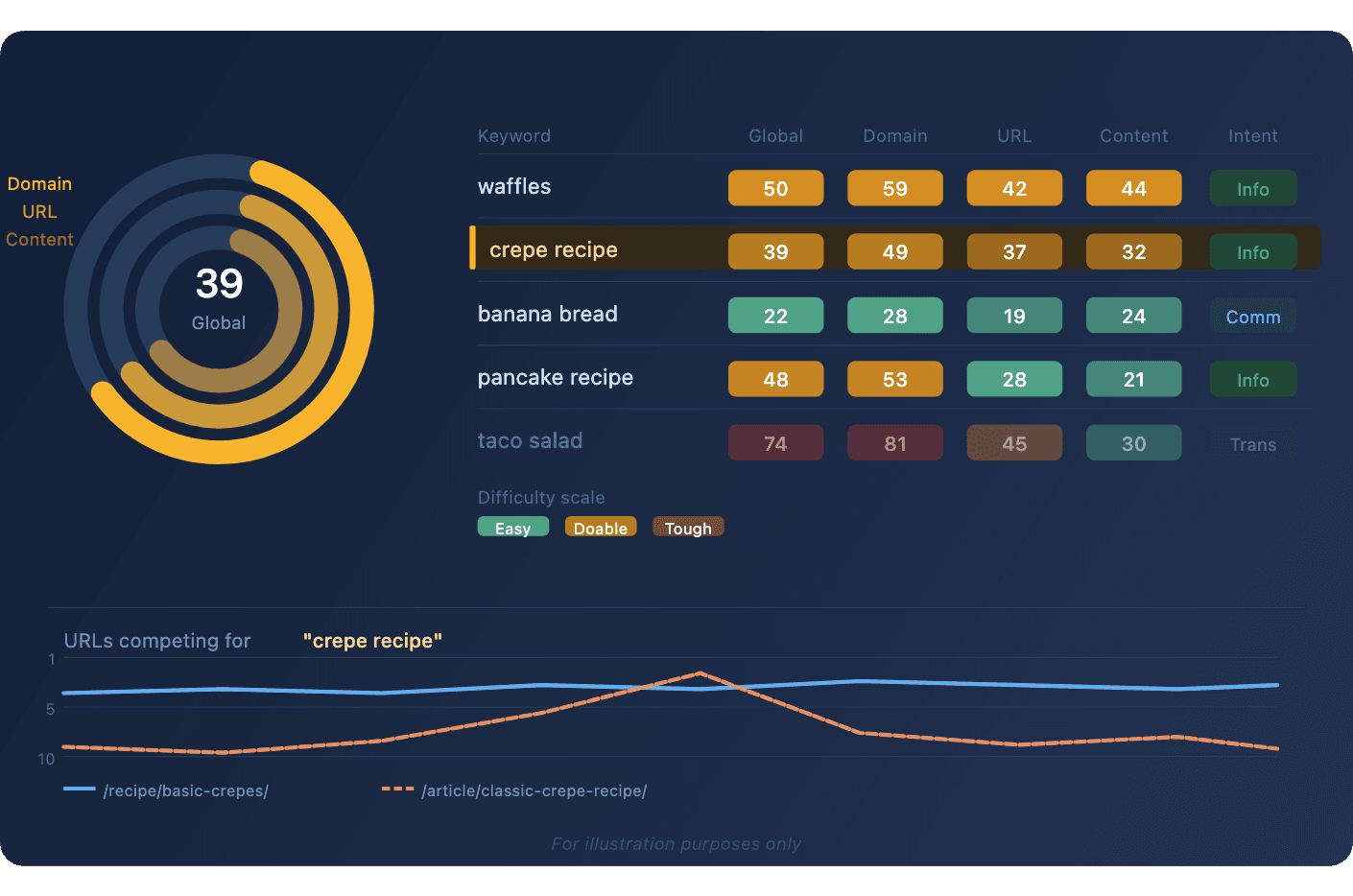
The cannibalization filter deserves a special mention as it flags when multiple pages on your site are competing for the same keyword and intent, one of the most common causes of unexplained ranking ceilings at scale.
Explore the Cannibalization filter, Keyword Difficulty, and SERP Features report to see how to put them to work.
9. 4,000+ Search Engines Across 170+ Countries
AWR covers two distinct categories of search engines, giving you a complete picture of where your content ranks across both traditional and AI-driven search.
Traditional search engines include major platforms like Google, Bing, Yahoo, and DuckDuckGo, dedicated engines like Amazon and YouTube, country-specific engines like Baidu, and custom location-based engines that let you track rankings down to zip code or street address in any country where Google is supported. All tracking is available across desktop and mobile.
AI search engines include Google AI Mode, ChatGPT, and Perplexity, with support continuing to grow as AI search evolves. Availability depends on the platform and target country.
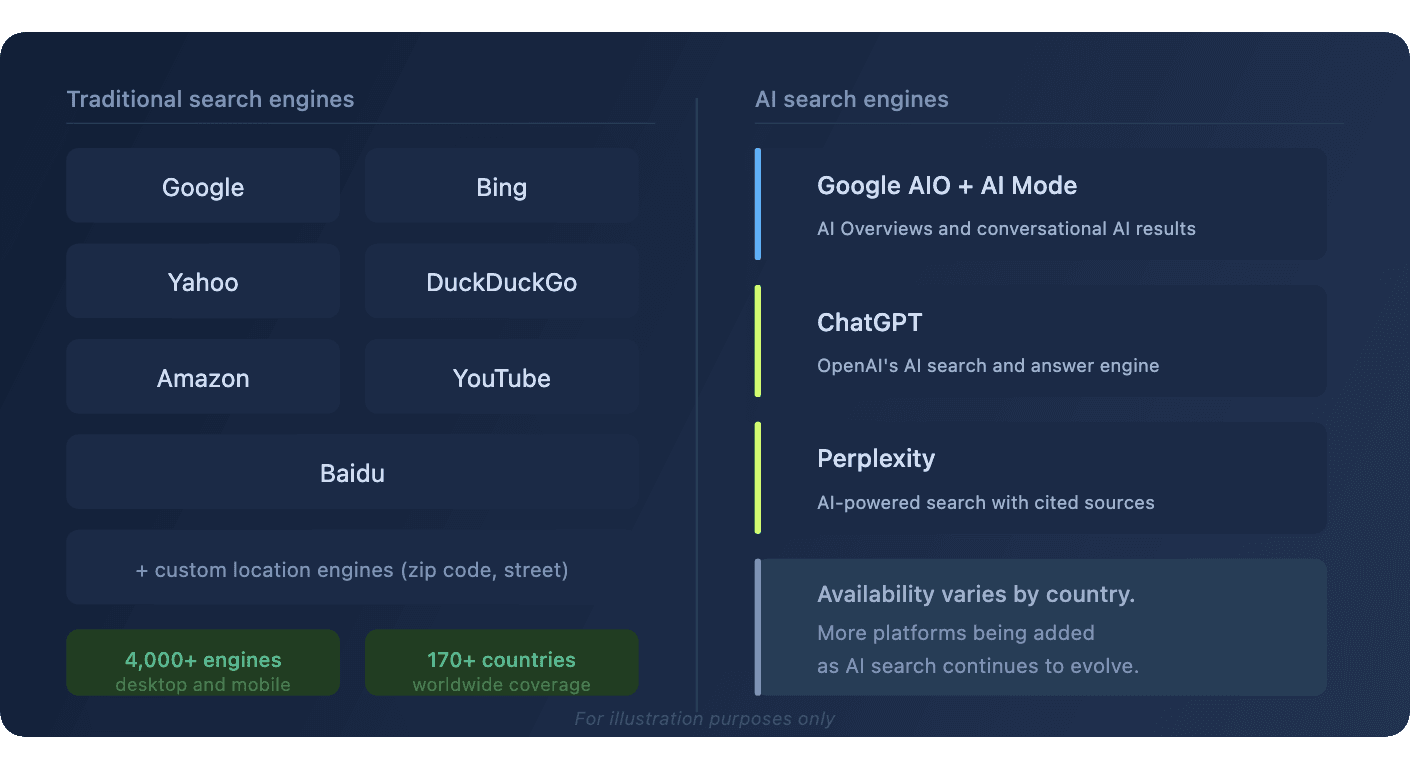
See the full breakdown in Search Engines in AWR and the Supported AI Search Engines guides.
10. Fully Customizable White-Label Reports
Whether you're reporting to clients, stakeholders, or an internal team, AWR's reporting engine is built to make that process faster and more professional. You can create fully branded reports with your own logo, colors, and custom domain, sent from your own email address. The result looks and feels like your own reporting tool, with no AWR branding in sight. The Whitelabel documentation section walks you through the full setup.
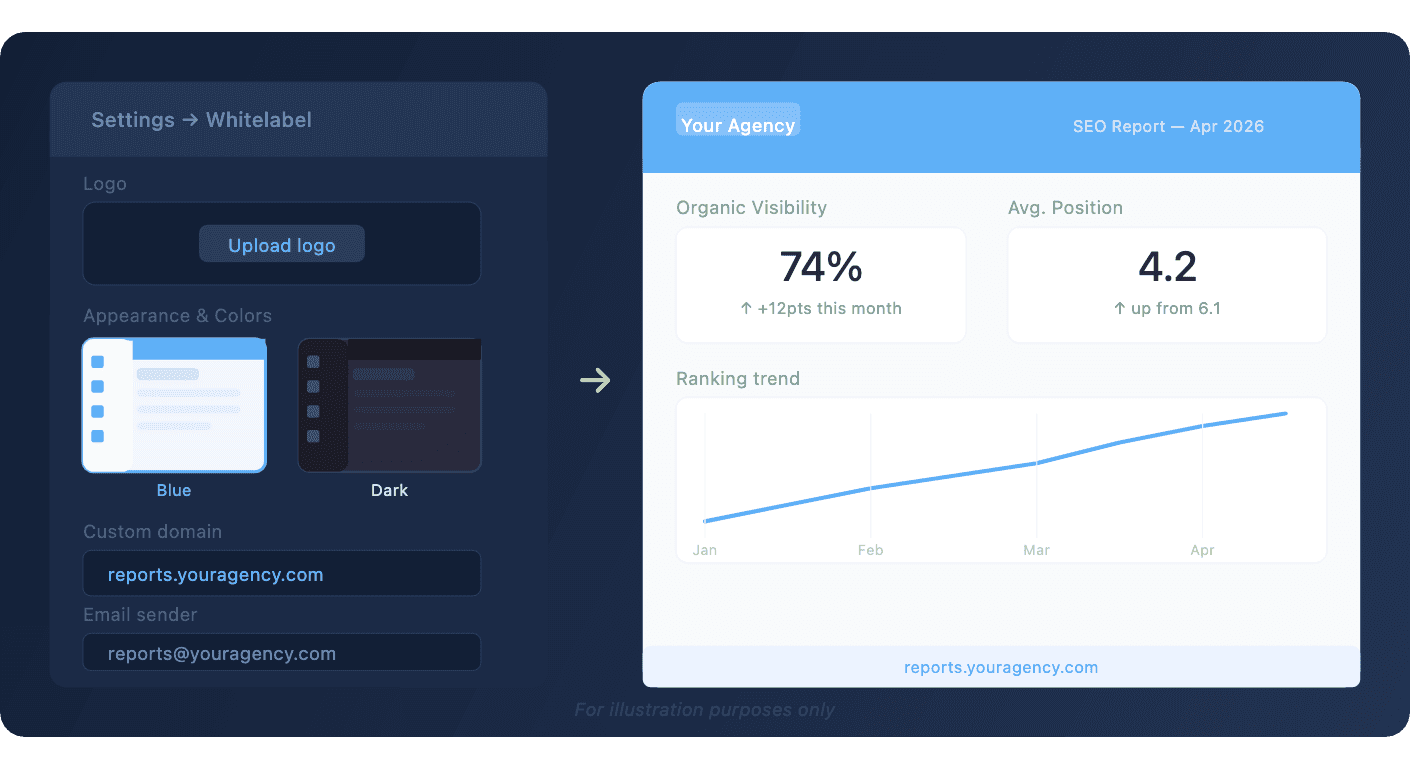
The WYSIWYG report builder supports drag-and-drop widgets, custom KPIs, scheduled delivery, and PDF export.
But if you prefer working in external tools, AWR data can be exported to third-party apps such as Looker Studio, TapClicks, BigQuery, Google Drive, or Slack via direct connectors, FTP, or the Developer API. See Dashboards & Reports and the full list of Third-Party Integrations for setup guides.
11. Developer API and MCP Server
AWR's Developer API gives full programmatic access to your ranking data, useful for building custom dashboards, feeding data warehouses, or connecting internal tools.
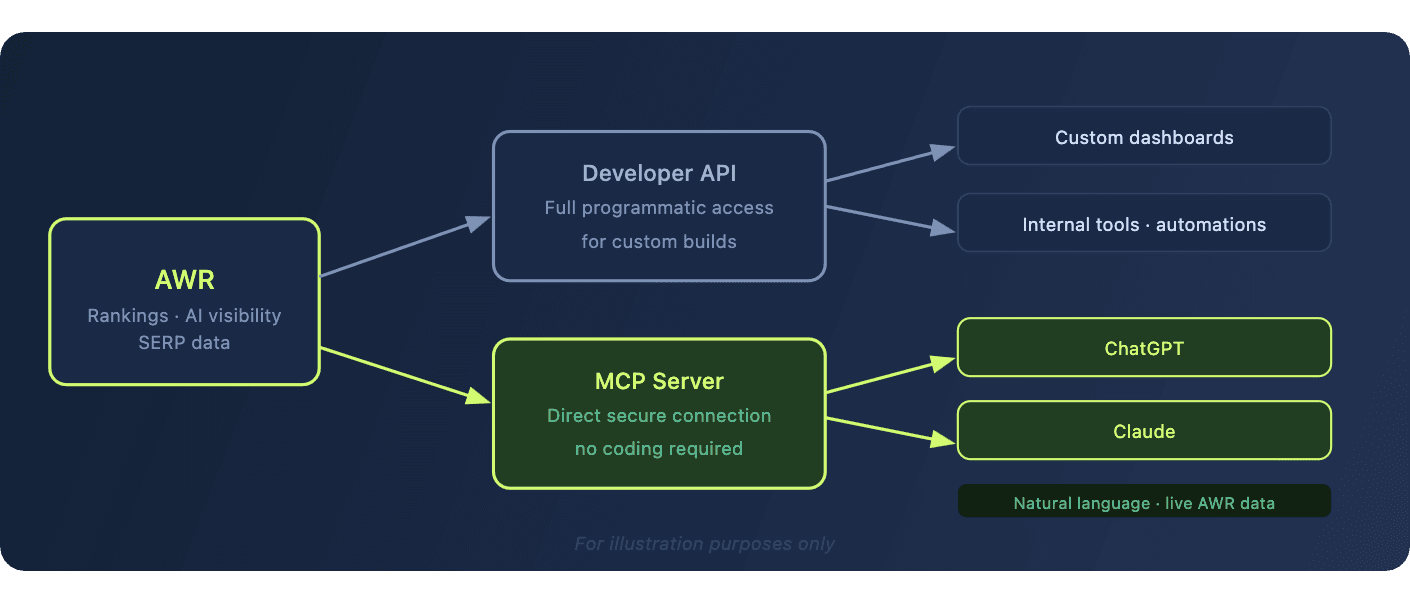
The AWR MCP Server takes this further: it lets you pipe your AWR data directly into AI tools like ChatGPT and Claude. Ask natural-language questions about your rankings and get answers backed by live AWR data. It's a genuinely new kind of workflow for SEO analysis, and currently unique to AWR. The AWR MCP Server guide and Developer API are the best starting points.
12. Competitor Intelligence
With AWR you can monitor up to 50 competitors per project at no additional cost. You'll see their keyword rankings, visibility trends, market share, SERP feature wins, and how they perform in both traditional and AI search, all in direct comparison with your own performance.
The competitor discovery feature automatically surfaces sites competing for your keyword set, so you're not missing rivals you didn't think to track. The Market Share view gives you an honest read on where you stand relative to the competitive landscape, not just how your individual rankings look.
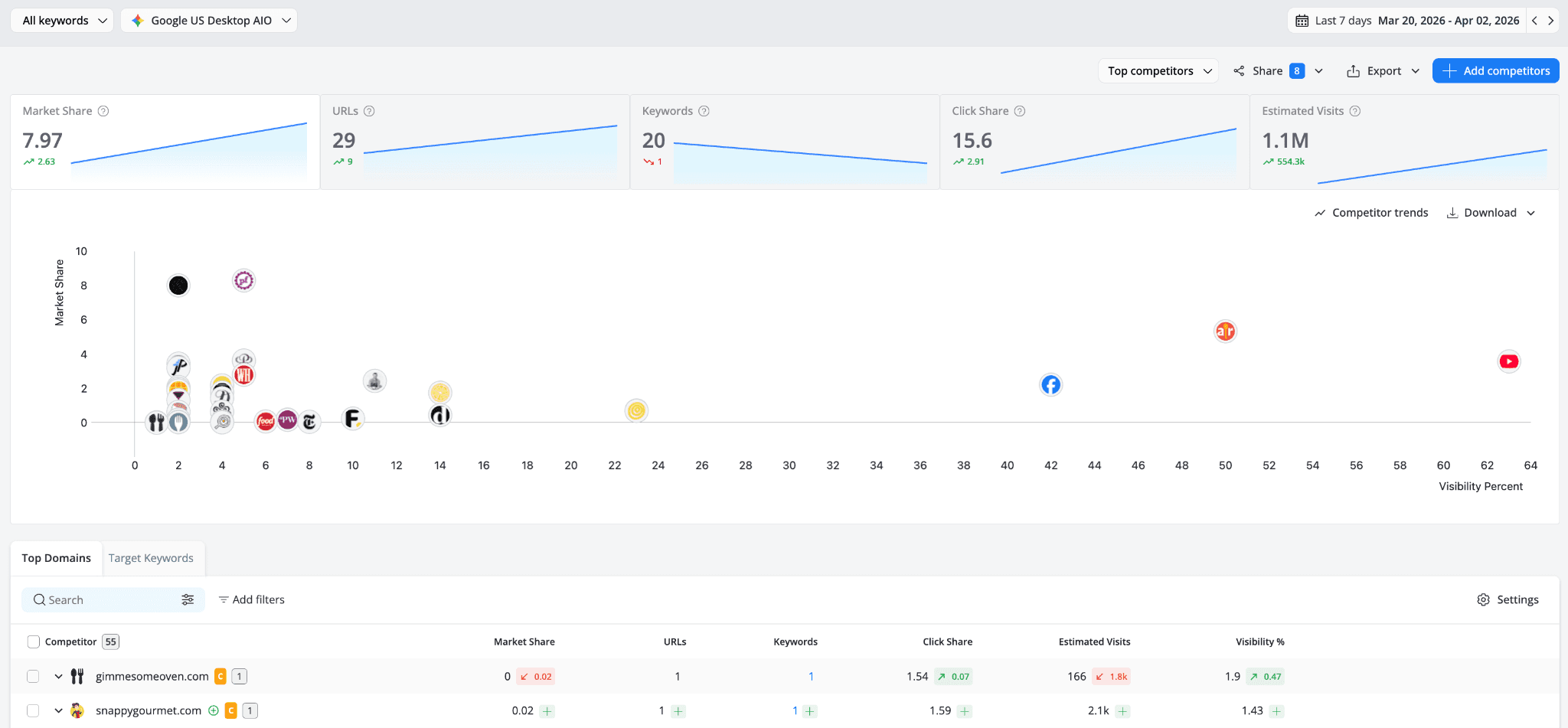
Check the Competitive Insights help section and the Competitor Analysis feature page for full details.
3 Things That Make AWR Truly Stand Out
Plenty of tools track rankings. Fewer do it well. Only one has been doing it for over 20 years while also building genuine AI search visibility and Brand Intelligence into the core product. Here's what actually differentiates AWR.
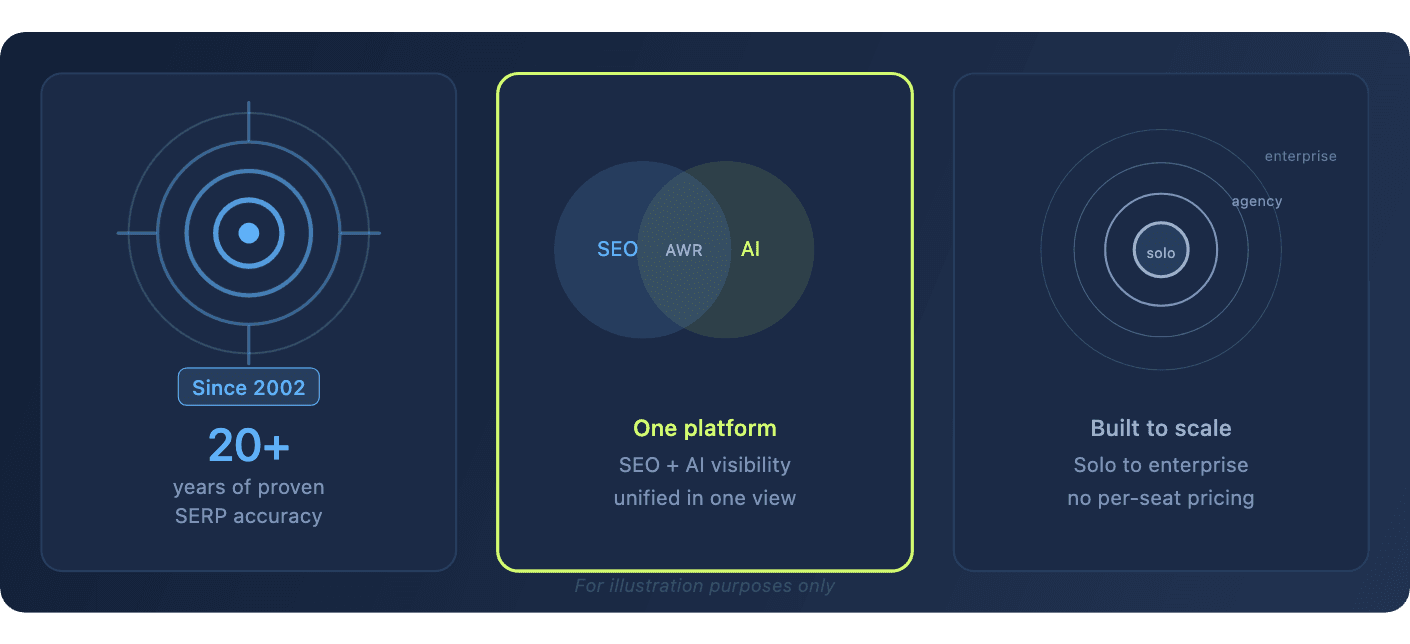
20+ Years of Proven SERP Accuracy
No other platform has been operating as long. That track record isn't nostalgia; it translates to data collection infrastructure, proxy networks, and parsing reliability that newer tools simply haven't had time to build. When the data matters, and in SEO it always does, accuracy isn't a nice-to-have.
The Only Platform Where SEO, AI Search, and Brand Intelligence Sit in One Place
While competitors bolt on AI features as afterthoughts, AWR built AI search visibility and Brand Intelligence as core modules from the ground up. You get traditional rankings, AI search presence, and brand perception in one project, not three separate tools patched together.
Enterprise-Grade Scalability with Agency-Friendly PricingUnlimited projects, unlimited users, no per-seat pricing. White-label everything. SSO, custom SLAs, dedicated account managers, and security audits for teams that need them. AWR scales from a solo consultant all the way to enterprise teams managing hundreds of thousands of keywords, without the pricing structure that usually comes with that kind of scale.
What AWR Users Actually Say
The feedback that comes up most from AWR users isn't only about the features. It's also about data reliability and how long the tool has been part of people's workflows. Agencies that have been with AWR for 5, 8, 12 years or more aren't staying out of habit.
They're staying because the ranking data is accurate, consistent, and proves itself right on repeat, and because the platform keeps evolving without making existing workflows obsolete. See for yourself in the AWR case studies and customer testimonials.
Ready to Explore AWR?
If you're already a customer, this list is your starting point. Pick one feature you haven't explored yet and give it a proper try. Chances are, it'll change how you work.
If you're still evaluating tools, jump in with a free trial. No credit card needed.
stay in the loop