

Advice and answers from the Advanced Web Ranking Team
Search for articles
Local rank tracking: track the places your customers search from
A country-wide Google engine lands somewhere different every update. Region and city tracking fixes what you measure, with live data and how to set up in AWR

In September we explained why tracked rankings no longer match what you see in Google. This guide is the practical half: what a country-wide engine measures today, shown on our own live test project across a week of daily updates, and how to set up tracking so the numbers describe your market.
In short
In practice Google answers every query for a place. A country-wide rank-tracking engine gives Google no place, so it answers from wherever the request appears to come from, which the tracker has no way to hold constant between updates. Track the regions or cities your customers search from, one engine per place, and keep the country engine, if at all, as an annotated trend line. In Advanced Web Ranking (AWR) this is one setting on a Google engine: turn on Track specific locations and pick from the Regions and Cities lists for the country.

The Add search engines modal with Track specific locations on, and the Locations field listing Regions.
Key takeaways
A "US" SERP is a page for a place you did not choose.
On our own live test project, the country-wide engine's top 20 for "furnace repair near me" shared no URLs between the Oct 5 and Oct 12, 2026 updates. One week it was national brands plus eight cities; the next it was twenty local pages from fourteen states.For a local business, country-wide tracking hides most of what it ranks for.
Over five weekly updates, the same project ranked at least once for 267 of its 322 keywords from Manassas, VA, and for 82 of them on the country-wide engine. Brooks is #1 or #2 in its town and "not ranked" nationally for the same query.A fixed location makes bad pages visible. On Oct 12 the Manassas engine received a page whose local pack was right and whose organic results came from twelve other states. Against the previous week's fully local page, the artefact is obvious. On the country engine the same artefact looks like any other update.
Location fixes what you measure. Collection quality is a separate problem.
Industry data from September shows location-targeted and national requests received altered pages at the same rate. Detecting those pages is the tracker's job, and it is still being worked on across the industry, AWR included. On this project, five of the seven daily updates between Oct 14 and 20 were degraded in some form, on every engine.
What changed between country tracking and 2026
For most of the last decade, a Google search for "furnace repair" from anywhere in the United States, with no precise location, returned something close to a national page. Rank trackers were built on that assumption: one country engine per market, one position per keyword.
Three things removed that assumption, all covered in the September article: the country domains folded into google.com in April 2025, ranking became hyper-local even for queries with no local intent, and since mid-September 2026 Google has been serving blocked, truncated or altered pages to traffic it does not trust.
For a country engine the consequence is the same across the three: the request carries no precise location, so Google answers it for the place it infers from the request, which changes with the IP the tracker uses. The position you get back is real, but it is the position for a place you did not choose and will not get again next week.
What a country-wide engine measures
The data below comes from one AWR project, our own test project for Brooks Heating & Air (brookshvac.com), a heating and air-conditioning company in Manassas, Virginia, tracking 322 keywords, most of them service terms such as "furnace repair near me" or "hvac repair manassas".
The project runs two Google desktop engines on the same keyword set: Google US, country-wide, on Google Search + AIO, and Google US · Manassas, VA, pinned to the city, on Google Search.
The weekly figures are from the updates between Sep 14 and Oct 12, 2026, a window that contains Google's September spam update (Sep 24 to Oct 8) and the anti-automation measures reported across the industry.
On Oct 13 we added three engines of the same type as the country engine (Google Search + AIO) with daily updates: Google US · Virginia (a region), Google US · San Diego and Google US · Chicago (cities). Findings 3 and 4 follow them day by day to Oct 20.
Engine | Location | Search type | Updates |
|---|---|---|---|
Google US | Country-wide (no location) | Search + AIO | Weekly |
Google US · Manassas, VA | City | Search | Weekly |
Google US · Virginia | Region | Search + AIO | Daily, from Oct 13 |
Google US · San Diego | City | Search + AIO | Daily, from Oct 13 |
Google US · Chicago | City | Search + AIO | Daily, from Oct 13 |
Both engine types report the organic positions alongside featured snippets, local packs and the other result types on the SERP. Google Search + AIO additionally tracks positions inside the AI Overview block when Google shows one, though that data is not part of this study. The organic positions are comparable between the two engine types, which is what Finding 4 uses for its like-for-like transitions.
Four findings from our own test project
Finding 1. The country-wide engine returned a different page every week
In the Top Sites report for "furnace repair near me" on the country-wide engine, three consecutive updates returned three different pages, with one URL in common across all of them.
On Oct 5 the top 20 was a mix of national pages and towns:
National: Carrier's furnace-repair page, Angi, Home Depot, Lennox's dealer locator, the BBB, Trane's locator
Local pages from: Duluth MN, Grayson GA, Chicago IL, Baltimore MD, Mentor OH, Grand Rapids MI, White Bear MN, Dover DE, Pittsburgh PA
On Oct 12 the top 20 shared no URL with the week before: twenty results from fourteen states, no national HVAC brands.
Positions 1 to 3: three Colorado results - All American Heating at #1, then Carbon Valley Heating and Air's pages for Firestone and Frederick
Positions 4 to 20: a Yelp list for Fulton NY, a Maryland contractor, Cleveland OH, Wisconsin, New Market MD, Marietta GA, Syracuse UT, a Facebook group in Wareham MA, Thumbtack for Culver City CA, Mesquite TX, Kresgeville PA, Bristol CT, Portland ME, Waynesville MO, Wareham again and Highlandville MO

Two days later, on Oct 14, the page changed again. All American Heating kept position 1 in the local pack, now with My Buddy Plumbing and Heat and Elite Hvac Contractors beside it (three Colorado businesses), and the organic list underneath was replaced in full: a Yelp list for Henderson KY, a contractor in Tulsa OK, Yelp for Worcester MA, a Yahoo listing for Lake Charles LA, Bennington NE, Yelp for Bremerton WA, a Broadly listing, Yelp for Clearwater KS, Rockford MN and McHenry County IL.
Neither page is wrong. Each is Google's answer for some place on that day. The engine cannot tell you which place, and nothing in either page tells you which of the two, if either, was also an altered page served to an automated request. A position recorded on this engine is a position in a city that changes every update. For "ac air conditioner repair", a keyword with no "near me", the Oct 12 top 10 came from Arizona, Oregon, California, California, Florida, Texas, South Carolina and Texas; the keyword's volatility score in AWR was 10 out of 10 for the month.
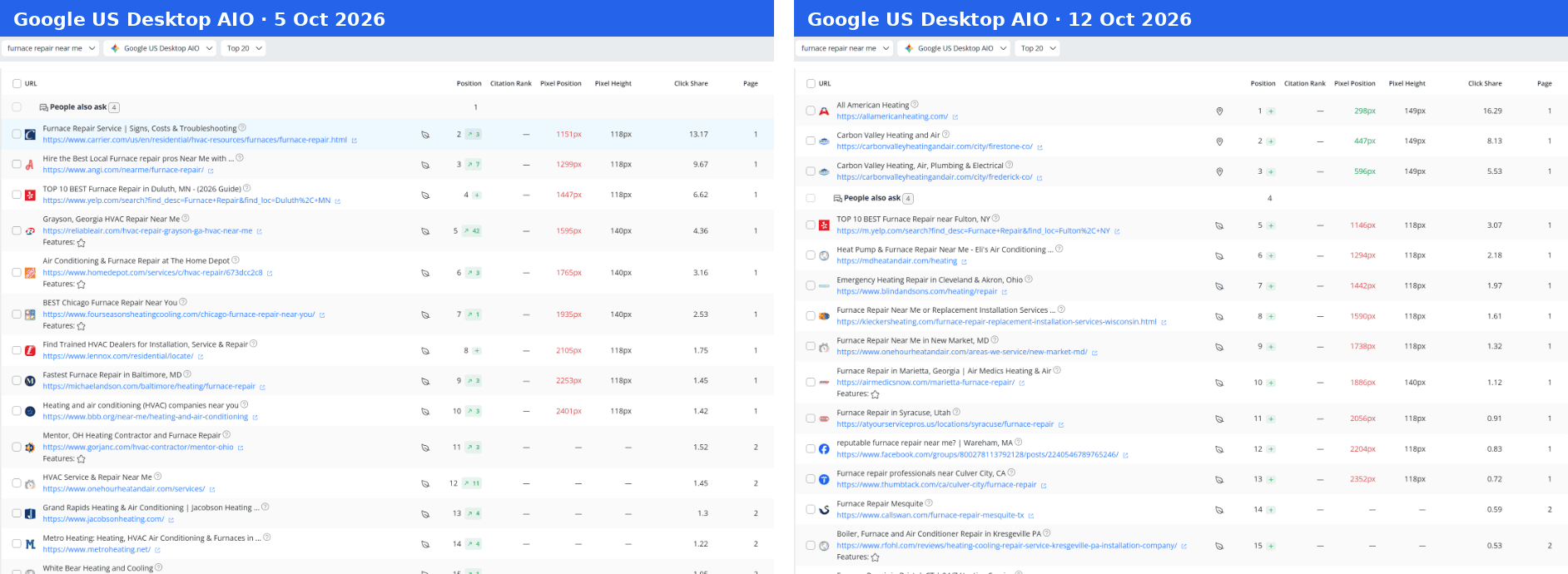
Top Sites, "furnace repair near me", Google US Desktop AIO: Oct 5 (left) and Oct 12 (right). No URL in common.

The same report on Oct 12 (left) and Oct 14 (right): the Colorado local pack stays, the organic list is replaced again.
Finding 2. For a local business, country-wide tracking reports "not ranked" for most of what it ranks for
Across the five weekly updates, the Manassas engine returned a position for 267 of the project's 322 keywords at least once, and for 99 of them every week. The country-wide engine returned a position for only 82 at least once, and 57 every week. That leaves 240 keywords that never ranked country-wide, and 185 of them did rank from Manassas at least once, so a country-wide report keeps them in the "not ranked" column while the city sees them.
The gap stays in the top 10: 133 to 161 keywords from Manassas across the five weeks, 49 to 61 country-wide, with 160 vs 53 on Oct 12 (the altered-page day in Finding 1). On the country engine the ranked count also fell from 77 to 62 between Oct 5 and Oct 12, with 15 drop-outs in one update, consistent with the industry reports from that week.

For a business that serves one metro area, the two engines answer different questions. "Does the site rank for furnace repair near me in the United States" has no useful answer, because in practice nobody searches from the United States. The Manassas engine answers the question the business is asking. In Search Engines Comparison, with both engines as columns, the gap is the first thing you see.

Search Engines Comparison, keywords containing "manassas": position 1 on every engine, with the month's change next to each position. The three daily engines show "+" because Oct 14 is their first full update.
Finding 3. With the location fixed, an altered page is visible. Without it, it is just another update.
Now the same two dates on the Manassas engine.
On Oct 5 the page was entirely local: twenty results, twenty Manassas pages. That is the page a customer in Manassas gets.
Local pack: Hudson's, Brooks, Express Tech Air
Organic: Yelp for Manassas, Alex HVAC, United Air Temp, Turner's, Leonard's Plaine, Falcon, ConsumerAffairs' Manassas list, F.H. Furr, Angi for Manassas, Brennan's, Mannix, Virginia Air, Brooks' Yelp listing, JSJ, Twin Air
On Oct 12 the local pack was still Manassas, with Brooks at #1, but the organic results below were replaced by the same scatter the country engine shows every week.
Local pack: Brooks, Hudson's, Express Tech Air (all Manassas)
Organic: Jim Thorpe PA, Naugatuck CT, Uniontown PA, Muskegon MI, Harwich MA, New York, Pleasant Grove UT, Kennesaw GA, Cleveland OH, Apple Valley MN, Dover AR and so on
On Oct 14, two days later, the Manassas page was local again from top to bottom: the same local pack, then Yelp for Manassas, United Air Temp, Alex HVAC, Falcon, Turner's, ConsumerAffairs' Manassas list, F.H. Furr, LocalProBook for Manassas. The recovery lasted one update, with the degraded days returning on Oct 15.

The Oct 12 page has the signature Nozzle described on Oct 10 in its study of 27.5 million SERPs: a complete, normal-looking page whose organic results have been replaced, with the usual sites gone and lists, social and directory pages in their place. Nozzle found 8.0% of SERPs altered this way since Sep 13, a peak of 27% on Sep 29, and 77.9% of them back to normal within three days.
The point of this guide is what the fixed location does with such a page. On the Manassas engine the page can be compared with the previous week's page: SERP Similarity between Oct 5 and Oct 12 is low, the local pack is unchanged, the organic set is implausible for the place, and the next update will most likely restore it, as the Oct 14 update did. Every one of those checks needs a stable reference, and the location is what makes the reference stable. On the country engine the Oct 12 page is indistinguishable from Oct 5's, because both are pages for an unknown place.

View SERP on the Manassas engine, organic positions 5 to 9: Oct 12 (left) is pages from Pennsylvania, Connecticut, Michigan and Massachusetts; Oct 14 (right) is Manassas again.
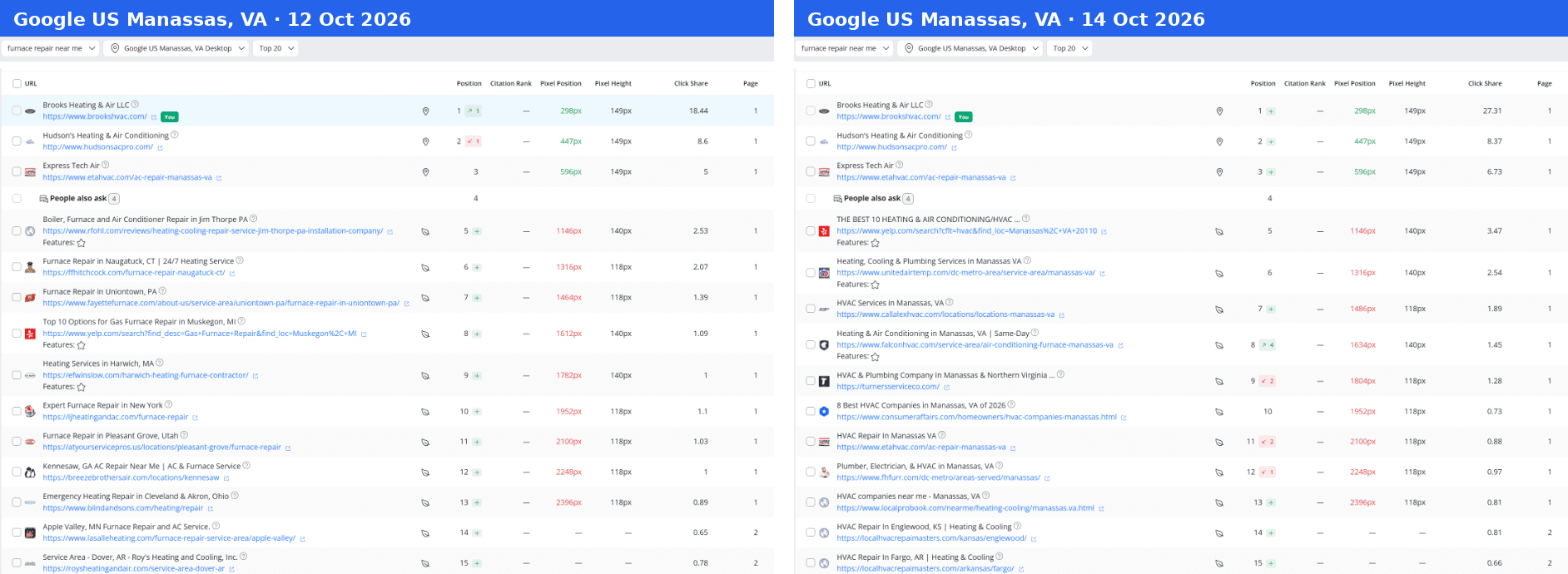
The same two dates in Top Sites: the local pack rows are identical, every organic row on Oct 12 is marked new ("+") and the Oct 14 list is the local set with small moves.
The same signature on the daily engines
The daily updates from Oct 15 showed the same signature in a clearer form. For "hvac manassas virginia", a query Brooks had held at position 1 on all five engines, the Oct 15 pages from the country engine and from Manassas list the right town but the wrong kind of site: Angi, Yelp, Nextdoor, Facebook, three MapQuest listings and manufacturer dealer locators, with Brooks absent from the top 20. The Virginia engine returned a normal page for the same query, with Brooks at #2 in the local pack and #10 organic.
For "furnace repair near me" the Manassas page went further: the local pack stayed Manassas, the first organic results were Yelp lists for Delaware City, DE, Newport News, VA, Mishawaka, IN and Warner Robins, GA, and positions 14 to 20 were pages that merely contain the words "near" and "locations": a USDA service-center locator, Virginia's cooling-centers page, the Amazon listing for "The Singularity Is Near", a DMV locations page, a Chicago library branch called Near North. No person has ever been shown that page. It is what Google serves when it has decided the request is not a person, and it is detectable for exactly the reasons above: the local pack is unchanged, the organic set is implausible for the place, and the previous day's page is the reference. Nozzle's figure for such pages is three days to clear for 78% of them. On this project it did not clear in three days; Finding 4 follows the rest of the week.

The Oct 15 Manassas page for "furnace repair near me": the local pack holds, positions 5 to 13 are out-of-state Yelp lists, positions 14 to 20 match the words "near" and "locations" rather than the query.
The organic side of the degraded days has a second signature, and it lives beyond page 1. On Oct 16 the Manassas page for "furnace repair near me" is local to position 13: the same pack, Yelp for Manassas, Alex HVAC, United Air Temp, Leonard's Plaine, Turner's, Falcon, ConsumerAffairs, Brooks at #12. From position 14 it is Yelp lists for Anniston, MO, Fargo, AR, Henderson, TN, Taos, MO and Shawnee, KS, and from position 24 it is pages that contain the word "me": the NHS page on ME/CFS, r/AMA, a personal site on a .me domain, a song called "I / Me / Myself", "Wiser Than Me", "Marry Me Chicken", "Men Explain Things to Me", then Maine's state sites. Google's own "People also search for" block at the bottom of that page suggests "ME/CFS causes" and "Can you die from ME". A page 3 like that is not a ranking; it is Google answering the tokens of the query rather than the query, and any position a tracker records from it is noise. This is the same mechanism we described in September for positions five to ten pages deep, now visible from page 2.

Page 3 of the Oct 16 Manassas page for "furnace repair near me": results that match the word "me", and Google's own related searches for ME/CFS.
Finding 4. Over a week of daily data, degraded days moved every engine the same way
Findings 2 and 3 are about what is measured. Whether the positions themselves are steadier on a location engine is a separate question, and this project gives a more nuanced answer than yes or no. On the first like-for-like transition, Oct 13 to 14 on the four Search + AIO engines, the location engines were much steadier: on the 38 keywords ranked on all four engines on both days, the position was unchanged for 6 of 38 country-wide and for 27, 32 and 25 of 38 from Virginia, San Diego and Chicago; the mean absolute move was 3.4 positions against 1.2, 0.8 and 1.6. That is the advantage the setup rule promises, and it showed on the one pair of clean days.
Then the degraded days came, and they moved every engine. On Oct 15 every engine in the project lost between a quarter and a third of its ranked keywords in one update: the country engine from 74 to 48, Virginia from 67 to 46, San Diego from 71 to 43, Chicago from 65 to 50 and Manassas from 198 to 129. On Manassas the keywords in the top 3 went from 148 to 17.
From there, the week sorts into two kinds of day. On Oct 14 and again on Oct 19, Brooks held its local-pack position on the place-named queries on every engine: 148 and 124 keywords in the top 3 from Manassas, 57 to 69 and 21 to 31 on the four Search + AIO engines. On Oct 15, 16, 17, 18 and 20 it was in almost no local pack on any engine: between 0 and 17 keywords in the top 3 from Manassas, 2 to 11 on the others. The organic positions did not vanish with the pack. For "hvac manassas virginia" on Oct 17 the Manassas page is a plausible Manassas page, with Express Tech Air, Twin Air and Davis Ford in the pack and Brooks at #9 organic; on Oct 14 and 19 the same query has Brooks at #1 in the pack. The pattern is identical on the country-wide engine, which has no location at all, so it is not something the location did; it is something Google did on those days to every request from the tracker, and we do not yet know whether the business's listing changed on Google's side or whether the pages served to automated requests carry a different pack. Both are being checked.

Dates Comparison, Oct 12 to 20, Manassas engine (top) and country-wide engine (bottom): full columns on Oct 14 and 19, dashes on the days between, the same shape on both engines
Across the six daily transitions from Oct 14 to 20, the share of positions unchanged day to day ranged from 20% to 62% on the country engine and from 0% to 57% on the three location engines; drop-outs per day ran at 9 to 28 keywords country-wide and 7 to 30 on the locations; the mean absolute move on the keywords ranked on both days was 1.5 to 4.3 positions country-wide and 1.5 to 7.6 on the locations. Of the keywords ranked on Oct 14, 32 of 74 were still ranked on the country engine on Oct 20, and 31 of 67, 31 of 71 and 24 of 65 on the location engines. The Manassas engine, which carries the local pack for the generic "near me" queries, swung hardest: 198 ranked on Oct 14, 101 on Oct 18, 183 on Oct 19, 104 on Oct 20.

Nozzle found location-targeted and national requests altered at the same rate, 7.5% against 7.4%. This week, on this one project, every engine saw the same shape of week, five degraded days out of seven. The location does not protect a tracker from Google's bot-facing pages, and we will not claim that it does. What it changes is what the movement means. On a country engine, two consecutive updates compare two different places, so a move from 3 to 9 can be Denver against Tampa, and a degraded day is indistinguishable from an ordinary one. On a location engine, two updates compare the same place, so a move from 3 to 9 is either a real change or a collection artefact, and the next update, the unchanged local pack, the implausible organic set and Search Console tell you which. On this project the week reads as two clean days and five degraded ones precisely because the reference was fixed; on the country engine alone it would read as a site that lost half its rankings and got them back twice. Fixing the location removes the one source of ranking fluctuations that is yours to control. It is also the precondition for detecting the ones that are not.
Where to track: a setup rule per business
Three definitions, then the rule.
Country-wide tracking is an engine with no location: Google answers from wherever the request appears to come from, which changes with every update.
Region tracking pins the engine to a first-level division of the country, such as a US state, an English region, a German Land or a Japanese prefecture, and Google answers as it would for a searcher located there.
City tracking pins the engine to a city, and Google answers as it would for a searcher there, local pack included.
The rule: track where your revenue comes from, at the granularity Google uses to answer those queries.
Business | Track | Why |
|---|---|---|
Single-location service business | One city engine per city served; mobile and desktop as separate engines where mobile matters | Customers search from one place; the local pack is the result that pays. |
Multi-location brand | One city engine per location, grouped; a region engine per state or province for the brand terms | Each location competes in its own SERP; region engines show the brand across the territory with less single-city noise. |
National e-commerce or SaaS | Three to five region or major-city engines spread across the markets that convert, with Search Console as the national reference | A small fixed set of anchors gives a repeatable national view; the median across them is your "national" position. |
Agency reporting to a local client | The client's city or service area; the country engine only as an annotated trend line, if at all | The client compares the report with what they see on their phone. Give them the page they see. |
International brand | One or two region engines per country, chosen where the audience is (England and Scotland rather than "UK"; Bavaria and North Rhine-Westphalia rather than "Germany") | Markets that are large and dense are where a country engine lands somewhere different most often. |
Two practical limits. Each location is its own search engine and uses units like any engine, so a chain with 40 stores tracks its priority keywords per store rather than the whole list everywhere. And a region engine is a request from inside the region; treat it as "a searcher in Virginia" and confirm with a city engine where a specific metro matters.
Setting it up in AWR
Location tracking in AWR is the Track specific locations toggle on a Google engine, for any of the countries AWR covers. Until now you typed each location. With the new location picker, each country comes with two curated lists, Regions and Cities, and typed locations are validated before they are saved.
Open Add search engines from Project settings ▸ Search engines (or step 2 of the project wizard), pick the country in the left rail and click Google.
Set the engine as usual: device, tracked results, language. Google Search + AIO is the recommended type and works with locations.
Turn on Track specific locations. The Locations field opens with the country's Regions and Cities lists. For the UK that is England, Northern Ireland, Scotland and Wales, then the largest cities.
Pick from the lists or type. Each picked entry becomes a chip. A typed location is checked when you press Enter and the chip shows the resolved name, or an error you can fix. Street addresses are rejected: rank tracking works at city level or broader.
Read the count before you confirm. Three locations means "Add 3 search engines", and the resource bar shows the units. Each location becomes its own engine named after it, for example "Google UK · England".
Keep the country engine only if you want the trend line. It will not match the location engines and it will not match your customers' screens; annotate it as such in client reports.
The field formats and limits are in the help article on custom locations.
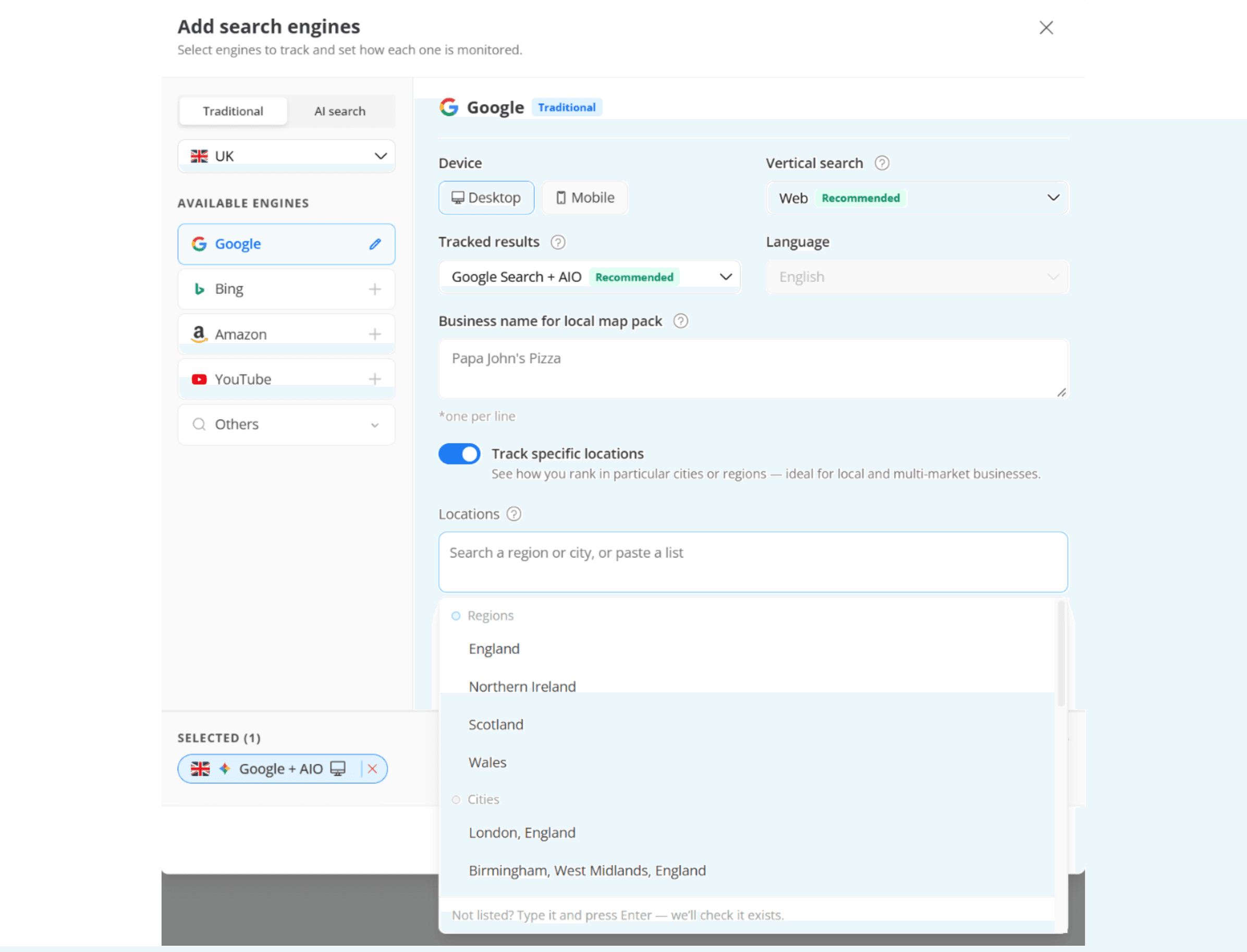
The Add search engines modal with Track specific locations on: the Locations field lists Regions (England, Northern Ireland, Scotland, Wales) and Cities for the UK.

Two regions picked from the list and "Leeds" typed and resolved to Leeds, West Yorkshire, England; the footer counts three search engines and the resource usage they add.

The project's Search engines list: one engine per place, named after the location.
Run the test on your own project
The same flow takes a week on any project, and the result is usually persuasive to a client.
Add two or three location engines next to your country engine, same device and search type, in the cities or regions your customers are in. Keep the keyword set as it is.
After two or three updates, open Search Engines Comparison. Sort by the country column. Count the keywords that show "not ranked" country-wide and a position on a location engine. That is your coverage gap.
Open Dates Comparison for the country engine and read the positions across the last five updates for the keywords that matter. Switch the engine selector to a location engine and read the same keywords. Compare how often a position holds from one update to the next.
Open Top Sites for one keyword on the country engine and click View SERP. Read where the top 10 are from, then do the same for the previous update. Repeat on a location engine. A client who sees these two SERPs side by side understands the problem without further explanation.
Use SERP Similarity between two dates on the country engine, then on a location engine, to put a number on how much the page itself changed. Low similarity with steady impressions in Search Console means the page changed under you while your site did not.
Decide, then annotate. Switch client reports to the location engines, keep the history of the country engine, and mark the switch date on the charts so the jump is read as a setup change.

Dates Comparison on the country engine, Sep 14 to Oct 14: the place-named keywords hold positions 1 to 3 with drop-outs ("-") on Oct 12.

The same report on the Manassas engine: generic terms such as "hvac contractors" and "furnace maintenance" at position 1, the Oct 12 column full of drop-outs, the Oct 14 column back.

View SERP on Oct 14 for the same keyword: the country engine (left) shows "United States" and a Colorado local pack; the Manassas engine (right) shows "Manassas, VA" and the Manassas local pack with Brooks at #1.
How to read location engines
Local pack and organic are two results. On "near me" and service queries the local pack is the localised answer; the organic list under it can be scattered, and on an altered page it will be. Report them separately; Top Sites marks local pack results with the pin icon.
Positions are ranges. With the location fixed, a one-update move of a few positions is noise until it repeats. Treat a change that holds for two updates as real, and a drop that reverses within three days as collection; that is the pattern Nozzle, SEOmonitor and Morningscore all reported for the September window.
Visibility and Estimated Visits summarise better than positions. They absorb single-keyword flicker and move only when many keywords move together.
Search Console gives direction. It averages everyone's pages; use it to confirm that impressions and clicks held when a tracker shows a drop. The help article on why ranking results vary lists the other differences.
Expect to re-tune. Google changed how it serves results to automated requests several times in 2025 and 2026 and will again. A location-anchored setup keeps the one variable you control fixed through those changes.
What AWR is doing on its side
The location picker is the visible part: curated Regions and Cities for every country, validated typed locations, and one engine per place so each update queries the same place. The collection work described in September continues: full browser rendering, the retry on sub-prime pages, redirect handling as a post-processing step, and a larger, more diverse IP pool. We are also measuring, on our own projects, the rate at which pages come back altered, and we will publish those figures once they are stable rather than before.
Frequently Asked Questions
Should I delete my country-wide engines?
Which is better, a region or a city?
Does location tracking cost more units?
Will location tracking stop the drops and recoveries I saw in September?
How do I get a national position for a national site?
Can I still type a location that is not in the lists?
stay in the loop