

Advice and answers from the Advanced Web Ranking Team
Search for articles
>
>
Track How AI Overviews Change Across Markets Using AWR's Custom Location Feature
Learn what influences AI Overview content, how location changes results across markets and how AWR helps you track every market.

If you've ever Googled something from a different city and noticed the results looked nothing like what you'd see at home, you already understand the core idea behind this update.
AI Overviews don't just answer questions. They answer questions for a specific place. But location is only part of the picture. The content of an AI Overview is shaped by a combination of factors, from search intent and query phrasing to the authority of local sources and the competitive landscape of a given market. Geography is one of the most impactful of those factors, and also one of the hardest to track without the right tools.
AWR's Google Search + AIO engine uses a dedicated scraping mechanism to ensure more consistent retrieval and accurate reporting of AI Overview results. And now it supports custom locations. You can track AI Overview results at the region, state, city, or zip code level, with the reliability that the dedicated engine was designed to provide.
This article walks you through what that means in practice: how to set it up, what factors shape the content of AI Overviews and why location is one of the most important variables to track once you understand how it works.
What this article covers
The key factors that shape what appears in an AI Overview and why they matter for your visibility strategy
How location influences AI Overview content across countries, states, cities and languages, with real examples
Five use cases showing exactly how the same query produces different results across markets
Whether AI Overviews and Local Packs can appear together on the same SERP
How to set up custom location tracking for AI Overviews in AWR
What influences the content of an AI Overview?
AI Overviews are not static summaries pulled from a fixed database. They are generated dynamically, which means the same query can produce a different response depending on a range of variables. Understanding what drives that variation is the first step toward tracking and influencing your visibility in them.
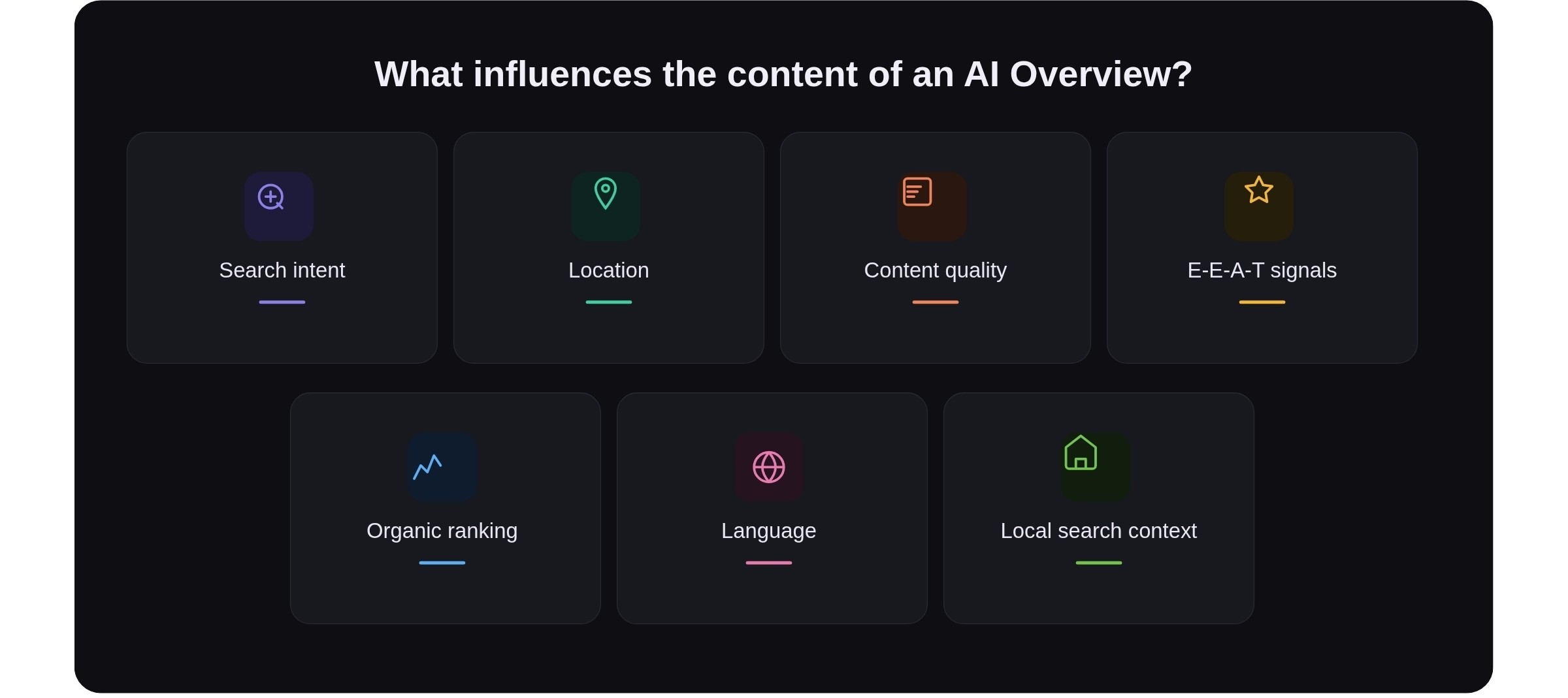
Search intent and query phrasing
The way a query is worded has a direct impact on whether an AI Overview appears at all and what it contains. Longer, more specific queries are more likely to trigger one than short, vague searches.
Informational and advisory queries — the kind that start with "how," "what," or "why" — are far more likely to generate an AI Overview than transactional or navigational ones. Even a small change in phrasing can shift the response significantly, so two people researching the same topic but wording their queries differently may end up seeing very different summaries.
Content quality and relevance
Google's AI systems favor content that answers a query completely and authoritatively. Specific, well-structured content backed by verifiable sources is more likely to be cited than generic material that simply repeats what is already widely available. Freshness matters too. Recently published or updated content tends to be favored over older material, particularly for topics that evolve quickly.
E-E-A-T signals
Experience, expertise, authoritativeness, and trustworthiness remain central to how Google evaluates content for AI inclusion. Named authorship, verifiable credentials, and consistent topical focus all contribute to how much weight Google gives to a source. Sites that cover a specific subject area in depth tend to perform better than those that publish broadly across many unrelated topics. Being a recognizable authority in your niche matters more than ever.
Organic ranking position
There is a strong relationship between traditional search rankings and AI Overview citations. Pages that rank in the top positions for a given query are more likely to appear as cited sources in the AI Overview for that query, though ranking well does not guarantee inclusion. A page outside the top results can still be cited if its content is a particularly strong match for what the AI needs to answer. Think of organic rankings as a strong signal, not a guaranteed ticket in.
Language and regional preferences
AI Overviews adapt to linguistic and cultural norms. Terminology, spelling and the examples used in a summary can shift depending on the dominant language or regional usage associated with the search.
"Color" becomes "colour," "soccer" becomes "football," and product or service names may differ depending on what is common in a given market. These are subtle differences, but they signal that the AI is tailoring its response to a specific audience rather than delivering a one-size-fits-all answer.
Local search context
AI systems pull from location-based signals to make answers feel relevant to where the user is searching from. A search for "best coffee shop" in New York might surface recommendations in Manhattan or Brooklyn, while the same search in Paris would point to cafés in Le Marais or Saint-Germain. The AI is not just answering the question, it is answering it for a specific place, and that distinction changes everything from the sources cited to the businesses mentioned.
Location
Taken together, all of the above means that location is one of the most powerful filters through which AI Overviews are shaped. It influences which sources get cited, which businesses get mentioned, and what the AI considers the most useful answer for that specific place.
That is why tracking AI Overviews at the region, state, city, or zip code level gives you a fundamentally different and more accurate picture of your visibility than tracking them at the national level. And it is exactly what AWR's latest update makes possible.
How location influences AI Overviews content and sources
The factors we covered earlier explain what shapes AI Overview content in general. But to understand how location specifically influences what appears, it helps to see it in action. The following use cases illustrate how the same query can produce different content and cite different sources depending on where it is searched from, across countries, states, cities, and even languages.
Use Case 1: Business operating across global markets
For businesses operating across multiple countries, AI Overviews are not globally consistent. The same query can produce different interpretations depending on the market in which it is searched. This variation is not only driven by local context, but also by how information is structured and prioritized within each market’s search environment.
As a result, the information surfaced reflects more than just the query itself; it reflects how that query is understood and assembled in that specific market.
What appears at headquarters is only one version of this output, but not necessarily the one seen by users in other countries.
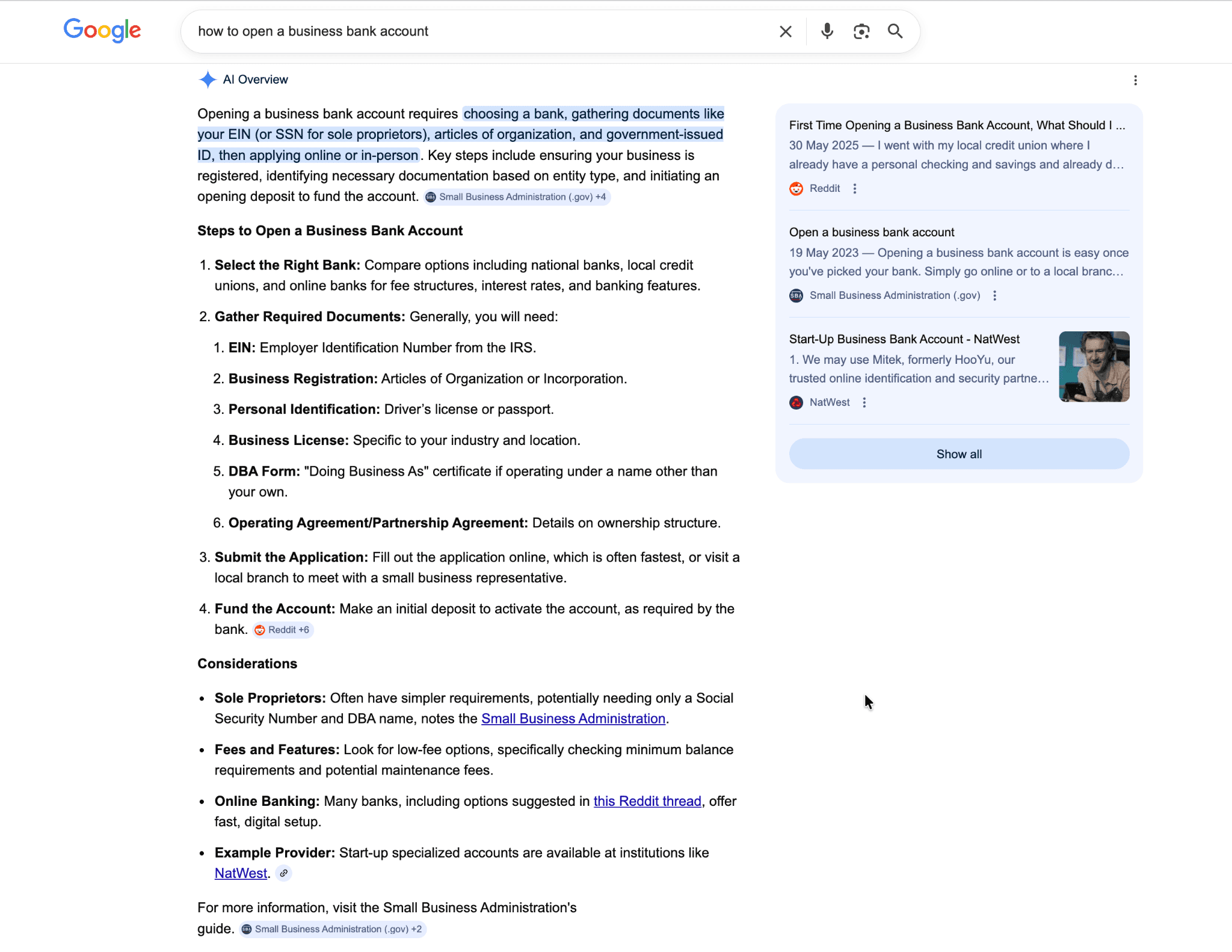
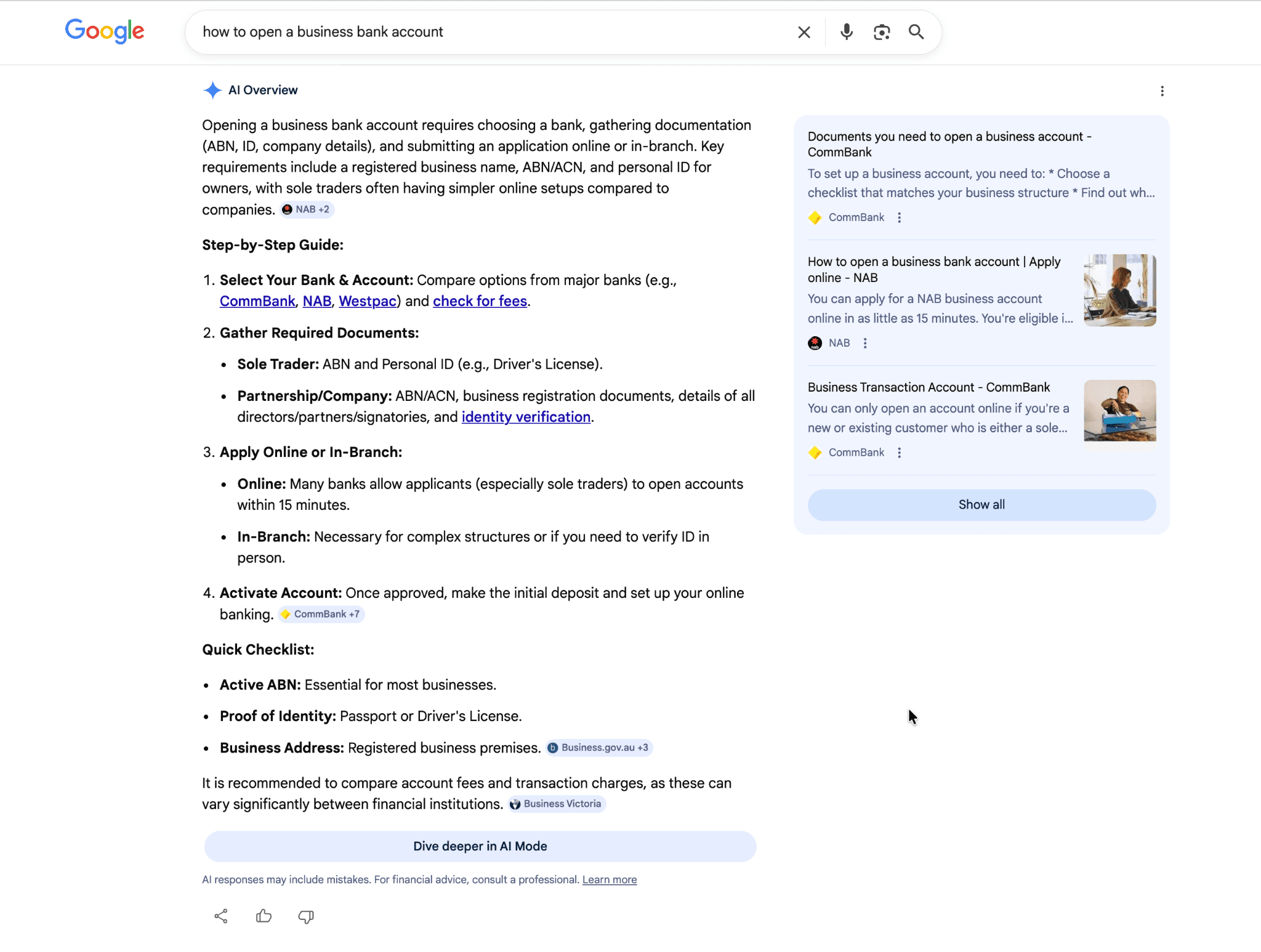
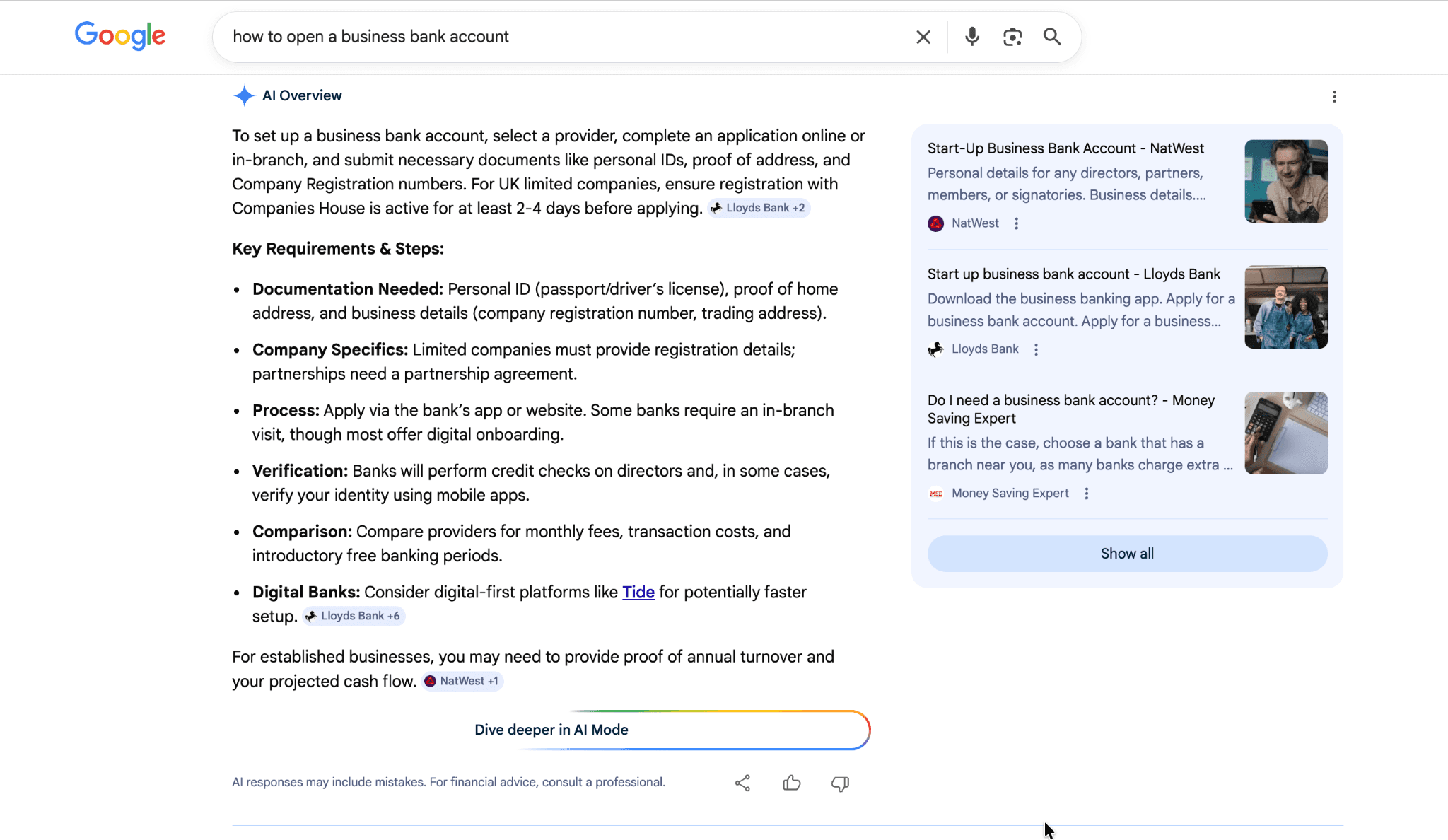
Let's take the query "how to open a business bank account" and search it from four different locations, just as a fintech platform operating across multiple markets would do to understand their AI Overview visibility:
Boston, United States
Melbourne, Australia
London, United Kingdom
Berlin, Germany
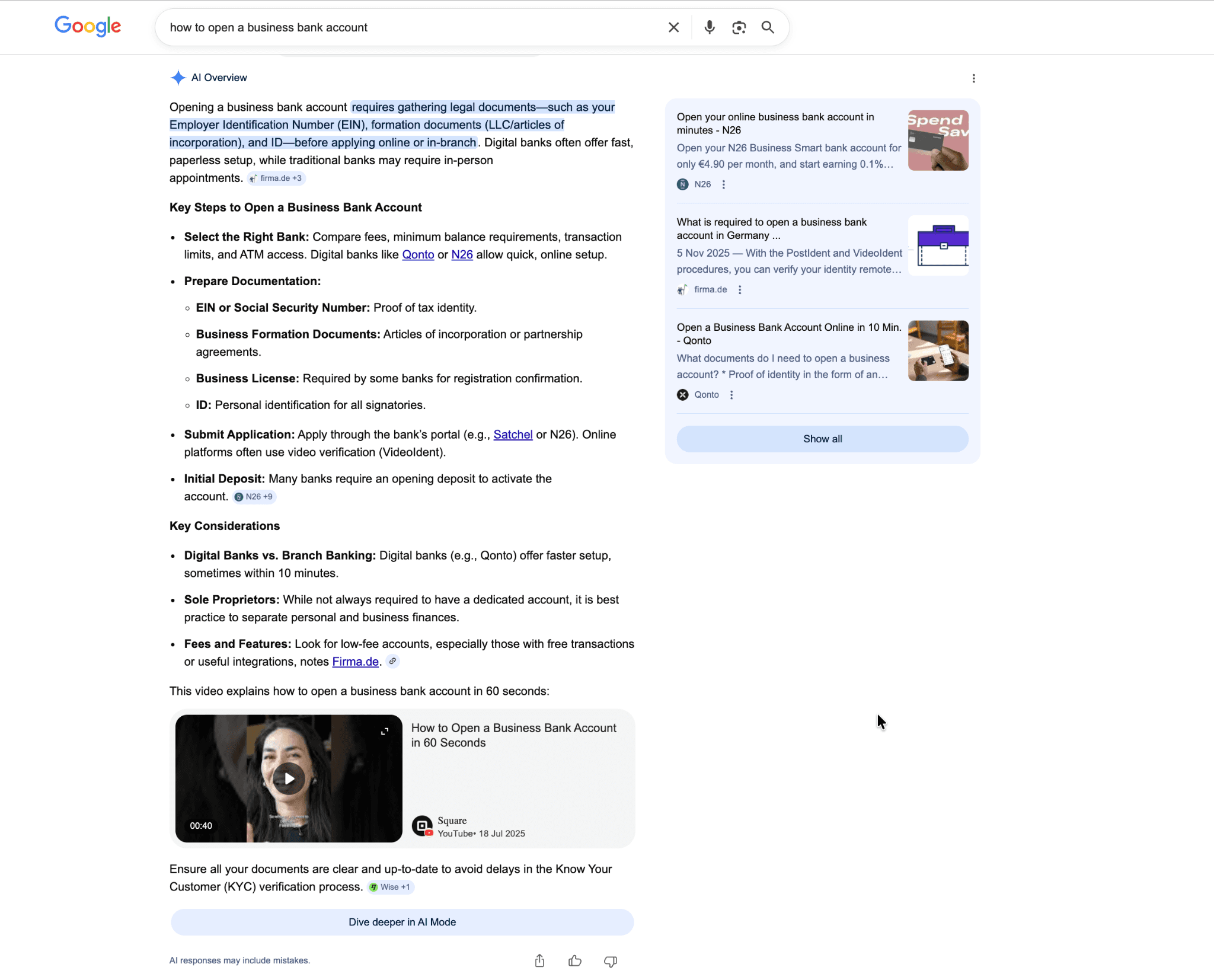
Same query, four markets, four different answers. Each AI Overview is shaped by region-specific sources, variations in terminology, and a different competitive landscape. A content strategy built around a single market’s AI Overview is invisible elsewhere.
Use Case 2: Multi-state B2C business
For businesses operating across multiple states, the assumption that one AIO fits all markets is a risky one.
The same query can tell different stories depending on which state it is searched from. Sources cited, recommendations made and the overall framing of the answer can all shift significantly from one market to the next even within the same country.
That means users in different states are essentially receiving a different version of the same answer, which directly influences how they think about their options and which businesses they end up considering.
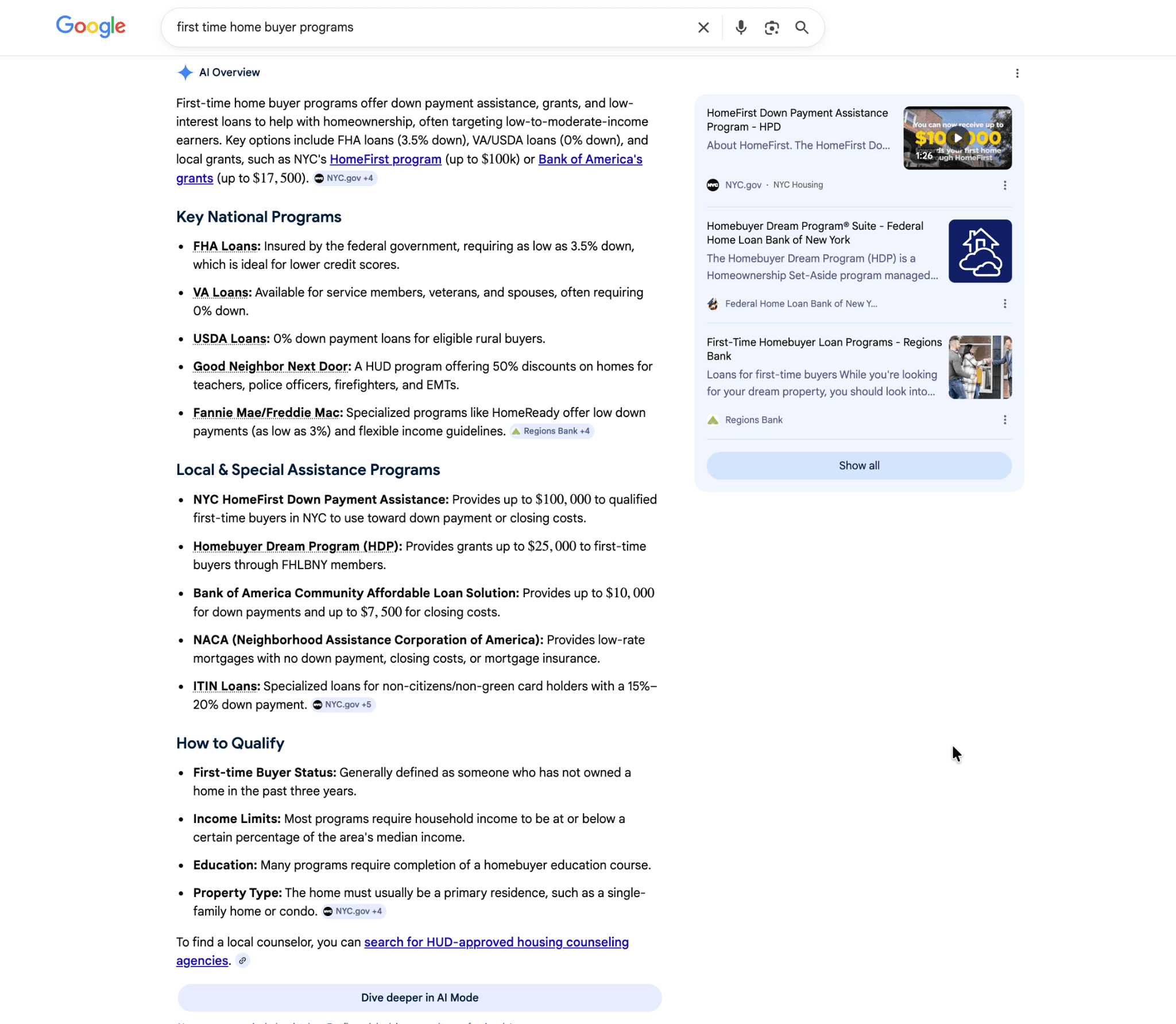
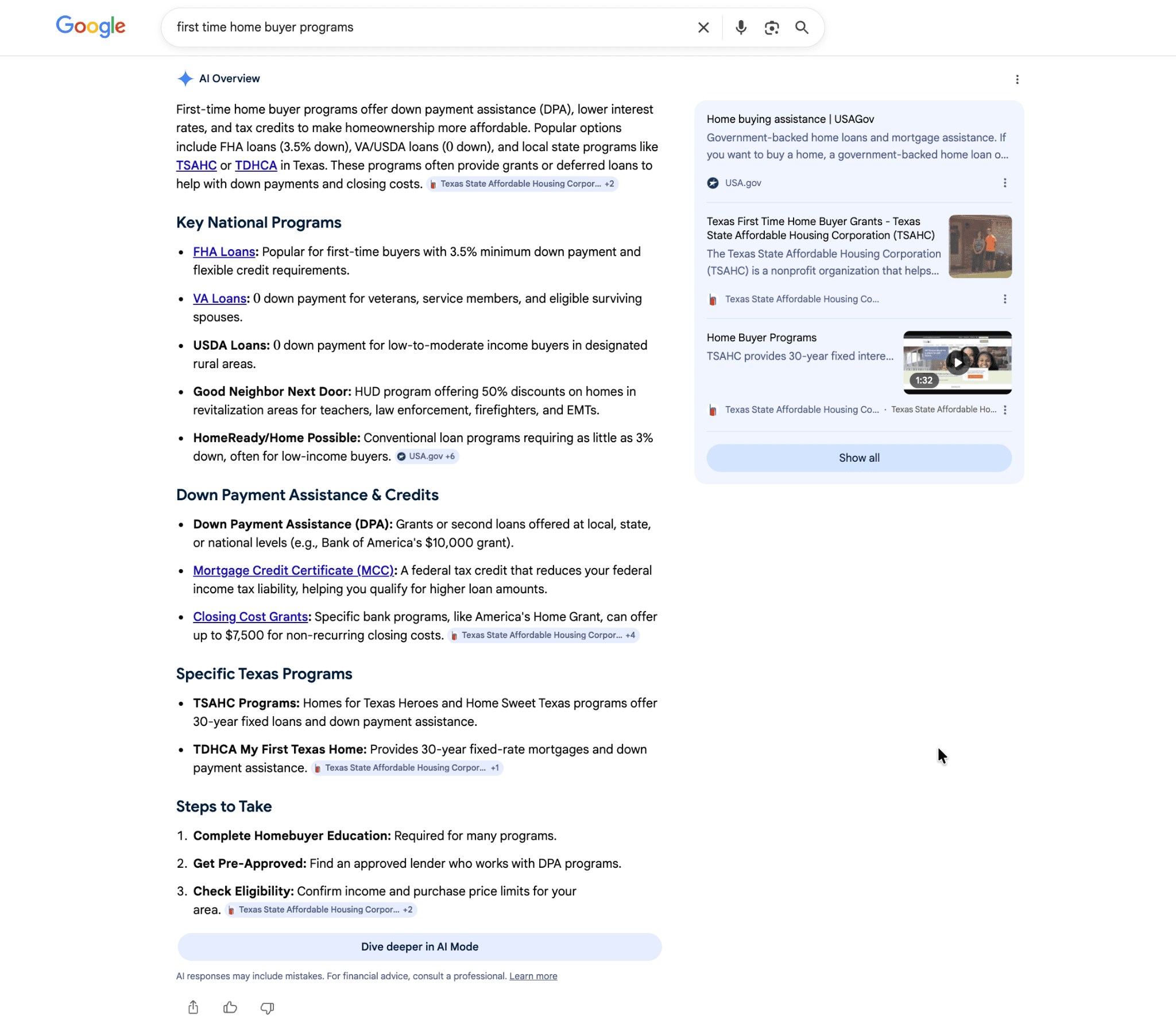
Let's take the query "first time home buyer programs" and search it from three different US states, just as a mortgage broker operating across multiple markets would do to understand their AIO visibility:
New York
Texas
California
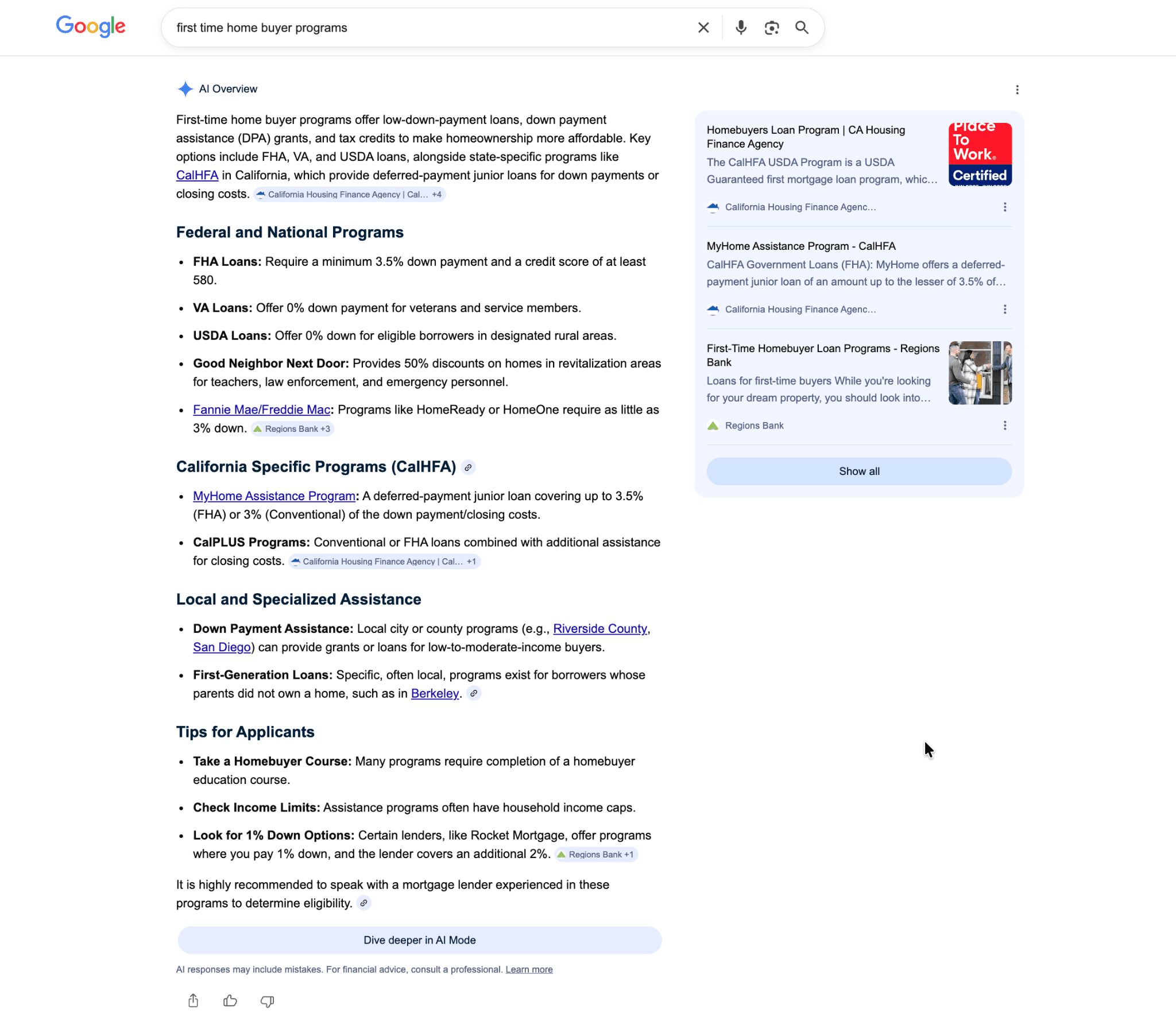
The sources cited, the programs recommended and even the structure of the AIO shift from one state to the next. For a mortgage broker, this means that the content strategy that earns them a citation in Texas may do nothing for their visibility in California or New York.
Use Case 3: Searching a global query from different locations
For many queries, AI Overviews appear universal at first glance, especially for topics that are not tied to a specific country or region. However, even global queries can produce different outputs depending on where the search is performed.
The examples, sources, and angle of the AI Overview may shift based on the user's location, even when the query itself remains unchanged and non-local in intent.
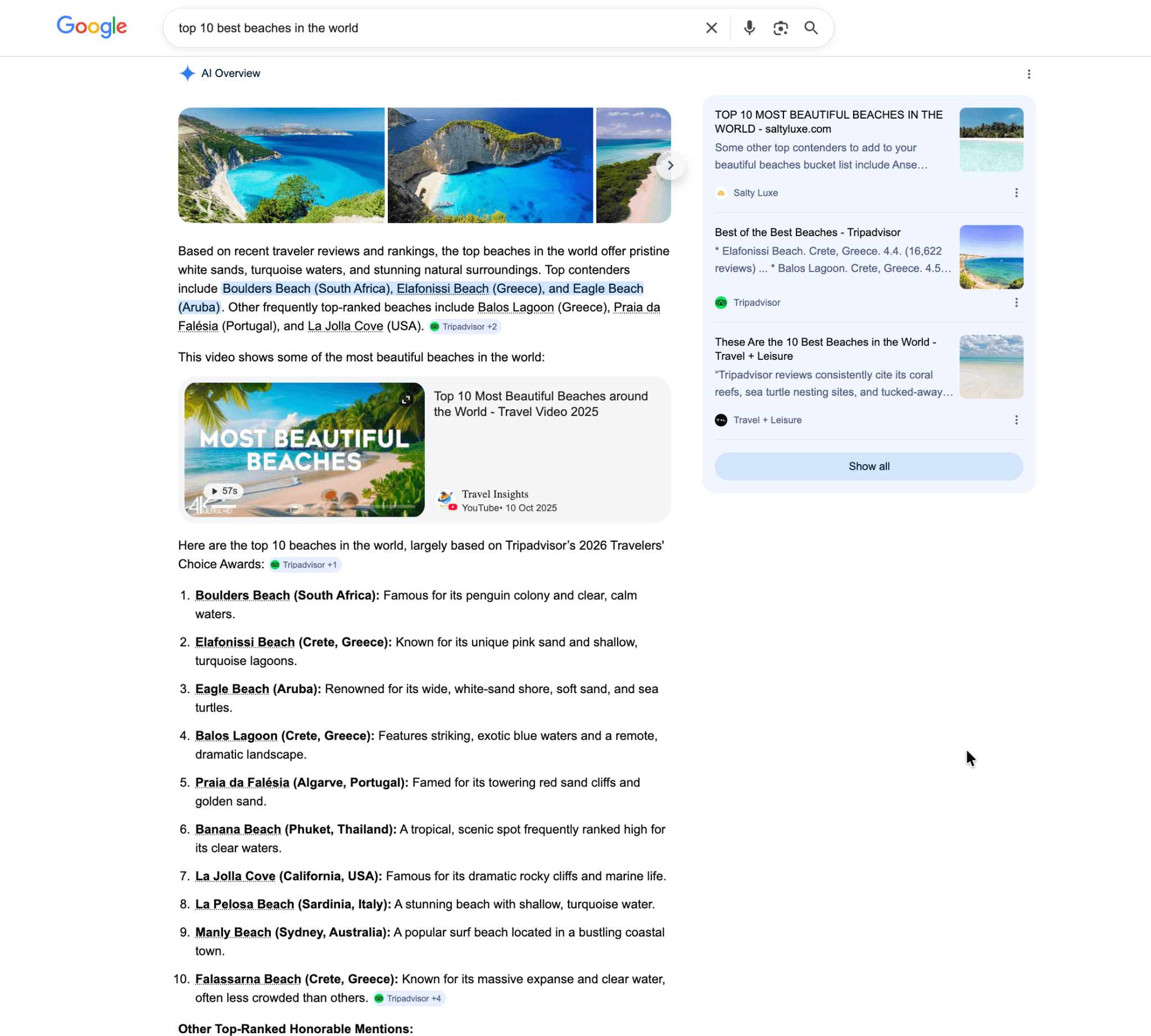
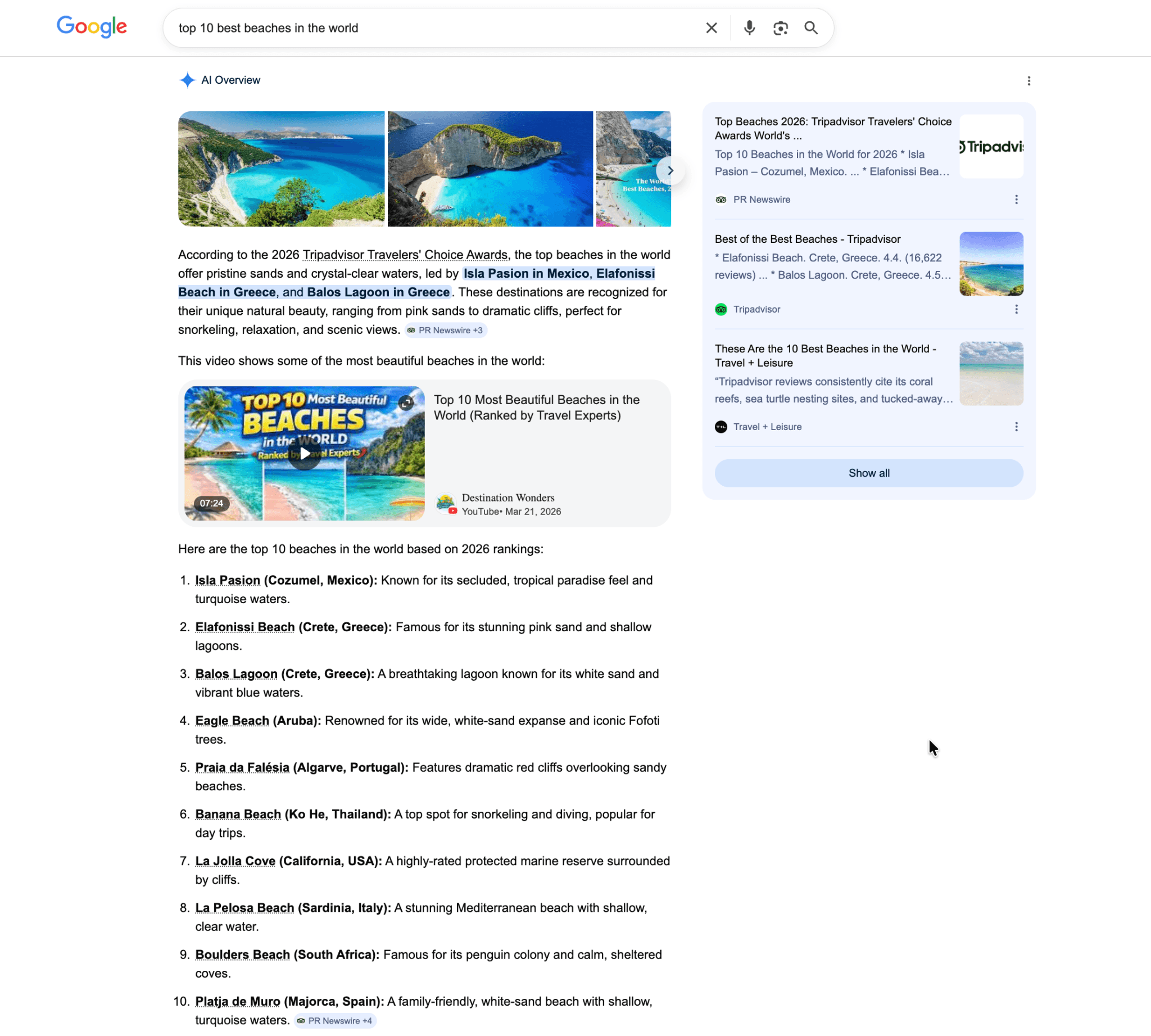
To test this, let’s take a globally relevant query such as “top 10 best beaches in the world” and run it from different locations to observe how the AI Overview changes across markets.
Berlin, Germany
São Paulo, Brazil
London, United Kingdom
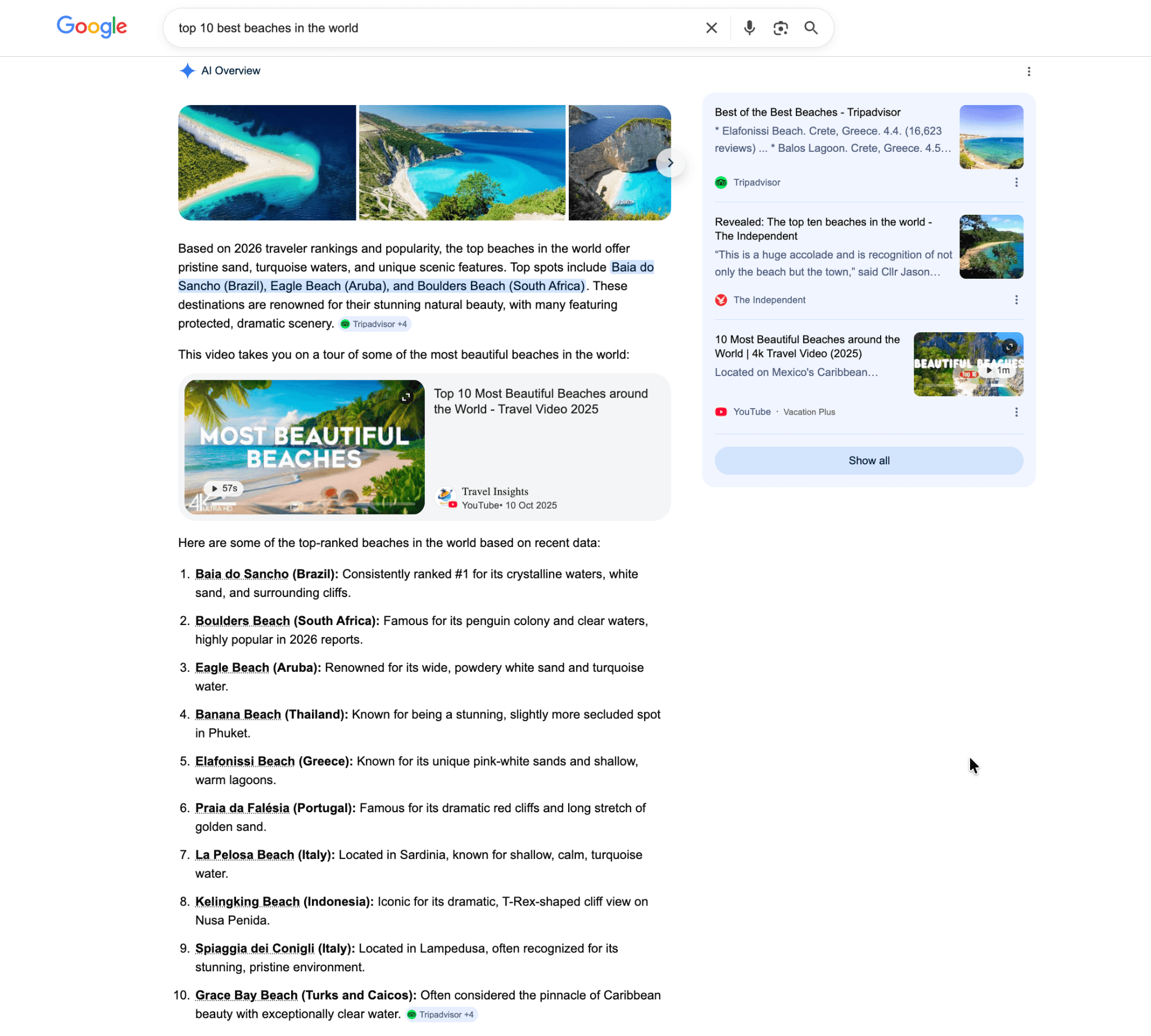
Searching the same query from London, São Paulo and Berlin reveals clear differences in the AI Overviews returned. Not only did the list of beaches vary across locations, but the sources used to support those recommendations also changed.
Even though the query was identical and globally oriented, each market produced a slightly different version of "top beaches in the world," both in terms of which destinations were included and which sources were cited. Even global queries are not fully standardized in AI Overviews, which means that monitoring from a single location gives you only one version of a much bigger picture.
Use case 4: How regional trends influence AI Overview results
Not all AIO content variation is driven by regulations or market structure. In some cases, AI Overviews adapt based on regional preferences and cultural context, even when the query is broad and does not include any location signals.
This means that the same search can produce different answers depending on where it is performed, reflecting local habits, expectations and trends rather than a universal response.
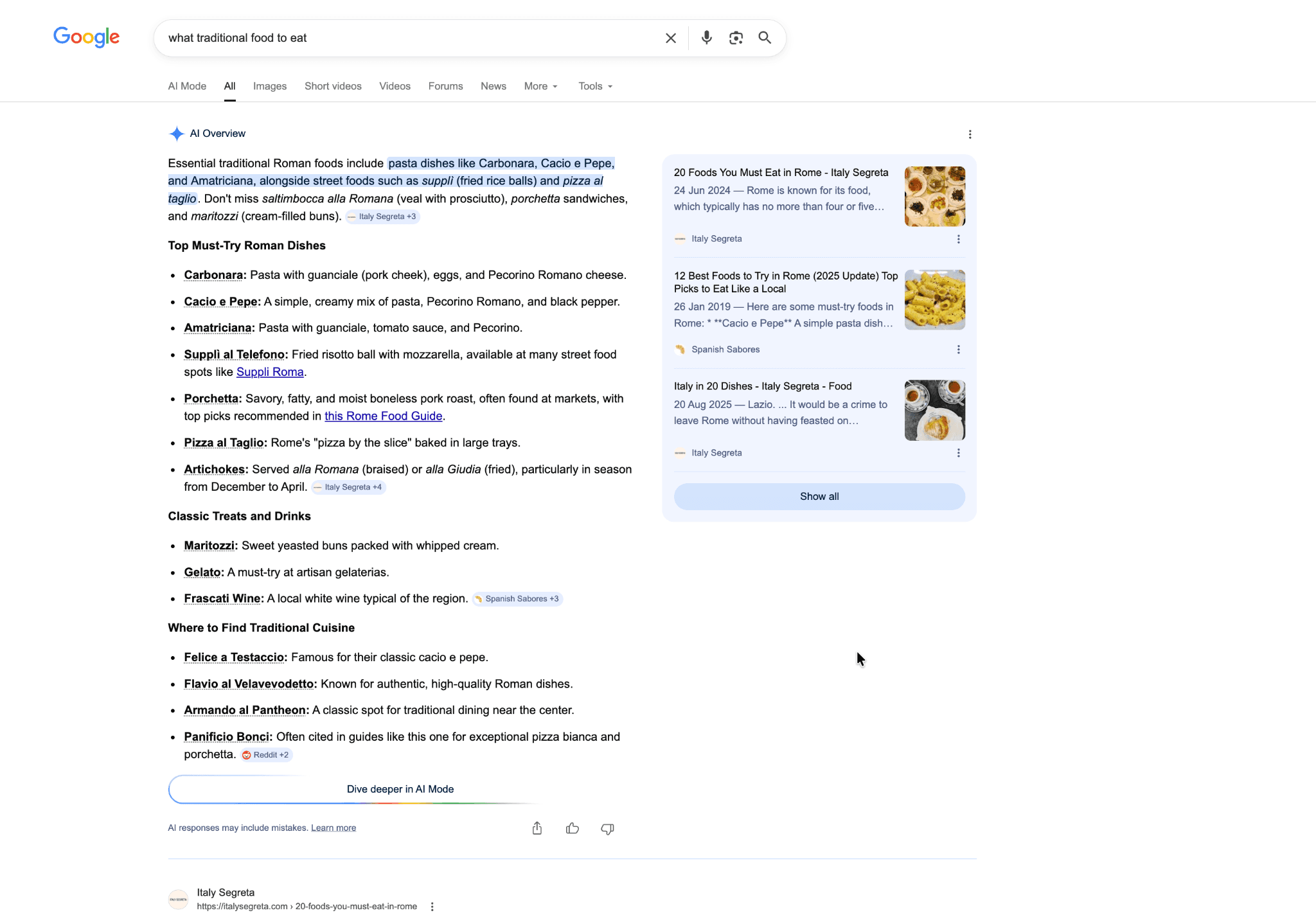
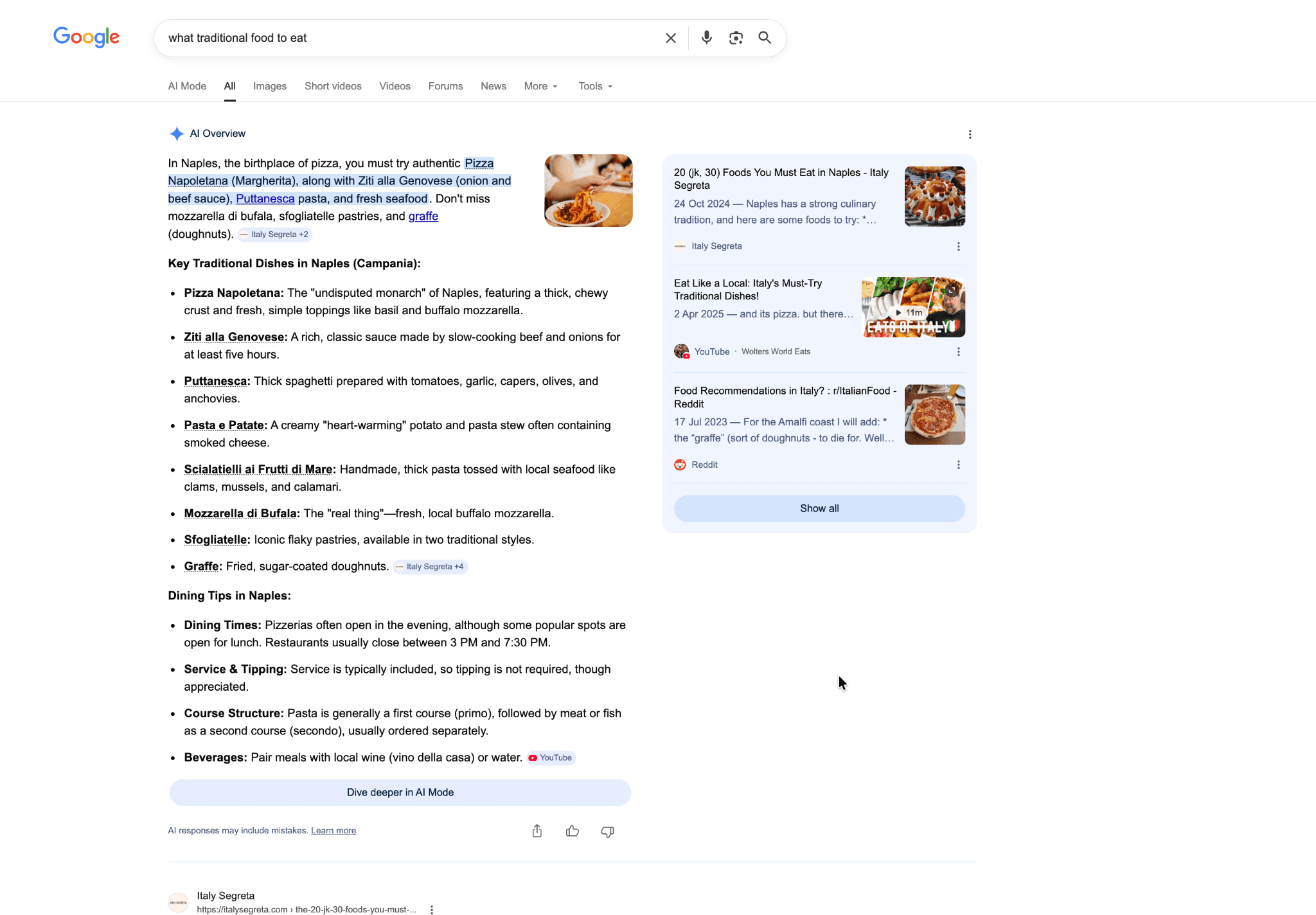
To illustrate this, let's take the query "what traditional food to eat" and search it from three different Italian cities:
Rome
Naples
Palermo
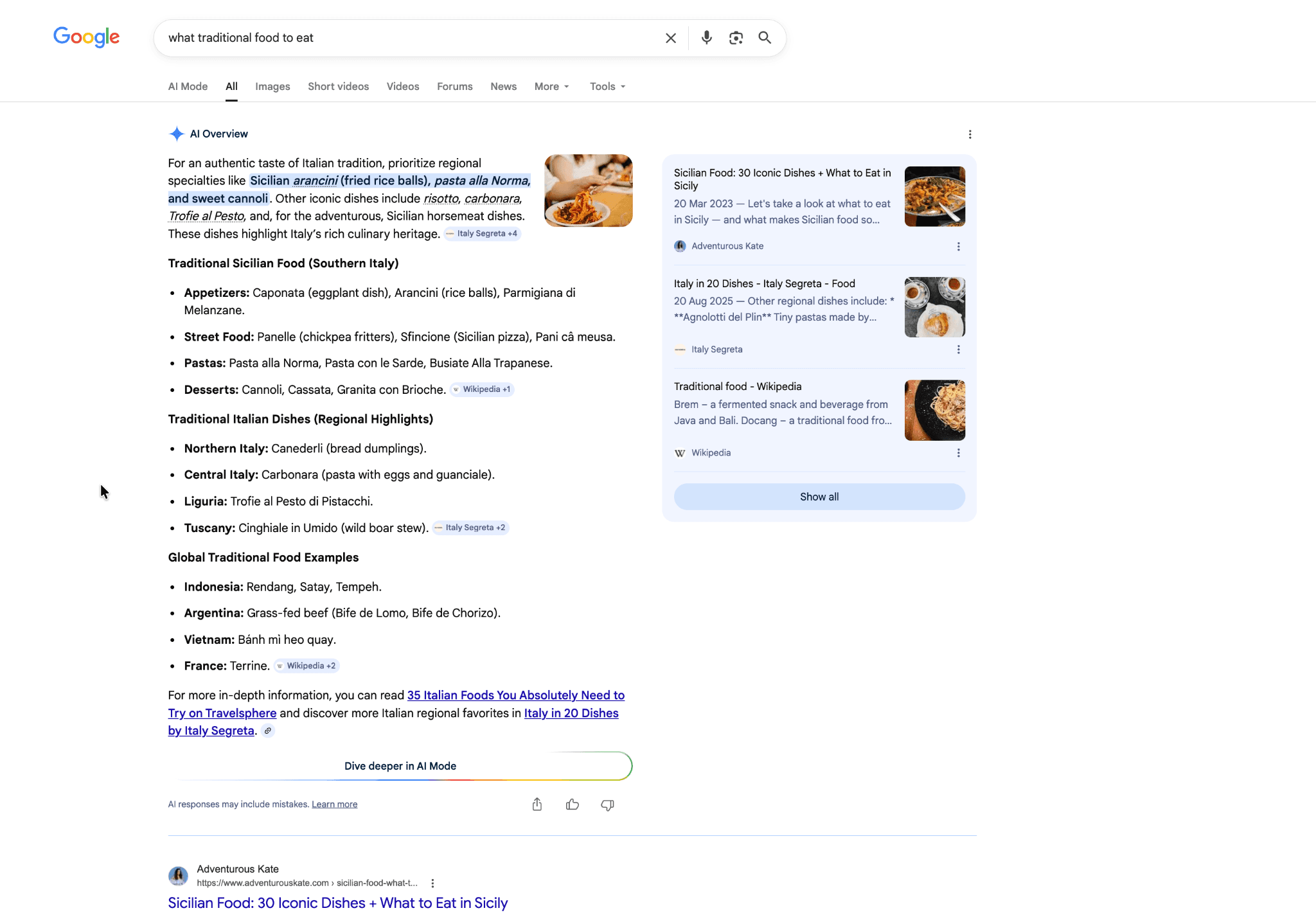
The same query produces three distinct answers, each shaped by the culinary identity and cultural expectations of its region. The dishes change, the sources change and so does the competitive landscape for any business whose content is rooted in local culture. This is exactly the kind of variation that location-level tracking is designed to surface.
Use case 5: How language shapes AI Overview content in multilingual markets
In bilingual markets, language is not just a matter of communication. It is a lens through which AI Overviews interpret and respond to queries. The same query typed in two different languages from the same location can surface entirely different content, different sources, and different cultural references, even when the underlying intent is identical.
Canada is a good example of this. With both English and French as official languages, cities like Montreal and Quebec City have two distinct linguistic communities, each with their own media, platforms, and cultural touchpoints. When the same query is searched in both languages from the same city, the AI Overview reflects those differences directly.
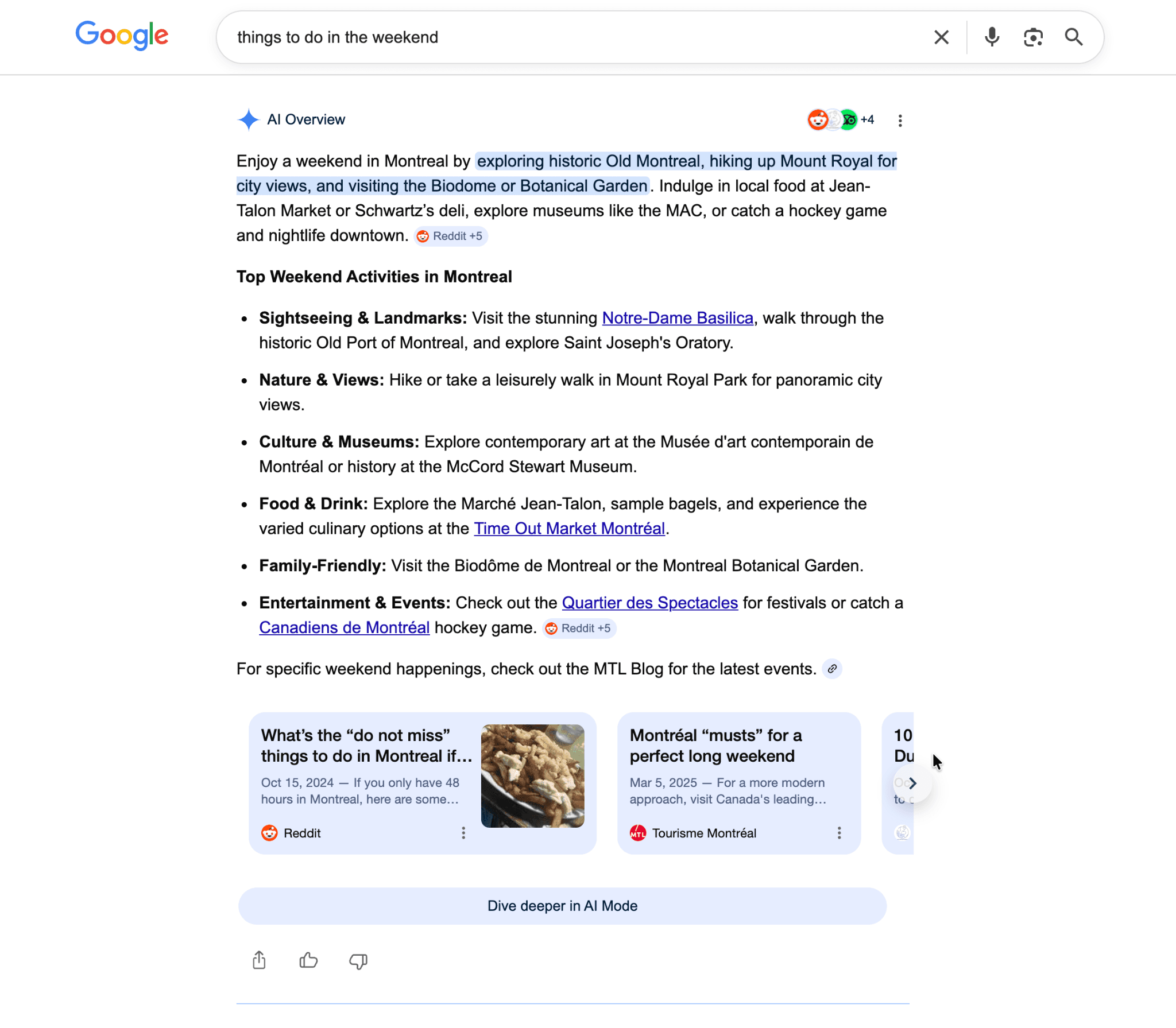
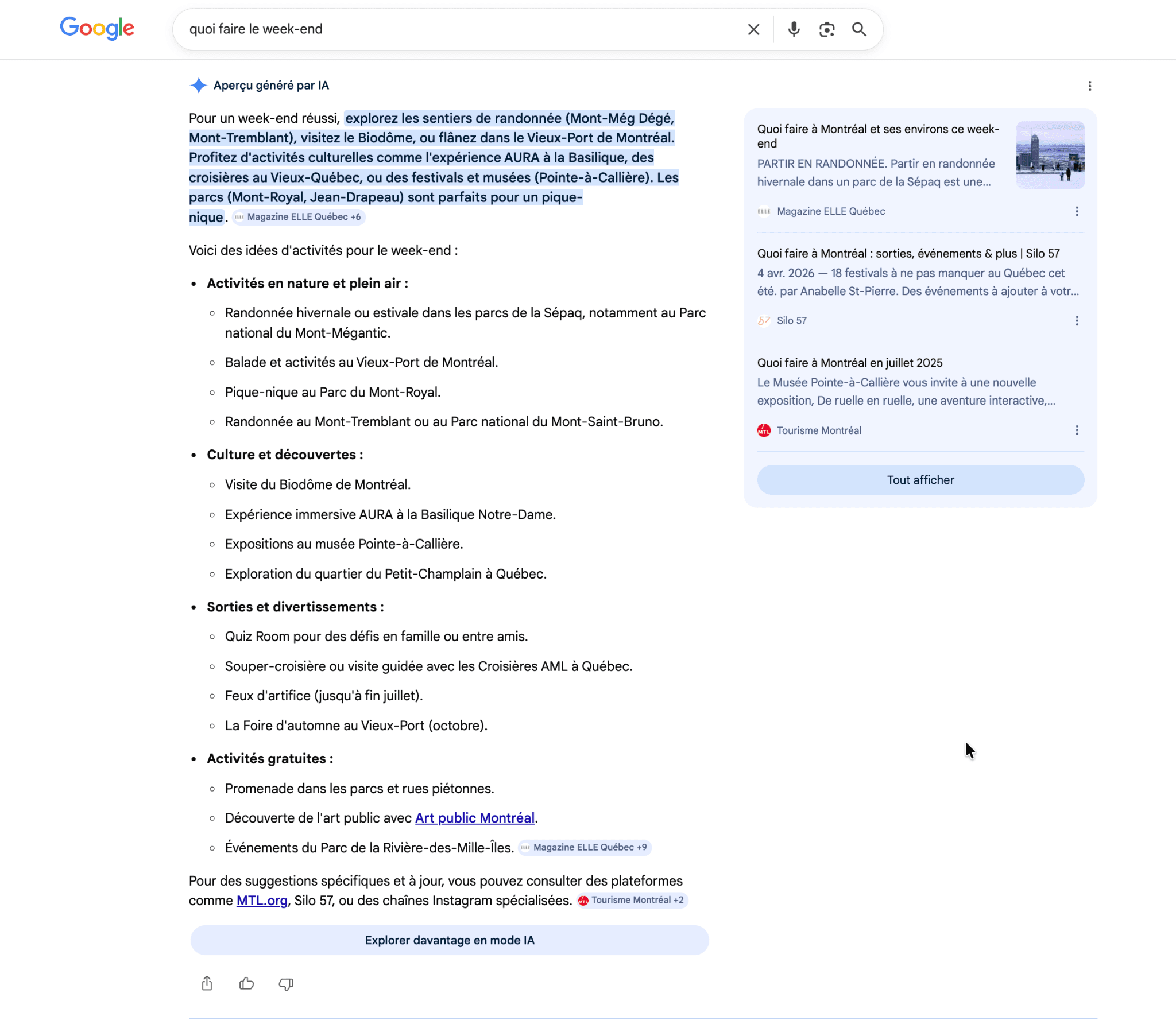
Take the query "things to do in the weekend" in English and "quoi faire le week-end" in French, searched from Montreal and Quebec City:
Montreal, Canada
English
French
Quebec City, Canada
English
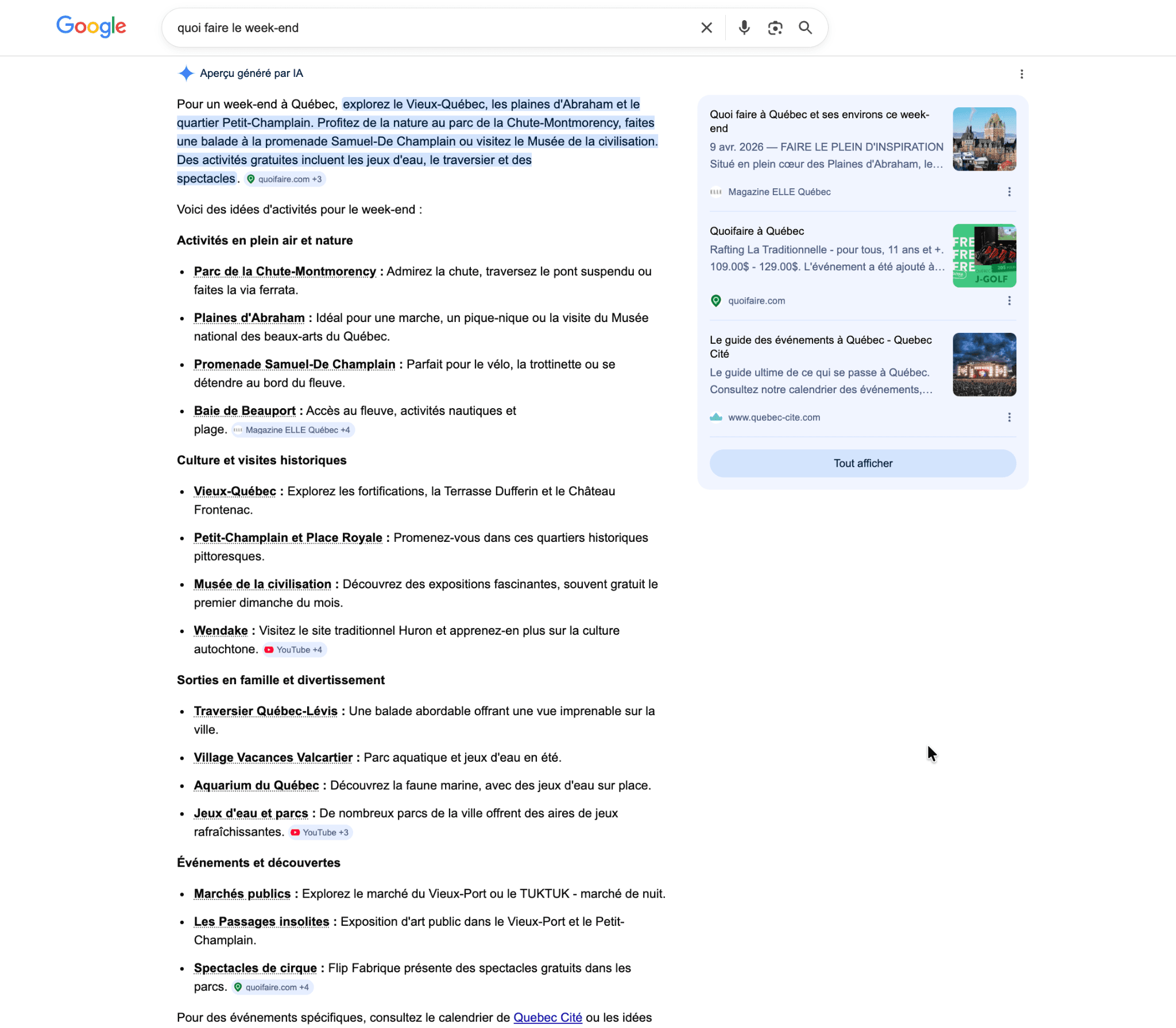
French
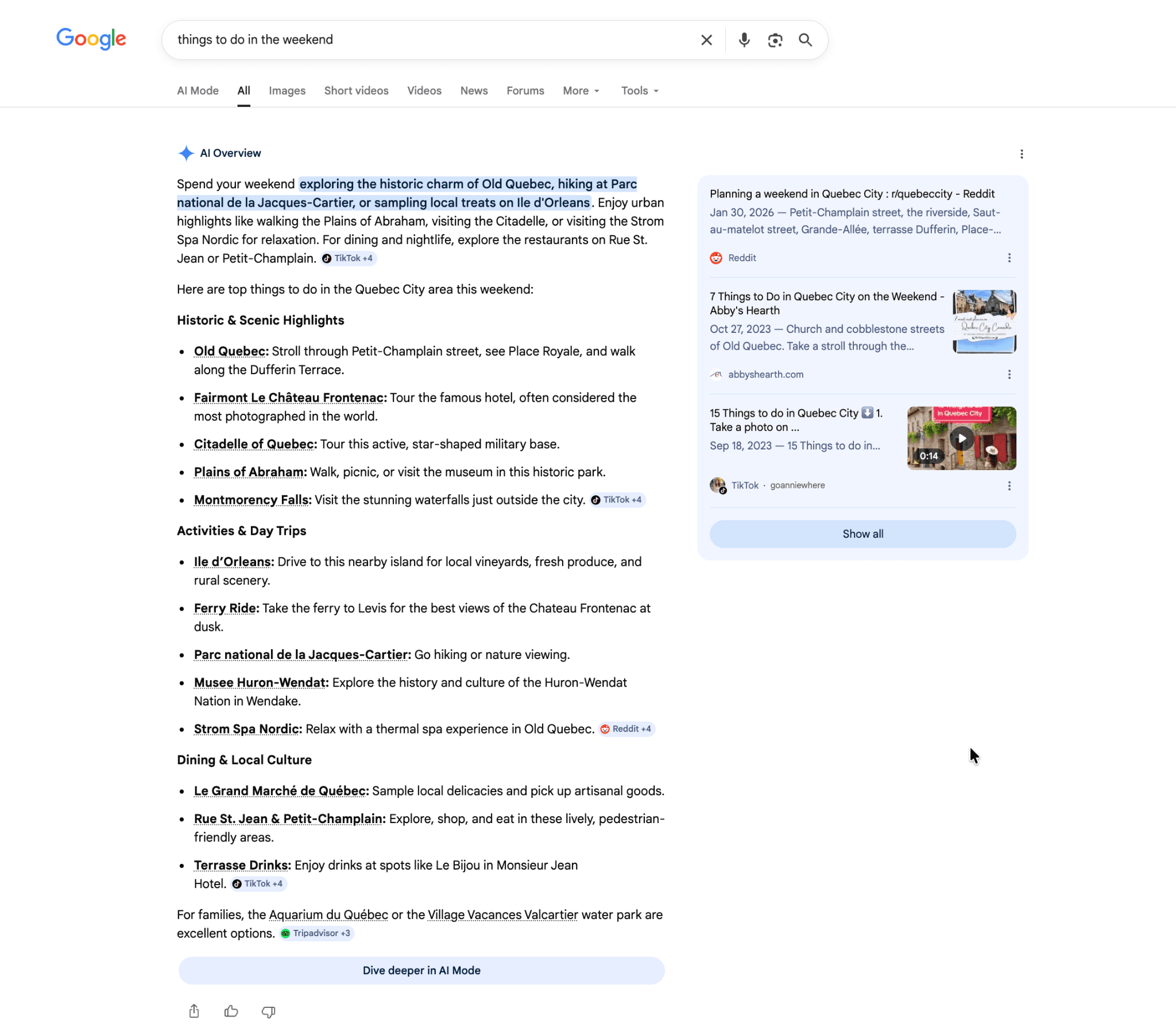
What makes this example particularly interesting is that neither query includes any location signal. Yet the AI serves culturally specific answers in both languages, suggesting activities and sources that reflect each linguistic community's own version of the city. In bilingual markets, language alone is enough to shift the entire response.
These five use cases only scratch the surface of what location-level AIO tracking can reveal.
Whether you are monitoring visibility across global markets, tracking how state-level regulations shape the answers your audience sees, or understanding how language influences what gets cited in a bilingual city, the pattern is the same: location changes everything.
AWR's custom location support for the Google Search + AIO engine is built precisely for this, so you can track the locations that matter to your business and see exactly what your audience sees, wherever they are.
Do SERPs with AI Overviews also contain Local Packs?
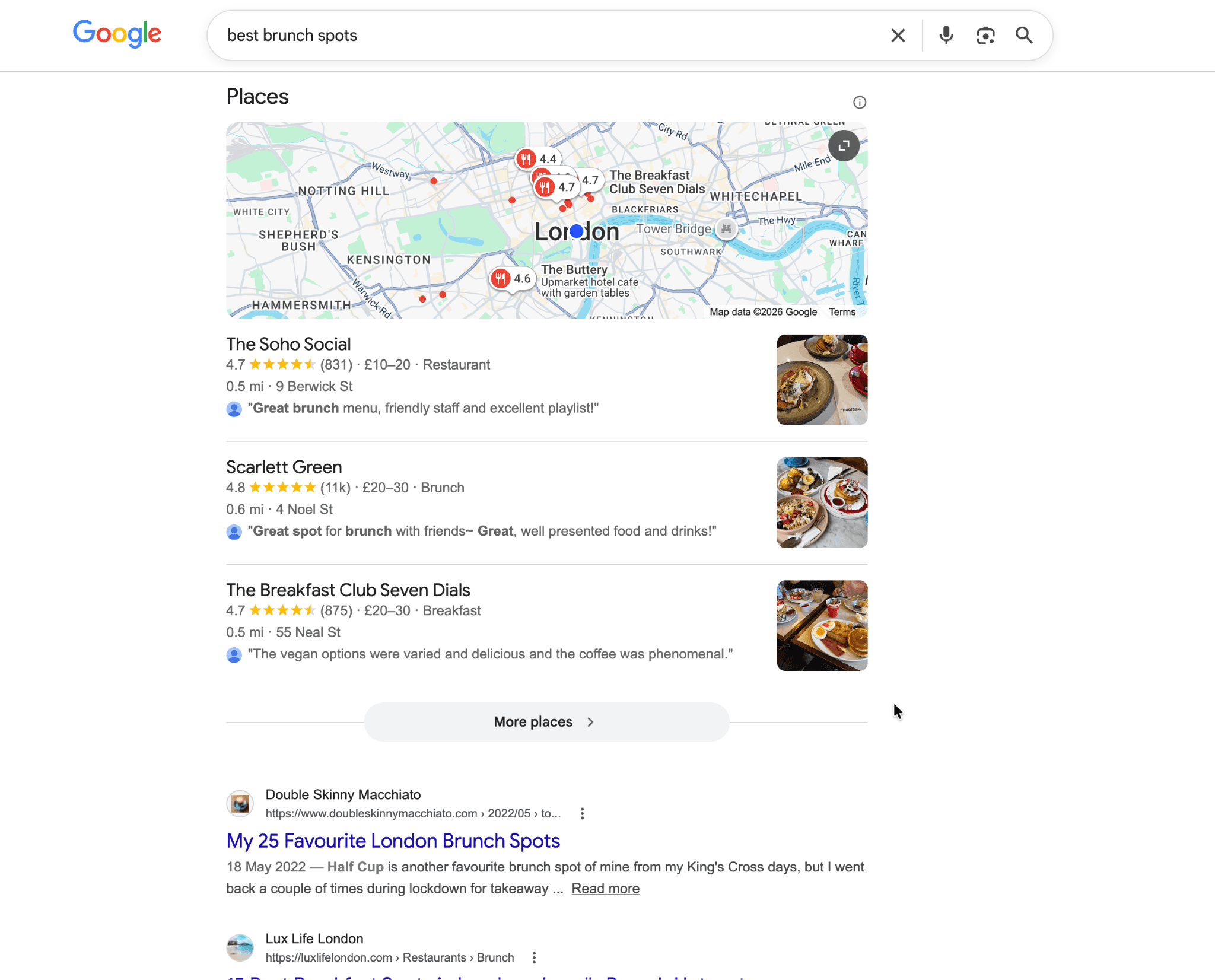
The short answer is: sometimes, but rarely. AI Overviews and Local Packs tend to serve different types of searches, which means they usually appear separately rather than together on the same SERP.
The pattern follows search intent. Transactional and discovery queries, the kind where a user is ready to visit or contact a business, almost always trigger a Local Pack. Informational queries, where a user is looking to understand something before taking action, are far more likely to trigger an AI Overview.
Take "best brunch spots" as an example. The query has clear local, transactional intent. Google responds with a map and a list of nearby businesses complete with ratings, reviews, and distances. No AI Overview appears.
Now take "what to do in London for free." The intent is informational. The user is not looking for a specific business to visit right now, they are gathering ideas. Google responds with an AI Overview summarizing free experiences, museums, and parks.
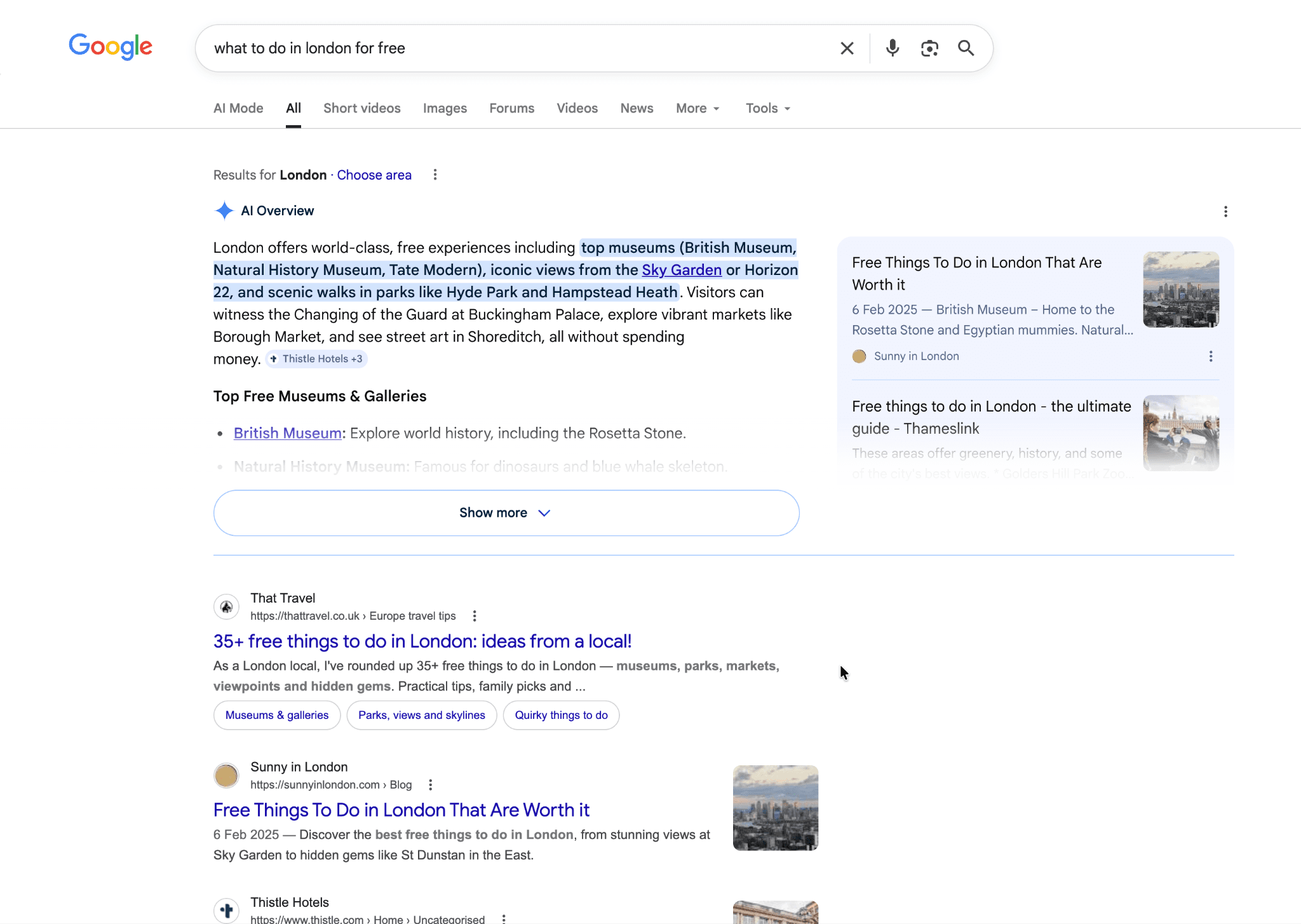
The two can appear together when a query has both informational and local intent, but this combination is uncommon. What this means in practice is that AI Overview visibility and Local Pack visibility are two separate challenges that require two separate strategies. Appearing in one does not guarantee visibility in the other.
AWR now supports custom location tracking for AI Overviews
AWR's Google Search + AIO engine was designed specifically for more accurate and consistent AI Overview tracking.
This search engine uses a dedicated scraping mechanism to ensure more complete and reliable reporting of AI Overview results. It captures all types of web search results across both Desktop and Mobile SERPs (except Ads) and is available for tracking in over 170 countries.
Since the Google Search + AIO search engine relies on a more advanced query mechanism to capture this data accurately, it uses twice the number of resources compared to standard engines.
For more details on keyword units consumption, check out our dedicated article.
Until now, tracking with Google Search + AIO meant selecting a country as the target location. That was already a significant advantage over standard tracking. But for businesses that operate at a more granular level — across states, cities, or specific zip codes — country-level data only tells part of the story.
That changes with this update. You can now track custom locations with the Google Search AIO search engine, down to the region, state, city, or zip code level.
This means you can finally see what your audience sees, wherever they are, with the same reliability the engine was already known for.
How to set up custom location tracking for Google AIO
To get started, select the project for which you want to configure the search engine from the Projects drop-down list.
You can add the Google Search + AIO engine either from the Search engines drop-down available in most UI reports, such as Keyword Ranking
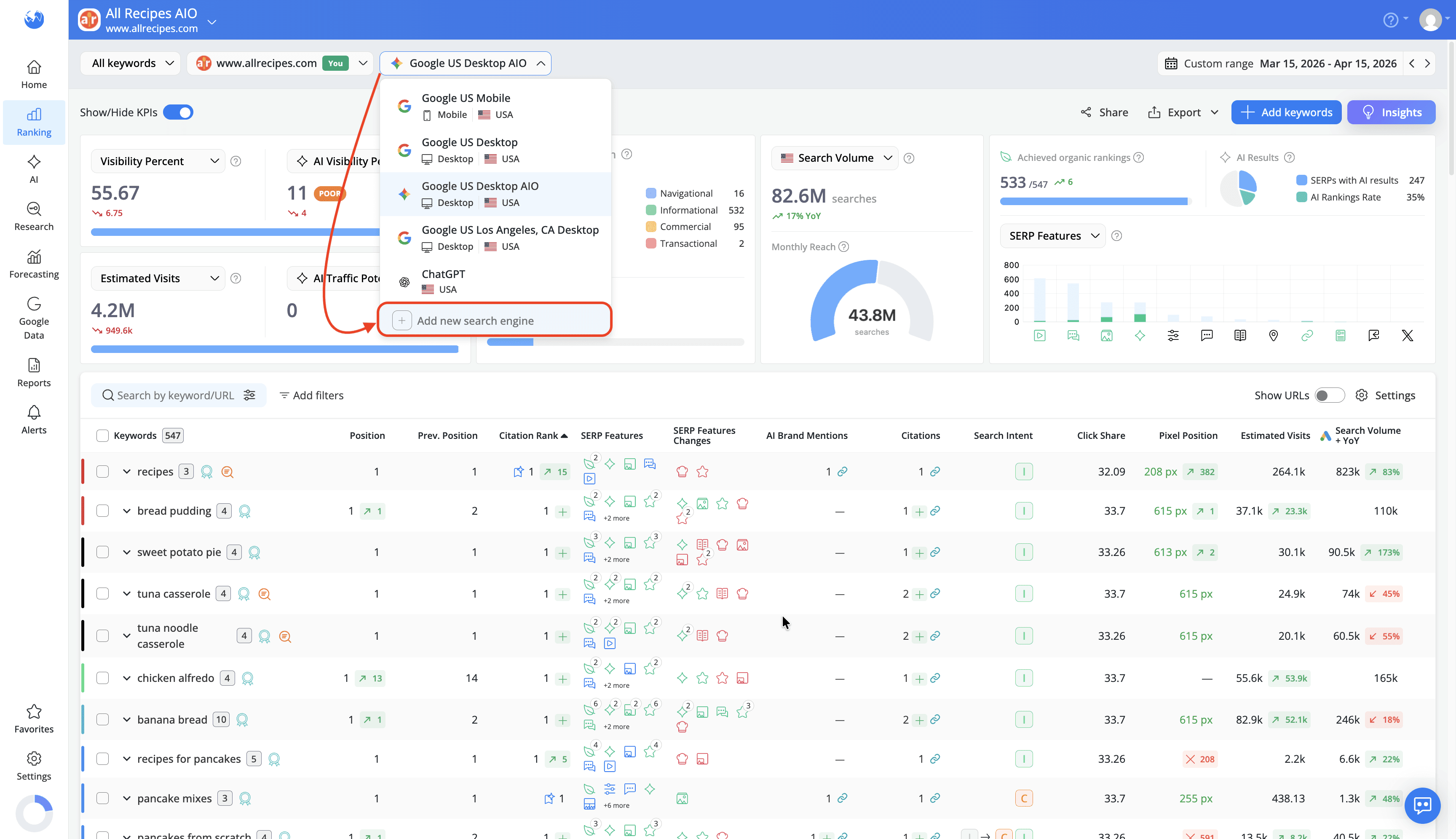
or from the Project Settings> Search engines section.
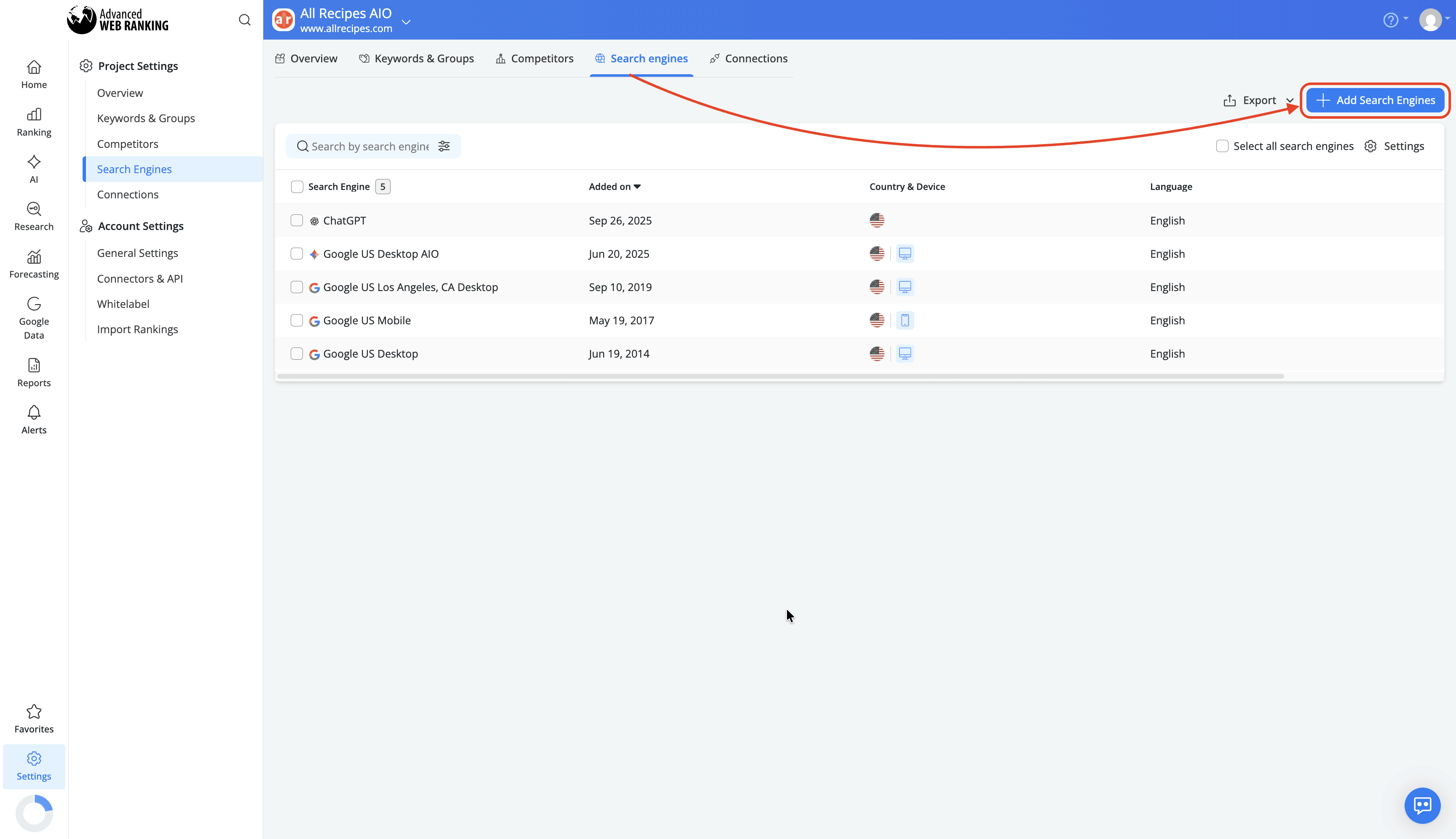
In the search engine wizard, select one of the supported countries as the target location. Under Search features, select Google Search + AIO. Then choose your custom location — region, state, city, or zip code — for the level of granularity your tracking strategy requires.
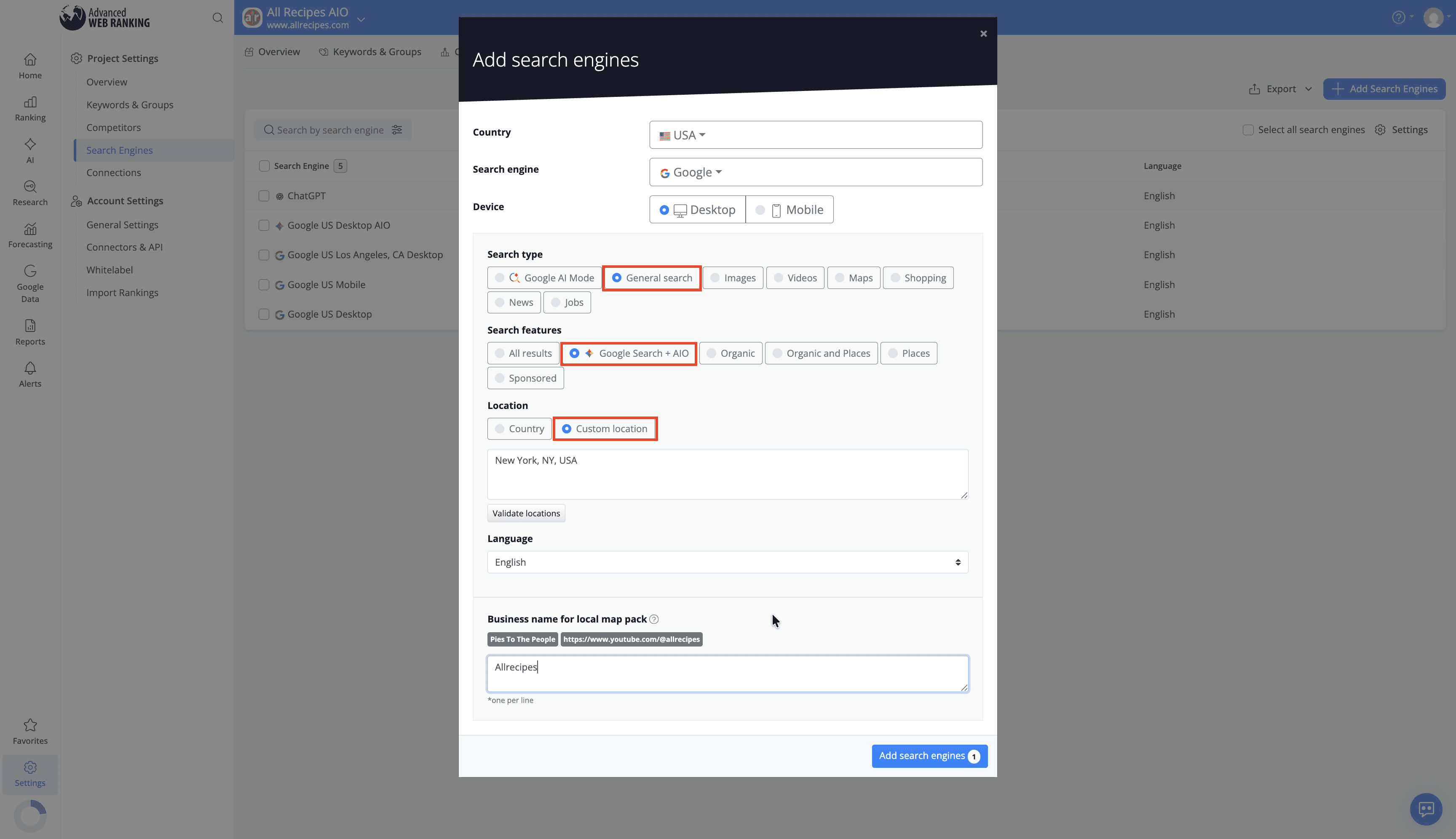
If you want to track multiple locations, you’ll need to set up a separate search engine for each one.
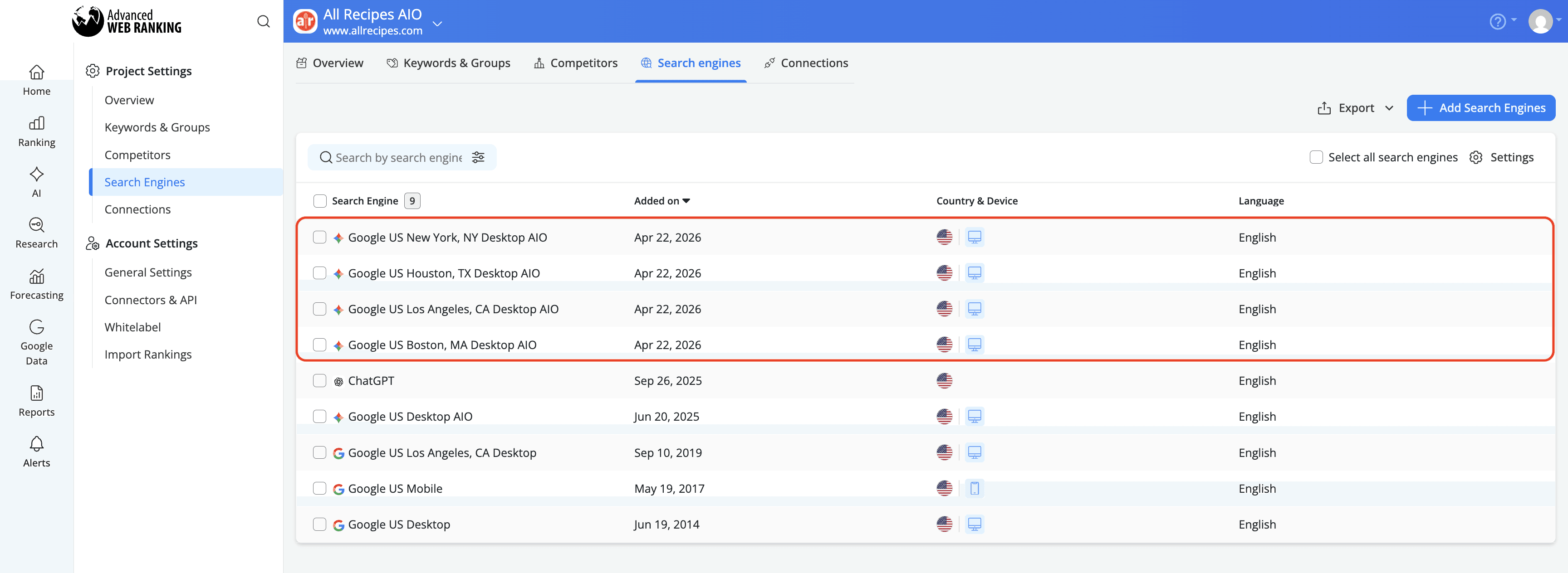
Once the search engine is set up, your rankings and AI Overviews data will reflect the results for that specific location, giving you a ground-level view of your visibility that national tracking simply cannot provide.
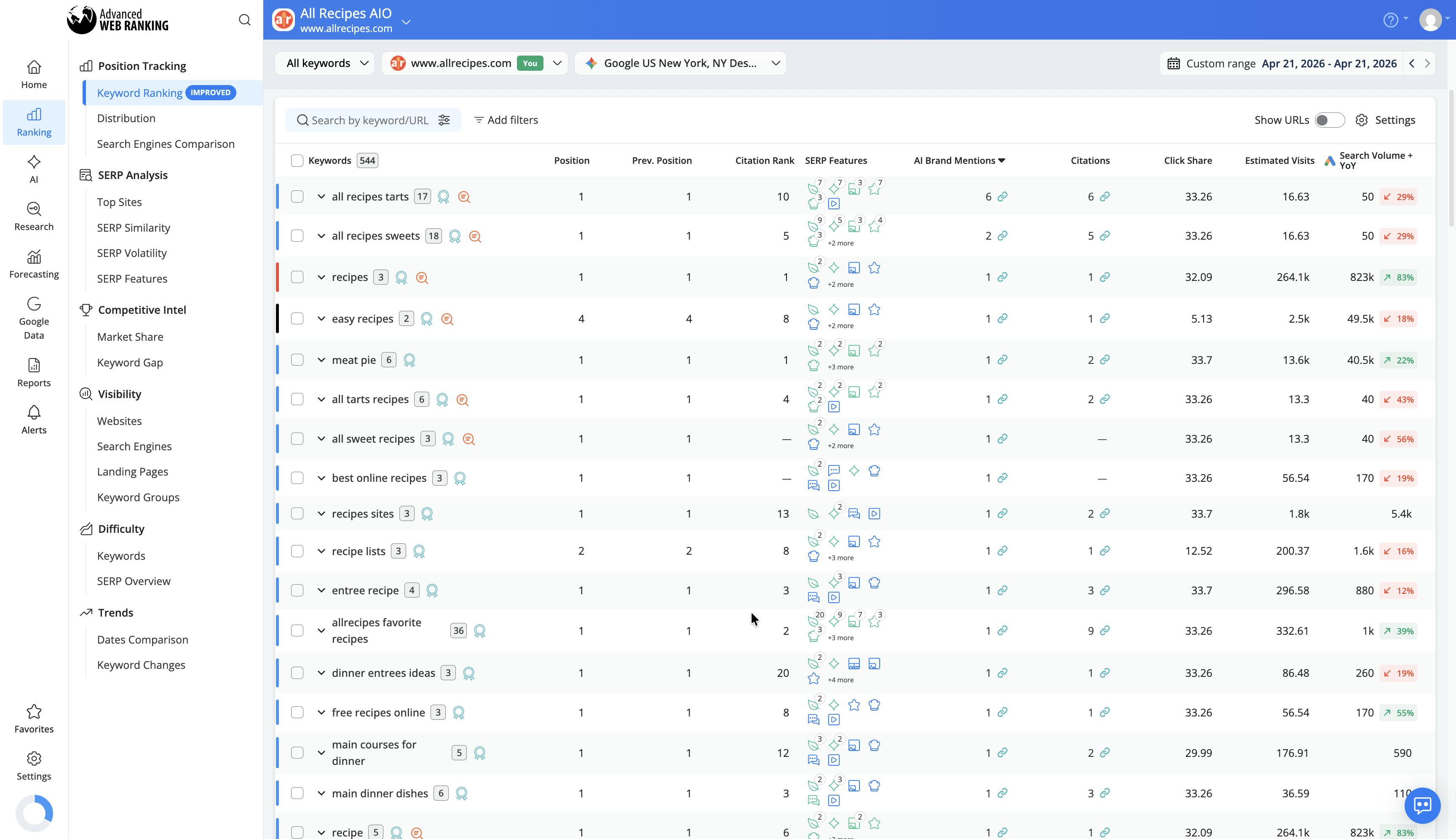
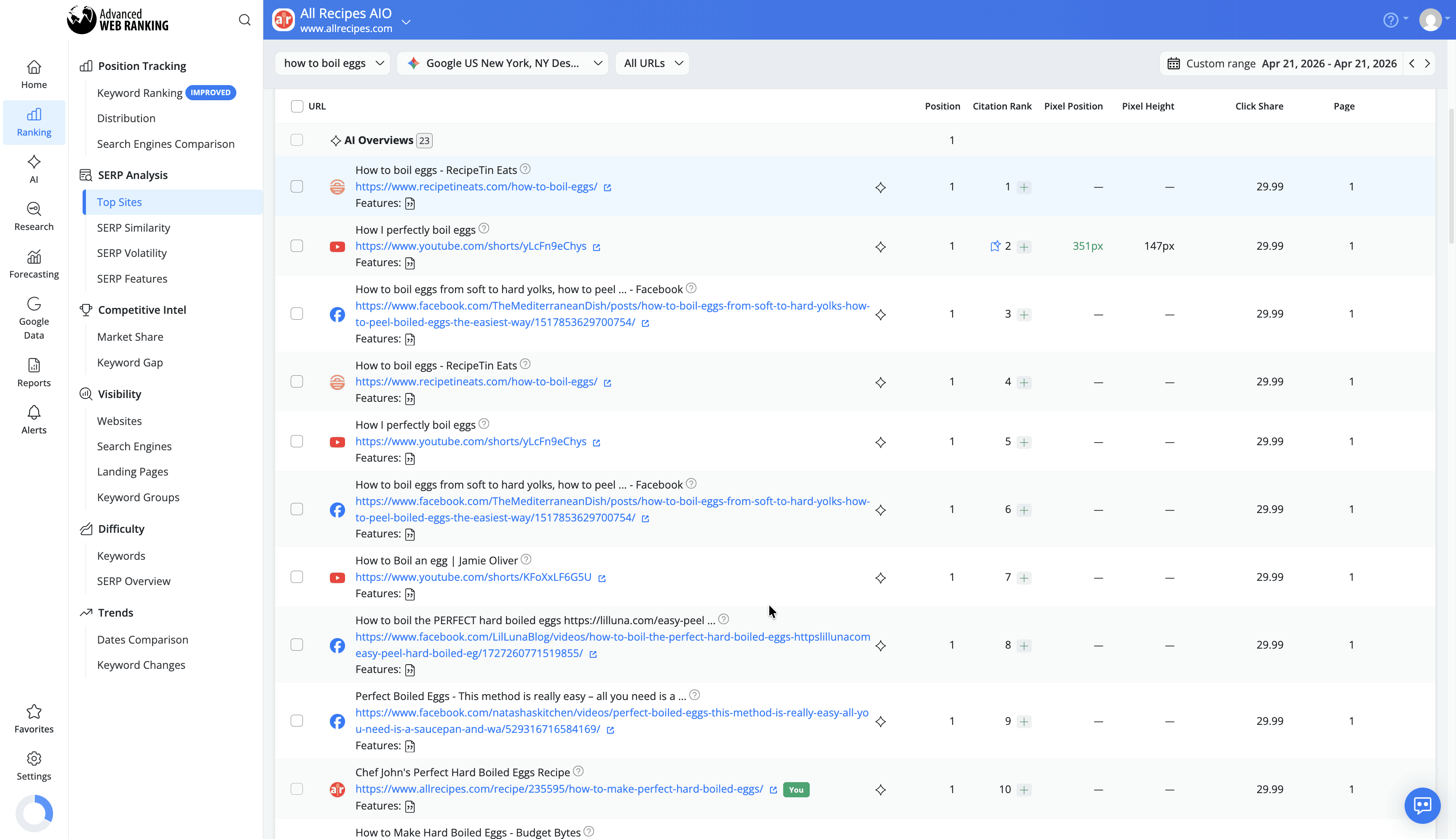
To get a full picture of the competitive landscape, AWR also provides a breakdown of all websites referenced as sources in AI Overviews in the Top Sites report, including the title and URL of each cited source. This makes it easy to see which sites are dominating AI Overview citations in your target market and where you stand in relation to them.
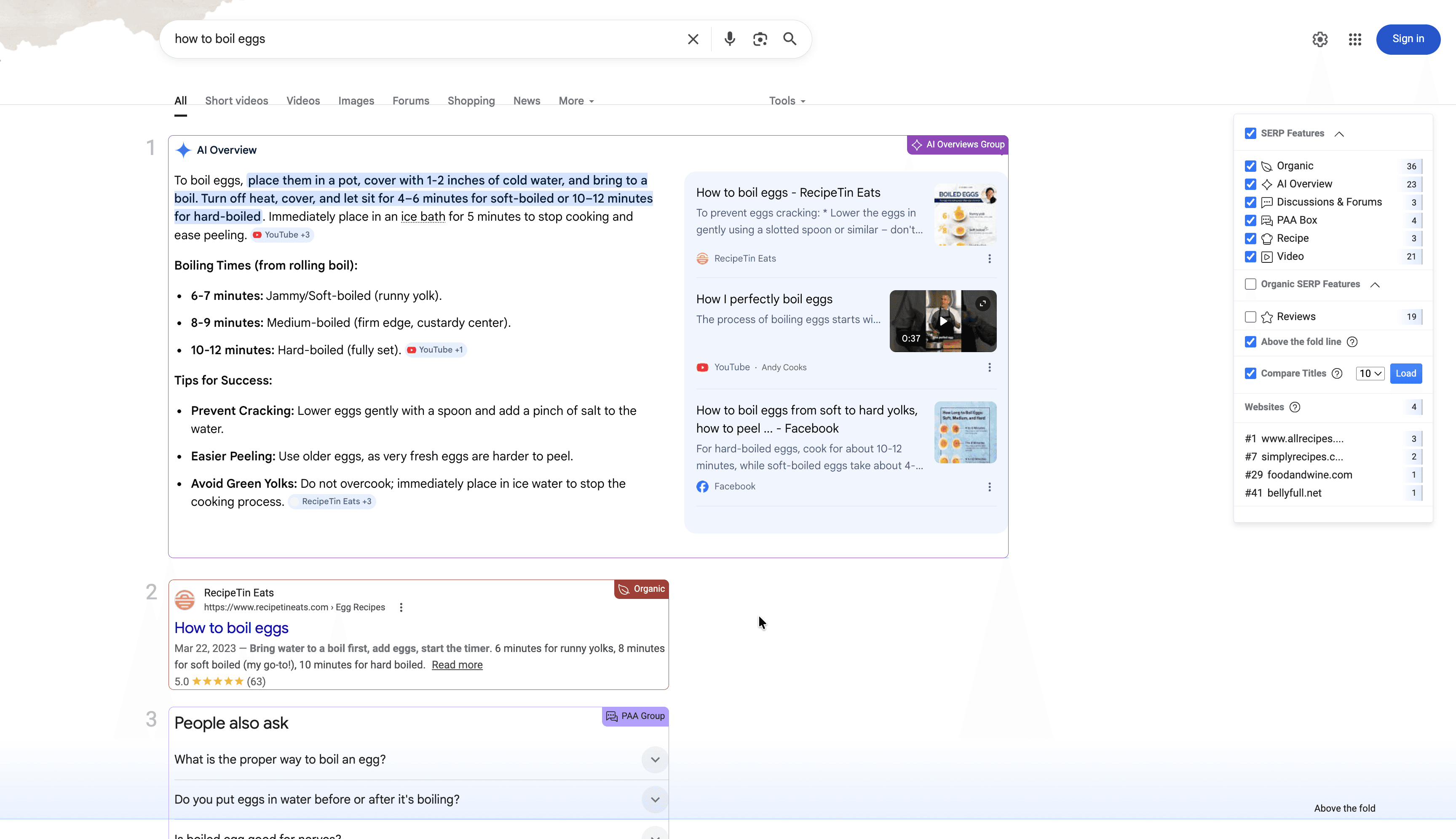
You can also view a SERP snapshot of the actual results page for every tracked keyword. This way you can see exactly how the results looked at the time of retrieval, offering instant insights into how your site and competitors appear in the search results.
Conclusion
AI Overviews are not a static feature. They evolve constantly, and so does the competitive landscape they create. What appears in an AI Overview today may look completely different tomorrow, and what appears in one location may bear no resemblance to what users in another market are seeing.
The use cases in this article show that location is one of the most powerful variables shaping AI Overview content. From global markets down to individual cities and languages, the same query can tell a very different story depending on where it is searched from. Understanding those differences is no longer optional for businesses that want to stay visible in AI-driven search.
Custom location tracking for the Google Search + AIO engine in AWR gives you the granularity to see exactly what your audience sees, wherever they are. Whether you are tracking visibility across multiple countries, monitoring how your content performs in specific states, or understanding how competitors appear in a city you are trying to break into, the data is now available at the level that actually matters.
Start tracking your custom locations today and get a clearer picture of where you stand in AI search, market by market.
Do you have any further questions or need more information about this product update? Don't hesitate to get in touch with our dedicated support team.
Frequently Asked Questions
Does Google show different AI Overviews to users in different countries?
Does location affect which sources are cited in an AI Overview?
Can the same query trigger an AI Overview in one location but not another?
Do AI Overviews change depending on the language of the query?
Does ranking in the top 10 guarantee appearing in an AI Overview?
stay in the loop