


Images in AI Search
Sections 3 through 5 covered surfaces where a human looks at your image. This section covers surfaces where a machine looks at it first, decides what it is, and then decides whether a human ever sees it at all.
This is the newest material in the guide and the least documented. I will be explicit throughout about which claims come from vendor documentation and which are inference, because the gap between the two is wide here and a great deal of published advice on the topic does not distinguish them.
Visual search fan-out
Start with the one thing in this section that is fully documented, because it is also the most important.
Google’s AI Mode is built on a technique Google calls query fan-out: rather than answering a query directly, the system decomposes it into many sub-queries and issues them in parallel, then synthesizes the results. Deep Search extends the same mechanism to hundreds of searches for a single question.
In September 2025, Google announced the visual counterpart and named it. From Google’s own announcement:
our new "visual search fan-out" technique allows us to have a deeper understanding of precisely what’s in an image […] recognizing subtle details and secondary objects in addition to the primary subjects […] rooted in […] Google Search with Lens and Image search, combined with Gemini 2.5’s advanced multimodal and language capabilities.
This is official Google terminology, not a practitioner coinage. That distinction matters because the term has circulated in SEO commentary with varying degrees of embellishment, and a guide claiming source-of-truth status should be able to point at the primary source.
Read the quotation closely and it describes exactly the mechanics of section 2, operating at a new scale. The system is not identifying the object in an image and searching for it. It is identifying many objects — including "subtle details and secondary objects" — and fanning out queries across all of them simultaneously.
The consequence for ecommerce is concrete, and it inverts a long-standing instinct:
A styled photograph is no longer one query. It is a dozen. The interior scene containing your pendant lamp is also generating retrievals for the mirror, the cushions, the curtains, the rug and the floor. Every recognizable object in your imagery is an independent entry point.
For a retailer selling across a category, this is a strong argument for lifestyle photography over pure catalogue shots, provided the objects in frame remain individually legible. It also sharpens the clutter warning from section 2 into something more precise. The failure mode is not "too many objects." It is too many objects rendered indistinctly. A well-composed room shot with eight clearly-separated, well-lit products is eight opportunities. The same room shot dimly lit and visually busy is eight low-confidence detections, which is worse than one good one.
Images in AI Overviews and AI Mode
Return to the lamp journey from section 4 but follow it down a different branch.
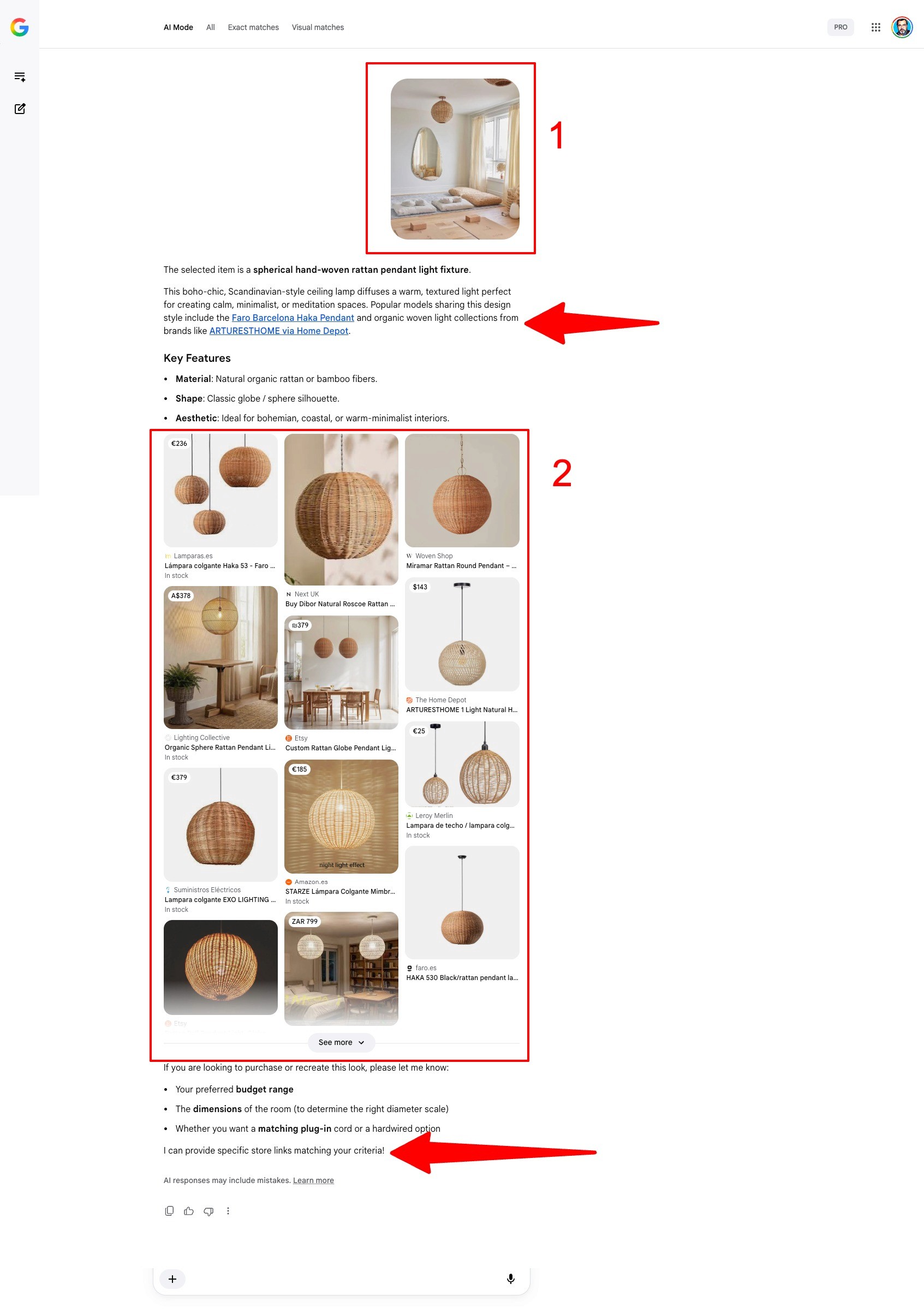
Caption: The same object selection, resolved in AI Mode. (1) The source image the shopper selected from. Below it, a written identification with inline links to named vendors. (2) A shopping grid of matched products with prices across multiple currencies and merchants. Beneath, follow-up prompts inviting budget, dimensions and fitting preferences.
Three things are happening on that screen, and each one has a distinct optimisation implication.
The identification is prose, and the prose contains links. The description of the object — a spherical hand-woven rattan pendant, boho-chic, Scandinavian-style — carries inline links to specific named vendors. Those links are the AI-search equivalent of a ranking position, and they are attached to entity identification, not to keyword matching. Being the brand the model names is the objective.
The shopping grid is dense and comparative. A dozen-plus products, each with merchant, price and stock status, drawn from marketplaces, manufacturers and independent retailers across several countries and currencies. This is the product graph section 5 described, rendered visually. Every tile in it originates in a feed.
The follow-up prompts are attribute questions. Budget range. Room dimensions. Plug-in or hardwired. The model is offering to narrow the set, and it will narrow it using structured product attributes. A catalogue that carries fitting type, dimensions and price in machine-readable form can survive that narrowing. One that holds those facts only in prose on the PDP, or only in a photograph, will be filtered out of the second round.
That last point deserves emphasis because it is where most ecommerce catalogues will lose. Visibility in AI shopping is not decided at the first answer but across the refinement. The shopper who says "under €200, hardwired" is running a query your product data either can or cannot answer.
Remember: Google states there is no special markup for AI Overviews or AI Mode. There is no schema type for AI answers. The eligibility requirements are the ordinary ones: crawlable content, accurate structured data, and markup that matches what is visibly on the page. Anyone selling you AI-specific schema is selling you something that does not exist.
What is true and follows from the architecture rather than from any announcement: the systems answering these queries are drawing on the same product data, the same structured markup and the same image index as the classic surfaces. Section 8’s technical foundations are not superseded by AI search. They are the input to it.
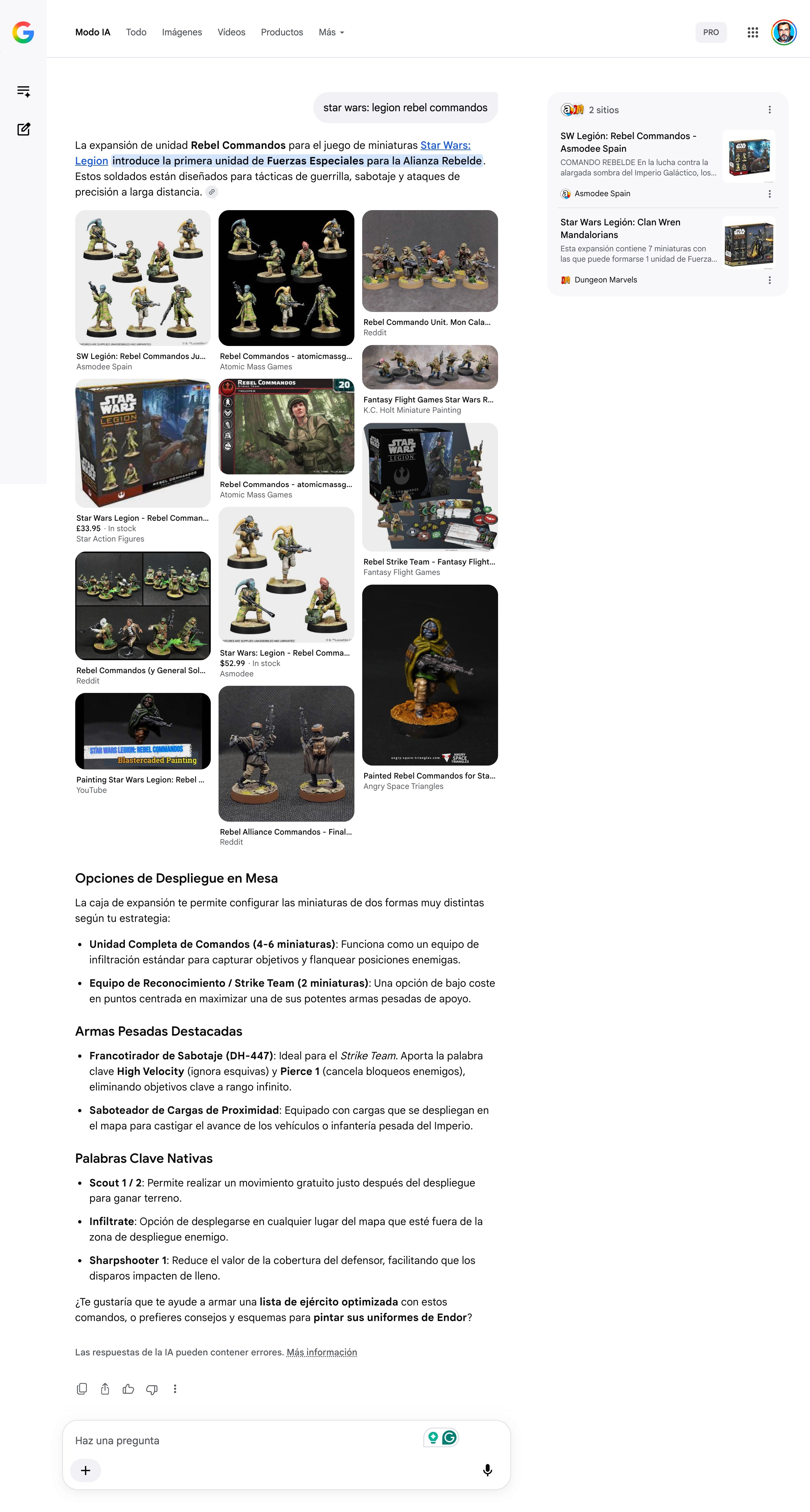
Caption: An AI Mode answer showing how images appear when the user never photographed anything — the complement to "AI Mode 4", which is Lens-initiated.
Turn visual search data into actionable insights
Advanced Web Ranking gives you a clearer view of visual search performance, from rankings in Google Images to image results in Universal SERPs and visibility across major AI engines.
How ChatGPT, Gemini, Claude and Perplexity ingest images
Section 2 established the headline: on direct upload, frontier models read pixels and ignore your metadata. Here are the operational specifics, drawn from vendor documentation, because the differences between models are real and occasionally decisive.
Formats | Limits | Metadata | Notable | |
|---|---|---|---|---|
GPT-4o / GPT-5 | PNG, JPEG, WebP, GIF | Patch/tile tokenization | Not processed — including filenames | Weaker on small text and rotated images; blocks CAPTCHAs |
Claude | JPEG, PNG, GIF, WebP | 10 MB direct API; 8000 × 8000 px; 28 × 28 px visual patches | Not processed | Will not identify people; cannot determine whether an image is AI-generated |
Gemini | PNG, JPEG, WebP, HEIC, HEIF | Under 20 MB inline, File API above; up to 3,600 images per request | - | Object detection with normalized bounding boxes (0–1000) and segmentation |
Four practical readings.
Filenames and metadata are worthless on direct upload. Both OpenAI and Anthropic state this explicitly. The descriptive-filename discipline in section 8 remains correct, but its value is in web retrieval and classic image search, not in the multimodal conversation.
Gemini’s documented object detection is the tightest available confirmation of the mechanics in section 2. Normalized bounding boxes and segmentation are not inferred capabilities; they are in the API documentation. When reasoning about what Google’s systems can extract from a product photograph, this is the primary source to reach for.
Claude cannot detect AI-generated imagery. Worth knowing when thinking about provenance in section 8: the C2PA and SynthID machinery exists precisely because model vision alone does not answer this question.
Format support is narrower than the web’s. AVIF — which section 8 recommends for performance — is not on these lists. This is not a reason to avoid AVIF, since these limits govern uploads, not crawling. But if you serve AVIF exclusively with no fallback, you are assuming about every downstream consumer of your images. Serve modern formats with conventional fallbacks via the picture element, and the question resolves itself.
Perplexity sits somewhat apart, because it is citation-native by design: every answer carries numbered source links, product cards included. It also signed a multi-year licensing deal with Getty Images in October 2025 to display licensed imagery with credit and links back to source, which is a structural commitment to attribution that neither Google’s AI surfaces nor ChatGPT match. For ecommerce, Perplexity is the surface where being the cited source translates most directly into a click.
Does image optimisation influence citation?
Here is where I want to be careful, because this is the question many ask and the evidence is thinner than the confident answers circulating would suggest.
What is documented:
Google states that AI Overviews and AI Mode draw on its existing index and require no special markup.
Visual search fan-out operates on image content, extracting primary and secondary objects (Google, September 2025).
On direct upload, frontier models process pixels and not metadata (OpenAI, Anthropic).
Google’s product graph — feeds — supplies the shopping components of AI answers.
What is credible expert analysis: Myriam Jessier’s work on image SEO for multimodal AI argues that models parse images through visual tokenization and OCR, which makes image quality functionally a ranking input: aggressive lossy compression produces noisy tokens, and noisy tokens increase the likelihood of misidentification. She frames alt text as a semantic signpost — grounding that reduces ambiguity rather than substituting for vision — and argues that object co-occurrence within a frame signals brand positioning. This is the strongest named-specialist treatment of the subject I am aware of.
What is inference and should be labelled as such: that during browsing and retrieval — as opposed to direct upload — textual signals dominate image content, because running vision inference across every candidate image is expensive and slow. The cost asymmetry is real and the reasoning is sound. No vendor has confirmed it. Anyone stating it as fact is overreaching.
What nobody can currently measure: whether a specific image optimisation caused a specific citation. Search Console does not report AI Mode appearances separately from AI Overviews ones. There is no impression data for being named but not linked in an AI answer. Section 11 deals with this honestly rather than pretending otherwise.
The defensible position, and the one I take in this guide:
Optimize both the pixels and the text layer, because the retrieval path is not observable from outside, and the cost of covering both is low relative to the cost of guessing wrong.
That is a weaker claim than "here is how to rank in AI search." It is also the only one the evidence supports.
Turn visual search data into actionable insights
Advanced Web Ranking gives you a clearer view of visual search performance, from rankings in Google Images to image results in Universal SERPs and visibility across major AI engines.
Agentic commerce: when the buyer is a machine
The final development in this section removes the human from the transaction entirely, and it reframes what product imagery is for.
OpenAI launched Instant Checkout in ChatGPT in September 2025, built on the open Agentic Commerce Protocol, developed with Stripe. Etsy was live at launch, with Shopify merchants following. Merchants participate by submitting a product feed — CSV, JSON or XML, refreshable as often as every 15 minutes — carrying identifiers, descriptions, pricing, inventory, fulfilment and media, plus two product-level flags controlling whether an item is searchable and whether it is purchasable. OpenAI is not the merchant of record; merchants keep their own payment relationships, and product results are organic rather than sponsored.
Google announced the Agent Payments Protocol (AP2) on 16 September 2025 with sixty-plus partners including Mastercard, PayPal, American Express and Coinbase. It uses cryptographically signed Intent, Cart and Payment Mandates built on W3C Verifiable Credentials, extending the A2A and MCP protocols. Product data flows from the Merchant Center graph.
Perplexity runs a Merchant Program, accepting product feeds, alongside Buy with Pro and Snap to Shop, aka visual search that photographs an item and finds purchasable equivalents.

Caption: A ChatGPT product card with Instant Checkout, showing what a machine-mediated product presentation looks like.
Three observations, in ascending order of importance.
Feeds are now the shared substrate. Google, OpenAI and Perplexity all ingest merchant product feeds, in broadly similar formats, carrying broadly the same fields — and every one of them requires an image URL as a mandatory field. Your feed is no longer a Shopping channel. It is the canonical machine-readable description of your product, consumed by every system that shops on a user’s behalf. If your feed image is the lowest-quality asset in your catalogue, that is the image representing you across all of them.
Image quality survives the human’s absence. It is tempting to conclude that when an agent transacts, pictures stop mattering. The opposite holds. The agent uses the image to identify and disambiguate the product — and the human still sees the image in the product card the agent presents. Both the matching and the presentation run on the same asset.
Not every catalogue can participate. Amazon has been blocking third-party LLM crawlers and sued Perplexity in March 2026 over scraping of product pages, reviews and imagery. The practical effect is that Amazon sellers are structurally absent from ChatGPT and Perplexity commerce. For brands selling both on Amazon and direct, this is a genuine argument for the direct channel: your own site, properly fed and marked up, can appear on surfaces where your Amazon listing cannot.
The section’s through-line, and the bridge to what follows: every AI surface reaches for structured product data before it reaches for a page and reaches for an image at the moment of identification. The next section and section 8 cover exactly those two things: the markup that makes your product legible, and the technical foundations that make your images available and readable.
Continue the guide
Images in Universal Search ← Previous · Next → Image & Product Structured Data

Article by
Gianluca Fiorelli
With almost 20 years of experience in web marketing, Gianluca Fiorelli is a Strategic and International SEO Consultant who helps businesses improve their visibility and performance on organic search. Gianluca collaborated with clients from various industries and regions, such as Glassdoor, Idealista, Rastreator.com, Outsystems, Chess.com, SIXT Ride, Vegetables by Bayer, Visit California, Gamepix, James Edition and many others.
A very active member of the SEO community, Gianluca daily shares his insights and best practices on SEO, content, Search marketing strategy and the evolution of Search on social media channels such as X, Bluesky and LinkedIn and through the blog on his website: IloveSEO.net.