

Advice and answers from the Advanced Web Ranking Team
Search for articles
>
>
AI vs Organic Overlap: The New AWR Metric That Reveals Whether Your SEO Actually Feeds Your AI Visibility
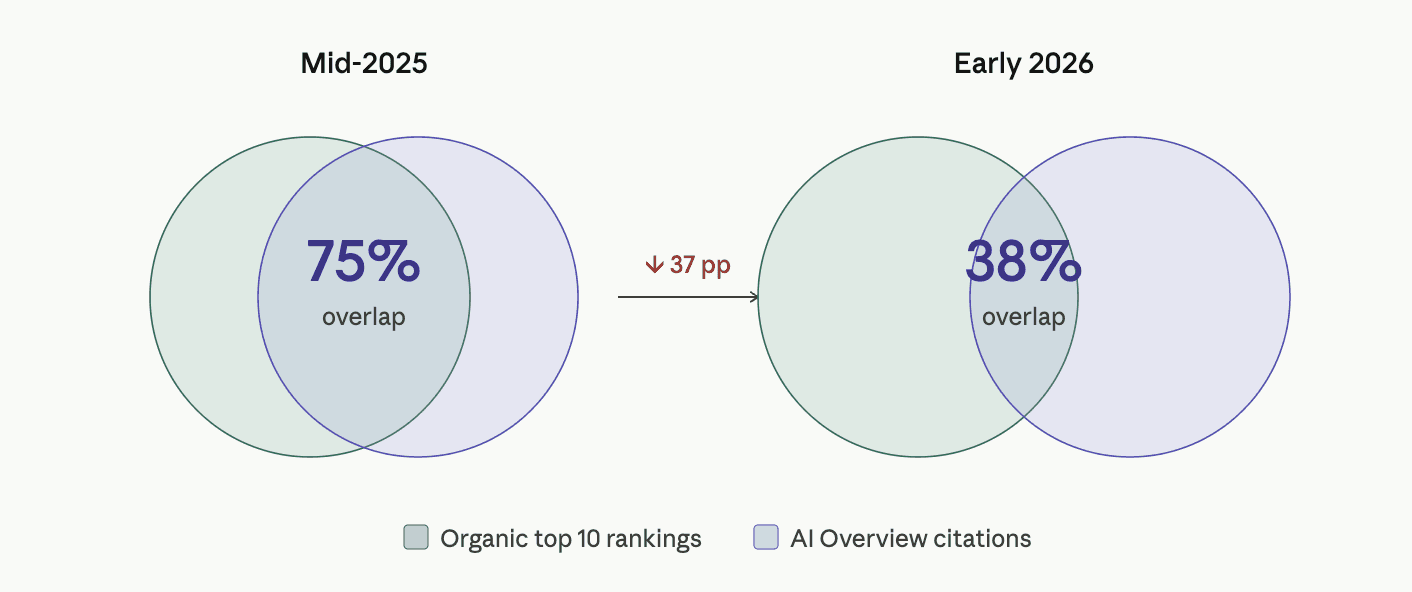
The overlap between top-10 organic rankings and AI Overview citations has collapsed from 75% to under 38% in barely a year. If you're not measuring both channels side by side, you're missing half the picture.

There's an uncomfortable question most SEO professionals are avoiding in 2026: Is my organic ranking strategy actually helping me show up in AI-generated results?
For years, the assumption was straightforward. Rank high on Google, and Google's AI will cite you. The data supported it. Through mid-2025, roughly 75% of AI Overview citations came from pages already sitting in the top 10 organic results. Organic SEO and AI visibility were, for practical purposes, the same exercise.
That assumption has shattered. Ahrefs' February 2026 study of 863,000 keywords found the overlap had dropped to 38%. A parallel BrightEdge analysis put it even lower, at around 17%. The trend line is clear, and it's not flattening.
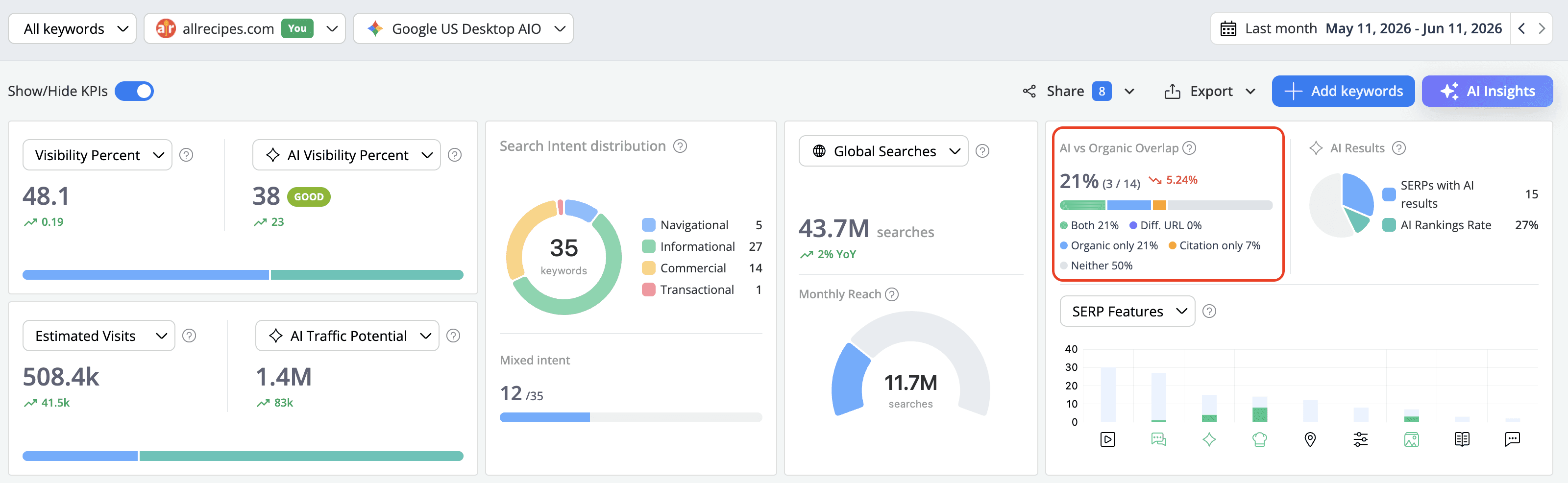
This is the context in which Advanced Web Ranking is shipping a new metric called AI vs. Organic Overlap, and it couldn't have come at a more critical time. You'll find this metric in the Keyword Ranking report, where it replaces the former "Achieved organic rankings" KPI card.
What this article covers
What AI vs Organic Overlap measures and how the calculation works, so you can understand exactly what's behind the number and why certain keywords are included or excluded
The five keyword segments (Both, Diff. URL, Organic only, Citation only, Neither) and what each one tells you to do next, turning raw data into a prioritized action list
Where this metric fits alongside AWR's existing AI tracking metrics, so you can see how your organic and AI visibility data connect
Two real-world use cases: a SaaS company discovering untapped "Citation only" keywords and an e-commerce brand fixing its "Organic only" problem, with step-by-step strategies you can adapt to your own data
Why tracking this trend matters, and how AWR's historical charts help you catch overlap shifts as they happen
What the Metric Actually Measures
The AI vs Organic Overlap KPI answers a single, strategic question for every keyword you track: Does my URL appear both in the organic top 10 and as a citation inside the AI Overview?
The formula is clean:
Overlap % = (Keywords where your URL ranks in the organic top 10 AND is cited in the AI Overview) ÷ (Keywords where an AI Overview with at least one citation exists) × 100
A few design decisions make this metric sharper than a raw overlap number. Only keywords where an AI Overview actually appears and contains at least one citation URL enter the calculation. Keywords without AIOs, or those with an AIO but zero cited sources, are excluded entirely from the denominator. This prevents noise from diluting the signal. It also distinguishes between exact URL overlap and domain-level overlap where different pages from the same site appear in each channel, a common pattern that other tools either miss or misclassify.
The organic threshold is fixed at the top 10 positions, and only true organic blue-link results count - not Featured Snippets, not Knowledge Panels, not any other SERP feature. The citation match is URL-aware. When the exact same URL ranks organically and is cited in the AIO, that's a full overlap ("Both"). But AWR also detects when a different URL from the same domain is cited: if your organic result is example.com/guide-a but the AIO cites example.com/guide-b, the metric flags it as "Diff. URL" rather than ignoring the domain-level presence. This gives you the nuance: same-page overlap vs. same-domain-but-different-page overlap, each with different strategic implications.
Beyond a Single Number: The Six Keyword Segments
The real analytical power isn't in the aggregate percentage. It's in how every single keyword gets classified into one of six states, each with a distinct strategic implication.
Both means the ideal state is achieved - your URL ranks organically in the top 10 and is cited in the AI Overview. These are your defended positions. The priority here is monitoring: watch for citation drop-off, because the data from the past year shows these positions are less stable than they used to be.
Diff. URL is the nuance that most tools miss entirely. Your domain appears in both the organic top 10 and the AIO citations, but with different pages. Maybe your /pricing page ranks organically while the AIO cites your /blog/comparison-guide. This tells you something important: Google's AI sees your domain as authoritative enough to cite, but it's reaching for different content than what ranks traditionally. The tooltip in AWR shows you both URLs side by side, so you can evaluate whether to consolidate (redirect the weaker page to the stronger one), cross-link them, or accept that Google's organic algorithm and its AI citation engine value different content formats from your site. This status was added because without it, these keywords would misleadingly show as "Organic only", hiding the fact that your domain actually has presence in both channels.
Organic only is the content optimization signal. You rank on page one, but Google's AI isn't pulling from your page when it generates its overview. This typically indicates a content format mismatch - the page may lack the structured, concise, directly-answerable content that AIOs tend to prefer. The page has authority, but its information architecture doesn't serve the AI's needs.
Citation only is arguably the most interesting segment. Your URL is being cited in the AI Overview despite not ranking in the organic top 10. This means Google's AI recognizes your content authority for that topic even though the traditional ranking algorithm doesn't place you on page one. It's both a validation and an opportunity: strengthen the page's organic signals to capture the double-channel presence.
Neither means the AI Overview exists for this keyword, but you're invisible in both channels. Your URL doesn't rank in the top 10, and it isn't cited. This requires a fundamentally different response than the other states - it's not a tweak, it's a content gap or an authority gap.
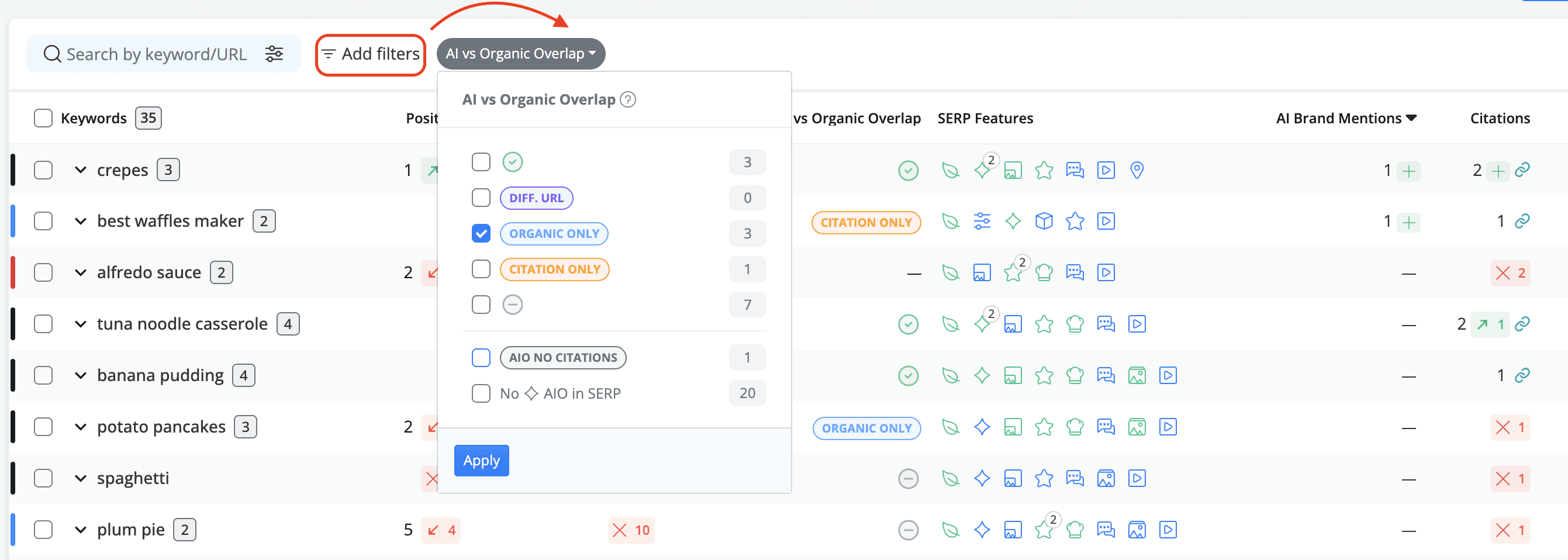
In the table below the KPIs, every tracked keyword gets a color-coded badge in the dedicated AI vs Organic Overlap column, which you can add to your report using the column selector. The labeled badges (Citation only, Organic only, Diff. URL) are self-explanatory, while the green checkmark means Both and the gray dash means Neither.

Additionally a dedicated filter lets you isolate any combination of keyword segments and work on them in batches. Multi-select is supported, so you can combine , for instance Organic only and Citation only to see all keywords with partial presence, or filter to Diff. URL to find every keyword where your domain appears in both channels but with different pages.
Where This Fits in AWR's Broader AI Tracking Stack
If you've been following AWR's product evolution over the past year, this metric doesn't appear in a vacuum. It's the connective layer between several capabilities that, together, form one of the most complete pictures of how a website performs across traditional and AI-powered search.
AWR already tracks AI Overview presence as a SERP feature, showing you which keywords trigger AIOs and whether your site appears in them. The dedicated Google Search + AIO search engine provides enhanced accuracy for capturing AI-generated results across desktop and mobile. The AIO Citation Rank metric tells you where your URL sits within the citation list - whether you're the first source cited or the tenth.
Then there's the AI Brand Mentions system, which captures when your brand is named, linked, or cited in AI summaries - covering not just AIOs but also Google AI Mode and Universal search engines. And on the LLM side, AWR tracks your brand's presence, for now, in ChatGPT, Perplexity, and other search engines.
The AI vs Organic Overlap metric sits at the intersection of all of this. It takes the organic ranking data AWR has been collecting for over two decades and maps it against the AI citation data that's been building since the AIO tracking launched. The result is a diagnostic layer that tells you whether your two most important search visibility channels are working together or drifting apart.
The KPI card for this metric replaces the Achieved organic rankings card in the Keyword Ranking report - a symbolic change that reflects the reality of 2026 SEO: measuring organic rankings alone is no longer the complete picture.
Use Case 1: The SaaS Company Watching Its "Citation Only" Keywords Spike
Consider a mid-size B2B SaaS company tracking 1,200 keywords across their product category. They've invested heavily in long-form educational content: comprehensive guides, technical comparisons, implementation tutorials. Their organic rankings are solid: a visibility score above 60%, with hundreds of keywords in the top 10.
But when they enable the AI vs Organic Overlap metric in AWR, a pattern emerges. Roughly 22% of their eligible keywords fall into the "Citation only" segment. Google's AI is citing their deep-dive technical guides in AI Overviews for queries where those same pages don't crack the organic top 10.
This is happening because of the query fan-out mechanism that now powers AI Overviews. When a user searches for something like "best project management tool for remote teams," Google's AI doesn't just look at pages ranking for that exact query. It breaks the question into sub-queries - evaluating remote collaboration features, pricing models, integration capabilities - and pulls citations from pages that comprehensively cover those sub-topics, even if those pages rank for different head terms.
The SaaS company's detailed comparison pages are exactly the kind of content that fan-out favors: structured, factual, directly answerable, and covering multiple angles of a topic. They're getting cited because of content quality and topical depth, not because of traditional ranking signals for the specific query.
The strategic response unfolds in layers. First, they export the "Citation only" keyword list from AWR's filter panel. Then they cross-reference each keyword with its current organic ranking (often positions 12-25, close to page one but not on it) and the AIO Citation Rank to see how prominently they're cited. For keywords where the organic position is 11-15 and the citation rank is in the top 3, the ROI case for an organic push is strong: targeted internal linking, updated content, and backlink acquisition could move these pages into "Both" status, capturing visibility in both channels simultaneously.
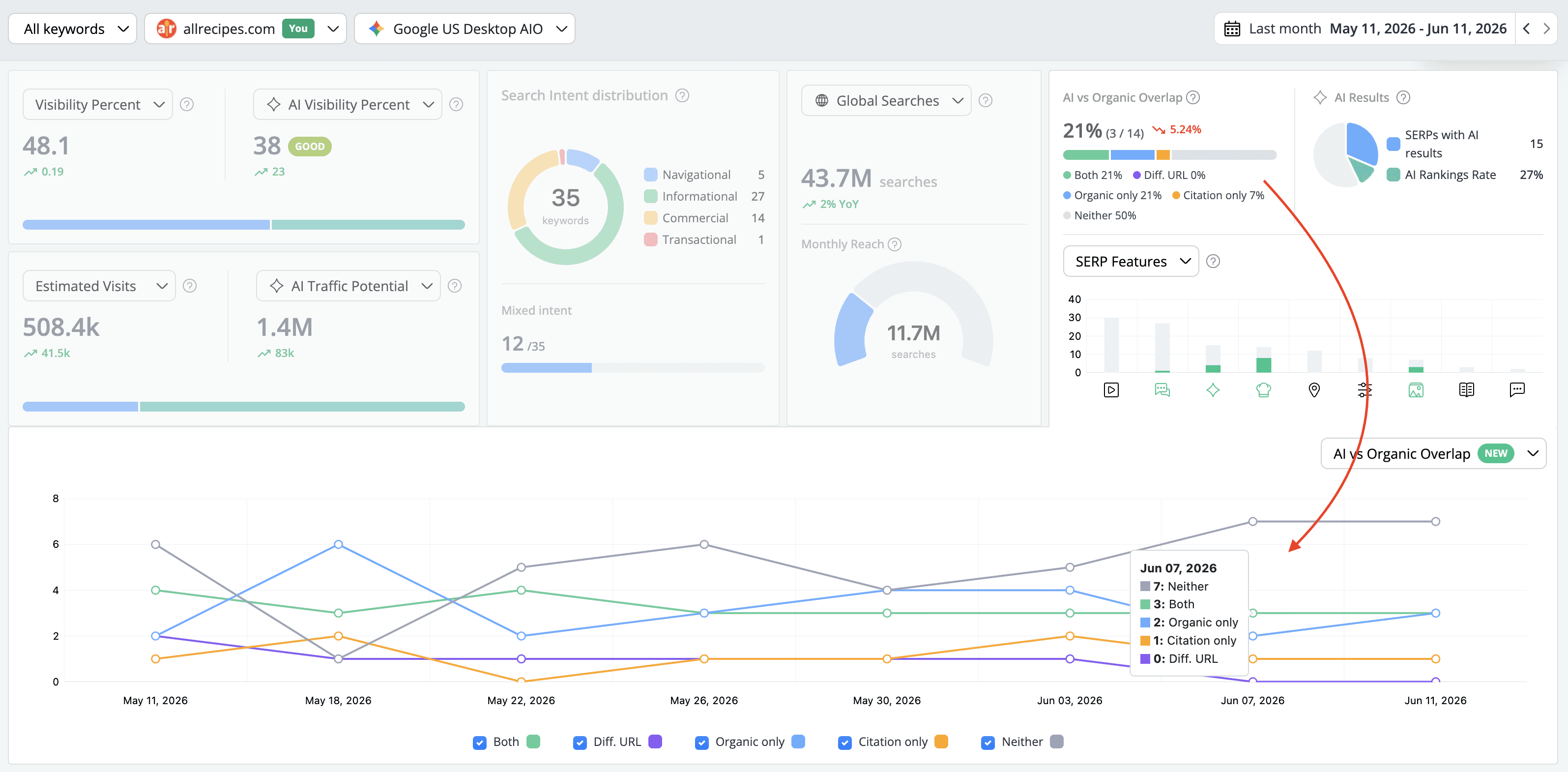
They also monitor the trend over time using the SERP Features chart integration, which now includes an AI vs Organic Overlap option showing line series - one per segment - plotted across updates. Watching the "Citation only" line climb while "Both" stays flat would indicate the fan-out effect is accelerating, and their content strategy needs to pivot from single-keyword optimization to topical cluster coverage.
Use Case 2: The E-Commerce Brand Discovering Its "Organic Only" Problem
A direct-to-consumer brand selling outdoor gear tracks 3,000 keywords across product categories, brand terms, and informational queries. Their organic SEO program is mature: product pages rank well, category pages hold strong positions, and their blog drives significant traffic through informational content.
The AI vs Organic Overlap metric reveals a different story. Their overlap sits at just 14% - well below what they expected. The dominant segment is "Organic only" at 41%. They rank on page one for hundreds of queries, but Google's AI barely cites them.
Digging into the "Organic only" keywords, a pattern appears tied to content format. Their product pages rank organically for queries like "best waterproof hiking boots" or "ultralight backpacking tent comparison," but the AIOs for those queries cite sources that provide direct, structured answers: specification tables, bullet-pointed pros-and-cons, concise recommendation summaries. The e-commerce brand's pages are built around conversion - images, pricing, add-to-cart buttons - not around the kind of information the AI needs to construct a helpful overview.
Interestingly, when the team filters for "Diff. URL" keywords, they discover another pattern. For queries like "hiking boot sizing guide," their product page /boots/waterproof-hiking ranks at position 4 organically, while the AIO cites their blog post /blog/how-to-size-hiking-boots. Google's AI is preferring the informational content over the commercial page for citation purposes, even though the commercial page wins organically. This insight shapes their content strategy: rather than forcing product pages to do double duty, they invest in dedicated informational companion content that the AI can cite, while keeping the product pages optimized for organic ranking and conversion. The "Diff. URL" segment makes this two-track strategy visible and measurable.
The fix for the "Organic only" keywords isn't abandoning product page SEO. It's layering AI-friendly content formats on top of existing pages. Adding structured FAQ sections with direct, factual answers. Publishing comparison data in clean, parseable formats. Creating buying guides that explicitly answer the sub-questions the AI is likely decomposing from broader queries.
Using AWR's keyword group filtering alongside the overlap segments, the team prioritizes product categories where they have the highest "Organic only" concentration. They focus on categories with the highest search volume and the most AIO prevalence (visible through the existing SERP Features data), because that's where converting "Organic only" keywords into "Both" will have the biggest traffic impact.
Industry research from BrightEdge has shown that overlap varies dramatically by vertical - from 0.6 percentage points in e-commerce to 53.2 points in education. Knowing your industry baseline matters, and the trend data in AWR lets the team benchmark their progress against their own historical performance rather than chasing an abstract target.
The strategic reframe is significant. This brand had been measuring SEO success purely through organic rankings and conversion rates. The overlap metric introduces a second dimension: are those organic rankings also feeding AI visibility? Because in a world where AI Overviews appear on 48% of queries and brands cited in them earn roughly 120% more organic clicks than uncited brands on the same query, an "Organic only" keyword is leaving measurable value on the table.
Why the Timing Matters: The Overlap Is Still Falling
The most critical aspect of this metric isn't the snapshot - it's the trend. The overlap between organic rankings and AI citations has been falling at a rate that should concern anyone whose traffic strategy depends on traditional SEO alone.
It's worth restating how fast this is moving. In mid-2025, three out of four AIO citations came from top-10 pages. By early 2026, that ratio had dropped to somewhere between one in three and one in six, depending on the study. BrightEdge reported a 400% increase in citations pulled from pages ranking in positions 21 through 30. YouTube has become the single most-cited domain in AI Overviews according to Ahrefs' tracking, growing 34% over six months.
The shift has a technical explanation: Google's continued evolution of the AI model powering AI Overviews has accelerated the fan-out query process. The AI evaluates content against sub-queries that the user never explicitly typed, drawing from a broader pool of sources. A page's direct ranking position for a specific keyword matters less; its depth, accuracy, and ability to support related angles matters more.
This is precisely why a static, one-time measurement won't cut it. The AI vs Organic Overlap metric in AWR is designed to be tracked over time, with a trend delta on the KPI card (showing directional movement like ↑ 3.2 or ↓ 1.5 between updates) and the historical chart view showing all six segments across your tracking timeline. If your overlap is declining week over week, that's a signal - even if your organic rankings haven't moved.
What This Means for Your SEO Strategy
The emergence of an overlap metric between organic and AI citation performance marks a broader shift in how search success is measured. The KPIs that mattered in 2024 - average position, organic visibility score, traffic from organic search - aren't going away. But they're no longer sufficient on their own.
AWR's top 12 feature overview captures this evolution: the platform now unifies traditional SEO rankings and AI search visibility in the same dashboard, spanning organic positions, AI Overview citations, AIO Citation Rank, AI Brand Mentions, and now the overlap metric that ties the organic and AI dimensions together. Add the LLM tracking for ChatGPT, Perplexity, and Google AI Mode, and you're looking at the most complete measurement framework for how a website performs across every surface where search happens in 2026.
The practical takeaway is simple. If you're running an SEO campaign and you're not measuring the relationship between your organic rankings and your AI citations, you have a blind spot - and it's growing wider every month. The AI vs Organic Overlap metric doesn't ask you to choose between organic SEO and AI optimization. It shows you how your organic and AI visibility overlap, where they drift apart,, and where the best opportunities are for making them work together.
The six keyword segments give you a prioritized action list without needing to build custom spreadsheets or cross-reference multiple tools. And the trend tracking ensures you're not reacting to a snapshot, but watching a signal that updates with every ranking refresh.
If you want to see where your own overlap stands, AWR offers a free trial with access to the Keyword Ranking report and SERP Features tracking, which includes AIO monitoring. Set up a project with your keywords, add a Google AIO or Universal search engine, and the overlap data starts building from your first update.
Because in 2026, the question isn't whether AI Overviews affect your SEO strategy. The question is whether you can see it happening - and what you're doing about it.
stay in the loop