

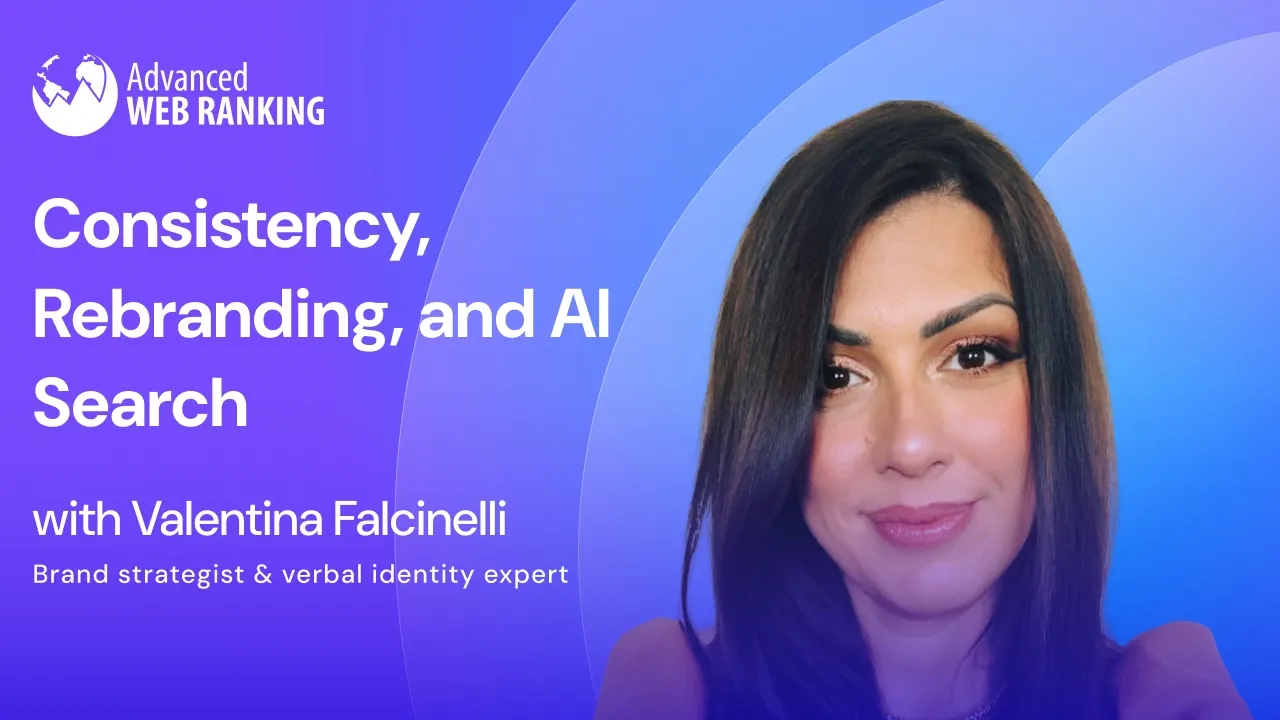
Hello, and welcome to The Search Session. I’m Gianluca Fiorelli. Today I’m talking with Valentina Falcinelli, a brand strategist and copywriter based in Rome, Italy.
We talk about why companies struggle to prioritize branding over quick campaigns, how to diagnose whether a brand is clear enough to be understood, and what a rebrand requires beyond a launch. Valentina also explains the CRED framework she uses in audits and how tone of voice and brand books should guide both people and AI tools.
What you’ll learn in this session:
Why branding takes longer than performance marketing: companies often confuse visible activity, such as campaigns and redesigns, with progress, while branding needs months and clear answers about who the company is and who it competes against.
How to diagnose a brand’s clarity: ask marketing, SEO, and sales teams what makes the company different, since conflicting answers show the problem before customers can understand the brand.
How the CRED framework audits a brand: test whether the brand is cohesive, relevant, easy to understand, and genuinely different from its competitors.
Why internal alignment matters: guidelines and workshops give employees a shared reference point, but the core promise should stay stable while its expression adapts to each audience and channel.
Why inconsistency weakens brands: constant small changes to visuals and tone tire audiences and erode identity, and gradual drift can surface in places a company cannot monitor.
What a rebrand requires beyond the reveal: a storytelling line and a communication plan help the public accept the change, because a single announcement post does not explain it to customers or search engines.
How to use AI without losing your brand: AI can reveal patterns in copy and help draft content, but output built on weak brand guidelines stays generic, so the brand book has to come first.
What tone of voice and a brand bible contain: vocabulary, personality traits, values, a recurring brand refrain, and plenty of examples, so anyone can write on brand.
Why copywriters need strategic thinking: AI can produce average copy in seconds, so the copywriters who keep their value connect business strategy, buyer insight, and competitive differences to the words they write.
Tune in for a conversation grounded in Valentina’s seventeen years of work on tone of voice, copywriting, and rebranding, and her view of what AI changes for brands.
Topics covered: brand consistency · rebranding · tone of voice · brand bible · CRED framework · internal branding · brand strategy · performance marketing · AI search · AI and copywriting · brand spokespeople · strategic copywriting
About the Guest

Valentina Falcinelli
Founder of Pennamontata
Valentina Falcinelli has seventeen years of experience in copywriting and brand strategy. She specializes in tone of voice, verbal identity, brand positioning and rebranding, and copywriting that gives companies a distinct voice.
She founded Pennamontata, a branding and rebranding agency that works with SMEs, scale-ups, established brands and NGOs. Its 12-week strategic branding process covers diagnosis, strategy and execution, including visual identity, tone of voice and internal team training. Clients include BPER Banca, Subito and WWF Italia.
She teaches copywriting and writes the newsletter Brand con Personalità, which began in January 2023. Her book Testi che parlano, published in 2018, focuses on tone of voice in corporate texts.
Video Chapters
Transcript
Full conversation between Gianluca Fiorelli and Valentina Falcinelli.
Gianluca Fiorelli: Hi, I'm Gianluca Fiorelli, and welcome back to The Search Session. Today we are going to have a good friend of mine, an Italian friend of mine. I have known our guest for many years now, and we always talk about the importance of brand. But do SEOs really know what it means to be a brand, to work on creating or reshaping a brand?
Or what does it mean for a brand to change its identity, and to do, as we could say, a migration from the old brand to the new vision of a brand, and so on, and so on, and so on. So I wanted to invite our guest today, because she is really an expert, with 17 years of experience working on things like tone of voice, copywriting, branding, rebranding, corporate image, and so on.
All of these things are even more important now for us search marketers too. Our guest is Valentina Falcinelli. Hey, Valentina, how are you doing?
Valentina Falcinelli: Ciao, Gianluca. Hello, everyone. I'm fine, thanks. What about you?
Gianluca Fiorelli: Oh, I'm recovering from a strong influenza, but yes, I'm fine. I'm ready for this episode. And obviously I cannot ask you how SEO is treating you lately, because you are not an SEO. So let's remake the question around your main topic, which is branding. How is branding treating you lately?
Valentina Falcinelli: Hmm. It's kind of treating me like dirt, I should say. Not treating me that well, I think because of AI. Copywriting is mistreating me very badly. Branding is treating me so-so.
Why Companies Neglect Brand Building for Performance Marketing
Gianluca Fiorelli: Yes, I can understand that copywriting and AI have a complicated relationship. A sort of love-hate relationship, may I say. But why also branding?
Valentina Falcinelli: Ah. Because branding is not performance marketing, and it is not seen like many other activities, such as SEO or advertising, which give you an immediate return. Branding is more like: if I had to bet, I would bet on branding. Although, I might say, branding is crucial now, more than yesterday. With AI, it's way more important than yesterday. But—
Gianluca Fiorelli: Yes. In fact, that's why I invited you. In my field, SEO, there is a problem of attribution right now, because AI is not really driving much traffic, and if traffic does come from AI, it is not clearly attributed to the efforts we have made. But what we have seen, and that's why I invited you, is that one of the factors, let's call it that, even if it's not the correct word, is the strength of a brand. The more the AI model knows the brand, the more frequently it will cite or mention the brand, or compare it with another similar brand.
So why do you think some business companies, not all, but a very big number of them, are struggling to understand, because of AI search, the importance of branding for visibility in AI search, which could be a strong driver for looking at how they communicate their values, their mission, their voice, and so on, through branding? Why do you think some companies really struggle to focus on this topic, which I think is so substantial to what they are?
Valentina Falcinelli: I think one of the biggest problems in marketing and communication is that companies often confuse activity with progress. There is a strong bond between performance marketing, advertising, and SEO and results, and a much weaker bond between branding and results. They want to launch a campaign, restyle their website, improve their social media presence, and they want to do it immediately. In many cases they get some results in a short time. Branding needs time, Gianluca. At least six months, at least. They want everything just for yesterday, I would say. And they don't always want to answer some questions that are crucial to growing. Those questions are strongly related to the brand: Who are we? Who are we really competing against? Why should someone choose us? They have to invest some budget in finding the right answers, and now the budget is all about performance marketing and all related activities.
Branding is, I would say, a ribbon. If you have some ribbon, you can put a ribbon on. If you don't have any ribbon, it's okay.
Gianluca Fiorelli: Well, I sincerely find this situation quite myopic. Performance marketing, like PPC or advertising on social media, can obviously be something that must be present. I'm not denying that campaigns exist, but something like this must exist. The same is true of SEO. SEO is not really performance. It also takes time, and maybe in this case we suffer a similar situation sometimes. But the fact is, why would someone choose an unknown brand, or a brand that is not salient at all, when in the same social media stream, search result page, or AI answer, it is paired with other brands that are super known just from the name? From the name, they are associated with certain types of value, certain types of service, certain types of product quality, et cetera, et cetera, et cetera.
It's very hard to understand why these brands don't understand this.
Diagnosing Brand Clarity and the CRED Framework
Gianluca Fiorelli: But let's try to be positive. You are used to working especially with small to medium businesses. I know you also work with important Italian brands, but let's say an average client is someone who comes to you and says, "Okay, God enlightened me, and now I understand that we need to seriously work on making people understand that we are a brand with these things, blah, blah, blah." What kind of diagnostic, what kind of review, apart from those questions you cited before, do you usually do?
Valentina Falcinelli: Okay. I have to say that questions are the key ingredients in all of my activities. I always start by questioning. One of the most revealing exercises I do with companies, and I work with medium to big ones, small or local companies are not my kind of clients, is very simple. I ask different people inside the organization to explain what makes their company different. Gianluca, you know I always get very different responses. I ask the SEO, the marketing team, and the salespeople, and sometimes it feels as though I'm interviewing three different businesses. The SEO talks about innovation and long-term vision. The marketing team talks about quality, expertise, and customer centricity. The salespeople talk about competitive prices, fast delivery, flexibility, and so on. None of these answers is wrong, but the problem is they don't tell the same story.
This is when a diagnosis becomes crucial and important, because if a company can't agree internally on why customers choose it, or should choose it, can we expect customers to understand? So I use a framework, a brand auditor framework, defined by two branding strategists. It's called the CRED framework, and it is based on the book Rebrand Right by Rachel Fairley and Sarah Robb. CRED is an acronym. C stands for cohesion, R for relevance, E for ease, and D for difference.
About cohesion, we should answer a crucial question: does the brand communicate and behave consistently across all touchpoints? Relevance asks whether the brand addresses needs, expectations, and priorities that actually matter to its audience. About ease: how easy is it for people to understand the brand, recognize its values, interact with it, and make a decision? And finally, D, difference: does the brand offer and communicate something meaningful and distinctive? Can people recognize the brand and distinguish it from its competitors? Of course, we should get a yes for all of these answers, but in many cases I collect a lot of nos.
Gianluca Fiorelli: Well, I think this is relatively normal. Having worked with many brands myself, some of those questions are the same ones I ask, in order to really understand. For instance, one of the questions you listed before was about who your real competitors are. That is a classic question I also ask. What are your USPs, your unique selling points? What is really making you different with respect to your competitors? These are things I also ask, because in search we must use this as a level to distinguish a brand when it is mixed up with others, in the search results or in the answers of AI search.
So it's quite interesting that many of the questions are the same. I recognize the situation where you say no, or where there are usually a lot of nos. But I think you probably have another type of complication, because we SEOs receive this kind of question, and we can more or less manage it. We try to find a few rules to understand and fix it. Okay, these are the brand personas, these are the buyer personas, these are the audience personas, and we are happy.
Related Episodes
Silvia Martin - SEO for Branding: Bridging Visibility and Business Strategy
Miracle Inameti-Archibong - What Brand-Led SEO Looks Like Today
Laura I. Abreu - Aligning SEO and PPC with Authentic Brand Authority
Internal Brand Alignment and the Cost of Inconsistency
Gianluca Fiorelli: But branding is not just communicating outside the company. Branding is also internal communication. There is one thing I really like in your methodology. I was reading your articles and posts, and the fact that you use the power of branding, imbuing the values of branding and, eventually, of rebranding (we will talk about rebranding later, because it's an interesting topic), to communicate and to instruct and mentor the employees of a company about the brand. How important is this kind of work inside the company as well?
Valentina Falcinelli: Yes, I would say it's crucial. Brand guidelines, brand books, workshops: everything that is branding is also a management tool. Everything around the brand helps create a common reference point for decisions, priorities, behaviors, and, of course, communication. Giving employees the tools to represent the brand at its best is the crucial part of my work. It helps an organization answer not only "What should we say?" but also "What should we prioritize?", which is interesting too. And I have to add one important thing for me, which is the following. Alignment doesn't mean forcing everyone to repeat the same corporate script.
Gianluca Fiorelli: That would also be dangerous, because you would start feeling the brand as a robotic brand, when everybody is repeating substantially the same language, the same phrasing, and so on, and so on.
Valentina Falcinelli: What is important is being able to infuse the brand promise in everyone's mind. The core promise should remain stable, while the way it's communicated can change and should adapt to audiences, context, channels, and touchpoints. Everyone should be able to answer in less than five seconds the question: Why does our brand exist? What do we do? And for whom?
Gianluca Fiorelli: Quite metaphysical. It's a hard question to answer in five seconds. But I can understand. Obviously, a brand is not something you can create, define, and consolidate in a matter of weeks, but of months, sometimes even years, and through repeated action, repeated visibility, and especially consistency. Is inconsistency the biggest problem in branding?
Valentina Falcinelli: I would say it's one of the biggest ones, Gianluca, because people get tired of seeing the same stuff every day. Starting from the logo, the same pictures, the same symbols, the same colors, the same typography, the same messages, the same everything. We get tired of seeing our own brand. So at a certain point, a manager wakes up and decides it's time to change everything, little by little, piece by piece. They start by changing the colors in an advertising campaign, then the typography on a billboard, and then why not the pictures, or the messages, or even the tone of voice? Suddenly we are way too professional, or we move to ironic language, or, I don't know, a friendlier, warmer tone of voice. We should stick to our identity. That's it.
Gianluca Fiorelli: Yes, because otherwise you are going to do something like the classic example of Jaguar, the car brand, which changed from a classic British, serious car brand into something that was really weird to the eyes of the people buying Jaguar, and it had a huge backlash. That is a classic example of—
What a Rebrand Needs Beyond the Reveal
Gianluca Fiorelli: Of course, it's different when there can be a situation where the stakeholders decide to change everything all of a sudden, completely revolutionizing the actual brand. That can be justified if, for instance, there is a fusion, an acquisition, and so on. But that can be dealt with. You can deal with that. The problem is what you are describing, which is a sort of entropy of branding: chaos slowly infects the branding, and it starts to pop up in places you cannot even control or monitor. And usually, what kind of reaction do you see from the public when these things happen?
Valentina Falcinelli: It depends on how good the brand has been at managing the transition. You cannot wake up one morning and say to everyone, "Hello, it's the new me. Everything is brand new. Everything has changed. Nothing has remained like you knew us." So you should take your brand by the hand and create a storytelling line, with a communication plan for your rebranding. If the brand has been good enough to tell the world about the transition, the rebranding, the restyling, or whatever it is, it's not a big deal. I mean, it's not a piece of cake. Not every rebranding is a piece of cake. But it's not a big deal.
If you wake up one morning and see a new Jaguar out of the blue, the public could feel betrayed, and you can lose a lot of money. I remember the Tropicana case. We're talking about millions of dollars, I would say 20 million dollars, lost in a week or two.
Gianluca Fiorelli: Yes, in fact, rebranding can be compared to a website migration. If you plan everything with time and do it well, it takes its time, obviously, to be completed, to finally assess the signals passing from the old website to the new one, and so on. But sometimes it has happened to me too, as an SEO, to work on a technical migration because of a rebranding. And one of the biggest struggles for SEO in a migration of this kind, because of a rebranding, is how well the client is able to communicate the change, the rebranding of the company.
No SEO is going to help them if they are not able to communicate it well. In fact, there are a lot of companies, and I work with a couple of them, that are obliged to keep the first communication about the change of name and branding constantly visible and reachable for Google and for LLMs, so that Google understands, even after years, that they are no longer the old brand, and that the old brand changed to this new name and new identity. And, yes, it's sincerely a pain in the ass. And—
Valentina Falcinelli: Gianluca, most companies misunderstand what a rebrand actually is. They think a rebranding is just a reveal, as I told you before: months of research, workshops, positioning exercises, naming discussions, visual exploration, and debate. Eventually all of this leads to one big moment. The website goes live, someone publishes a LinkedIn post, and that's it, and that's supposed to be the end of the story. That is not a rebranding handled the right way. For everyone outside the team and the organization, everything is new, so you should introduce yourself again, with the right techniques, the right words, the right timing, I would say.
Related Episodes:
Joanna Lord - Building Resonant Brands with AI
Rand Fishkin - Branding in the Age of AI and Zero-Click SERPs
Viola Eva - B2B Brand Visibility and Reputation in the AI Search Era
Using AI Without Losing Brand Personality
Gianluca Fiorelli: And, yes, you cited a few components of branding before: the tone of voice, the visual aspects, and surely other things. But as my memory is very short, I have already forgotten the others you cited. I want to talk about them, because there are a few tools, and I want to return to AI. I know your work on branding is still very human-led, and I'm not saying that in a negative sense, quite the contrary. So you yourself, your team working on the brand, reasoning about the brand, et cetera. But if you are using AI, how much do you use it, and for what, in this process of analysis?
Valentina Falcinelli: Okay. Everyone is using AI now. I'm using AI, of course, in building the verbal identity, for instance. I would use AI for collecting examples and revealing some patterns in my clients' copy. That's about it, Gianluca.
Gianluca Fiorelli: Oh, yes, this is something I did too. I did it with myself, in the sense that I write a lot, but I'm Italian, obviously living in Spain, as everybody knows. Writing in English has always been quite painful for me. So AI helps me write directly in Italian or Spanish, depending on my mood, and then I ask the AI, in turn (it can be ChatGPT one day, Claude another day), to create a tone of voice guide based on everything I've written before in English. That includes my classic mistakes, because it would be stupid and quite shocking for people used to reading me if I suddenly started writing like Shakespeare, when I used to make at least a couple of mistakes in English, and so on, and so on.
So I find this an interesting way to identify the patterns in my style of writing, and so on. And I started doing it for clients too, sometimes, to make them understand what their faults are when they write, and how they can adjust them. And this is really a great use, I think, of AI.
Valentina Falcinelli: This is a good use to preserve the personality of the author.
Gianluca Fiorelli: Yes. And the businesses that are usually so hyped about this, everything new, let's use AI for this and this and that: how do you put a brake on this enthusiasm that some of these clients may have about the use of AI for branding?
Valentina Falcinelli: You cannot. I don't want to be too negative, but I am realistic now. You cannot tell your client, "Do not do this." For instance, last year I worked on a big, huge rebranding for a cosmetics company. We remade the entire visual identity, starting from the logo, the visual guidelines, the packaging lines, the microcopy style, the positioning statement, the value proposition, and so on, as you say. This year they are about to launch the new website, and the client wrote to me, so happy, that he's using AI to create the content for the website. He used everything I gave him last year in the AI, because I gave him a good brand book, a good positioning statement, and excellent verbal identity guidelines. You know the GIGO acronym, garbage in, garbage out.
Valentina Falcinelli: Stuff in, and then you have good stuff out.
Gianluca Fiorelli: Yes. In fact, there is a quote from Blade Runner that I always cite when it comes to the use of AI. Tyrell asks Deckard, played by Harrison Ford, whether he likes the replicants, and he says, "No, replicants are not a problem. Replicants are like any other machine. If they are a problem, I will solve it. If they are not, I don't care." I think AI is an instrument in this case. If you can use it well, like to use all the work you prepared for this company to feed the AI in order to create content, with a human review after the AI has produced the content, obviously. That kind of use of AI is fine, I think.
The problem is when you use AI at scale without feeding it everything: your brand bible, your brand tone of voice, your visuals for creating the visual part of the content you want to make, and so on, and so on. In that case it can be very dangerous. There are already so many cases of websites that used AI to produce a huge amount of content, obtained fantastic traffic and visibility, and then Google tanked it. It's called the Everest graph, because it goes up, up, up like a mountain and then goes down in a very steep fall.
Defining the Brand Bible and Tone of Voice
Gianluca Fiorelli: And I want to talk about one thing, because it's a kind of tool that we are starting to use a lot, and that the smartest among us are starting to use a lot: many of the things you are creating. The brand bible, we use it because we are feeding AI with it, the tone of voice, and so on, and so on. But sometimes I think people use these documents without really knowing what they are. What is a brand bible? What do you mean by tone of voice?
Valentina Falcinelli: Tone of voice is not what we say; it's how we say what we have to say. It's all about choosing the right words and the rhythm, reflecting the brand personality, and humanizing the brand voice. So a brand could sound warm, friendly, or even ironic, or it could sound rough, arrogant, or professional. It's all about choosing the right words and defining the brand messages, and using a brand message as a sort of refrain. In a song there are refrains, and you remember them because they come back over and over again. So a brand should use its own brand refrain to make its message memorable.
The tone of voice and the brand bible are the sum of the brand vocabulary, the archetype blending formula, and all the personality traits that we as a brand want to represent. They are our values. In a brand book, we should find a lot of examples: written copy, facts, and messages, of course. So when a person opens the book and reads it, he or she immediately has all the tools to always write on brand.
Gianluca Fiorelli: And that's why it's the perfect document to give to an AI, in order not to use the language of others, and to work within the frame of your brand language.
Choosing Brand Spokespeople and Managing Their Risk
Gianluca Fiorelli: But I want to ask another question, because we are going a few steps back, but it's related to this. We have been talking about the company as if it were something monolithic. We are the company. That is branding with a capital B. But there is also branding with a lowercase b, where, for instance, we have stakeholders like the CEO, the CTO, the CFO, and the CMO, who also have their own personal branding but talk in the name of the company. How much can you modulate the personal branding of a single person working for a company while maintaining consistency with the overall brand voice?
This matters because there is a lot of talk in the international landscape of SEO and GEO, or whatever you want to call it, and also in Italy, where the term digital PR has finally become quite popular after years. Digital PR often uses people, the stakeholders of the company, as spokespeople to contact a journalist, for instance. So how can these two levels of brand voice, the micro level of a single person and the macro level of the brand, coexist and not go against each other? Are you doing some sort of workshop for the stakeholders, or do you give them some sort of agility to move without feeling constrained?
Valentina Falcinelli: Yes, that is the answer, Gianluca, to the last thing you said. First of all, I think the organization should pick the right person, someone who is able to impersonate the brand. I know it sounds kind of difficult to understand, but—
Gianluca Fiorelli: Sort of an alias for a brand.
Valentina Falcinelli: Yes, kind of. When you have to onboard new people, you should choose the one who represents your brand for its values and its personality. Sort of a mirror. That's why we should work on a strategic level first, because the brand is like a filter. So if you have your brand well built, all the people around your organization will be able to talk like your brand.
I remember a brand called Innocent, a very famous one, Innocent Juices. I heard about it, I think, on a podcast or a webinar or an interview, I don't remember, where the CEO talked about Innocent's verbal identity. He said they do not have any verbal identity guidelines, any verbal identity brand book—
Gianluca Fiorelli: They are innocent.
Valentina Falcinelli: They're Innocent, of course. They choose the person who speaks the same way Innocent does. So I think maybe they read the LinkedIn posts or social media posts of those people, I don't know. But I think this is the key: you should pick the right person. And if you already have your people and you're trying to rebuild your brand, you cannot give them a grid to move into. You should give them some kind of—I don't want to talk about rules, Gianluca, I don't know how to define them—some best practices.
We as a brand are open-minded. We are for inclusion. We love to stay close to people, so please write in a way that represents our brand in the best way you can. And sometimes people working for a brand write under their posts, "I'm talking for myself, not on behalf of my organization."
Gianluca Fiorelli: Yes, that's a classic: This post is representative of my own view, not of my company. However, there is also a risk when you choose this person as the clear spokesperson for the brand. What happens if that spokesperson, for one reason or another, gets involved in something damaging to them personally? Because they are the alias for the brand, it damages the brand too. What are the counteractions? How do you react to this kind of situation? What are your emergency guides?
Valentina Falcinelli: This is the risk you take when you also call an influencer or a sponsor for your brand. The same thing.
Gianluca Fiorelli: Oh, like the recent, super-recent case of Mbappé and China. It happened just yesterday, or during the ceremony of the Ballon d'Or. A surprise in football: they asked Mbappé, "Hey, Mbappé, how are you doing?" "Oh, I'm fine." And they started to show him a lot of memes that were created using him. They asked, "What is the meme that you like the most?" You know that Mbappé represents Real Madrid and is the main attraction of the Spanish football league. And he said, "Oh, when they use my face on the body of this Chinese dictator." The Chinese dictator was Mao Zedong. And, obviously, China said something like, "Hey, dear Mr. Mbappé,” I mean, he's not a small country. It's a country where one party can decide everything. “All the Chinese companies break the contracts they have with you. Not only that, we also break the contract with the Spanish football league, and we forbid Real Madrid merchandising in China." So one stupid phrase substantially destroyed a market of millions, thousands of millions, for Spanish football.
Yes, this is how you can react to this kind of situation.
Valentina Falcinelli: Many years ago here in Italy, during a radio broadcast, I think it was the CEO of Barilla, Guido Barilla—
Gianluca Fiorelli: Yes, I remember.
Valentina Falcinelli: He said one thing live on the radio: that Barilla would never represent a family that is not traditional. So everyone raised their voice against Guido Barilla, and the brand had to have an emergency plan. In this case, words are not enough. You should take actions. And if you have your brand with strong values, you should work on those values, not with words, but with actions. Many years ago, Barilla, in order to delete everything around this case, built the diversity and inclusion board. So it was right, it was brilliant, spot on. It was on brand.
Related Episodes:
Maria White - From Fashion to Travel: Lessons in SEO, Brand & Data
Jes Scholz - SEO Beyond the Funnel: From Personalization to Brand Salience in the Age of AI
Martha and Mark van Berkel - The Semantic Data Layer: Building a Brand AI Can Understand
The Evolution of Copywriters into Strategic Brand Architects
Gianluca Fiorelli: And a last question. We talked at the very beginning about copywriting, and you were saying that copywriting is not treating you so well. But I think you also propose an evolutionary idea for copywriters: upleveling their profession from being, let's say, a by-the-hour typist of articles to something more relevant. You were talking about strategic brand architects, which sounds very cool. What would you mean by strategic brand architects, as an evolution for copywriters? Or, as they say in the US and UK, technical writers?
Valentina Falcinelli: Well, copywriting has traditionally been associated with the ability to create persuasive, memorable, engaging language. That ability still matters, of course, but generative AI has changed the model and the economics of text production, and that's why I would talk about leveling up the role of copywriters. Almost anyone can generate a well-written email, a social media post, a product description, or a landing page in a matter of seconds. The quality isn't always excellent, as you may know, and human expertise remains important, but the barriers to producing good content have fallen a lot.
This means copywriters can no longer rely on their ability to write better sentences and better headlines. They need to become better thinkers. This is what I think is crucial now: learning how to think better. Because AI will write better and better, and our role, as humans and experts in copywriting, is thinking in a more strategic way. I believe the future of copywriting is not about competing with AI on the production of words. That doesn't work.
Gianluca Fiorelli: There is no way to win in that case.
Valentina Falcinelli: It's just another league. It's about taking responsibility for the decisions behind those words. That requires a much broader understanding of branding, business strategy, consumer behavior, positioning, and communication systems. That's why I talked about strategic copywriting. A strategic copywriter should be able to understand the market, understand people and buyer personas, identify meaningful differences between competitors, and question a company's real value. And that's it, Gianluca.
Gianluca Fiorelli: Yes, I agree. I think the good copywriters who are still able not to struggle, and I know many who struggle to keep themselves in the market even now, are of two kinds. The ones you describe, who have a really strategic mind, or the ones who are so specialized in a specific vertical. Because what you were saying is that AI is able to write relatively good content, but it's flat content, in the sense that it's based on the average. It's content that could live on my website, but also on my competitor's website, without any change.
So the key for the copywriter, and SEO can also be a good ally for copywriters, is to understand: what can we put into this content? It can be not only text, obviously, but also the image and video packaging of the content, the interactive applications inside it, and so on. What can we adapt, so that this content, which risks being like all the others, becomes unique? So I think the copywriter with the best lateral thinking and knowledge is maybe the one who is going to survive.
Valentina Falcinelli: Hmm. Also the one who will be able to connect business strategy with language.
Gianluca Fiorelli: To conclude, a question. How are you living the transition from a pre-AI era to an era dominated by AI? How do you see your profession evolving, given the premise we are living in now?
Valentina Falcinelli: Oof. Good question. I don't know, Gianluca. I really don't know. I'm full of questions with no answers. I'm full of doubt, and I really don't know what to say. And I think we should stay human, of course, and keep the bar high, I would say.
Gianluca Fiorelli: Okay. Thank you, Valentina. Anyway, an hour has already passed. It has gone quite fast, and I think our conversation brings us especially to a public that is usually not your public, with very good information about things they believe they know, but I can tell from this side that many of them don't know. So thank you for your help, thank you for all your answers, and I hope to see you soon, also in real life.
Valentina Falcinelli: Thanks for having me. Let's see each other soon, Gianluca. When you want, come and meet us in Rome.
Gianluca Fiorelli: Okay. Thank you and bye-bye.
Valentina Falcinelli: Thank you. Bye-bye.
Gianluca Fiorelli: And thanks to all of you. And because I must now transform myself into a YouTube influencer, which I'm not, I simply remind you to subscribe to the channel to help us grow, and especially to ring the bell, so you can be notified when a new episode like this one with Valentina comes out on your YouTube or Spotify stream. Thank you and bye-bye.

Podcast Host
Gianluca Fiorelli
With almost 20 years of experience in web marketing, Gianluca Fiorelli is a Strategic and International SEO Consultant who helps businesses improve their visibility and performance on organic search. Gianluca collaborated with clients from various industries and regions, such as Glassdoor, Idealista, Rastreator.com, Outsystems, Chess.com, SIXT Ride, Vegetables by Bayer, Visit California, Gamepix, James Edition and many others.
A very active member of the SEO community, Gianluca daily shares his insights and best practices on SEO, content, Search marketing strategy and the evolution of Search on social media channels such as X, Bluesky and LinkedIn and through the blog on his website: IloveSEO.net.