

Advice and answers from the Advanced Web Ranking Team
Search for articles
>
>
Keyword Difficulty Data Source for Data Studio: Dimensions, Metrics, and Parameters Explained
Learn what each attribute means in AWR's Keyword Difficulty data source for Data Studio. Includes definitions for dimensions, metrics, and parameters.

The Keyword Difficulty data source brings AWR's difficulty scoring into Data Studio, giving you a per-keyword view of how hard it is to rank against the top 10 results. This article walks through the dimensions, metrics, and parameters available, with definitions to help you build reports that prioritize keywords by ranking opportunity.
What this article covers
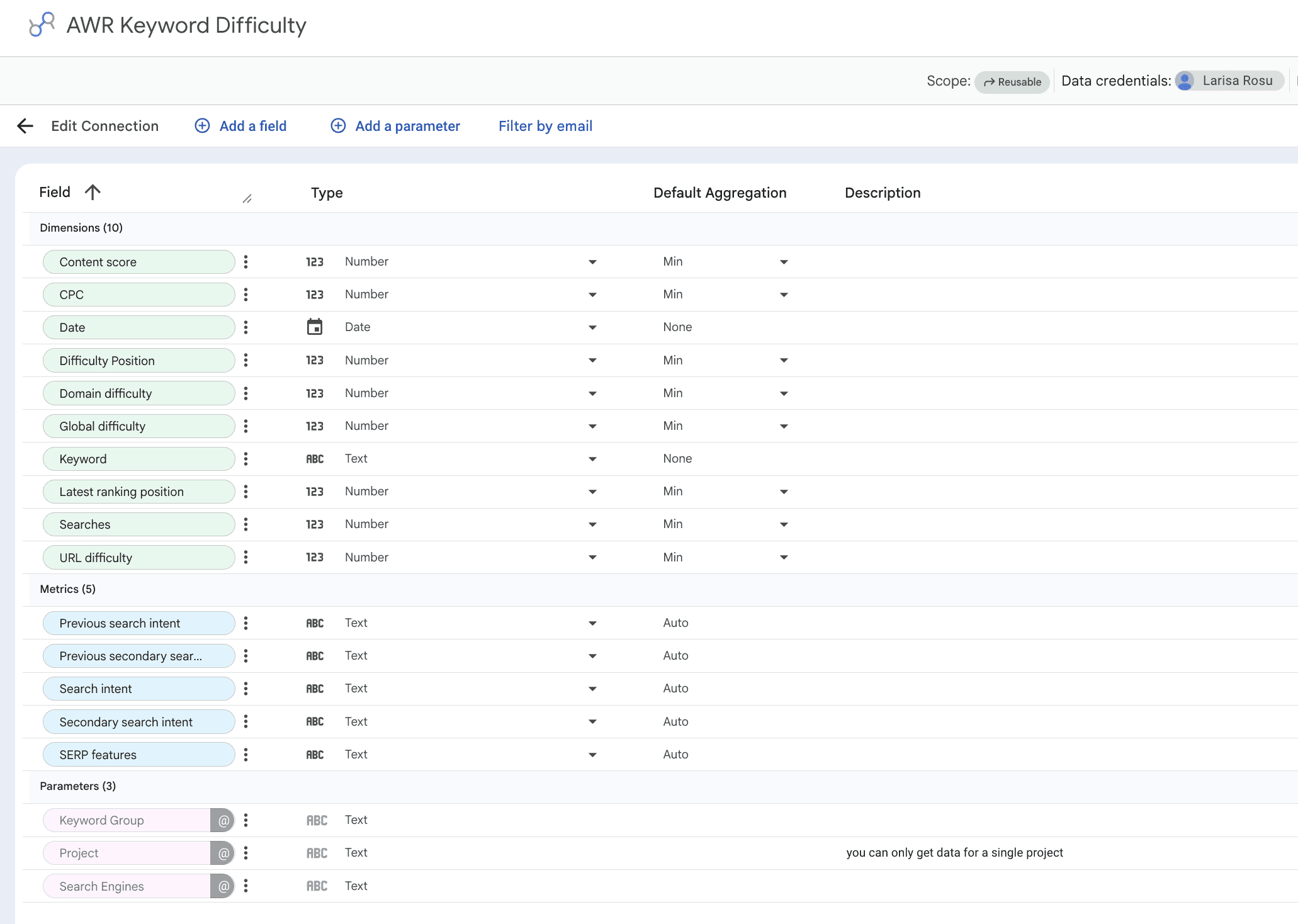
The Keyword Difficulty data source is built for one purpose: pulling AWR's difficulty scoring into Data Studio for prioritization work. The export includes the four difficulty components (global, domain, URL, content), plus search demand, CPC, intent signals, and SERP context for each keyword in the selected scope.
⚠️ Difficulty metrics are computed only after a dedicated difficulty update has been completed for the project. If you don't see difficulty values in your data source, check that a difficulty update has run for the selected keyword group and search engine.
💡 For step-by-step setup, head over to Google Data Studio Setup.
Dimensions
The Keyword Difficulty data source surfaces 10 dimensions in Data Studio, covering the four difficulty scores, keyword-level context (positions, search volume, CPC), and the contextual labels that tie everything together. Below you'll find the full set, grouped by what each one tells you, with default aggregation methods included alongside the definitions.
A note on aggregation: like other keyword-level data sources, most numeric fields default to Min because the export contains one row per keyword per update date. Changing the aggregation on difficulty scores or position fields will give you numbers that won't match what AWR reports.
Difficulty scores
All four difficulty scores in AWR are on a 0 to 100 scale, with higher values indicating tougher competition.
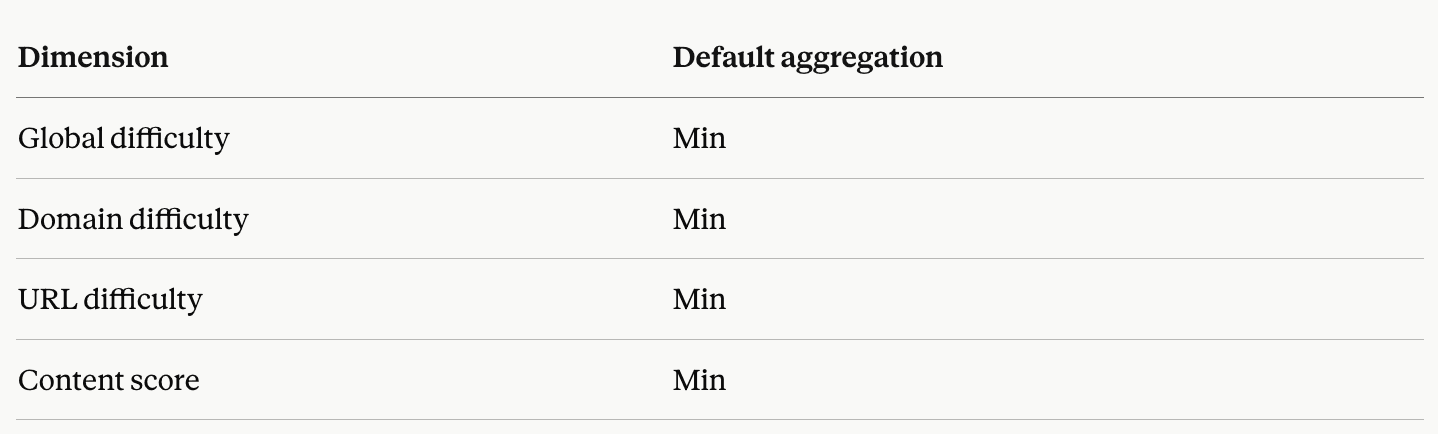
Global difficulty: the weighted overall difficulty score for the keyword, combining Domain difficulty, URL difficulty, and Content score with SERP features presence and Top 10 affiliation. Use this when you want a single number to rank keywords by competitive pressure.
Domain difficulty: scores how strong the backlink profiles are for the domains ranking in the top 10. Higher values mean you're up against domains with serious authority.
URL difficulty: scores the backlink quality and authority of each individual URL in the top 10, not just the domain it sits on. Useful for spotting cases where a weak page on a strong domain might be beatable.
Content score: rates how well-optimized the top 10 pages are on on-page factors, including keyword targeting, content depth, structure, and 14 other content-relevancy signals. Helps you gauge whether content quality alone could move the needle.
Keyword and positions
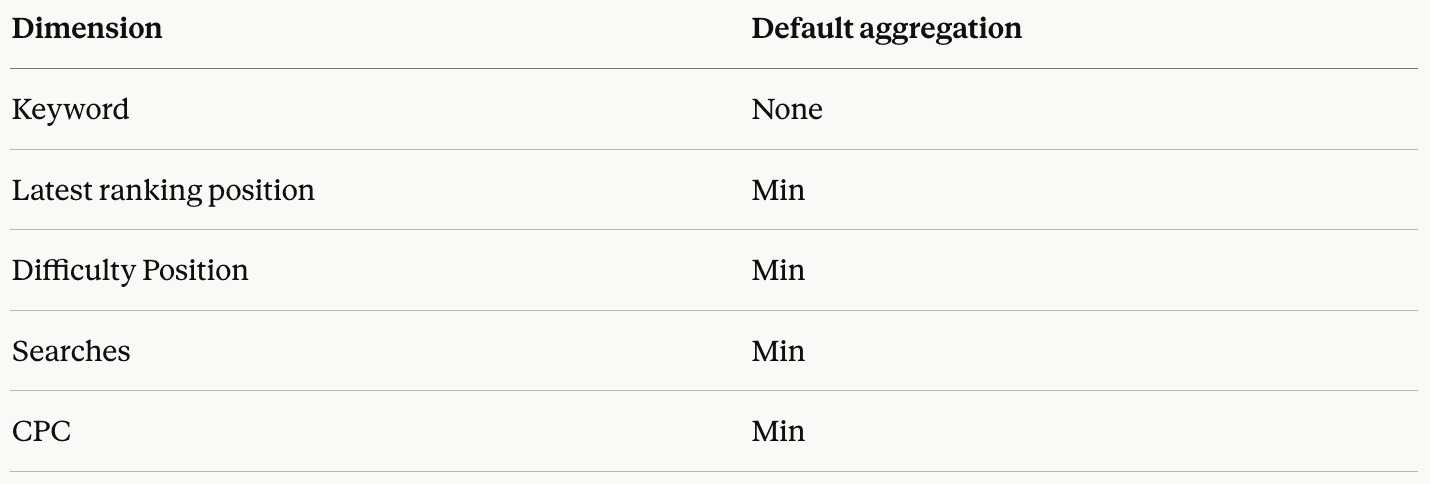
Keyword: the search term tracked in your AWR project.
Latest ranking position: the most recent SERP position your main website holds for the keyword, pulled from the latest ranking update.
Difficulty Position: the SERP position recorded at the time the last difficulty update was processed. Because difficulty updates and ranking updates run independently, this can lag behind Latest ranking position if a newer ranking update has happened since.
Searches: how many times the keyword is searched on Google each month, tied to the country of the monitored search engine. Sourced from Google Keyword Planner and refreshed monthly.
CPC: the going rate advertisers pay per click on Google Ads for the keyword, averaged over the last 30 days and reflecting the country tied to the search engine.
Other

Date: the day the difficulty update was completed.
Metrics
Five fields in this data source are classified as metrics. They cover current and previous search intent signals plus the SERP feature set, all useful as descriptive layers when filtering or grouping your reports.
Search intent: the type of need a searcher is trying to fulfill with the keyword, derived from the top 10 Google results. Labeled as Informational, Navigational, Commercial, or Transactional.
Secondary search intent: a secondary intent signal picked up from the same top 10 results, helpful when a keyword sits between two intent types.
Previous search intent: the primary intent recorded during the previous difficulty update. Use it as a reference point for tracking how a keyword's intent profile evolves.
Previous secondary search intent: the secondary intent recorded during the previous difficulty update. Pair it with Previous search intent to see how both the dominant and supporting intent layers shift between updates.
SERP features: the SERP features detected on the current update for the keyword, like Featured Snippet, AI Overview, People Also Ask, or Image Pack.
Parameters
Parameters define which slice of AWR data the data source pulls in. You set them at connection time, and several can be exposed as in-report controls so editors can tweak filters without reconnecting.
Project: the AWR project supplying the data. Only one project per data source.
Search Engines: the search engine you want to pull difficulty data for. Only one search engine can be selected per data source.
Keyword Group: a single keyword group from the selected project, or All Keywords to include everything regardless of group.
Step-by-step setup for every parameter is covered in the Google Data Studio Setup guide.
Explore metrics and dimensions for other AWR data sources
Do you have any other questions? Don’t hesitate to get in touch and we will keep building the FAQ.
stay in the loop