

Advice and answers from the Advanced Web Ranking Team
Search for articles
How to Turn AWR Data into AI SEO Actions
Competitors appearing in AI answers instead of you? Ranking well organically but still invisible to AI? This guide walks you through the most common scenarios and what you can do about each one using AWR.

You've diagnosed your brand's AI presence. You've studied your competitors. Now what?
Knowing what's wrong is only half the work. This article takes the insights from Why My Brand Doesn't Show Up in AI Answers and How to Analyze Your Competitors in AI Search with AWR and turns them into a practical framework for action: what each situation might mean, and what you can do about it, both inside AWR and in your actual content.
One thing worth saying upfront: no one outside of Google (or any other AI engine) knows exactly what makes a piece of content get cited in an AI answer. There's no public checklist, no guaranteed formula. What we can do is identify patterns, spot meaningful gaps, and make informed decisions about where to focus. The scenarios below are frameworks for thinking, not promises of outcome.
What this article covers
What to do when competitors are cited on keywords where you have no AI presence
How to act on keywords where you rank well organically but have no AI visibility
What low Citation Rank might suggest about your content and how to improve it
How to handle an AI presence that's tied to a single page or a few keywords
How to respond to AI visibility that fluctuates significantly over time
How to track whether your changes are making a difference
Scenario 1: You're not being cited on keywords where competitors are
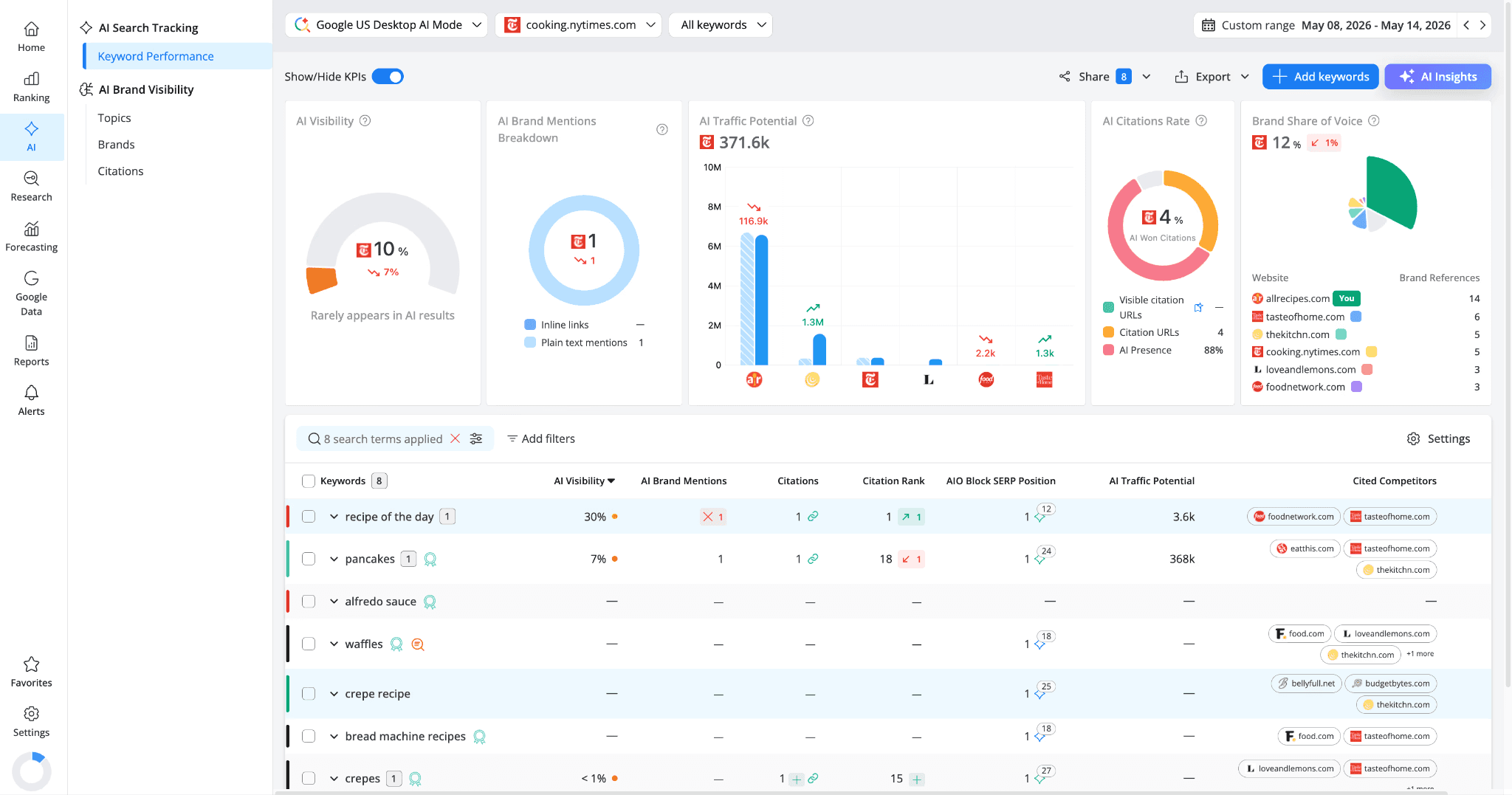
In the AI Keyword Performance report, looking at the keyword table, you've noticed that one or more competitors appear at Citation Rank 1 or 2 for several keywords, while your brand has no Citation Rank and no AI Visibility for those same keywords. AI answers are being generated, just not with you in them.
What this might mean
Your content either doesn't address what the AI is looking for on that topic, or it isn't structured in a way that makes it easy to extract a useful answer from. It's also possible your page covers the topic but gets outcompeted by content that's more direct, better formatted, or more comprehensive on that specific angle.
What you can do
Open the actual SERP file which contains the AI-generated answer for those keywords and read it carefully. What question is it answering? What kind of source is being cited: a how-to, a definition, a comparison, a list? Use that as a content brief.
If you don't have a page that answers that question directly and clearly, creating one is a reasonable first step. If you do have a page but it's not being cited, check whether the key information is buried deep in the content. According to a CXL study analyzing 100 AI Overview citations, 55% of cited passages come from the top 30% of a source page, which suggests that where your answer sits on the page may matter as much as whether the answer exists at all. Moving your clearest, most direct answer closer to the top is a low-effort adjustment worth testing.
Also visit the competitor's cited pages for those keywords and look at the structure: do they use clear headers that match the search query? Do they answer the most important question early? Do they use numbered steps, tables, or concise definitions? You're not looking to copy their content, you're looking to understand what signals the AI seems to respond to on that topic, and then evaluate your own pages against those same signals.
Scenario 2: You rank well organically but have no presence in AI answers
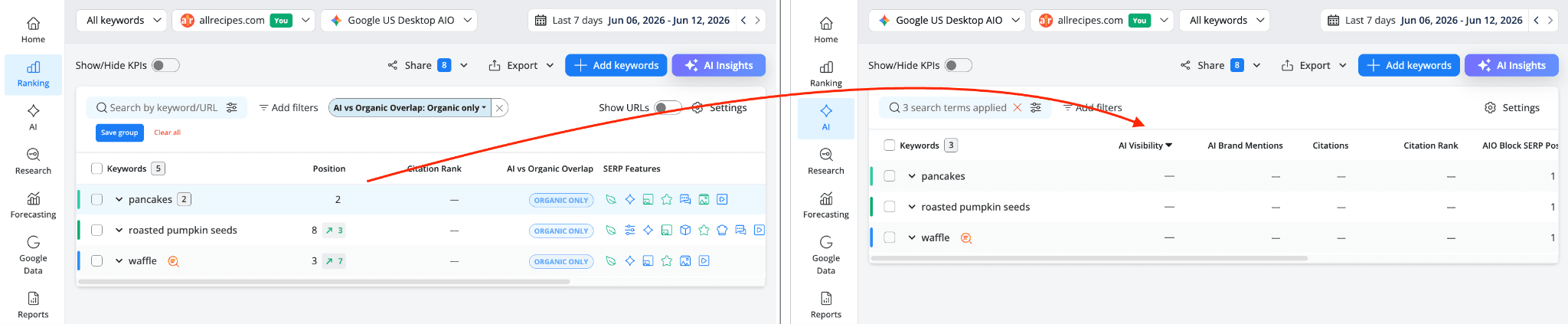
In the Keyword Ranking report, you've spotted keywords where your brand holds a top organic position. But looking at those same keywords in the AI Keyword Performance report for those same keywords, your Citation Rank is blank and your AI Visibility is zero.
What this might mean
This is the clearest version of the organic-vs-AI gap. Your pages are doing well in traditional search, but the AI is pulling its answer from somewhere else. This often happens when a page is optimized for ranking signals but isn't structured to be easily quoted or extracted by an AI model. A long, well-written evergreen article can rank #1 and still not contain a single passage the AI can cleanly use as an answer.
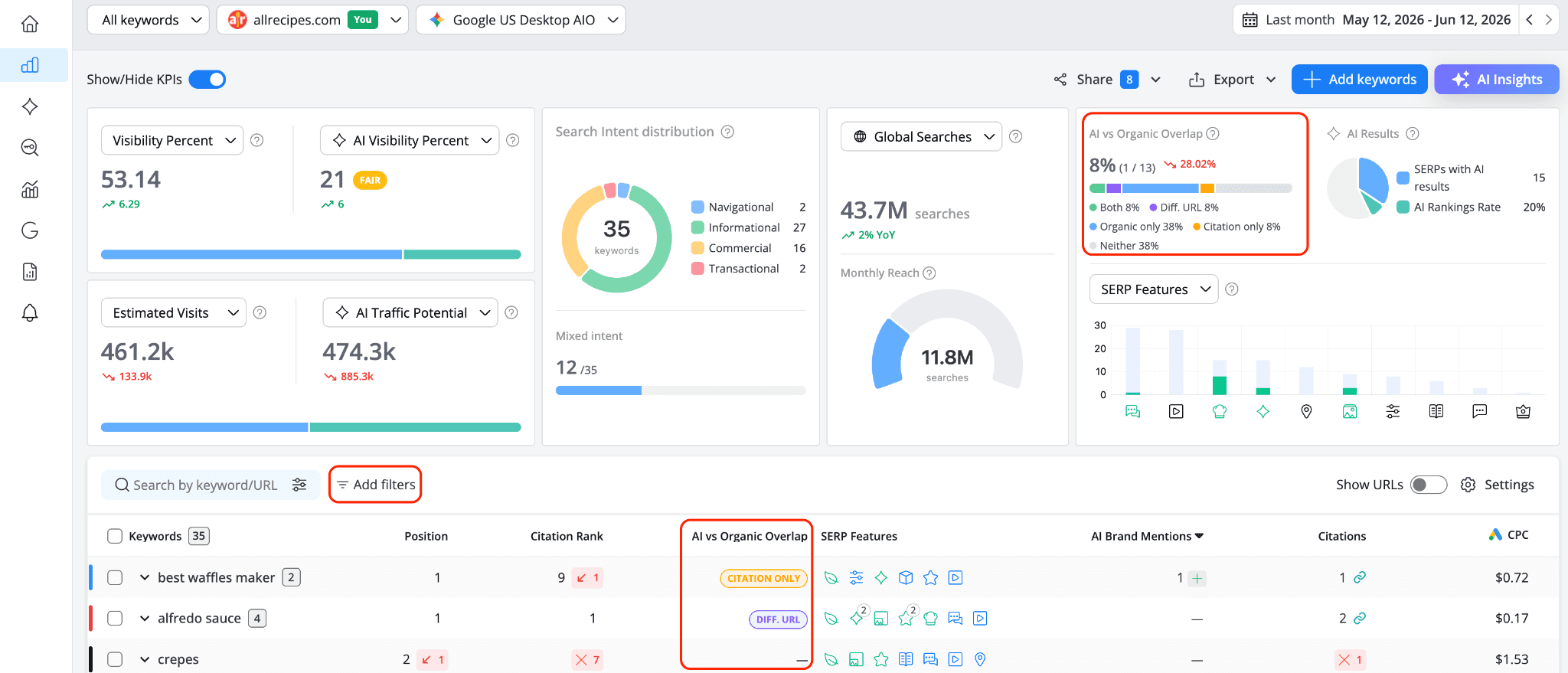
💡If you want to see how widespread this pattern is across your keyword set, the AI vs Organic Overlap metric in the Keyword Ranking report can help. The KPI shows the overall percentage of keywords where your organic presence translates into AI citations, while the dedicated filter and column in the keyword table lets you filter and find all the keywords that fall into the 'Organic only' category. Learn more about how this metric works.
What you can do
These keywords are your highest-priority opportunities. You already have organic traction, which means the topic is clearly relevant to your site. The gap is specifically in how the content is formatted or structured for AI.
Look at each of those pages and ask: is there a clear, direct answer to the keyword's implied question somewhere near the top? Is that answer self-contained, meaning it can be understood without reading the surrounding paragraphs? If not, restructuring the page to lead with a concise, direct response before expanding into detail is worth testing.
Also consider whether the page covers the topic comprehensively enough. AI answers sometimes pull from pages that go deeper on subtopics, not just the main query. If your page is thin relative to what a competitor offers on the same topic, that gap might be a factor.
Scenario 3: You're cited, but always deep in the citation list
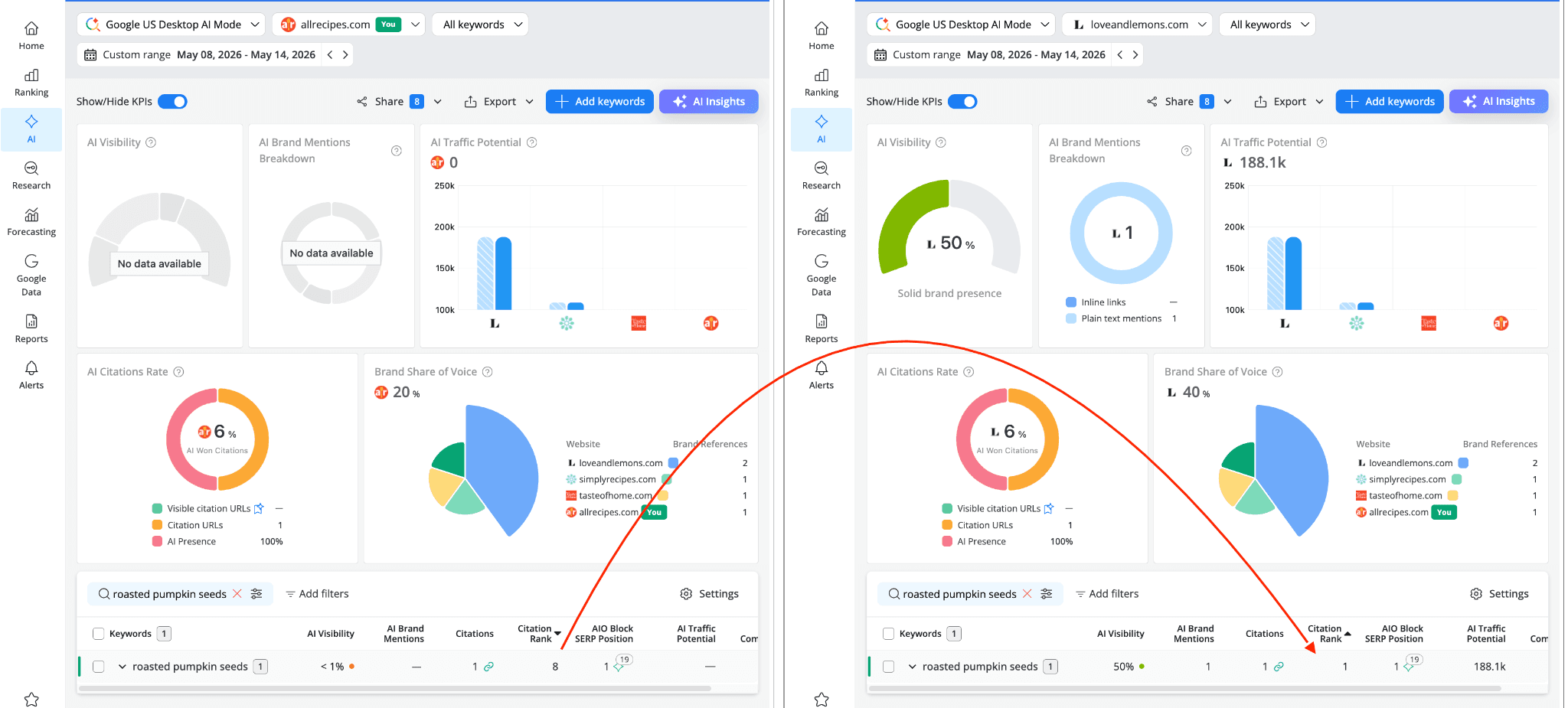
In the AI Keyword Performance keyword table, your site shows up with a Citation Rank of 8, 12, or 15 on certain keywords. You're being cited, but not in prominent positions. Competitors sit at Citation Rank 1, 2, or 3 for the same queries.
What this might mean
Being cited at all is a meaningful signal that your content is considered relevant enough to include. But lower Citation Ranks typically mean less visibility and a lower chance of a click. The content may be addressing the topic but not as sharply or directly as the top-cited source.
What you can do
Look for patterns in your keyword table: are you consistently deep for a specific keyword cluster? Are there pages that appear multiple times at low Citation Ranks? That clustering can point to a specific section of your site or a content type that needs attention.
Then open SERP files containing the AI answers for those keywords and compare your cited page to the page at Citation Rank 1. What's different? Length, structure, formatting, the presence of a clear direct answer, the freshness of information? This isn't about matching competitors word for word, it's about identifying whether your page is offering the clearest, most extractable version of the answer. If you can tighten that, moving up in the citation list is a realistic goal.
Scenario 4: Your AI presence is tied to a single URL or a few keywords
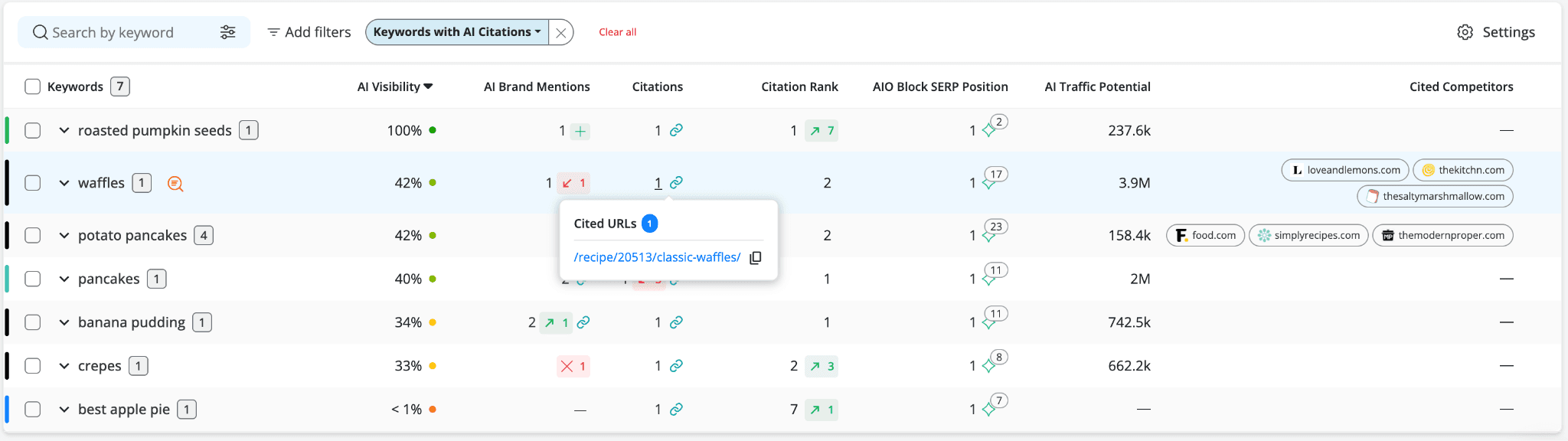
Looking at the Cited URLs in the AI Keyword Performance report, you've noticed that most of your Citations and AI Brand Mentions trace back to one or two URLs. The rest of your tracked keywords show no AI presence at all.
What this might mean
You have a content asset that's performing well in AI, but your broader site isn't earning citations. The structure, tone, or format of that one high-performing page likely isn't reflected consistently across the rest of your content. It might also mean there are topic areas in your space where you simply don't have competitive content yet.
What you can do
Study what makes your top-cited page work. Is it the structure? The depth? The directness of the answer? Then check whether those same qualities exist on your other relevant pages. If not, applying the same content approach to pages that are currently getting no AI presence is a reasonable starting point.
You can also use the Keyword Gap report in AWR to find keywords where competitors are cited and you have no presence at all. These are opportunities to either create new content or significantly expand thin existing pages.
Scenario 5: Your AI visibility fluctuates significantly over time
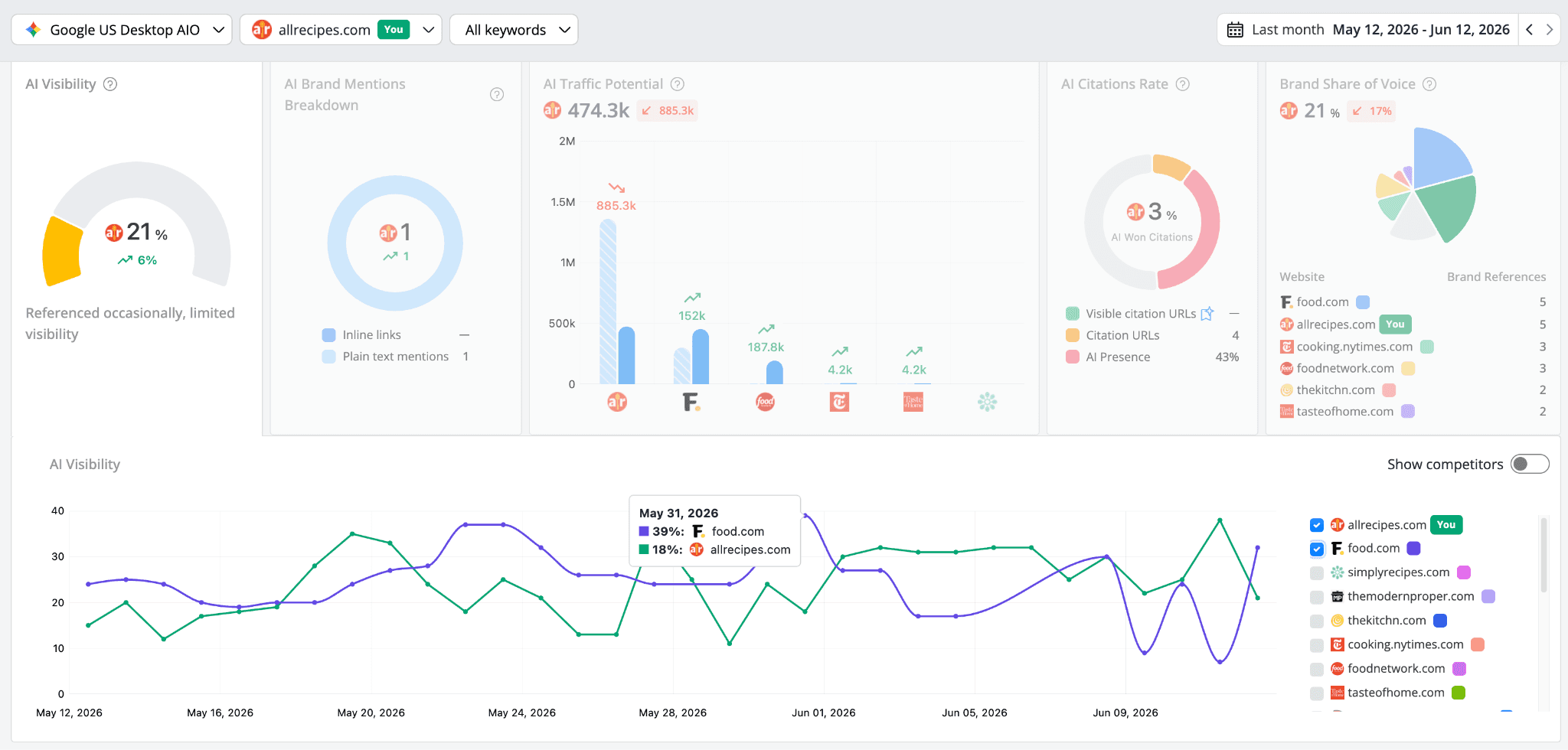
In the AI Keyword Performance report, the AI Visibility trend chart shows noticeable spikes and drops week over week. Your Citation Rank for the same keywords changes frequently, and competitors that weren't visible last month are now showing up ahead of you in the Brand Share of Voice chart.
What this might mean
AI-generated answers are dynamic. The sources cited can change based on how the AI model is updated, how fresh the content is, and what competing pages do in the interim. Consistent downward movement or sudden drops are worth investigating, but some fluctuation is just the nature of AI search.
What you can do
Identify which specific keywords show the most volatility and focus your attention there first. Also watch the Brand Share of Voice chart to see whether specific competitors are gaining ground consistently, rather than just fluctuating alongside you.
Check whether your cited pages have been updated recently and whether competitors have published or refreshed content on those topics. Keeping your most-cited pages fresh, accurate, and up to date is a practical ongoing task that directly relates to citation stability. It's also worth noting whether major AI model updates coincide with your drops. If they do, the change is likely broader than anything on your own site.
Track whether your changes are making a difference
Making changes is only half of the loop. The other half is knowing whether those changes are having any effect.
After making content updates, give it a few weeks, then come back to AWR and look at:
AI Visibility trend: Is it moving up, staying flat, or dropping?
Citation Rank: Are the keywords you targeted moving to higher positions in the citation list?
AI Brand Mentions: Are you picking up new mentions on keywords that had none before?
Brand Share of Voice: Are you gaining ground relative to the competitors you identified?
AI vs Organic Overlap: Is the percentage of keywords where you appear in both organic and AI results going up? A rising overlap means your content improvements are translating across both channels.
There's no fixed timeline for when changes will show up. AI systems re-evaluate content on their own schedules, and timelines vary. What matters is building a habit of checking these metrics consistently so you can spot trends early.
One practical approach: pick a set of keywords where you made changes, note your current Citation Rank and AI Visibility score, and check back every two to three weeks. That gives you a lightweight before/after view without setting up complex tracking workflows.
A note on expectations
None of the actions above come with guarantees. AI citation selection isn't a fully transparent process, and the signals that influence it aren't officially documented. What this framework gives you is a structured way to move from observation to action: using real data to make informed decisions, rather than guessing.
The brands that build the strongest AI presence over time are likely those that combine consistent content quality, clear structure, and ongoing monitoring. Less about finding a single trick, more about treating AI visibility as an ongoing practice, the same way you'd approach traditional SEO.
This article is part of a series on AI search visibility in AWR. You can also check out Why My Brand Doesn't Show Up in AI Answers? How to Fix It with AWR and How to Analyze Your Competitors in AI Search with AWR.
stay in the loop