


Every SEO decision - whether to optimize pages, fix issues, or pursue opportunities - needs a foundation. Metrics are that foundation. They are the difference between knowing whether your SEO work is producing results and assuming it is.
The challenge is that there are many SEO metrics to choose from, and not all of them reveal something meaningful. You need reliable metrics that consistently reflect your traditional and AI search performance and provide a strong foundation for making better decisions.
This guide breaks down each metric: what it measures, why it matters, where it can mislead you, and what extra context you need to interpret it correctly in today’s search results.
With the right metrics in place, you can:
Build better SEO reports.
Set more relevant SEO KPIs.
Track SEO performance more confidently over time.
What Are SEO Metrics?
SEO metrics are measurable signals that help you understand how your website performs in organic search: how it is discovered, ranked, seen, and clicked, and how well it turns organic visitors into business results.
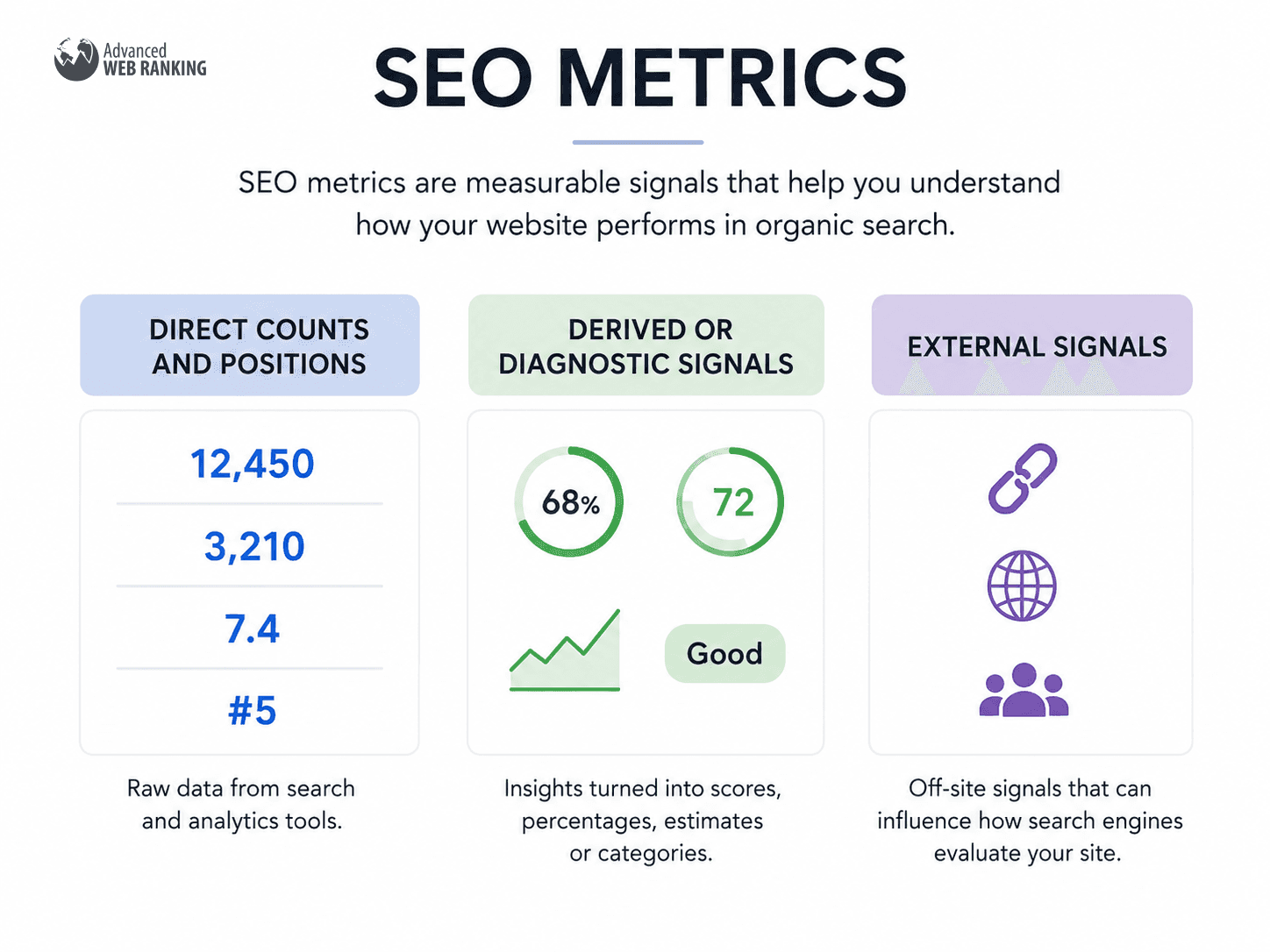
SEO metrics can take different forms:
Direct counts or positions, such as rankings, clicks, impressions, or conversions.
Derived or diagnostic signals, which turn search, analytics, or page-experience data into scores, percentages, estimates, statuses, or reporting categories such as search visibility, CTR, Core Web Vitals, SERP feature visibility, and traffic cost.
External signals, such as backlinks and referring domains, which can influence how search engines evaluate your site.
A metric is a measurement. When that measurement is tied to a goal, a target, and a timeframe, it becomes a KPI. See our SEO KPIs guide for how the same metric can produce different KPIs depending on the goal.
What Are the Most Important SEO Metrics?
The most important SEO metrics are the ones that help you see performance from different angles: how visible you are, how much traffic you earn, whether that traffic creates value, how strong your authority signals are, and whether technical issues are limiting growth.
That is especially true now because search has not only become more complex but also expanded. Traditional results are more crowded and visual, which means familiar metrics need more context around the SERP layout. At the same time, AI-generated answers create new forms of visibility that older metrics were not built to measure.
The list below covers the main SEO metrics worth tracking today, from traditional search performance and SERP feature presence to AI visibility, authority signals, technical health, and business outcomes.
Some metrics are single measurable signals, such as rankings, impressions, clicks, or conversions. Others, like AI visibility, Core Web Vitals, and SERP feature visibility, combine several related signals because no single number captures the full picture.
1. Keyword rankings
Definition: The position your page holds in organic search results for a specific query, on a specific search engine, device, and location.
Why it matters: Rankings are often the first sign that SEO work is having an effect or that something is starting to decline. They are also the base layer for most visibility metrics.
When it misleads you:
Ranking data loses meaning when reported as a single number without segmenting by device, location, or search engine. The same keyword can perform very differently across markets.
A single keyword moving up or down is rarely the full story. Reporting isolated keyword wins without looking at how an entire topic cluster is performing can make progress look stronger or weaker than it actually is.
A higher ranking does not always mean more traffic, clicks, or business impact. A position 3 result can still receive fewer clicks than expected if AI Overviews, or other SERP features push it down the page.
Read rankings alongside search volume, SERP layout, CTR, and conversions before treating a position change as a result.
How AWR helps: Track rankings across markets and search types
AWR tracks rankings across more than 170 countries and up to 50,000 unique search engines, segmented by device, location, and search type (including Google AI Mode and AI Overviews) so the same keyword can be tracked across every market and search environment that matters to your business.
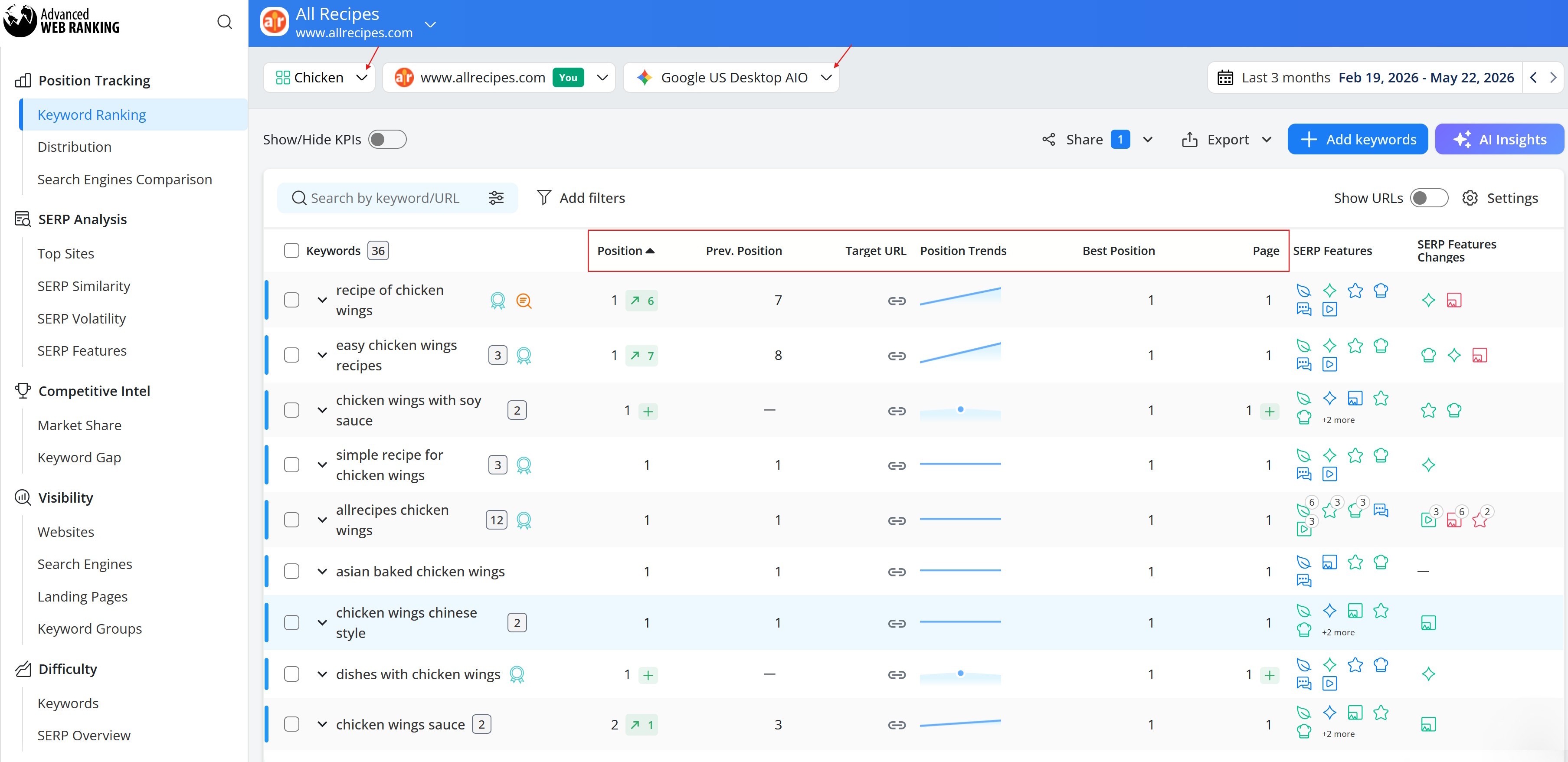
For each keyword, AWR shows current position, previous position, best position, ranking page, and position trend, so you can see whether performance is improving, declining, or fluctuating.
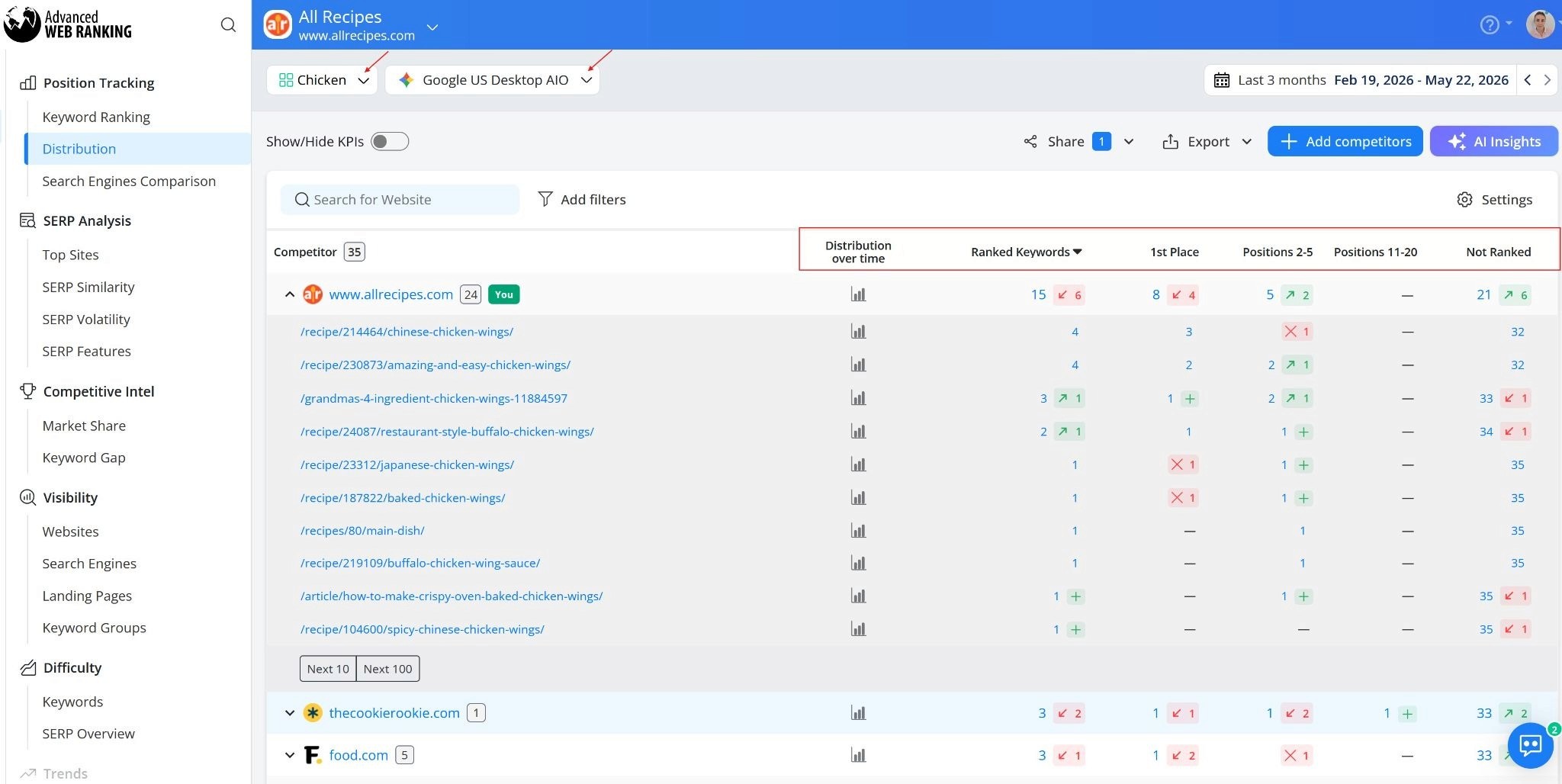
At the keyword group level, AWR's ranking distribution shows how an entire topic cluster moves across position ranges. Progress is measured across a set of related keywords, not isolated wins that can make performance look stronger or weaker than it actually is.
2. Search visibility
Definition: The level of organic search presence your website has across a tracked keyword set. It turns ranking performance into a score or percentage that reflects your organic presence.
Why it matters: Visibility helps you understand whether your rankings are strong enough to create real exposure in crowded search results. It also shows whether that exposure is growing or declining across your entire keyword set rather than one query at a time.
When it misleads you:
The total score shows the net result, not what is driving it. Branded terms, high-volume keywords, or one strong group can lift visibility while non-branded queries, priority topics, or key markets decline.
Most visibility scores are ranking-based, so they show position strength, not actual page exposure. A score can improve while on-screen visibility falls if SERP features or ads push strong rankings further down the page.
Read the score alongside pixel-based placement metrics to understand both how strong your rankings are and where they actually appear on the page.
How AWR helps: Connect visibility to SERP placement
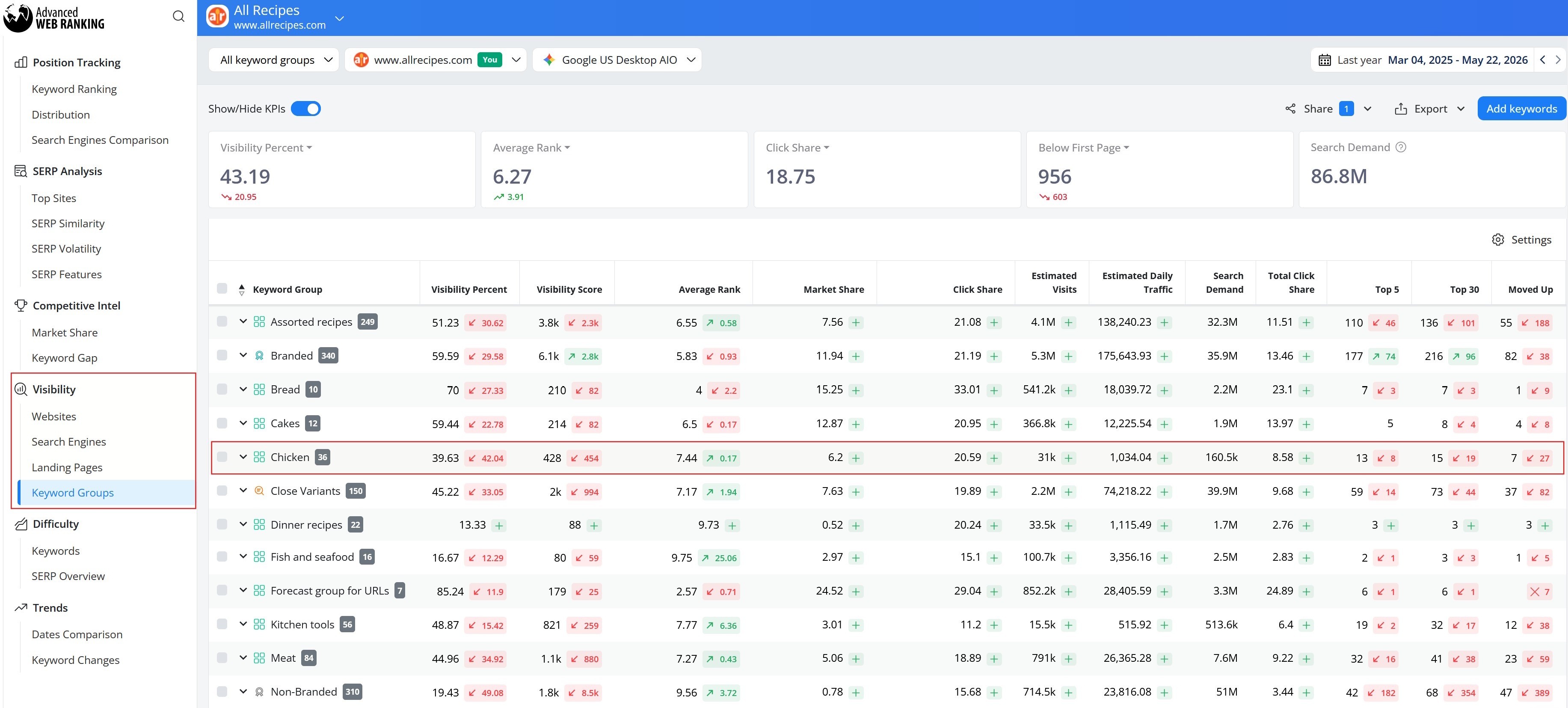
Search visibility in AWR is primarily ranking-based. Visibility Score shows how much visibility you are capturing in absolute terms, Visibility Percent shows how that compares to your maximum possible score, and Average Rank shows whether positions are moving up or down across your tracked keyword set.
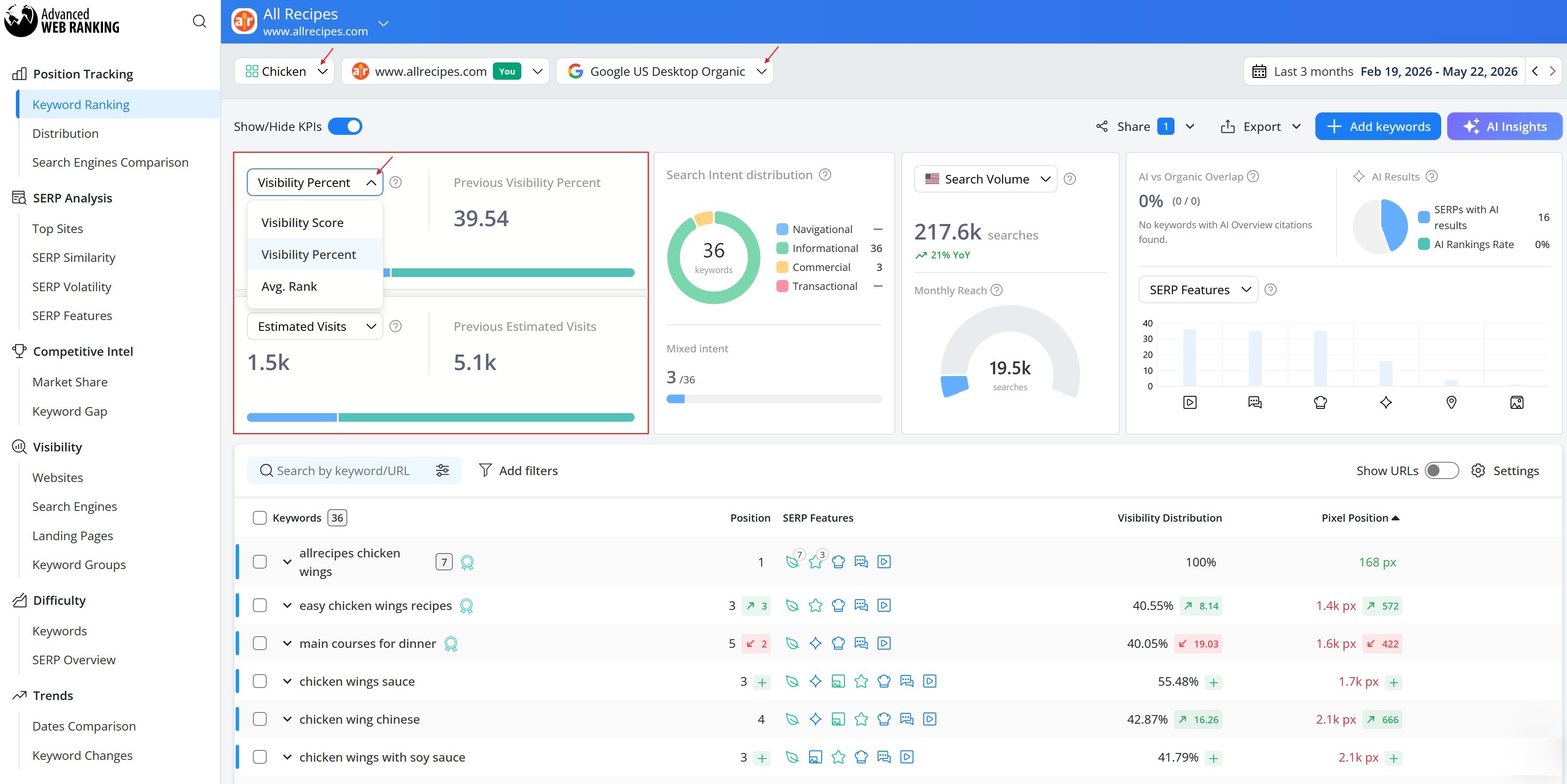
AWR adds a second layer that ranking-based metrics cannot provide: actual SERP placement. Pixel Position shows the exact distance in pixels from the top of the page to your listing, and Brand Ownership shows the total percentage of SERP space your brand controls across all your ranking URLs for a given keyword. The metrics are measured at the individual keyword level.

Visibility Distribution works at both levels. For individual keywords, it translates pixel distance into a percentage showing how close your result sits to the top of the SERP. Beyond individual keywords, Visibility Distribution aggregates that proximity score across keyword groups, competitors, and search engines so you can compare actual on-page exposure across every dimension you track, not just ranking strength.
3. SERP feature visibility
Definition: Your website’s presence in the SERP beyond standard organic listings, such as AI Overviews, People Also Ask, images, videos, local packs, or recipes.
Why it matters: SERP features change how users see and click search results. A keyword that triggers multiple features can produce very different click patterns than one that shows only organic results, even at the same ranking position. Appearing in features like People Also Ask or being cited in an AI Overview can create visibility beyond your standard organic ranking.
When it misleads you:
Not every feature creates the same value. Some increase attention and clicks, while others answer the query directly or push organic results further down the page.
Feature presence is not the same as feature ownership. A keyword may trigger a SERP feature, but that does not mean your website benefits from it. If a competitor owns the feature, it can draw attention away from your organic result, even if your page ranks well in the standard organic results.
Treating AI Overviews like any other SERP feature and checking whether you own them is not enough. What matters is whether your brand is mentioned or cited, where that citation appears, and whether that presence leads to clicks and traffic or simply visibility without visits.
Read SERP feature visibility with clicks, CTR, rankings, and search intent to understand whether the feature is helping discovery, attention, or traffic.
How AWR helps: Measure SERP feature visibility and impact
AWR tracks which SERP features appear for each of your keywords and whether your website owns them. A green icon means you rank for that feature. A blue icon means the feature is present, but a competitor holds it. The SERP Features Changes column shows what you gained or lost since the last update. This helps you move from “I rank” to “I know how I appear on the SERP.”
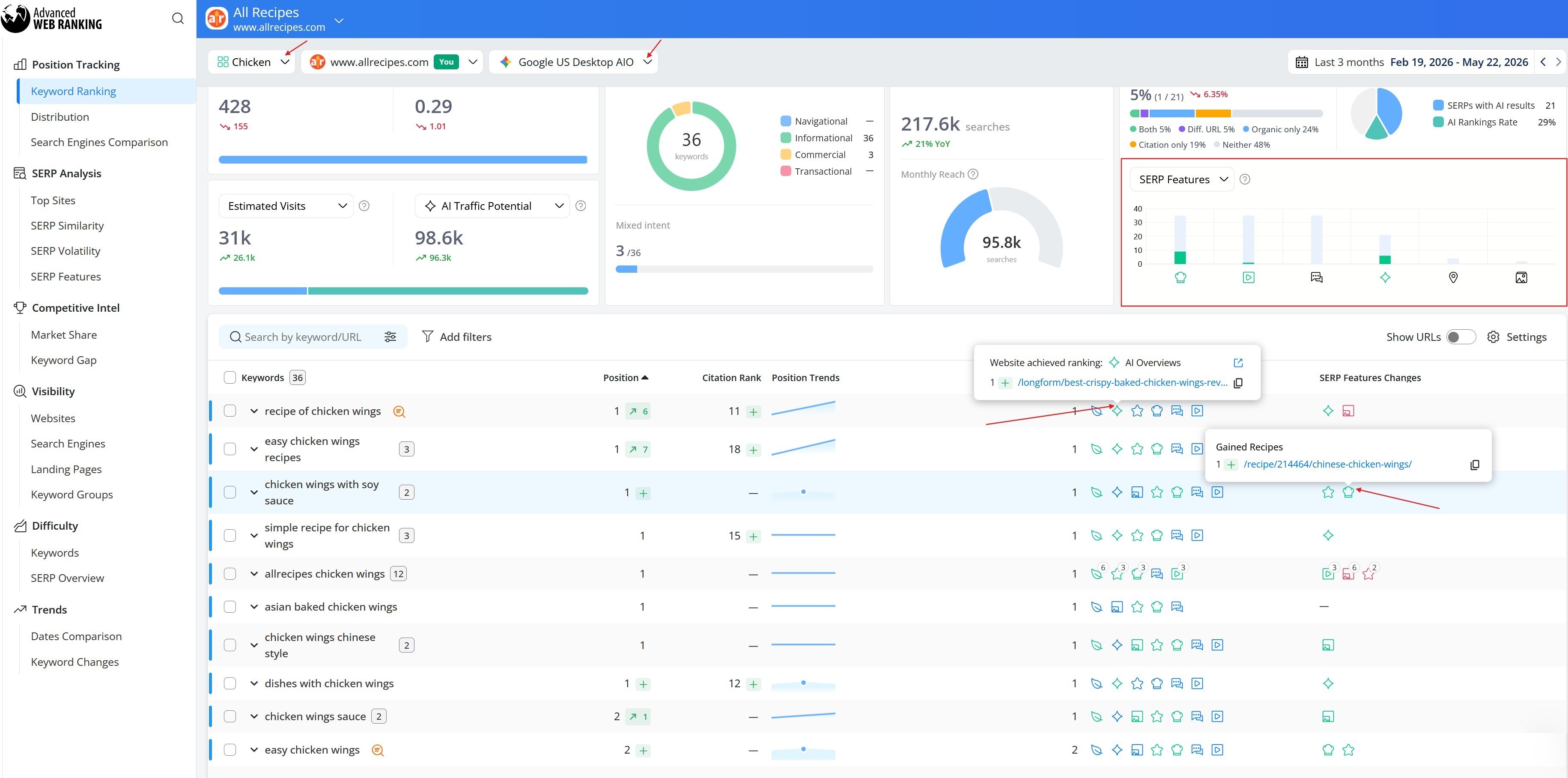
The SERP Features report goes further. It shows which features appear across your set or group of tracked keywords, who owns them, and how your ownership compares with competitors. It also adds CTR by feature type, Won vs. Lost traffic impact, and trend charts, so you can judge feature opportunities by visibility, click value, and competitive movement, not presence alone.
AI Overviews need their own interpretation, and AWR treats them as a separate search environment rather than only another SERP feature. By selecting Google AI Overviews as a dedicated search engine, you can track AI-specific signals such as brand mentions, cited URLs, citation position, and AI vs. Organic Overlap.
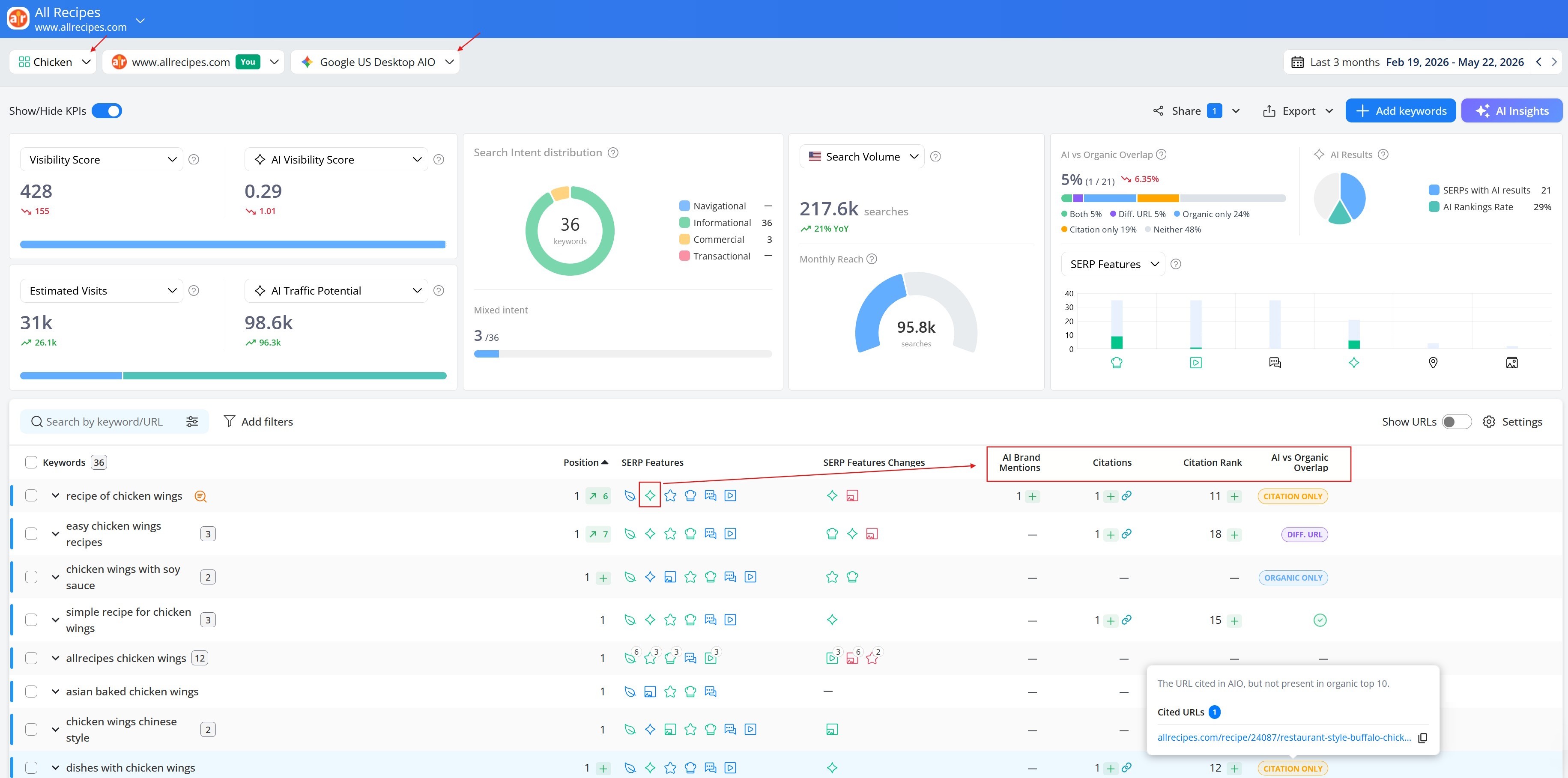
This helps you compare your AI presence with your traditional organic rankings and understand whether AI Overviews are supporting pages that already rank well, surfacing pages that do not appear in the organic top 10, or exposing a gap between your organic visibility and AI visibility.
4. AI visibility
Definition: Your brand’s presence in AI-generated answers, measured by how consistently and prominently it appears. It turns brand mentions, citations, and citation prominence into a score or percentage that reflects your AI presence.
Why it matters: AI visibility shows whether your brand is part of the answers users see in AI search environments, not just traditional organic results. Ranking well in organic search does not guarantee presence in AI answers, so a keyword can have strong search visibility and weak AI visibility at the same time. This helps you understand whether AI systems are mentioning your brand, citing your pages, or giving competitors more visibility for the same topics.
When it misleads you:
High AI Visibility does not always mean broad AI presence. It may come from a narrow set of keywords that trigger AI responses, while your brand is still missing from important topics or discovery queries.
AI Visibility does not explain the type of presence on its own. A plain mention, inline link, cited URL, and high-ranking citation do not carry the same value. Mentions build awareness, links create click opportunities, and citations show that your content is being used as a source.
AI visibility does not always match organic visibility. A page can rank well in traditional search but be missing from AI answers, or appear in AI answers without ranking strongly in organic results.
Read AI visibility alongside mention type, citation rate, citation rank, share of voice, organic traffic, and CTR. This shows how strong your AI presence is, who else appears with you, and whether that visibility creates visits or stays inside the AI answer.
How AWR helps: Measure the quality of your AI presence
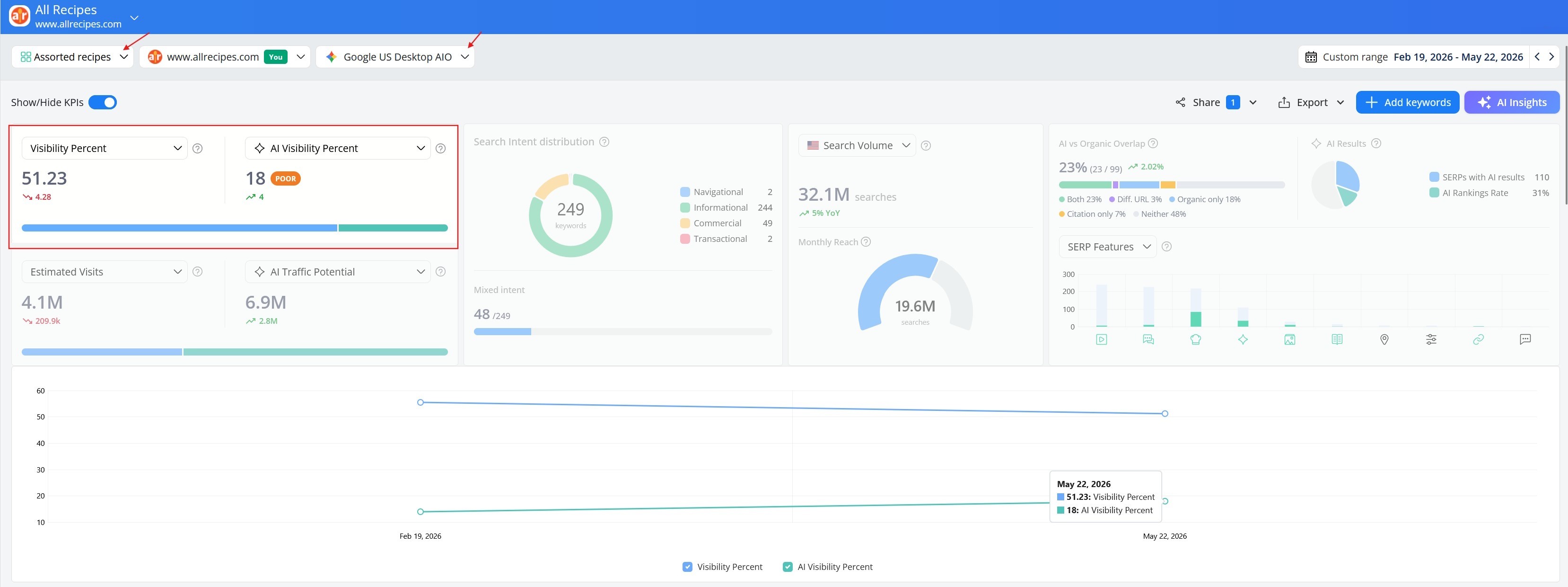
AWR lets you see how visible a topic is in both traditional search and AI-generated answers for the same tracked keywords. By placing Visibility Percent next to AI Visibility Percent in the Keyword Ranking report, you can compare organic visibility and AI visibility side by side and see where your presence is stronger.
For a deeper view, the AI Keyword Performance report breaks AI Visibility down into the signals behind it. AI Brand Mentions Breakdown shows whether your brand appears as plain text mentions, inline links, or citation URLs, while AI Citations Rate shows how often your pages are cited as sources in AI results. This helps you understand not just how visible your brand is, but what kind of AI presence is creating that visibility.

Brand Share of Voice adds the competitive layer. It shows, of all the AI visibility available for the selected keywords, how much belongs to your brand versus your tracked competitors. This helps you understand whether your AI presence is stronger or weaker than other websites targeting the same keyword group.
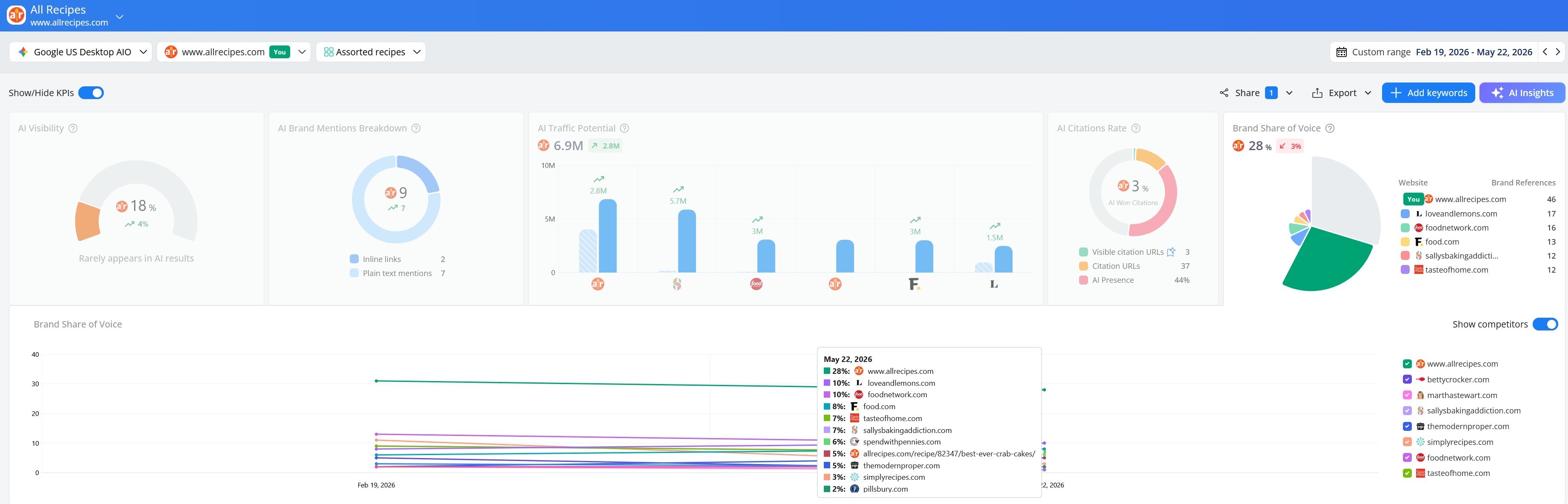
Finally, the keyword-level table shows the data behind the top-level AI metrics. For each keyword in the selected set, you can inspect AI search performance signals such as visibility, brand mentions, citations, citation rank, AI traffic potential, and cited competitors.

This helps you understand which keywords are creating AI visibility, where your brand is mentioned, whether your URLs are cited, how prominent those citations are, and which competitors are also being referenced in the same AI results.
5. Impressions
Definition: The number of times your pages appeared in search results for a given query within a selected time period. An impression is recorded each time a result is shown on the results page, even if the user does not scroll down to see it.
Why it matters: Impressions help you understand search demand and visibility potential. Growing impressions suggest your pages are appearing more often in search because rankings improved, search demand for your tracked queries increased, or your content started showing up for more queries. Dropping impressions may signal lost visibility, declining search demand, or fewer queries triggering your results.
When it misleads you:
More impressions do not mean more visits. Impressions can rise while clicks stay flat or fall, which means your pages are appearing more often in search results but those appearances are not turning into visits.
An impression does not always mean real visibility. A result can be counted as shown even if it appears low on the page. In that case, impressions may grow while actual attention stays limited.
Impressions can rise because more people are searching for the topic, because of seasonality, news, or branded demand, not necessarily because your rankings improved.
Read impressions alongside clicks, CTR, average position, and search volume to understand whether they reflect real visibility and genuine search demand, or just more appearances in places where users are unlikely to click.
How AWR helps: Understand what’s driving impressions
Impressions are measured by Google Search Console. Connecting GSC to AWR gives you access to impression data alongside clicks, CTR, and average position in the same platform where your ranking data lives.
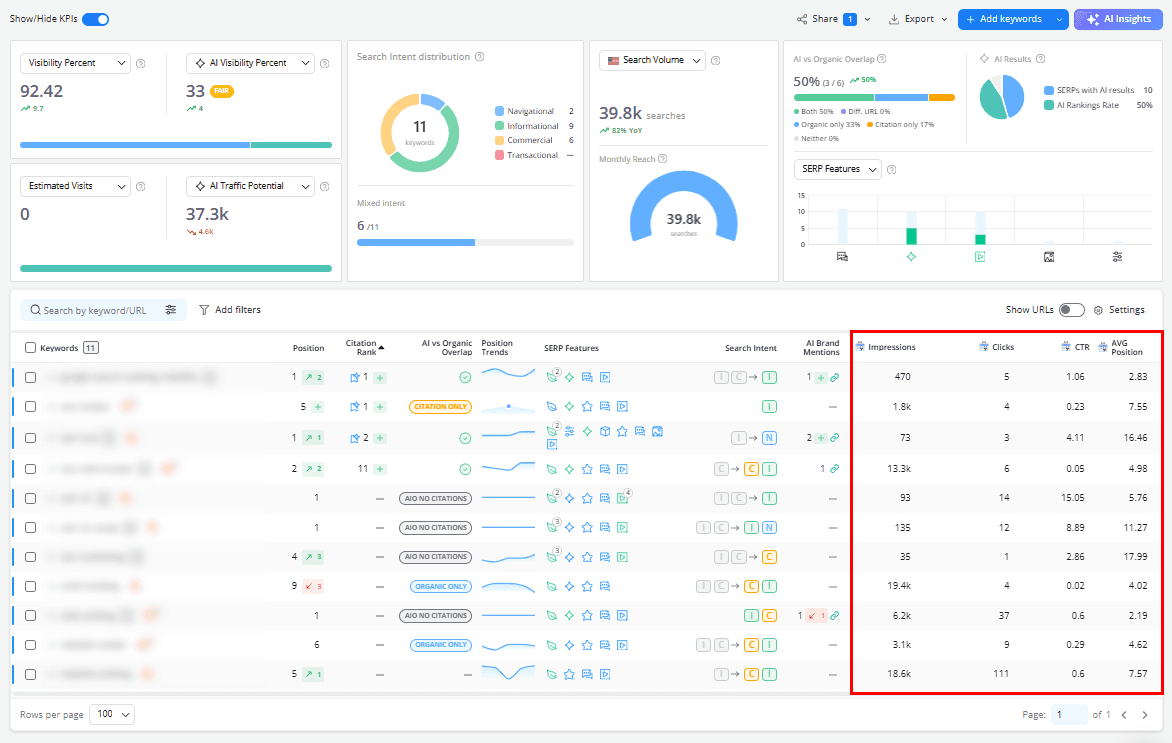
This means you can investigate whether impressions changed because rankings moved, search demand shifted, or more queries started triggering your pages, without switching between tools.
Context layer: branded vs non branded performance
Branded vs non-branded performance is not a standalone metric. It is a segmentation layer that helps you understand what is really driving your SEO and AI visibility numbers.
Branded keywords show demand from people who already know your brand or are searching directly for it. They usually reflect existing awareness, loyalty, reputation, or previous marketing activity.
Non branded keywords show whether you are earning visibility from broader discovery moments, where users are still researching topics, comparing options, or looking for a solution without naming your brand.
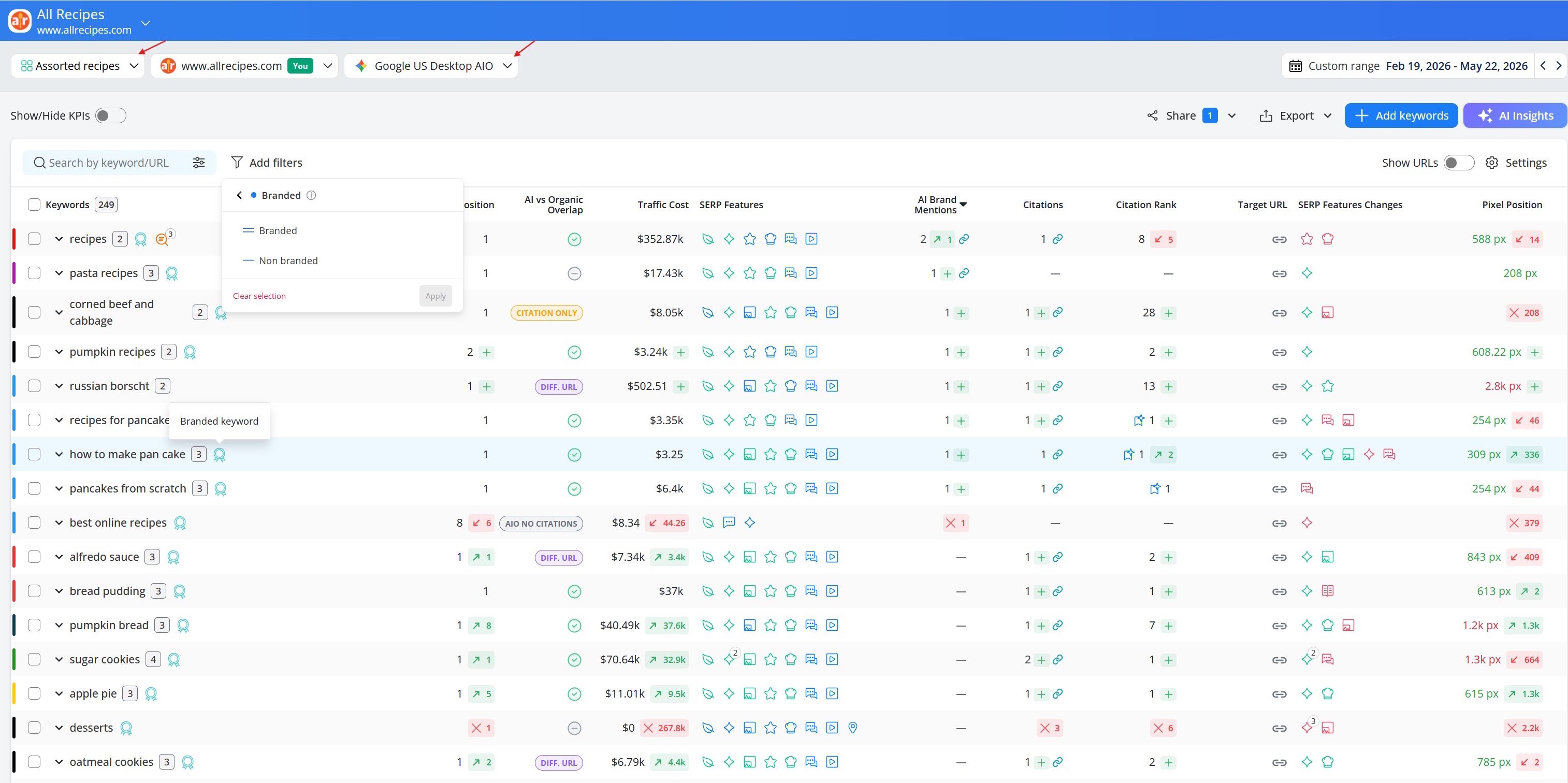
AWR automatically labels keywords as Branded or Non branded, and you can filter results based on this classification in both the Keyword Ranking report and the AI Keyword Performance report. This helps you separate visibility driven by existing brand demand from visibility earned in broader discovery moments, across both traditional search and AI-generated answers.
6. Organic traffic
Definition: The number of visits your website receives from unpaid search results.
Why it matters: Organic traffic remains one of the SEO metrics closest to a measurable business outcome because, when tracked over time, it shows whether search visibility is turning into actual visits. If traffic drops while impressions remain stable, you need to investigate what is preventing those impressions from turning into clicks.
When it misleads you:
In a zero-click search environment, traffic can decline even when rankings and impressions remain stable. SERP features and AI answers may reduce clicks without reducing visibility, but your content and brand can still build awareness and influence decisions through AI Overviews and other search features without generating a session.
An increase in organic traffic does not necessarily prove that your SEO work is responsible. Branded campaigns, seasonal demand, trending topics, or news coverage can generate more searches and visits even when your rankings and visibility have not improved.
Even when SEO improvements directly generate more organic traffic, that growth does not necessarily create business value. Visitors may arrive through irrelevant queries, land on pages that do not support their intent, or leave without converting.
Read organic traffic alongside visibility, CTR, SERP feature presence, AI visibility, and conversions to understand whether people can find you, what influences their decision to click, and whether those visits generate business value.
How AWR helps: Connect organic traffic to search performance
Organic traffic is tracked in Google Analytics 4. Connecting GA4 to AWR gives you access to organic traffic data in the same platform where your ranking data lives, without switching between tools. You can view actual Sessions and Page Views for each URL alongside its rankings, visibility, and Estimated Visits.
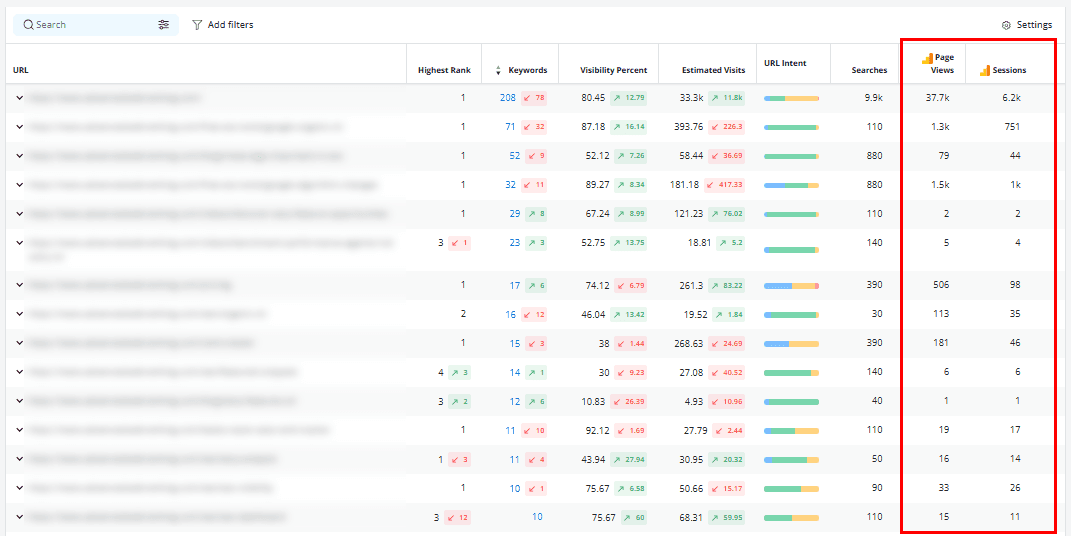
Sessions show how many visits the URL received, while Page Views include every time it was viewed, including repeated views during the same session. Reading these metrics together helps you understand how changes in search performance relate to actual website activity.
stronger rankings, or contributed to organic growth7. Click-through rate
Definition: The percentage of search impressions that result in a click. It is calculated as clicks divided by impressions, multiplied by 100. For example, if a page appears 1,000 times and receives 50 clicks, its CTR is 5%.
Why it matters: CTR shows whether search impressions are turning into visits. A page can rank well and generate high impressions but still fail to attract visitors if the title, description, or SERP context does not compel a click. It is the metric that shows whether your search presence is converting into traffic.
When it misleads you:
A low CTR does not always mean your title or description is weak. It can also happen when your result ranks lower on the page, when ads, AI Overviews, or other SERP features answer the query before users click.
CTR misleads you when compared without context. A percentage that looks low for one position, device, intent, or branded vs. non-branded search may be strong in another.
CTR can improve while total clicks, traffic, or conversions decline. A rising CTR does not always mean better performance. It can simply mean fewer impressions or a narrower, more concentrated keyword set.
Read CTR alongside average position, impressions, SERP feature visibility, and branded vs non-branded performance to see whether the change reflects a real optimization opportunity or simply position, layout, or query-mix shifts.
How AWR ads context:
CTR is reported by Google Search Console. Connecting GSC to AWR gives you access to CTR alongside clicks, impressions, and average position in the same platform where your ranking data lives. This means you can investigate whether CTR changed because your position shifted, because impressions grew, or because the SERP context made users less likely to click, without switching between tools.
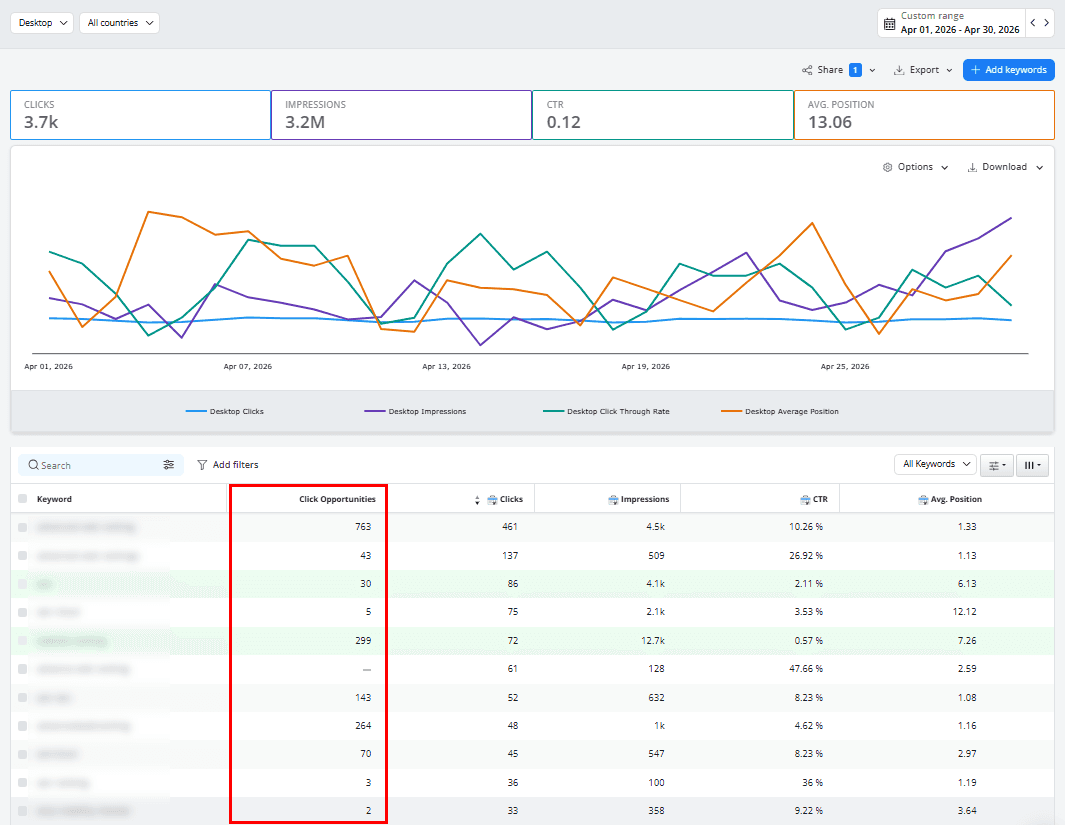
The Click Opportunities column adds a prioritization layer. It estimates the percentage of clicks you may be losing because of low CTR and highlights the keywords with the strongest potential to drive measurable traffic increases.
Calculated by AWR from your GSC data, it helps you move from diagnosing CTR problems to deciding which keywords are most worth improving first.
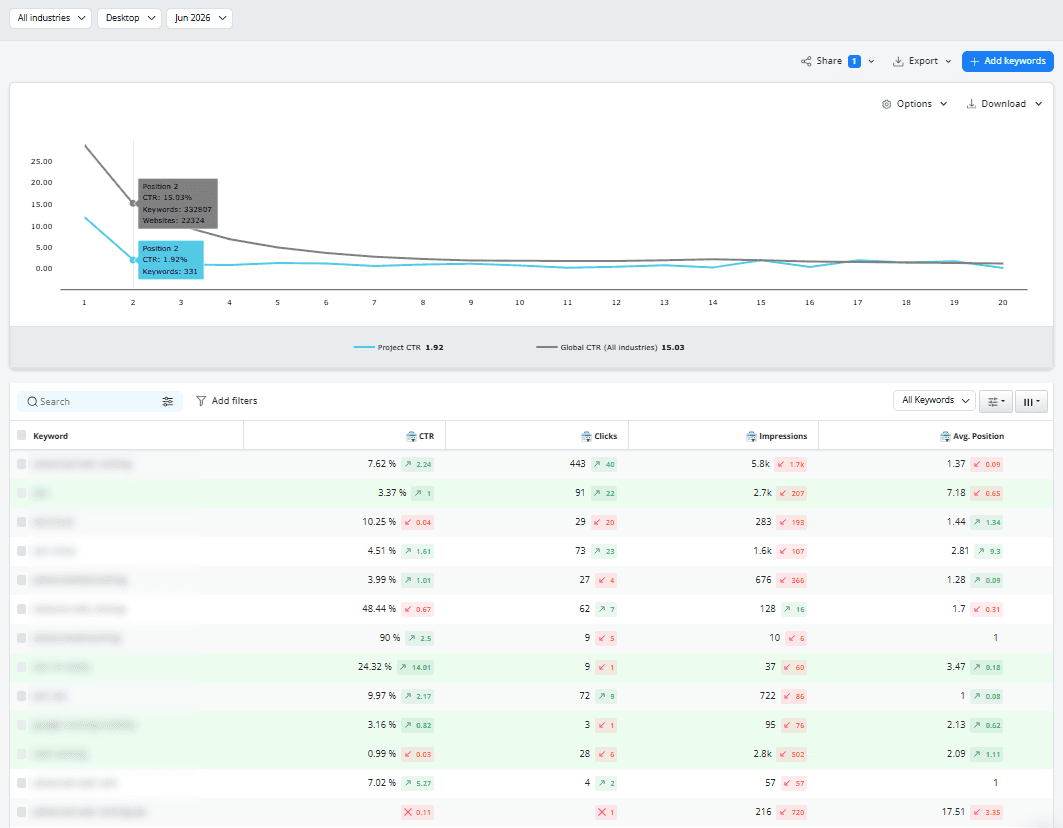
AWR calculates your average CTR per position using Google Search Console data and represents it with the blue line. It then compares your CTR with the Global CTR curve, shown in gray, based on the benchmark from AWR’s free CTR tool. This comparison reveals where your pages attract more or fewer clicks than expected, helping you investigate the factors influencing their performance.
8. Organic conversions
Definition: The number of desired actions completed by users who arrived from organic search, such as purchases, form submissions, signups, demo requests, phone calls, or any other goal you defined.
Why it matters: Organic conversions indicate whether SEO traffic is contributing to meaningful business outcomes, not just visits. However, search journeys are increasingly fragmented across search engines, AI platforms, social media, marketplaces, and other channels that cannot always be tracked together. As a result, organic search may influence a conversion without receiving credit for it, so this metric should be interpreted as an attribution-based estimate rather than a complete measure of SEO’s contribution.
When it misleads you:
More conversions do not always mean SEO improved. They can rise because of branded demand, seasonality, pricing changes, CRO updates, or offline marketing, even when organic visibility remains unchanged.
More traffic does not always mean more conversions. Visits from low-intent queries, poor-fit keywords, or landing pages that do not match conversion intent may not convert regardless of volume.
Attribution rarely captures the full journey. Users may encounter the brand across several platforms before converting, while the attribution model credits only one channel or touchpoint.
Changes in GA4 events, consent settings, attribution models, or tracking setup can make organic conversions appear higher or lower without any real change in performance.
Read organic conversions alongside organic traffic, landing pages, keyword intent, conversion rate, and attribution settings to understand what is actually driving the change.
How AWR helps: Connect rankings to conversion
Organic conversions are tracked in Google Analytics 4. After connecting GA4 to AWR, you can add a Conversion Rate widget to your Dashboards and configure it for a specific period and channel, such as organic search. Viewing this rate alongside ranking and visibility data helps you investigate whether changes in search performance correspond with changes in the percentage of organic visits that convert, without switching between tools.
9. Organic revenue and ROI
Definition: Organic revenue shows how much income comes from unpaid search traffic. Organic ROI, or return on investment, compares the value generated by SEO with the cost of SEO work to show whether the investment paid off.
Why it matters: Organic revenue and ROI connect SEO performance to business impact. They show whether organic search contributes to commercial goals and whether SEO resources are being spent in the right places. They also help compare SEO’s return with other marketing activities and identify where to scale successful initiatives or improve underperforming markets and pages.
When it misleads you:
In a zero-click and multi-channel search environment, these metrics capture mainly the value generated after a tracked organic visit. SEO may also influence awareness, consideration, and later conversions through AI answers, SERP features, and other platforms without receiving attribution, so revenue and ROI should be interpreted within the broader customer journey.
Revenue growth may come from demand, not SEO improvement. Branded demand, seasonality, promotions, pricing changes, product availability, or offline campaigns can make organic revenue rise even when organic visibility has not improved.
Revenue does not show profitability on its own. Two pages can generate the same organic revenue, but one may be more profitable because it sells higher-margin products or requires less support, fulfillment, or discounting.
ROI is unreliable when costs are incomplete. SEO ROI is hard to read unless you include tools, content, technical work, developer time, agency fees, and internal team time.
Read organic revenue and ROI alongside organic traffic, conversion rate, average order value, assisted conversions, branded vs non-branded performance, profit margin, and SEO costs.
How AWR helps: Include revenue into SEO reports
Organic revenue is tracked in GA4, ecommerce platforms, or CRM tools. ROI requires combining that revenue with SEO costs, which typically live outside AWR. After connecting GA4, you can add a Revenue widget to your AWR Dashboards and configure it for a specific period and channel, such as organic search. Viewing this revenue alongside ranking and visibility data helps you compare search performance with attributable commercial results. ROI must still be calculated separately using your SEO investment data.
10. Traffic cost
Definition: An estimation of how much it would cost to generate similar traffic through paid search instead of earning it organically. It is a paid-media equivalent of organic visibility.
Why it matters: Traffic cost gives organic search a monetary frame that non-SEO stakeholders can quickly understand. It is useful for justifying SEO investment, onboarding new clients, or communicating SEO value to leadership in terms that are closer to paid media and budget impact.
When it misleads you:
Traffic cost is an estimate, not actual revenue or savings. CPC reflects what advertisers pay for clicks, not what organic traffic actually generates for your business in conversions, profit, or saved budget.
High CPC does not mean high business value. The number can be inflated by branded terms, expensive low-intent keywords, or queries that would not convert for your specific business.
Organic and paid visitors do not behave the same way. Using PPC costs as a proxy for organic value assumes paid and organic clicks have similar intent and conversion potential, which is not always true.
Traffic cost can change even when SEO performance does not. CPC rates can rise or fall because of market competition, seasonality, or paid search demand, not because your rankings or organic traffic improved.
Read traffic cost alongside search intent, rankings, and conversion data. It is a directional indicator of value, not a precise financial figure.
How AWR helps: Quantify the potential value of SEO
AWR calculates Traffic Cost at keyword level, so you can see which specific queries contribute the most paid-equivalent value and how that value changes as positions move up or down.
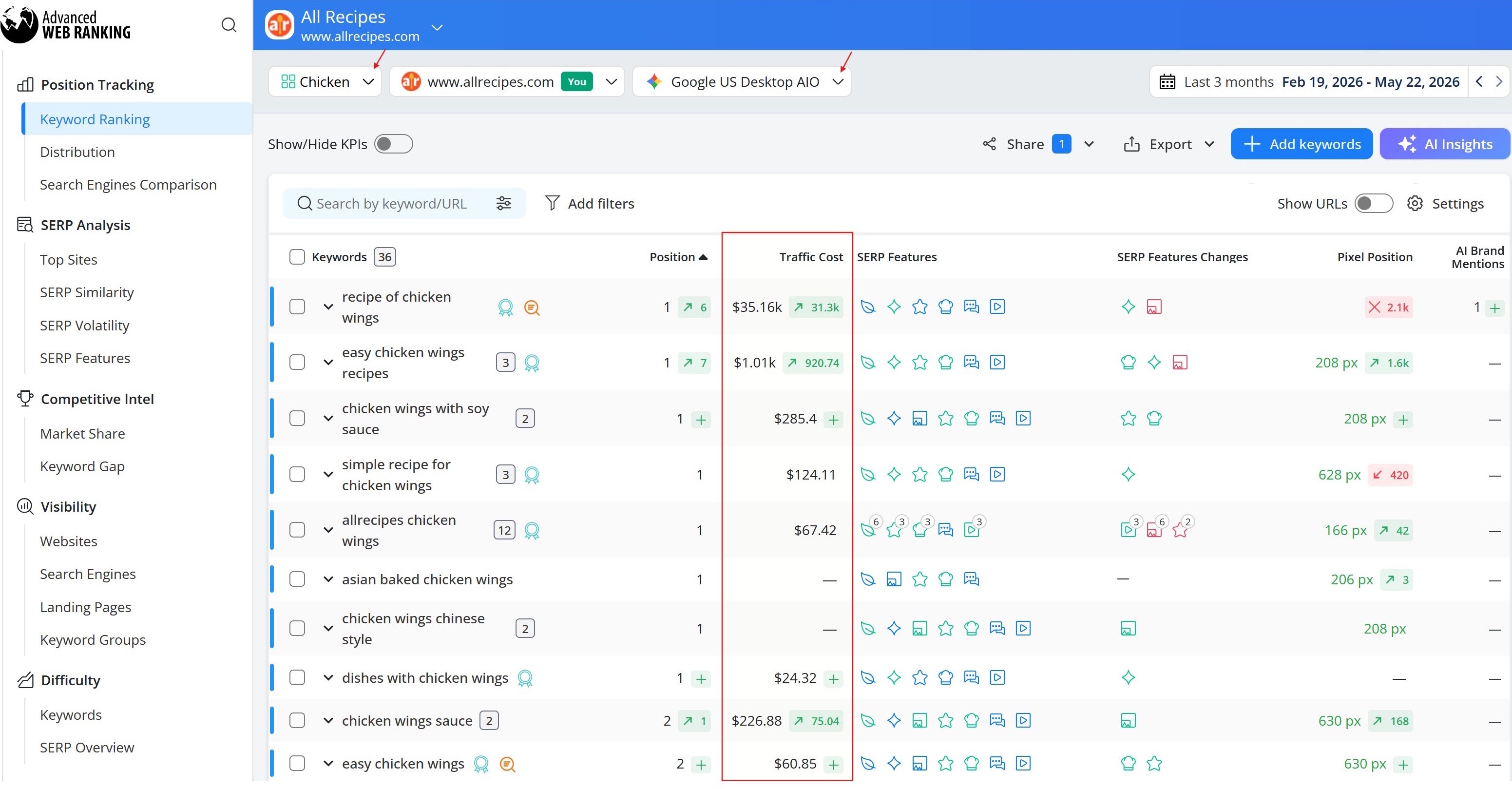
The metric appears next to ranking position, SERP features, SERP feature changes, Pixel Position, and AI visibility signals. This helps you understand whether a keyword’s estimated value is supported by strong rankings, visible SERP placement, and relevant search features, or whether the number looks impressive without enough business context.
11. Backlinks
Definition: Individual links from other websites that point to your pages. Each link counts separately, even if several links come from the same website.
Why it matters: Backlinks help search engines discover pages and evaluate authority, trust, and relevance. Strong, relevant backlinks can support better rankings, especially for competitive keywords where content quality alone may not be enough.
When it misleads you:
Total backlink count is misleading without quality context. A high number of backlinks means little if they come from low-quality, irrelevant, duplicated, or spammy sources. A smaller number of relevant links from authoritative domains can be more valuable than a large volume of weak ones.
A sudden backlink spike is not always good news. It can signal a negative SEO attack, an unnatural link pattern, or links being built at a pace that search engines may treat as manipulative.
Anchor text can distort the picture. A backlink profile with too many exact-match anchors pointing to the same page can look unnatural, even if some of the individual links come from legitimate sources.
Read backlink count alongside referring domains, link quality, topical relevance, anchor text distribution, rankings, and organic traffic to understand whether your link profile is actually supporting rankings and organic visibility or just inflating a number.
How AWR adds context:
Link quality, spam risk, and anchor text are usually checked in dedicated backlink platforms. AWR adds context by showing whether the pages and keyword groups supported by link-building are gaining search performance afterward.
Group the target keywords or landing pages involved in a link-building campaign and track how their rankings, search visibility, Click Share, and estimated visits change over time.
By connecting Google Analytics and Google Search Console to AWR, you can also bring actual traffic and conversion data into the same workspace, so you can report not just how many links were gained, but whether the linked pages became more visible, earned stronger rankings, or contributed to organic growth.
12. Referring domains
Definition: The number of unique websites that contain at least one backlink pointing to your site. Where backlinks count every individual link, referring domains count the sources.
Why it matters: Referring domains is a more reliable signal of link profile strength than raw backlink count. Ten links from ten different trusted domains carry more weight than ten links from the same domain. A growing number of referring domains suggests your content is earning recognition from a wider range of sources, which is a stronger indicator of genuine authority than link volume alone.
When it misleads you:
More referring domains does not always mean stronger authority. A large number of low-quality, irrelevant, or spammy domains can inflate the metric without helping rankings, traffic, or trust.
Referring domains are more useful than backlink count, but still need quality context. Ten links from one trusted domain do not carry the same value as links from ten different trusted domains, which is why referring domains are often a better signal of link profile strength than raw backlink count.
New referring domains are not always valuable. A spike in referring domains can come from scraper sites, syndicated content, sitewide links, spam networks, or negative SEO, so growth should be checked against relevance, authority, anchor text, and traffic impact.
Read referring domains alongside backlink quality, topical relevance, anchor text distribution, link growth patterns, rankings, search visibility, and organic traffic to understand whether your link profile is actually supporting organic performance.
How AWR adds context:
Just like backlinks, referring domains are usually checked in dedicated backlink tools. AWR adds context by showing whether more websites linking to you is reflected in search performance.
For referring domains, the useful question is not only “Are more websites linking to my website?” but “Is that wider authority footprint helping important pages and topics become more competitive in search?” By tracking rankings, search visibility, and Click Share for the pages earning new referring domains, AWR helps you connect authority growth to actual search gains.
13. Core Web Vitals
Definition: Core Web Vitals are Google’s user experience metrics for page loading, interactivity, and visual stability. The three current Core Web Vitals are Largest Contentful Paint, Interaction to Next Paint, and Cumulative Layout Shift.
Why it matters: Core Web Vitals show whether users can load, interact with, and read your pages comfortably. They matter for SEO because poor page experience can limit performance, but they also affect what happens after the click: user frustration, engagement, and conversion potential.
When it misleads you:
Passing Core Web Vitals does not guarantee SEO performance. A page can be fast and stable but still fail to rank, attract traffic, or convert if the content is weak, the intent match is poor, or the page lacks authority.
Site-level scores can hide page-level problems. Core Web Vitals may look healthy overall while specific templates, devices, countries, or high-traffic landing pages are failing.
Lab scores and real-user data can tell different stories. A page may perform well in a controlled test but still create a poor experience for real users on slower devices, weaker connections, or specific locations.
Read Core Web Vitals alongside organic traffic, rankings, conversions, device data, page templates, and real-user performance data before treating a “pass” as proof that page experience is no longer an issue.
How Wattspeed helps: Connect CWV scores to technical issues
Wattspeed helps you read Core Web Vitals as an ongoing monitoring workflow, not just a one-off test.
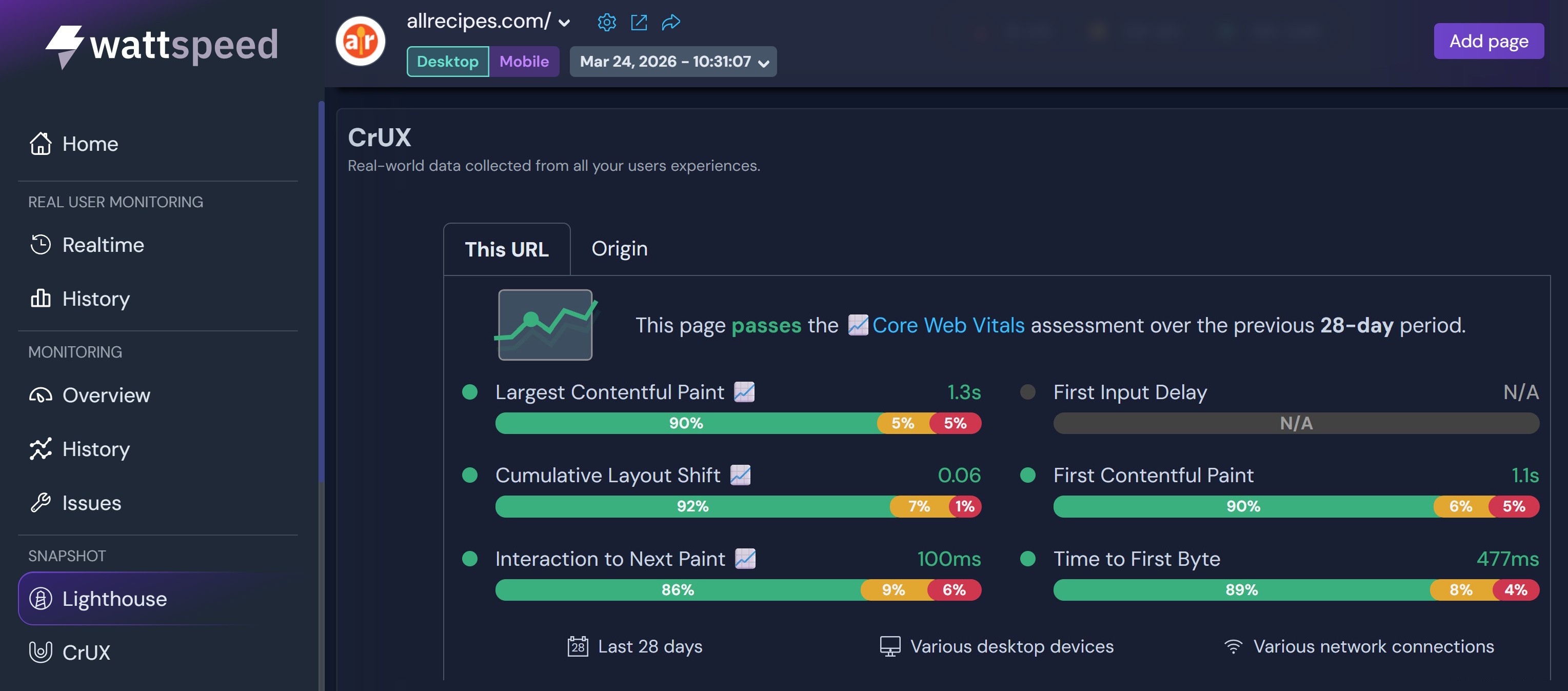
In the CrUX snapshot, you can see whether a specific URL or the wider origin passes Core Web Vitals over the previous 28 days, with separate data for LCP, INP, and CLS. This shows whether the issue is related to loading, interactivity, or visual stability.
In the Lighthouse snapshot, you can filter diagnostics by the Core Web Vital you are investigating, such as LCP, CLS, or INP. This helps surface the technical issues that may be contributing to the problem, such as unused CSS, image issues, JavaScript delays, or LCP element delays.
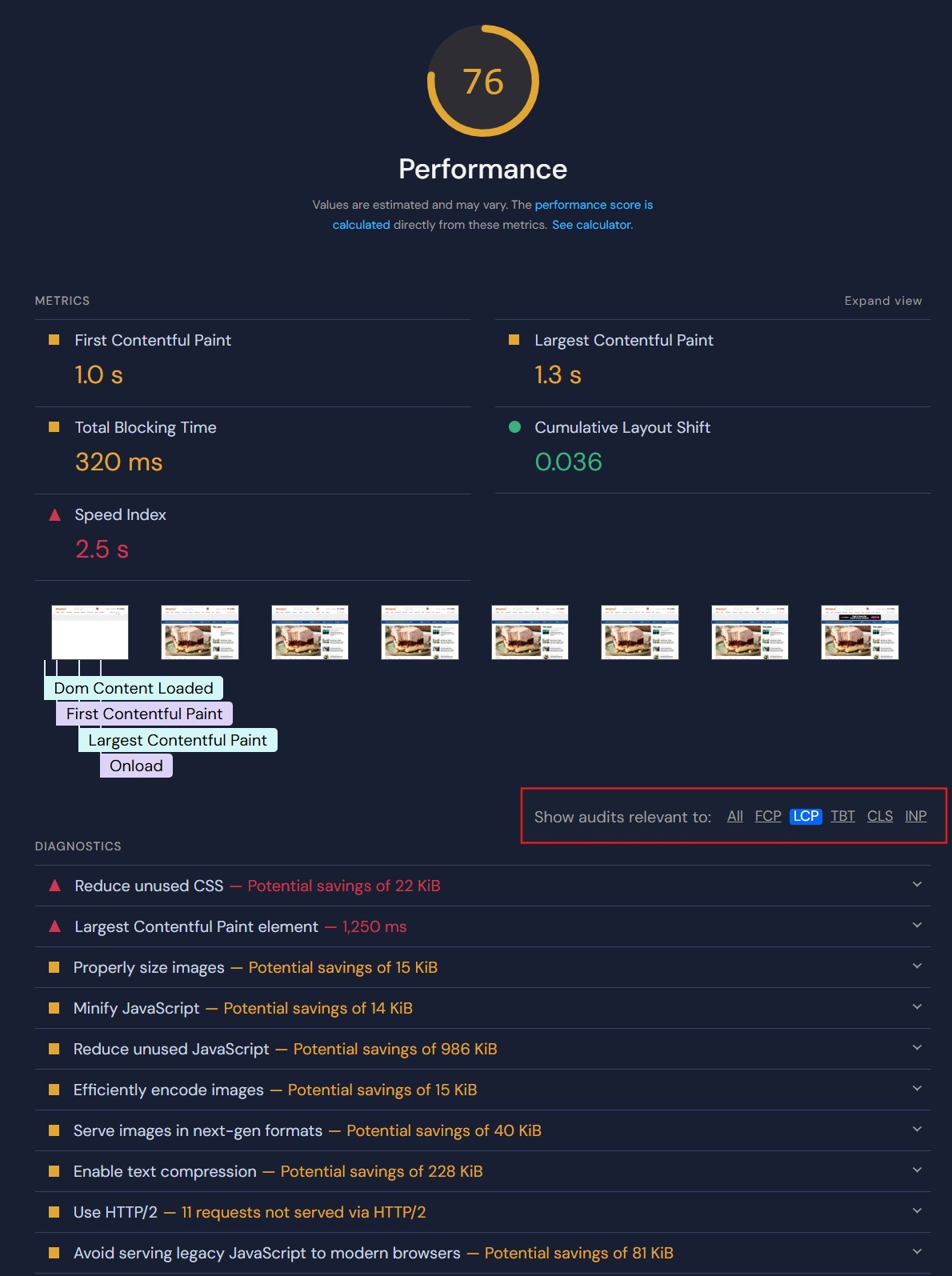
For live monitoring, Wattspeed’s RUM Realtime report shows what users are experiencing right now, based on data from the last hour. It includes realtime Core Web Vitals, top countries, country-level CWV status, and top pages, with controls to refine the report by location or device.
14. Indexability
Definition: Whether a page can be crawled, understood, and included in a search engine’s index.
Why it matters: A page cannot rank if search engines cannot properly access or index it. Indexability is the technical foundation behind visibility, rankings, traffic, and conversions.
When it misleads you:
An indexed page can still fail to rank, attract traffic, or convert if the content, intent match, authority, or competition is weak.
A ranking or traffic decline may look like a content or authority issue when the real problem is crawlability, rendering, canonicalization, or indexing.
Canonicals, duplicate content, redirects, robots rules, hreflang issues, or weak internal linking can cause search engines to choose another version of the page instead of the intended one.
Read indexability alongside rankings, organic traffic, canonical tags, internal links, and crawl signals to catch problems before they show up as ranking or traffic losses.
How Wattspeed helps: Diagnose indexability issues
Wattspeed’s Page Source report includes a dedicated Indexability section that checks page-level issues around canonical tags, meta tags, and other HTML elements.

Issues are flagged with their source element, so you can see what needs fixing per URL and device. This helps you catch technical barriers before misreading a ranking or traffic drop as a content problem.
Turn SEO Metrics Into Better Decisions
A metric should not end the analysis; it should point to the next question. A ranking change, visibility score, CTR, citation, conversion, or technical status becomes useful only when you understand what caused it, what it affects, and whether it matters for the outcome you are trying to improve.
Use the metrics in this guide as a reference set, not as a list to apply the same way every time. Choose the signals that match the question you need to answer, read them with the context each one requires, and connect them when needed to see the full picture across traditional search, AI-generated answers, and business performance.

Article by
Irina Diaconu
I’m a passionate content writer who loves researching and exploring new topics. With a keen eye for detail, I am dedicated to creating well-informed pieces that captivate and inform readers. Sharing knowledge and arousing curiosity is at the heart of my writing journey.