


A ranking can improve. Traffic can grow. Visibility can rise. However, none of those changes tell you whether SEO is delivering the outcome the business actually needs. With plenty of metrics available, the harder part is deciding which ones best reflect that outcome and turning them into clear KPIs.
This guide covers the most important SEO KPIs, how they help you evaluate SEO performance, and examples for different goals. It also shows how to track a KPI in practice with AWR and avoid common mistakes when setting and using KPIs.
What Are SEO KPIs?
SEO KPIs are measurable indicators used to evaluate progress toward a specific search or business goal. They help teams define what success looks like, use SEO tracking to monitor performance against that goal, and decide when a change in approach is needed.
KPI Checklist
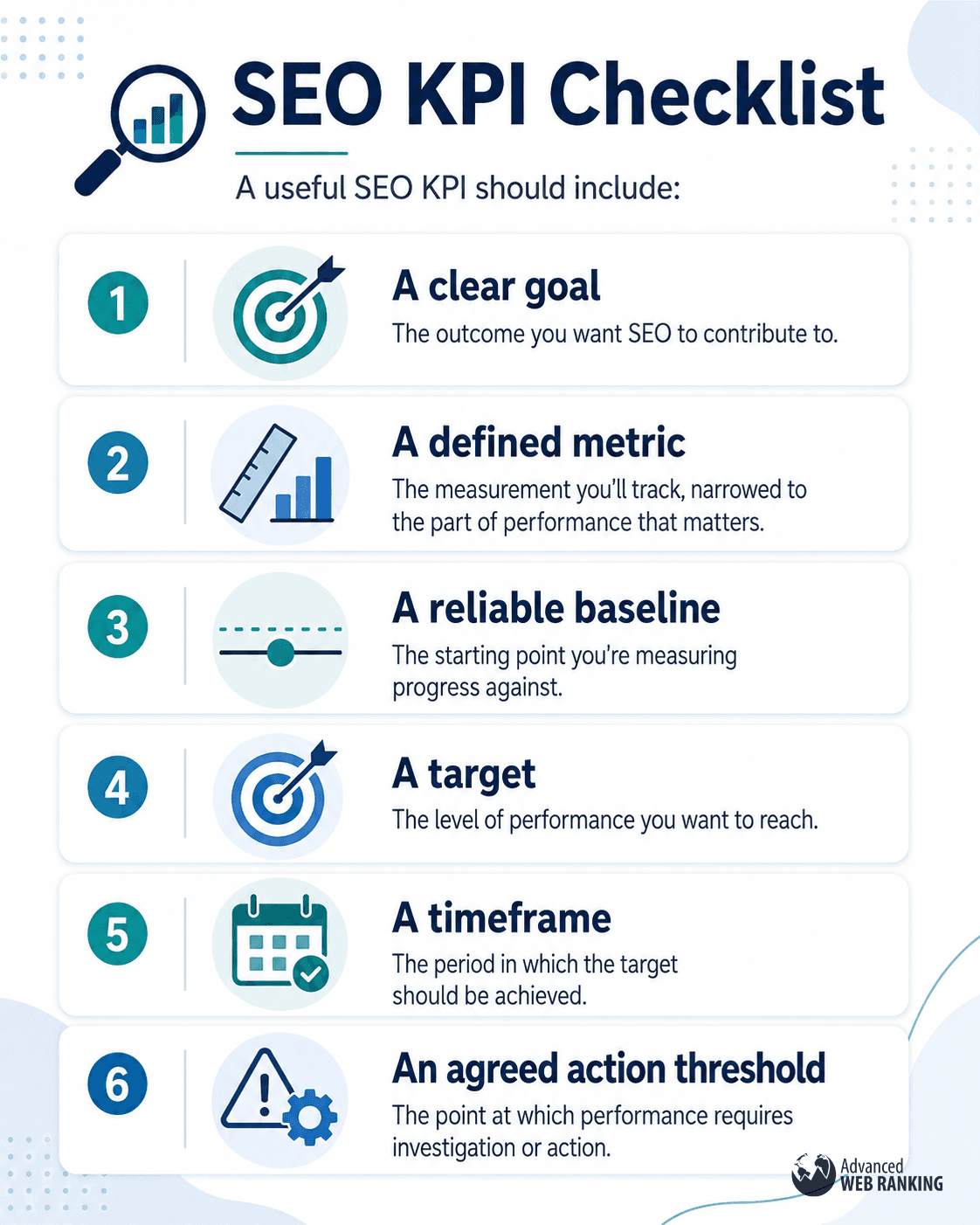
A well-defined SEO KPI should include:
A clear goal: the outcome you want SEO to contribute to.
A defined metric: the measurement you'll track, narrowed to the part of performance that matters.
A reliable baseline: the starting point you're measuring progress against.
A target: the level of performance you want to reach.
A timeframe: the period in which the target should be achieved.
An agreed action threshold: the level at which a change in performance should trigger investigation or action.
What Are the Key Differences Between SEO Metrics and KPIs?
SEO metrics and KPIs are closely related, but they serve different purposes. Metrics help you monitor and understand performance, while KPIs use particular metrics to judge progress toward a specific goal.
The same metric can therefore become different KPIs depending on what you are trying to achieve. Take organic traffic:
A content team might use it as a KPI to increase non-branded organic traffic by 30% year over year.
After a site migration, the same metric could become a KPI to recover organic traffic to pre-migration levels within 90 days.
The measurement is still organic traffic, but its goal, scope, target, and timeframe change. Other metrics, such as rankings, impressions, CTR, or search visibility, can still be monitored to provide context and help explain KPI performance.
For a deeper look at SEO metrics, including what they measure, why they matter, and how to interpret them in today’s search environment, see our complete guide to SEO metrics.
What Are the Most Important SEO KPIs to Track?
The most important SEO KPIs to track are the ones that best reflect what the business needs from SEO at a given moment. Those priorities can change as the business evolves, new goals emerge, or changes in search performance require a different focus.
For practical use, we grouped SEO KPIs into five main areas: business outcomes, search acquisition, search visibility, authority, and technical performance. You may monitor performance across all five, but only the areas directly connected to your current objectives need to become primary KPIs.
1. Business outcome KPIs
Business outcome KPIs measure the value SEO generates for the business. They look beyond whether rankings, visibility, or traffic improved to determine whether that progress produced business value.
Organic conversions
Organic conversions are the desired actions completed by visitors who reach your website through unpaid search. They are most valuable as a KPI when SEO is expected to generate leads, purchases, sign-ups, bookings, demo requests, or other actions connected to a business goal.
Their interpretation becomes less straightforward as discovery and decision-making spread across more surfaces. Organic search may influence users through AI answers, SERP features, and multiple touchpoints without receiving credit for the final conversion. Organic conversions therefore represent attributable outcomes rather than SEO’s complete influence.
Organic revenue and SEO ROI
Organic revenue measures the income generated through unpaid search, while SEO ROI compares the value generated with the cost of SEO work. Organic revenue is most useful as a KPI when SEO is expected to contribute directly to sales and that contribution can be measured reliably. SEO ROI is more useful when the goal is to evaluate whether the return justifies the investment in content, tools, technical work, and team resources.
These metrics remain valuable, but today’s zero-click and multi-channel journeys make attribution less complete. Organic search may introduce or support a purchase without receiving credit for it, causing organic revenue and ROI to underestimate SEO’s broader commercial contribution.
2. Search acquisition KPIs
Search acquisition KPIs measure how effectively SEO brings visitors to your website through unpaid search. They show whether your visibility in search results is turning into clicks and traffic.
Organic traffic
Organic traffic tracks the visits your website receives from unpaid search. It is most effective as a KPI when increasing visits is an immediate goal, such as expanding into a new topic or market or recovering after a migration.
Its role is narrower in a search environment where users increasingly receive answers without visiting a website. People may see and be influenced by your content in AI answers or SERP features, but they are not reflected in organic traffic unless they click. Organic traffic should therefore be treated as a measure of visits, not total search impact.
Non-branded organic traffic
Non-branded organic traffic is organic traffic segmented to include only searches that do not contain your brand name. It is most valuable as a KPI when the goal is to grow discovery beyond existing brand demand. It shows whether you are attracting visits from people searching for the topics, products, or solutions you want to be found for rather than for your brand by name.
Click-through rate (CTR)
Click-through rate is the percentage of search impressions that result in a click. It becomes particularly useful as a KPI when the goal is to get more visits from the search visibility you already have. It helps you assess how effectively your presence in search results earns clicks when it appears.
3. Search visibility KPIs
Search visibility KPIs measure how prominently your website or brand appears across traditional and AI search results. They show whether you appear in the searches you track and where you rank in those results.
Keyword rankings
Keyword rankings show the positions your pages hold in search results for specific queries. They are most relevant as a KPI when the goal is tied to particular ranking positions, such as improving rankings where competitors currently lead or increasing the number of keywords in a group that rank in the top 10. You can set these targets for individual keywords or groups based on topics, products, search intent, or other criteria.
Search visibility
Search visibility measures the strength of your organic presence across a defined set of tracked keywords, usually as a score or percentage based on where your pages rank. It works well as a KPI when the goal is to improve overall presence across a group of keywords rather than focus on specific ranking thresholds. It helps you see whether performance is strengthening across a topic, product area, or other tracked keyword set.
SERP feature visibility
SERP feature visibility measures how often your website or brand appears in search features beyond standard organic listings, such as AI Overviews, People Also Ask, local packs, images, or videos. It becomes helpful as a KPI when the goal is to expand your presence across different parts of the SERP rather than improve traditional rankings alone. These features can give your brand additional search-result space alongside your organic rankings, helping you occupy more of the page and strengthen overall visibility.
AI visibility
AI visibility measures how consistently and prominently your brand appears in AI-generated search results. It is most useful as a KPI when the goal is to strengthen your presence in AI search environments that traditional rankings do not capture. Track brand mentions and citations, along with how your visibility compares with competitors across the topics and queries you monitor.
4. Authority KPIs
Authority KPIs track the external links and websites pointing to your site. They help you assess whether link-building, digital PR, and content promotion are expanding the external signals that can support organic search performance.
Backlinks
Backlinks are individual links from other websites pointing to pages on your site. They are most useful as a KPI when the goal is to earn links to specific pages, content assets, or sections of the website. Rather than focusing only on volume, backlink targets should reflect the relevance and quality of the links you want to acquire.
Referring domains
Referring domains are the unique websites that link to your site. They work well as a KPI when the goal is to broaden the range of websites linking to you rather than earn additional links from sources you already have. This makes them particularly useful for link-building and digital PR campaigns focused on expanding external reach.
5. Technical performance KPIs
Technical performance KPIs measure whether your website meets the technical conditions needed to support search visibility and a good user experience. They help you track whether important technical requirements remain stable or improve over time.
Core Web Vitals
Core Web Vitals measure real-user experience across loading performance, responsiveness, and visual stability. They are most useful as a KPI when the goal is to improve page experience across important pages or sections of the site. They can help turn broad performance work into measurable targets for the parts of the website you want to improve.
Indexability
Indexability shows whether the pages you want to appear in search can be crawled and included in the index. It works best as a KPI when technical issues are preventing important pages from being eligible for search, especially after a migration, redesign, or large-scale site change. It helps you track whether those issues are being resolved across the affected pages.
SEO KPI Examples by Goal or Business Type
The right SEO KPIs depend on what the website is expected to achieve. A content-led site, a local business, and an ecommerce store may track many of the same metrics but turn different ones into primary KPIs.
SEO context | Metrics to consider | How to choose the right KPI | Example KPI |
|---|---|---|---|
What are the main KPIs for content marketing? | Search visibility, non-branded organic traffic, keyword rankings, organic conversions, backlinks, referring domains | Base the KPI on whether the content is meant to drive discovery, rankings, conversions, or links. | Increase non-branded organic traffic to the content hub by 25% within six months. |
What are the main KPIs for local SEO? | Keyword rankings, search visibility, SERP feature visibility, organic traffic, organic conversions | Focus on visibility in target locations or the customer actions SEO is expected to generate. | Increase organic bookings from location pages by 20% by the end of Q4. |
What are the main KPIs for ecommerce SEO? | Organic revenue, organic conversions, SEO ROI, search visibility, keyword rankings, non-branded organic traffic, SERP feature visibility | Connect product discovery with the commercial outcome SEO is expected to support. | Increase organic revenue from category and product pages by 20% year over year. |
What are the main KPIs for B2B or SaaS SEO? | Organic conversions, non-branded organic traffic, search visibility, keyword rankings | Prioritize lead-generation outcomes or discovery across commercial topics and solutions. | Increase qualified leads from non-branded organic search by 15% within six months. |
What are the main KPIs after an SEO migration? | Organic traffic recovery, search visibility recovery, keyword rankings, indexability | Focus on the performance that needs to be protected or recovered after launch. | Restore search visibility for priority keyword groups to at least 95% of the pre-migration level within 60 days. |
How to Track an SEO KPI in AWR
Once a KPI is defined, you need a consistent way to monitor progress and understand what is driving any change. Here’s how the process works in AWR, using a search visibility KPI as an example.
1. Set up the KPI scope
Suppose you want to improve search visibility for a specific keyword group in a defined market, device, and search engine.
In AWR’ Keyword Ranking report, we’re tracking the Meat keyword group for allrecipes.com on Google US Desktop Organic, covering 84 keywords.
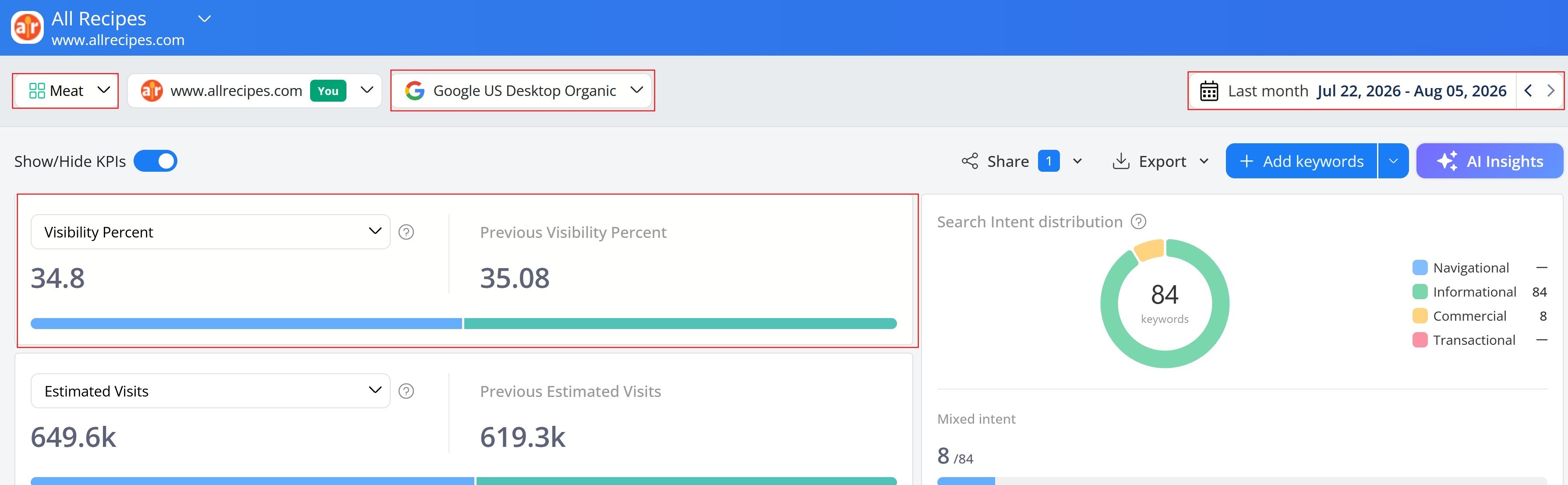
For this example:
Goal: improve search visibility.
Metric: Visibility Percent for the Meat keyword group on allrecipes.com, Google US Desktop Organic.
Baseline: 34.8%.
Target: 40%.
Timeframe: by the end of 2026.
Action threshold: investigate if Visibility Percent falls below 32%.
The KPI becomes:
Increase search visibility for the Meat keyword group on Google US Desktop Organic from 34.8% to 40% by the end of 2026.
Keep the same keyword group, website, and search engine throughout the KPI period to ensure consistent metric measurement.
2. Track progress over time
Click Visibility Percent to open its extended chart, then choose a date range that includes the 34.8% baseline and subsequent updates to see whether visibility is moving toward the 40% target.

The current and Previous Visibility Percent values provide a quick comparison between the first and latest ranking updates in the selected date range, while the chart shows how visibility changed between them.
3. Analyze what is driving the KPI change
Use the Keyword Groups Visibility report to understand what is behind changes in Visibility Percent.

In this example, more keywords moved down or dropped from the rankings than moved up or were added. Average Rank declined slightly, while Visibility Distribution fell by 2.85, indicating that the keyword group also lost prominence on the SERP. Together, these changes help explain the decline in Visibility Percent and show where further investigation is needed.
4. Investigate the keywords behind the change
Move back to Keyword Ranking when you need to identify which queries are contributing to the KPI movement.
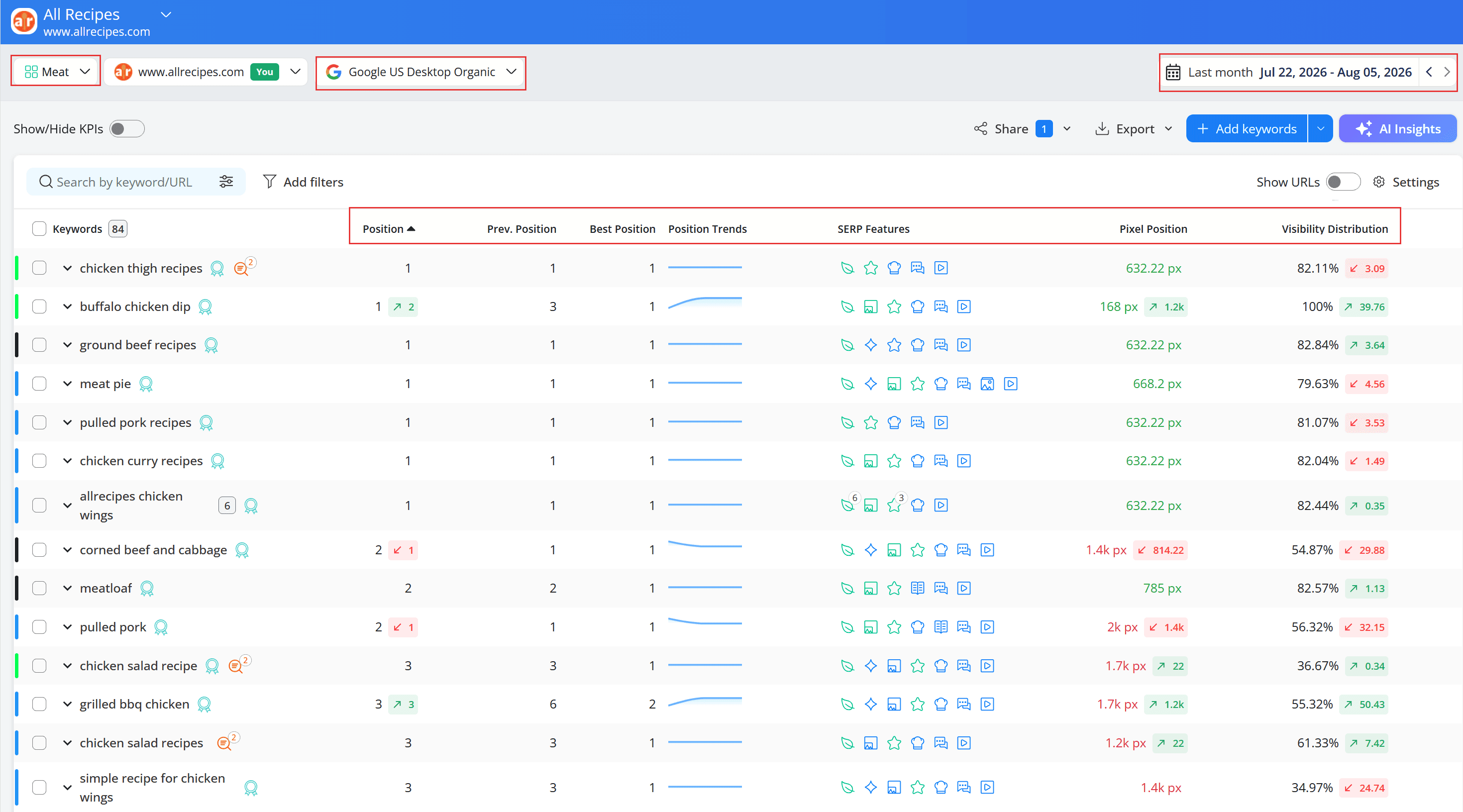
Compare Position, Previous Position, Position Trends, SERP Features, Pixel Position, and Visibility Distribution to see where gains or losses are coming from and whether changes in the SERP layout are affecting visibility.
This takes you from the keyword-group KPI to the individual keywords that may require attention.
You can also use AI Insights to speed up this analysis. Ask what caused the visibility decline for the keyword group and which keywords or SERP changes contributed most.
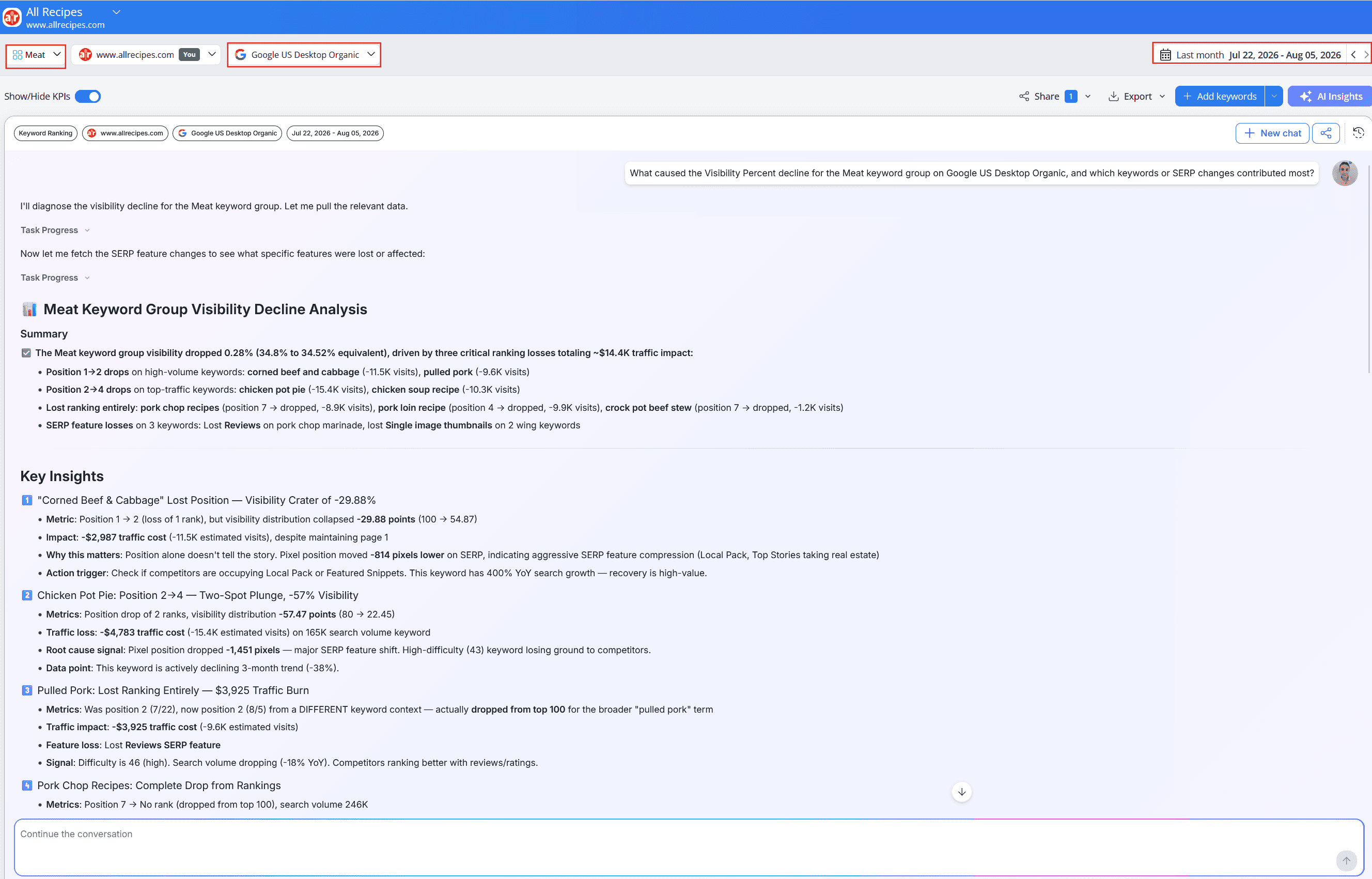
In this example, AI Insights traces the decline back to specific ranking losses, including keywords that dropped several positions or disappeared from the rankings. It also surfaces changes in Pixel Position and SERP features, helping you identify which losses contributed most to the visibility decline and where to investigate first.
5. Set alerts for important KPI changes
Create a visibility change alert for the same keyword group and search engine.
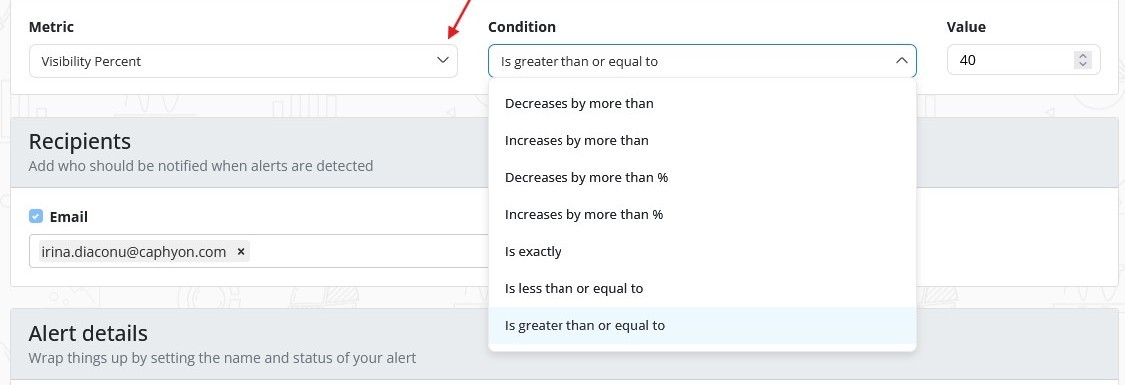
For this KPI, an alert set to Is greater than or equal to 40 can notify you when the target is reached. You can also set a lower threshold, such as below 32%, to trigger an investigation when visibility declines significantly.
Supporting alerts, such as Pixel Position, can help surface changes in SERP prominence even when traditional rankings remain relatively stable.
6. Build a dedicated KPI dashboard
Create a custom dashboard around the KPI so you can monitor it and its supporting signals in one place. Keep the same keyword group, website, and search engine across the relevant widgets to preserve the KPI scope.
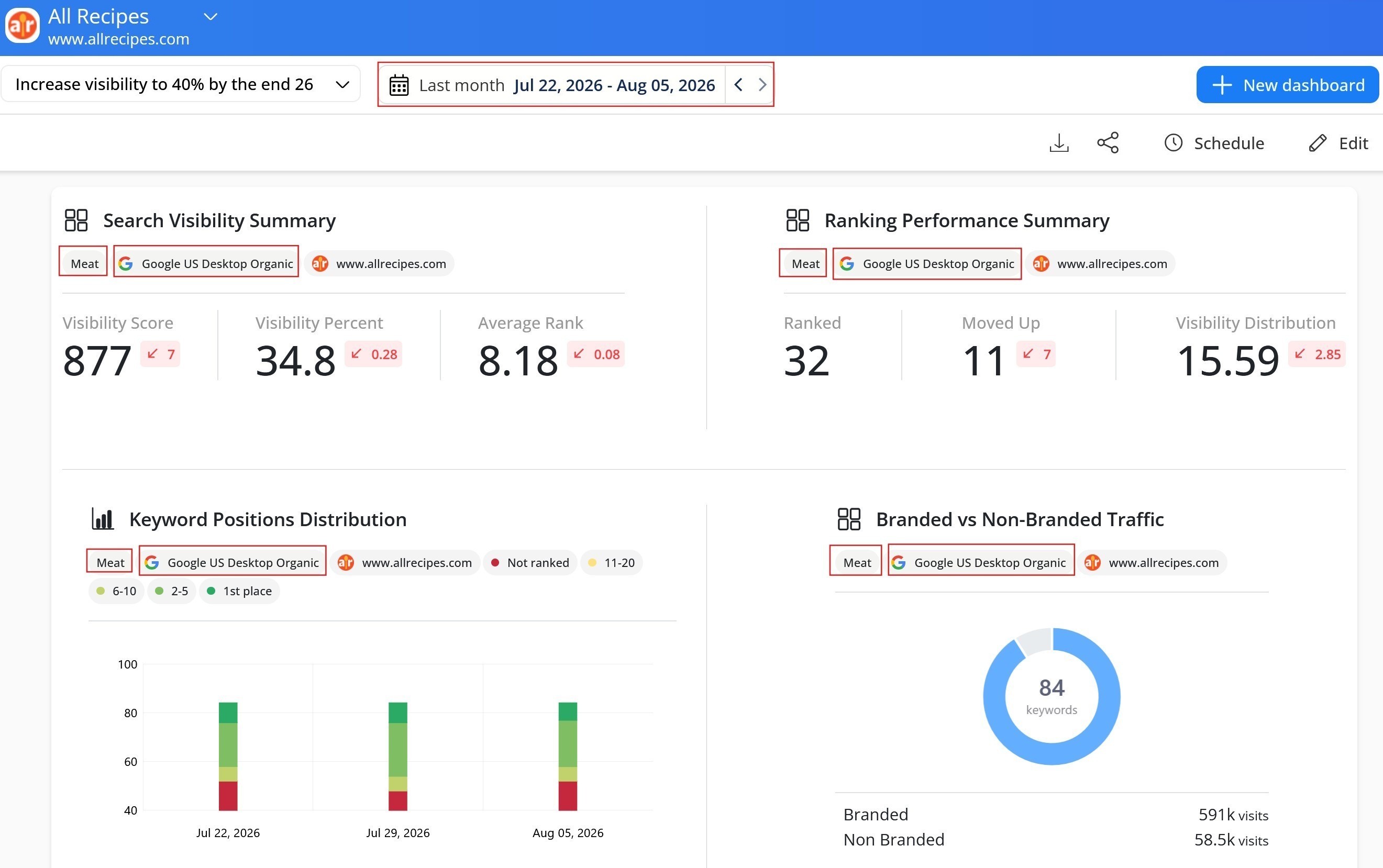
For this visibility KPI, you can place Visibility Percent alongside ranking performance and keyword distribution widgets. This gives you a consistent view of the KPI and the signals that help explain its changes, without moving between several reports.
It also makes the data easier to communicate to stakeholders by keeping the main result and its supporting context together. AWR dashboards can combine KPI, chart, and table widgets, with inputs configured for each widget.
Common SEO KPI Mistakes
Most SEO KPI problems come from how KPIs are selected, defined, and used rather than from the data itself. Even an accurate metric can make a poor KPI when it does not support useful evaluation or decision-making. The following mistakes are some of the most common ways that this situation happens:
Treating every metric as a KPI. Not every metric needs a target and timeframe. Too many KPIs make it harder to see which results actually define success.
Setting targets without a baseline. Without a reliable starting point, it is difficult to judge whether a target is realistic or how meaningful the progress toward it is.
Defining KPIs without a clear scope. A KPI should specify the part of performance that matters. Broad definitions can make progress harder to evaluate against the actual goal.
Confusing leading indicators with outcomes. Rankings, visibility, and impressions can signal progress, while conversions and revenue show the business results that follow. The KPI should match the outcome you are actually trying to measure.
Choosing KPIs SEO cannot meaningfully influence. SEO does not need complete control over an outcome, but the team should be able to affect it enough for the KPI to guide decisions.
Changing KPI definitions between reports. Changing the scope, baseline, filters, or calculation method makes progress difficult to compare consistently over time.
Reporting KPI performance without deciding what happens next. KPI reporting should not stop at whether a target was met. When performance falls short, the agreed action threshold should make it clear when investigation or a change in approach is needed.
Making SEO KPIs Work for You
SEO KPIs are not universal; they depend on what SEO is expected to achieve for the business.
Choose the metrics that matter most, set a clear baseline, target, and timeframe, and then use supporting metrics to understand what is driving the result. This makes it more straightforward to see when performance is moving in the right direction, when something needs a closer look, and when the strategy may need to change.
Once you know where performance needs attention, you can focus on the SEO best practices most relevant to improving it.
The goal is to make KPI tracking useful for decisions, not just reporting.

Article by
Irina Diaconu
I’m a passionate content writer who loves researching and exploring new topics. With a keen eye for detail, I am dedicated to creating well-informed pieces that captivate and inform readers. Sharing knowledge and arousing curiosity is at the heart of my writing journey.