

I asked Google a simple question: "How do AI Overviews choose their sources?" It answered with an AI Overview, citing its own developer documentation among the sources: AI Overviews pull from top-ranking traditional search results and evaluate content through core ranking signals.

My data says that self-description is half the story. I did a small, exploratory study and ran 40 SEO queries through Google AI Overviews and Bing Copilot Search, logged all 265 citations they produced, and hand-coded 112 passages: the ones the engines quoted, and the ones Google surfaced elsewhere on the same results page yet declined to cite. Google does cite what ranks. Then it cites past the ranking entirely, and sometimes it uses a #1 result without naming it. The unit that decides attribution is not the page. It is the passage. This study is about what that passage needs to contain.
Two recent pieces on the AWR blog frame the question. Gianluca Fiorelli argued in his consensus and information gain essay that visibility in AI search is governed by where a source sits on the consensus axis. The 481-site brand mention volatility study measured whether brands appear in AI answers at all. Both stop one level above where attribution actually happens. A page does not get cited. A sentence does. My study goes down to that sentence.
The Difference Between a Cited and an Absorbed Passage
A cited passage is quoted by an AI answer with a visible link to its source. An absorbed passage supplies information the answer uses without attribution. The cleanest documented case in this study is a page ranking #1 in organic results, on the exact query its content answers, receiving no citation while lower-ranked competitors did.
Absorption is inferred, not proven. I cannot see inside Google's retrieval pipeline. What I can see is an AI Overview whose definition matches a top-ranked page almost clause for clause, sitting on the same screen as that page, with no citation pointing at it. Every case I present survives a screenshot check.
How I Ran the Study
I ran 40 prompts across 5 lanes of SEO knowledge: semantic SEO, topical authority, technical SEO, generative engine optimization, and entity SEO. Each lane held 8 prompts spread over 5 query types: definitional, comparison, how, why, and best practice. Two engines answered them: Google AI Overviews and Bing Copilot Search.
The reproducibility box:
Sessions: logged out, fresh profiles, no personalization.
Locale: English, with hl=en and gl=us pinned. Requests originated from a Thailand IP; AI Overview trigger rates may vary by region, and I disclose that rather than hide it.
Window: one collection day, July 29, 2026, so engine drift could not smear the snapshot.
Evidence: a full-page screenshot for every capture, raw extraction files for every query, and a coding sheet for every passage. Anyone can rerun the 40 prompts and re-judge my coding.
Collection: agent-assisted through a scripted browser, human-reviewed at every step. When Google served a CAPTCHA to one collection profile, I switched profiles rather than solve it. When Bing stopped serving answers to an automated profile, I recollected those queries interactively.
Verification: automated collection failed twice, and both failures are disclosed because they shaped the numbers. First, an extraction pass misread People Also Ask links as organic results; every rank claim was re-verified against screenshots and the misread cases were reclassified, not discarded. Second, load-time page snapshots missed AI Overviews that streamed in moments later; the screenshots caught them, and an audit of all 40 confirmed an AI Overview on every query. Presence stats use the screenshot ground truth. Citation-level analysis covers the answers captured in fully expanded form: 12 from AI Overviews and 13 from Copilot Search.
Coding: 5 attributes per passage: answer position, format, named entity at first mention, freshness, and consensus versus information gain. Pages that blocked fetching were logged as failures, not guessed: 8 of 120 passages.
The numbers that follow describe 40 AI Overview appearances (12 captured in full), 13 Copilot Search answers, 265 logged citations, and 112 coded passages. This is a small-N study by design. It trades scale for passage-level depth that larger studies skip.
Supporting materials & reproduction guide: Access the full prompt list, coding sheets, screenshots, raw materials, and instructions for rerunning the study.
Finding 1: The AI Overview Is Now the Default Surface, and It Cites in Bulk
Google rendered an AI Overview on 40 of my 40 queries. Not most of them. All of them.
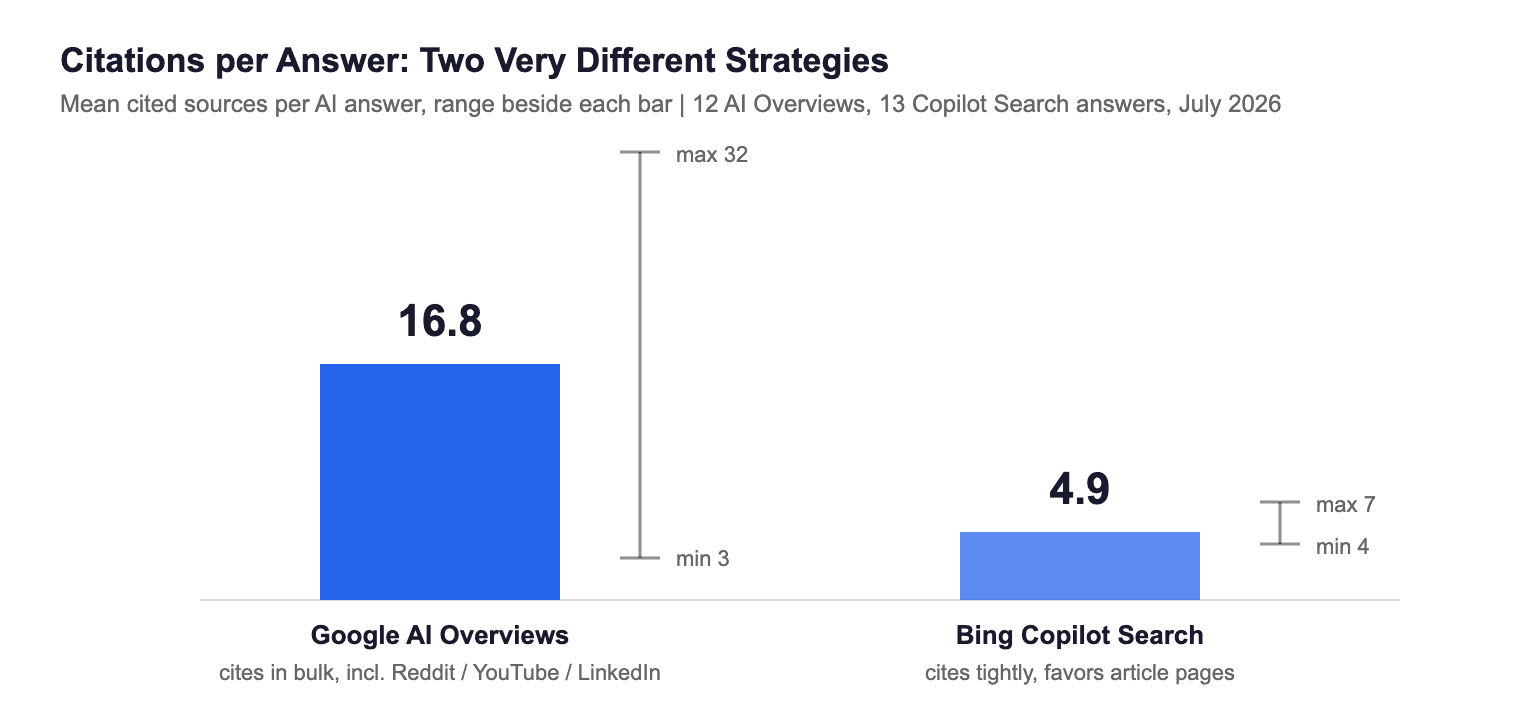
Across the 12 answers I captured in fully expanded form, each cited 16.8 sources on average, with a range from 3 to 32. Bing Copilot Search answered every query too and cited 4.9 sources on average, in a tight range of 4 to 7.
Hold that 100% against AWR's own AI Overview study, which measured a 12.4% AIO trigger rate across 8,000 keywords in July 2024. My sample is 200 times smaller and deliberately informational, so treat the comparison as directional. The direction is still blunt: for informational SEO queries in 2026, the AI Overview is not a SERP feature you sometimes trigger. It is the default answer surface, and the classic results render underneath it.
The citation-count gap matters more than the trigger rate. An engine citing 32 sources is running a different editorial policy than an engine citing 5. Google spreads attribution wide and shallow. Bing concentrates it narrow and deep. If you optimize for one, you are not automatically optimized for the other.
Finding 2: 59% of AI Overview Citations Are Not Traditional Web Pages
Of the 201 citations across the 12 fully captured AI Overview answers, 119 pointed at Reddit threads, YouTube videos, or LinkedIn posts: 59% of all attribution.
Reddit took 43 citations, YouTube took 49, LinkedIn took 27. Blog posts and documentation pages, the formats SEO teams actually produce, competed for the remaining 41%.
One answer illustrates the policy. For "what is topical authority in SEO," the AI Overview cited 17 sources: 5 Reddit threads, 3 YouTube videos, 3 LinkedIn posts, and 6 web pages. The web pages included Semrush, Ahrefs, and Neil Patel. The Reddit threads included one arguing that topical authority is overrated. Google is citing the argument about the concept, not just the concept.
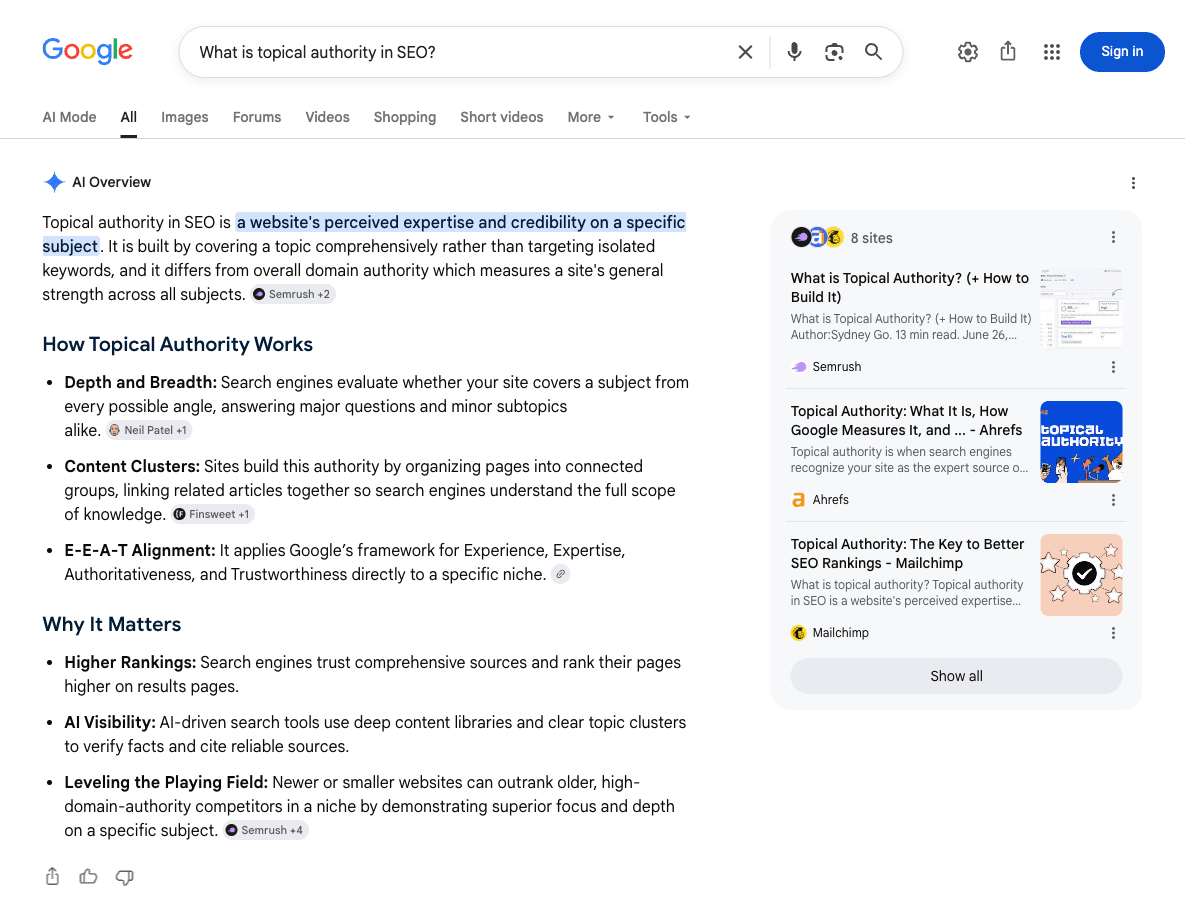
I read this as a corroboration play. Google's own patent on corroborating answers (US11354342B2) describes checking candidate answers against multiple independent sources. A Reddit thread, a YouTube transcript, and a blog post agreeing with each other are three independent surfaces of the same consensus. The AI Overview cites the spread to show the answer is corroborated, not because a Reddit comment outranks your pillar page.
Finding 3: The AI Overview Cites Almost Everything That Ranks, With One Instructive Exception
On 11 of the 12 AI Overview answers I captured in full, every organic result visible on the page was also cited by the AI Overview.
I expected rank and citation to diverge constantly. In this sample, on the SERP itself, they almost never did: when Google puts an AI Overview and organic results on the same screen, the citation list swallows the ranking nearly whole.
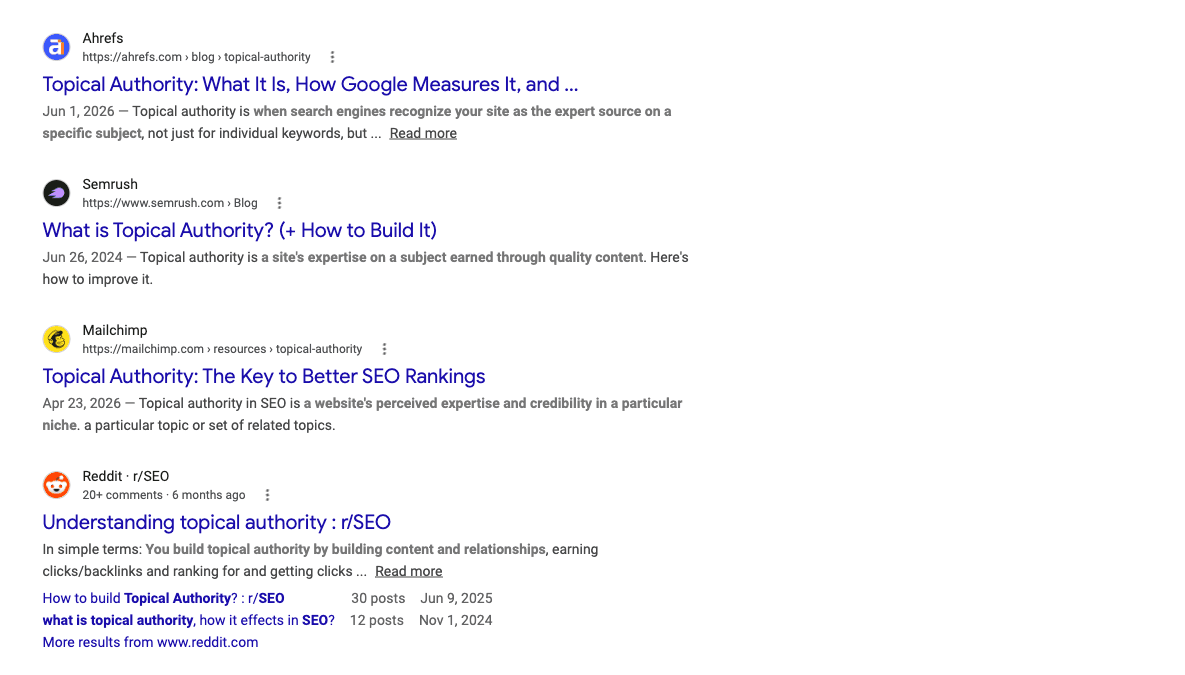
That is worth reconciling with AWR's volatility study, which found 28% of top-ranking pages never surface in LLM answers. Both can be true. The volatility study measured chatbot engines at brand level. I measured the AI Overview sitting on the SERP, query by query. On its own results page, Google's answer engine is far more generous to rankers than the chatbot engines are. The blind spot is real, but it lives off the SERP.
The exception is the instructive part. On "what is semantic SEO," the AI Overview's definition, optimizing for meaning, context, and intent rather than exact-match keywords, tracks the #1 organic result closely. That result is WordLift. The citations went to Reddit, Search Engine Journal, and SE Ranking instead. Backlinko at #5 and Neil Patel at #6 fed the same consensus and also went uncredited. Three pages, same query, same screen, no attribution.
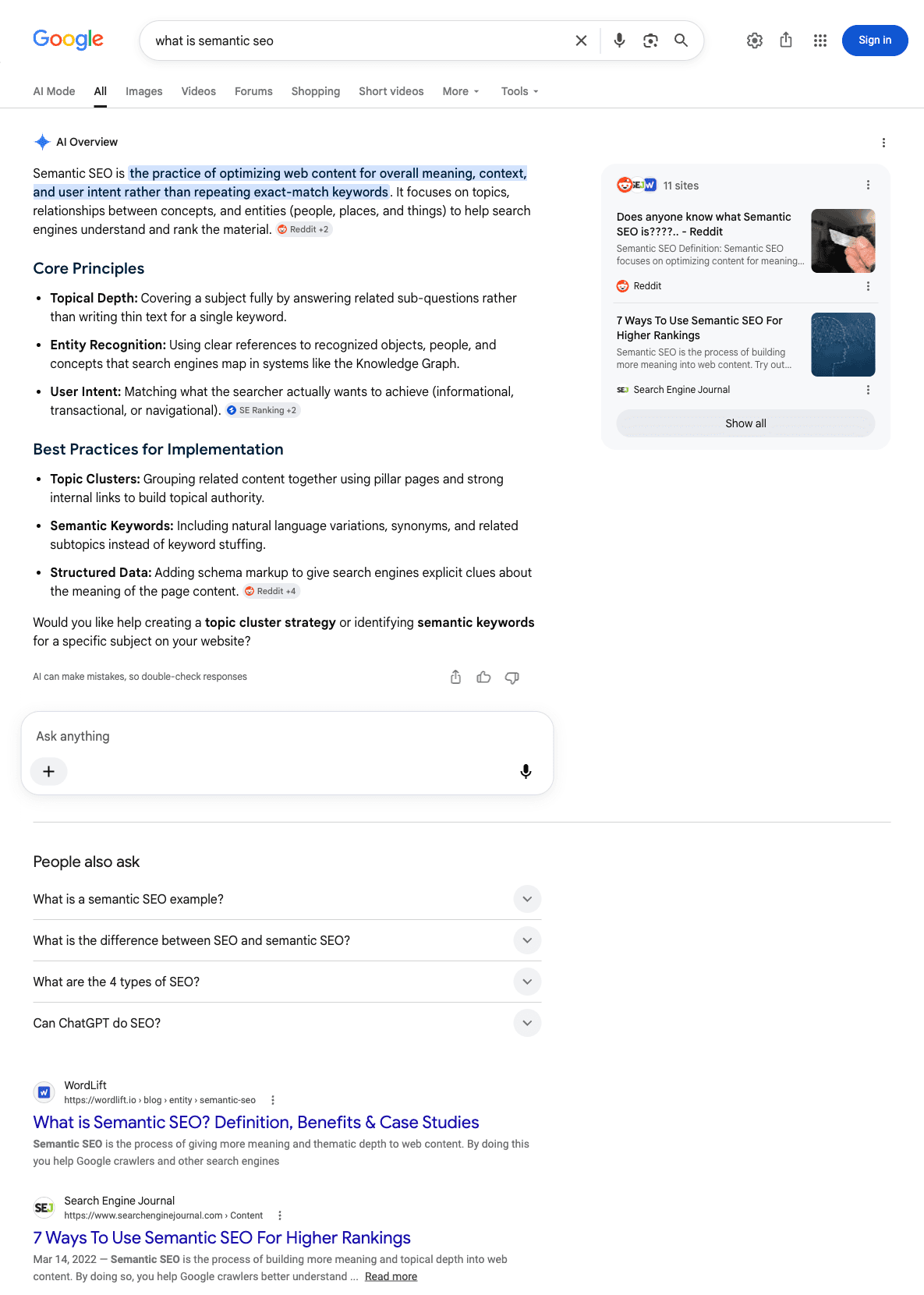
My coding sheet says why WordLift lost the credit it arguably earned: the definition carries no visible date and reads interchangeably with five other consensus definitions. There is nothing in the passage that forces attribution to WordLift specifically. Rank got it seen. Nothing in the sentence got it named.
The reclassified cases point at a second uncited surface: People Also Ask. Fourteen of the uncited pages I coded were not organic results at all. They were pages Google itself surfaces inside the People Also Ask block, answering the same intent, invisible to the AI Overview's citation list.
First Page Sage sits there for "what is technical SEO" carrying a May 2024 timestamp while every cited page is fresher. Responsify sits there for "what is topical authority" with a glossary entry that actually defines topical relevance: the neighboring entity, not the queried one.
Google's left hand surfaces these pages; its answer engine does not name them. The uncited coding sheet labels every one of these pages by the surface it appeared on, organic or People Also Ask, so the split is checkable.
Finding 4: The Two Engines Disagree About Quality
On identical queries, Google AI Overviews and Bing Copilot Search cited materially different source sets, and Copilot's skewed lower-authority.
For "semantic SEO vs traditional keyword SEO," Copilot cited five sources: two LinkedIn Pulse posts and three low-authority SEO blogs, including a site whose main visibility play is selling guest posts. For "what is semantic SEO," Backlinko was absorbed by Google's AI Overview and cited by Copilot, on the same day, for the same prompt.
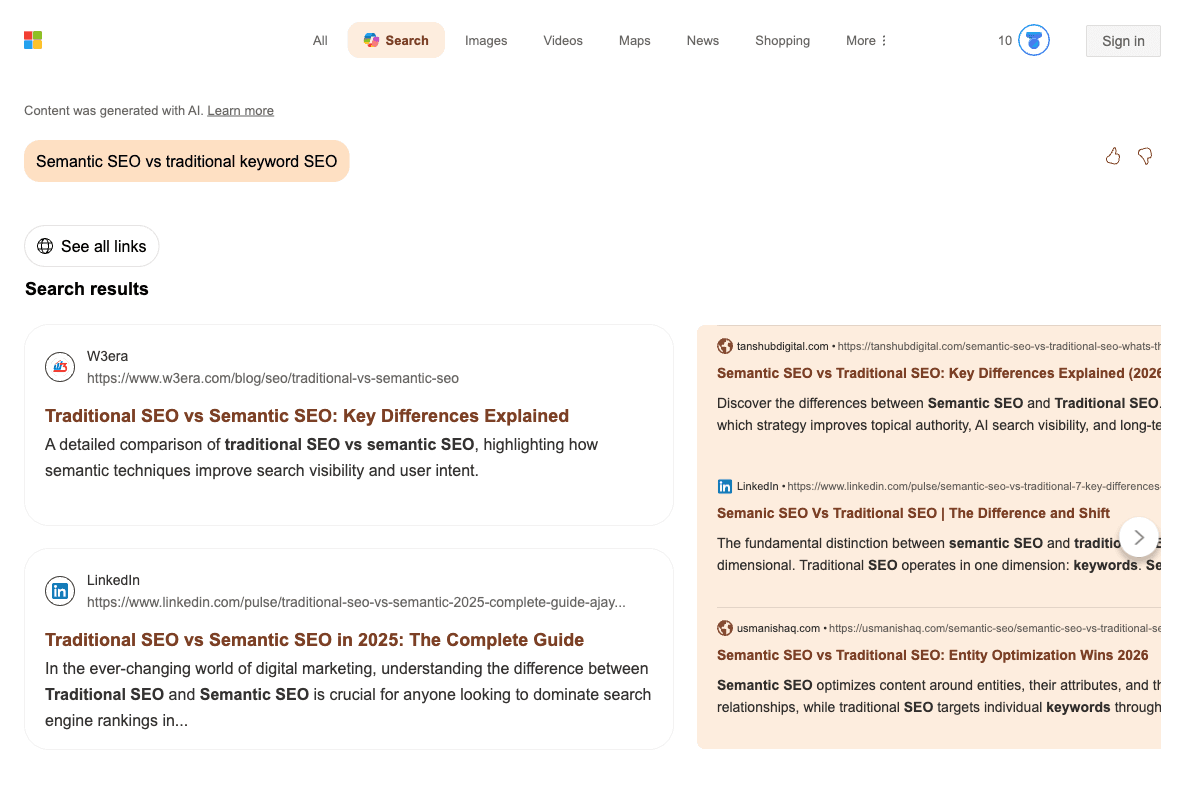
The coded data confirms the split is systematic. Copilot's cited passages were extractive at a higher rate than Google's (82% versus 70%) and fresher (89% versus 72%). Copilot appears to run a simpler retrieval: fewer sources, heavily weighted toward pages that answer fast and answer recently, with a weaker authority filter in front. Google filters harder on source trust, then sprays attribution across formats.
The operational consequence: cross-engine visibility is not one strategy but several, which is the core of what answer engine optimization actually is. A page can win Bing's citation test and fail Google's, and my data contains the live examples.
The Attribute Table: What Cited Passages Have That Uncited Passages Lack
Freshness, explicit entity naming, and escaping pure consensus separate cited passages from surfaced-but-uncited ones. Position and format barely do.
I coded 95 cited passages and 17 passages from pages Google surfaced on the same results page, organic or People Also Ask, without citing.
The rates:
Passage attribute | Cited (n=95) | Surfaced, uncited (n=17) |
|---|---|---|
Fresh date visible (2025-2026) | 80% | 53% |
Named entity at first mention | 96% | 82% |
Pure consensus restatement | 61% | 82% |
Extractive answer in first sentences | 76% | 71% |
Definition-format passage | 60% | 65% |
Contains a hard number | 6% | 0% |
Novel claim (information gain) | 7% | 0% |
Read the bottom of that table before the top. Being extractive did not separate the groups: 76% against 71%. Being a definition did not either: uncited passages were definitions slightly more often than cited ones.
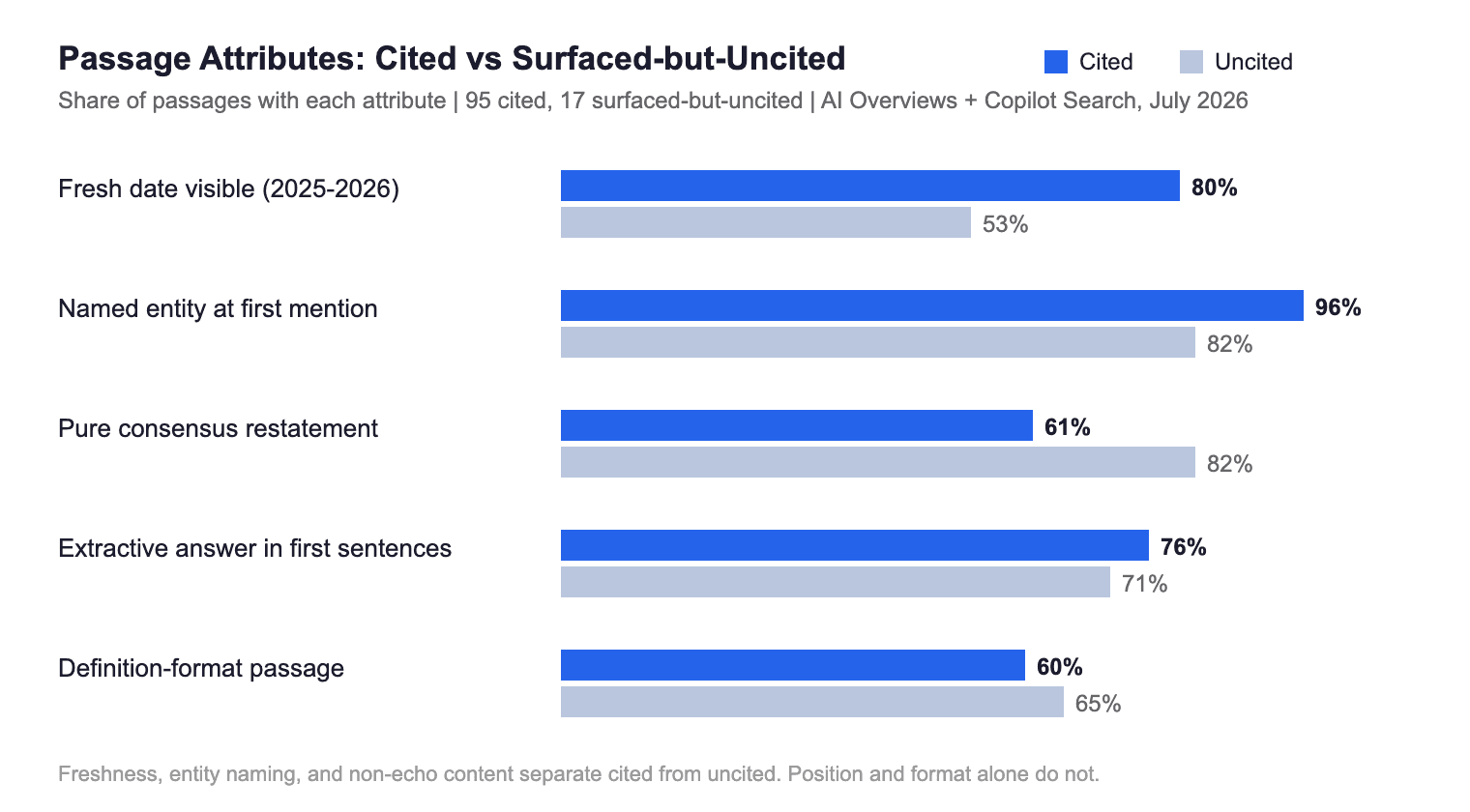
The uncited pages mostly did the on-page work right. They answered early, they used definition format, they were extractable. That is precisely why their content shows up in and around AI answers.
The separation lives in three attributes. Cited passages showed a fresh 2025 or 2026 date 80% of the time; uncited ones, 53%. Cited passages named their entity explicitly at first mention 96% of the time; uncited ones dropped to 82%, and the failures were expensive: Responsify sat on the results page defining topical relevance while the citation went to eight pages that defined topical authority. And uncited passages were pure consensus restatements 82% of the time against 61% for cited ones.
The last row pair is small but telling. Not one uncited passage contained a hard number or a novel claim. Zero of 17. The passages that fed answers without credit were, without exception, interchangeable.
Why These Attributes Win: A Linguist's Read
An AI engine cites a passage when attribution adds information the answer cannot carry alone; it absorbs a passage when the content is fungible.
My background is linguistics before it is SEO, and I trained directly under Koray Tuğberk Gübür, so I read this table as an entity problem, not a formatting problem.
A retrieval system resolves a query to an entity and hunts for passages that specify that entity: attribute by attribute, value by value.
A passage that opens "Topical authority is a site's demonstrated depth on one subject" hands the parser a clean entity-attribute-value triple with the entity named in subject position.
A passage that opens "This concept has become important lately" makes the machine do coreference work, and at 96% versus 82% in my data, machines visibly prefer not to.
The entity mismatch case is sharper still: a passage specifying the wrong neighbor entity, topical relevance for a topical authority query, loses the citation entirely no matter how well it is written.
Freshness works the same way. A visible 2026 date is an attribute value the answer can lean on when consensus shifts. A dateless passage forces the engine to corroborate elsewhere, and the citation follows the corroboration.
Consensus is the subtle one, and it is where my data gives Fiorelli's essay its passage-level confirmation. He argued that pure-consensus content risks being treated as common knowledge, and common knowledge needs no citation.
That is exactly the pattern in my table: 82% of surfaced-but-uncited passages were consensus restatements. The engine already holds the consensus answer in its parameters. Your consensus paragraph does not inform the answer; it merely confirms it, and confirmation gets absorbed.
What earns the link is the thing the model cannot say without you: your number, your named case, your dated claim, your disagreement.
The Absorption Trap
Writing the standard answer in the standard way is now a strategy for feeding AI answers without being named in them.
For a decade, SEO teams optimized toward the consensus answer in extractable format, because that is what won featured snippets.
I have argued in SEO in the age of AI that this optimization target quietly expired; this table is what its expiry looks like in the data. Featured snippets cited by construction: one source, one box, one link. AI answers broke that contract. They synthesize from many sources and attribute selectively, and the selection logic punishes interchangeability.
I want to be precise about what I am not claiming. I am not claiming extraction optimization is dead: 76% of cited passages were extractive, and you still need to be in the candidate set before attribution is even possible. I am claiming extraction gets you used, and only distinctiveness gets you named. Those were the same thing in the featured snippet era. They are different things now.
What I Would Change on a Page Tomorrow
Seven passage-level edits follow directly from the coded data. Each one targets an attribute where cited and uncited passages diverged.
Name the entity in subject position in the first sentence under every heading. Not "this approach," not "it."
Put a visible, honest updated date on the page, and actually refresh the claims behind it.
Add one hard number to your core definition passage, sourced from your own data if you have it.
Add one claim the consensus does not already contain: a measurement, a named case, a documented disagreement.
Check that your passage answers the entity in the query, not a neighboring entity. A topical relevance glossary lost the topical authority citation to exactly that gap.
Keep the extractive structure. It is the entry ticket, just not the prize.
Test your own queries on more than one engine. My data shows the same passage can be quoted on Bing and absorbed on Google the same day.
What This Study Cannot Tell You
This is a directional, single-operator study of 40 prompts on one day, and its absorption calls are inferences. The limitations, stated plainly: N is small. One person coded the passages, so coding bias is possible; the sheet is public so you can re-judge it. Absorption is observed correlation between answer content and uncited pages, not a view inside the pipeline. Engines drift, and a July snapshot is a July snapshot.
My collection ran from a Thailand IP with locale pinned to US English, and AI Overview behavior is region-sensitive. Automated collection failed me twice, once by misreading People Also Ask links as organic results and once by snapshotting pages before the AI Overview finished streaming; every claim here was re-verified against screenshots, and I am publishing both corrections rather than hiding them.
The citation-level findings describe the 13 fully captured answers, and which answers rendered fast enough for full capture was an accident of timing, not a property of the queries. A stability recheck of a 10-prompt subset is the natural follow-up, and a larger-N replication would turn these percentages into something firmer than direction.
None of those caveats touch the core observation, because it does not depend on rates: a page ranking #1 fed an answer without credit while lower-ranked, fresher, more distinctive passages got named. That happened, screenshot attached.
Reproduce It Yourself
The full prompt list, the coding sheet, and every screenshot exist, and the method needs no paid tools. Run the 40 prompts logged out, log every citation, diff the cited set against the organic results you can see, verify against screenshots before trusting any extraction, and code the passages on the same 5 attributes.
Supporting materials & reproduction guide: Access the full prompt list, coding sheets, screenshots, raw materials, and instructions for rerunning the study.
If your rates disagree with mine, publish them. The passage-level layer of AI search needs more data than one operator can produce, and disagreement with a documented method is information gain. The table above tells you exactly what that is worth.

Article by
Bart Magera
Bart Magera is the founder of Mojo Links, a link-building and SEO agency known for delivering high-authority backlinks and innovative SEO strategies. As a Technical SEO expert, Bart specializes in site architecture, indexing, and semantic search - bridging the gap between content, links, and performance to create scalable, data-driven solutions.
With a deep understanding of search intent and user engagement, he takes a holistic approach to SEO, ensuring that technical structure, content impact, and link authority all work in perfect sync to drive organic visibility and conversions.