



How to Do an SEO Competitor Analysis (Step-by-Step Framework)
The benefits of running an SEO competitor analysis are significant, making it an essential step in building a successful search strategy.
By identifying your competitors’ strengths and weaknesses, whether for your own business or a client, you gain valuable insight into what’s actually working in your industry. These insights help shape smarter decisions and steer your SEO strategy in the right direction.
In this guide, I’ll break down the key elements you need to include in your analysis, explaining both why they matter and how to approach them.
But first, what is an SEO competitor analysis?
An SEO competitor analysis or competitor analysis is a foundational step in building a search strategy that identifies your rivals' strengths and weaknesses.
It is a process used to determine who your real search rivals are, how they earn links, and whether they are optimizing for keywords, SERP features, and brand presence in AI-driven results more effectively than you.
Why do competitive analysis?
Because guessing is risky. Competitive analysis helps you answer critical questions like:
Who are my real search competitors?
How are competitors earning authority and building links?
Are they optimizing for important keyword clusters more effectively than I am?
Who truly dominates search visibility across organic results, SERP features, and AI-generated answers?
Instead of relying on assumptions, you step back and look at real data. You see what’s working in your niche, where competitors are gaining attention, and where gaps exist.
It helps you avoid costly trial and error, prioritize smarter actions, and build on proven patterns while still identifying opportunities to do things better.
Competitor analysis is not about copying competitors. It’s about understanding the playing field so you can compete strategically and grow visibility with confidence.
How to conduct a competitor analysis?
So, how do you conduct a competitor analysis? Where should you start? And which SEO competitor analysis tools should you use?
1. Identify the top competitors in your industry
When it comes to finding out which companies truly lead the market in your niche, there are two primary approaches you can take. Both are valuable, and ideally, you should use them together.
A. Manual SERP research
Start by searching for high commercial intent terms related to your products or services. Look at who consistently appears in the top results. This gives you a quick, real-world view of which domains Google considers authoritative and relevant for revenue-driving queries.
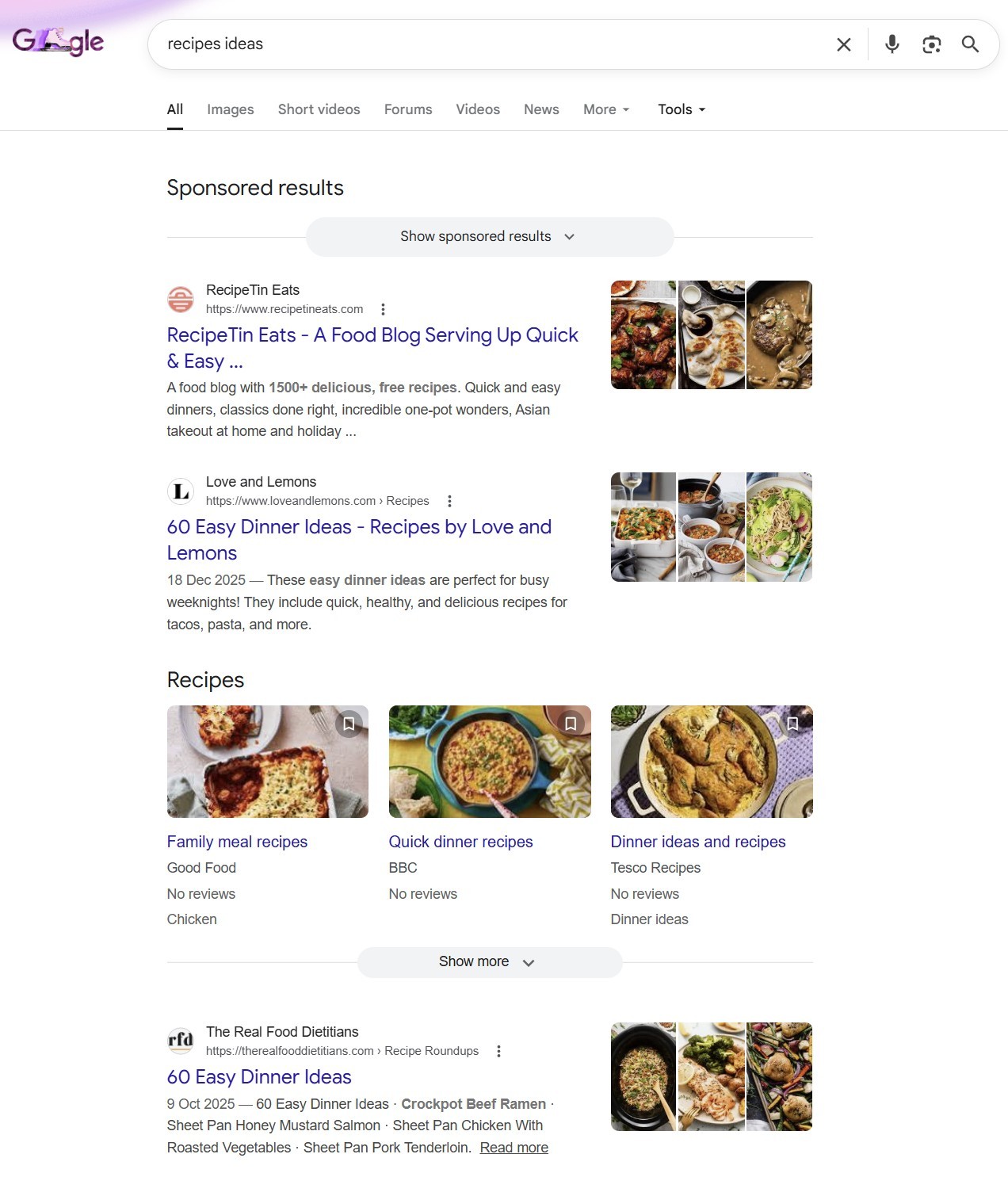
Manual research helps you:
Spot recurring domains
Identify marketplaces or publishers competing with you
Understand how competitors present themselves in search
This method is simple but powerful. It shows you who dominates your most important queries, straight from the source.
If you’re working with a client, this is also a good moment to ask who they consider their competitors. Including familiar brands in your analysis makes your findings easier to communicate and align on. From there, you can refine the list by adding sites with strong keyword overlap and measurable search visibility.
However, manual research only gives you a surface-level view.
That’s where the second approach becomes essential.
B. Using a competitor analysis tool
What tool to use for competitor analysis?
If you’re searching for the best competitor analysis tools, it’s important to understand that there isn’t just one, and there shouldn’t be.
Different tools specialize in different areas of SEO. Some focus on keyword research, others on backlink analysis, SERP tracking, technical performance, or AI-driven visibility.
Because no single platform covers everything equally well, an effective analysis often combines multiple data sources.
In this guide, we’ll focus on Advanced Web Ranking (AWR) and show how you can use it to analyze competitors across keyword visibility, market share, SERP features, link performance, technical benchmarks, and AI brand visibility, all within one structured workflow.
AWR in Action: Who are you really competing with?
AWR’s Competitors view helps you see who you’re actually up against. It’s not just the brands you assume are your competitors, but the sites appearing alongside you on the same SERPs.
Once you enter your domain, AWR automatically pulls in competing websites and shows how their keyword footprint compares to yours.
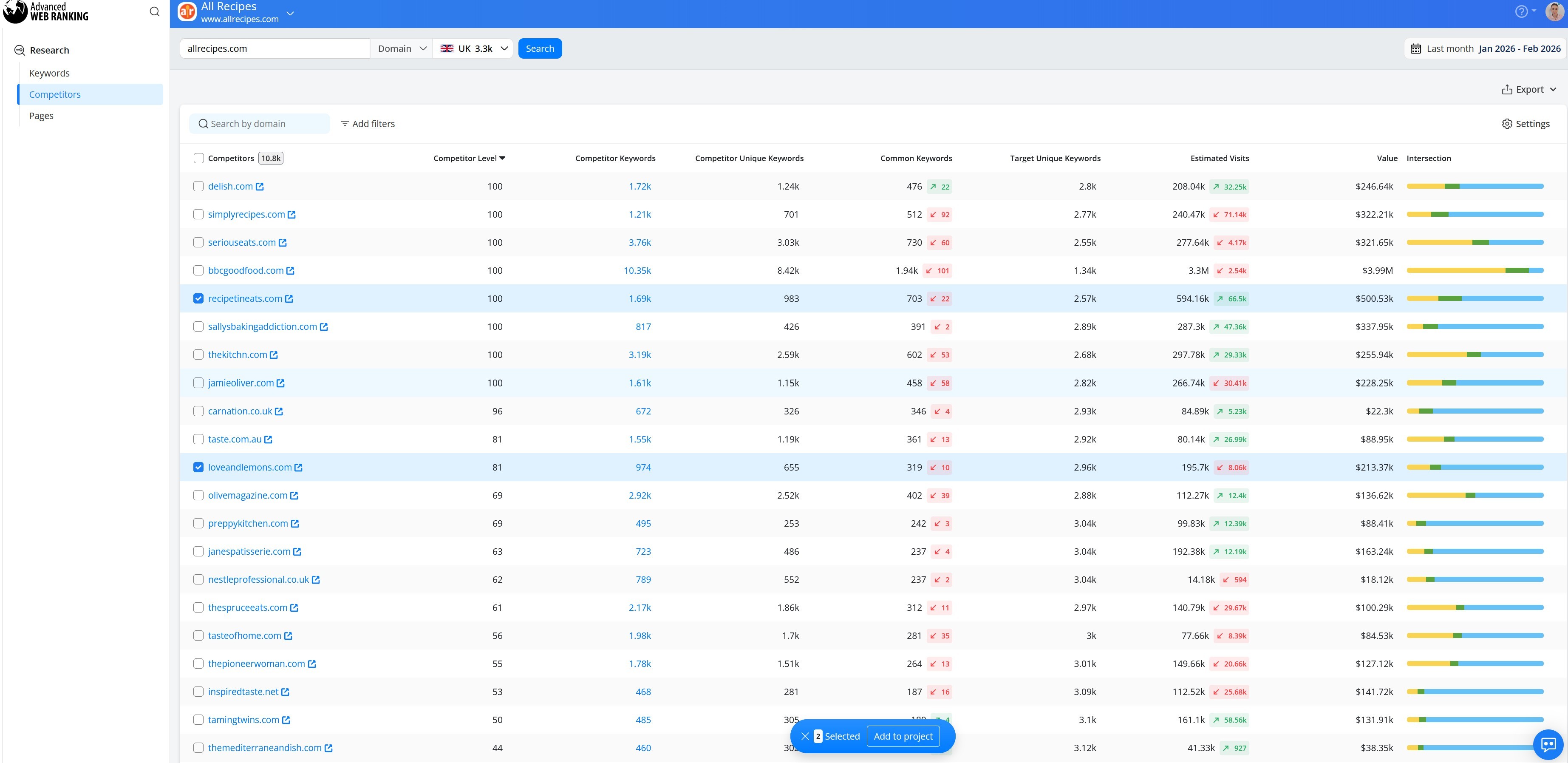
Here you can quickly check:
Who your real search rivals are and how strong their overall visibility is compared to yours.
Where you’re competing head-to-head and where gaps exist, so you can spot content opportunities and overtaking potential.
Where you already have the advantage, helping you protect and strengthen those positions.
Who is likely capturing the largest share of traffic and how valuable that visibility is, giving you a clearer picture of the competitive landscape.
You can also filter the data to focus on the competitors with the biggest overlap or highest traffic and add them straight into your AWR projects to keep tracking their performance alongside yours.
Keep in mind that competitors can change a lot depending on the keyword category and search intent. The biggest differences usually show up when comparing informational keywords to commercial ones.
You can usually categorize competitors based upon whether they are “content competitors” or “commercial competitors.
Content competitors: websites that rank for the same topics but don’t compete with you commercially, such as blogs, publishers, or news sites.
Commercial competitors: businesses offering the same or similar products or services as you.

2. Measure overall market share
With your new list of websites you’re competing against, you’ll want to identify exactly how “competitive” each of those competitors is. The market share analysis gives you a top-level view of who controls the most visibility and how your domain compares.
AWR in Action: See how your competitors are performing
In AWR, the Market Share report has fancy statistics that enable you to see your competitor’s metrics in really granular detail.
A. Evaluate your own search performance
The first thing you will see is a market share overview of you against your competitors.
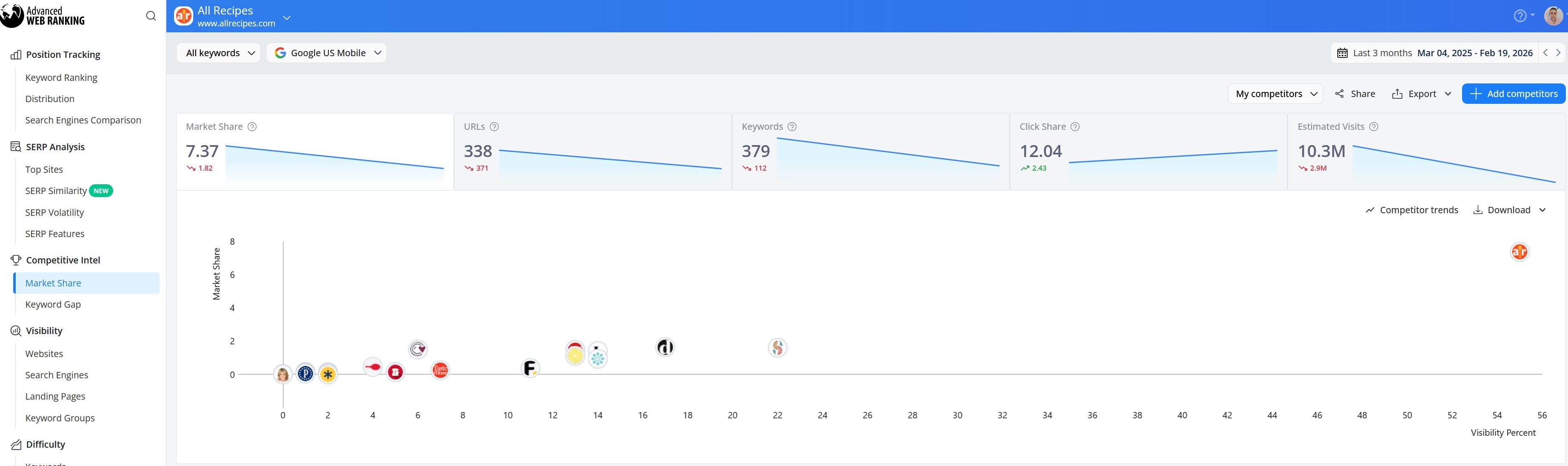
Some metrics in the Market Share report are click share, number of keywords, estimated visits, and visibility to help you:
See how much of the total traffic opportunity you actually own compared to your competitors.
Understand how many of your pages are contributing to visibility, and whether your presence is broad or concentrated.
Get a clear picture of how strong your overall ranking footprint is across your tracked keywords.
Estimate how much of the available organic clicks you’re likely capturing.
Connect your rankings to real traffic potential and business impact.
Get a quick snapshot of how visible your domain is overall in search results.
Want to stop guessing why performance changed? The “Show Google Algo Changes” checkbox in AWR overlays known Google update dates directly onto the Market Share chart.
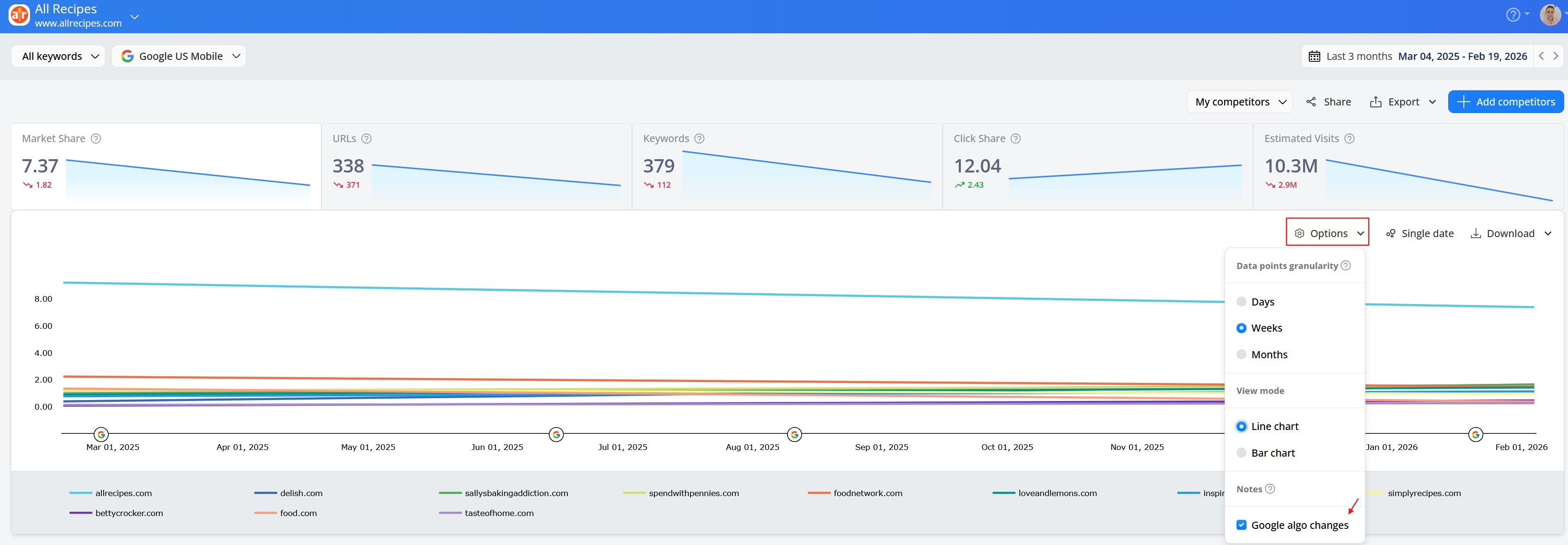
B. Compare market share across competitors
Scroll down to view the table with the same set of data for each of your competitors.
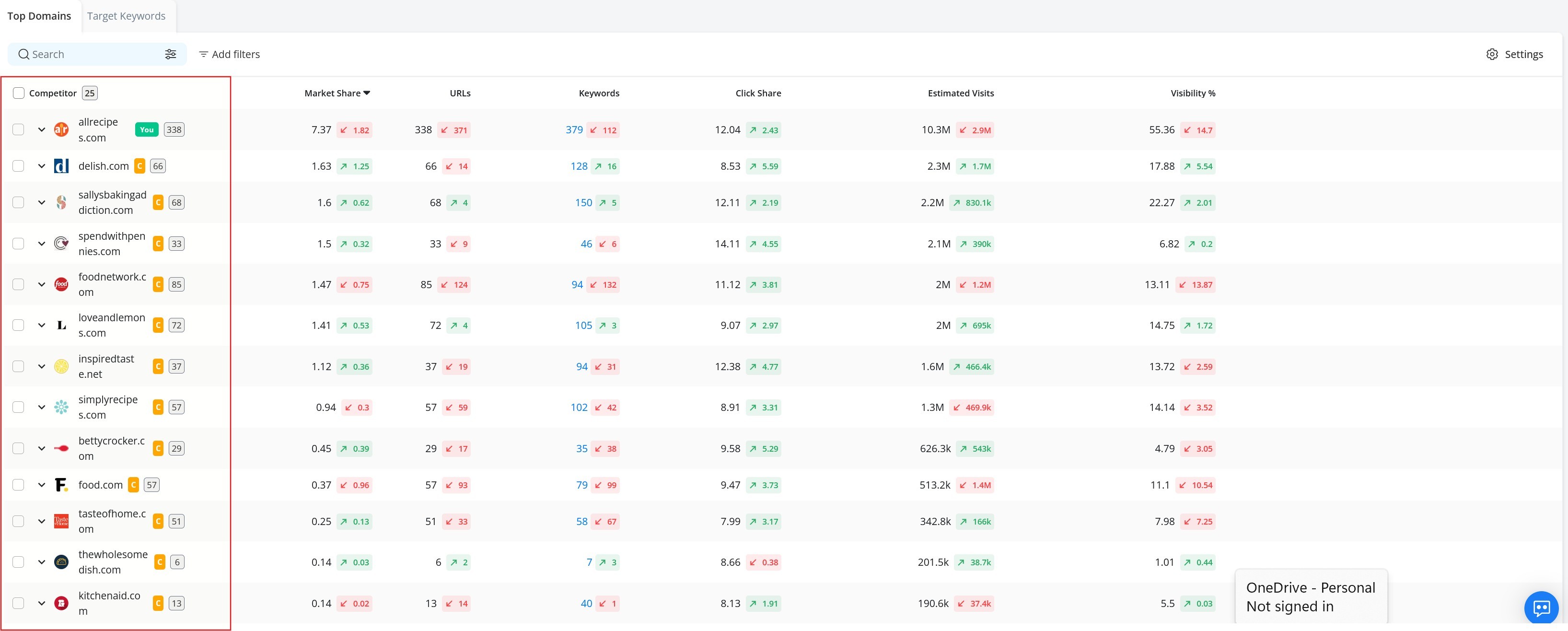
If your project has already been updated several times, then you will also see how these SEO metrics change from one update to another for each website.
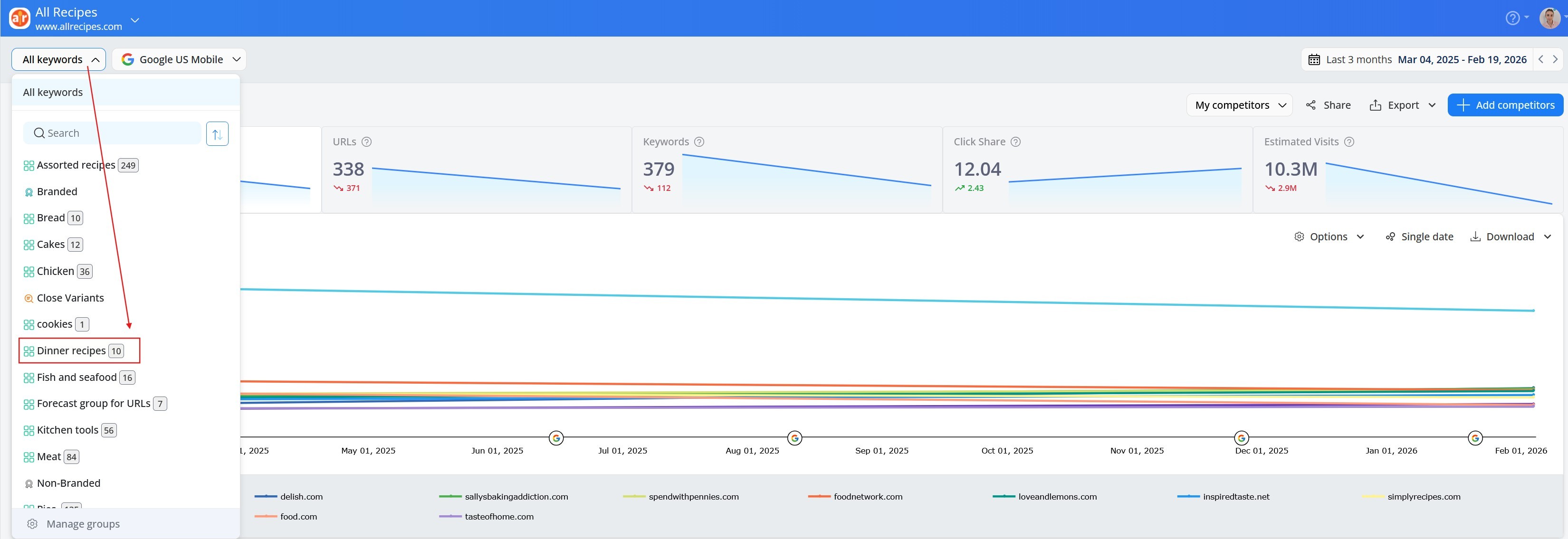
To get deeper insights from the Market Share report, use keyword groups to filter the data. Simply select a specific keyword category to see which competitors perform best in that segment, rather than looking at overall visibility alone.
3. Measure each competitor's keyword performance
After identifying who your competitors are, analyzing their keyword rankings is one of the quickest ways to understand how they’re truly performing in organic search and where the real opportunities lie for you.
It’s especially helpful if you’re:
Entering a new market
Launching a new website with little to no analytics data
Benchmarking yourself against more established competitors
AWR in action: How to analyze a competitor
You can assess a competitor’s performance from two angles: overall keyword visibility and page-level contribution.
A. Analyze overall keyword performance
Use AWR’s Keyword Research to enter a competitor’s domain directly into the Keywords view to uncover their full organic search presence.
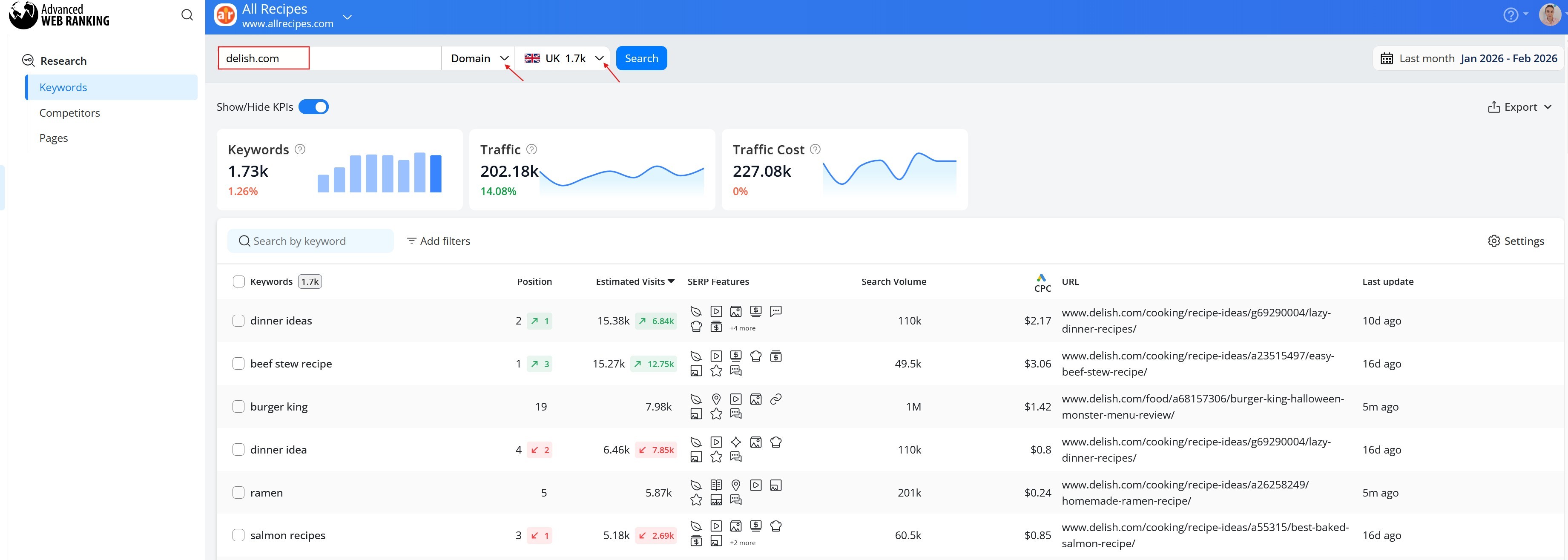
Right at the top, you get a quick snapshot that helps you understand:
How broad their search presence is across the Top 50 results, so you can see the size of their keyword footprint.
How much organic traffic they’re likely generating, giving you a sense of their real search impact.
How commercially valuable that visibility might be, helping you understand what their organic reach would cost if they had to pay for it.
In just a glance, you can tell how big they are in search and how strong their performance really is.

From there, you can dig deeper into detailed keyword-level data to get a clearer picture of how each term is performing.
B. Analyze page-level performance
Once you understand their overall keyword footprint, the next step is to see which pages are driving that visibility.
In the Pages view, you can identify which URLs contribute the most to their organic performance.
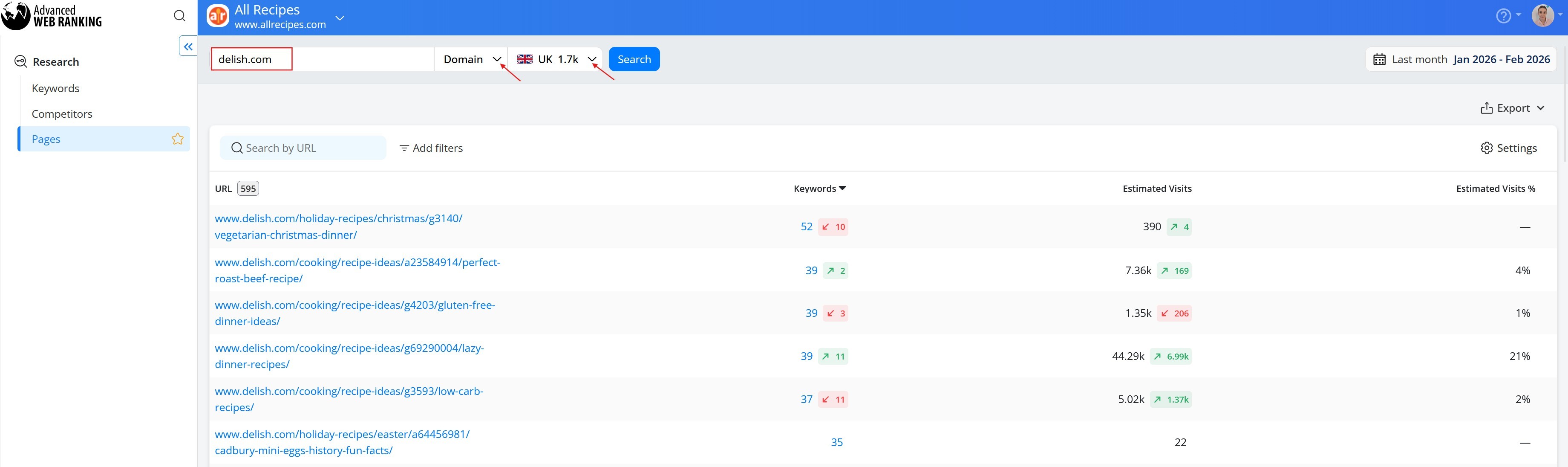
For each page, you’ll see:
Keyword coverage: how many search terms the URL ranks for in the Top 50.
Traffic potential: the estimated monthly organic visits it may generate from Top 20 rankings.
Overall impact: the share of the domain’s total estimated traffic driven by that URL.
You can also:
Switch between countries to analyze performance in specific markets. This is incredibly useful if you’re targeting international audiences or exploring regional growth opportunities.
Break the data down by subdomain, subfolder, or individual URL.
4. Analyze SERP feature dominance
SERP features are critical to your strategy. It’s important when doing your analysis to see what SERP features your competitors are capturing and if there are any trends to show how they’re doing it.
To see the most popular SERP features in your country, you can get this information for free from Advanced Web Ranking’s tool here.
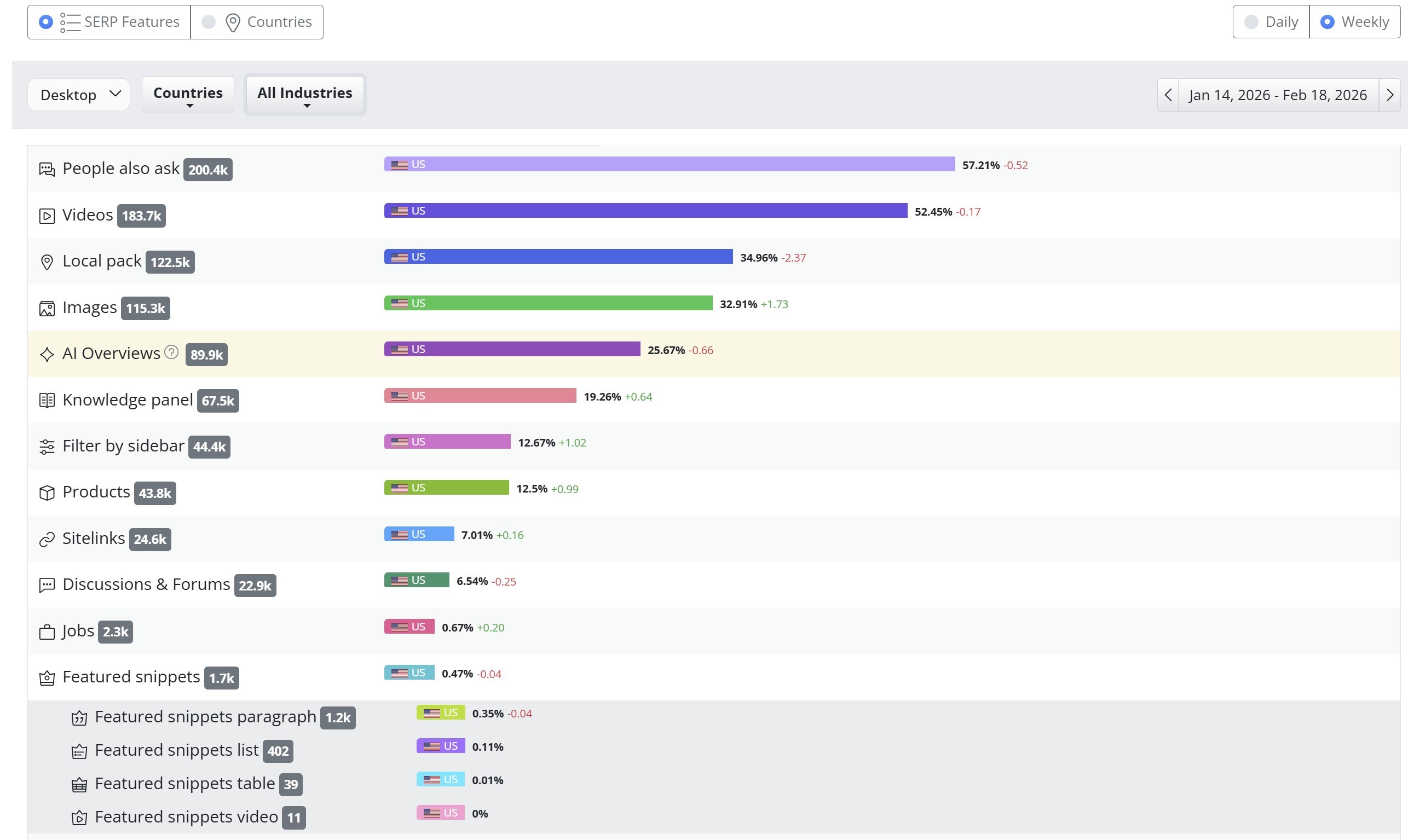
AWR in action: Who owns specific SERP features?
To fully understand SERP dominance, analyze both traditional features and AI Overview visibility.
A. Analyze traditional SERP feature presence
The SERP Features report allows you to get an insight into what types of features are commonly popping up on the SERP alongside which features you and your competitors are capturing.
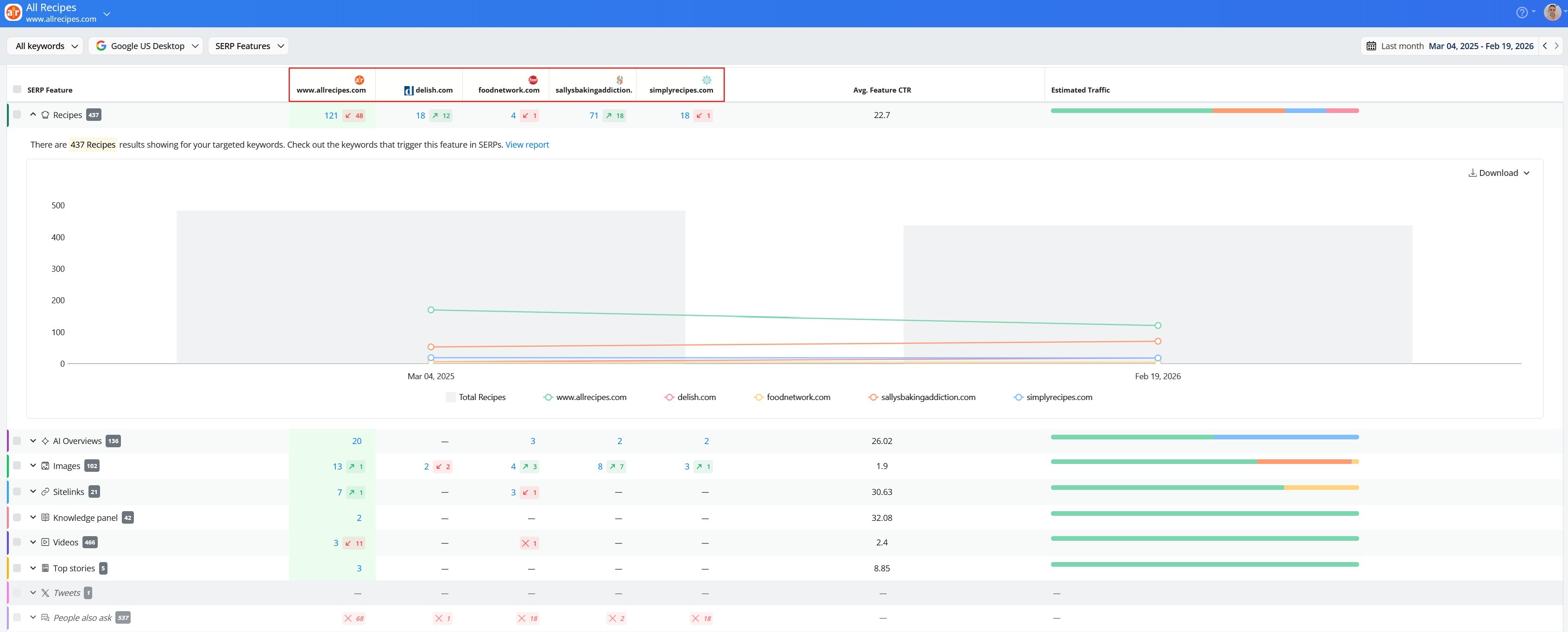
You can compare up to five competitor domains side by side and analyze their presence across specific SERP features like People Also Ask, Images, Videos, Local Pack, and more.
For each feature, you can expand the row to see detailed data, including how that specific SERP feature evolved over time for you and your competitors, from the start to the end of the selected date range.
With this data, you can:
See which SERP features you and your competitors appear in
Understand not just who ranks, but who wins specific SERP features
Spot features where competitors dominate, and you don’t
Identify visibility gaps beyond traditional rankings
Track how feature presence changes over time
Prioritize the content formats that drive the most exposure
If you notice that a particular competitor is ranking for a specific SERP feature, you can do a SERP analysis on some of the keywords they’re capturing snippets for. This should highlight what they are doing to rank for those feature types.
B. Analyze AI Overview visibility separately
As AI Overviews continue taking over prime real estate in the SERPs, tracking them properly is no longer optional.
AWR lets you track AI Overviews using a dedicated search engine built specifically for this feature. Because AI Overviews load dynamically, they require a more advanced tracking method to capture them properly.
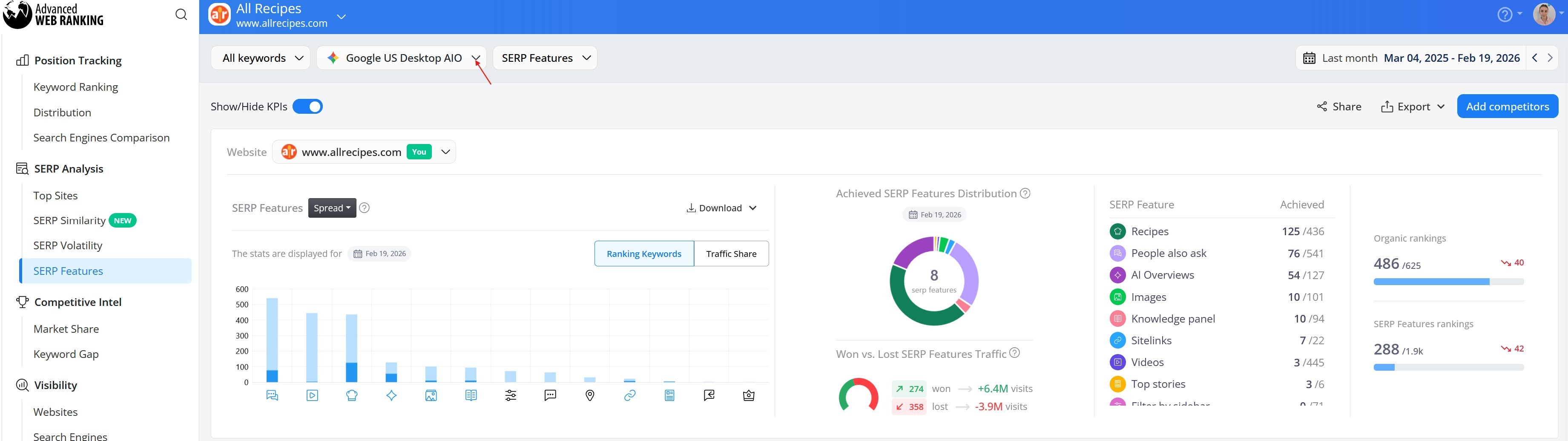
With this setup in place, you’ll be able to:
Detect when an AI Overview is triggered for a tracked keyword
See whether your domain appears as a cited source within the AI Overview
Compare citation presence between you and competitors
Monitor AI Overview appearance across devices (if configured separately)
Track changes in AI Overview presence over time
5. Perform a competitor keyword gap analysis
A keyword gap analysis helps you identify keywords that are driving traffic to other websites but not to yours. This step can uncover valuable opportunities you’re not currently competing for, but others are.
By running a gap analysis, you can discover:
Opportunities to create new categories or service pages
Content ideas to add to your editorial calendar
Potential new product lines to explore with your merchandising team
Identify quick wins in low-ranking positions
Strengthen existing pages by targeting missed keyword variations
Instead of guessing where to expand, a keyword gap analysis gives you a clear, data-driven direction for growth.
AWR in action: Identifying keyword opportunities your competitors are missing
The Keyword Gap report helps you quickly see how your keyword profile compares to up to five competitors. After at least one ranking update, the report begins showing where you overlap and where gaps exist.
You can explore keyword gaps by first seeing how you overlap with competitors and then identifying the keywords you’re missing.
A. See how you overlap with competitors
The visual keyword intersection diagram makes it easy to understand overlap at a glance.
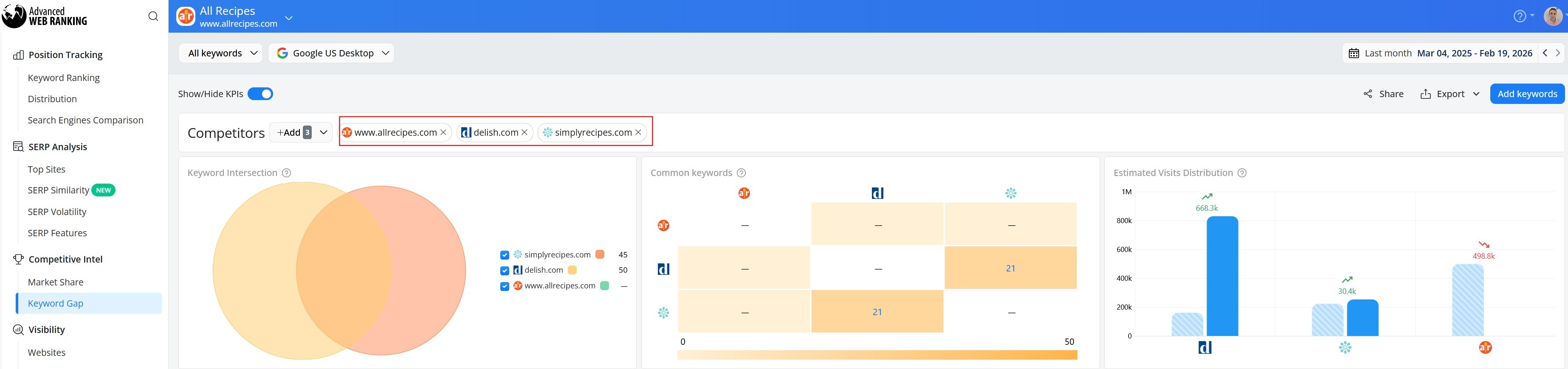
From there, you can:
Which keywords you and your competitors all rank for
How much overlap exists between domains
Which competitors share the strongest similarity with you
How estimated visits are distributed across competitors
B. Identify keyword gaps
Once you understand the overlap, move to the detailed keyword table to uncover specific opportunities.
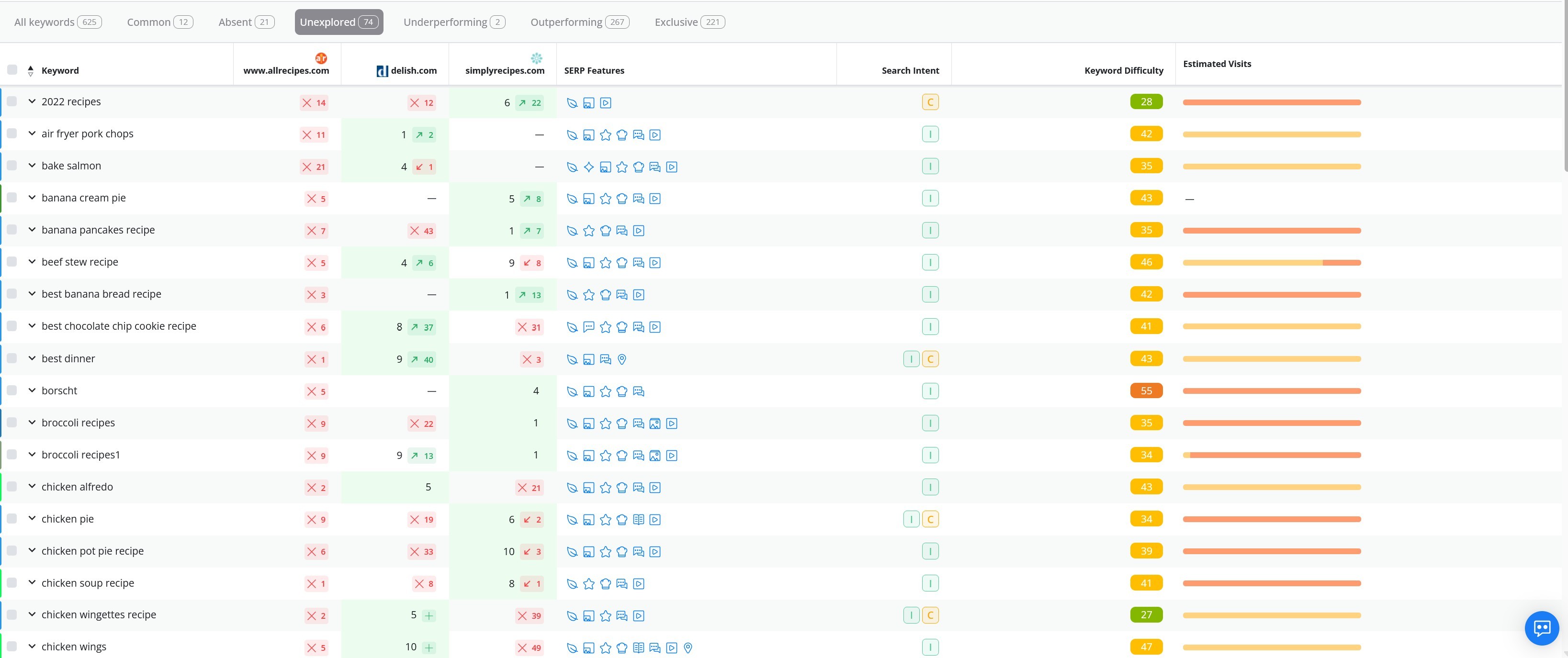
With this view, you can:
Discover keywords competitors rank for that you don’t, revealing clear growth opportunities.
Identify where you’re being outranked and prioritize high-impact improvements.
See where you’re directly competing and where you already have the advantage.
Uncover new opportunities beyond your current targeting strategy.
Because the report includes metrics like search intent, keyword difficulty, estimated visits, and SERP feature presence, you can prioritize opportunities based on impact, effort, and competitive difficulty.

6. Analyze Competitor Link Strength and Strategy
When it comes to links, there are a few common metrics you can look at, depending on the tool you’re using. For example, Moz has Domain Authority (DA), Ahrefs uses Domain Rating (DR), and Majestic provides Trust Flow (TF) and Citation Flow (CF).
These metrics give you a quick sense of how strong a domain’s backlink profile is overall.
There are two main ways to approach this.
A. Measure link authority
You can look at overall link authority to understand the strength of a domain’s backlink profile. This gives you a high-level view of how established and trusted a website might be from a link perspective.
It’s also helpful to look at link acquisition trends over time. Most link tools show whether the number of referring domains is increasing steadily, spiking, or slowing down. This can give you insight into how active link-building efforts are and whether growth is consistent.
B. See how competitors are earning links
Link building isn’t always straightforward. It can be difficult to know where to start.
A good first step is to look at which pages are attracting strong inbound links and understand why. This helps you see what type of content earns links naturally, whether it’s guides, data studies, tools, or product pages.
Several SEO tools provide this insight, allowing you to analyze referring domains, anchor text, and the specific pages receiving links.
Reviewing this data helps you:
uncover patterns,
identify link-worthy content formats,
build a smarter outreach and content strategy moving forward.
7. Evaluate technical performance
It’s always worth taking things a step further and comparing page speed.
We’ve all been there when we’ve had to wait just a couple of seconds for a page to load and we went back and clicked the next relevant link. If your page speed is behind competitors, there’s a good chance this could be happening to you.
On top of that, Google uses page speed as a ranking factor, so having a fast-loading website could give you a small boost in search performance.
A. Compare page speed against competitors
If your competitors’ pages load faster than yours, they may be:
Providing a better user experience
Reducing bounce rates
Supporting higher engagement
Gaining a small technical edge in rankings
On the flip side, if you’re faster, that’s a clear performance advantage you can lean into.
To compare page speed, you can use PageSpeed Insights or Wattspeed.
B. Monitor Performance and Core Web Vitals over time
In Wattspeed, add the URLs or domains you want to monitor, and from there, you can automate tracking by choosing the location, device type, and update frequency. This allows you to consistently measure performance instead of relying on one-off tests.
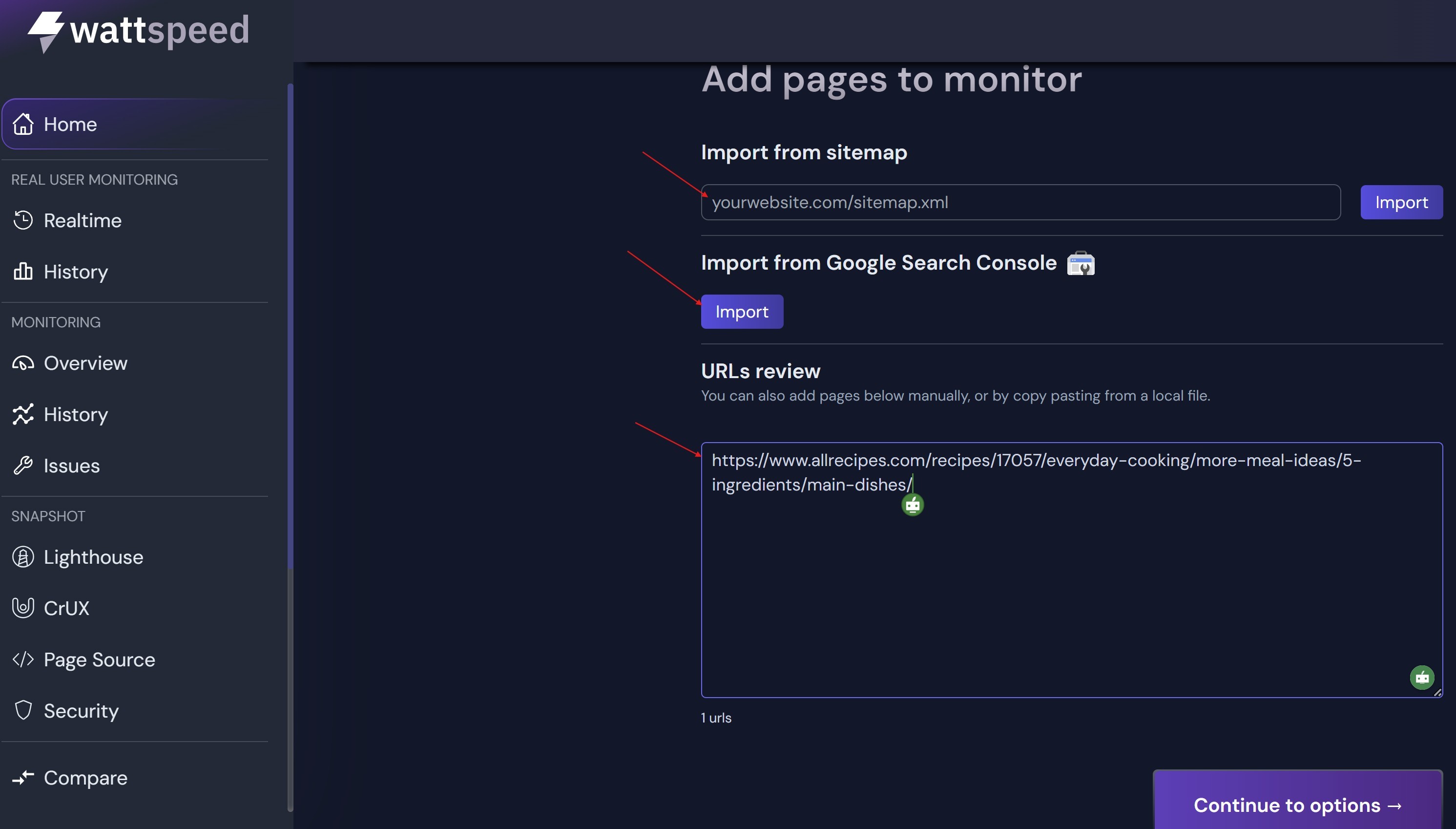
Then, you can:
View overall performance across the tracked domain or specific pages
Analyze speed and Core Web Vitals at both domain and page level
Track historical performance trends over time
Identify technical issues affecting load speed
Compare snapshots from different dates to see improvements or declines
8. Compare performance on high-importance keywords
Once you’ve analyzed competitors at scale, it’s useful to zoom in on a few high-importance terms and apply direct comparisons between your website and theirs.
For these strategic keywords, you can approach the analysis in two ways: visually reviewing the SERP and then quantifying your actual presence.
A. Perform a manual SERP review
Start by conducting a simple SERP analysis for a specific query you want to rank well for.
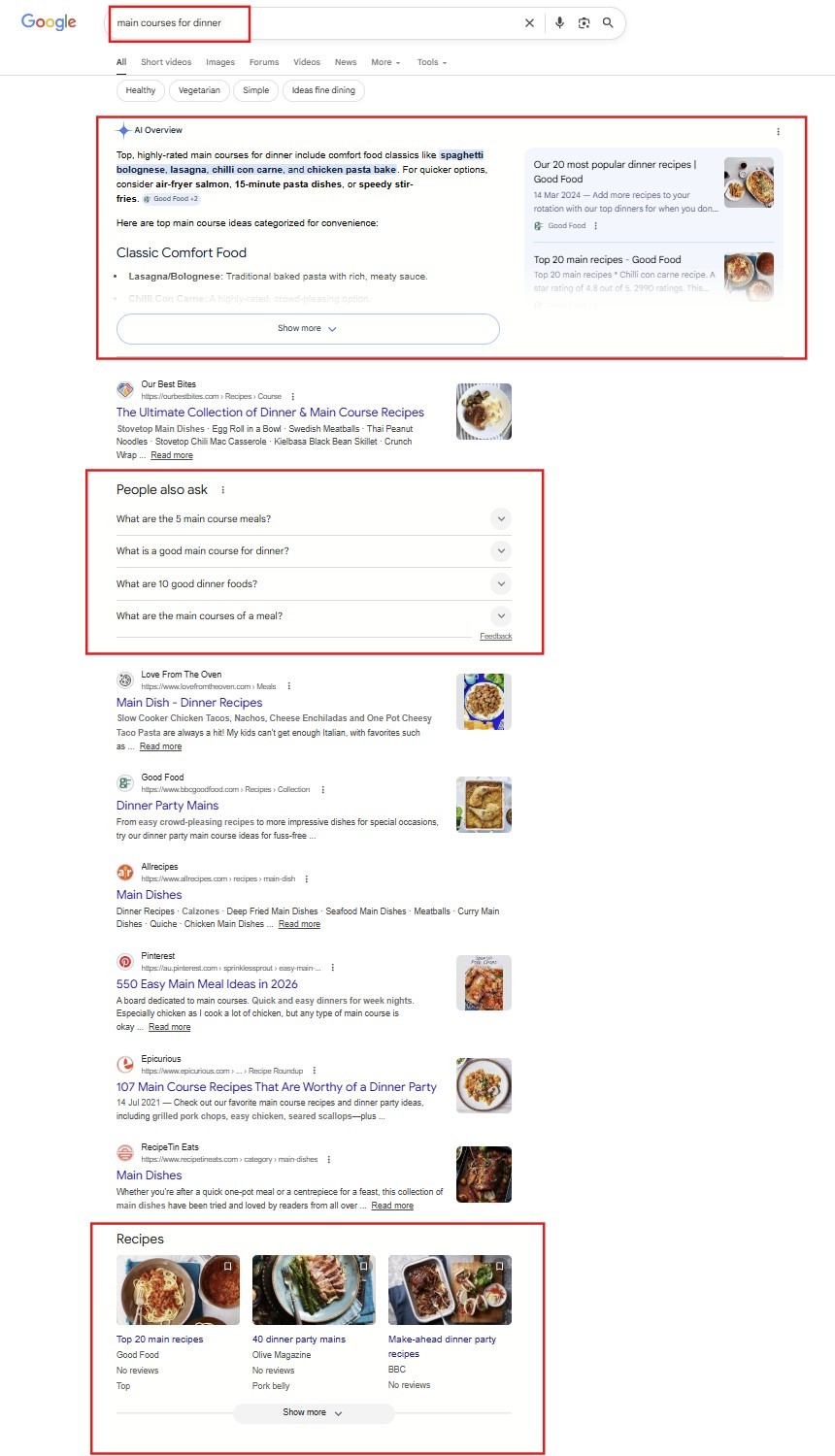
At this point, make some quick notes from what you see, like below:
AI Overviews opportunity
People Also Ask opportunity
Recipes opportunity
Strong use of numbers in titles (e.g., 60, 75, 100 ideas)
High competition (e.g., ourbestbites.com, lovefromtheoven.com)
Brand authority bias (are established brands dominating?)
This manual review helps you understand what Google is rewarding for that specific query. Once you’ve analyzed several pages, you’ll start building a clear list of improvements.
B. Quantify your SERP visibility
After reviewing the SERP visually, take it one step further by measuring how much of that space you actually control.
AWR in Action: Measuring Brand Ownership
This is where AWR’s Brand Ownership metric from the Top Sites report becomes incredibly useful. Instead of just looking at rankings, Brand Ownership tells you what percentage of the SERP space (measured in pixels) your brand occupies for that specific keyword. This makes it perfect for analyzing high-importance terms individually.
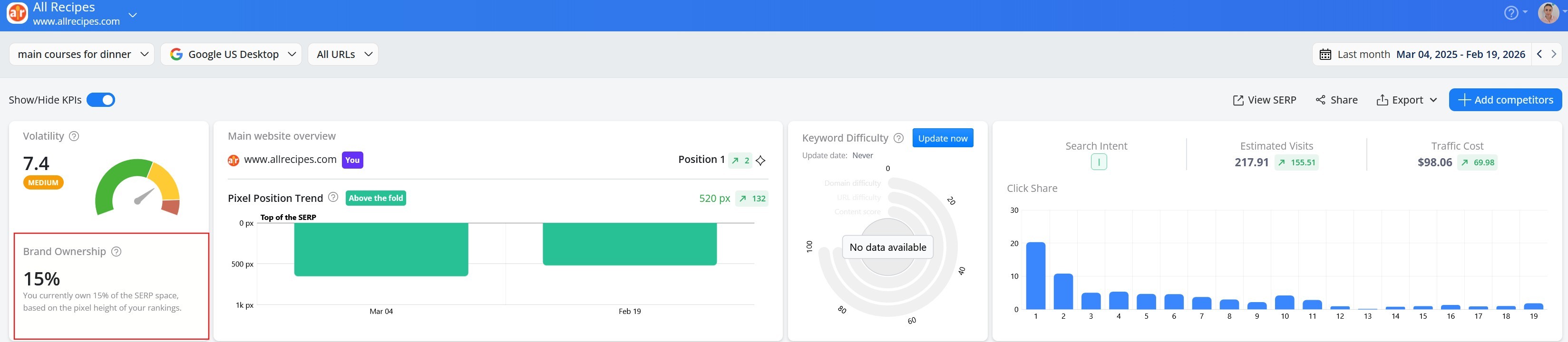
In the results table, you can then compare yourself to competitors by looking at metrics like pixel position, pixel height, and click share.
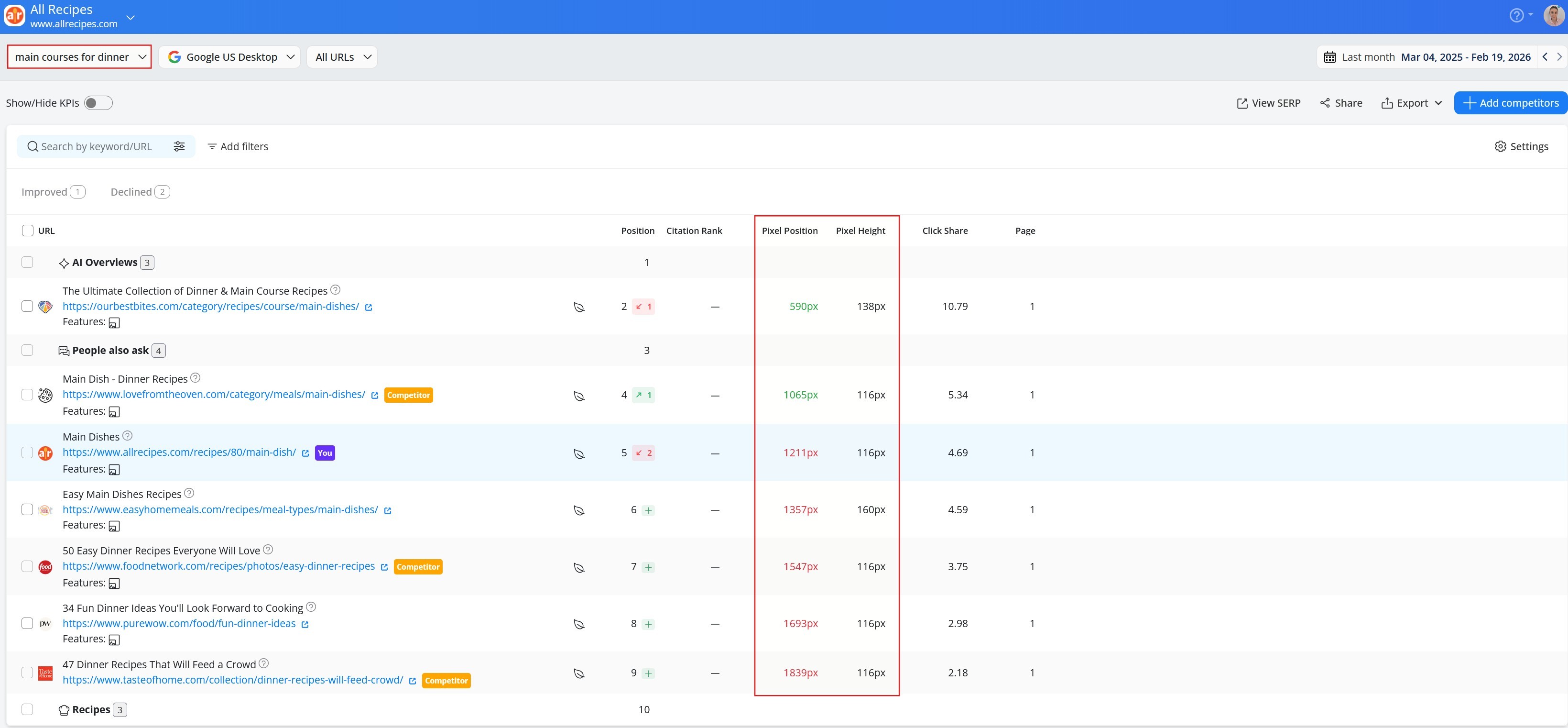
This helps you:
Identify who appears higher on the page
See who appears above the fold
Spot who is taking up more vertical space
Understand whether SERP features are pushing results further down
See who’s most likely capturing user attention
In other words, even if you’re ranking higher than your competitors, they might still dominate the page visually with larger listings or multiple placements.
Next, pick out the top-performing pages and highlight what they’re doing and what you’re not. For example:
Do they have better imagery?
Custom graphics or branded visuals?
Are they covering topics or subtopics you’re missing?
Is there an opportunity for video content?
Are they structuring their content more clearly (categories, jump links, filters)?
Are they using stronger, benefit-driven titles?
Once you’ve done this for a few different pages, you have a list of things you could be doing better.
Another helpful trick (which is quite an old one!) is to review your own content using the 23 questions from Amit Singhal regarding Panda recovery. These were published all the way back in 2011, but going through each of them for your site and your competitors can really help to highlight issues.

9. Analyze Brand Visibility in AI Conversations
AI-driven search engines are no longer just answering questions — they are shaping brand perception. Understanding how your brand appears inside LLM-generated responses is now part of modern competitor research.
AWR in Action: Track AI Brand Visibility in LLMs
The Brands report in the AI Brand Visibility section lets you evaluate competitive brand exposure from two angles: high-level KPIs and detailed brand-level data.
A. Evaluate Brand Visibility KPIs
At the top of the report, you’ll find key metrics such as Market Share, Mentions, and Brand Visibility.
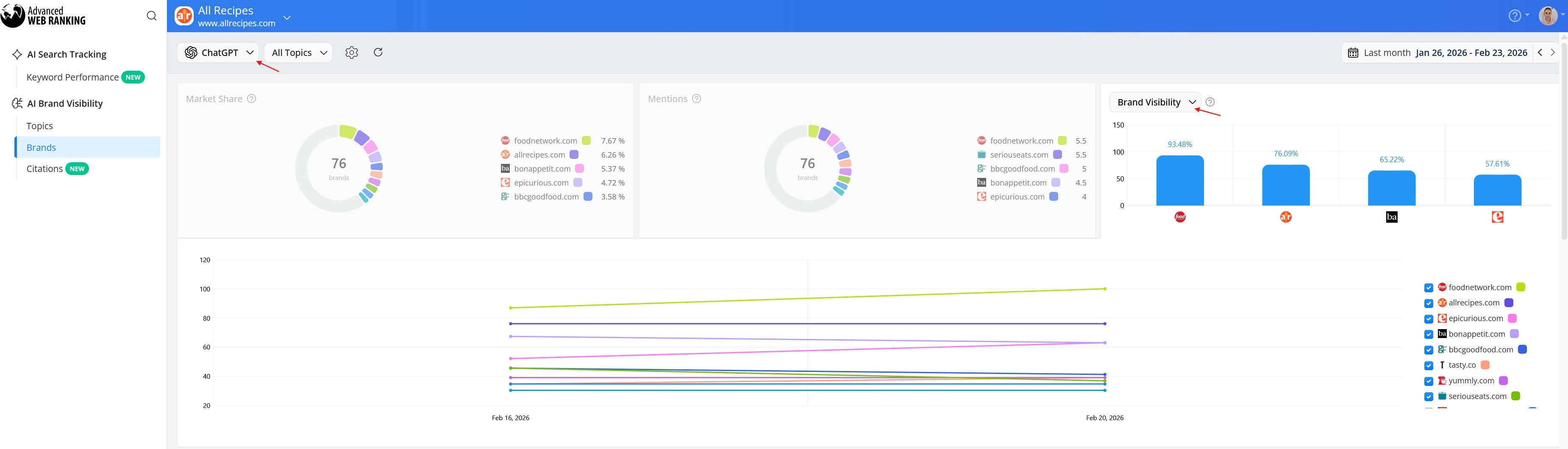
These KPIs help you quickly understand:
which brand captures the largest share of AI visibility, and how your presence compares.
which competitors are mentioned most frequently, and how often your brand appears in AI-generated answers.
not just whether you are part of the conversation, but whether you are leading it.
how consistently strong your positioning is across topics and time.
Each KPI is expandable. Clicking on it opens a chart showing how performance changed across updates, helping you analyze trends over time instead of just a static snapshot.
B. Dive Deeper with the Brand Table View
Below the KPIs, the table expands the analysis to include all brands, not just the top 10.
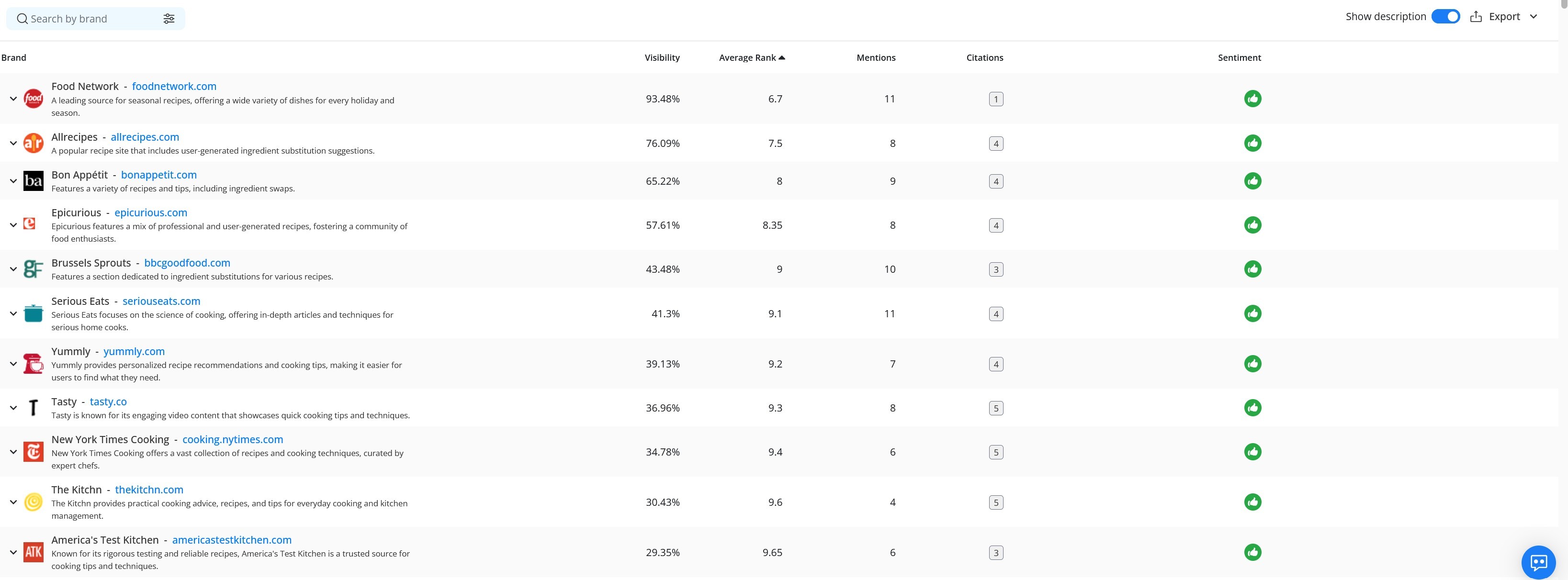
From this view, you can:
See how your visibility compares against every competitor, not just the leaders
Understand your average positioning strength across updates
Measure how often each brand is mentioned within the selected time range
Detect emerging competitors gaining traction
You’ll also find the Sentiment column, showing whether brands are described in positive, neutral, or negative terms.
This adds a crucial qualitative layer to the analysis:
High visibility + positive sentiment = strong AI authority
High visibility + negative sentiment = potential reputation risk
Low visibility + positive sentiment = growth opportunity
10. Build out your strategy
Once you’ve worked through the analysis, you should have a clear picture of who your competitors are and what their strategy looks like.
Now it’s time to turn insight into action.
Whether you’re building a new strategy or refining an existing one, it can help to step back and frame your thinking with a simple SWOT-style review.
Ask yourself:
Where does your competitor currently have an advantage?
What areas do they clearly excel in?
Where are their weaknesses?
Where does your brand have the edge?
Once you’ve answered these, you can start planning your next moves.
That might include:
Creating new content assets
Refreshing or expanding outdated content
Targeting new keyword topics that competitors are owning
Building out stronger category or service pages
Developing a more focused link acquisition or outreach strategy
To Conclude
As you can see, there is so much you can do within a competitor analysis. Taking the time to run through each recommendation is only going to benefit you and put you in a good position to be ahead of the game and reap the rewards.

Article by
Irina Diaconu
I’m a passionate content writer who loves researching and exploring new topics. With a keen eye for detail, I am dedicated to creating well-informed pieces that captivate and inform readers. Sharing knowledge and arousing curiosity is at the heart of my writing journey.

![Branded SEO Guide 2026 [Strategic Edition]](https://framerusercontent.com/images/KxDuiJ90izP5CJpAVcf0sEHLnto.png?width=1920&height=1080)