

Ever since I started AWR, I always wanted to help people with their SEO tasks. But that wasn't always easy, especially since most of our clients are experts in SEO.
Fast forward 20 years later, everything changed with the advent of AI agents. They knew almost everything about SEO, but there was something missing.
It all started when I asked Claude one day why one of my competitors is ranking above us in SERPs. It wasn't the first time I asked AI this question, but this time the answer was prompt and fast:
"I'm sorry, but I cannot answer this question without more data."
What? I was surprised. I sat there and looked at the screen for a few seconds, saying: when did AI become so smart?
Then I asked: what data do you need to answer this question?
And Claude came up with a list of things which I immediately recognized, because that was the exact data we collect every day for our clients in AWR.
I logged in and made a few CSV exports from AWR with the data it asked for and, to my surprise, it came back with the best answer I ever got for this question from an AI.
I was so happy. I finally had something useful. Something that will help anyone that has an online presence answer their most important SEO questions.
That moment stayed with me for weeks. Not because the AI was impressive. By then, we'd all gotten used to AI being impressive. It stayed with me because of what it revealed about the work itself.
Think about what a normal Monday looks like for an SEO. You open your favorite rank tracker. You export the rankings. You export the visibility report. You export the competitor data. You open a spreadsheet. You build a pivot table. You compare this week to last week. You notice a drop. You export more data to figure out why. You build another pivot table. You take a screenshot. You annotate it. You paste it into a deck. You write three paragraphs explaining what the screenshot means. You send it to a client. The client replies: "But why?" And you start over.
This is the grind. Not the strategy work. Not the creative work. Not the part where you actually move the needle for a business. The grind is the assembly, the hours spent gathering, formatting, and stitching data together just to get to the moment where you can finally think.
Every SEO I know has accepted this grind as the price of doing the job. It's just how it works. The data lives in one place, the questions live in your head, and the bridge between them is you, with lots of coffee and a spreadsheet.
But that day with Claude, I realized something obvious. The AI didn't need me to assemble anything. It just needed the data. I was the bottleneck.
So we built AI Insights into AWR. Not as a chatbot bolted onto a dashboard, but as the thing that should have always been there: a way to ask your data a question and get an actual answer back. No exports. No pivot tables. No reformatting. You open a report, you type what you actually want to know, and the answer comes back with charts, KPI cards, and prioritized next steps already attached.
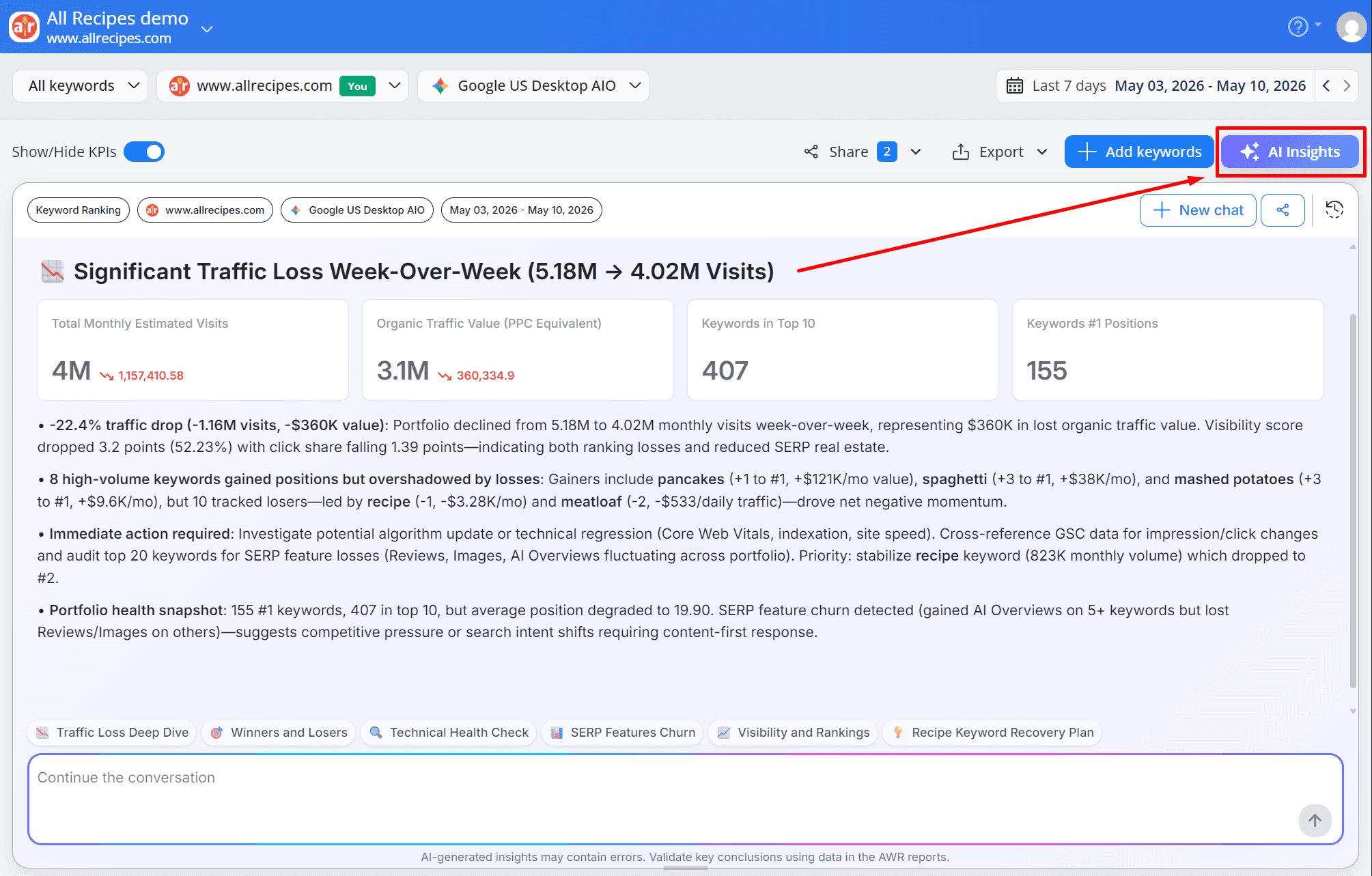
Here's what that looks like in practice. Not as a feature list, but as the questions you've probably been wanting to ask for years, but never had the time to chase.
Why did our rankings drop?
Monday morning. Visibility is down. Your client noticed before you did. In the old workflow, this is half a day of work: exporting rankings, segmenting by keyword group, cross-referencing with SERP feature changes, hunting for the Google algorithm update that might explain it.
Now you ask. AWR’s AI Insights pinpoints which clusters lost ground, quantifies the traffic impact, and tells you whether it was an AI Overview loss, a competitor move, a relevancy issue, or something else entirely. By the time your second coffee is ready, you have the headline, the breakdown, and a recovery plan. The client email writes itself.
Why are we one push away from page one?
You know the answer is in your data. Keywords sitting at position 11, 12, 13. Close enough to feel the heat of page one, far enough to be invisible. You've meant to pull that list for months. You never quite get to it, because pulling it means filtering, sorting, cross-referencing with volume and difficulty, then re-sorting by traffic potential.
Now you ask. AI Insights surfaces the quick wins, grouped by type, with estimated impact and recommended actions. The keywords already trending up. The ones bleeding to a new SERP feature. The ones one nudge from page one. That list you've been promising yourself you'd build? It's already in front of you.
Who's stealing our share of voice?
Competitive benchmarking is one of those tasks that should be weekly and ends up being quarterly, because doing it properly means stacking everyone's visibility curves, calculating share shifts, and translating it into something a client can act on.
Now you ask. AI Insights compares your market share, ranking distribution, and estimated traffic against every competitor you track and tells you who's rising, who's fading, and where the share is moving. Not a chart you have to interpret. Something you can actually use.
Are we showing up when AI answers?
This is the new one. The question that didn't exist a few years ago and now keeps every SEO awake. ChatGPT, Perplexity, Google AI Overviews, they're answering the questions your customers used to type into search bars. Are you in those answers, or are your competitors?
Now you ask. Insights analyzes citation presence, brand mentions, and AI traffic potential across platforms. It shows you the gaps: queries where you rank #1 organically but aren't cited at all, keywords where you dominate one AI engine and are invisible on another, topics where competitors are quietly owning the mindshare. Prioritized by volume. Ready to act on.
Which client needs me most this week?
If you run an agency, this is the question that defines your week and the one you almost never get to answer with data. You eyeball it. You go on instinct. You check whoever shouted loudest in the last meeting.
Now you ask. From the Home view, AI Insights summarizes performance across every project you track. It flags underperformers, surfaces cross-portfolio trends, and tells you where to focus. You walk into your monday standup already knowing which accounts are quietly winning and which ones need you to roll up your sleeves.
MCP Server
And if you'd rather not leave the tool you already think in, like the ChatGPT tab that's always open, or the Claude conversation you've been using to plan your week, we built a second doorway. The AWR MCP Server lets you connect your AWR data directly to ChatGPT, Claude, or any MCP-enabled assistant.
Claude and ChatGPT get access to the same AWR data through the MCP tools. The main difference is the system prompt and the skills that we used to build our agentic AI workflow, the secret sauce.
Your Turn
So here's what I'd ask of you. Pick the question. The one that's been nagging you for months. The one you keep meaning to dig into when things slow down. Except things never slow down. The competitor you can't quite figure out. The drop you never fully explained. The cluster of keywords you suspect is hiding something. The AI search question you've been dreading because you don't know where to start.
Ask it.
The answer has been sitting in your AWR data the whole time. Now it can just talk back.

Article by
Philip Petrescu
Philip is the CEO and Co-Founder of Caphyon, managing the team that is building Advanced Web Ranking since 2003.