

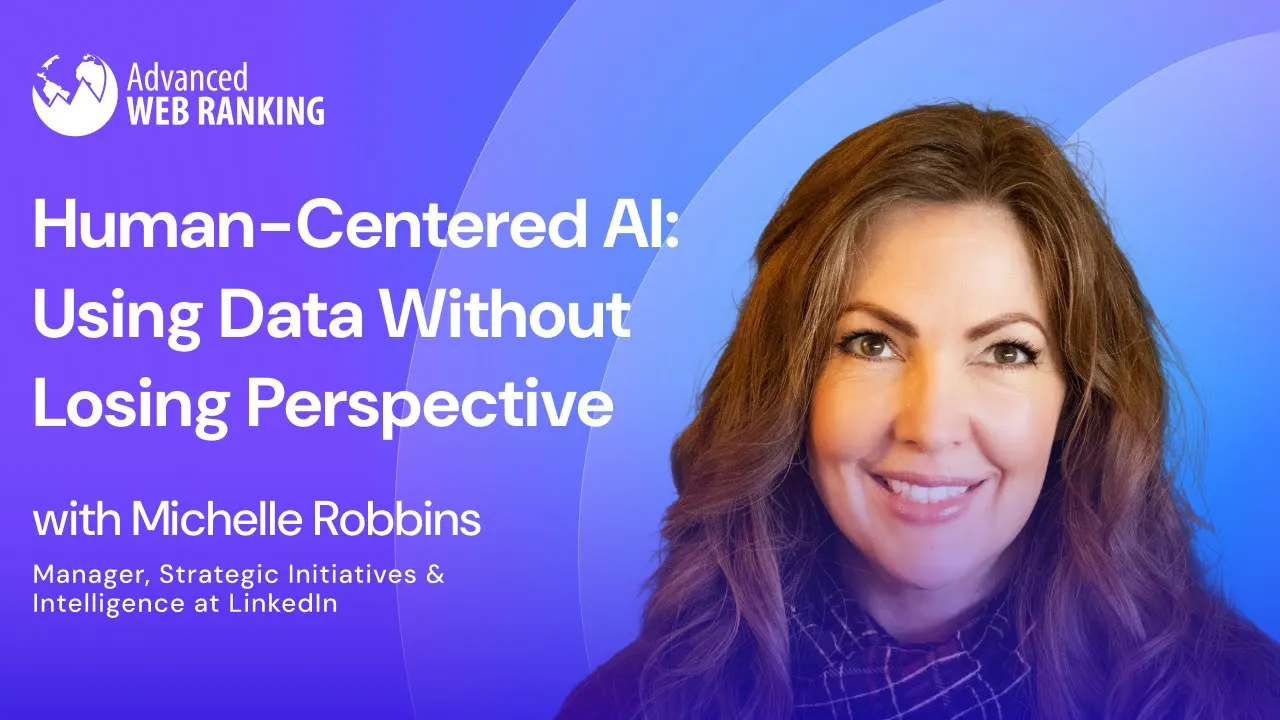
Great to have you back on The Search Session! I’m Gianluca Fiorelli, and in this episode, I’m joined by Michelle Robbins, data, AI, and search strategy expert. We explore how marketing’s core principles haven’t changed, how AI reshapes (but doesn’t replace) them, and why reconnecting with human behavior is now more important than ever.
Here are the main topics we look into:
Brand fundamentals in an AI era: why platforms change but the work of understanding people and building resonance stays the same.
Human insight over tool obsession: how reconnecting with behavior, language, and intent makes AI and SEO strategies far more effective.
Practical AI adoption, not hype: why success depends on defining the real problem, distinguishing generative AI from traditional ML, and fixing data foundations first.
Evolution or revolution depends on data maturity: why AI feels transformative for some companies and simply incremental for those already strong in data.
Choosing the right model for the job: how Michelle evaluates Claude, ChatGPT, Gemini, Copilot, and others based on their specific strengths.
SEOs’ misplaced expectations of Google: why Google’s responsibility is to users—not to send traffic—and how this contrasts with attitudes toward OpenAI.
Why publishers respond differently to LLMs: how business models, audience trust, and past digital disruptions shape strategies like blocking, licensing, or collaborating.
Ethics in artificial intelligence (AI): the challenges and nuances around defining, applying, and enforcing ethical standards in AI development and deployment.
Watch now and join us for a thoughtful, practical conversation!

Michelle Robbins
Manager, Strategic Initiatives & Intelligence—Central Operations at LinkedIn
She is an analyst and engineer with deep experience across data, AI, and operations, Michelle specializes in integrating generative AI and automation into complex go‑to‑market organizations to unlock business value and improve decision‑making.
Before joining LinkedIn, she built her career across both big agencies and smaller consultancies, working on web development, data infrastructure, and engineering for a wide range of companies.
She holds a Master of Science in Business Analytics (MSBA) from the Rady School of Management at UC San Diego and is a frequent industry speaker on the intersection of data, AI, and marketing.
Video Chapters
Transcript
Gianluca Fiorelli: Hi, and welcome back to The Search Session! I'm Gianluca Fiorelli, and today we have a very special guest.
This person—reading from her LinkedIn—holds an MSBA. She served in strategic initiatives in intelligence, AI, and automation. So, she is perfect for our podcast! She’s also a women’s ERG leader, analyst, engineer, board member, and mentor. She's working as a Manager, Strategic Initiatives and Intelligence—Central Operations.
I'm going to ask her precisely what all this big stuff means. Anyway, it's really a big honor for me to have this guest with us today, Michelle Robbins.
Hey Michelle, how are you doing?
Michelle Robbins: I am doing good, Gianluca. How are you?
Gianluca Fiorelli: I’m fine. It's still very warm here in Valencia. I think you are living on the Pacific Coast, right?
Michelle Robbins: Yes, I’m in Los Angeles.
Gianluca Fiorelli: So we have a similar climate.
Michelle Robbins: A little bit. It's starting to pretend to be fall. I think it's starting to get a little gray in the mornings. We've got the overcast coming in from the ocean, so I think it's finally starting to cool down here.
Gianluca Fiorelli: This is the big difference. You have the ocean, and I have the Mediterranean, so it’s even more temperate.
Michelle Robbins: Yes.
Gianluca Fiorelli: So, before, when I was presenting you as Manager, Strategic Initiative and Intelligence, in plain English, what does it mean? What exactly do you do at LinkedIn?
Michelle Robbins: I sit within the broader Central Ops organization, which is part of the Global Business Organization.
What you're probably most familiar with about LinkedIn is the product itself, the flagship product, both consumer-facing and business-facing. Central Ops supports all of our business teams.
So it's the business end of the business, if that makes sense, not the product end. We work across Sales Ops, Go-to-Market Ops, and customer support—all of those types of teams. And we're horizontal across those functions.
The team I work with, in particular, is our AI and automation team. We support efforts to find areas of opportunity where we can streamline processes to make our sales and customer support teams more productive and more efficient and provide better support for all our customers, essentially by automating the work that can be automated.
Gianluca Fiorelli: Okay, cool. I’ll ask you something more specific about that, but first—just to break the ice—in the past years, even before AI was a cool thing to talk about, you were really pointing the finger in that direction. So, how is AI treating you lately?
Michelle Robbins: AI is keeping me extremely busy. I think it’s keeping all of us really busy. And to your point, I’ve been in this space and thinking about it for a very long time.
The first time I ever did a presentation about AI coming into digital marketing and really starting to change things was in 2014, where I talked about the implications of Google’s acquisition of DeepMind and how they were starting to acquire and hire all of the AI and machine learning researchers into that organization.
So it’s something I’ve been tracking and following for over a decade now. And as I’ve done so, my focus is always with an eye toward the implications—not just in how we’re working, but in society more broadly. Understanding how this is going to change consumer behavior and how it's going to change all of our behaviors.
I’ve been less focused—but still very concerned—about the impact on the environment as well. Most of what I focus on is: what are the larger implications of how this changes how we work and how we relate to one another?
Gianluca Fiorelli: Yes, and I remember your talks, specifically that one. I remember it well.
I also remember another one you did. And as our listeners and viewers can tell, you're a really big fan of pop culture—from the Wonder Woman and Superman print behind you.
And one series I remember you like—and this makes you very similar to some other friends I have—is Battlestar Galactica.
Michelle Robbins: Yes.
"All Of This Has Happened Before"
Gianluca Fiorelli: And I remember one presentation that you did where you were using the very famous last phrase of Battlestar Galactica in the final episode. And now, obviously, I don’t remember it literally, but it was something about the returning cycle of history. You were also referring to marketing history in this case.
Michelle Robbins: Yes. “So, all of this happened before. All of it will happen again.”
Gianluca Fiorelli: Exactly. And I think it’s perfect, especially now. Because, for instance, in our little world of SEO—well, we make it big, but it’s still a little world—we’re saying, “clicks are fading,” or “what’s important now is visibility.” And people are starting to rediscover what marketers were doing before search, before click attribution, and so on.
So your phrase from Battlestar Galactica seems very well fitted.
Michelle Robbins: Yes. This has actually been a through line throughout my career in the industry, right? Which, you know, started quite some time ago, kind of aging myself, so I’m not gonna give the year!
But I’ve been around a while in search, digital marketing, and technology in general. My background was engineering and development. So when I joined the search industry at large—via Search Engine Land, Search Marketing Expo, and running all the technology for those properties—what always struck me at our events was when folks would be on stage talking about SEO as if it’s something entirely new, entirely different, and not like anything that’s ever happened before. And marketers wouldn’t understand it. Only this tiny industry understands it. And I’ve always thought that was wrong.
I’ve always believed that building a brand is building a brand. How you acquire an audience will change—as channels change, platforms change, and audience behavior changes—but the fundamentals of how you reach your audience that’s never changed.
And brands were built, you know, for a century before we had the internet. Brands will continue to be built with every new iteration and every new technology change as well, because, again, the fundamentals don’t really change.
So with this shift to AI now, and everybody focusing on how the AI chat interfaces are a completely different thing than SEO—or something new or different—I maintain it’s not. It’s always been about building a brand.
It’s always been about meeting your customers where they are, with a message that will resonate across any platform, any surface. Billboards still work. Commercials still work. Adverts in the Tube still work. You know, it’s just one new channel.
Gianluca Fiorelli: Yes, and I totally agree, also because with my almost 10 years of experience working in television, I’ve always paid attention to how advertising works, especially on TV.
And I think that, for instance, with some specific types of ads, many famous internet company brands, especially in the travel industry. I’m thinking of Booking and Trivago; they were always very smart in buying the space before the weather forecast.
All this kind of big exposure, prime placement for a TV advertisement—because that’s what, at the end of the day, helps you build your brand. Because without doing those kinds of things, Booking would just be an exact match domain, not a brand.
Michelle Robbins: Yes, exactly. And I just think it's about understanding. A lot of it comes down to understanding human behavior and how humans absorb information and where they are versus where you believe they are, right?
I sometimes think that marketers spend a lot of time trying to complicate something that’s not that complicated. They try to say, “No, but this is uniquely different. This is entirely different from this over here.” And it’s like—I don’t see that it is.
A channel, a medium, and a platform are different. But fundamentally, what you’re doing is getting your brand in front of a potential customer. That’s the game, right?
Gianluca Fiorelli: Yes, and I think that sometimes—when you were saying “overcomplicating”—and I don’t want this to sound like a criticism, even of friends who are really deep into this kind of knowledge… Sometimes, for instance—okay, it’s true. We want to understand. We are like little kids sometimes, breaking everything apart to figure out how something works.
But what I fear is that sometimes we spend too much time breaking things and not enough actually playing with them.
Michelle Robbins: Yes.
Soft Skills and Linguistics in the AI Era
Gianluca Fiorelli: So, when you were saying we should start reconnecting and knowing how customers—who are people—think, search, behave, and so on, it’s coming to my mind something that you were also saying, I believe on LinkedIn, about the role of the humanities, the soft skills. But especially maybe “humanities” also in terms of knowledge of something for us.
For instance, let’s say LLMs are really based on natural language processing. But maybe, if you're curious about linguistics in general—how people talk, why people talk the way they do, how different people talk in one situation versus another—then maybe some things that at first seem very complicated start to make more sense. You begin to see: “Okay, these people do this, those people do that,” and it becomes easier to understand.
Michelle Robbins: Yes, you know, over the past couple of decades, everything—with respect to technology—was focused on “Everyone should learn how to code.” “Everyone should be an engineer.” “Everyone should focus over here.”
And what got left behind was focusing on psychology, consumer behavior, and, like you mentioned, linguistics. Which, right now, that’s really the game, right? These chat interfaces are, like you said, based on natural language processing.
So if you’ve spent all your time focusing on the technology—instead of on how users interact with the technology, how users are going to be searching, what their language is, how they behave—even with these chatbots—then you’re already behind.
And this is something I’ve seen across the industry at large. And again, we have the same friends, some incredibly smart people doing incredibly great work—but the emphasis has always been on trying to figure out how Google’s behaving, instead of how your users are behaving, instead of how your users are searching for things.
And that’s a very broad brush, right? People are also focused on that. It’s just that I think what rises to the top in discussions tends to be more about reverse-engineering Google’s algorithm, or something like that, rather than reverse-engineering how you can reach people where they are—what the psychology around user behavior is, and how it differs in context.
So, I guess that’s what I’m seeing. And I think if we take that same approach with the AI tools, then it’s like I said: “All this has happened before. All of it will happen again.”
I see a lot of really smart people focusing on the technology behind the tool instead of, again, thinking about, "How do you build a brand within these tools?"
Gianluca Fiorelli: Yes, and I think also that not having this kind of humanistic knowledge can make it harder to understand.
Because ultimately, what these channels—like Google, like GPT, etc., etc.—want to do, especially now with AI, is mimic how we converse, how we reason, and how we decide something.
So if we know the mechanisms of how humans think and act, we can try to understand the mechanisms these tools are trying to imitate. So we can create something—like, for instance, how to be persuasive to both the final user and the agent that wants to mimic the user.
So it becomes a substrate of knowledge that can reinforce the validity of the technical reverse engineering you're doing.
Michelle Robbins: Yes, I think in a way, the folks in our business, in SEO in particular, are best suited to get the best information out of the models. Because we've spent our careers understanding how to search and how to get the best out of search, right?
And so, really understanding what a really good prompt is becomes a big unlock in your own personal utilization of these tools—and in getting the best information out.
On the other hand, do we believe that consumers at large also behave this way with these machines? I don’t know. Have they figured out how to get the best information out, how to create the best prompts? Or are they more casual about it, sort of like chatting with a friend?
I think we have to understand that these new tools really broaden the aperture of what utilization is going to look like. I think there’s going to be a big difference across demographics, across regions—meaning geographic regions—across intents.
I think, in a way, it makes the job a little bit harder, because the information we were always given from the search engines gave us a lot of insight into what that intent is, what keywords are people coming to, what phrases are being used—things like that. We've had a way to get at that.
I think that's going to be a lot harder to understand with these LLMs. And so, trying to focus on, again, the reverse engineering and figuring that out, instead of focusing on what we can understand about user interaction, instead of focusing on machine learning at this point—and trust me, I’ve studied this, so it's weird for me to say it—but for the application of what marketers are trying to do, I think going back and understanding user behavior, consumer behavior, and psychology is a much better way to spend your time than trying to figure out how to tune a model, for example.
If that’s not what you really need. If what you really need is to acquire customers, then you need to understand how the customers are using these tools—not how the companies are developing them.
Gianluca Fiorelli: Yes, in fact, if I had to suggest one specific field of study right now, it would be sociolinguistics, because it’s the perfect combination of sociology: how people behave, and how people transmit and communicate a need or something.
Michelle Robbins: Yes, absolutely.
Why Data Foundations Matter More Than AI Models
Gianluca Fiorelli: We’ve talked about us as practitioners, but let’s move to the other part. Well, there are three parts: the practitioner, the user, but let’s talk also about the businesses.
So, you were saying that in the work you're doing, you're relating a lot to business companies.
Let’s say, after the first huge hype that maybe it’s still there, about the eruption of AI, what do you see? What are you seeing in how businesses perceive the importance of AI now—about a year, a year and a half, or even two years after it started putting such pressure on them?
Have businesses moved beyond the initial hype and uncertainty around AI toward a more mature, practical understanding of how to integrate it into their workflows—or, as we’re seeing in the news, is there also a sense of disillusionment with its potential?
Michelle Robbins: Yes. So I think it's important to separate out AI from generative AI.
AI in general—just talking about machine learning, algorithms—that’s been in use across businesses for a very long time. They’re not new, right? We’ve had automated processes, RPA (robotic process automation), things along those lines in industry and across businesses for quite a while.
The change is generative AI—and the chatbots—that really focus more on enabling access to knowledge. And that’s a huge unlock, especially across large and complex organizations that have a lot of data, a lot of documentation, for example.
There are a lot of use cases for using a chat interface to access that kind of information. And the critical point, I think, is that so many businesses are like, “What do we do with this? Where do we start?”
Because it does sound like a really big thing to take on—especially if you're focused on, “How do we use this massive LLM?
An analogy I like to use a lot is that you don’t need to take a monster truck to go grocery shopping. So I think it's important to narrow down: what is the problem you're trying to solve, and what is the best tool for that?
And does it need to be something that is LLM-based? Or do you just need to develop, you know, a machine learning algorithm to handle this process and, you know, change a system somewhere?
I think it’s really important to understand the differences in where the levers are—and because of the complexity, as well as the potential risk. Because again, when you throw an LLM into the mix, it's important to know—and this is something I’ve been saying for years—that they’re prediction machines. They're not fact machines.
So, at every output, there's a level of prediction: “This is the best output for this query.” So, you also have to consider: what is the risk of a model outputting incorrect data in this given process? And evaluate that risk against the benefit of including that tool in the process chain.
So I think it takes a lot of evaluation—of risk and reward, the best tool for the job, and understanding: is your enterprise set up, is your business set up to even onboard something like this? Because that requires a lot of really good data foundations. The data is everything here, right?
You can take a model and fine-tune it for your particular data and business use case—but if your data is not well-structured, if it’s not consistent across your organization, this is where things start to get tripped up.
Also, you know, when you talk about knowledge-based data—documents—I don’t know how you are, but I have found, literally throughout my career, that documentation tends to be the last thing created in any given process or project. A lot of times, information lives only in the heads of subject matter experts.
So not only is it a matter of getting that information into a document, but then you have to look at what the structure of your documents is.
And this is something that’s part and parcel to daily life for SEOs, right? Understanding schema and things like that—and the importance of well-structured data and information.
So you can’t just go, “AI is here, and now we’re gonna do AI,” right? There’s a lot of planning, a lot of use case development, and really evaluating: What is the right thing for this given piece that we want to integrate? But I think there’s a lot of value there.
Gianluca Fiorelli: Yes, and I was smiling—and somehow trying to contain my laughter—because I have a personal case where, essentially, the knowledge base was one physical engineer. He was basically the Wikipedia of the company.
My very first three months of work with this client were just me having very long video calls with this engineer, trying to systematize all this knowledge into something usable. I was recording everything—and then, from the recordings, using AI to transcribe what he was saying.
It felt like I was, you know, an anthropologist interviewing someone in Papua New Guinea!
Michelle Robbins: Yes.
Gianluca Fiorelli: It was really incredible—because yes, I think what you were saying is true: the knowledge base is fundamental.
Sometimes, you can find such beautiful, valuable golden nuggets in terms of content that should be on the site, for instance, instead of being buried in a PDF stored in an archive. But also from there—I usually am more of a one-tier person—but now I’m really getting into Knowledge Graph.
Michelle Robbins: Yes.
Gianluca Fiorelli: Because I think, at the end of the day, it’s the best tool—not just for organizing but for enabling everything else. I find it’s maybe the easiest way to start putting a very strong foundation under everything that’s going to be agentic.
Michelle Robbins: Yes, absolutely. That’s the right path. Absolutely. But as you start looking at those knowledge bases and that information, you have to look at the size of the organization. But think about things like acronyms. Acronyms are everywhere, right?
But does that acronym, in a given context, mean something else? In another context, right? Or is it used consistently across an organization?
Imagine someone interacting with a bot, asking about something using an acronym, and then getting served an answer that's completely wrong and unrelated.
And the problem with that is—well, sure, you can ask again and define the acronym, and that’s fine. But the more people interact with tools like that and get wrong information back, the less confident they become that these tools are robust or useful. And that’s unfortunate, because they are useful, right?
It’s just that they output what they're given as input. Obviously, there’s prediction and other things happening at the same time, but it’s usually not that the machines don’t know what they’re doing; it’s that they’re working with what they’ve got, right? It’s the data they’re working with.
And that’s why, if you're going to roll out an AI initiative in your company, the first question is, “What’s the use case? Is it an appropriate use case for AI?” Then the next question has to be, “What does our data look like, and is it ready?” Because probably the largest part of an AI initiative is going to be that foundational building of the data sources and documents.
Gianluca Fiorelli: Yes, and now I’m remembering. I think it was a 2018 talk you gave, and you were already stressing that—it was just about machine learning; not everything was LLMs back then, but the foundation, especially. And you were saying that maybe the most important thing was governance—in the sense that one of the most important roles would’ve been, or would’ve become, the controller of the data. Because if the data is BS, for instance, or is wrong, then everything—no matter how smart and wonderful the AI model you’re using—is still going to be BS or wrong.
Michelle Robbins: Well, and you also have to think about how data changes over time, right? Data drift is a real challenge.
Gianluca Fiorelli: Yes, this is also what I’m stressing about when I’m working with clients, creating knowledge graphs. Because, I mean, the knowledge graph is like a living library. It’s not something you create and forget about. For instance, new products must enter the knowledge graph.
Michelle Robbins: Yes.
Gianluca Fiorelli: New links, because if you include the link graph in the knowledge graph, new links must be added. New ways of referring to your products—or to products in general—by people. You should include them with, you know, all these types: partial match, strong mind-related match, etc., etc. You must make this knowledge graph live. So yes, this is somehow the forgotten part of the big work that must be done.
Michelle Robbins: Yes, it’s the less interesting part, that’s the challenge, right? It’s like, one of my professors in the master’s program I took said, you know, “Everybody wants to do the model. Nobody wants to clean the data.” Because running the model and doing the modeling is the fun part.
But you can’t get there. Like, 80% of the work is actually in the data and the foundations. 20% is in the modeling—picking parameters, tuning things, and experimenting there. But you can’t get to a robust model output if your data foundations are a wreck.
How Michelle Robbins Evaluates AI Models in Real Work
Gianluca Fiorelli: And I have a question that may sound very simple, but I don’t think it is. So, what do you think about AI? Do you think that AI in general, not just in terms of LLMs, but in general, for a business company, or also for us as people, is more of a revolution or an evolution?
Michelle Robbins: I guess it depends on where your business starts with it, right? I think for businesses that have mature processes with their data already—strong data foundations in place, strong governance around data as well as InfoSec—I think for them, it’s an evolution.
But if you’re maybe a smaller business still working from spreadsheets—and even the concept of a data warehouse is foreign to you—then it’s going to be a revolution for you. So, I really do think it just depends on where you’re starting from.
I think the biggest gains that AI is bringing to the market are going to startups—I really do. I think being a startup now, the way you can scale, how fast you can scale operations and put operations in place for your startup, is so much more accelerated now, versus even five years ago.
Just because of the capability of the tools, the capability of what the AI models can enable for you—as well as agents—that’s pretty revolutionary, I think, for startups.
Gianluca Fiorelli: Curiosity—maybe I’m biased because I was documenting myself about what you’ve shared, what we’ve been talking about lately—but I saw that you’ve been sharing a lot, at least recently, about news from Anthropic and Claude. So, is it correct for me to think that Anthropic is your preferred model?
Michelle Robbins: I would say yes—but it also depends, right? I’m gonna say “it depends”—everyone, that’ll resonate.
What I really appreciate about Anthropic is how they’re approaching model development—how they approach model alignment and how seriously they take the safety of the models and what they put out into the world.
So just from an ethical and responsible AI standpoint, the work that Anthropic does really resonates with me.
But I also find that Claude is the best thought partner. I test all of the models all the time. I use Claude, I use ChatGPT, I use Copilot, I use Gemini, and I use Perplexity—I use everything.
And I like to, periodically—if I’m thinking about something or researching something—I’ll use all of them. And I pay for all the models too, so I’m using the pro versions. I’ll give them all the same prompt—not only because I want to see how they approach it and what they return, but I also want to see where there’s agreement across the information delivered.
If it’s something where the subjectivity of the response could be high—meaning I could rely less on it being accurate—then I like to see where there is agreement on something that’s more fact-based than idea-based, right?
But as a kind of thought partner, I just really appreciate—I appreciate the output from Claude. It’s much better as well when doing deep research. I’ve found that when we’re really going deep on a topic, what you get out of Claude tends to be more robust. That’s been my experience, but it could also vary based on what I’m looking at and researching versus what somebody else is.
I think ChatGPT is great, for example, in my work at LinkedIn. I work with a couple of different tiger teams, as well as the Women at ERG—I think you mentioned that at the top. And part of that involves creating a newsletter. Whenever I’m looking at articles I want to summarize or include as a digest in a given newsletter, I find that if I give that to ChatGPT to summarize, it produces a better, more engaging output.
Claude is much more thoughtful—almost like asking a PhD student to do something, versus asking your college dorm radio mate or something. Right? It’s just a different tone that gets output. So, I appreciate them for different things.
And then when it comes to coding, I’ve actually found that using Codex with VS Code has produced better, more optimized code. Using Cursor, or even Copilot, sometimes I find that the code it generates is unnecessarily complex. And so, there’s a lot of back and forth, which then tends to reduce the gains you’d get if you just did it yourself, if that makes sense.
So again, I think they’re all good for a lot of different reasons. As far as image generation—like, I needed to make an avatar of me for something, and I was like, “Here’s me—but Avatar, comic book, Wonder Woman,” right? Like, that kind of thing. And I gave it to Nano Banana—you know, Google’s thing—and it was like, “There you go.” And it was perfect. First time out. Nothing weird-looking—instantly nailed it. So, for that use case, I’d probably use Nano Banana.
So it just depends.
Gianluca Fiorelli: Yes, it depends on the need. You use the model you think is better.
Different LLMs surface different perspectives depending on how they’re trained and what they prioritize.
That doesn’t just apply to research or creative work—it applies to brands, too. Different LLMs may describe your brand in different ways, associate it with different topics, or mention it alongside different competitors.
With Advanced Web Ranking, you can see how LLMs are actually talking about your brand today—what topics they connect it to, the sentiment behind those mentions, and who else shows up in the same conversations.
Try AWR for free and learn how your brand is being represented in AI-generated answers!
The Hard Truth: Google Does Not Owe You Traffic
Gianluca Fiorelli: And talking about this, for instance—but talking more about the companies—it’s more about the strategy, especially the two big companies, Google and OpenAI, are using or have established.
I mean, my perception is that Google is going very, let’s say, granular. So, Gemini is the big one, but then there exist dozens of different types of sub-Gemini, let’s call them so.
The ones that we see for the search—even if for the search itself, there are three different types of Gemini, because one is AI Mode, one is AI Overview, and one is Web Guide.
Michelle Robbins: Yes.
Gianluca Fiorelli: They are not the same one. Then we have the specific Gemini for medical, the specific Gemini for specific niches. So this seems to be the strategy that Google is trying to follow—to push, in order to offer the best solution for specific needs.
Michelle Robbins: Yes.
Gianluca Fiorelli: Instead, OpenAI seems more like the generalist—at least from what it seems to me. So, what do you think is the best way—the best strategic way—for the famous AI world?
Michelle Robbins: Actually, what OpenAI is doing with the release of GPT-5—on the backend—it’s taking the prompt, rewriting it, and then routing it to the correct agent. Routing it to the correct model, if you will, where it can generate the best output.
Also, it kind of goes back to the monster truck analogy, right? Not everything needs to get an output from a big, huge, generalized LLM. If you’ve got a specialized LLM that’s been fine-tuned to produce really efficient code, then routing a code-based question to that model makes the most sense, right? It’s going to be more efficient, and it’s going to have a higher degree of accuracy.
So, they’re also doing that—I just don’t think that’s necessarily transparent to the user.
Gianluca Fiorelli: I see. Yes, I think it’s maybe more about communication—how they communicate things. And yes, as SEOs, we usually tend to be very paranoid about Google.
Michelle Robbins: Yes.
Gianluca Fiorelli: For instance, one thing that sometimes surprises me is how much the SEO world criticizes Google. Before, it was the classic “zero-click”; now, with AI Overviews, it’s “Google is stealing all our traffic.”
And I don’t see the same—let’s say, rage—when talking about OpenAI. For instance, ChatGPT never sent any traffic, actually. But people aren’t angry with ChatGPT; they’re excited to be cited and linked by it.
Michelle Robbins: I think it’s the expectation that’s been set, right? And that’s another thing I’ve always, from the beginning, thought was strange in SEO, that idea that Google owes you traffic.
Google doesn’t owe you traffic. If you don’t want to provide your information to Google, you don’t have to. Recognizing that it’s a valuable traffic stream is one thing, and playing along with them because you’d like that traffic is another—but at the end of the day, they don’t owe anybody traffic.
They owe their users—users of their product—good information. That’s their promise. It has always been: “We will provide you with good information that we have found out in the world.”
When they cease to provide that, they will lose users. And so—that's, you know, that’s the business they're in. They’re not in the business of providing everybody with traffic and making SEOs happy. They're in the business of making their searchers happy.
And that’s just never been something that SEOs have been happy about—especially as search features change and traffic distributions shift.
So I’ve always thought it’s a strange dynamic that was set up. And I wonder if, you know, if they could rewind the clock—would Google still set in motion the relationship with the community that they did by providing a lot of information and providing a lot of answers?
Because, to your point, nobody expects someone from OpenAI to say, “I’m going to tell you how this all works—here’s our manual, here’s...” You know what I mean?
Whereas, there’s definitely that expectation from the reps at Google. And I’ve just always found that odd, you know?
Gianluca Fiorelli: Yes.
Michelle Robbins: Like, you would never expect Ford to tell you how they manufactured the carburetor for your car or whatever. You just get in your car and drive—and you’re happy it works. So I just think it’s strange.
Gianluca Fiorelli: Yes. In fact, I always have this sort of odd sensation. I think maybe the expectation our community—our SEO community—has about Google is that “Google is retaining our traffic,” when actually it’s not. It’s trying to retain its own traffic.
That’s why, for many years now, I’ve always used Google as if it were my best tool for understanding what people search for.
I love SEO tools because they make our lives easier. I mean, we’re hosted by Advanced Web Ranking for this podcast, a wonderful tool. And you recently talked at Spotlight, produced by Semrush, another fantastic tool.
There are a lot of amazing tools out there. But the best tool is Google. And maybe it’s not even Google Search Console—it’s the actual Google Search interface itself.
Just seeing how Google is trying to retain users gives you hints. It shows you the search journey that Google understands people are on or are going to follow. So I think sometimes, okay, yes, blame Google—but also try to use the same, let’s say, weapons that Google is using. Use the same tricks Google is using to make people stay on Google to understand how you need to be visible.
Michelle Robbins: I mean, build a brand, and you don’t have to rely on Google, right?
Gianluca Fiorelli: No, right, right. But I think if you want your brand to be visible in Google and you know that Google is pushing—let’s say—from this type of search to this related search, or to this potential question that “I know you’re asking when you’re searching,” or something like this, so you can map the potential search journey.
So if you map it—not literally—but in terms of how the final micro-moments are included inside Google Search, then you can say, “Okay, where am I failing as a brand to be present?” So you adjust.
Michelle Robbins: Yes, I would agree. I would also say that your best source of data is always going to be first-party data, right? So your log files, your demographic information about your site visitors, and about the people who buy your products. That’s always going to be your very best source of data.
And focusing more on that and what you can understand about your first-party data and then how you can scale that out to other platforms across, not just Google.
If your audience is avid cyclists, right? And let’s say you sell a weird product that you don’t even think of as a cycling product, but it turns out a lot of cyclists buy this product for some strange reason that only cyclists know about—what are you doing to engage that community?
Do you even realize that’s happening? And then are you going to the places where cyclists go? To the forums, to the subreddits, things like that? Are you advertising there? Are you getting your brand in front of people in other avenues, instead of just relying on, you know, kind of a wing and a prayer that Google’s going to provide all the traffic you need?
I think we just have to be a lot more creative than we have been—because I think the distribution of traffic has been changing forever, right? It always changes.
The first big change, I think, was when social hit the scene. And everybody was like, “Oh, now it’s all social media; that’s what we need to focus on.”
And it’s never that you need to focus on one thing—and that’s why it’s hard, right? You have to focus on all the things. Because the reality is customers are everywhere.
Customers are using TikTok, or they’re using Instagram, or they’re not using any of those, and they’re only on Reddit, right? So it’s tricky to understand where your customers are and how you can reach them where they are. And it’s going to be in a lot of places. It’s not just going to be one.
Gianluca Fiorelli: Yes, you have to be ubiquitous, somehow.
Michelle Robbins: Yes, you do. Absolutely.
Publisher Strategies in the AI Era
Gianluca Fiorelli: Yes, and talking about the fading traffic—as recently, in Spotlight, you were on the panel, and you were talking about the, let’s say, love-and-hate relationship that publishers have with AI. Love because AI can actually be helpful in their daily work—but then hate because it’s also a threat.
Especially for publishers who are not in the news space—because, still today, the news category is somewhat protected. Especially Google, but also Bing, is saving their top news blocks from AI, etc., etc.
But publishers that are more like—let’s say, to give a simple example—National Geographic, with its wonderful articles about destinations, or research, or history, etc., etc.—they’re seeing how traffic is somehow being stolen by the instant answers.
Michelle Robbins: Yes.
Gianluca Fiorelli: Coming back home, as you are now, from the event—what did you take away from the panel? What’s the perception you have about the situation? The situation that publishers are in and the different, maybe discordant, views that publishers have about AI?
Michelle Robbins: I think that people have realized the mistake that was made when everything went digital, right? I think especially large publishers learned that, when the web came along, they should’ve been all in from the beginning.
And I feel like a lot of the larger publishers were dragged—kicking and screaming—into being digital and moving away from print, because print was their world. And they lost ground, right? Because then Google became the place where people found their news, instead of going directly to those publishers.
I think they’ve learned from that, and I think they’re all taking different approaches. So, for example, you’ve got the New York Times suing OpenAI and Microsoft because so much of their historical content was used to train the models. I think that’s fair. I think that’s available for any other work that was used to train these models—like books and their authors.
Anthropic is actually settling with authors. If you’ve produced a book in the past number of years, I believe they’ve got a webpage where you can go and—I'm going to say it wrong—you’ll get paid for your work having been used if it was part of the corpus that trained the models.
So I think there are model developers who recognize the debt that is owed to creators. And you see this not only in the news space, but in the creator space of art as well.
I think it’s a really turbulent time to be a creator—producing art or knowledge. And I understand the frustration of the different publishers, and they’re all taking a different approach.
So, the New York Times is suing and blocking. The Economist is not suing, but they are blocking. However, they’re primarily supported by their subscriptions—their really heavy subscription model. So they haven’t noticed an impact with the rollout of all the LLMs because, again, their focus has been on building their brand and a very large subscriber base.
The Financial Times is kind of in the middle. They’ve got a licensing agreement with OpenAI, and they’re working with the other LLMs as well, because they realize that they do depend on showing up as a resource. Just showing up there helps drive subscriptions to their base.
So I think it’s just going to depend on what your business model is. And I think that the publishers that have strong relationships with their subscriber base—or their readership—are going to be in a better position going forward, regardless of whether they choose to block or not block the models from absorbing their content, or if they’re able to come to some sort of licensing agreement.
I just think it’s unrealistic to assume that every publisher on the web is going to have a licensing agreement with all of the LLMs.
Gianluca Fiorelli: Yes, I was thinking about the classic small publisher. I’m not saying the super independent, two-person company publishing, but I’m thinking also about the classic small publisher in a very niche area. Maybe they can have an agreement—because if they’ve been able, over the years, to create and own the space in that niche...
Michelle Robbins: Yes.
Gianluca Fiorelli: ...they could be very interesting, even for the models. Because they have the knowledge. They are the knowledge base for that niche.
Michelle Robbins: Yes, but this gets into: what is your point of differentiation, right? There are a thousand blogs, and there might be ten that actually drive the news and information that the other 990 reproduce.
Gianluca Fiorelli: Exactly.
Michelle Robbins: You know what I mean? So it goes back to the original content, original news.
Gianluca Fiorelli: Yes, the classic test that I also ask my clients to do when they have a blog—for instance, not necessarily because they’re a publisher, but because they’re a brand. Let’s say, in fashion—they have their magazine, because it was clear that, in the past, it was a good way to capture a certain type of inspirational search.
And the classic thing I ask them to do is to go on every browser—especially on mobile—search for something, and then click to open one of these blog posts, but in text-only mode, without all the templates, just reading the main content.
Then I ask them—because usually I send them a screenshot, otherwise they BS me, because they already know what their blog looks like—I send one of theirs and three from competitors, and I ask, "Can you recognize your own content?"
And many, many times, they’re not able to. Even if they’re part of the creative team, they don’t recognize it.
Michelle Robbins: Yes. So, I think the model developers will pay for certain high-quality sources they can trust—sources they know are valid and that bring value to the users of their product. So think of it in terms of partnerships that need to be developed.
It was—it was Gemini, right? It was Google that developed a partnership with Reddit, which was really smart. I don’t know if that’s exclusive—but I think it is. Keep me honest here—which was brilliant on their part.
Gianluca Fiorelli: I think maybe Reddit also had something similar with OpenAI.
Michelle Robbins: Okay.
Gianluca Fiorelli: Then Google did it—and it was stronger. So it’s something that maybe isn’t exclusive, but really, really, really stronger than the OpenAI one. If they ceased the OpenAI one.
Michelle Robbins: Yes, I don’t remember the terms of the deal, but that was really smart. Because Reddit is a thriving platform that is constantly generating new information and new discussions, following the trends, right?
So when you think about data changing over time, think about how language changes over time—what people are talking about and what’s important when, right? And the signals that you can derive from that. So that was just a very, very, very smart deal to make.
I don’t know if there are other communities—for example, all of the big model developers are also focused on healthcare, right? So, where is the best source of healthcare information—of good, valid, scientific healthcare information? I would suspect that deals are being made in those areas as well.
So I think there is a way for people who are providing really good, high-quality information to benefit from what’s happening. But I think you have to be one of those. And I just don’t think there are going to be as many of those as there are publishers of this kind of information.
And it kind of goes to…think about the Helpful Content Update that everybody was extremely unhappy with—just your face there. It begs the question: how many blogs for a given topic are actually required, right?
I always remember—I don’t recall exactly, I think it was at a PubCon or something—Gary Illyes was speaking, and he said, “Boiling an egg—you don’t need 2,000 blog posts on how to boil an egg.”
There are really just a couple of instructions for boiling an egg. You don’t even need to link out to something—because the facts are the facts. Nothing changes about boiling an egg.
And so I think about that kind of content versus something like “Who’s the most popular music artist today?” That’s going to keep changing; you have to keep your eye on it because it’s always evolving. Boiling an egg? That’s sorted.
Gianluca Fiorelli: Yes. And that’s why, for instance, in this case, Claude is very clear. Sometimes I like to ask chatbots, “What are the sources you use for creating this?” Because sometimes I want to have the real sources to avoid the hallucinations. And Claude is very clear in this. He says, “I don’t need any source because it's in my model—because it’s a known fact. So I don’t need to refresh the facts that are known.”
And so, this is something that people in our same industry, in this niche, don’t understand.
Michelle Robbins: Yes.
Gianluca Fiorelli: That’s the big difference—between an answer generated from training data and one from fresh data. Training data is never linking to anything, from my experience; when it’s doing real-time search, then it’s giving you a source.
Michelle Robbins: Yes, if it’s directly known. But I think that’s really important too. People should always be grounding what they ask for with “Give me a source.” Because especially if it’s something where you need to have the right information, having a source and then actually looking at the sources provided, that’s the trick, too, right?
Not just saying, “Give me a source.” Because, as we’ve seen, they can hallucinate sources. And so, I think if you ask for sources, you need to validate those sources.
There are times when I’ve been looking for information or asked a question and asked for sources, and I look at them like—this is where having brand authority actually really does matter.
I see the sources that are returned, and if I’m asking something that’s, you know, relatively newsworthy, and they’re all things I’ve never heard of—new sources I’ve never heard of—I ditch out. It’s like, “Nope, I’m gonna go to Google.”
Because if I want valid sources, you know, Google’s not gonna hallucinate a list of 10 links.
More episodes on how publishers and news sites are adapting to the AI-driven search landscape:
The Complexity of AI Ethics
Gianluca Fiorelli: Yes. Just a last question about AI. We just touched on this topic very briefly before: the need for strong ethics in all this work.
Because if there’s not—I mean, we’re used to the jokes about AI ruling the world—but if we don’t put the ethics in, then at the end of the day, anything can be good if you don’t add an ethical layer to everything we’re doing, especially in the field of AI.
Where do you think there is lacking ethics in the AI industry?
Michelle Robbins: That’s a tough question. Because ethics, in getting to establishing ethical guidelines, it’s a really hard thing to do. Ethics are contextual, right? In one scenario, this might be the ethical thing to do. In another, that might be the ethical thing to do.
And ethics can also be contextual by culture, right? For certain cultures, doing this thing is perfectly acceptable. In other cultures, it’s completely unacceptable, right? And so you have to think about the context and how the context may change based on those kinds of things when you're thinking about applying really strict guidelines and rules.
So I think it’s a very big challenge to say that it’s entirely ethical or entirely unethical to produce this information in response to a query. And, you know, politics gets in the way a lot as well. When you think about the kinds of information and output that a large portion of a population might agree is not okay, but you might have a minority of the population thinking that's perfectly okay—it’s censorship if you don’t. Do you know what I mean?
Gianluca Fiorelli: Yes.
Michelle Robbins: I think this is going to be an area that the model developers continue to struggle with—continue to iterate upon. And again, all of that layering on the ethics and layering on the alignment happens after the model’s trained, right?
So once a model’s trained, it’ll answer anything. It’ll give you any answer, give you any information—like, “You want to know how to build a bomb? Here you go. Go build this bomb.”
Then, in the tuning and the post‑training—tuning and alignment—is where the really big problems are, right? The ones where, like, we can all agree: we don’t want people knowing how to make bombs, or we don’t want people knowing how to make viruses that could kill a population.
So it’s getting at those things first, right? Getting at the harm reduction.
But I think that agreement on what is contextually and culturally ethical—I think that’s much farther down the line and much harder to get to.
So I think the most we can hope for are safe and harmless models. And then, when you start talking about ethics—that’s almost like, you know, talking about religion in a way, right?
Gianluca Fiorelli: Yes, it’s something like this.
Michelle Robbins: Now, I think you can talk about the ethical use of AI. But when you talk about getting, you know, ethical replies out of an AI—that’s two different things.
Gianluca Fiorelli: Yes.
Michelle Robbins: The ethical application of AI—I think there's a lot of really important work around that. I think when you talk about facial recognition, when you talk about using AI in credit scoring and hiring and things like that. I think there—that’s really important work and really important discussions to have. Because again, the harm is coming from the application of the AI, not from the AI itself.
Gianluca Fiorelli: Yes, like in Blade Runner, where the problem is not the machine but how the machine is used.
Michelle Robbins: Exactly, yes.
Michelle Robbins — Life, Books, and Beliefs
Gianluca Fiorelli: And talking about science fiction, let’s close the chapter on AI, search, and everything like that. Let’s talk about you.
You are a big lover—we see DC beside you, and we talked about Battlestar Galactica. But what I remember is that you’re a really huge fan of Star Trek, right?
So, if you could—for some strange reason—disappear from your house and appear in the Star Trek universe. What character would you like to be in that universe?
Michelle Robbins: Oh, gosh. I have honestly never thought, “I’d be that character,” right? I’ve always thought more like, “Which ship would I want to serve on,” right? “Which crew would I want to be a part of?”...then which character.
Oh, Lower Decks is so much fun. Lower Decks is a lot of fun, actually. I could be her. I would only serve under Picard, because I think you’d get killed on any other ship. So I think your likelihood of survival—and ethical choices being made—is higher on Picard’s Enterprise than on any of the other captains’ Enterprises. So I would go with being part of Picard’s crew, in whatever role. Probably Troi. Um, probably Troi. But, I don’t know, they’re all a lot of fun. It’s hard to choose one.
Gianluca Fiorelli: And talking about science fiction, because I see a lot of references to comics, to series, to movies. What about books?
Michelle Robbins: Oh gosh—books. That’s interesting. If I had to pick a favorite fiction book, it would be To Kill a Mockingbird, for sure. But mostly, I read nonfiction. I am, unfortunately, a nerd that way. I read a lot of cognitive science. I keep up on cognitive science, ethics research, and issues around the implications and applications of technology to society. So, I approach everything from a sociotechnical lens, and all of my reading tends to support that.
There were a couple of years where all I read was textbooks—when I was doing my master’s program. It was a lot of coding and machine learning and books around that. So I didn’t have a lot of time for other things. But those are the kinds of books I tend to read regularly.
I’m reading a lot recently about the impact of big tech overall—on society and what we’re seeing. A really good book that I would suggest for everyone—I think it’s Nexus by Yuval Harari.
I think that would help set a lot of people up for understanding the moment we’re in. And I appreciate the historical lens he gives to technological revolutions, especially around knowledge.
Gianluca Fiorelli: Yes, I like it too. And the very last question. Are you more about your brain or your gut? What does your gut tell you is going to be the next thing people should pay attention to in our field?
Michelle Robbins: That is very difficult. So, in our field, do you mean in the field of, like, digital marketing?
Gianluca Fiorelli: Digital marketing.
Michelle Robbins: Oh, I think that's going back to basics. I think really understanding that traditional marketing still works. And the more you can learn about that… I would highly suggest that people also understand paid advertising. I know that’s an anathema to SEOs sometimes, but I think that if your job is to build an audience and customers for your clients, then you would be remiss not to be investigating all of the channels that are available.
And stop focusing so much on Google. Diversify that pie. I think, gosh, was it like 2013? I think I did a presentation where I said, “If your brand is relying 70% on Google and 30% on Facebook for all of your traffic, you don’t actually have a brand.”
You need to diversify that pie so that if something changes on one of those platforms, you're not heavily impacted. And I think what we've seen—historically, throughout our industry—is the over-reliance on a single channel. So I would suggest that everyone stop and focus on the wider distribution.
Because again—I don’t know anybody who lives on Google, except SEOs. That’s the only place they care about. People in the real world—you know, start talking to normies. Start talking to people who don’t live in the world we live in.
Gianluca Fiorelli: Yes.
Michelle Robbins: Find out where they get their information from—and how you can be in front of those people, in those other spaces.
Gianluca Fiorelli:Okay. Thank you, Michelle. It was a wonderful conversation.
Michelle Robbins: Thank you so much for having me, and it was so good to see you again. It’s been too long.
Gianluca Fiorelli: Yes, and let’s promise—make a promise to ourselves: let’s meet in the future, maybe have a new conversation, and see what happened in the middle.
Michelle Robbins: I’d love that.
Gianluca Fiorelli: Okay. Thank you. And thanks to all of you. Remember—this is my, let’s say, creator moment: ring the bell to always be notified about new episodes, and help us grow by subscribing to our channel. Thank you, and bye-bye.

Podcast Host
Gianluca Fiorelli
With almost 20 years of experience in web marketing, Gianluca Fiorelli is a Strategic and International SEO Consultant who helps businesses improve their visibility and performance on organic search. Gianluca collaborated with clients from various industries and regions, such as Glassdoor, Idealista, Rastreator.com, Outsystems, Chess.com, SIXT Ride, Vegetables by Bayer, Visit California, Gamepix, James Edition and many others.
A very active member of the SEO community, Gianluca daily shares his insights and best practices on SEO, content, Search marketing strategy and the evolution of Search on social media channels such as X, Bluesky and LinkedIn and through the blog on his website: IloveSEO.net.