

As SEO teams scale, the limitations of their tools become harder to ignore. Choosing the right SEO platform becomes less about feature checklists and more about how well the tool scales with the agency’s workflows, reporting demands, and client expectations.
This comparison isn’t about which tool is better. It’s about which one is right for you.
SE Ranking and Advanced Web Ranking are often treated as competitors, but in practice they address different layers of the SEO workflow.
SE Ranking positions itself as an all-in-one SEO suite. It covers the essentials—rank tracking, site audits, backlink analysis, and content marketing—while extending its capabilities through paid add-ons such as Agency Pack, AI Search, Local Marketing, and API access.
Advanced Web Ranking focuses narrowly—and deeply—on rank tracking and SERP intelligence. It provides pixel-level tracking, detailed SERP features, AI-driven visibility metrics, and competitive intelligence. Every plan includes unlimited projects, users, and reports, making it easier to scale without reworking internal processes.
In this guide, we compare SE Ranking and Advanced Web Ranking across the factors that matter most to SEO teams. By the end, you’ll have a clear view of which tool—or combination of tools—can deliver dependable, actionable insights you can build on with confidence.
TL;DR
SE Ranking and AWR are not direct substitutes — they solve different problems.
SE Ranking
Broad SEO toolkit (audits, backlinks, content, local SEO)
Good value for freelancers and small teams
Feature access and scalability depend heavily on paid add-ons
Rank tracking and SERP insights are position-based, not pixel-based
Search engine coverage is limited to Google, Bing, Yahoo & YouTube
Advanced Web Ranking
Purpose-built for rank accuracy, SERP intelligence, and scale
Unlimited projects, users, and white-label reports on every plan
Pixel-level SERP analysis, AI visibility tracking, and forecasting included
4,000+ global and regional search engines covered
Pricing scales only by keyword volume — no hidden caps
Bottom Line:
Use SE Ranking for content marketing, backlink monitoring, and site audits.
Choose Advanced Web Ranking for high-precision rank tracking, SERP and AI visibility analysis, forecasting, advanced reporting, and scalable agency workflows.
Who This Comparison Is For
SEO agencies managing dozens (or hundreds) of client accounts
In-house teams tracking large keyword sets across markets and locations
Enterprise SEOs who depend on accurate, repeatable reporting
Data-driven teams integrating SEO data into BI tools and dashboards
AWR vs SE Ranking: Quick Comparison
Before diving deeper, here’s a quick comparison table showing how Advanced Web Ranking and SE Ranking stack up across key performance parameters.
Scalability & Pricing
Feature | AWR | SE Ranking |
|---|---|---|
Projects | Unlimited across all plans | 30 (Pro), Unlimited (Business) |
Users | Unlimited across all plans | 3 (Pro), 5 (Business); $20/extra user |
Reports | Unlimited manual & scheduled reports | Unlimited manual; scheduled capped (20–50) unless add-on ($50/mo) |
Pricing Model | Scales by keywords tracked | Tiered by projects, users & features; Paid add-ons |
API Access | Full, no credits | Limited or paid ($149/mo) |
Rank Tracking
Feature | AWR | SE Ranking |
|---|---|---|
Keyword Limit | Scalable (1K → 40K+ daily) | 500–15K daily, depending on plan |
Update Frequency | On-demand, daily, weekly, monthly | Daily or on-demand through API |
Search Engines | 4,000+ (Google, Bing, Amazon, Baidu, Naver, YouTube, and more) | Google, Bing, Yahoo & YouTube |
Targets per Project | Unlimited search engines | Up to 100 targets |
Geo Targeting | GPS, ZIP, city, region, country | 1–3 locations per project |
AI Search & LLM Visibility
Feature | AWR | SE Ranking |
|---|---|---|
AI Search Tracking | Visibility in LLMs and Google’s AI Mode and AI Overviews | 50 prompts (Pro), 100 (Business); up to 1K with paid add-on ($89–$345/mo) |
AI Search Insights | Brand topic associations, AI snippets, KPIs | Limited unless upgraded ($89–$345/mo add-on) |
MCP Server | Full access included | Limited or paid ($149/mo) |
Competitive Intelligence & SERP Analysis
Feature | AWR | SE Ranking |
|---|---|---|
Competitor tracking | 50 competitors | 20 competitors |
SERP Analysis | Pixel-level visibility, click share, volatility & similarity | Basic rank position only |
SERP Change Detection | Advanced volatility & layout tracking | Not available |
Competitive Metrics | Share of voice, visibility curves, overlap | Basic comparisons |
Scalability & Pricing
Not every platform scales the same way. Advanced Web Ranking takes a more open-ended approach to scalability, whereas SE Ranking structures growth around defined plan tiers.
Below is a side-by-side look at how the two platforms compare across the key scalability pillars: projects, users, reports, keywords, and pricing.
Projects
As your client base grows, so does the number of websites, campaigns, and markets you need to manage.
Advanced Web Ranking includes unlimited projects on every plan, allowing teams to:
Onboard new clients without triggering an immediate upgrade
Experiment with new campaign structures or strategies freely
Expand into new regions or markets without worrying about project limitations
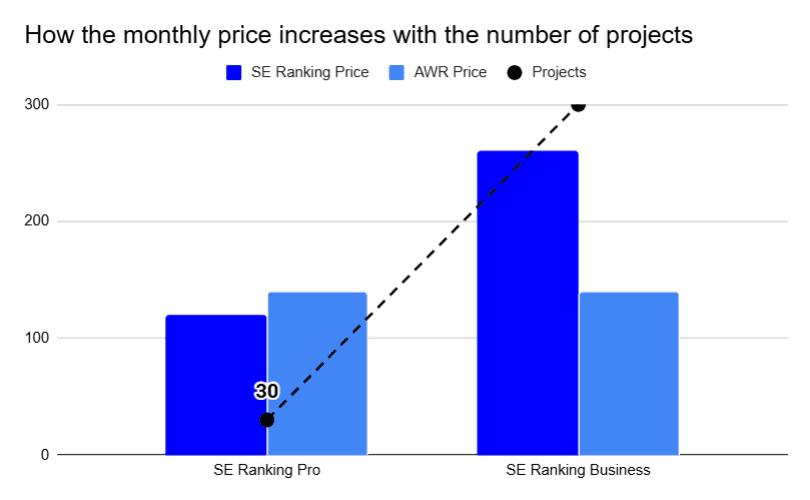
SE Ranking, by contrast, links project capacity to plan tiers. The Pro plan supports up to 30 projects, while unlimited projects are available only on the Business plan.
This setup works for freelancers and small teams, but it quickly becomes restrictive for agencies managing accounts or anticipating growth. Many often upgrade to avoid hitting ceilings, not to gain new value.
Users
Collaboration is often essential—especially for agencies working across teams, departments, or regions.
Advanced Web Ranking keeps teamwork simple by including unlimited users on all plans. Whether your team has five members or fifty, everyone can:
Log in securely and access shared dashboards.
Create and distribute client-ready reports without worrying about seat limits.
Work together across campaigns, departments, and regions without surprise costs.
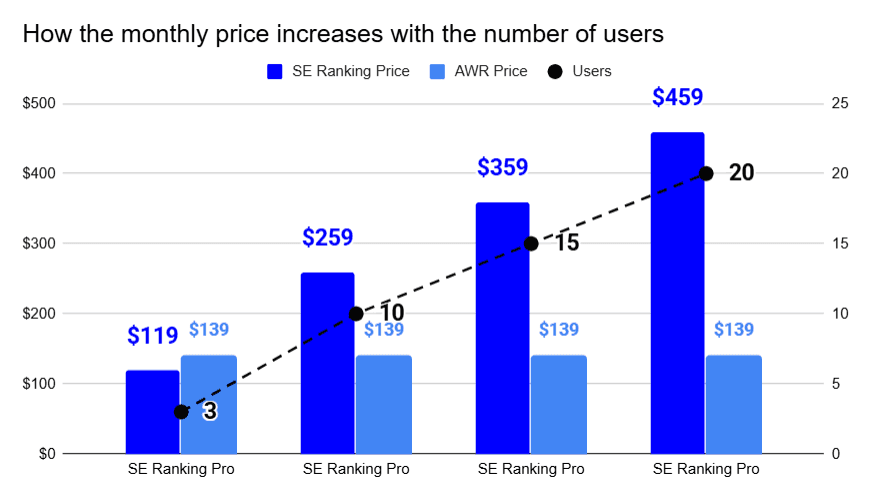
SE Ranking, on the other hand, limits user access by plan. The Pro plan includes 3 users, while the Business plan allows up to 5. Additional users are available at $20 per seat per month.
This can be manageable for lean teams, but costs can rise quickly as agencies scale collaboration across larger teams, sometimes outpacing increases in data usage itself.
Reporting
Reporting plays a central role in demonstrating value, guiding strategy, and justifying budgets. The right setup can significantly reduce manual effort.
Advanced Web Ranking treats reporting as a core feature. All plans include:
Unlimited scheduled reports
Full white-labeling (logo, colors, custom domain)
Automated delivery on daily, weekly, or monthly schedules
With AWR, teams can:
✓ Export or share reports via PDF, CSV, or live links
✓ Build custom dashboards aligned to client KPIs
✓ Deliver reports via email, URL, Google Drive, or FTP
✓ Integrate data from GA4, Search Console, or Looker Studio
SE Ranking, offers solid reporting capabilities but applies tighter limits. The Pro plan allows 20 scheduled reports per month, and the Business plan allows 50. Unlimited scheduling and full white-label features require either the Agency Pack add-on ($50/month) or a higher-tier plan.
For agencies with lighter reporting needs, these limits may be sufficient. For those managing frequent, automated client reporting at scale, they introduce additional planning—or added cost.
Keywords
AWR gives teams flexibility over both the volume of keywords tracked and how often they’re updated—daily, weekly, or entirely on demand. Rankings can be refreshed at any time, with updates typically completing in under an hour.
AWR also stands out for its unmatched coverage. It tracks keywords across more than 4,000 search engines, including Google, YouTube, Amazon, Baidu, and Naver, as well as emerging AI-driven platforms like Perplexity and ChatGPT.
Location targeting is equally flexible, scaling from street-level, ZIP code, or GPS tracking all the way up to global coverage across 190 countries.
SE Ranking, by comparison, covers the fundamentals of keyword tracking but with far tighter limits. Its coverage is restricted to Google, Bing, Yahoo, and YouTube, and each project is capped at 100 search engine targets.
Local tracking is also more constrained, with just one location included on the Pro plan and three on the Business plan. Additional locations cost $23 per month each, which can quickly inflate costs for brands running multi-location or multi-market campaigns.
Pricing
Pricing models often determine how smoothly a platform can scale with an agency.
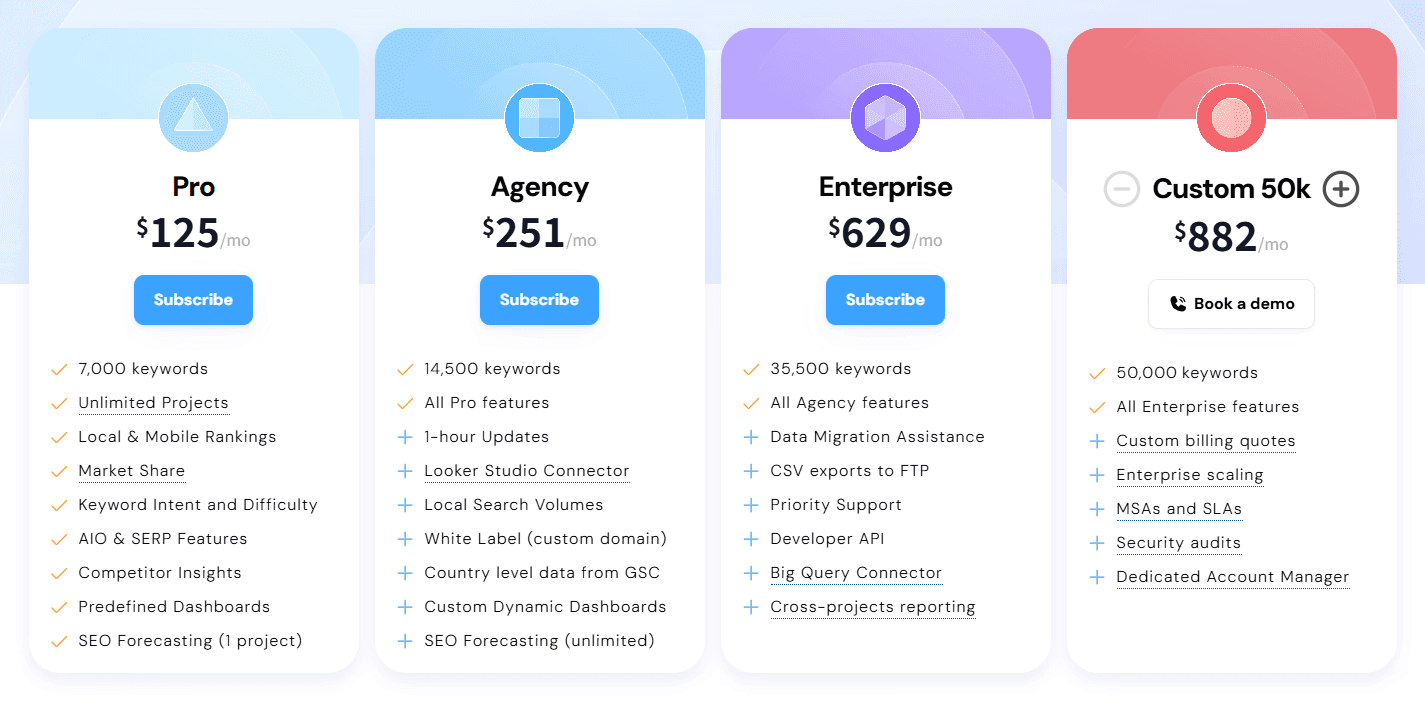
Advanced Web Ranking bases pricing primarily on tracked keywords. Agencies pay for keyword volume, while projects, users, and reports remain unrestricted. This makes costs predictable and directly tied to data usage rather than team size or workflow complexity.
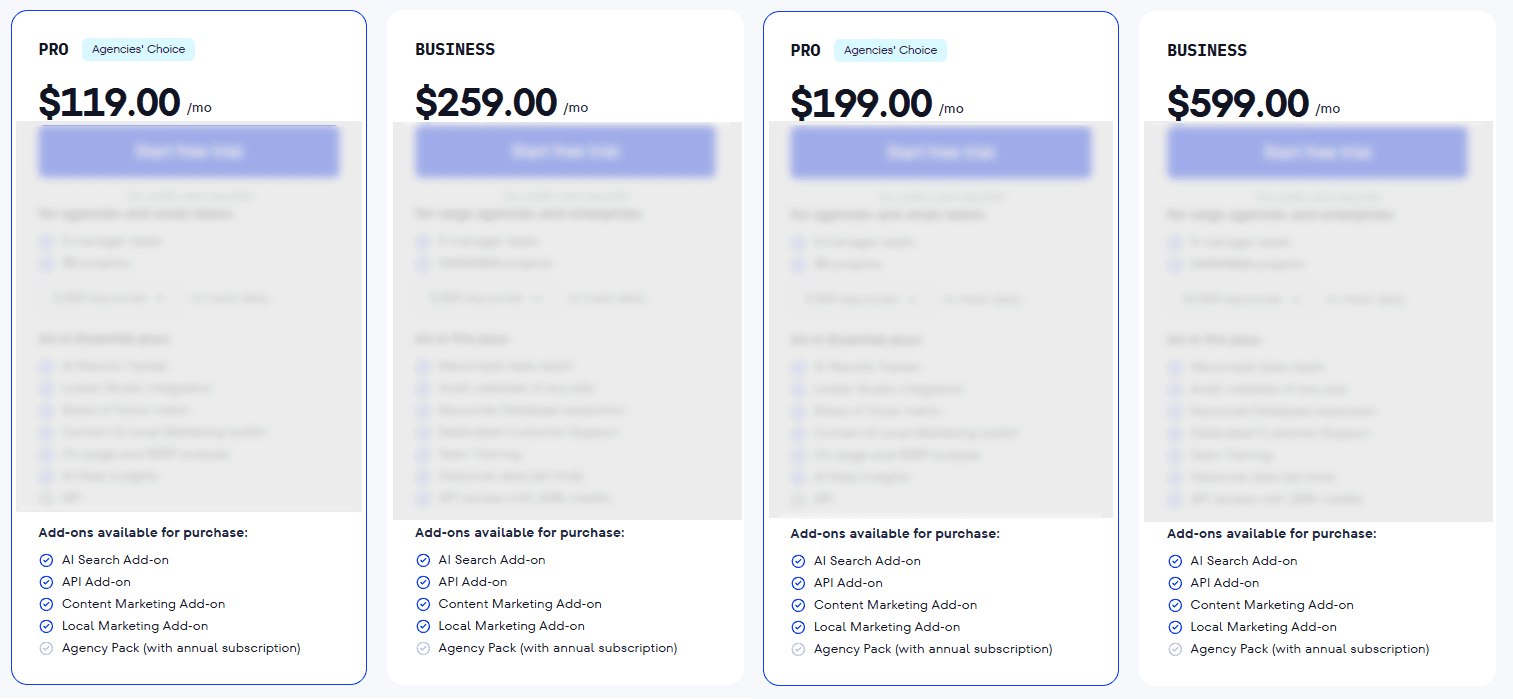
SE Ranking uses tier-based pricing, with limits on keywords, users, and reports baked into each plan. Additional functionality often requires paid add-ons, such as: the Agency Pack ($50/month), AI Search ($89-$345/month), and Local Marketing ($23/month per location)
AWR:
SE Ranking:
AI Search Tracking
As AI-driven results reshape how users discover brands, tracking visibility inside generative search is quickly becoming as important as traditional rank tracking.
Both Advanced Web Ranking and SE Ranking address this shift—but with very different depth, flexibility, and scalability.
AWR: AI Brand Visibility
Advanced Web Ranking’s AI Tracking capabilities are designed to show how AI systems understand, recommend, and cite your brand—and how that exposure compares to competitors—across Google’s AI Mode, AI Overviews, and major LLMs.

Interpretation & Topic-Level Insights
AWR goes beyond simple brand mentions by analyzing how AI platforms associate your brand with specific topics:
Topic Associations reveal which themes, concepts, and queries AI chatbots connect to your brand—and whether those align with your strategic positioning.
Custom Topic Tracking lets teams monitor anything from niche industry terms to customer questions and emerging trends.
AI-Recommended Domains identify which websites AI models mention alongside yours, surfacing real competitive and partnership signals.
Actionable AI Visibility Metrics
AWR translates AI exposure into measurable performance indicators:
AIO Citation Rank – See when and how your pages become top cited sources in AI Overviews.
AI Citation Rate – Measure how frequently your URLs are used as authoritative AI sources.
AI Brand Mentions – Track every reference to your brand, including sentiment, frequency, and linked sources.
AI Visibility & Brand Share of Voice – Quantify your true share of AI-generated exposure versus competitors.
AI Traffic Potential – Estimate how much traffic AI results could realistically drive, grounding visibility in business impact.
These capabilities are included across AWR plans without prompt limitations or AI-specific add-ons, making AI tracking scalable and predictable for agencies and enterprise teams.
SE Ranking: AI Search Add-On
SE Ranking also offers AI visibility tracking through its AI Search Add-On.
The built-in AI Results Tracker monitors where a domain appears in AI-generated answers, providing up to 50 results on the Pro plan and 100 on the Business plan. To extend this capacity, users must purchase the AI Search Add-On: $179/month for up to 450 prompts (Pro) or $345/month for 1,000 prompts (Business).
Key capabilities:
AI Results Tracker – Monitors brand mentions and rankings in AI-generated responses, though coverage depends on plan limits.
Competitive research – Analyzes competition within ChatGPT, Gemini, and Perplexity.
Sources and reports – Provides mention counts, ranking positions, and traffic potential, but results may vary in consistency.
While effective for early AI visibility tracking, SE Ranking’s pricing structure and plan limits quickly restrict larger teams. Its shared prompt quota also consumes the same resources used for keyword and competitor research, reducing flexibility and inflating overall costs.
API & Integrations
An API is the backbone of automation and reporting. It determines how seamlessly a rank tracker fits into professional workflows and how much control, flexibility, and data access it truly provides.
AWR: Native API
Advanced Web Ranking offers full, developer-level API access starting with its Agency plan. All API functionality is included by default, without additional tiers or usage-based upgrades.
What AWR’s API offers:
Comprehensive data access – Pull live keyword rankings, SERP features, pixel visibility, and competitor metrics directly from tracked search engines.
Built-in integrations – Native connections with Looker Studio, BigQuery, Google Analytics, Google Search Console, FTP, and other common data destinations.
Predictable scalability – No credit system or hard usage caps; API usage scales in line with tracked keyword volume.
No extra cost – Bulk exports, automation, and white-label reporting are included within the standard subscription.
For teams that rely heavily on reporting pipelines, dashboards, or ongoing automation, AWR’s API works as a stable foundation rather than an optional add-on.

SE Ranking: Native, Standalone & Add-On API Options
SE Ranking offers three types of API access designed for different use cases. All are credit-based, which adds flexibility—but also introduces limits that teams need to plan around.
Native API
The Business plan includes up to 100,000 API credits/month for data exports to third-party tools. Once credits are exhausted, API access pauses until the next billing cycle, which can disrupt automated workflows if usage isn’t closely monitored.
Standalone API
Designed for users who want access to SE Ranking data without actively using the platform interface. Pricing starts at $149/month for 1 million credits, with access to Backlinks, Domain and Keyword Research, SERPs, Website Audits, Project Management, and AI endpoints.
In practice, many teams still pair the Standalone API with a core plan to handle project management or generate visual reports more efficiently than the API alone allows.
Add-on API
Available as an extension to existing plans:
1M credits – $149/month
5M credits – $349/month
20M credits – $999/month
This option works well for occasional or low-volume automation. However, continuous or high-frequency workflows can consume credits quickly, increasing costs over time.
Bottom Line
Use SE Ranking’s Business or Standalone API for light automation or raw data access, with controlled usage and credit management. The API add-on is best for selectively scaling within an existing plan.
AWR’s API is better for teams that need unrestricted access, pixel-level ranking data, and built-in integrations without extra automation or reporting costs.
Rank Tracking
Rank tracking shows how keywords perform in traditional search across locations, and devices. It underpins visibility analysis by revealing which queries drive traffic, how rankings change over time, and where performance gaps or opportunities exist.
AWR: Live Rank Tracking
Advanced Web Ranking stands out for its precision, configurability, and depth of insight. Users define the exact keywords, locations, and search engines they want to monitor, and AWR collects live data directly from the SERP.
Keyword Rankings
AWR gives users full control over update frequency—on demand, daily, or weekly—ensuring data freshness aligns with business needs. Beyond basic position tracking, it adds meaningful context by:
Measuring pixel position to distinguish visibility above and below the fold
Surfacing Keyword Difficulty, Search Intent, and Estimated Visits
Translating raw rankings into practical visibility and opportunity insights
This makes it especially useful for teams that need to understand not just where they rank, but what those rankings actually mean in real-world visibility terms.

Keyword Distribution
AWR places strong emphasis on ranking dynamics and momentum:
Distribution charts show keyword coverage across Top 1, Top 5, Top 10, and Top 30 positions
Winners vs. Losers reports highlight gains, drops, new entries, and lost rankings
Visibility trends and competitor breakdowns help contextualize movement within the broader market
Pixel-based visibility converts ranking positions into measurable screen exposure
These features are well suited to agencies and advanced SEO teams that need to monitor progress, volatility, and competitive shifts at scale.

Search Engine Comparison
With coverage across more than 4,000 search engines, AWR extends far beyond Google. It includes platforms such as Bing, YouTube, Amazon, Baidu, Naver, and many regional engines. Tracking can be configured by GPS coordinates, ZIP code, city, region, or country, supporting both hyperlocal and international SEO strategies.
This allows users to:
Compare performance across search engines, devices, and markets
Identify which regions or platforms generate the strongest visibility
Detect cross-market gaps that inform prioritization and optimization
Overall, AWR positions rank tracking as a decision-support system rather than a reporting checkbox. Its breadth and precision are major strengths, though the depth of data may feel more than is necessary for teams seeking a lightweight or purely Google-focused solution.
SE Ranking: Tracking Features
SE Ranking approaches rank tracking as part of an all-in-one SEO platform, prioritizing simplicity, consistency, and ease of use. Its tracking capabilities are designed to cover core monitoring needs, particularly for small to mid-sized teams.
The platform provides:
Keyword tracking across Google, Bing, Yahoo and YouTube.
Automatic daily updates (without on-demand or instant refresh options)
A primary focus on Google, with more limited coverage of local or vertical search engines
While dependable for standard monitoring, SE Ranking’s fixed update rate and narrower engine coverage make it less suited for agencies requiring real-time insights or cross-platform visibility.
SERP Analysis
SERP analysis goes beyond rank tracking to explain how a search results page is structured, why certain results appear, and what users are most likely to engage with. It brings together search intent, feature placement, volatility, and visual dominance to turn static rankings into insights that reflect the real search experience—and real visibility opportunities.
AWR: Deep SERP Insights
In Advanced Web Ranking, SERP analysis is a foundational capability built for teams that need a complete picture of search ownership. AWR visualizes how results pages evolve over time, capturing not just rankings but how much space brands actually occupy and how prominently they appear.
Key AWR SERP capabilities include:
Pixel-level visibility metrics that measure Brand Ownership, Click Share, and Market Share based on on-screen presence rather than rank alone.
SERP volatility and similarity scoring to detect both major and subtle algorithmic shifts.
Tracking of 35+ SERP features, including AI Overviews, Featured Snippets, Local Packs, Videos, Images, and People Also Ask.
This depth makes AWR especially well suited for agencies and enterprise teams that need historical context, competitive insight, and defensible reporting
SERP Similarity
The SERP Similarity report compares two SERPs across time, devices, or markets, assessing ranking stability, URL overlap, and shifts in search intent.
AWR’s Similarity Score combines URL matches, positional consistency, and intent alignment, helping teams spot algorithm updates, content cannibalization, or emerging competitors early—before performance changes become obvious in traffic or conversions.

SERP Volatility
AWR’s Volatility Report measures how stable or dynamic a SERP is over time, functioning as an early-warning signal for algorithm changes. It helps distinguish between visibility changes driven by Google reshuffles and those caused by on-page or competitive factors.
Teams can monitor ranking turnover, domain-level movement, and intent evolution to ensure optimization strategies stay aligned with how the SERP is actually behaving.
SERP Features
AWR tracks every major SERP feature, from Images and Local Packs to Videos, People Also Ask, and AI Overviews—and maps each to a dominant search intent: informational, navigational, commercial, or transactional. This makes it easier to see which features are attracting attention and where visibility is most likely to translate into clicks.
The Brand Ownership metric further quantifies the percentage of total SERP pixels a domain controls, helping teams maximize visibility where visual prominence drives engagement.

SE Ranking: SERP Visibility under Plan Caps
SE Ranking’s SERP analysis tools are designed for quick checks and high-level visibility monitoring. They work well for smaller teams or in-house marketers who value speed, simplicity, and daily updates over deeper analytical layers.
Feature Tracking Module
SE Ranking tracks the presence and frequency of SERP features, offering a useful snapshot of feature adoption. However, it does not measure screen share or pixel-level visibility, and more detailed feature reporting requires the Agency Pack add-on.
Visibility Reporting
Visibility Score and Share-of-Voice metrics provide a clear overview of performance trends and market presence. Reports are clean, customizable, and easy to interpret, but they rely primarily on average rank positions rather than visual exposure or intent-weighted click data.
Bottom Line
SE Ranking delivers intuitive dashboards, reliable daily updates, and accessible SERP visibility reporting, making it a practical choice for teams with straightforward monitoring needs.
AWR, by contrast, offers deeper, more consistent SERP analysis with long-term historical data and pixel-based metrics that better reflect how users actually experience search results. The right choice ultimately depends on whether your priority is speed and simplicity—or granular insight into total search visibility and SERP dynamics.
Competitive Intelligence
Competitive intelligence turns SEO data into strategic market insight. By connecting rankings, visibility share, and traffic potential, it helps teams understand who truly owns the search landscape—and why.
When done well, it goes beyond tracking positions to reveal opportunity gaps, measure domain influence, and anticipate competitive shifts
AWR: Competitive Insights with Strategic Depth
With AWR, this capability goes beyond basic comparisons. It quantifies how much visibility each brand actually owns across markets, devices, and search engines. Keyword-level data is translated into a multi-dimensional view of competition, combining rank, click share, and pixel ownership metrics to show how search demand is actually distributed.

Key capabilities include:
Tracking up to 50 competitors per project.
Measuring Market Share, Click Share, Estimated Visits, and Brand Ownership for every tracked keyword.
Integrated forecasting and ROI modeling, connecting visibility metrics directly to traffic and revenue potential.
Market Share
Market Share analysis in AWR quantifies how much of the search market each competitor controls. Using pixel-based visibility metrics, it calculates Click Share and Brand Ownership, based on screen real estate and estimated traffic distribution—not just rankings.
By segmenting analysis by country, search engine, or device, global and local teams can align strategy with greater precision and consistency. The trade-off is a denser dataset, which rewards structured workflows but may feel less immediate for quick checks.
This approach is especially valuable for teams managing complex markets or reporting performance at scale, though it does require more upfront configuration and analytical maturity than lighter-weight tools.
Keyword Gap Analysis
AWR’s Keyword Gap Analysis combines ranking data with difficulty scores, intent classification, and content performance metrics to identify opportunities where competitors rank, and you don’t.
It highlights which keywords drive competitor traffic, stimates the effort required to compete, and highlights SERP features competitors dominate.

Built-in forecasting allows teams to model potential traffic, conversions, and ROI before committing resources—all within a unified dashboard, without manual exports or data stitching.
This depth supports strategic planning, though teams seeking only high-level gap identification may find it more detailed than necessary.
SE Ranking: Competitive Overview
SE Ranking is designed for fast comparisons and high-level visibility snapshots rather than deep, data-driven market analysis, with accuracy and scope varying by plan tier and update frequency.
Competitive & Keyword Research
The Competitor Research module compares domains by keywords, traffic, and visibility. Within each project, you can monitor 10 competitors with Pro plan and 20 with the Business plan, and see where they appear in the Top 5, 10, or 30 results.
The interface is accessible and easy to navigate, making it effective for quick insights. Under the hood, however, the data reflects a position-based rank-tracking model updated on fixed cycles. While this is sufficient for identifying who ranks higher, it offers limited context on market dynamics, visibility ownership, or the underlying drivers behind ranking changes.
Backlink & Paid Visibility Overview
SE Ranking also includes modules for backlink monitoring and paid search insights, offering visibility into referring domains, anchor text distribution, and competitor ad presence. These features provide a useful overview for campaign reporting and competitive awareness.
That said, the insights remain broad in scope. They are helpful for summaries and directional analysis, but less suited for dissecting long-term authority building or competitive positioning in depth.
Final Thought
Choosing between SE Ranking and Advanced Web Ranking ultimately comes down to how much precision, scale, and certainty your SEO work demands.
SE Ranking is a capable, accessible platform for teams that need a broad toolkit and straightforward reporting, particularly in content marketing, audits, and backlink monitoring.
Advanced Web Ranking, on the other hand, is built for teams that need absolute accuracy at scale. With pixel-level visibility, deep SERP intelligence, and AI-driven insights, it delivers defensible data and consistent reporting—giving you a lasting advantage across both traditional and AI-powered search.
The best way to evaluate that difference is to experience it firsthand - start a free trial of Advanced Web Ranking and see how accurate, scalable SERP intelligence changes the way you plan, report, and grow SEO with confidence.
Frequently Asked Questions
Which tool is better for scaling an SEO agency: AWR or SE Ranking?
Can I migrate existing rank data from SE Ranking to AWR?
Is white-label reporting free in both tools?
Can SE Ranking track non-Google engines?
Which tool offers better historical SERP analytics?

Article by
Philip Petrescu
Philip is the CEO and Co-Founder of Caphyon, managing the team that is building Advanced Web Ranking since 2003.